Tag Archives: interviews

A Conversation with  Lynne Sachs / Hammer to Nail

By Jonathan Marlow 
January 7, 2026 
https://www.hammertonail.com/interviews/lynne-sachs/

Some filmmakers are known for their documentary works. Others for their narrative films. Still others—the better filmmakers (for me), generally—do not fit comfortably into either category. Or any category whatsoever.

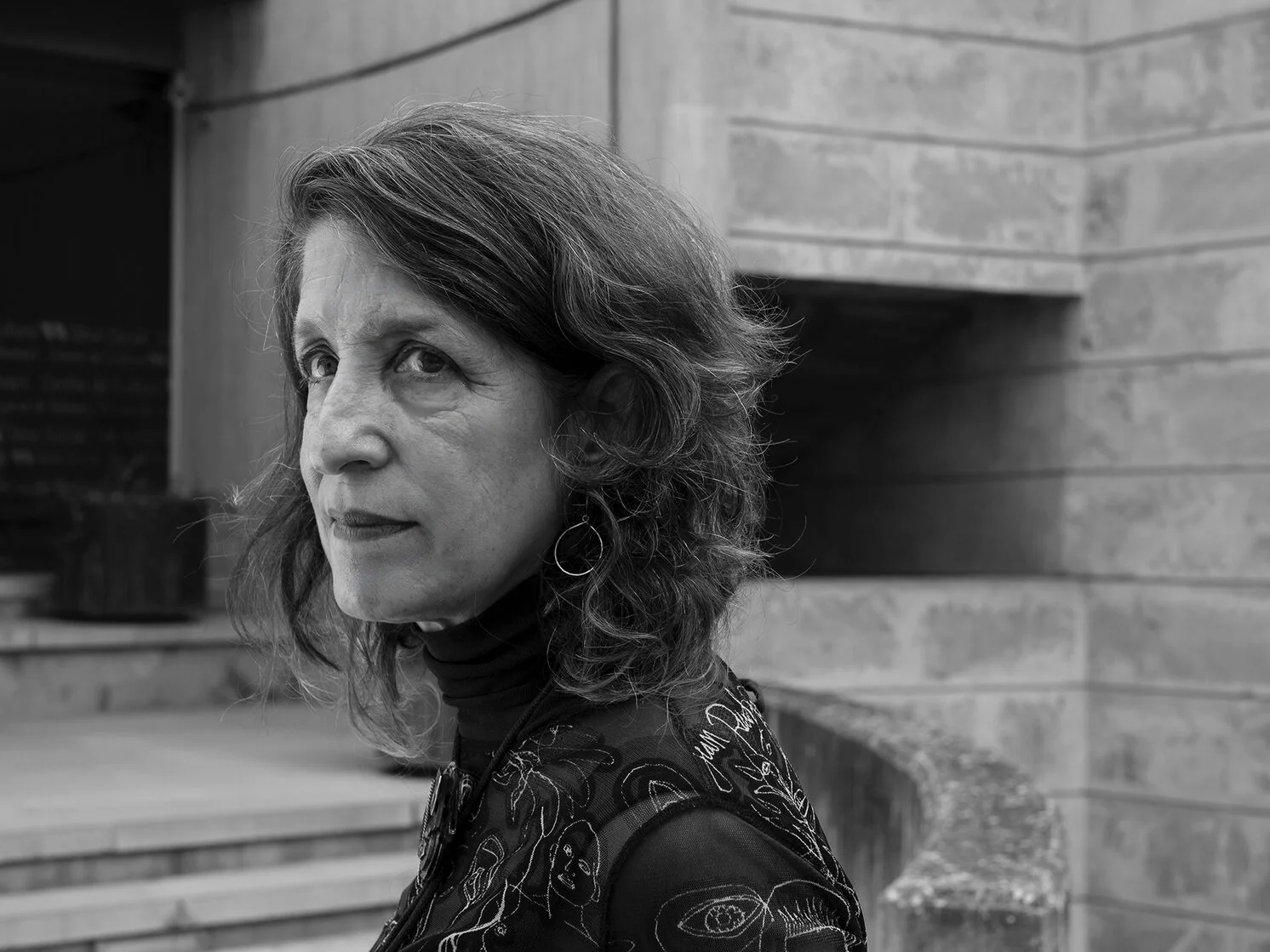
Poet / artist / filmmaker Lynne Sachs is one of the later. During a brief tour of Northern California for a variety of events (partially illustrated below), Jonathan Marlow, SV Archive [Scarecrow Video] Executive Director, took an opportunity to meet at a small café in the East Bay (recommended by former Pacific Film Archive programmer Kathy Geritz and former Views from the Avant-Garde programmer Mark McElhatten, a short stroll from their home).

[Individuals referenced (in order-of-appearance): Lynne Sachs. Jonathan Marlow. Kathy Geritz. Mark McElhatten. Kathleen Quillian. Gilbert Guerrero. Betty Leacraft. Meryl Streep. Bradley Eros. Robert Beck. Brian Frye. Jeanne Liotta. Mark Street. Dan Rowan. Dick Martin. Hansel. Gretel. Jerome Fandor. Fernando Pessoa. Ira Sachs. Peter Hujar. Bette Davis. Dana Sachs. Marguerite Duras. Chantal Akerman. Louis Massiah. Angela Haardt. Heinrich Heine. Walter Benjamin. Lawrence Brose. Oscar Wilde. Matt Wolf. Paul Reubens. G. Anthony Svatek. Maya Street-Sachs. Noa Street-Sachs. Boris Torres. Kirsten Johnson. Viva. Felix. Rae Wright. Lori Felker. Werner Herzog. Heddy Honigmann. Adam Curtis. Stephen Vitiello. Emily Packer. Ana Siqueira. Claire Lasolle. Gunvor Nelson. Carolee Schneemann. Barbara Hammer. Dorothy Wiley. Robert Nelson. William Wiley. Lonzie Odie Taylor.]
[conversation already in progress in Oakland, California, 2025 November]

Hammer to Nail: Do go on about Shapeshifters, a very wonderful place! A very wonderful family enterprise.

Lynne Sachs: It is also a really good place for a performance (which is basically what Kathleen [Quillian]* and I were doing). She even was in costume! The whole conceit was built around lint. I’ve done a few book readings like this, always tailored to the space. This was probably the eighth. I discovered that she was into lint. I love the idea of lint because it comes from the hair on our bodies, little bits of skin, some fabric. She collects it because she is a sewist.
*[ed. Proprietor of Shapeshifters with Gilbert Guerrero, a remarkable microcinema / microbrewery in Oakland.]

HTN: You both have that in common. At the conclusion of EVERY CONTACT LEAVES A TRACE, you’re in the midst of needlework renderings of your drawings. There must be a show at some point of those pieces?

LS: I didn’t really go very far with the sewing. As a kind of trope or a connection—when we’re pulling the thread out—it creates a tactile trajectory, from her back to me and me back to her. But Betty [Leacraft, in the film and in life]…

HTN: …she is a captivating character!

LS: She is. She is a force of nature! She really, really, really wanted to come to Amsterdam [for the premiere of EVERY CONTACT LEAVES A TRACE at the International Documentary Film Festival Amsterdam/IDFA]. It would be difficult for her to get around there. Whenever I find out where the U.S. premiere will be, she’ll be there for that.

HTN: What is evident—from not just this film but all of your work—is that you’re very interested in making the seams of filmmaking fairly apparent. In this instance, you’re directing her actions (and those direction remain in the documentary). “You need to put your hand in the frame.” She was resisting every part of it.

LS: She even says, “I’m not Meryl Streep!” Streep is mentioned twice in the film. When she says her name, that actually led me to think about all of the different things that a documentary expects of a subject. To be as charismatic as an actor. Performing as a character. There is a paradigm in documentary—which I don’t follow at all, really—that says you have to build your narrative. That is not a word I use often. You build [a narrative] around a character people can identify with or people feel appalled by.

HTN: That goes back to a whole formula of literature. I love literature but I don’t believe that literature needs to impose itself on us or our work. You definitely hold elements of literature throughout your films. The written word comes through consistently [and, occasionally, literally]. Not traditional storytelling, with a notion of a conflict and then a resolution. There is prose and then there is poetry. Poetry seems to be a stronger influence in your work.

LS: Totally. Yes.

HTN: Clearly, within the structure of EVERY CONTACT LEAVES A TRACE, you introduce a whole array of possibilities and then you narrow those possibilities. I have to admit, if I could ever be as effortlessly charming as Bradley Eros [another interviewee in the film], I would aspire to be that sort of person.

LS: I am so happy you said that. Absolutely.

HTN: Anytime I go to Anthology [Film Archives], he is there. He is a welcoming presence.

LS: Does he take your ticket?

HTN: The last time that I was there, he did! He was there. Jeanne Liotta was there that evening as well. A pleasant surprise.

LS: The thing about Bradley is that he breaks the mold! The idea that a [business] card is a distillation of who you are… A card doesn’t epitomize “who you are” but it is “how you want to present yourself.” Everything is represented. The way that you dress. The way that you act. It is all a performance of some sort.

HTN: The card is the piece that you take away. Everything leaving a trace, part of you is still there within the card. The process of handing the card to someone else, you’re basically giving a piece of yourself to that person.

LS: Exactly. I get that energy when I hold a card. It brings all that back. I remember this person. I believe they work as mnemonic devices. The thing about Bradley, I’d said, “I’d like to talk to you about this film.” The way that these pieces of paper can become the essence of a person. I didn’t even know if he had a card! I just thought he might have some ideas around them. I get to his house and he has a lifetime of cards from other people. Then he disrupts them in collages. He shoots holes through them. He becomes them! He breaks up everything about the model of a card. That was exciting to me. It was far beyond what I would’ve expected.

HTN: We initially met at the Robert Beck Memorial Cinema [which wasn’t a cinema but a series at Collective Unconscious], along with his then co-conspirator / co-host / co-programmer Brian Frye. I could certainly relate to their impulse to exhibit otherwise nearly-impossible-to-see work and share that work with other people.
[ed. Both Sachs and Marlow are on the Board of the Canyon Cinema Foundation with Frye.]

LS: I didn’t even live in New York at that time. We [Sachs and filmmaker Mark Street, one of the cinematographers on EVERY CONTACT LEAVES A TRACE] lived in Baltimore. We would come up and go to the Robert Beck Memorial Cinema. It was like going to see [Dan] Rowan and [Dick] Martin.

HTN: Eros and Frye, in their introductions, were opposites.

LS: One was very tall, the other not. They were kind of foils for each other in a way. They were sweetly glib and charming.

HTN: It wasn’t an affectation. They weren’t trying to be different. They just were different. Similar things were happening in San Francisco and Brooklyn and Vancouver and Seattle and Chicago and elsewhere with ambitious individuals creating nontraditional spaces to screen work. I’ve exhibited films in all of those cities (and others), as have you. This way of talking about time and space(s) has much to do with your documentary.

LS: You don’t know that you’re in an era until it is actually ends.

HTN: You hardly know that it was even a phase of your life.

LS: A turning point. A chapter, until you can finally look back at it. The cards gave me that chance to think about the passages of time in which I was doing something consistently. Or maybe a period of time in which health issues were overwhelming. Or another period of time where I was traveling a lot or when I had young children. The cards are like little punctuation marks for all of that. The thing is that they are only punctuation marks for the most part. They’re not whole personal epochs. They’re little moments in time. People talk about Hansel and Gretel and their little crumbs. The thing is that I didn’t leave them behind. I brought them with me.

HTN: I should admit at this point that I was very nervous watching the film because I knew that I was included in those stacks of cards. I have given you various cards over the years—for Fandor and San Francisco Cinematheque, in particular—at some point. The moments that were particularly enlightening for me was seeing assorted cards in there for individuals whom I know or once knew. That brought up extension within the film and memories of folks I haven’t thought about in quite a while.

LS: I am glad that happened to you because I’m really intrigued by a film that can do that. Films that take you to another space. It takes you along my trajectory but, in the end, you walk out thinking about your own.

HTN: Not everyone wants that from a film. Although I don’t know how else you would move beyond a project that is theoretically about one person to a film that is ultimately about all people.

LS: Characters could have various different personas and identities. It reminds me of The Book of Disquiet where Fernando Pessoa says, “Everything that surrounds us is part of us.” That was very meaningful to me.

HTN: To me as well.

LS: Both experientially and, in this case, what it is to have a shared consciousness with another person, even in a fleeting way. That was very important for me to understand.

HTN: Why do you think it is? I had felt it was a strange synchronicity that your brother [Ira Sachs] was visiting the Bay Area at the same time.

LS: Actually, he is not here. He was supposed to be here yesterday.

HTN: At the Roxie screening [of PETER HUJAR’S DAY].

LS: I think he did the discussion on Zoom because of COVID. He was here spiritually even though he should’ve been here in body. We didn’t know of the overlap until [mutual friend] Kathy Geritz told us!

HTN:  Two different threads! Simultaneously. Why do you think it is that you and your brother both became filmmakers?

LS: I will tell you that I’m the older one, by four years. When we were growing up, we didn’t both think, “I want to be a filmmaker!” Definitely not the term “filmmaker” or even to make movies. He was really involved in the theater world. He was also the kind of kid who watched Bette Davis movies and things like that. I was a kid who liked to write poetry and I did that for years. I was probably more into photography and drawing and things like that.

HTN: You’re both very artistic. That doesn’t come from your parents, necessarily.

LS: Definitely not. Not at all. My mother said that she gave us a pretty nice box of crayons.

HTN: There is a sister in-between.

LS: Dana [Sachs]. She is a writer. We’re all drawn to the arts! We are. Our parents were not. My mother would say, “Well, I would take the kids to museums!” She wasn’t obsessive about that. I love art history and I can talk a lot about different artistic periods. When I took art history classes, people were memorizing dates and looking at slides. I thought that was oppressive. I think Ira probably feels the same way. But we drank it up.

HTN: Were you exhibiting your photographs before you started making films? Or was this happening in parallel?

LS: I was very involved with painting. In college, I did a lot of painting and then I was in the more academic world. Then I went to live in France for my junior year abroad. I saw a few films by Marguerite Duras and [Chantal] Akerman. It was a total switch! I found that you could bring in photography, you could work with people, you could write poems and they can all go in the same vessel. That was incomprehensible to me before that.

HTN: What did you see, specifically?

LS: GOLDEN EIGHTIES!

HTN: Appropriate.

LS: I never finished with the Streep story! She is mentioned in two places. There is the one with [shape-shifter of textiles] Betty Leacraft. Louis Massiah asked me to teach a class on film and performance in Philadelphia. Only two people took it and she was one of them! I got to know her. It was meant to be. Years later, I wanted to find her. I actually had to hire a kind of make-believe detective that Louis helped me find because none of the phone numbers or emails on her card worked. You know, when you’re in this field, the more obstacles that come your way, the more that you say, “I’m meant to do this.” Because I make hybrid films, if I didn’t find her, I was going to invent her! Then I did find her with the help of the faux-detective. I went down to Philadelphia to talk to her about the first time that we’d met and about this notion of teachers and students. Yet I felt I’d learned more from her than she had learned from me.

HTN: The framing is fairly tight on her.

LS: We’re sitting there together and I said, “Could you use your hands this way?” The way you might direct an actor. Then she says, “I’m not Meryl Streep!”

HTN: You’re asking her to do things that probably felt unnatural for her.

LS: She said, “I’m not going to be anybody but myself.” She invokes Meryl Streep because she is the epitome of someone who can transform herself. But she comes up again in the film in a totally different place. There is a woman in the film named Angela Haardt. You might know her.

HTN: She used to run [Internationalen Kurzfilmtage] Oberhausen. When her voice is first heard in the film, I thought, “I know this voice!” She is a wonderful person.

LS: She is a really, really, really special person. They all are! Angela and I talk about the Holocaust. She was a child during the Holocaust in Germany and we talked about the fact that she didn’t really understand what was happening around her when she was growing up. I’m using the word “Holocaust” here but—when I was growing up—we didn’t use the word. We talked about World War II and we talked about concentration camps. But there wasn’t one word that invoked everything. I was wondering why that word came to me later in life—as a teenager—but my parents and grandparents were not using that word. Where did it come from? I did some research and there was a television miniseries called THE HOLOCAUST and Meryl Streep was the star! The series popularized it. Then it became the Shoah.

HTN: This goes back to what you were saying before about the notion that the era you’re in gets defined later.

LS: That is exactly right. Exactly. One way to think of it is in terms of copyright. We wait for the copyright to lapse in order to reinterpret work. In poetry, that idea that something can’t be touched until some period after it has been in the world for a while [doesn’t really exist]. We can engage with it now. It is what was happening with Heinrich Heine and other poets of that era. Folks were immediately inspired to take these ideas and adapt them and use them in different ways. Angela Haardt reads THE SILESIAN WEAVERS [in the film, about the Weavers’ Revolt in 1844, the same year that the poem was written].

Angela is a very erudite person. A person who knows about cinema and many, many more things. She is someone who enlarges my worldview. That is one of the reasons that we enjoy reading and meeting new people. They make you think about things in new ways. The next afternoon, after we filmed, I am on the subway underneath Berlin and I am going with her through Heinrich-Heine-Platz. Seeing it with an audience [in Amsterdam], I will be very interested to see their reaction to this section about the Holocaust. Like Walter Benjamin’s idea of the “angel of history” where you’re moving forward but you’re always looking back. I am thinking about Gaza and my own culpability. What is it to be a Jewish person today? All those things went through my mind [during this scene].

HTN: You decided to include an individual where you’re conflicted about things you have discovered about them. Those decisions are part of the running narration of the film, to decide whether to remove their story and potentially leave them and their story on the cutting-room floor.

LS: If I decided to remove them, then why am I even doing this? Whether it is misinformation, am I then not allowing this person to speak for themselves? If I’d engaged in removing it, I’d be preventing them from telling their side of a story. A story that other people are using anecdotally or for whatever ends they might have.

HTN: In the context of your references to the Holocaust, some who died in the concentration camps are often excluded from the conversation.

LS: That is my own personal connection to what is happening in Gaza. These are the ways in which a huge Palestinian population within Israel are not included in this larger dialogue.

HTN: It is a very good question and there is a less-than-good answer for it. It is all terrible. Disproportionately terrible. Terrible in proportions difficult to fully comprehend.

LS: One of the things that I came to terms within this film is that when you’re working with reality—or you’re working in a documentary practice—sometimes things become difficult. They’re difficult logistically or they’re difficult emotionally. You’re traumatized by something and you say, “You know what? I’m just going to take that part out because I haven’t resolved that.”  There is a man—Lawrence Brose—in the film who had been through an extremely traumatic legal case involving Homeland Security, accusing him of possessing child pornography. I had his card from thirty years earlier.

HTN: When you initially reached-out to Lawrence, were you fully aware of the case?

LS: I reached out to him because of this. I reached out to him because I couldn’t resolve how I felt. We make these conclusions based on impressions or facts. We also realize that the facts we thought we’d collected might be misinformed. Did he have child pornography or not? Why was it that his legal situation catapulted him into the public arena? Many people knew about the case. I had friends who said, “Well, he didn’t make the pornography.” Others immediately avoided him over these accusations. Then other people said he was accused of something that he didn’t even do at all. I kept wondering if it was my job as an acquaintance of his to resolve that. I decided that the harder it was for me to understand his life, the more I had to insist to include him in this film. I reached out to him during the early days of the pandemic and we did a series of Zoom conversations. Interviews for hours and hours, over several years.

HTN: Was it his choice initially to be in silhouette?

LS: I wanted to give him that option. Then he could just talk [without concern]. I said, “We’ll just use the audio.” He wasn’t sure whether he wanted to be visible. The more that I talked to him, the more I realized that he had been a victim of a state system that that was targeting people who were different. People who were gay. People who were artists. Then he also explained that it wasn’t even material he had downloaded. Nevertheless, I still was bewildered by my own ambivalence.

Then he started to articulate the parallels between his life and the life of Oscar Wilde. He had been targeted by the system and sent to prison. It essentially destroyed him. In Larry’s case, he was sent to Attica. He was punished for who he was rather than what he had [supposedly] done. We worked together on getting the story correct. Then, about eight months ago, I called him and I said, “I’ve finished the film. I’d love for you to see it before I show it anywhere.” He said, “You better bring it soon because I am going to die in a month.”

HTN: I noticed that acknowledgement at the end of the film.

LS: That was on a Friday. On Sunday, I flew to Buffalo and I showed him the film and he gave me his blessing, which was relief. We both had a cathartic moment. It was very profound to talk to him about the film. He was the first person to see it completed! He did die a month later.

HTN: Have you seen the documentary by Matt Wolf about Paul Reubens?

LS: Not yet.

HTN: A section of the film deals with similar issues of being railroaded for having child pornography. In his case, these were primarily artworks that he had purchased. The authorities came in and accused him of having naked photographs of young boys. They confiscated it all. Granted, this is a bit of an oversimplification.

LS: With Lawrence Brose, he knew how media works and the hierarchies of a filmmaker and their subject. He was constantly apologizing to me. He was saying, “Did you get what you want?” Whereas Betty Leacraft had a clear idea about who she is [and how she should appear in the film]. If you are going to be photographing her, she needs to define the terms. Different forms. Different grammars.

HTN: How do you feel about being a subject? Because you are often a parallel subject within your own film.

LS: You have more control over how you appear in your own work. It is interesting that you say that. I mean, I definitely grow older! There is an image of me in Germany in the late-1980s. The Berlin Wall is still up. Then there is an image of me in my sixties.

HTN: There was never any question that you would be the narrator? You were never concerned about distancing yourself from the telling?

LS: I could have. I could have distanced myself a little more by using the voice of someone else. I actually thought about writing in the third-person at times.

HTN: Or having your daughter(s) [Maya Street-Sachs and Noa Street-Sachs] as surrogate(s)?

LS: Maybe that’ll be my next film.

HTN: I was thinking more in terms of the ways in which you have a kind of “rogues gallery” of collaborators these days. Consistent individuals involved in the shooting and editing. You keep pulling a reliable group on individuals together to collaborate.  Does that then make you recent films variations on a theme?

LS: You noticed, for example, G. Anthony Svatek.

HTN: Indeed.

LS: You know him very well.

HTN: I adore Anthony!

LS: Do you want to know what footage he shot? It is very beautiful. He shot the footage at the end with the thread, the sewing.

HTN: That sequence is remarkable. Truly beautiful. The ways in which you’ve inserted the drawings throughout and then how these drawings are animated. The crafting of those drawings with the needlework is astounding.

LS: Like trajectories. I called them vectors. I was reading about what you’d call affect theory. I wish something on you and you create an emotional response in me. All of those come from this whole conversation.

HTN: Every relationship is some form of compromise. Friendships, couplings. Ideally, those compromises are equal. Sometimes they’re greatly out of balance. I either open up to you or I build a wall.

LS: I feel punctured by you or I feel enthralled by you. I think about all of those things. I wanted to say that and many of those things at the same time. I think the stand-ins for me—at another point in my life—were my niece and nephew.

HTN: Who are in the film, like a Greek chorus. They’re very charming.

LS: Those are Ira’s kids. Ira and [painter / artist] Boris [Torres].
[…and cinematographer / filmmaker Kirsten Johnson]

HTN: I was wondering. I presumed that they were relations but I didn’t know how they were related!

LS: They grow-up in the film because we started when they were around eight. They’re twins [Viva and Felix] and they’re very perceptive. But they challenge me.

HTN: They keep asking you questions about the purpose of your work.

LS: They’re absolutely the Greek chorus! They’re just these kids sitting on a bed, asking, “Why are you doing this? What are you thinking about this?”

HTN: Wise beyond their years, seemingly.

LS: They’re also silly about these interactions. They come up with these ideas for the cards that I never would’ve imagined. “Why don’t you put them in a bottle and throw it out to the ocean?” Felix says, “Why don’t you put them on the wall of your house and then open it up?” That is basically what I did! He understands time. There were things that came to my mind from watching a lot of movies with Ira [as a kid]. Putting cards in a bottle and throwing them out to sea. The message in a bottle. The idea of a house containing your whole history. Or putting the cards in balloons and then letting them float away. Then they become someone else’s property.

HTN: They propose the ending. [spoiler] The box goes back on the shelf.

LS: Thank you for noticing.

HTN: There is an element of you on that shelf. You and an assortment of folks that you’ve met.

LS: I’ve told people about this film and many have said, “Oh, I used to have a box of cards, too, but I threw them all out.” They don’t take up a lot of space! But you’re actually throwing out these stories.

HTN: It is difficult for me to let go of them primarily because there are so many people who are now gone. Either physically gone or they’re merely not a part of my life anymore.

LS: It constantly brings you back to that moment [of meeting].

HTN: What was the dialogue with that person where they felt that they wanted to continue this conversation? “Please stay in touch.” Many of them I remember completely. I remember the circumstances of our meeting. Others, I do not recall at all. The actor playing the therapist addresses this directly. She persists in interpreting the limited information you’ve given her.

LS: She says these things but very quietly. You could miss it! I wouldn’t have taken [what she said] literally. We’re always acting on camera [and off]. We are.

HTN: Did you prompt her to ask these questions?

LS: I told her a little bit about what had happened in my life when a therapist or maybe a nurse—I’ve conflated these two together—had said to me, “If you want to have a baby, just make it happen.” I was literal about it and that is not what she [Rae Wright, the actor playing the therapist] thought about that. She and I had a series of conversations about it and she really moved into a very reflective, therapeutic mode while we were making the film. She challenged me in really tough ways. I didn’t expect her to do that.

HTN: I could see that you were unprepared with how to respond to these questions. Which is why it doesn’t seem like she is acting [and she isn’t identified as an actor until the end-credits]. You have seen Lori Felker’s PATIENT?

LS: I have seen it.

HTN: It operates in a similar space where you don’t recognize that the people you’re watching are actors.

LS: Exactly.

HTN: They’re not what they appear to be. Your relationship with what you’re seeing changes the moment you realize that what you’ve just seen is not what you believed you were seeing. When I saw that in the end-credits [of EVERY CONTACT LEAVES A TRACE], I’d re-thought through your conversations with her. It was clear on first-viewing that your reaction was genuine. You weren’t complying but she was performing. Those interactions were extremely interesting.

LS: It changed everything. I wanted to include it [at the end] because I did not want to ruin that experience for the viewers. I sorted through all of that while making this film. I have come to see every narrative film as a documentary. A documentary of a bunch of people getting together, playing make-believe. Unless it is Candid Camera, most documentaries are forms of performance. There is a certain kind of contrived intention to it. There is a bit of a theater-game going on. We were playing a theater-game but she [the actor playing the therapist] was considerably more clever than I was.

HTN: Well… She is a professional actor!

LS: True. Not every actor likes to improvise.

HTN: Also true.

LS: Many do not. She had been recommended to me by a friend. She took a lot of risks and we spent months and months working together. She really becomes a therapist for the surgery. She transformed from being an actor to being the actual thing!

HTN: For the premiere [at IDFA, mid-November], it seems as if audiences there are more accommodating of films which intersect at the margins of nonfiction and quasi-documentary. [Perhaps even venturing into the “ecstatic truth” realms of Werner Herzog, Heddy Honigmann, Adam Curtis and others.]

LS: I am excited for these screenings!

HTN: Will there be others associated with the film in-attendance?

LS: [Composer] Stephen Vitiello will be there as well as [editor] Emily Packer. She is coming with her mother! The three of us will be together [to speak about the film]. You know who else is going to be there? Someone we both know: Ana Siqueira [of the Belo Horizonte International Short Film Festival].

HTN: I am immensely fond of Ana and the work she has done in Brazil! I was introduced to Ana at the same festival where I met Claire Lasolle [of FID Marseille]. Claire is among the cards pictured in your film! Connections! One of the catalysts for your visit to the Bay Area is a screening at BAMPFA of the work of [Swedish filmmaker and San Francisco Art Institute teacher] Gunvor Nelson which [Program III] includes your short CAROLEE, BARBARA & GUNVOR, along with RED SHIFTTIME BEING and BEFORE NEED REDRESSED, her collaboration with Dorothy Wiley. Have you ever seen BLEU SHUT, their film with Robert Nelson and William Wiley?

LS: That is one of Bob’s films I’ve never seen.

HTN: It is one of my favourite shorts of all time!

LS: I will try to find it. I will be introducing the program and I have this fantastic document that she created for her students called “Notes on Editing.” I’ll send it to you when I get back [to Brooklyn]!

HTN: What was she like as a teacher [at SFAI]?

LS: I was looking at the notes from her and her handouts (which she hand-wrote in pencil along with other suggestions). In re-reading them, I realized how much of an effect she had on me. She did not like transparent cuts. She wanted you to notice negative space and she wanted these edits to be fierce. She wanted you to be in the world of the film, which definitely reflects the notion of “every content leaves a trace.” Each is a world for me. It is a period of time. I remember working on SERMONS AND SACRED PICTURES [about the life and work of Reverend L.O. Taylor], the final film for my degree, which I finished in 1989. I said [to Gunvor Nelson], “I have been working on this for two years. I really want to finish it!” She said to me, “You’re going to miss it!” It is interesting that projects like these are gifts of immersion. Gifts of totality.

HTN: All of them—each person, each project—leaves a trace.

– Jonathan Marlow (@aliasMarlow), SV ARCHIVE [SCARECROW VIDEO] Executive Director

Doc Talk Podcast Makes Contact With ‘Every Contact Leaves A Trace’ Director Lynne Sachs And ‘Trillion’s Victor Kossakovsky / Deadline

Matthew Carey
December 17, 2025
https://deadline.com/2025/12/doc-talk-podcast-lynne-sachs-victor-kosskofsky-1236650761/

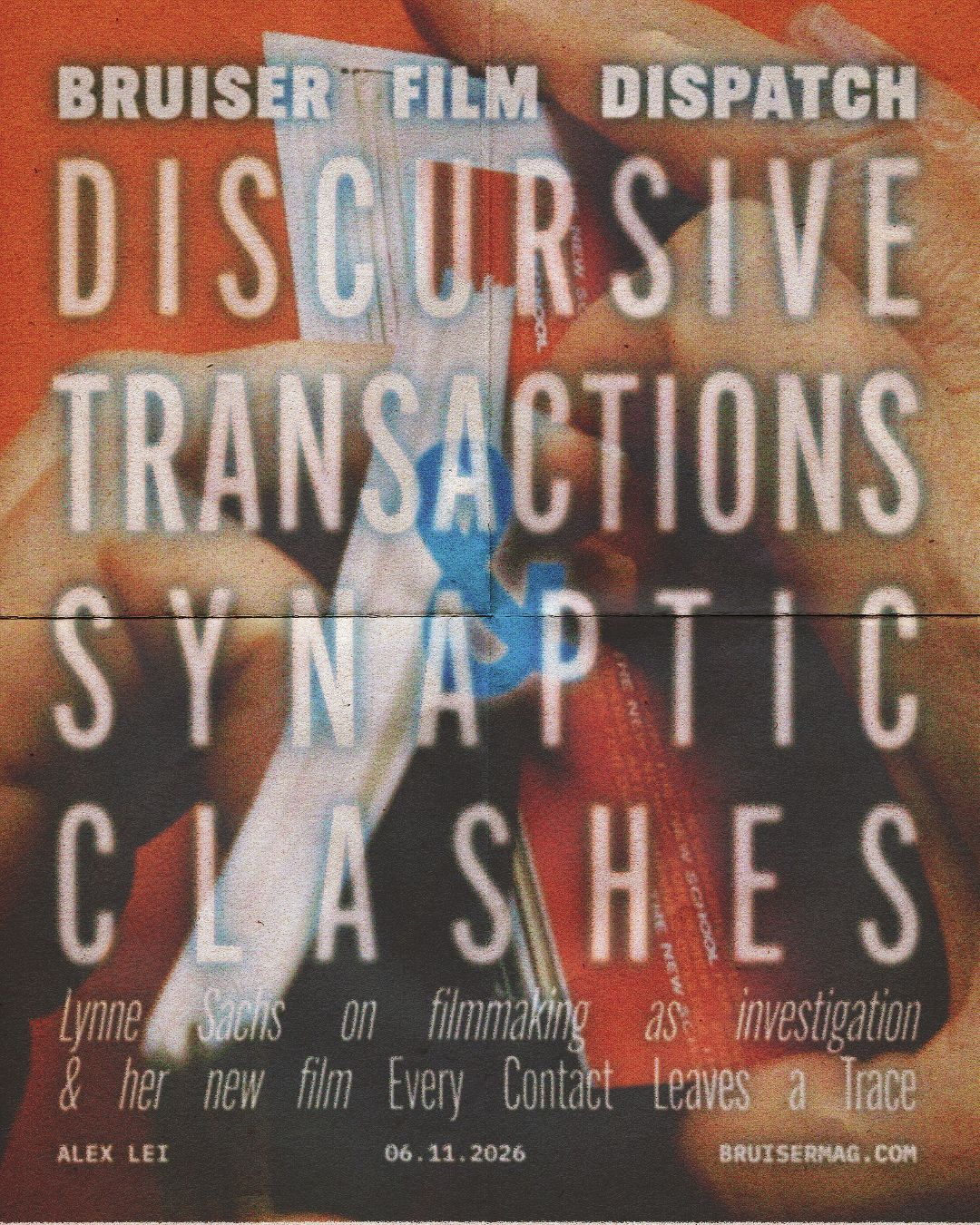
If you hand a business card to filmmaker Lynne Sachs, don’t be surprised if she holds onto it – for a very long time.

Over the course of several decades, Sachs has collected an enormous stack of them, numbering around 600. For her new documentary Every Contact Leaves a Trace, she decided to try to reconnect with some of the people whose identities are, in some sense, inscribed in those 2” x 3” cards. It’s a launching point to ponder the traces that are left behind when we interact with others – the residue, sometimes physical, often intangible. 

Sachs’ documentary premiered in the Signed section of the recently concluded International Documentary Festival Amsterdam. Deadline’s Doc Talk podcast met up with Sachs at the festival to discuss her film and the people with whom she reconnected, including a therapist, a hairdresser and a Syrian immigrant, among others. She tells us how the work of pioneering French criminologist and forensic scientist Edmond Locard inspired her cinematic exploration. And she explains why an interaction at IDFA that involved the new way of exchanging contacts – by bumping phones – left her feeling slightly unnerved.

At IDFA, we also speak with the award-winning Russian-born documentary filmmaker Victor Kossakovsky, who came to the festival to premiere his film Trillion. It’s perhaps one of the most mysterious documentaries ever made – shot in black and white and without dialogue. In gripping fashion, it follows the movements of “a woman [who] walks barefoot over a rocky outcrop, somewhere by the sea,” as the IDFA catalog puts it. She totes a burlap sack, reaching into it to cast a shimmering material across a stony peninsula. Kossakovsky tells us how the mystery woman became the center of the second in his projected “Empathy” trilogy (the first in the series was the Oscar-shortlisted Gunda).

Gunda, a film about the titular pig, as well as a one-legged chicken and other barnyard creatures, sprang from the director’s respect for sentient creatures – a moral position that made him a vegan from the age of about 5. Kossakovsky tells us about the experience he went through as a young boy that convinced him never to eat meat.

Doc Talk hosts John Ridley and Matt Carey also parse the list of documentaries announced for the 2026 Sundance Film Festival, the last Sundance that will be held in Park City, Utah.

That’s on the new episode of Doc Talk hosted by Oscar winner Ridley (12 Years a SlaveShirley), and Carey, Deadline’s senior documentary editor. The pod is a production of Deadline and Ridley’s Nō Studios. Listen to the episode above or on major podcast platforms including SpotifyiHeart and Apple.

Film Stories / Portrait of a Filmmaker Who

John Bleasdale talks to Lynne Sachs, the Memphis born, Brooklyn based filmmaker. Since the 1980s, Sachs has created cinematic works that defy genre through the use of hybrid forms and collaboration, incorporating elements of the essay film, collage, performance, documentary and poetry. Her films explore the intricate relationship between personal observations and broader historical experiences. With each project, she investigates the implicit connection between the body, the camera, and the materiality of film itself.

Film Stories is a UK based, magazine, website, podcast and (as you can see) YouTube channel that loves to dig into the stories behind popular movies.

Writers on Film
Season 1, Ep. 23
by John Bleasdale
10/14/2021

Interview Transcript

Losing a Bit of Control When Our Bodies Move in Circles / Interview with Lynne Sachs

Lynne Sachs, Huei-Yin Chen, and Peggy Awesh

2024 WMWIFF / Interview by Huei-Yin Chen

https://funscreen.tfai.org.tw/article/38821
https://www.wmw.org.tw/en/title/1009

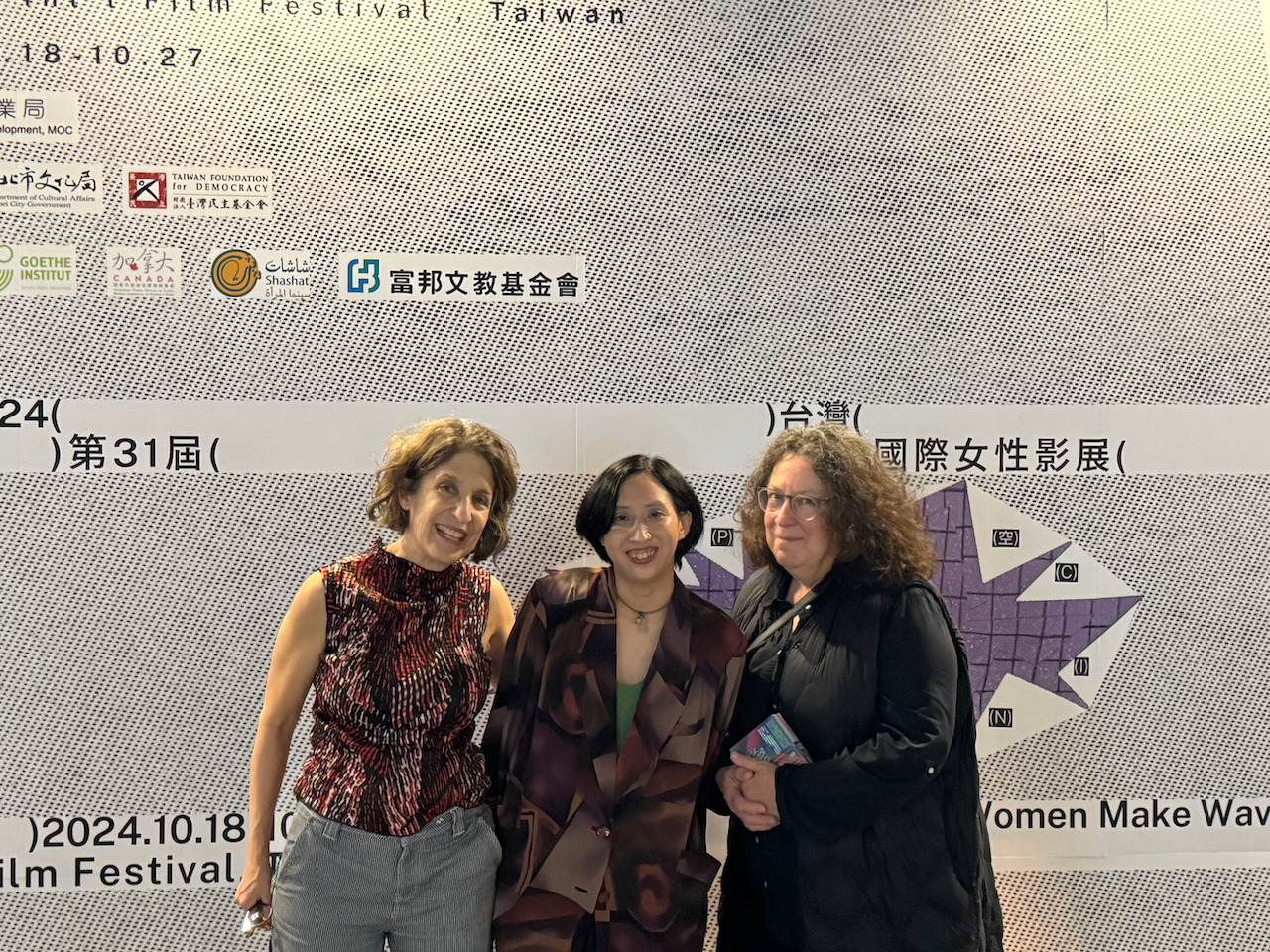
In October 2024, Women Make Waves International Film Festival in Taiwan invited US experimental filmmaker Lynne Sachs to lead an interactive workshop “The Body in Space” and attend the QA sessions for her latest short film Contractions and accompanying sound piece We Continue to Speak. Workshop participants attended one online and one in-person workshop. Over a period of a few weeks, each of the 30 participants produced a one-minute video which was then compiled into a single half-hour compilation that was integrated into a live performance as the final presentation for the festival public.

Under the very limited time constraints of the workshop, Lynne Sachs generously shared eight of her own films with the students in advance. Through these films, she encouraged the participants to think about the relationship between the body and space from the perspective of performance and imagery. Since the 1980s, Lynne Sachs has been rigorously pushing boundaries as an experimental filmmaker and poet. These eight films became an excellent entry point for understanding her recent creative trajectory.

Starting with Contractions (2024) and We Continue to Speak (2024), which were screened during the film festival, we also talked about four works out of the eight works shared in the workshop——Your Day Is My Night (2013), A Month of Single Frames (for Barbara Hammer) (2019), Maya at 24 (2021 ), and Film About A Father Who (2020). These works can be connected to the discussion of the body, space, and framing during the workshop: the spectrum of the subject matter shifting from works that are more socially engaged and in collaboration with local activist groups or residents; the creative relationship between her and other experimental filmmakers; and, finally to her closest inner circle, herself and family members. Such assumptions lead to a process that moves from the outside toward the inside, like drawing a circle. As time goes by, the overlapping trajectories become more dense, all the issues, subject matters, and emotions are intertwined with each other, and the inside and outside becomes intertwined with each other. All come together. In her practice, Lynne Sachs invited her family members to run and walk in a way that deviate from their daily routine. In the face of the most embarrassing situations or creative difficulties, she mentioned the preciousness of collaboration with others.

Sometime while we talked, a lot of words were left out of the formal interview, and later picked up in random chats, or during a follow-up online interview when she suddenly turned her computer around and let me see the New York street scene through her window.


Q: Maybe we can start from a more social dimension of your work. Let’s start with Contractions, which is very outspoken about the legal situation in US.

You know, in some ways Contractions is outspoken. And in some ways Contractions is a film that recognizes silence. It recognizes that those people who are most affected by any kind of political upheaval often don’t know how to speak, don’t have access to the microphone that would allow them to be heard, and so they had this sensation of being silenced. When I decided to make this film, I was trying to think of a form that could recognize an erasure as much as a presence.

Initially, there was this 2023 call from a filmmaker in California [Kristy Guevara-Flanagan] who was very upset about the end of Roe vs. Wade (the 1973 law that gave women the right to an abortion throughout the US), the new Supreme Court decision which gave each state the right to make its own laws about a woman’s right to have an abortion. She put out an announcement looking for people who wanted to make a film about abortion clinics that no longer offer services. And so about five or six of us responded, and formed the Abortion Clinic Film Collective. I realized that this was an opportunity to go back to my hometown of Memphis, Tennessee, because I’m very interested in this relationship we have to the place where we grew up.

I was very upset that something we had taken for granted about the decision-making process about our own bodies had been taken away. We all make assumptions about living in a civil society. You don’t know what you have until you lose it.

I felt like it wasn’t just that our rights were taken away. It was like our faces were taken away and our voices were taken away. I wanted to figure out how I could visualize that. I was actually inspired by Meredith Monk’s Ellis Island (1985) in which she took a group of performers and dancers to an island off the coast of Manhattan. There was this decaying old building. She took performers there and had them interact with the building. The way that performance activates real spaces is very interesting. Kristy Guevara-Flanagan had one requirement for all of the participating filmmakers: we all needed to go to a clinic that used to offer abortion services and no longer does. So I thought, how do I interact with a building? My cousin is an activist in reproductive justice, she performs in the Vagina Monologues every year in Memphis. So she helped me find the people who were in the film.

I actually just finished a part two to Contractions, called This Side of Salina. I collaborate with a Black women’s empowerment group [Layla’s Got You] for that. The film was projected outdoor in Syracuse, New York onto an exterior façade of the Everson Museum of Art, which was designed by the renowned Chinese-American architect I.M. Pei. I have their voices in the film and they also perform in it, a similar spirit to Contractions.


Contractoins 


Q: One thing I am also curious about is the covering of faces in Contractions.

Even in New York now, there are religious protesters every single day in front of clinics that offer women’s health services, including mammograms! Abortion is only a small part of what these clinics offer. People are also coming there for urinary tract infections, for example. All of those women are photographed by the protesters because the protesters don’t know who is actually coming to have an abortion. So they film everybody and invade everybody’s privacy.

I could give two answers about the covering of faces. One, the practical answer, is that someone choosing to be in this film was making a decision that was a little bit precarious. I asked everyone to sign a document stating that they were willing to be photographed, but I promised them there would be no faces. And then accidentally, we had one shot where we didn’t turn the camera off after people had already turned their bodies. And I love that shot because I love little mistakes. I needed to go back and ask everybody’s permission to include the shot. So I made a screenshot and I sent it to each person individually. In the film, you see women not only covering their faces but also are bowing. Maybe there’s a little ambiguity here: I’m bowing with strength, but also maybe you’re asking me to be subservient too. Are the performers bowing to the power? And, who’s bowing. I wanted to spark these questions.

Q: Did you come up with the sound piece We Continue to Speak after finishing Contractions?

I realized that personally I was uncomfortable with not letting the women speak because the whole idea was they were silenced. I think they have a lot to say, so I went back to Memphis just a few months later. I got all the women in the film together, plus one of the men in the film. I also interviewed a woman named Dr. Kimberly Looney, who had been the director of medicine for Planned Parenthood in Tennessee, as a central part of the voice-over. She’s very respected in the state of Tennessee and she’s very involved with Black women’s health. But I had told her from the start, you don’t have to put your name in the film because it could cause problems at the hospital where she works. And then she decided that she wanted her name in it. We’ve only shown the film once in Memphis. She came with her mother and her daughter. And she said, “My mother is scared for me, but I’m not scared.”

Q: How long did it take to shoot the film?

About three hours, since it was potentially dangerous to do so. In fact, when we were organizing the production, I had every shot drawn out because I knew we had very little time. I had never seen the building before, but I had drawings imagining it. My cousin and her friend were helping organize everything. She brought a volunteer marshal for security, in case we had protesters or something worse. Keep in mind, this clinic was known for offering abortions. Yes, it was closed, so why would 14 women in patient medical robes be standing in front of that building? People who were very much against abortion might have done anything. One of the local co-producers later told me during the QA of True/False Film Fesitval that we actually had 14 security marshals in different places, like in cars or and behind windows. It just shows you that this issue is very charged. Just a few years ago, several abortion doctors were basically assassinated in the US.

Q: In both Contractions and This Side of Salina you collaborated with the local activist groups and individuals. In Your Day Is My Night, this layer of collaboration transferred to that of the local Chinese community in New York City. This film looks at the shift-bed (temporary) housing phenomenon in Chinatown as a backdrop, resulting in a hybrid documentary-performance project.


One thing that became kind of joyous in the film was that the people in the film found pleasure in playing with the camera. In documentary, there’s a way of emphasizing the moment of the reveal. There’s also this way of developing a trust. And I think both of these systems can be kind of formulaic and manipulative. I just tried to get the participants in the film excited to do something that was different and might bring something new to their own lives. I never wanted them to feel “I’m doing this because this story hasn’t been told before, or people outside the community need to see it.” In fact, there was an exhibition at Taipei Fine Arts Museum we went to yesterday called “Enclave.” I really like the word “enclave.” You could look at Chinatown as an enclave, or this women’s film festival as an enclave. This very thought-provoking exhibition made me reflect on a seemingly hermetic space that can transform into a more porous one.


Your Day is My Night


For this film, I’d conducted audio interviews that became the basis for our film script, distillations you might say of these much longer interviews. In a sense, each member of the cast was able to have fun performing their own lives. If someone is in my film, I like to find ways that they get to be inventive or to harness their own imagination. We were working on this film as a live performance for about two years before it became a film. I thought it was going to be a film, but I didn’t know how to make it. Honestly, I went through a kind of creative desperation, trying to figure what to do. Your Day is My Night was a live performance first, and then it returned to being a film. This is the film that got me excited about working in this way.
 

Q: It’s a very hybrid film that blurs the docu-fiction boundary. Can you also talk about the Puerto Rican performer?

Well, we’d been working for a year, and one day we all got together – our cast and crew –  and the cast told me that audiences would be really bored with our movie because they thought their own lives were really boring. As a group, they suggested that our film needed a better story that people would care about, perhaps some romance. I proposed this idea: What would happen if someone outside, like me or a Puerto Rican woman, moved in? Remember, we were talking about that idea of disrupting a hermetic space! So, I invited a Puerto Rican actress who had worked with me on other projects to join our filmmaking community. Everyone had a much better time once I made it hybrid.  We needed to free ourselves from the limitations of our own reality, you might say.

Q: I really like the way you mentioned ‘enclave’ and the idea of porous relationship. I would like to mention A Month of Single Frames here, because in this case, you are dealing with someone else’s materials. The film is made up of Barbara Hammer’s film footage and sound recordings shot in the 80s.

I love finding out that Barbara Hammer came here to Taipei, two times. I didn’t know that until I arrived here. I made two films with Barbara. Barbara and I had known each other since the 80s because we both lived in San Francisco and we were involved in the Film Arts Foundation. And we both moved to New York, so we kept up a lot over that period of time.

In around 2006, she found out that she had ovarian cancer. That was about the time when she turned 60, and I promised to give her a birthday present, which was to shoot a roll of film with her and her wife, Florrie Burke. But she was so busy that it took me years to set up an appointment with her. And by that time, I was quite involved in her life through her cancer. So each time she had chemotherapy, my husband Mark Street would cook and I would deliver, so we were getting closer through that experience.

In 2018, I finally got to shoot the roll of 16mm color film with her. You can see that footage in Carolee, Barbara & Gunvor. I asked all three of these remarkable women artists who also happen to be dear friends, “How does the camera allow you to express yourself?” They all knew each other, but they never expected to be in one cinematic vessel together. Let’s call the film a female bonding moment perhaps. Thinking across generations, Carolee and Barbara were exactly the same age as my mother. They were all born in 1939.  Gunvor Nelson was ten years older.

In 2018, when Barbara really knew that she was dying, she asked me and three other filmmakers, including my husband Mark Street, to make films with material that she wasn’t able to finish. So what happened was that she gave me the footage of material she had shot during an artist residency in Cape Cod in 1998, but at first she’d forgotten she kept a detailed journal as well. I asked if I could record her reading out loud from her journal. I thought I’d be able to take it home and pick the parts. But she was in a hurry. She knew that life was not long for her. She asked me to go in the other room and pick out what she was going to read, right away.

One thing that was important to me was to actually find a way to communicate with her, maybe in a kind of transcendent way outside of the film, because she passed away while I was making it, so she never saw it finished. And the text becomes my communication with her and with the audience.

Q: I really like the on-screen texts. They are very beautiful.

Thank you. She never saw that. I felt that I needed to enter the material with her. But also it allowed me to understand something that’s very specific to film. When you’re inside a film, you’re actually in another period of time. We leap from the now to the then or to the future. And as you’re watching the film, you’re actually watching it with Barbara and me next to you. That’s a cosmic thing that film can do that, that you feel like you were in the room with Barbara. And it doesn’t have to do with her being dead or being a ghost. She’s very present in the film. And I knew that and I wanted to celebrate that.


A Month of Single Frames


In fact, Barbara had arranged for all of us to have some funding for the post production from the Wexner Center in Columbus, Ohio. I flew from New York City to Columbus early one morning so that I would arrive in Ohio ready to start. As I was heading there, I fell asleep on the plane. I woke up and I wrote all the text. It came to me in a dream.

I was thinking about the environment, she had filmed in, the sand dunes in 1998. So it’s kind of like your epidermis, the top layer of your skin. Your skin is the same as the sand, both have evolved over many years; your skin is slightly different, scarred or wrinkled, same with the land. In film, we feel as if we can go back in time. That’s what I was thinking about with Maya at 24. We can go back or simulate going back, and we can feel that there is also a here and now for us. You are here, I’m here. We’re all here. Because it’s activated by you, the audience.

Q: Speaking of Maya at 24, its sense of time is very unique. You film your daughter Maya running in circles, clockwise, at ages 6, 16 and 24, while a sense of time is simultaneously embodied through the movement. Can you talk about this gesture of running in circles?

I like that there’s a way that the person holding the camera loses power and control, while the person running gets to have fun. I like that disorientation. And also I like the eye contact that happens. The person who’s following your directions doesn’t really have to do much, but they’re definitely doing something that’s out of character. Even a little gesture, you notice how the camera is able to see how my daughter moves a piece of hair behind her ear, in a mature kind of way. There’s a moment when she’s 24 where she self-consciously makes this gesture. When she’s 16, she’s more defiant. And when she’s 6, she’s kind of more playful with me, more physical. In fact, I made three films, all shot in 16 mm. The first one is called Photograph of Wind, referencing an expression that I heard the renowned American photographer Robert Frank use. Maya as a word also means illusion. I was trying to hold onto her childhood, but it was ephemeral and it was going away like the wind. I called the second iteration Same Stream Twice. It came from the Greek philosopher Hiraclitus who wrote you can never step in the same stream twice, but in film you can step in the same stream twice. Maya at 24 was shot when she was 24 years old. It’s also about film itself running at 24 frames per second. So it’s a little reference to the materiality of the medium.

There’s something I find very energizing and unpredictable, about the flow of two circles running almost in opposite directions or two circles spinning at different rates so that you have this sense of being behind and ahead. And there’s an unpredictable register, which has to do with the person filming, with my energy, my ability, my stability, and the person who is being filmed. If you are in motion, sometimes you lose a little bit of self-consciousness. You’re just thinking about working together on this very unambitious and unfamiliar project, which is running in circles. So I took that way of working into Film About A Father Who. There’s a point where my father’s walking along in a circle. And my mother did that too.
 

Q: For Film About A Father Who, I really have to say it was a bountiful watching experience, with materials that span 35 years of documentation and creation that also encompass different mediums including 16 and 8 millimeter, video , and digital. As an experimental filmmaker, how do you perceive the medium in this film?

So, it’s interesting to me to consider that as I was making the film, technology kept changing. There’s an assumption that as technology changes, it witnesses and documents our lives. We assume it gets better,  that there is a pure, mimetic relationship to what you see with your eyes and what you record. Even though I see myself as an experimental filmmaker who likes the degraded or imperfect image, the more I looked at my old material, the more critical I was of it. I was critical of the medium, but I was even more critical of my skills. But deeper than that, honestly, was a kind of aesthetic critique of my father and of our lives. I had a lot of embarrassment. I was deeply embarrassed about my work as an artist and about my role as a daughter. That was one of the reasons I couldn’t finish it. I could shoot it, but I couldn’t look at it. I just had a lot of shame.

And I did have anger. Initially, I started the film because I thought my dad was really interesting. He was an iconoclast. He was a rule breaker. He was maybe one of the reasons I found myself making the kind of films that I make. I wasn’t intimidated by odd situations, and that’s the way he was. But then as things kept happening, I became more and more uncomfortable. Sometimes I wanted to make a critical film, sometimes an introspective film. In fact, I discovered that at different points, different camera registers or modalities worked better for different subjectivities.


Film About A Father Who


Q: About degraded image, there is one certain sequence that repeats: kids playing in a little stream. The timing of repetition is quite crucial, too.

I show that little stream three times at three different moments pulled from one long shot, and it’s critical to the narrative of the film. But what is more interesting to me is that each time you as a viewer are thrown back into that scene, you know more. You have gained knowledge, and you have shifted your position from being an outsider to being omniscient. You realize that you have been privy to information and to a complexity that not everyone in the film is aware of, so that’s compelling to me to let the viewer grow with that image. To me, it’s probably the prettiest image in the film.

In Hito Steyerl’s article, In Defense of the Poor Image, her writing is a celebration of how images travel through culture and become changed in the ways that our bodies change. We get wrinkles, and we get less vibrant, and images do the same thing. They reveal something about the time in which they were made, but also the time in which we as viewers currently live. But I didn’t understand how important this was to me as an artist until I made this film. Because, the first time my editor and I went through all the footage, that kind of image (the stream image), was one that I probably dismissed. It was on a degraded, improperly archived tape that my father had shot on Hi 8 in the 1980s.  Time had not been kind to the material.

So with Hi 8, you had these tapes that were like the size of your palm. They went into the camera and you would shoot. And then you would go home and you would connect your camera with a cable to a machine with a VHS tape, and you would transfer the original to a VHS tape. And then, you would reshoot over the original tape with new material.  There was no original anymore! Everything was just a copy, and each copy was more degraded than the one before it. Since I had forgotten this technical fact, I spent a couple of years trying to find the original of that tape. Then I finally realized that my dad wouldn’t care about the original. He just wanted to collect images and watch them.

I went back to the VHS tape, which was just a considered a viewing format, not of serious historical importance to archivists anywhere.  But when I had it digitized, I realized it is a lot prettier than the digital images of today. It looks more like an Impressionist painting. It has more of an essence than a more precise, better preserved image would ever have, plus it’s got Dad’s voice speaking to his children.

There you see these three children, my half siblings. My father was probably standing behind a camera using a tripod. I guess he forgot he was even recording! Consequently the shot was about 8 minutes long, long enough for him to reveal something very loving, stern in a fatherly way, which my dad usually wasn’t, and very relational. He was dealing with children in a very traditional parent-child way. And the other thing about the image is that it had become pink and yellow and soft blue. The image is truly painterly, so beautiful. Everything about it was meaningful to me.

We’re always using the camera to witness other people’s presence in the world, but it’s also such a gift to see how they frame their own world. So that shot of the children in the little stream is how my father saw his younger children, the ones from the 1980s, my half-siblings. And it’s very loving.


Q: As the film attempts to unveil various “truths” in one family, it also unveils another kind of complexity itself, which turn the clear distinction between good or bad totally upside down, maybe that’s where all the love and hate come from.

That was exactly the gateway I had to go through to make this film. It wasn’t a simple judgment or any emotional realization that came to me. I needed to find a place for something else. I think almost everyone has a person in their family that they’re constantly trying to figure out —  where to place them in their consciousness. With our parents, for example, they each choose what they want to share with us in the cosmos of family.

In the film, I wanted to find formal ways of articulating transparency, obfuscation, even covering up. But I think what’s more interesting is giving a viewer the ability to understand that everything we interpret comes with layers of meaning. For example, when you see my father in a tuxedo going to these ostentatious galas with my grandmother dressed in a fancy ballgown, what you realize is that there is no transparency here. It’s all performance. That’s why I intentionally use a little bit of Disney music. This scene actually feels very unreal.

Before my father would go see my grandmother, he would always cut his hair. This way his way of being who he wasn’t. And that’s actually one of the most poignant things in the film. Here’s someone whom generally society does not approve of, at least in term of how he conducted his life. But then parallel to it this is a son who could never be himself with his mother. And there’s pathos there. I think where you find pathos in a film is like an entry point. Not pity, not disgust, not just elation because something great happens, but where you find pathos is really important to me.


Film About A Father Who 


As a filmmaker, I need to find an interesting moment between every cut. Even in my longer films, I never want a cut to be simply the result of cause and effect. I want an edit between two shots to be an entry point of activation for a viewer, then there’s possibilities of pathos, as well so many other sensations.

Q: In this film, you are not the only person who was filming. Other than the stream sequence shot by your father, we can constantly see your brother filming. In a way, it seems that your family members are quite used to having someone in the family who is filming. Nevertheless, I am really curious what made you want to finish the film?

My brother [Ira Sachs] is a filmmaker who makes narrative films. But there was a period of time where he went with my father to Moscow, and he would sometimes go down to Florida with my father for my grandmother’s birthday.

There was a way that my father would talk to my brother, in that man-to-man kind of way, even though he knew my brother was gay. He would show Ira a list of all the women he’s trying to date or sleep with. My brother found that to be a turnoff, but he kept the camera going.

So that occurred to me. When I was trying to work on this film, I asked my brother if he could look for the outtakes from Get It While You Can (2002), the short film he made from his Moscow footage. In this way, Film About a Father Who would not offer just a single perspective on a man.


Let me tell you one of my favorite images that was shot by Ira. He’s on the bed and he’s listening to our father in the other room with a young woman, during their trip to Russia. Ira’s holding the camera, you see his feet and a floor lamp, and he’s humming to himself. And it’s amazing because you feel like you’re in this young man’s head. It’s so internal. Both scenes are really gendered, but play out by revealing something complex going on between a father and a son.
 

For me, this all plays out like a Cubist painting, let’s say a Picasso’s painting of his daughter Maya. He’s trying to articulate different planes of perception, and that’s how a family works. That’s what this film is recognizing. Those different points of view. I am trying to see how a family works anthropologically. For example, I got very interested in how lying works in our family. I think all families are built around a series of white lies. People try to protect the ones they want to protect, but they also try to protect themselves.

But the thing is in a film like this, you’re still journeying, since, as a filmmaker, you’re hiding behind the camera too.

Q: This film also tackles some of hard situations. I remember there is a scene where his girlfriend and second wife sit side by side.

I remember the year I shot that scene, in 1992, and I was shooting with a really good 16 mm Arriflex camera. I had just started dating my now husband Mark, who is also a filmmaker, and I asked him to record sound. I looked at that footage right when I got it back from the film lab, and I knew it looked “pretty.” I also knew that it was very dramatic, and very disturbing. It showed two women being very honest about their feelings and their assessment of their situation. But once I looked at it after I got the film footage back, I didn’t look at it for probably 25 years, and it moved around with me in carboard boxes from California, to New York, to Maryland. It moved with me everywhere, and it became this Pandora’s Box saying “Look at me!” And, I couldn’t look at it.

And then, I reconnected with a former student of mine named Rebecca Shapass. She started working with me as my studio assistant, and I just said, “let’s look at the footage together.” For some reason, I never felt embarrassed, and it was a breakthrough. We went through every tape and every roll of film. And that was kind of a watershed moment. I was able to explore ideas with her, as we sat side by side, so she ended up being the editor for the film. We did it together, and it was very freeing for me. I’ll never forget that connection that we had.

註1:本文中文版本原載於國家電影及視聽文化中心出版之《放映週報》776 期
註2: 本文所有劇照皆由琳恩・薩克斯提供
Note 1: For the Chinese version, please refer to Taiwan Film and Audiovisual Institute’s Funscreen Weekly No. 776: https://funscreen.tfai.org.tw/article/38821
Note 2: All the film stills used in this interview are provided by Lynne Sachs.

“A Troupe of Twenty-Four Images Marches”: An Interview with Lynne Sachs / 128 LIT

https://www.128lit.org/lynne-sachs-yehui-zhao-interview

Yehui Zhao: I want to start by recalling a very memorable scene from your film, Tip of My Tongue (2017), that has lingered on my mind for many years. I’d like to share a quote from a statement of yours for the film:

“To celebrate her 50th birthday, filmmaker Lynne Sachs gathers together other people, men and women who have lived through precisely the same years but come from places like Iran or Cuba or Australia or the Lower East Side, not Memphis, Tennessee where Sachs grew up…Together they discuss some of the most salient, strange, and revealing moments of their lives in a brash, self-reflexive examination of the way in which uncontrollable events outside our own domestic universe impact who we are.”

One of the film’s participants, Sholeh, talked about being a mom during the Cultural Revolution in Iran in 1979 when the monarchical government was overthrown by a religious cleric. With no diapers for her baby and a strict dress code, she recalled a hot summer day when she went to the post office wearing a garment and scarf that covered her entire body. While waiting in line with her baby, she felt this “wetness, a sour smell, and a thick yellow color.” There was no access to a public bathroom. When she got home, she placed her baby in the bathtub and the smell spread throughout the house. She said, “Her, me and the faucet, we were all weeping.”

While Sholeh recalled this, we saw a scene of beautiful magnolia flowers in early bloom. The fragrance of magnolia had the effect of amplifying the foulness, making the smell even more unbearable.

Lynne Sachs: My gosh, I love that detail that you have noted.

YZ: You’ve assigned meaning within the story to that magnolia, which is something you do in your films. Can you talk about the process of creating meaning through films?

LS: I actually think it’s interesting that you use the term “assigned meaning” because it sounds like a responsibility, but it also is this exhilarating opportunity to give an object a resonance. I think it was Emerson who said, “Things are in the saddle.” Do you know that quote? It means that in some ways we look at things as being too weighty in our lives, like our cars or our homes. They’re in the saddle, and they control us. They’re driving us. In another way, we could say things are in the saddle—not needs, not hungers, but the objects in our lives that evoke memories, relationships, or meanings, much like what you just described.

Honestly, I couldn’t say for sure that I thought about aroma or smell when I put that shot in, but I love that you brought it up. As you know, we learn to appreciate decisions that we make in filmmaking, from really observant spectators. Maybe it was in my mind. I’m trying to remember, but I don’t think that I could give myself credit for that. But I loved Sholeh’s story as a distillation for a moment in history. When she told me that, I knew it would help me better understand this tumultuous moment in her life when she was thrown into motherhood instead of living out her zesty, outlandish, and young womanhood. She told me it was during the pre-revolutionary period in Iran, when she could walk around in a miniskirt. Can you imagine in one year going from that kind of personal freedom to wearing the veil and being an 18-year-old mother? I’m not trying to elevate miniskirts, mind you, but they do represent a kind of comfort with revealing your body in public.

YZ: It’s these very dramatic changes in the social environment that have an impact on people.

LS: In some ways, it’s like the 1973 decision here, when abortion became legal, and then in 2022, when the constitutional right to abortion was overturned, making it illegal or unavailable in at least twenty-one states around the country. Those are situations where a major shift in history seeps down into someone’s most intimate life.

YZ: As the director and participant in Tip of My Tongue, you also created Year by Year Poems (Tender Buttons Press, 2019), a collection of 50 poems, one for each year of your life. In the book, you tied together major social events with very intimate moments in girlhood and womanhood. What was your process like in creating this book, and are you still writing more?

LS: I do write. I’m actually finishing a film called Every Contact Leaves a Trace. So I’ve been writing a lot for that. But I have a mission to write about the next 10 years of my life for Tenement Press. I’m a little behind. I haven’t started writing that series. It’s the first thing I want to do when I finish this film. You and I were talking just a few weeks ago about this sense of trying to have closure for one thing so it doesn’t tarnish the next, meaning whatever you’ll be working on in the future. I need to write those poems when I’m not thinking about the practicalities of finishing a film. As I keep saying, and as we both know, film necessitates a lot of producing, which we don’t have to do for poetry, right? I’m looking forward to that headspace of reflecting on the last 10 years or so of my life in the same spirit of Year by Year Poems. I wrote a lot of poems during the pandemic. But they were very much in that moment. They weren’t looking back at my history at all.

Over the years, I’ve found a lot of, let’s say, gratification in workshops I’ve taught where I talk about Year by Year Poems and Tip of My Tongue with people who don’t usually write poetry. I say, “This is a construct by which you can enter the poetic discourse, and also think about who you were in a moment of history.” People have found that to be provocative enough as a way to distill moments in their own lives, creatively. I really love the gesture or the impulse to distill.

From Tip of My Tongue. Image courtesy of Lynne Sachs

It’s a key aspect of Tip of My Tongue that goes back to a professor I had in college, Naomi Schor, who wrote a wonderful book called Reading in Details: Aesthetics and the Feminine (Routledge, 1987). Let’s say you’re reading a novel by Balzac or from another author. Most people will read it as a vivid, rich story and immerse themselves in the characters. What she was saying, and she said this from a feminist perspective as a literary discourse, is that the details—like the magnolia you spoke about—start to take on a resonance. It’s something the reader is left with that goes beyond the narrative or the plot and leaves its mark. I loved her insistence on details and distillation, maybe because I don’t really fancy myself a storyteller in the traditional sense. I like to accumulate details and then see how they create new meaning, as you said earlier.

YZ: The process of accumulating details—is that how you wrote this book? Through collecting details over the years? What was that process like?

LS: One of the great things about writing that book was that I chose to throw myself into each year of my life. It was overwhelming because so many things happen in 365 days. But once you land on an image in your head that resonates, you can let everything else fall away. People say to me, “Well, how do you remember what happened in 1961?”, which is the year that I was born. And I say, “No, no, no, no. I don’t rely on memory at all and could never claim that I remembered that year.” I can only give myself permission to, let’s say, reconstruct my infancy and look back on it through my present time. I remember thinking about the house where my parents lived until I was six. In my mind, I was able to recreate a presence for a baby in that room, then imagine what might have been there at the time. Then I just worked it out. That’s totally how I make films. I work from the center. I don’t impose a story on it. Let me just go to that poem.

1961 
Born at dinner time on an August evening,
the child of a twenty-one and twenty-three-year-old
a crystal ball at my fingertips
smooth and inviting, deceptively transparent.
I touch its surface with my wet tight fist.
Glass shatters the delivery room.
Our future blows beneath the bed
down the hall
out the front door of the hospital
into sweltering Memphis darkness.

I wrote about how the glass shatters the delivery room, and about a crystal ball, which, of course, there was none, but I’ve always been fascinated by crystal balls and how people look into the future. A poem gives you that freedom to insert objects or things.

From Tip of My Tongue. Image courtesy of Lynne Sachs

I want to introduce one idea that’s very mundane. You can go on Wikipedia and type 1975, for example, and it will tell you all the public historical events worthy of recognition that went on in the United States and worldwide. It also tells you about culture, like the most popular songs at the time. That was extremely helpful. I didn’t rely on it, but it brought back the past in this shared communal way. I really respect Wikipedia because of how it is generated. It was very helpful to just get that whole milieu thrown at me in such a generic way. I could find my way and carve out my own relationship to a moment in time. For instance, 1976 in the United States was a big patriotic year. It was the 200th anniversary of the country. Honestly, most of what happened was very tacky and overly patriotic. People would make quilts or they’d have special gifts at the gas station, things like that. But it allowed for this flood of memories for me. I’m a little embarrassed to say that I used Wikipedia, and that it was actually very helpful.

YZ: The first time I met you was when you were teaching Frames and Stanzas, a film and poetry workshop in Hunter College’s Integrated Media Arts program. So that’s what you assigned us to do, to write poems through locating past events on Wikipedia. We picked three years from our lives, including our birth year, and wrote a poem for each one. Then the whole class created a book of poetry.

LS: Right. I remember that because then we read them in chronological order.

YZ: We actually created our own collective archive of history with Wikipedia’s help. 

LS: I remember using that research approach with your group, which was probably the first time that I referenced it. And I’m sure that it’s very, I don’t like to use East-West, but I’m sure that it has a certain orientation towards the United States and Europe for that history, I’m guessing.

YZ: I think so because most of the internet users are based in the West. It was powerful to write and read our book of poetry together. I remember that so well.

LS: Thank you, I really enjoy your questions. As you look at your own crystal ball, you don’t seem to see the befores or afters. You see a constant present. And I think that’s kind of how I work. It connects to my poetry writing and to my films. One line generates the next, but the flow is not one of cause and effect. It’s the same with my filmmaking. I get excited by juxtapositions between one shot and the next because something magical or implied occurs between the two shots. It might not be there in the words, but it’s a way for you to infuse it into the film, and that’s not traditionally how filmmaking has evolved, at least in the mainstream. I really go back and forth between film and poetry. Film’s relationship to time is potentially mimetic, though it doesn’t need to be. If we feel exhilarated by other kinds of juxtapositions, then that mirroring of reality can leap outside of time. And I think that leaping is sort of what happens inside the crystal ball, because you could also look into the crystal ball and see the past, as well as the future. Ultimately, the crystal ball is just a reflection on you. You look at it and you see refractions of your own face. That’s all you see.

YZ: I was very lucky to have seen Contractions (2024), your latest film, at DCTV’s Firehouse Cinema. The film is about the discontinuation of abortion services at a women’s health clinic in Tennessee. You’ve carried a tradition of performance in this film. In another film of yours, The Washing Society (2018), there was a scene where the workers danced with the laundry machines and created movements and beats. In your definition, what is performance in film? And how do you create it?

LS: Okay, first of all, I believe that at every moment in front of the camera, people have an implied power relationship to the director. I’m going to take a step back and say that you’ve probably noticed that when you do an interview with someone and ask them a question, you nod. So, you ask me a question—or maybe you just watch me—but let’s say you ask me a question, and I respond. I’m watching your eyes, I’m watching your face, and you’re acknowledging that what I’m saying serves your needs. You’re nodding in the way that nonverbal communication works in society. You’re nodding and saying, good, good. And I think that happens implicitly in every filmic moment, unless the camera’s hidden. And it doesn’t matter if it’s a narrative film with actors or it’s a documentary with people who are players or participating in a real life scenario. If they have agreed to be in the film, they have agreed to follow the rules. They’ve agreed, in a sense, not to yell profanities. If you signed a release with them—maybe you didn’t—they’ve agreed to perform as they normally would. There are all of these expectations that come with being in front of the camera. It’s a power relationship that I believe is problematic.

Ultimately, when I decided to make Contractions, I created a scenario where I was the director, asking my performers, participants, or collaborators to move in a certain way and wear a specific costume—a patient’s robe from a doctor’s office. In other ways, they had a kind of freedom because their backs were to the camera. This gave them a sense of fluidity and liberation, freeing them from being pegged in a particular way—whether by age or by being considered a good or bad performer.

From Contraptions. Image courtesy of Lynne Sachs.

They felt integrated but not projected upon. And that’s not something that I really understood before I did it. My initial impulse was to give them anonymity because it was a very charged situation around abortion in a state where women no longer have complete bodily autonomy. The state has severely limited the right to an abortion, essentially making it illegal. Now, as I reflect on it, I realize the 14 performer-activists in the film were able to perform because they had moved away from their personal identities. This shift gave them internal permission to engage artistically and dramatically, freeing them from the concern of how they looked or how they were perceived in the image.

In The Washing Society, my co-director Lizzie Olesker and I were working with two women in particular, Veraalba Santa and Ching Valdez Aran. They both had an enormous amount of experience as actors. When they were placed in that film in a laundromat, they could loosen up a little bit and create an ambiguity between who they were as members of the artistic community of New York City and their roles as laundry workers. Class is an issue. In a laundromat, they created a fusion of identities across class lines which sometimes confused people in the film. When we did the live performances, people were wondering who’s real and who’s not. I love that. I love that a viewer is thrown into a little bit of uncertainty, which might become revelation, in a meta-way, let’s say. When I’m reading short stories, when I’m reading something that you would call a mystery, where you have that moment of not knowing who you are and where you’re going and then it all settles in, you feel a charge when it all starts to become apparent.

It’s the same with poetry. It’s that moment when you read poetry and say, “I’m not familiar with this poet’s vernacular.” And then by the end of the poem, you want to circle back and read it again because you speak their language. So that excites me. And when people say, well, I was confused at the beginning because I didn’t know who was real and who was not, that’s taking the viewer to a discourse that’s very heightened and that they rarely go to.

YZ: I felt that in Contractions performance activates reality. I felt the same about The Washing Society. I also really like this idea of dancing between real and unreal…

LS: One of the reasons we make our work is to create echoes. An activation of a new point of awareness is fundamental to me. That’s been a guiding principle of my work for a long time. Like for the title of Which Way Is East (1994), some people said to me, “You need to put a question mark on ‘Which Way Is East.’” But I didn’t want there to be an answer. I wanted it to be suggested from a position of acknowledging that it’s only an orientation, especially on a globe.

From Which Way Is East. Image courtesy of Lynne Sachs

YZ: I’m curious as the director, when you’re working with, let’s say, characters or participants, how do you invite them to perform? Do you give them prompts? What’s the process like?

LS: Okay, I’m going to say something that’s a bit cinematic which might speak to you. I like to think about the body in space. Sometimes, when I’m working with people, I think of them in a diagrammatic way. I think about a person being almost like a cat, or like a character from an alphabet. I really love silhouettes. I adore that. Not that the performer would think of themselves as a silhouette, but I focus on their bodies moving in relation to one another, shifting attention away from the face. One of the things that’s really important to me is suggesting that not every emotive experience originates in the face, although I shoot a lot of closeups of the face. I’m reminded of Roland Barthes’ famous essay, The Face of Garbo (1957). You may have read it—he writes about how Garbo’s face is so expressive, so ostensibly affecting. Whether it invites you in or keeps you out of Greta Garbo herself is something I can’t claim to know. I like when the face, or the gesticulation of the body, like a cipher, reveals something about the energy between two people or what’s happening internally. So, if you ask about a prompt, sometimes I say things like, “Move in the space and be responsive to objects in the space as if they were other human beings.” I don’t actually ask people to read lines over and over again, but I ask them to move and then to see where the words tumble out. In The Washing Society, we wanted the machines themselves to become like surfaces you could slap.

Poster of The Washing Society. Image courtesy of Lynne Sachs

One of the things that we tried to do was to take an object that seemed inanimate and make it feel animated, like slapping a washing machine is, in a way, ridiculous, but it’s also sort of slapping at the moment, slapping at history. Doing things that are out of the ordinary in a very ordinary space is very interesting to me. In Contractions, moving your body closer and closer toward an abandoned building with your back to the camera, surrounded by other people, on a sunny June day, creates an unfamiliar, anxious dynamic. But I suppose that’s intentional—leaning into the unfamiliar often heightens behavior in front of the camera. I never want my performers to get too comfortable. That said, I do rehearse with them, and I always film the rehearsals. For me, rehearsals are part of the discovery process, which I find incredibly exciting.

YZ: Going back to how I met you, which was during the Frames and Stanzas workshop, something that really struck me from the class was your approach to sound. Unlike the traditional notion that dialogue must be recorded with almost no background sound, you really value the sound of the environment. In your work, we can often hear, for example, a flushing toilet, footsteps, children laughing, or crying during voiceovers. What’s your philosophy with sound and how do you generate a rich soundscape while on set?

LS: I’d like to talk about a point in The Washing Society that ostensibly would have been referred to as a mistake, but it’s often people’s favorite part of the film. The two main actors, Ching and Veraalba, are sitting on a bench inside a laundromat where we’re filming. Off camera you hear a man who comes in and says, “When are you gonna finish this? I need to get to my wash.” He was a customer. We could only afford to rent the laundromat for our production for a few hours. The owner of the laundromat told us we need to open it up for the customers unless we want to pay several thousand dollars for the whole day, which we didn’t. At that point, the customers started to come in and they were a little resentful of us being in the way. This particular man started to yell at us, so we stopped the camera, but we didn’t stop the sound immediately. We ended up getting all this extra sound of him continuing to be irritated and a little bit aggressive.

The performers stayed in character, and they said, “We’re making a movie.” This elevates it, as if to say, “We’re doing something special, which is more important than your wash, than your clothing.”

From The Washing Society. Image courtesy of Lynne Sachs

Of course, it’s not true, but you know, it’s the way our culture works: This is a movie. We need to stop traffic. We need to shift over and do whatever this director needs, even if you’re not being compensated for it, because this is a movie. Anyway, so they said, we’re making a movie and he didn’t care. I liked that irreverence. When we were editing the film, our first impulse was to take that part out. It’s so humiliating. But then, as we were editing, we started listening again to this outtake—this moment where someone from outside our diegesis, let’s say, was actually puncturing the hermetic space of the movie set. The idea of perfection in a traditional production is absolute silence. People say, “Quiet on the set!” right? And then everybody does it, even passers-by. Everybody’s quiet. It’s part of our social contract. But in this case, this man didn’t want to be a member of that compliant class. He wanted to take care of his own business, and he punctured our world. That became significant because he threw the creation of our movie space into disarray. He brought in the real world, and it became all the more interesting. It was very special because isn’t that inherently part of the surprise of making films? And haven’t we learned that the disruptions are actually the most revealing parts of the process?

YZ: You’re an icon of creating and experimenting and you’re a prominent feminist filmmaker.

LS: No, no, no, no, no, no, no.

YZ: To me you are. For how many years have you been making films?

LS: My very first Super 8 film was made in 1983. There were actually two films: one called The Tarot and the other called Ladies Wear. I was 22 years old, having just graduated from Brown University where I was actually a history major, focusing on intellectual, women’s and medieval history. I also did a lot of studio art, but I didn’t make films as an undergrad. I discovered experimental film and film as poetry during my junior year in Paris. After college, I moved to New York and thought, “I’ll take a filmmaking class.” I took one, but ultimately didn’t enjoy it very much—because my teacher believed all short films had to have a punchline. I’ll never forget what he said to me at our final film show: “Are you a liberal arts student or something like that?” Like it was a stain.

I learned how to make films and ended up making two in 1983. The first one was a project I approached with great gusto and intention. It was called The Tarot and starred my best friend Kathy Steuer, who grew up with me in Memphis, Tennessee, and also lived in New York. It was a film about a young woman trying to figure out what to do with her life. So she goes to a tarot reader and she has her cards read. Then you see this animated scene with her turning into all different kinds of women.

From The Tarot. Image Courtesy of Lynne Sachs.

That was it, just three minutes. The splices were so bad that the film barely ran through the projector. Kathy came to the screening totally dressed up with a big boa around her neck. You know, like a big, flashy scarf. The story was quite literal. A young woman has her future read like a crystal ball, and then she imagines herself that way, and that’s it. It’s kind of embarrassing. I projected my life on my best friend. She’s still my oldest friend because we’ve known each other for 63 years.

Then I made another film that I never edited at all, because I really didn’t know how to edit very well. It’s called Ladies Wear since there was a sign on a store in the fashion district that read “Ladies Wear.” This is an old-fashioned expression for workday clothes that women wear. The whole film follows my brother, who was 18 at the time, as he rides the New York City subway.

From Ladies Wear. Image courtesy of Lynne Sachs

Back then, the subways were covered in graffiti, inside and out. You see him on the subway, putting fingernail polish on his hands, which was pretty funny because, in those days, you never saw men with fingernail polish. Also, who would put fingernail polish on in the subway? Now, looking back, I see it as transgressive—really playing with gender. But I can’t really give myself credit for thinking that way at the time. I honestly don’t know what my conceptual intentions were. I just asked my brother, who was visiting me while he was in college, “Come, let’s shoot a movie together. I’m learning how to make films. Here’s some fingernail polish—put it on in the subway.” He didn’t even know how to apply it—he’d never done it before. Now jump ahead, 40 years later, my brother Ira Sachs is a filmmaker as well, and his husband Boris Torres is a painter who will not walk out the door without fingernail polish on!

YZ: 41 years of filmmaking. Congratulations! In your career, what are some of the themes that have evolved over time?

LS: I’m going to just bring up one theme that revealed itself to me as a surprise. In around 2005, it occurred to me that I had spent the last 10 years making films that dealt with war. But it was not a plan, it was not an intention. I had made around six projects on that topic. I was very interested in the idea that the violence, the repercussions, the culture, the patriotism, the protest, all of the things that came from war and how our perceptions of it depended on who we are and where we are. We organize a lot of things in the United States around war. That was during the Vietnam War. That was during World War II. That was World War I. That was the Korean War. But wars have not happened on our own land. That’s why for many people it’s a war of the imagination.

So much of what we understand about a war is delivered to us by some form of media—an article, a news report, a fiction film set in a certain period of time. There were many films made about romance during World War II or the Vietnam War. It seemed inherently American that you could find love with the backdrop of these kinds of crisis moments. 

I was reckoning with how I had imagined the war, having grown up as a kid in the 60s. I was watching the Vietnam War on television, always in black and white. And the very first line of the film Which Way is East is, “When I was six years old, I would lie on the living room couch, hang my head over the edge, let my hair swing against the floor and watch the evening news upside-down.” It was like an experimental film! Or, at least, that’s how I remembered it. Then I made Investigation of a Flame (2001), which looks at the protest movement here responding to the Vietnam War.

Poster of Investigation of A Flame. Image courtesy of Lynne Sachs

I created a film—or rather, a collaborative web-art project with the artist Jeanne Finley — called The House of Drafts, which explored the war in Bosnia in the late 1990s. From 1994 to 2009, I made six films and a web project that dealt with war. I called that body of work I Am Not a War Photographer.

For the most part, women have been elevated more for our appearances than for our creative impulses or abilities. I was struck by this early on in my life as a teacher at the university level. I would give out a questionnaire to my students and ask them to name their favorite director, and it would always be a man—always. So, the next year, I changed my questionnaire and became more direct, asking, “Name your favorite male director, and name your favorite female director.” A lot of people were challenged to name their favorite female director. So, I changed it again, saying, “Name your favorite male director and name a female director.”

On the set of The House of Drafts. Image courtesy of Lynne Sachs

Times have changed, and I’ve been teaching since the late 80s, so I’ve really seen this gender dynamic evolve. Early on, it became evident to me that if there aren’t very many women directors that the general population of college students knows, then I need to make them aware of what they don’t know. I need to somehow, within my curriculum, introduce them to that work. And for my female students, I need to say, “Here, you know, here’s your time, take it and run and do whatever you can.” It’s tricky. For example, from what I remember, there was a period of time when I was showing films by Carolee Schneemann. I love her work and I’ve made films with her. She was one of the first filmmakers to embrace the camera as equal to the paintbrush. One of her earliest films is called Fuses (1967). She’s in it with her body. It’s supposed to be the perspective of her cat and she’s making love with her partner, a man, not throughout the whole film but in parts of it. You see her body nude and you see his body nude. It’s just wonderful. I love it. But for some women viewers, female nudity on the screen was not empowering.

There’s been a whole kind of ebb and flow around this question: do we want women’s bodies in front of the camera? Maybe we want women behind the camera, but if we have them in front, how do we film them without objectifying them? You know, there are a lot of complications. At one point this was called somatic cinema, the cinema of the body. I’m interested in these dilemmas.

Going back to an early film I made called Still Life with Women and Four Objects (1986), I have this woman who’s putting on a coat three times, and I show the curves of her breast. I think it’s beautiful, but I was also kind of self-conscious about it. I’ve been grappling with that ever since. I remember when I was in graduate school in San Francisco, a woman asked me to be the cinematographer on her film. I thought, great, you know, we’re going to shoot 16mm film. I get to be the camera person. Then I found her point of view to be very sexist towards women. So, I eventually had to quit. You know, just because you’re working with a woman, doesn’t mean she will want to produce images that you’re happy with.

What’s another theme? I have made quite a few films with my family and hopefully they’re not just explicitly about my family, but about relationships, for example, like between a mother and a child. I have three short films, Photograph of Wind (2001), Same Stream Twice (2012), and Maya at 24 (2021), where I ask my daughter to run circles around me.

I would love to teach a class about running circles. Not that it would be full of instruction, but I would just be fascinated by how other people might do that on the level of perception. I love how, when a person runs in a circle around another person holding a camera, the person in the center holding the camera becomes very dizzy, while the person on the outside remains much more stable. It shifts that power dynamic because the person in the center is holding the camera, but he or she or they become more unstable or fragile.

Then I shot a feature-length film with my father over, I believe, 35 years. The camera became an activator, but also just a witness to the dynamic between my father and all nine of his kids. I guess the personal revelation for me was realizing that we see another person from our own perspective, but the person next to us, whether in the family or in the room, sees that person from a completely different perspective. As we accumulate all that, it becomes like a Cubist representation, in the way that Picasso would look at his daughter, Maya, and create a whole series of paintings in the Cubist style. You would see Maya from different vantage points and I thought that’s what I did with Film About A Father Who (2020)—I tried to articulate my vantage point as well as those of my siblings.

I will say one other thing. I’ve played a lot with found footage and archival footage. That’s one more material or formal trope I’ve tried to explore. I will mention something about one of my early, slightly longer films, Sermons and Sacred Pictures (1989). Have you seen that film? I made that in 1989 and it’s a film on, or celebrating the work of Reverend L.O. Taylor, who was a Black minister and filmmaker in the 1930s and 40s in Memphis, Tennessee. I went back to my hometown and made this film about his life because he was at the center of this very vital African-American community. He would film the first black-owned barber shop or beauty parlor or he’d film a baptism in the river, always in this gorgeous black and white film stock and using a 16mm Bolex. He was my first inspiration as a filmmaker, even though I didn’t meet him. He died in the 70s. I met his wife and lots of people from his community. I went back to Memphis and walked all over neighborhoods where he had been a minister and talked to people about him and filmed. And then I included his film material in my movie. It’s only 29 minutes, but ever since then, I’ve been super interested in the distinction between archival images and found footage. I love both. For me, with archival images, you have reverence, you care about its preservation. It’s an opportunity to think about the past, to think about who was witnessing whose lives. For example, in Sermons and Sacred Pictures, here’s a Black man filming his community in the 1930s and 40s. That’s pretty special. And people did not know about his work. I was really happy to have an opportunity to work with that material. That’s an archive to me. Those are sacred pictures to me.

Then I’ve made many films like The House of Science: A Museum of False Facts (1991) and Investigation of a Flame (2001) in which I take found imagery and really disrupt those found images. The House of Science is composed of images of women and of science that disturbed me, while Investigation of a Flame uses found material that suggested astronauts might be seen as heroes in a sort of militaristic way, during the same period of time that the United States was involved in Vietnam. They made astronauts look like soldiers, rewriting the story of the military-industrial complex. The moon landing was often presented in a way that felt very naive, a distraction from the war.

From Investigation of a Flame. Image courtesy of Lynne Sachs

I wanted to be a bit aggressive, to look at the found footage in order to examine it as problematic. That’s been a theme all the way through—taking images from culture and either subverting them or celebrating them, depending on their origins.

YZ: My last question is…what’s your advice for taking breaks and self-care for artists and filmmakers?

LS: I love that question. Can I quote somebody first? In 1993 I saw a film called Thirty Two Short Films About Glenn Gould (1993). Do you know who Glenn Gould was? He was an absolutely amazing piano player. I guess you would call it jazz. He was one of the most renowned 20th century musicians. This was a film, very experimental yet quite popular, that was kind of inspired by Gould, directed by Canadian filmmaker François Girard. I really want to see it again. I loved it. Actually, it’s kind of been an inspiration to me because it was a feature length film, but it was also a series of short films using a lot of different visual discourses. It kind of reflects on filmmaking in a meta way, while also serving as a thought piece on music. It screened in theaters all over the United States. I remember hearing an interview with the director. The journalist said, “So what are you going to do next year? What’s your next project?” The director responded, “I’m going to spend the next year reading books.” You might think that sounds like drudgery, but I thought it sounded really fantastic. I think that as artists, for most of us, rest does not mean the cessation of our creative spirit, but it can sometimes be a slight shift that gives us new joy and awareness. As you know, with filmmaking, there’s all the creative part and then there’s all the producing. I’ve never used the word producer and in fact, I’ve never worked with a producer, ever. I do all of it myself. I make all the phone calls. I write the development grants. I’m not bragging. I’m just saying I don’t know how to work with a producer, but I hope to learn one day. But that part is very tiring. It requires constant interactions with people all the time. That can be very exhausting.

I love taking a bath. I take a bath every day. I like being in the water. I like when things are slowed down. And I feel like, you might have heard me say this, I don’t know, but I think women are really lucky that we sit on the toilet every day for a number of times and men have to stand. I wouldn’t be able to just come up with great ideas standing in front of a toilet. I would hate to look at a toilet. But if I’m sitting on a toilet, I feel like it’s very generative, and another time to rest.

YZ: I grew up reading on the toilet. That’s where I found most of my inspiration. 

LS: Men only get to do it once a day or so. I feel like I have no penis envy whatsoever because I like what my body offers me for those moments. Every moment can be contemplative. The other thing that I really love is hiking. It doesn’t have to be a hard hike, but I love being in nature. You might be surprised about that since I live in Brooklyn. But I really find it nourishing. For example, about a month ago, I went up to Cold Spring, New York, with my daughter Maya, where you can take the train there, walk to a wonderful park, go on an amazing hike, and then get back on the train or in the car and come home, all in one day. Afterward, you feel so different. Nature is very nourishing for me.

DOCTHINKS Interview with Lynne Sachs

USA | First person cinema· Correspondences· Aesthetics

20min | 6 Chapters | English

Overview

American filmmaker Lynne Sachs immerses us in the secrets of her art, especially in her touching documentary film About a Father Who. Sachs discusses how this intimate project, which focuses on her complex relationship with her father, challenges the rules of traditional documentary. She boldly addresses society’s fear of the camera and its power to reveal uncomfortable truths. Furthermore, Sachs deepens her use of silence as a tool for contemplation, breaking with conventional cause-and-effect editing techniques. This powerful combination invites the viewer into a deeper, more reflective experience.

Chapters

  1. What led you to become a filmmaker?
  2. What role do image and sound play in your cinematic grammar?
  3. What are the challenges of documentary filmmaking in a time marked by social media?
  4. What drives you to make your films the way you do?
  5. How does your family feel about you always filming with your camera?
  6. Silences mark your films in a very powerful way; could you explain to us how you use them in editing?

Bio

Lynne Sachs is an American filmmaker and poet based in Brooklyn, New York. Her work explores the complex relationship between personal observations and broader historical experiences by weaving text, collage, painting, politics, and sound design into layers. Strongly committed to a feminist dialogue between film theory and practice, she seeks a rigorous interplay between image and sound, pushing the visual and aural textures in her work with each new project. Her moving image work ranges from experimental short films to rehearsal films and hybrid live performances.

Interviewing with Empathy: Interactive discussion with Lynne Sachs / Syracuse University

https://newhouse.syracuse.edu/event/2024-oct-17/interviewing-with-empathy-reproductive-justice-topics?utm_content=buffer15f8d&utm_medium=social&utm_source=twitter.com&utm_campaign=buffer

October 17th 2024 from 11 AM to noon at the CODE^SHIFT Lab (425, Newhouse 3, Reading Room)

The Newhouse School’s CODE^SHIFT lab invites you to an interactive discussion with  Lynne Sachs, a documentary filmmaker and Light Work commissioned artist.  Using her film “Which Way is East,” Sachs will discuss how to establish trust with sources and conduct interviews with empathy while working on media projects. The session will conclude with a discussion on her latest collaboration with Light Work/Urban Video Project, “This Side of Salina.”

This session is co-hosted by Profs Lauren Bavis (MND) and Srivi Ramasubramanian (COM) for CODE^SHIFT Lab in collaboration with Light Work

RSVP: NHCodeshift@syr.edu by Oct 15 if interested. Seats are limited

CODE^SHIFT | Chai with Srivi episode 10: Lynne Sachs

CODE^SHIFT is Collaboratory for Data Equity, Social Healing, Inclusive Futures and Transformation. CODE^SHIFT is a multidisciplinary col(lab)oratory research space for communication and data justice and or addresses contemporary social issues using data, media, design, technologies, art, and storytelling. CODE^SHIFT is a research project led by Dr. Srivi Ramasubramanian and hosted at the Newhouse School of Public Communications at Syracuse University.

The full video of Chai with Srivi episode 10! Lynne Sachs, an American experimental filmmaker and poet, discusses unconventional approaches toward filmmaking and how a feminist lens can bring life to cinema. In Episode 10 of Chai with Srivi, she shares her thoughts on the battle for bodily autonomy and how she hopes her films help educate people on the women’s plight.

Transcription of Interview