DISCURSIVE TRANSACTIONS AND SYNAPTIC CLASHES
Alex Lei talks filmmaking as investigation with Lynne Sachs in her new film Every Contact Leaves a Trace
https://www.bruisermag.com/lei_sachs?brid=YWdncwENegXDz7mo5My_xIJaENr9
Lynne Sachs has been accumulating business cards for decades, little pieces of paper ephemera that not only serve as a functional piece of data, but evidence of an interaction. In Every Contact Leaves a Trace, Sachs seeks to reexamine her past and understand her present by exhuming these cards, creating an essay film following her investigation as she tries to reconnect with people who have both majorly and minorly touched her life, embarking on a Sophie Calle-esque quest with a starting point of brief physical contact.
I got together with Sachs, the former Catonsvillian, after her films both new and old played at the 27th Maryland Film Festival, having a long discussion about her prolific career as an experimental and essay filmmaker, her friendships with legendary and recently deceased queer filmmakers Barbara Hammer and Lawrence Brose, the process of constructing art multifaceted art through piecemeal interrogations, Deleuze & Guattari, and, of course, business cards.
Every Contact Leaves a Trace plays for free in Washington on June 14th as a part of DC/DOX. This interview has been edited for length and clarity.
Alex Lei
Do people ever give you those electronic business cards now?
Lynne Sachs
Oh, yes. I was at the premiere of the film at the International Documentary Festival Amsterdam, and they had a fancy dinner for the filmmakers. I met a man who was a filmmaker there showing a feature film. I won’t say the person’s name, but I will say his film was nominated for an Academy Award; it didn’t win. We were talking about business cards and he took his phone and pointed it at mine, and it felt like a come-on or something. Like, “Oh, wow! That’s your body and this is my body.” It was not the same as a handshake. A handshake involves your body, all five of your fingers — it could have nuances. Having your phones meet like that…it seemed very sensual or something.
AL
I think it’s strange. It’s like a transmission.
LS
It’s a transmission, yes. All a sudden their identity is inside your identity. It becomes very suggestive.
AL
You could take that metaphor pretty far, I’m sure.
LS
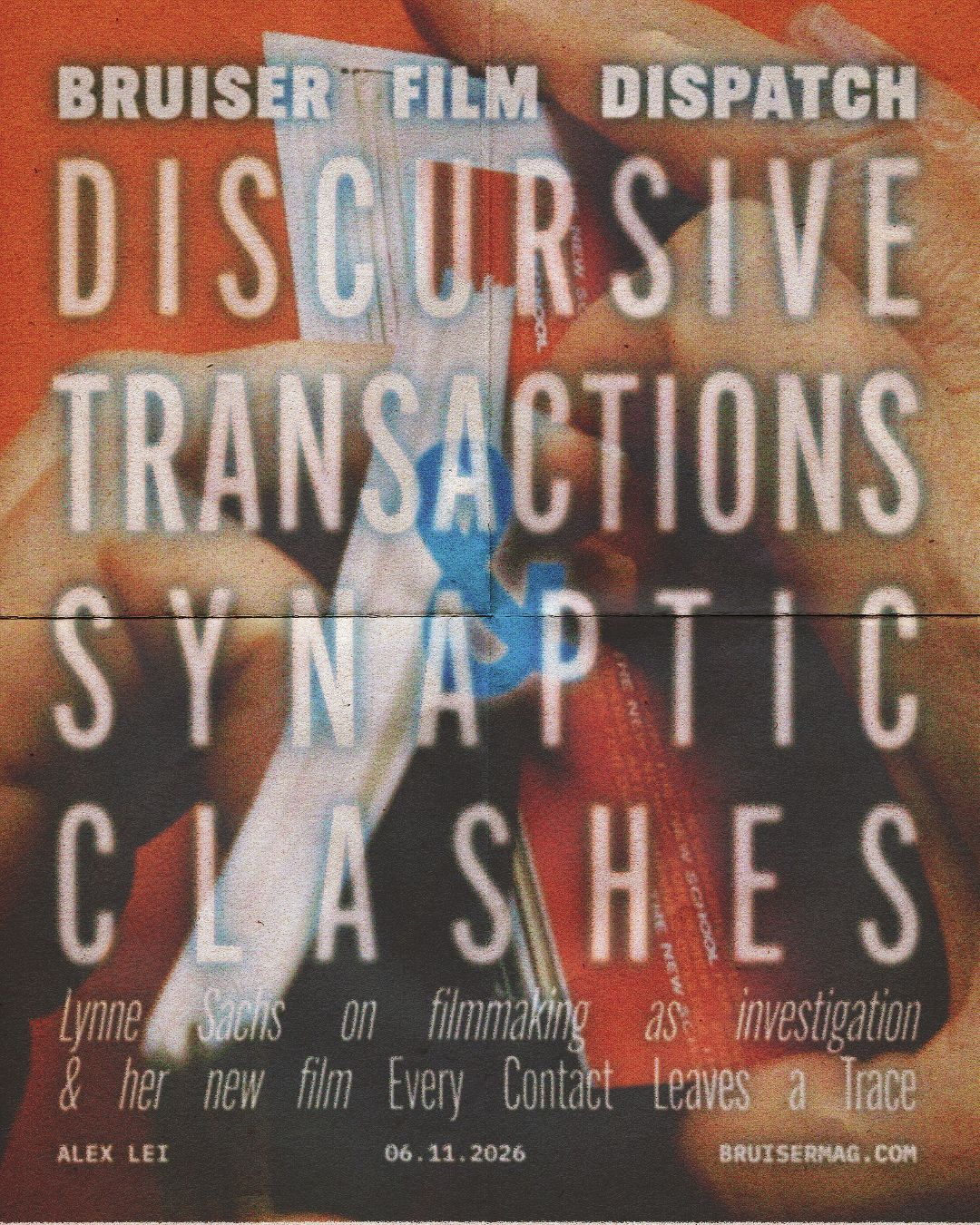
You certainly could. The poster [for Every Contact Leaves a Trace] has these two hands with a card, they’re in silhouette. That has a kind of trajectory, but the telephones touching is another thing entirely. It feels altogether virtual, not somatic. But the thing is, our phones these days contain everything practically who we are, so it’s very comprehensive.
AL
Let’s talk about where the film starts, with this forensic investigation. Forensics is such a precise, exacting process. Your process feels much more intuitive.
LS
First of all, it wasn’t hard to get that interview with the forensic scientists, they were so intrigued by the fact that I was out of the business of policing and investigation. Both of those scientists were a bit amused that I wanted them to wax poetic about their field. I did have a goal to see if there were still fingerprints on the cards, but if we didn’t discover that together, then we would talk about the practice of celebrating the haptic and the tactical. But for me, it was also a license to also knock on the door of a laboratory at the State University of New York and sashay my way in. It was an opportunity to think more deeply with people who would spark my contemplations.
AL
Do you often use your filmmaking that way, as a sort of means to get in these doors?
LS
Following an investigation that is a discursive one, that’s the key. Even if it’s a bit anomalous to see me in that space, I’ve always been intrigued by these synaptic clashes. The idea of two different worlds that shouldn’t mix that do mix.
AL
How often are you in your life finding these points of friction to make films about?
LS
Some films I make that are very introspective, and take me into a very familiar zone. Like making a film with a daughter of mine or my father. Then other films encourage a journey. It may be a journey to a faraway place, but I’m also keen on the journey being super close. When I made my film Your Day Is My Night, it was a moment in time where I needed to reclaim what home is. That home is also an urban space, and that there are pockets that may be completely unfamiliar and you need to reacquaint yourself with communities. With that film it was because so many people who live in New York only go to Chinatown to eat meals. After I made that film, quite a few people said to me, “You made me look up at the windows.”
AL
Lawrence Brose says something to that effect in Every Contact Leaves a Trace, “We’re in the gutter but we’re looking up at the stars.”
LS
Thank you for mentioning Lawrence Brose. Bringing him into the film was really a profound gift. It was one of the hardest and most vulnerable parts of making the film. He was one of the most open people I’ve ever met, but also perhaps the artist I’ve known who’s been most punished by society. He died from cancer [in 2025]. But the condition he lived for the last decade came very much from attitudes and biases that are deep within our culture, so I think his identification with — that’s a quote from Oscar Wilde that you mentioned — his awareness of being in the gutter but looking up at the stars. That’s another reason to make films, is you have a chance to talk to people who allow you to grow in these ways you might not have.
AL
In a certain way, too, it lets you hold onto them. Same with the business cards, it’s another piece of ephemera from this person.
LS
I’ve shown the film in the United States twice in the U.S. and in both audiences, at Ann Arbor [Film Festival] and in Maryland [Film Festival] with you, someone knew Lawrence Brose. Therefore, we got to hear his name and we got to talk about him as an artist, and that’s the only ephemeral gift we can give back to his spirit, is to talk about him.
AL
Was it a challenge reaching back out? How hard was it to try to reconnect with these people?
LS
You know, once I said I’m not just a detective, but I’m half-detective, half-human being, then the obstacles to the traditional “I’m trying to find this person who could be lost” became a much more artistic investigation. So, for example, the Syrian woman who I had met on a film set, and in some ways to me she connected to a geopolitical crisis, and I thought, “Oh, we’ll be able to talk about that. That’ll bring that part of the world closer to me.” And the fact that she built up a wall and switched the documentary paradigm around; she took control as subject. And I thought that is probably what we do with most people who’ve passed through our lives, a doctor we’ve had or a childhood friend, they become the accumulated gestalt of our existence, but we don’t have trajectories or vectors that can take us back to that.
During the making of this film, I discovered for the first time really Deleuze and Guattari, a book they wrote called A Thousand Plateaus. It’s a very dense book, but their idea of a “body without organs,” their concept of that, was such a revelation to me. This idea that we become an accumulation of all these energies or affects from people and that enters our being. Again, I was saying that making a film is a reason to knock on the door, but it is also a reason to do research. I’ll recommend a book that you might’ve read already, but it’s really on the other side of the spectrum of research. Have you read Suite For Barbara Loden?
AL
No!
LS
Oh my god. It’s so good. And it’s all about the earnest impulse to understand another human being and the failure to do so. Nathalie Léger, she wrote it, and I think you would love it.
AL
Yeah, I mean, I love Wanda, I love Barbara Loden’s work. She’s such a fascinating figure in the world of independent film. Even the way that she almost doesn’t exist. I think a lot about how she was originally in Frank Perry’s The Swimmer, but her scene got reshot and she was totally recast out of the movie. But there’s some images with Burt Lancaster sitting by the pool, and it haunts me in a certain way.
LS
That conceit that you just described sort of permeates the whole book. And it’s a beautiful book. It’s about a little bigger than my hand. The only reason I came across it was because after Barbara Hammer died, her partner Florrie [Burke] contacted me and a few other people and said, “Come over, I have a few things for you.” For me, she actually had some rings, and she gave me Barbara Hammer’s leather jacket and her motorcycle jacket because we were about the same size. I wear them and I love them. But she also had some books we could look through. Every book that Barbara had, at least that I saw there, had a sticker inside, like an Ex Libris type of sticker, it just said “Hammer.” But it was sort of like “From the library of…” I don’t know if your parents ever gave you any stickers like that for your childhood. So that book came from Barbara posthumously. I actually recommended it to people who didn’t know who Barbara Loden was and definitely hadn’t seen Wanda, and it doesn’t matter because it’s really about a kind of transposing of relationships to those we don’t know and want to understand. It also made me look back at my film, Film About a Father Who, because that film had so much access, but also so much resistance.
AL
I did want to bring up, too, that at Maryland Film Festival, I thought it was a great happenstance that Brydie O’Connor’s doc about Barbara Hammer [Barbara Forever] was playing.
LS
We got to meet for the first time, she and I. We had corresponded for maybe eight years, but we had never met in person.
AL
Also this year at Maryland Film Festival, you showed your old Catonsville film, Investigation of a Flame. How was it revisiting that?
LS
I just felt lucky to be coming back to Baltimore with that movie. And also to revisit how profound it was to meet with all of those people during that period of my life, people who had taken such incredible risks. We talk about risks like jumping off a cliff or athletic risks, but these were other risks of the body, of stature, of freedom. But all of that, they did because of their belief system, and it was very meaningful to me. It was a funny coincidence that it showed at the same time as NASA has been reinvigorated — that was a theme of my film, that in the late 60s the U.S. government was, in my mind, trying to distract us from the deaths of the Vietnamese and American soldiers, because Americans tend to care more about a few people dying who are Americans than the thousands of people that are dying.
Whatever the death was, they wanted people to look at the stars. Like you mentioned, they wanted people to look up from the gutter and back to the stars. I think it’s interesting that that was reinvigorated at the same time that we’re bombing Iran, and how culture works to wrap itself around political ideology.
At the first screening [at MdFF 2026] two of the people from the Catonsville 9 support group came. They’re in their late 80s and they spoke about that time, and they talked about making homemade napalm with the Catonsville 9. And the most surprising thing was that people from Catonsville who I spoke to. They told me that Catonsville is actually kind of a more lefty town then back when I lived there. I wondered if they’re teaching the story about the Catonsville 9 at their local high school. They would not have been in 2001.
AL
Tell me about when you lived in Catonsville.
LS
I loved Baltimore. My husband taught at UMBC, I taught at the Maryland Institute College of Art. Oh, do you know what 14Karat Cabaret was? It was a fantastic, very alternative performance space called 14Karat Cabaret run by a woman named Laure Dragoul — she’s a performance artist and sculptor in Baltimore. I know that’s a distraction from our conversation, but I just wanted to Laure. She’s a very special person in Baltimore.
But also, I was meeting all of these people who were my parents’ age or older, and spending so much time with them and learning from them about what it is to engage with society in a way that’s so committed to change. For example, Philip Berrigan lived in a very alternative community on the grounds of a cemetery in Baltimore, in West Baltimore, I think near Mount Street. Then I’d spend a lot of time at Viva House, which is a Catholic worker soup kitchen in Baltimore. I had all these reasons to learn about what we now called mutual aid communities in your city.
AL
Yeah I think Baltimore is such a great place for that, and these strange, alternative spaces.Do you know Skizz Cyzyk?
LS
Oh, totally! Yes.
AL
He ran a space in the 90s called The Mansion Theater.
LS
When I lived in Baltimore, Skizz was kind of the leader of anything movie underground in town. He was it. And he was also involved in the film festival. I admire him a lot. He also does some work with Slamdance, so I’ve seen him in Park City.
AL
His old space was a funeral home that converted into a punk house that was screening movies at.
LS
I even showed work there, I believe, before we moved to Baltimore. His reputation preceded him.

AL
A lot of this film concerns the perception of memory versus the reality of something, and you’re trying to square these intangible things with each other.
LS
I’m still learning about the film. It really is about the way that memory serves us and fails us, and that’s been a conceit for filmmakers for a long time. I think in a very primal way because film can ostensibly replace memory, but we know it doesn’t. But the suggestion of the film is that it allows you to go back in time. But I like that that is erroneous in most ways, that it’s a subjective return, as memory is. It’s one person’s perception, film is in an epistemological way. So, the fact that I could physically, potentially return to a human being that would be 20 years older, as I was, or 30 years older, and that we could revisit, at least in conversation, a moment in which our lives intersected. That was a potential opportunity to understand how my life had worked. That sounds selfish, but it was an impulse. And then as I was making the film, I saw that any failure had a reason for being a failure.
As you grow older, you learn that your first impressions of a person are probably wrong, but you go through a certain time in your life when you think I’ve matured enough to understand another person rather quickly. And those kinds of shadings of relationships have to do with growing older. And so I was trying to pursue that.
There’s a part of the film where I reveal that I had thought the woman who cuts my hair was from one part of Europe but actually she was from quite another part. That is an embarrassing revelation. Not one of any great consequence, but I like those kinds of moments in life in which a small incident becomes a distillation for a larger misconception or a larger assessment of a zeitgeist, or a claim to understanding is actually proven wrong. While I was making the film, quite a few people said, “I wouldn’t put that in the film. You should be kind of embarrassed that your geography is so bad.” And then I said, “Yeah, a lot of people have a bad sense of geography.” It’s particularly American to be that way. We have a “we’re at the center of the world” attitude, and why not talk about that?
AL
In a way cinema can act as a political tool to trowel through, or even try to right the wrongs of people’s memories. There’s a part early on, when it’s almost like the film that you’re exploring falls apart and you start questioning yourself over and over and over again. Your voiceover starts speaking over itself. There’s one line that you say: “I don’t swallow, I gulp.” Which I thought is a very interesting example of your process.
LS
A swallow is very considered, and a gulp is kind of an accident. That’s how it is to exist in any period of history. And sometimes, I don’t gulp at all. Sometimes I just ignore. It depends on what you’re capable of doing. I’m very interested in those kinds of decisions that are kind of accidental. I wrote this book called Year By Year Poems. In that book I try to think about things that happen in our domestic universe — that would be swallow, mostly — and then things that go on outside that, the periphery of your home or your contained consciousness. You might go outside and you gulp. And you didn’t mean to, but you did. And then it’s in you. And it makes you choke.
AL
Throughout the film you use these vector drawings to trace your relationship to people. Towards the end, they become more and more garbled, or even more experimental and don’t follow strict lines. It seems to me like that’s sort of a visual embodiment of your process as well.
LS
I actually like to draw what you might call storyboards before I do it. Not so much around acting, but around space. So I was using that impulse to draw energies between two people, going back to that idea of the body without organs, and to think about how another person’s energy enters my awareness and vice versa. So I was doing all these drawings, thinking they were just helping me understand my process, and then I think, “Oh! Actually, this is a bit of visualization.” Something similar happened when I was making my film The House of Science: A Museum of False Facts. I could not find the structure of that film at all. I did not know how to shape all of the scenes that I loved. And then I thought, oh my goodness, I’ve been keeping a journal the whole time I’ve been making this film. Maybe that journal will help me piece it together. And then it basically did. So, in this case, what was happening in parallel — which were those drawings — became a little bit of a template for understanding how my relationships were working with each of those people. So then I was working with an animator — she really is just a great artist named Rachel Rosheger — she created that animation that happens with my niece and nephews towards the end. I’d never really used animation like that, but we had a good time.
AL
Did you always think that this would turn into a feature? Or how did you shape it?
LS
It could turn into a book. I would actually like to write a book in the next year or two. Because there are a lot of people who didn’t make it into the film — probably five or six — and I think it could be an interesting experience. I like making books. I have a book that just came out with Punctum Books, which is a press I like. Actually, I was just in Baltimore with my press. Do you know about AWP?
AL
Yeah. Oh yeah.
LS
I’ve recently been in Baltimore a lot. I was just there for the AWP conference with a new book that is very much a visual book with text. It’s called Hand Book [A Manual on Performance, Process, and the Labor of Laundry]. So I think I want to make a book that will be a continuation of Every Contact Leaves a Trace. Different title, I think
I have at least four scenes that could be short films…I wish we called them “films,” and that we called features “long films.” There are probably three short films that I could possibly make. But I’ve been so involved in getting this film out that I haven’t returned to those scenes, but they’re already constructed. When I made Film About a Father Who, my mode of working, of creating that film, when I was so lost in the editing — which I always am, and then I tried to find it — I made 12 short films. And then I spent about a year moving those films around so that the transition from one short film to another could be evocative, I thought. In a way, Every Contact Leaves a Trace is also kind of like seven short films, except then I cut within them so that they build.
AL
Towards the end, you’re talking about how you just want to be done with the whole thing. You’re trying to close the book on troweling through these business cards — do you ever feel done with it?
LS
People are giving me their cards more often now. They feel an urgency to put their card into this collection. I hope the film kind of grows. I won’t change it per se, but I hope it grows with the times. The section that you referred to around the Holocaust and Gaza, for example, is a kind of open indication of how my mind was working at the time. The more people told me not to put that in, the more I insisted that I had to put it in. It’s always interesting to see the points that are the most vulnerable. I’m wondering if I look at this film five years from now, what will have happened in that part of the world? May I pray and hope that things are better. I just don’t know, I can’t know.
AL
In Every Contact you’re trying to have hindsight about your life, but you can only do that through where you are right now and what you’re thinking about when you’re making the film.
LS
That’s kind of what I was trying to explore, my so-called positionality at this point in my life. And I always hope that an essay film like this leaves people with kind of a doorway to do the same thing for themselves.