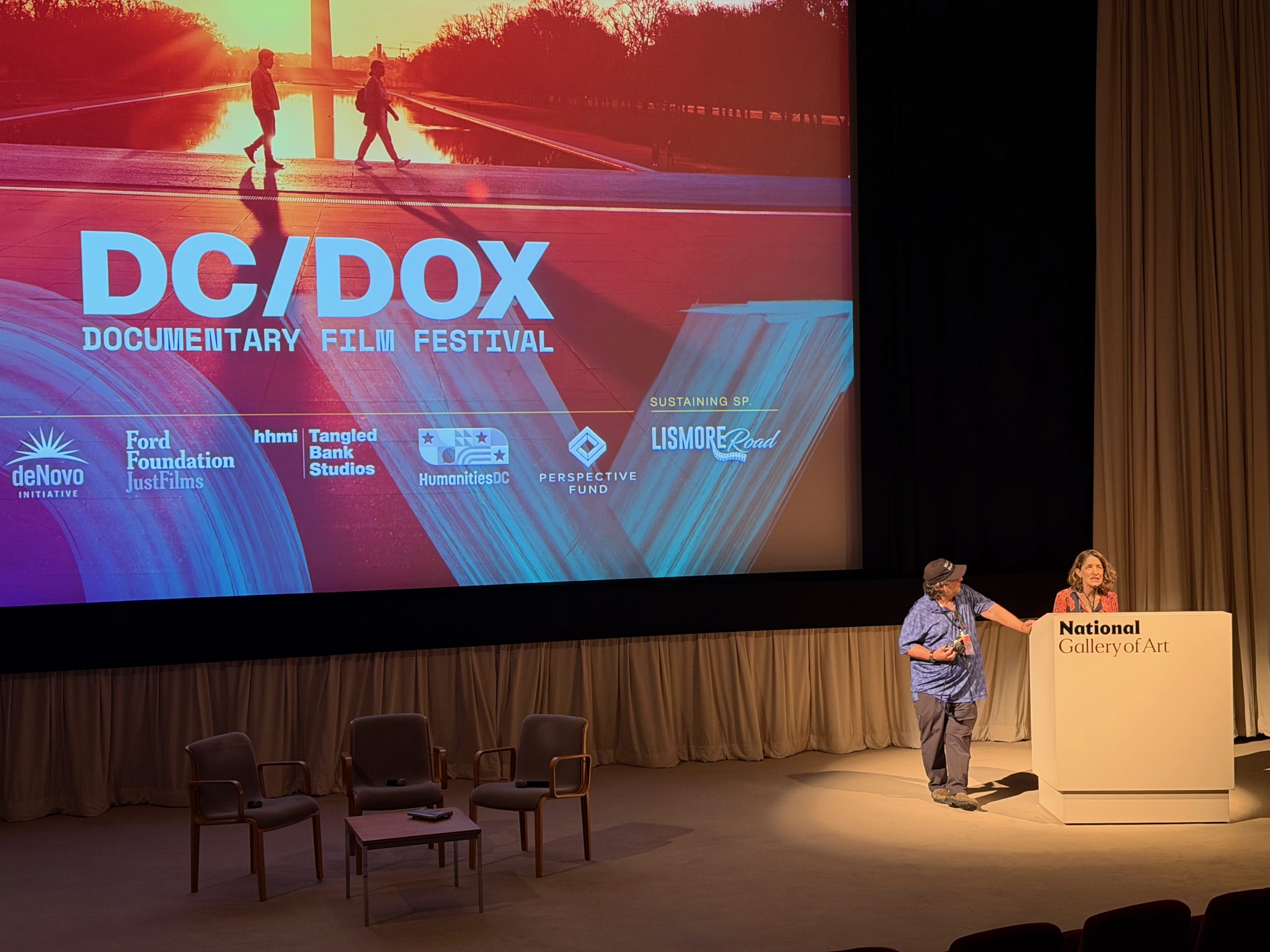
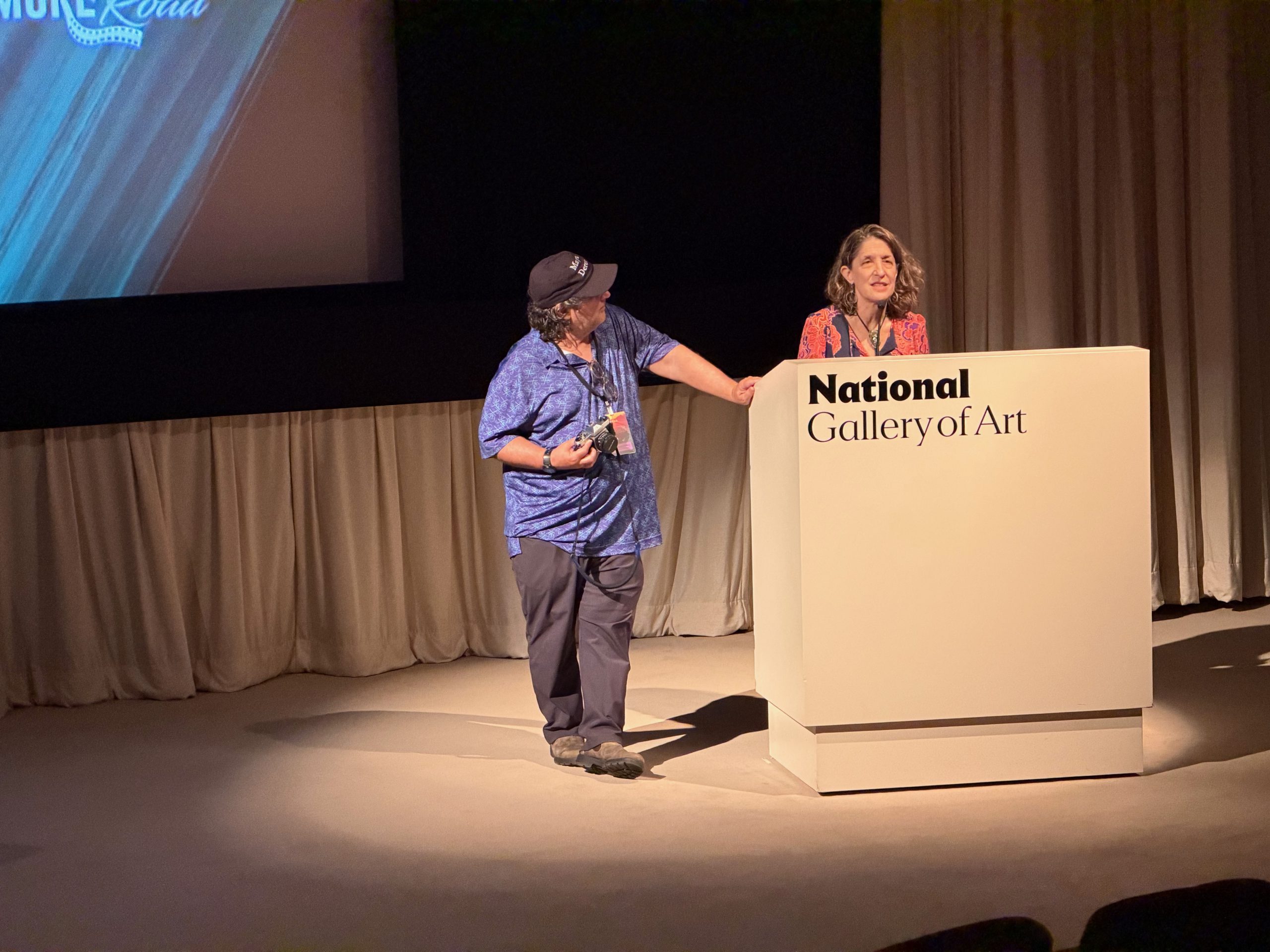
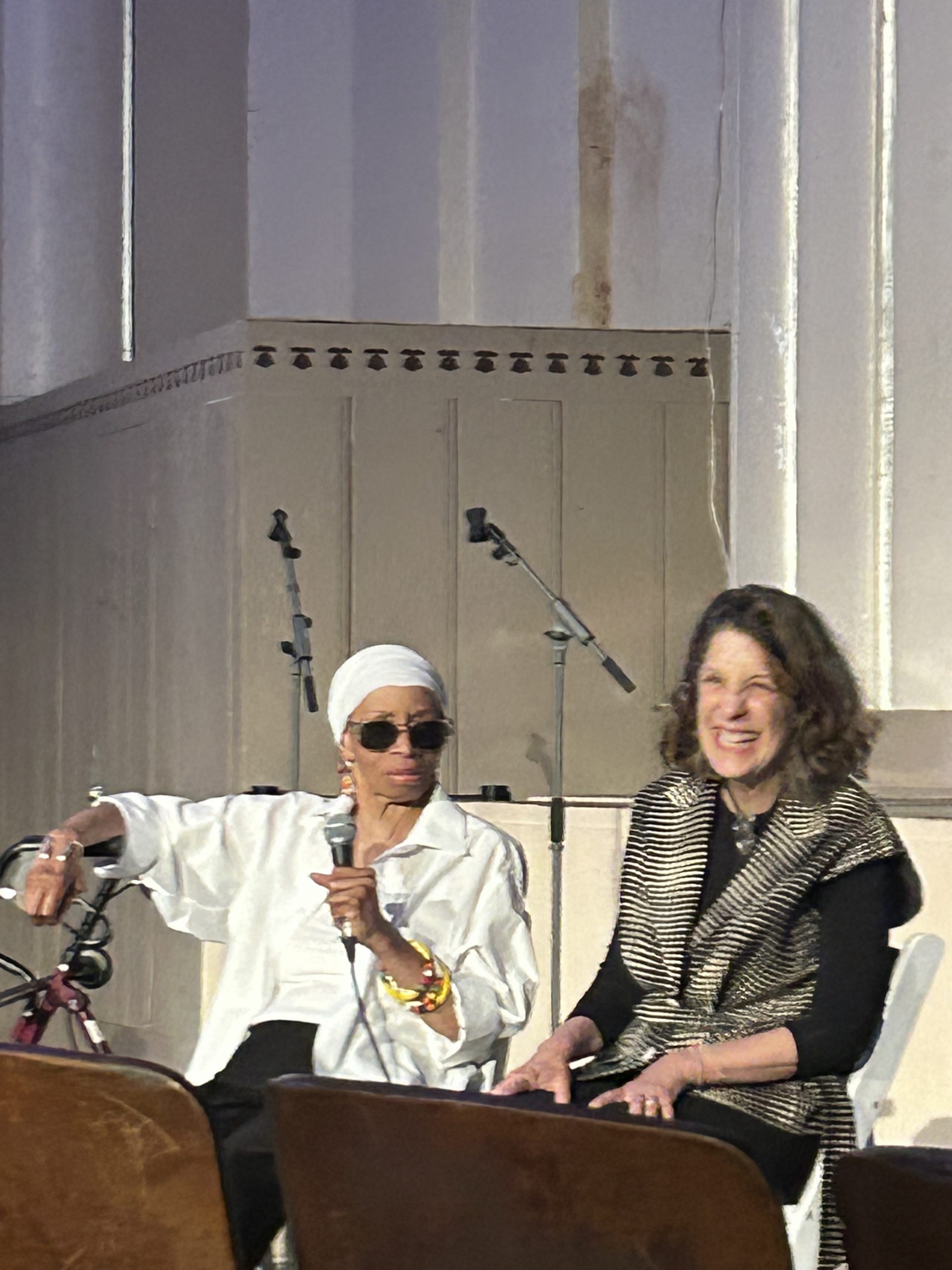
Join us for a post-screening discussion with filmmakers Lynne Sachs and Mark Street along with “Every Contact Leaves a Trace” Sound Artist Stephen Vitiello , in person.
Contact—tactile, evocative of one person touching another, physically and emotionally. Trace—a reckoning with the residue of that initial encounter, filtered by time and the imperfection of memory. Filmmaker Lynne Sachs has lived most of her life before laptops reshaped how people connect, and she has saved every business card she has ever been given.
Each card is a portal to her past, a reminder of how someone she met in person shifted her consciousness and left a trace of their presence: a German woman grappling with her country’s history; a therapist who erased all records of her own life; an artist confronting government censorship. Sachs selects seven cards from hundreds and sets out to uncover how and why they have endured. When possible, she follows these traces, seeking out reunions.
Revisiting fleeting encounters in kitchens, parks, offices, and festivals, she carries her cards to a forensic scientist’s lab to examine their DNA traces. Blending the real and the imagined, her essay film teases apart nearly forgotten resonances, intertwining personal memory with broader geopolitical histories.
Preceded by the North American premiere of Grazing on Images. Filmed on 35mm analog still film and Super 8, Grazing on Images is a diaristic work that travels from Dublin to Los Angeles, Oklahoma City, and Beloit, Wisconsin, before returning to the filmmaker’s home base in Brooklyn to reflect on a life shaped by rhapsodic, everyday images. (Mark Street, 2025, DCP, 17 minutes)
This program is presented in partnership with the DC/DOX 2026 film festival.
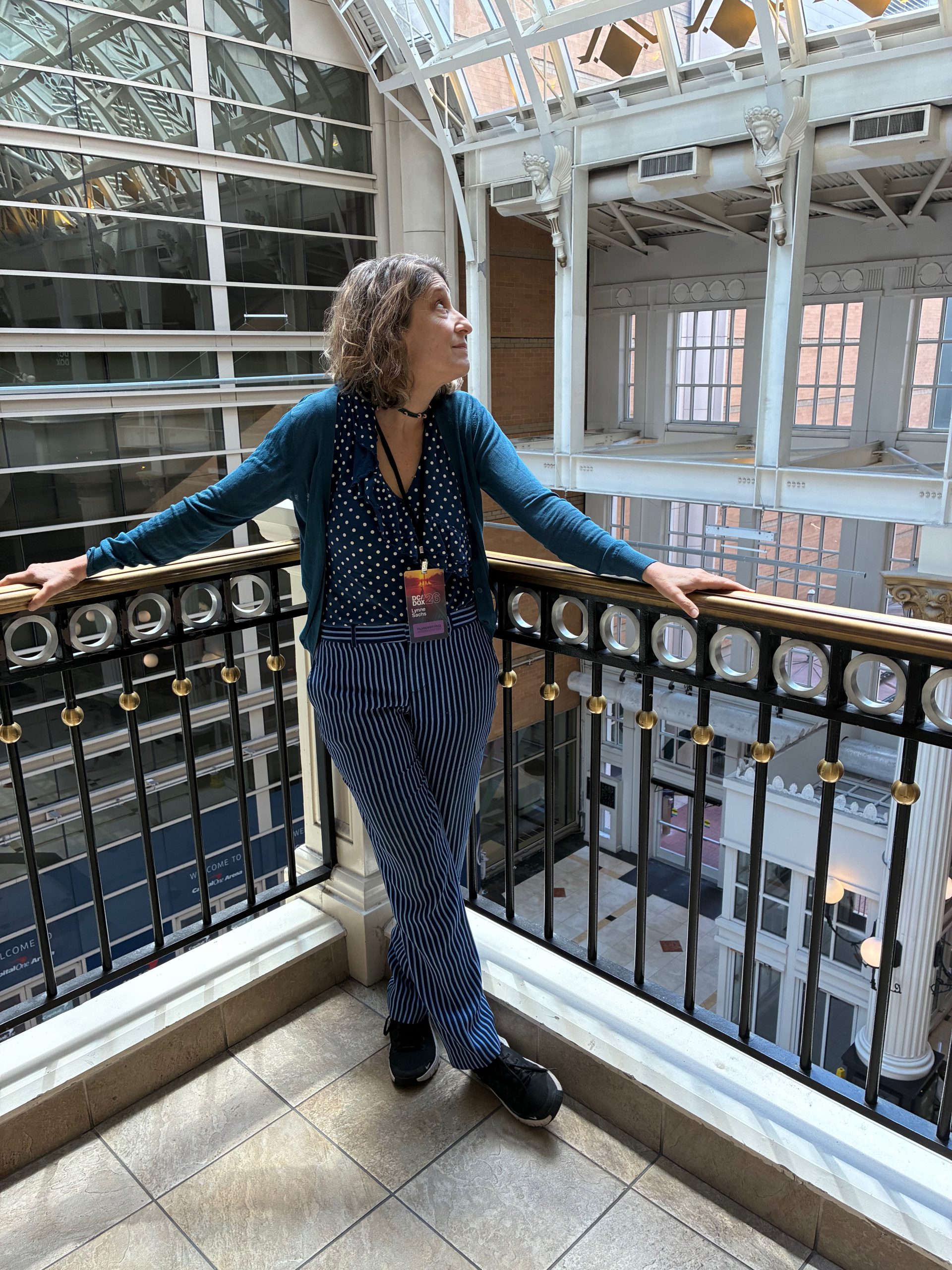
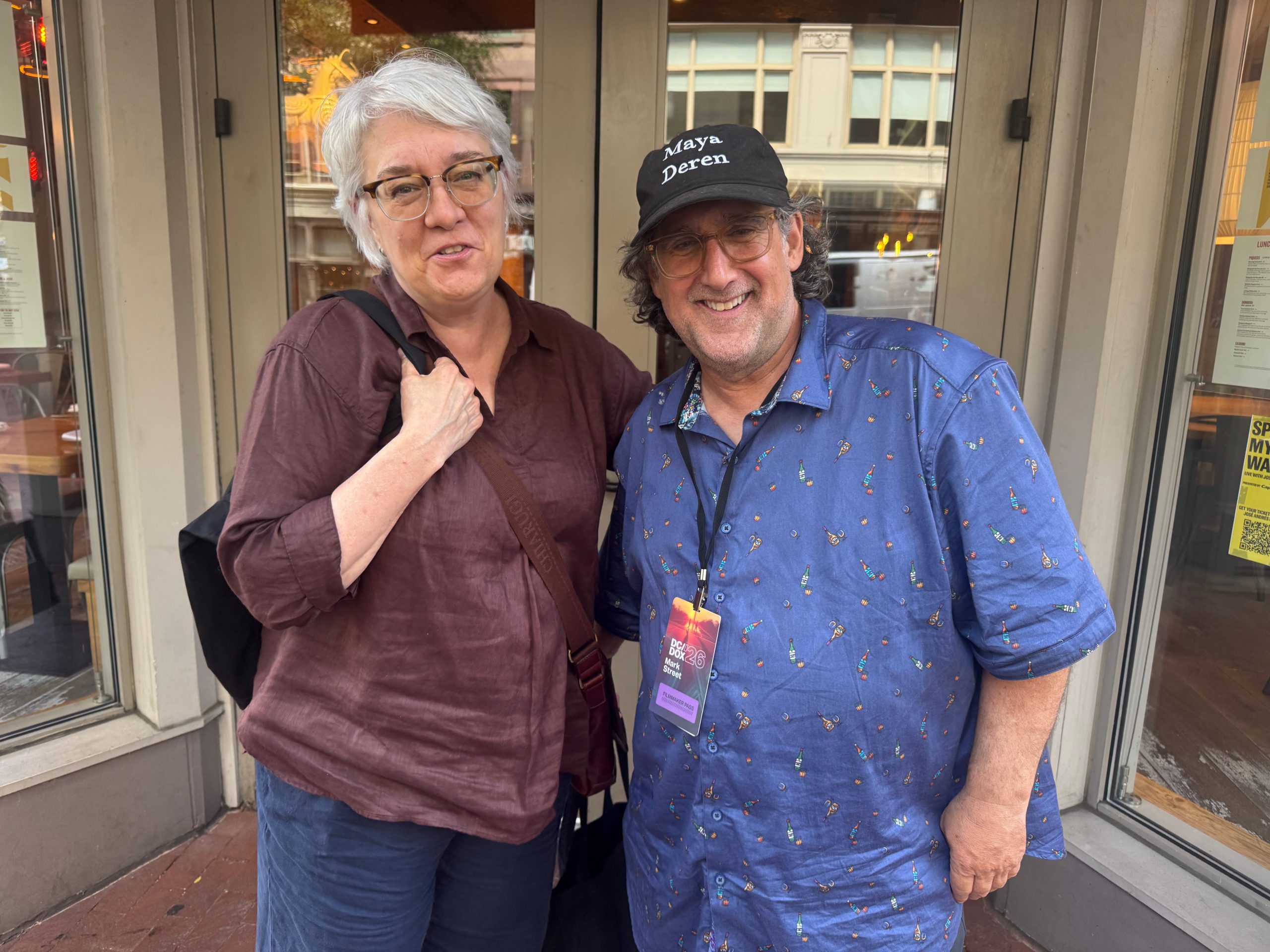
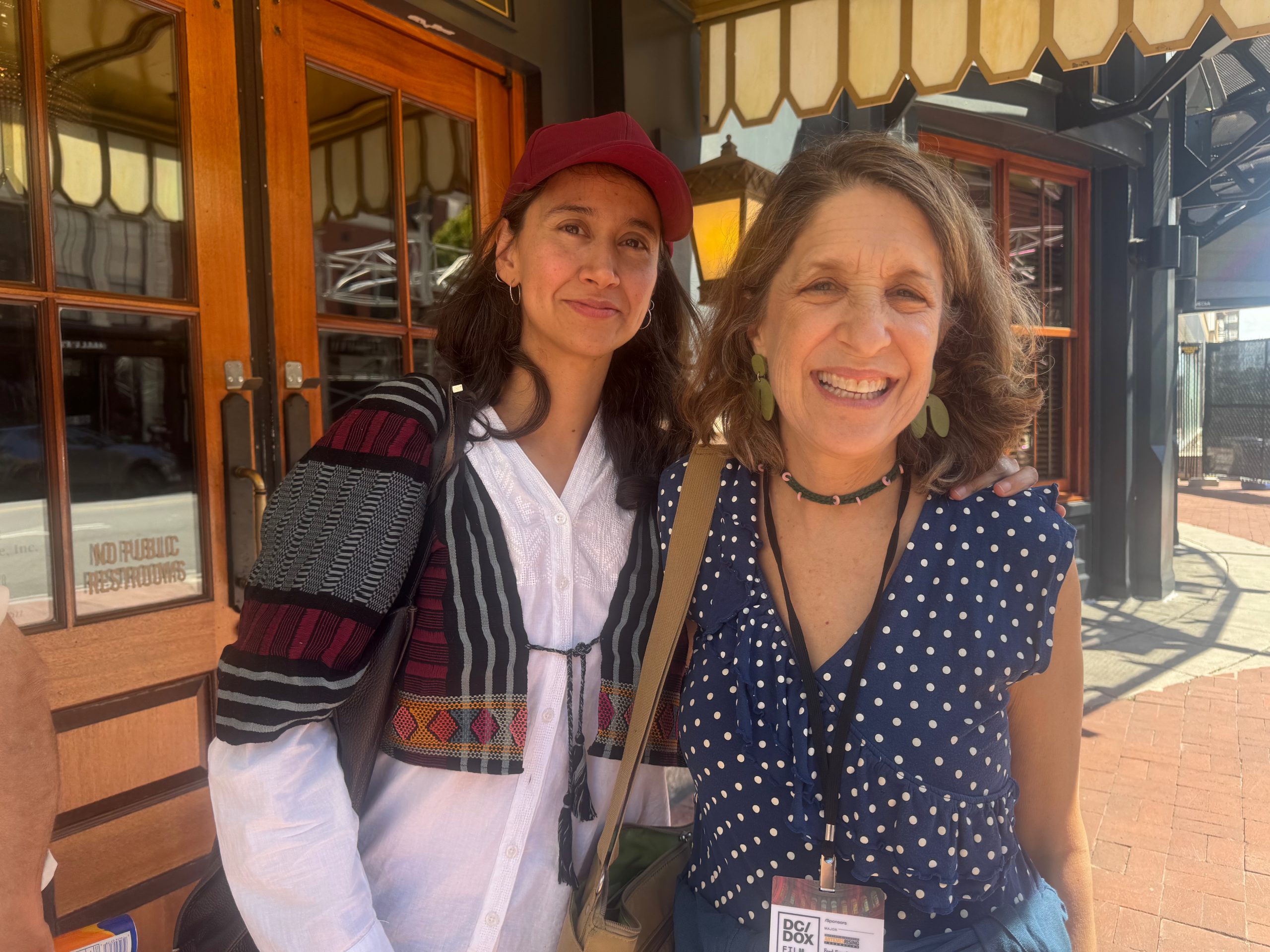
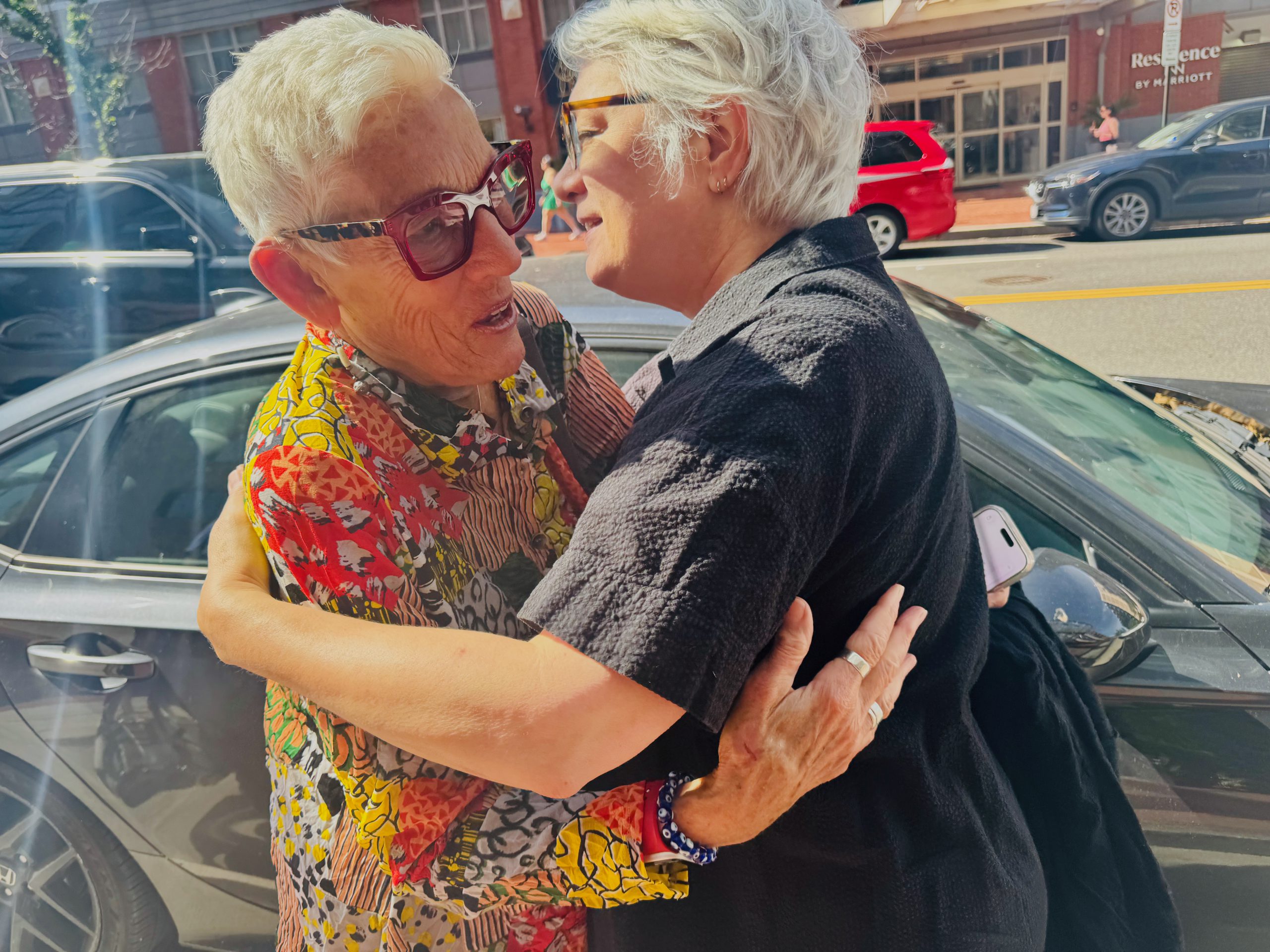
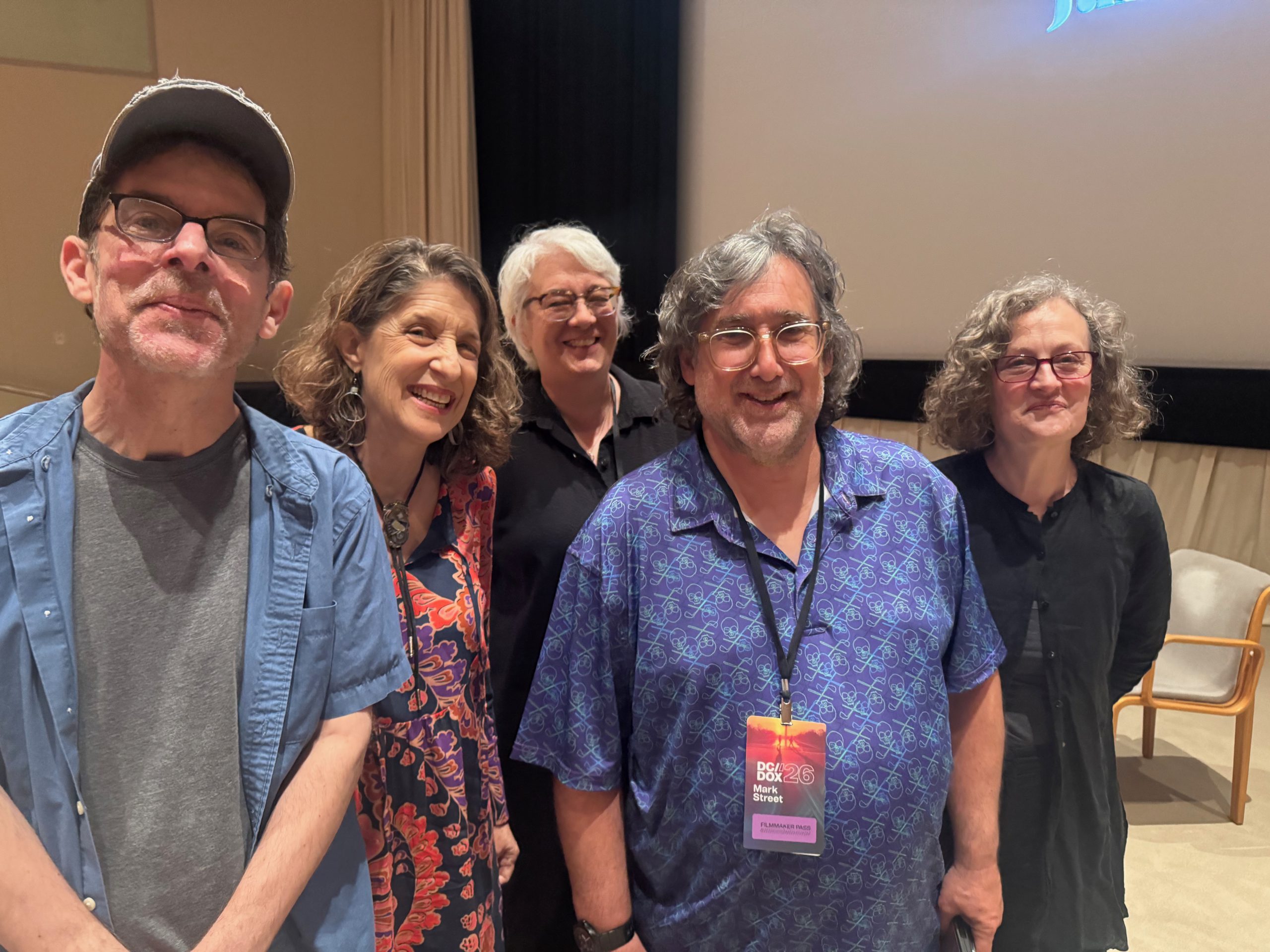
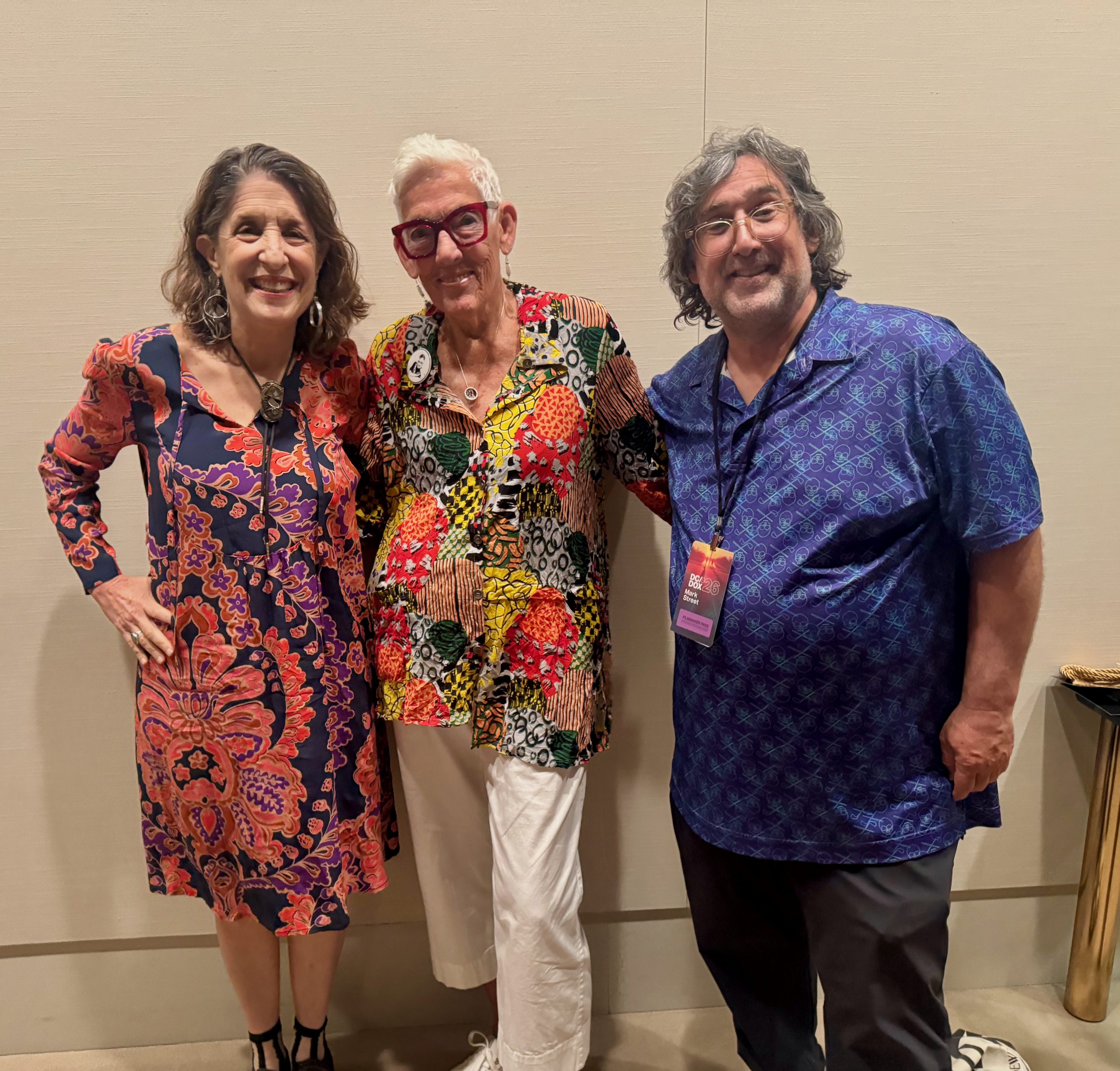
Joanna Raczynska, Film Curator NGA and Mark StreetOtilia Portillo Padua, Director Daughters of the Forest and LynneFlorrie Burke and JoannaStephen Vitiello, Lynne, Joanna, Mark, Tracy
Brooklyn documentary filmmaker Lynne Sachs is the recipient of the POV Award at the San Francisco Film Festival on April 29. The festival will be screening her latest film, “Every Contact Leaves a Trace.” Go here for more information. On May 3 the film will also be shown at NYC’s Anthology Film Archives.
Sachs has a collection of 600 business cards and decides to choose seven of them and attempt to reconnect with the persons who gave them to her. (Her ramblings while searching for candidates–”Oh, she won’t talk to me!”–is one of the most amusing parts of the film.) She says the premise is a foundation of forensic science invented by Edmond Locard, a forensic pioneer: any trace can link a person to a place, another person or an object. She even has a scientist analyze the cards for fingerprints and DNA. (This doesn’t reveal much.)
In her director’s statement, Sachs reports that “Chance meetings become distinct and revealing punctums, each physical interaction an encounter that pricks.” Punctum was a concept Roland Barthes created for his 1980 book on photography “Camera Lucida.” He distinguished between the “studium” of a photo (the obvious symbolic content of the photo) and its “punctum” (something, perhaps incidental, that “pierces” the viewer in a person way). In her usual technique of hybrid filmmaking, she comes up with a different way to model her interactions with the seven contacts.
One of the most unsettling contacts for her is Lawrence Brose, an experimental film artist whose films explored his gay sexuality, especially his feature-length film “De Profundis,” a hand-etched film inspired by Oscar Wilde’s 1887 letter to his lover from prison. Brose reveals to Sachs that he was charged with having child pornography and she wonders if she should cut him from the film only to learn later that he was innocent: a member of his art collective had downloaded the material and yet he was charged and his lawyer advised him to take a plea deal rather than to go to court.
Sachs met two of the contacts via her presence at various international film festivals over the years. Angela Haardt is a German avant-garde film artist who was born in 1940 and recalls her memories of Nazi Germany, including the continued popularity of 19th century German poet Heinrich Heine, whose work was banned by the Nazis. This prompts Lynne, who is Jewish, to think about the genocide in Gaza. Jiang Juan, a champion of films by women in China, lives with the director for awhile; Sachs uses striking split screen footage of her to illustrate her perception of her in the past and the present.
Betty Leacraft is a textile artist who lives in Philadelphia. She gently tutors the filmmaker in needlepoint, demonstrating her own method of tying off thread. Actress Rae C. Wright is employed to play a former therapist of Sachs whose advice surprised her. Lynne interviews her niece and nephew (children of her brother, filmmaker Ira Sachs) about her project. They offer her whimsical takes from a younger generation.
Sachs created a way to diagram her interaction with her contacts with white markings on a black background. (It looks a bit like football play diagrams.) One wonders how the film would differ had she chosen other business cards, which makes “Every Contact Leaves a Trace” what Barthes called a “writerly” text, one that forces the viewer to engage actively with the work. You may even want to go to your own collection of business cards and create your own series of experiments. Featuring a great soundtrack by Stephen Vitiello and lovely animation, Lynne Sachs’ latest film is another wonderful addition to her long body of perceptive, funny and warm feminist-informed explorations of creativity, memory, seriality and politics.
Go here to listen to Adam Schartoff’s interview with Sachs about this film.
Lynne Sachs’s new film Every Contact Leaves a Trace (2025) begins from a pun on Locard’s Exchange Principle: the forensic axiom that each encounter between people or objects deposits a material residue. Sachs turns the principle inward, toward the sedimented matter of a life lived among others: some 600 business cards accumulated over four decades, a paper archive indexing the chance encounters and professional exchanges of an illustrious career. The film appropriately screens on the occasion of Sachs’s Persistence of Vision Award from SFFILM, which recognizes her career in experimental documentary filmmaking.
As Sachs sifts through the stacks, narrating associations or confronting blank spots in her recollection, the cards’ standardized form gives way to the unruliness of relation. Sachs layers a restless flow of images, animations, and superimpositions over a diaristic voiceover, while frequent collaborator Stephen Vitiello’s omnipresent score hums beneath. She stages new encounters with select figures represented in her collection: a textile artist, a therapist, a refugee and mother who once cooked for her. Conversations always seem to turn toward days gone by, though the governing insight is less about recovering evidence of what “really” happened than observing how the past is continually remediated through its recounting and the subtle gravity people exert upon one another’s lives across space and time. At intervals, Sachs extends the interpersonal scale of her inquiry into a more expansive awareness.
While speaking to the woman who cuts her hair or searching for someone to make her maqluba, she holds Ukraine and Gaza on her mind. As she thinks of previous mistakes, of her ambivalent German-Jewish heritage, or her complicity in historical and current violence while living within the imperial core, her on-screen interlocutors serve as mirrors into her own wandering mind, a gesture toward entanglement reminiscent of Chris Marker’s reflexive Sans Soleil (1983). The “trace,” the film suggests, marks both the fact of contact and the asymmetries that shape it. At the same time, these traces may falter in their own ways, as they fail to hold the fullness of what passes between people. What constitutes intimacy? What does it mean to know someone? Closeness doesn’t necessarily produce understanding or solidarity. It can generate hostility or leave damage. With Sachs, we learn that to be in relation is to come to terms with one’s capacity to do harm and to accept that we might leave imprints that elude our awareness entirely. If Sachs begins from the business cards as her archive of traces, then, by the end she relinquishes the thinness of their description to the irreducible complexity of the people and relationships they represent.
Every Contact Leaves a Tracescreens Saturday, May 9, presented by Other Cinema at Artists’s Television Access, with Lynne Sachs in person.
Previously:
Every Contact Leaves a Trace screens Wednesday, April 29, at BAMPFA, with Lynne Sachs in person to receive SFFILM’s Persistence of Vision award.
EVERY CONTACT LEAVES A TRACE is a thought provoking overview of our digital era. We mostly live in a time and place where real life connections become rarer, yet any personal encounter can leave a lingering trace. Over a lifetime, filmmaker Lynne Sachs has collected business cards, mementos of these initial meetings with strangers. Sachs selects seven cards from hundreds and throws herself into finding out how and why these brief yet vivid moments left an imprint on her consciousness. When she is able, she embraces clues and seeks out reunions. But when there is no trace, she gambles with imaginary histories and futures. A lifetime of tactile, face-to-face encounters reminds her of identities passed from hand to hand. Director Lynne Sachs joins us to talk about her imaginative hybrid film, that draws inspiration from a basic principle of forensic science, coined by Edmond Locard, a pioneer in the field that any trace can link a person to a place, another person or an object.
Lightbox Film Center is Philadelphia’s premier exhibitor of film and moving image art. Beyond the traditional movie theater experience, Lightbox presents an unparalleled slate of repertory, nonfiction, experimental and international cinema that would otherwise not be screened theatrically in Philadelphia. We are dedicated to preserving and exhibiting films that are historically relevant along with contemporary films that have yet to become widely available. Building a community around a shared reverence for cinema, Lightbox celebrates the projected image as a framework for diverse ideas and perspectives. Our programs inspire discourse, invite exploration and challenge the status quo.
Followed by a conversation with director Lynne Sachs and Philadelphia artist Betty Leacraft
The latest project by filmmaker Lynne Sachs (Drift and Bough,The Washing Society,Film About a Father Who) opens with a quote from the French-born father of 20th-century forensic science, Dr. Edmond Locard: “Every contact leaves a trace.”
The basis for “Locard’s Exchange Principle,” it also doubles as the title of Sachs’ documentary, a deeply personal cine-essay.
With more time behind her than in front of her, a meditative Sachs uncovered a box of 600 business cards dating back to 1990 and the fall of the Berlin Wall. As a young woman and burgeoning filmmaker, Sachs met Angela Haardt, a Berlin resident, a founding member of the International Forum of the Film Avant-Garde, and the director of a shorts festival (1990-1997) where Sachs placed an early short film of hers. Her new film combines archival footage, reminiscences about post-war Germany, and its place in the Jewish-American imagination (more positive than negative for Sachs, the opposite understandably so for her mother)
Decades later, Haardt welcomes Sachs both as an equal and a long-lost friend. Looking back at their initial meeting, the intervening time, and the present, Haardt grapples with German history, identity, and culture, specifically how, when, and where Germans commemorate the Holocaust or deliberately forget it. It’s a tragedy that Sachs connects to her own conflicted, contradictory feelings about Israel, Gaza, and Israel’s initially defensive response to the October 7, 2023, Hamas attack on Israel, including the reoccupation of Gaza and the disproportionate effect on the Palestinian population.
Before Every Contact Leaves a Trace ventures too far into Israel, Gaza, or the commingled future of its peoples and the region itself, however, Sachs deliberately pulls back, returning to the original focus of her project, tracking down a select handful from the business cards she acquired over the years. Few are as compelling as Haardt, but they’re still fascinating on their own, sometimes less because of who they are or what they’ve contributed to film and the film community than their relationship to Sachs and the latter’s attempts, sometimes successful, sometimes not, to reignite long-dormant friendships or relationships.
Among Every Contact Leaves a Trace’s subjects, Sachs’ most intriguing interviewees include the late Lawrence Brose (DeProfundis), a pioneering queer filmmaker who found himself hounded by Homeland Security and ICE for the alleged possession of child pornography. Out of a combination of fear and prudence, Brose pled guilty to a lesser offense (obscenity), in exchange for two years of probation. During that period, Brose couldn’t own or access anything related to the LGBTQ community or risk his probation turning into imprisonment.
Brose’s persecution and subsequent plea deal could — and probably should — have been a documentary in its own right, but in Sachs’ cine-essay, it offers her another opportunity for self-examination, both as an individual and as a filmmaker bound by ethics. Given the seriousness of the accusations against Brose, she considered excising his segment altogether. It’s to her credit that she didn’t.
Even in a truncated form, Brose and his story needed to be heard and seen. Sachs’ ethical conundrum also serves as an opening for much-needed discussion and rumination on the other side of the screen.
Sachs’ other subjects include Juan Jiang, the director of the now-defunct Chinese Women’s Festival; textile artist Betty Leacraft, Sachs’ one-time student turned teacher; Felix and Viva Torres, Sachs’ nephew and niece, respectively (the children of Sachs’ filmmaker brother, Ira); and, in a meta-fictional twist, Rae C. Wright, a performer who serves as a stand-in for Sachs’ therapist. While Leacraft proves slightly prickly under Sachs’ performance-driven direction, Felix and Viva emerge as a charming duo, offering the occasional insight along with warmth of spirit and generosity toward their idiosyncratic aunt.
For some, Every Contact Leaves a Trace will seem overly personal and thus, too slight or of marginal interest. For those willing to look — and just as importantly, listen — Every Contact Leaves a Trace will, like the title of Sachs’ documentary, leave an indelible mark, asking important, open-ended questions about life, art, and mortality. Few have answers, but as Sachs suggests more than once, they’re all the more worth asking.
Every Contact Leaves a Trace premiered at the 2025 IDFA (International Documentary Film Festival) in Amsterdam. It played most recently at the 2026 San Francisco International Film Festival.
Prismatic Ground is a film festival I have been attending in-person for nearly three years, and while my streak of such attendance unfortunately ended this year, I have continued to watch and cover since its inaugural edition in 2021. Prismatic Ground remains so special because it maintains the tenets of its conception, which founder and director Inney Prakash explained as an attempt to fill the void of festivals dedicated to experimental cinema and a festival that doesn’t treat the COVID pandemic’s shift to online-accessible film-viewing as merely a “stopgap,” but an actual “effort to rethink the experience” of a festival.
The radical shift and change to the festival circuit for both cinema viewers and filmmakers—which includes actually paying the filmmakers for their work to be presented and removing geo-blocking so as many people as possible who can’t attend in-person screenings can still see some films online from anywhere—ties nicely to this year’s closing film, Isiah Medina’s Gangsterism. Always a self-assured and divisive artist, especially post-Inventing the Future, Medina, in his latest, is both his most combative and self-reflexive. Gangsterism is combative for how it seems to deconstruct the criticisms leveled at Medina’s previous films, such as their supposed obtuseness or the heavily academic framework for theorizing things like theft of art and liberation of technology that seems removed from material reality. Its self-reflection emerges from a major topic of discussion: that the central character, Clem, considers it insulting that potential financiers find his movies difficult to understand. Medina’s style is as distinct as ever. The patterns of repetition, sound, and image interrupting each other are contrasted through drawn-out sequences of characters forming arguments on the current economy of cinema, the financing of being a filmmaker, the social responsibilities and roles of academia, and, central to its plot, the proliferation of film via digital piracy.
The festival gives out only one prize per year: the Ground Glass prize, a career-achievement award. In its inaugural year, it went to Brooklyn-based artist Lynne Sachs, and this year it went to Japanese experimental artist Kohei Ando. Sachs also has a film this year, Every Contact Leaves a Trace, which pairs well with Ando’s work. Sachs’ film is a self-insert documentary where the filmmaker looks back to remember and re-encounter people with whom she shared and kept business cards. These encounters vary from friendly to awkward to uncomfortable, both in the memories they bring back and the inherent ideas that shoving a camera into someone’s face might elicit. Considerations of “performance,” “simulation,” and “vulnerability” seep into the forefront through the lens. Sachs considers aloud, while shuffling through the business cards, which of these people would be welcoming to meeting her again. A German festival director named Angela, whom Sachs met 30 years ago, recounts post-war Germany and the history of the Holocaust in people’s collective memory as another genocide in Gaza is unfolding today. Experimental filmmaker Lawrence Brose speaks about the persecution he faced as a gay artist while scenes from his film play in montage over conversation.
Like Sachs’ film, Kohei Ando’s cinema is very much tussling with ideas of time, memory, and connection to people. The most direct work that mirrors Sachs is the fun short My Friends in My Address Book, which goes through a montage of Ando’s friends smiling for the camera and holding up pieces of paper with their names. Other shorts, like his Passing Train series, exhibit time as something continuous and through multiple angles—intimate and unrelenting rather than something that creates distance. There is a sense of sentimentality that warmly lingers throughout these movies—especially On the Far Side of Twilight, which uses a saccharine piano score and cute narration that highlights his memories from childhood to old age. The image composition is immaculate, distinct in its bright coloration, and imaginative for how it breaks the fourth wall of the film plane, burning it, cutting it out, and transforming it into various shapes while moving it at different speeds.
It’s worth highlighting a number of shorts that bring forth examination and consideration for where experimental cinema is today. Rajee Samarasinghe’s A Flower Falling Back Into the Earth comprises excerpts and outtakes from the filmmaker’s remarkable feature documentary Your Touch Makes Others Invisible on missing children in Sri Lanka. The recontextualization of these outtakes from interviews—many of which feature the imperfections of sound, framing, and focus—confront us with how the difficult and traumatic experiences of real people cannot be decontextualized from the filmmaking process. Eislow Johnson’s Injured? is the most “action-packed” and funny of the shorts—a rapid-fire montage of a drive on a highway focusing on the litany of billboards for law firms for car accidents. It is ironic in its clear connection between America’s obsession with cars and suing people, but also fashioned as a sort of intense action film, mimicking the volume and ferocity of one of cinema’s great entertainments: the high-speed chase.
Yusuf Demiror’s Archura Leaves the City Forever is a beautiful, hypnotic fable. Its warm lighting and cold urban exteriors, mixed with fantastical costumes and lush natural highlights, make for a transportive work reminiscent of a mix between Jim Jarmusch’s Permanent Vacation and Nobuhiko Obayashi’s Emotion. Michael Barwise’s That Sanity Be Kept is a melancholy and nostalgic film, but also terrifyingly contemporary in its depiction of surveillance and the destruction of privacy as government agencies track the movements, faces, and clothing of various young people during a ceasefire amidst The Troubles.
Finally, three phenomenal and rare treasures by Iraqi filmmaker Parine Jaddo––Atash, Aisha, and Teyh––all highlight the artist’s conflicts (or false conflicts) of sexuality with religion, and modern discourses of fiction and the roles of men and women in Iraqi society in a rapidly westernizing world. All this occurs amid constant reminders of bombs and how post-war existence for the Middle East is always a pre-war state.
Trying to capture reality in my work means dealing with other people’s lives. Sometimes I yearn for something else, less interpersonal. I have a dear friend who’s been making films almost as long as I have. A few weeks ago, I started to vent (or dare I say hyperventilate?) with him about all the complex relationships that have emerged from my particular filmmaking practice. He said he understood completely, and that he’d decided to now only make archival films, no living people involved. The emotional toll was just too much.
Perhaps it would be better to bring people into my films through a more contractual or transparent arrangement where everything was laid out clearly. Then the people in front of my camera would have clear-cut roles. They could anticipate what I would be saying and how they were going to respond. This way, there might be fewer regrets, less instances of someone saying something they wished they hadn’t.
About 10 years ago, I started to ask people to sign film releases that would ostensibly clarify all of the potential problems that might arise. I try to convince myself that I am doing my professional best to acknowledge the rights of the person who signed on the proverbial dotted line, and theoretically, such documents also protect me. Unfortunately, their existence does nothing to relieve my anxiety, as asking people to “perform their lives” in front of my camera necessitates creating a fraught, sometimes unresolved arrangement that I find deeply intimidating.
Facing these haunting dynamics was fundamental to my impulse to make my latest feature, Every Contact Leaves a Trace, an essay film that examines the nature of all sorts of fleeting relationships I’ve had over the course of life. For the past 40 years, I’ve collected business cards given to me by strangers. Now in this digital era, these names, numbers and addresses, stored in a box in my house, have taken on an uncanny resonance. The first step in this 10-year filmmaking journey involved choosing seven cards out of the hundreds. I needed to find out why meeting the people who gave them to me had left such an imprint on my consciousness.
Before I committed to using this cache of cards, I grappled with their legacy as material objects. I learned that the standard size for a business card is 3.5 inches by 2 inches; almost every card is the same, in this way. It’s the people “behind” the cards who are so distinct. I also learned as much as I could about the social provenance of the cards themselves. In Japan, for example, the manner by which a recipient (me!) treats the presenter’s card is indicative of how the recipient will treat the presenter. Actions such as folding the card, or placing the card in one’s back pocket are considered disrespectful. Perhaps how I “treated” the card could tell me something about my relationship to its original owner.
For me, the cards were simply a jumping off point for thinking about what French theorists Gilles Deleuze and Felix Guattari envisioned as “the body without organs,” a swirling storm of psychic energy that creates an affect that I could not ignore. What I wanted to explore was how these cards illuminated and obscured the essence of a human being – semiotically and interpersonally. I was deeply interested in working with the trajectories that transpired between us, both in our initial meetings and later, far later, as I restaged our interactions in my memory.
Each of the cards presented something challenging – an awkwardness or ambivalence that forced me to think more deeply about documentary subjects, participants, informants … or whatever term you might use to refer to the people in front of the camera. The messier the production of the film became, the more I learned about the process.
Here are a few of the people who “made the cut”:
A retired German film festival programmer. While I am filming with her, this woman – born in the early 1940s – recounts the war she experienced and somehow misunderstood as a child. In our recorded conversation, she remembers, “The Jewish girls one day weren’t there any longer. You didn’t see the action, but you saw the results. How is that possible?” Now more than three quarters of a century after the end of World War II, our conversation opens up my own thinking, as an American Jew, about the genocide in Gaza today. Reckoning with these issues in my own life as I make public my own criticisms of the Israeli government adds another layer to my professional interactions with German film organizations. I worry for almost a year about how my friend will feel about being in a film that makes clear my own politics.
A gay artist who faced censorship and persecution from Homeland Security during and after a specious and controversial conviction for having child pornography in his computer. I ask myself if I should reach out to someone I met more than 30 years ago who was involved in such a fraught situation. In making documentary films, does establishing a commitment to a subject necessarily announce our positionality? I wonder if I need to know the truth about what actually happened. I wonder if it matters. After an extensive period of indecision, my own internal confusion forces me to seek him out for a conversation and perhaps a filmmaking relationship. What happens is beyond what I could ever have imagined. We spend more than a year in constant conversation, developing an interwoven series of scenes that articulate his painful story. Through my work with my editor Emily Packer, we develop a story that parallels Oscar Wilde’s 1895 conviction for sodomy, his banishment to a work camp, and his early death. All of this comes through in my voiceover, uncomfortably and, I hope, with transparence.
A Syrian chef and mother I met on a documentary film set. I make a date to shoot with her, but she cancels just hours before our appointment. She tells me that there was an emergency and that she needed to go to Michigan right away. I am not interested in the truth, but rather the fact that she has taken control. Something tells me that she is not scared of me per se, but of what I would extract from her through the apparatus of the camera. Extraction has become the geological trope for something we all do in documentary films. Her refusal to engage with my camera forces me to think about the inherent power imbalance between a director and her subject. Ultimately, her only presence in the film comes through when I cook a traditional Syrian dinner and “think out loud,” through voice-over narration, about her absence. Her existence is only articulated in the minds of my audience, never before their eyes.
A former therapist whose advice changed my life. For two years, I look for her and fail. Luckily, my enthusiasm for hybrid cinematic inventions provides the opportunity to create a kind of speculative staging of what could have happened but never did. Once I realize that the search for my subject is not as intriguing to me as the staging of it in my imagination, I release myself to an extraordinarily generative interaction with a New York City actress who takes on the challenge of becoming my long-lost therapist. We spend a summer role-playing and filming our evolving discoveries of each other. I am working with an actress, and there is no need for her to reveal anything real about herself. Our interactions are closer to those of a narrative film. The social contract is clear.
In her book Suite for Barbara Loden, author Nathalie Léger wonders if she really wants to learn anything about Loden, the beloved and complicated actor-director of Wanda: “I find myself wavering between wanting to know nothing and wanting to know everything, writing only on condition that I know nothing, or writing only on condition that I omit nothing.” Reading these words from one of the most introspective and uncanny film writers I have ever encountered supports my desire to be released from the rigidity of the documentary paradigm. I take a fluid, hybrid approach to the making of my films and allow myself to confront the two extremes of my practice as an artist. I embrace the uncompromising strictures of the real and the unformed, ever-expanding space of the imagined.
Tomorrow night at BAM Rose Cinemas, Ka Ki Wong’s I Heard That They Are Not Going to See Each Other Anymore (2026) will initiate the first wave of programming for the sixth edition of Prismatic Ground. Following the romantic misadventures of two couples across Taipei, the film’s dreamy sequences are punctuated by a vivid orange pincushion flower, which one of the protagonists, Melih, receives from his object of affection, the alcoholic Yu-Ping. Melih owns a noodle shop frequented by the eccentric Tao, whose infatuation with Shin drives her to physical antagonism, including stalking him and sending gangs to beat him up in cartoonish fight sequences. We intermittently view the lovers through the POV of Melih’s flower, which becomes a metaphor for longing and memory as both he and Tao grapple with their doomed romances in yearning monologues interspersed with listless wanderings across the city and its surrounding ruins.
Wong’s film will be followed by Nicolás Pereda’s Cobre (2025), an enigmatic portrait of Lázaro, a worker at a copper mine in a remote region of Mexico who stumbles upon a dead body on his way to work one day. Already on bad terms with the mine’s management for seeking sick leave for a respiratory illness contested by the mine’s on-staff doctor, Lázaro is closest to his aunt, who supports his recovery while he struggles to maintain his health and innocence. Conducive to suggestions of intrigue and desire, Cobre explores the limits of trust in the relationship between viewer, filmmaker, and protagonist.
Prismatic Ground is a film festival curated by Inney Prakash that showcases experimental works in short and feature formats. Grounded in a postcolonial perspective, the festival provides a space for a diverse range of filmmakers to exhibit their work, which ranges from technically innovative structuralist works, to dramatic features, to historically resonant documentarian efforts. This year’s selection includes a focus on avant-garde works from Asia and celebrations of queer life from across the globe. As with past iterations of the festival, a common invocation across films of wildly differing approaches and subjects is the fight for Palestinian liberation from the American-backed occupation by Israel. Further highlights include a celebration of June Givanni’s Pan-African Cinema Archive in conjunction with the launch of Onyeka Igwe’s book on Givanni at Anthology Film Archives, which will be followed by an evening of poetry and film curated by Shiv Kotecha and Courtney Stephens. Anthology will also host the festival’s presentation of the Ground Glass Award, which recognizes outstanding contributions to the field of experimental media, to Kohei Ando alongside a screening of six of his films.
“A mandala for opening the மனசு (manasu meaning heart and mind in Tamil) to the frequency of love in revolt” is the subtitle to Karthik Pandian’s Surrendur (2026), a vertiginous montage of footage documenting the political upheavals of 2020 in Minnesota, including the toppling of a Christopher Columbus statue orchestrated by American Indian Movement activist Mike Forcia (Bad River Anishinaabe). Forcia serves as a guide through the film’s interwoven networks of people and actions related to the George Floyd Uprising, the Anishinaabe Seven Fires Prophecy, and the Dakota 38+2 Memorial Ride. A recurring formal motif in Surrendur is a circle centered in the square of the frame, embodying the awakening to the colonial violence of American life experienced by so many in that period, including Ta Pe’juta Wičháȟpi Win (Hunkpati Dakota Oyate), whose political consciousness was sparked as she danced around the fallen statue of Columbus. At one point Forcia describes a fiber optic cable connected to our third eye, through which the light of a future free of the imperialist project in which we currently live may reach us, if only we can get on its wavelength.
The American Midwest is also the setting for Eislow Johnson’s short film Injured? (2026), which celebrates the fiftieth anniversary of attorney ads being legalized by looking to the future of American grift: manifestation influencers, numerology divinationists, and proprietors of the Marvel cinematic universe. The shorts in this year’s festival constitute some of the most powerful moments of its lineup, such as Anthony Banua-Simon’s WORLD ENTERPRISES (2026), a collage film composed of excerpts from the films available via mail-order from the distributor World Enterprises that were screened in 1940 for the workers of the Kekaha Sugar Company in O’ahu on their days off. Presented at an inflection point in the labor movement led by Filipino immigrant workers, the films depict the American settler project as an inevitable result of forward progress. Through Banua-Simon’s reconfiguration, the films reveal the cracks in the façade of capitalist omnipresence and the power of community-based political action.
Among the rich selection of films exploring queer life and history is the visually and audibly stunning Joy Boy: A Tribute to Julius Eastman (2026) by the Collectif Faire-Part. Divided into four distinct sequences, the film embodies the revolutionary nature of Eastman’s music in form and concept. Angelo Madsen’s My Structuralist Film (2026) is a smart reinvention of the genre suited to the exploration of the trials of trans visibility and disclosure within the body politic.
In the final wave of programming, Lynne Sach’s Every Contact Leaves a Trace (2025) presents a feature-length essay documentary structured by her investigation into seven people selected from the expansive collection of business cards she has accumulated over the last 40 years. What begins as an investigation into the impact of each encounter on the trajectory of both peoples’ lives eventually opens onto the legacies of broader geopolitical developments and the subjective nature of memory, both personal and collective. The festival concludes with a standout group of Chinese avant-garde shorts curated by Tone Glow, including Branches from Concrete (2026) by Zhou Zhenyu, a film shot in an abandoned shopping complex in the filmmaker’s hometown of Hengshui that has been taken over by nature and local residents who have repurposed certain spaces for community activities. Following the movement of gleaming humanoid metallic beings throughout the structure, the film’s juxtaposition of technology and ruin feels quite apt for our present age.
Prismatic Groundruns April 29-May 3 across BAM, DCTV, Anthology Film Archives, Light Industry, Metrograph, and online with wave ∞, a virtual selection free to watch at prismaticground.com.
When Inney Prakash, now the Curator of Film at Asia Society in New York, issued an open call for experimental documentaries at the end of 2020, “a programmer directly engaging with his community of filmmakers with an open-hearted all-points-bulletin was the antithesis of conventional festival gatekeeping,” wrote Caroline Golum for Notebook. By April 2021, the first edition of Prismatic Ground was up and running, albeit as a primarily virtual festival. At the time, the COVID-19 pandemic was still very much a thing.
Copresented with Screen Slate and no longer strictly confined to nonfiction, the sixth edition will roll out from Wednesday through Sunday in five “waves” across five New York venues. On opening night, Ka Ki Wong will be at the Brooklyn Academy of Music to present her debut feature, I Heard That They Are Not Going to See Each Other Anymore. Stories of requited and unrequited love are intertwined in the labyrinthine streets of Taipei, and when I Heard premiered at CPH:DOX in March, Wendy Ide, writing for Screen, called it an “uninhibited and wildly original picture which deals with pain, guilt, loneliness, and romantic disappointment in the most joyful and playful way imaginable.”
Among the highlights of wave 1 are Nicolás Pereda’s Cobre and Kevin B. Lee’s Afterlives. “A wry thriller of bureaucracy that started after Pereda learned about the suspicious death of an activist protesting labor conditions in a mining town, Cobre begins as Lázaro (Pereda regular Lázaro Gabino Rodríguez) finds a dead body on his way to work at the mines,” writes Cici Peng for Filmmaker. “As always, Pereda turns seemingly banal interactions into sly displays of power.”
Afterlives carries forward Lee’s exploration of the potential for the desktop documentary, which he calls “an emerging form of film and media making that presents the world as it is experienced through computer screens and networked interfaces.” With this one, he delves into the history of extremist propaganda and probes its possible futures, most of them likely involving a heavy reliance on AI.
“Afterlives insists on its own ambiguous relationship to visuals,” writes Savina Petkova at the Film Stage. “Perhaps this is why you will see Lee ‘leaving’ the desktop space and actually appearing in the flesh as a sort of exposure out of respectful necessity. Whatever cinematic form it inhabits, Afterlives is a dedicated, reflective documentary, the bell of its urgency ringing far into the past and into the futures of images.”
Screening as part of wave 2, Dane Komljen’s Desire Lines is “a spectral and hallucinatory landscape of bodies, which eat and gaze and desire but are also found to be frighteningly, or freeingly, insubstantial by those who inhabit them, as they shape-shift, merge, or even melt through walls,” writes Carmen Gray at the Film Verdict. Komljen’s film is “a poetic, unrushed but endlessly surprising vision, which operates according to a certain dream logic of echoing images rather than a traditional plot. Nonetheless, it has an unforced, intuitive coherence and affinity with nature (in keeping with his previous features including 2022’s Afterwater and 2024’s The Garden Cadences) that mesmerizes.”
In Isabelle Kalandar’s Another Birth, eight-year-old Parastu (Shukrona Navruzbekova) is encouraged by her mother (Kalandar) to memorize poems by Forugh Farrokhzad (The House Is Black), whose lines are recited both on-screen and off. “Saddened by her mother’s pain and the constant craving of her grandfather (Niezmamad Navruzbekov) for a missing son,” writes Clarence Tsui at the Film Verdict, “Parastu roams the land and sets off with her best friend Guliston (Shoira Abdulgaezkhonova) to look for a mythical spirit that could rejuvenate her loved ones. Through their small expeditions, the world opens up for them and for the viewers: Janis Brod’s camerawork (with additional input from Vladimir Usoltsev) presents Tajikistan’s Shakhdara Valley in the most lyrical of ways.”
On Saturday at Anthology Film Archives, the festival will celebrate the publication of June Givanni: The Making of a Pan-African Cinema Archive with author Onyeka Igwe and then throw a spotlight on the work of Kohei Ando—a pioneer of video art and experimental media and this year’s recipient of the Ground Glass Award—with the first retrospective of his work in the U.S. Ando’s 1974 short My Friends in My Address Book will screen on Sunday, preceding Every Contact Leaves a Trace, the latest feature from filmmaker and poet Lynne Sachs. In 2021, Sachs received the first Ground Glass Award, and this year, on Wednesday, she will be honored at the San Francisco Film Festival with the Persistence of Vision Award.
The title of Every Contact Leaves a Trace refers to a principle of forensic science that Sachs reinterprets as the marks the many strangers she has befriended or forgotten have left on her life. The starting point is a stack of around six hundred business cards she’s collected over the years.
As Sachs sifts through them, “narrating associations or confronting blank spots in her recollection, the cards’ standardized form gives way to the unruliness of relation,” writes Delaney Holton for Screen Slate. “Sachs layers a restless flow of images, animations, and superimpositions over a diaristic voiceover, while frequent collaborator Stephen Vitiello’s omnipresent score hums beneath. She stages new encounters with select figures represented in her collection: a textile artist, a therapist, a refugee and mother who once cooked for her. Conversations always seem to turn toward days gone by, though the governing insight is less about recovering evidence of what ‘really’ happened than observing how the past is continually remediated through its recounting and the subtle gravity people exert upon one another’s lives across space and time.”
A 35 mm print of Andrew Bujalski’s Computer Chess (2013), shot on analog video with three Sony AVC 3260s, will screen with Blair Barnes’s sitrep (2026), a twenty-minute short which “uses the 3250 as its foremost camera, with the Sony FX6 as the digital intermediary,” as Barnes explains. “The common denominator is the two-thirds-inch tube.”
Further Prismatic Ground 2026 highlights include several short film programs; three newly restored films by Iraqi Lebanese filmmaker Parine Jaddo; Adam and Zack Khalil’s Aanikoobijigan, the winner of an audience award at Sundance; “Horror, or the Splendour Of,” an evening of film and poetry; Jack Auen and Kevin Walker’s Chronovisor, fresh from its screening in Los Angeles; and a program of contemporary Chinese experimental films.
The festival will wrap at Metrograph on Sunday with Gangsterism, the latest feature from Isiah Medina, who will deliver a lecture, “From ‘Images and Sounds’ to ‘Frames and Cuts,’” on Friday at Light Industry. In Gangsterism, film director Clem (Mark Bacolcol) sends his cinephilic associates looking for the culprit who has been leaking his work.
Writing for In Review Online,Dylan Adamson senses in Gangsterism “a certain family resemblance with the Godard of the 1980s, but a point of origin for the spirit of the work might rather be In Praise of Love (2001), a framed poster for which sits prominently in many of Gangsterism’s sets. With that film’s abrupt cut from celluloid to blown-out miniDV colors for its final thirty minutes, Godard asserted that a new digital cinema had arrived, whether we were ready for it or not. Medina accepts this as a challenge, developing a cinematic idiom that shirks all debts to the dominant twentieth-century modes.”
Don’t miss out on your Daily briefing! Subscribe to the RSS feed.