“A Practice Run” Reflections of imperfection in Every Contact Leaves a Trace By Lynne Sachs
Daniel Adams
2026
In a sense “Every [experimental documentary] film is a document of an investigation” Lynne Sachs told me in a 2021 conversation. The investigations of her films are varied, from the poetical, to political subject matter, to geopolitical events and latterly to her own history.
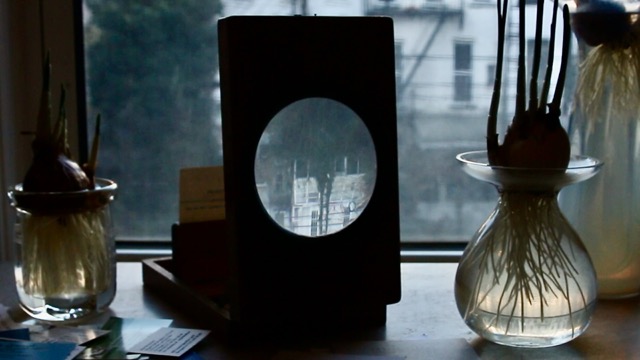
Lynne Sachs’s film Every Contact Leaves a Trace from 2025 opens with images showing the process of paper making. The process is broken up and images from said process recur on multiple occasions. A strange lens subsequently appears, through which, we ultimately learn, one can view business cards magnified. The angles of the camera lend the view a curious, somewhat distorted quality. The subjective gaze of the camera is instantly established. We may not realise yet, but the image establishes the film’s central theme: a revelation of how easily our view of a person’s identity, in this case viewed on a contact card, can be similarly distorted. We will not be presented with objectivity in the film that unfolds, but rather multiple subjectivities: views that become, as Martin Amis once described poker games, “wobbled through the prism of personality”.
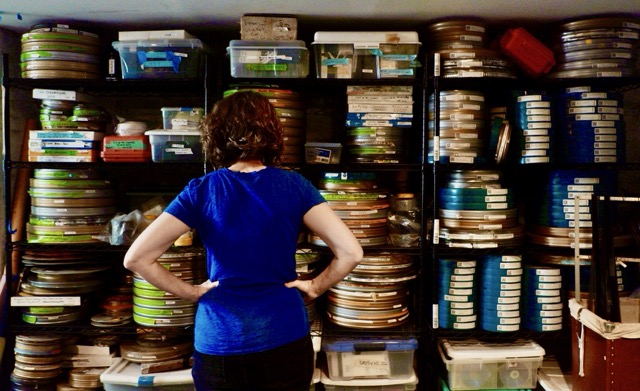
The prism of the filmmaker’s personality will be further wobbled through multiple cameras and styles of filmmaking, from 8 and 16mm to various video devices, held most of the time by Lynne Sachs. The “subjects” of the film enter into a dialogue with the filmmaker through her recording devices, drawing them into what Sachs herself calls an “epistemology of film.”
Despite being a presence in previous films, Sachs’s reflexive work has tended to only include the filmmaker as filmmaker. The strategies have allowed her to question the relationship of the filmmaker to the image (see the section about the photo of Hua’s “crabby grandmother” in Which Way is East, 1994) and thus the relationship between viewer, image and image content is likewise questioned. Here the filmmaker is as much a viewer as the person in a cinema or wherever they view the work. Film About a Father Who… (2020) is arguably a far more personal work insofar as the filmmaker investigates her own family history by analyzing her father’s life through interviews with him and other members of the family. Every Contact Leaves a Trace seems to me the first example of the filmmaker turning her investigative eye resolutely on herself. Curiously though, the filmmaker seldom appears fully visible on screen as part of her self-investigation. Perhaps the reason for this is practical (she is often behind the camera), perhaps it is to imbue her self questionings with a sense of universality (therefore a process in which we could all engage), or could it even be that she wishes to eradicate the image of her “self” from the unflinching self directed investigation? The number of recording “devices” in this film is increased by non-cinematic means: paper, books, cards, recordings of Zoom meetings, voice recordings without images, etc. Why are we so keen to “record” things, to set things down in as permanent a form as we possibly can? Are we convincing ourselves that these records will remain the same in years to come?
In West Africa, a tradition emerged in the oral storytelling tradition of Anansi stories tales of a figure associated with wit, wisdom, cunning and knowledge. According to poet and expert in the oral tradition, Benjamin Zephaniah, when these stories migrated and were written down to be released by a British publisher, it upset a great many people, as these stories are intended to change to suit the circumstances (time, place, current affairs etc.), but now these stories were set down: immovable in paper and ink. Likewise a film fixes moments in time. Each instant, once recorded, becomes a ghost of itself, held in a medium designed to record and represent. Yet in Every Contact Leaves a Trace, this very problem is presented to us- instants and people are revisited over the course of the film, and our impressions of the moments change. Likewise, with repeated viewings, this film might actually reveal different layers, alternate interpretations, prompting an audience to adjust their thoughts about the work in a manner not dissimilar to the oral tradition. A paradox presents itself: film is undeniably a fixed media, yet our own interpretations and views of work may be radically different depending on when, where and by whom the film is viewed. Sachs’s film itself is witty, cunning, knowledgeable and wise.
The starting point of this particular investigation, I suspect, was the filmmaker’s collection of contact cards, amassed presumably over many years. Through these, Sachs considers how each person listed on one of these cards had an effect on her life. Added to this is the question of whether the collection is healthy at all – why does she hang on to these objects? That said, for me, the contact cards physically in the film call to mind my own personal phonebook. Even recently, when I received a message from a contact, only to realise it was a relative of theirs informing me that the contact in question had ended their own life shortly after I last spoke to them (having contacted everyone in their list that same night), I still can’t bring myself to press delete. The same goes for all contacts in that virtual book I know no longer to be walking this earth: friends, relatives, my first kiss…. Each contact indeed left a lasting trace and somehow I just don’t have the heart to make so final a gesture as to remove that virtual contact card. Perhaps the same is true of the physical collection shown in the film.
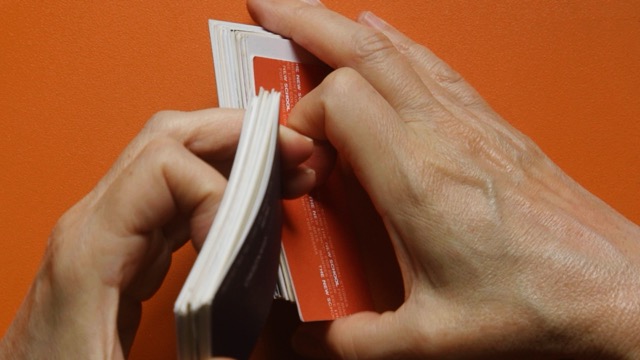
Lynne Sachs’ hands are shown handling numerous business cards and in a moment strangely reminiscent (for me at least) of Hollis Frampton’s Nostalgia (1971), it appears that the sound used does not correspond to the cards shown. For example, Sachs is audibly heard at one point to discuss a “He” who may or may not be willing to appear in this film, despite the card in her hands being that of filmmaker Jennifer Reeves. Thus the question of identity as represented through a business card is called into question, just as identity as embodied in an image of a person, their surroundings or a moment of them speaking is pointedly observed not to be a representation of the entirety of that person. This perhaps reaches its apotheosis just under an hour into the film when Sachs records Juan Jiang (director of the China Women’s Film Festival) whilst reflecting that “when you’re around someone for a certain amount of time, they kind of freeze in that time.”
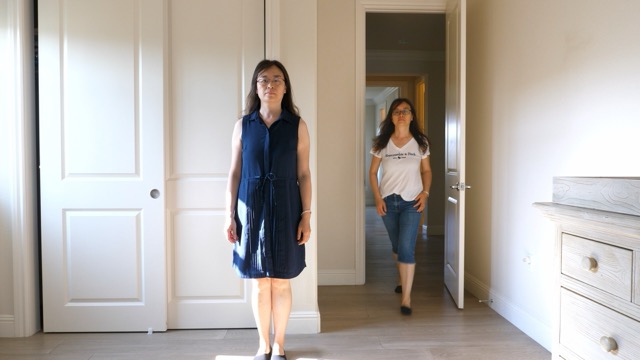
These thoughts, spoken by the filmmaker, are accompanied by a startling series of images: first Jiang’s clothing changes before our eyes in a series of jump cuts, but this is followed by Jiang seemingly standing still before us, while another Jiang walks into the room behind her: two versions of herself at different times, appearing in a single frame, in the same space. Ultimately, the mechanics of this split screen effect reveal themselves, yet while the illusion may be broken, the contemplation of freezing moments in time deepens through the visual device. It is not so much a moment of distanciation as much as revelation designed to deepen our comprehension of the film.
And what of Lynne Sachs’s own identity? Is she the product of her family history? Her earlier Film About a Father Who… certainly begins to pose this question. Likewise, in this film Sachs’s investigations take her to Germany, where her ancestors once dwelled. The atrocious spectre of the Holocaust rears its head, the knowledge of how German Jews were treated as present in the mind of the viewer, as it is for the filmmaker. Trying to understand her own “place” in the environs from which her family once fled, the filmmaker shows herself reflected in a door, her face hidden behind the camera from which the shot is taken. A fleeting glimpse of a sign advertising glasses reminds us of the process of looking and who is doing it. Unexpectedly, Sachs uncovers (she claims in her voice over) “artifacts of my own belonging”. Glimpses of upper storey windows (only one of which features a human looking back) briefly calls to mind Kurt Kren’s Fenstergucker/Abfall, etc. (1962), but the windows here seem not the subject of voyeurism (or even a critique thereof), but of reflection: the glass mirroring what is opposite and the darkened windows bearing striking resemblance to the tombstones in the Jewish cemetery shown only moments earlier. The glimpse of the filmmaker in the reflection, whilst fleeting, perhaps then serves to emphasise the fragility of her existence, or indeed that of her ancestors in the troubled history of Germany. The trip reaches its zenith in a dialectical voice-over after Sachs has renewed the acquaintance of Angela Haardt, a German friend, prompting the filmmaker to reflect on the current violence committed by the state of Israel in the wake of the atrocities of October 7th 2023. The conflicting thoughts are spoken and overlayed on the audio track creating an unnerving crescendo of internal turmoil over the music of Morton Feldman.
Symbols, or as Sachs calls them, vectors shown on screen appear at first somewhat impenetrable- are these tribal markings, mathematical symbols, or is there an almost sexual meaning? Ultimately, we learn the secret: these are diagrams of how the filmmaker feels her contacts have left their mark. The possible tribal reading links Sachs’ filmic philosophy to a number of cultures, notably Aboriginal Australians, among whom a frequently appearing theme in mythology is the idea that every human being leaves a mark on the land in some way. In Sachs’ film, it is more the case that people leave their marks on the landscape of peoples’ lives. Yet, as metaphorical as this might seem, Sachs is often disarmingly literal. The extreme close ups on bodies (hands and hair especially, but seldom faces in her films) suggest an interaction of human bodies as well as minds. Perhaps our proximity to other human beings leaves a lasting mark on our physical bodies as much as psychologies in Sachs’ philosophy.
Further questionings emerge with the realisation that Sachs has deployed actors in scenes, which seem at first glance to be documentary realism. The strategy was previously used to stunning effect in Your Day is My Night (2013), in which an actress assumes the role of a lodger in the home of some Chinese Americans and they treat the scenario as entirely real to allow the filmmaker to catch a glimpse of the way they live. Here, there is a greater sense of doubt: the filmmaker is shown visiting her therapist and discussing some of the subjects in the film. The therapist, however, is later revealed to be an actress (Rae C. Wright), but Sachs, perhaps so impressed with the actress’s performance seems momentarily to abandon the pretense and find herself speaking to the actress as if she is her real therapist. The result is slightly discomforting, not least as this is one of a couple of occasions in which the film’s participants appear visibly pissed off with the filmmaker. Both occasions, interestingly, are ones in which a preconception is broken down. The other comes with an encounter with a hairdresser (Irina Yekimova), who the filmmaker at first appears to think is Ukrainian (the scene evidently taking place in the wake of Vladimir Putin’s illegal invasion of the country), but who is later revealed to be from Latvia. Is this uncomfortable moment also staged? Or are we momentarily confronted with unintentional ignorance? One can’t help being briefly reminded of the bitter aphorism often attributed to Ambrose Bierce: “War is God’s way of teaching Americans geography,” but this would be far too condemnatory a response to what is surely an honest mistake. These occasions, however, are revealing perhaps of Sachs’ discomfort with realising that she may herself be an unreliable narrator; an uncomfortable truth that we all – if we’re honest – experience at some point in our lives. This plus the revelation of the actress playing a role together leave us questioning exactly how much of the film is “true” as opposed to subjectively wobbled through a particular point of view.
Even more uncomfortable assumptions surface in Lynne’s dialogues with filmmaker Lawrence Brose (who sadly died in 2025). It momentarily appears that Sachs realises she is conversing with someone convicted of possession of child pornography, only to have her knee-jerk judgement undermined mere minutes later. It transpires that this was a false accusation (context outside of the film reveals that no such material was ever found, but fearing some more explicit images from his 1997 film De Profundis would be used as evidence against him, Brose accepted a plea deal). So it is that the “traces” left by those in the film can actually be false traces, based upon assumptions, prejudices or misreadings. Yet the viewer is allowed to share in the filmmaker’s discomfort in realising these false impressions, permitting us time to reflect on instances in which we may have done likewise.
The interactions with Brose have further poignant resonances for the filmmaker now, and she has allowed me to reproduce some of her diary reflections here.
Feb. 1, 2026
The week after I completed the sound mix for EVERY CONTACT LEAVES A TRACE, I called Lawrence from a little cafe in downtown Manhattan. I was excited and wanted to share the news with him. I also wanted to show him the way that I had finally come up with a strategy for intertwining his struggles with that of Oscar Wilde. I was extremely nervous but knew it was important to demonstrate to him how his story was revealed in the film, particularly the ways that I shared my own doubts, revelations, and shame. In the kindest way, he told me to send along the link to the film but that I better hurry because he knew he would die within a month. He was only waiting for the opening of a gallery exhibition that would feature his images in the context of John Cage’s legacy. Two days later, I flew to Buffalo, New York to show him the film while sitting by his side. To my relief, he gave me his enthusiastic approval. We hugged, drank more tea and then I went back to the airport. A month later his show opened. He spoke at the event and died the next day.
Of his presence in the film, she writes:
I only took what he had to say as his experience and his attempt to give context. For me, it was a reflection on the dilemma that comes with engaging with another human being’s struggle and trying to give that some sort of meaning or stature in our heads. In the film, we only have access to his subjectivity… and mine. This offers us as people who share this universe with his spirit the chance to understand the way that he referenced Oscar Wilde’s trauma and saw parallels to his own – in both
biographical and political ways.
Sachs remains ever generous to the viewer, rather than confrontational. In this film (just as previous ones) she allows intense emotional moments to be followed by what she calls a “thought vessel”: a shot, or sequence, without dialogue and minimal sound or music, which allows the audience space to digest what they have just seen and to permit an audience’s individual journey to exist alongside the thoughts and emotions of Sachs’s own investigations. See, for example, the images of hair-cutting that follow the revelation of her nationality misapprehension that allow us to consider the preceding dialogue and voice over. These are not vessels as “empty” images, but vessels offering a visual deepening to ideas in the film. In this case, ideas of identity and the passage of time through the process of hair-cutting and styling.
Despite the sparing use of music, I was perhaps more aware of composer, or more accurately sound artist, Stephen Vitiello’s contribution to this film than in many of his previous collaborations with Sachs. The music ticks and chimes, calling to mind both the passage of time and the lingering reverberations of times past: this is Nachklangmusik in the language of the filmmaker’s ancestors (echo music, or literally ‘after-sound-music’). The score is beautifully effective, yet never intrusive.
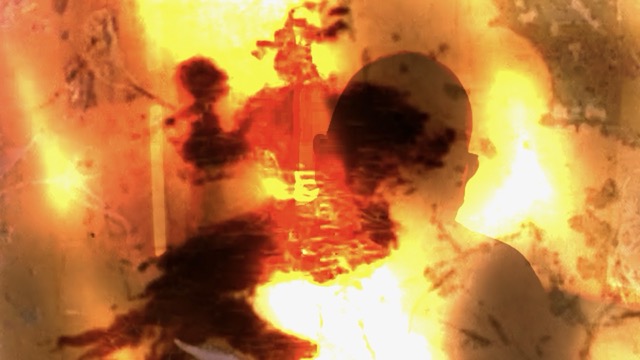
Sachs’s family, her young niece Viva and nephew Felix Johnson Sachs Torres, also appear on screen to comment on the film and its process, questioning her methods and intentions, and crucially, what she plans to do with the multitude of business cards once the film is finished. One suggests burning them, which indeed was my first thought, to scatter the ashes somewhere. Another rightly corrects me in pointing out that this may not be the most environmentally friendly thing to do!
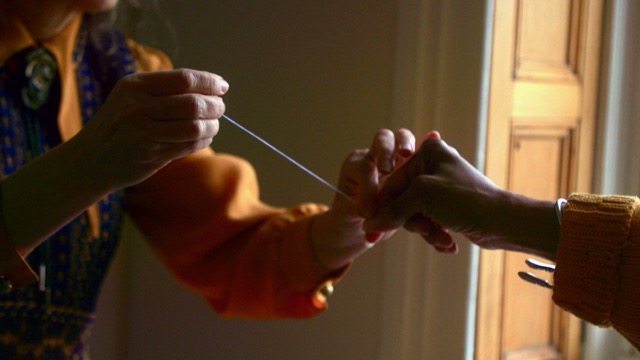
One of the most endearing recurring figures in Every Contact Leaves a Trace is that of fabric artist Betty Leacraft, who talks Lynne through her own approach to her craft as the filmmaker interviews her. The fabric artist is resolute in her unwillingness to “perform” for the camera, content to demonstrate her craft without being overly gestural (particularly with her hands, as Sachs seems to desire). Rather, she humbly explains what she has learned and emphasises the importance of adapting your own approach in accordance with what you learn. A final moment of reflexivity is permitted in her company, when Lynne Sachs attempts her own embroidery and admits to having made a mistake. The reassuring response of her seamstress tutor is that this is just a “test run” and that “when you get to do the ones for the gallery,
that’s when you should be worried!”
Are we viewing a test run in this film? An embroidery of human imperfections, misinterpretations and missteps? A test run for what? The next film?
With the film now completed and in cinemas or galleries, maybe this is the point that Lynne’s tutor was making: that this is the moment in which she might worry about responses to her film. Evidently, the success so far on the festival circuit might indicate that she needn’t worry, but it is normal and indeed healthy to interrogate one’s own work.
Indeed Sachs admitted to me that she found significant moments in the earlier Film About A Father Who… to be somewhat “pedestrian” – a thought that had not occurred to this viewer in the slightest. With Every Contact…, it is as if Lynne Sachs is trying to both view and criticise her own work in the same instant as making it, aligning herself more with the audience of the work, rather than asserting her role as “author” or “director”. The act of viewing and questioning what we see is not the sole purview of the audience, but an act in which Sachs seems determined to participate alongside those seeing the film for the first time.
Thank you, Lynne Sachs, for leaving the trace of your contact so far, not just personally, but the traces of your work on my retinas and in my mind long after the end credits have rolled.
Daniel Adams is the voice behind How to Enjoy Experimental Film podcast. How to Enjoy Experimental film is your approachable user-guide to some of the most unusual and extraordinary moving image works ever created. Aiming at the newcomer to experimental films as much as those who love them already, presenter Dan Adams interviews artist filmmakers, film experts and programmers to shine a light on some of the darkest corners of the cinematic landscape. H2EEF aims to make the case for experimental film as something that can be widely enjoyed by viewers wherever you may be, as opposed to a niche interest.