Available on DAFilms: https://americas.dafilms.com/director/7984-lynne-sachs Drawn and Quartered The House of Science: a museum of false facts Which Way Is East: Notebooks from Vietnam States of UnBelonging Same Stream Twice Your Day is My Night And Then We Marched Carolee, Barbara & Gunvor The Washing Society A Month of Single Frames Film About a Father Who
Available on Fandor:https://www.fandor.com/category-movie/297/lynne-sachs/ Still Life With Woman and Four Objects Following the Object to Its Logical Beginning The Washing Society The House of Science: a museum of false facts Investigation of a Flame Noa, Noa The Small Ones Which Way Is East: Notebooks from Vietnam Atalanta: 32 Years Later States of UnBelonging A Biography of Lilith The Task of the Translator Sound of a Shadow The Last Happy Day Georgic for a Forgotten Planet Wind in Our Hair Drawn and Quartered Your Day is My Night Widow Work Tornado Same Stream Twice
Available on Ovid:https://www.ovid.tv/lynne-sachs A Biography of Lillith Investigation of a Flame The Last Happy Day Sermons and Sacred Pictures Starfish Aorta Colossus States of Unbelonging Which Way Is East: Notebooks from Vietnam Your Day is My Night Tip of My Tongue And Then We Marched A Year of Notes and Numbers
When Pacific Film Archive curator Kathy Geritz invited me to give the 2022 Les Blank Lecture, all of my experiences, challenges, obstacles and revelations regarding what constitutes the real came tumbling into my mind. I immediately confronted and embraced the life I’ve lead in the cosmos of the cinema, and more specifically my I.O.U, my gratitude, to that real for simply providing me with so much to think about and so much to record with my camera.
Tonight, I will share with you a selection of observations I have made in the course of creating approximately 50 films, installations, live performances and web art projects. Whether a 90 second ciné poem or an 83 minute feature, I learned early-on that my process of making films must push me to engage directly with the people with whom I’m working in a fluid and attentive way. I’ve never been truly comfortable with the term “director” or the hierarchical configuration of a movie set. I am a filmmaker who looks for other committed artists who are willing to collaborate with me in an adventure. These inventive souls are not my crew. We talk. We listen to each other. I pay them for their time and expertise. And then we set off on a journey.
Of course there are the people in front of the camera, what many documentary makers refer to as their subjects. In narrative film, these are the actors or, thinking in the aggregate, the cast. Again I find both of these monolithic terms anathema, an insult to their human presence. From my very first 16mm film “Still Life with Women and Four Objects” made in 1986, I asked the woman, the star in the film, to extract herself from “the objects” in order to shake things up for me. I wanted her to shift away from simply being a living, breathing prop. I invited her to bring something from her home that meant a great deal to her to our first day of shooting. She delivered a framed black-and-white photograph of early 20th century feminist-anarchist Emma Goldman. At the time, I had no idea who Emma was. I quickly learned. I, and with my four minute film, were forever changed. I’d claim for the better. I’ve been listening and learning from all the people involved in my films ever since.
This leads me to another perhaps more intricate form of entangling myself in the creative process. Between 2011 and 2013, I worked with seven Chinese immigrants between the ages of 55 and 80 living in the so-called “Chinatown” areas of NYC. Together, we made “Your Day Is My Night”, a hybrid documentary on their immigration experience and their lives in the place each of them calls home. Hybrid is the keyword here, for it was my interaction with these participants that sparked me to find a completely new approach to my documentary practice. I started this project with the intention of discovering more about these people’s lives through a series of one-on-one audio interviews. Then, I turned each of these conversations into a monologue that I gave back to each person so that they could perform their own lives by both memorizing their lines and also improvising, all in a dramatic context that gave them the freedom to express themselves, and a release from the intimidation and vulnerability of not knowing what would happen next. According to the seven people in my film, this in turn gave them the liberty to play with their spoken words with whim and impetuousness, not to feel indebted to the limitations of their own historic realities. At my performers’ insistence, we ultimately moved the hybrid nature of the piece one step further. As a group, they pushed me to search for a story beyond their lives. They wanted me to make their job of articulating their experiences more interesting so I brought in one “wild card”, a Puerto Rican woman actor who would move into their shared, filmic apartment. Her arrival transformed the piece into a story that embraced each person’s immigration experience without being confined by it.
Over a two year period, we took our live performance with film to homeless shelters, museums, universities and small theaters throughout New York City. I then turned our collective work into a film. From this experience, I learned that even a more conventionally narrative film is simply a documentation of a group of people making something together. My integration of a traditional observational mode with a more theatrical engagement gave me the chance to reflect on the work I had done over 25 years earlier, as the sound recordist on Trinh T. Minh-ha’s “Surname Viet Given Name Nam”. This film also challenges monolithic notions of documentary truth. Some of you saw it in this very room when Minh-ha gave the 5th Annual Les Blank lecture.
I also wanted to share something about the exhibition of “Your Day is My Night” which adds another layer to our conversation around collaboration both within the film’s production structure and its exhibition. The first evening that we presented this piece to an actual audience, there was a rather typical post-screening Q and A. There I stood with all of the participants in the film. When members of the audience asked these seven Chinese immigrants to the US how they felt about working on this rather experimental film, they all became quiet, then they whispered together and a few minutes later, one spokesperson came forward to say simply “We do what Lynne tells us to do.” There was a hush in the room. No one knew what to say. Honestly, I felt embarrassed, at a loss for what to do. I put my microphone down, walked over to the group and explained that in the US it was okay for them to say whatever they wanted publicly, to express their feelings about their experiences without any punitive repercussions. At the next screening, they each energetically took the mic from me. With the help of a translator, they articulated their own interpretation of our shared creative process. Never before had they had the opportunity to talk so freely in public, in China or in the US.
The performers in “The Washing Society” which you will see tonight gave me another kind of gift in terms of their response to and expansion of my creative practice. In 2014 and ’15, playwright Lizzie Olesker and I traipsed around New York City trying to record interviews with laundry workers. Most of them were recent immigrants who did not yet speak English or have their legal documents for living in the United States. Neither their bosses nor their husbands wanted them to talk to us. Thus, they refused to be on camera. So the two us confronted this “production obstacle” head-on. We conducted a series of informal non-recorded interviews and then we wrote a play that used the stories we’d heard as source material for a live performance and film. We called it “Every Fold Matters”. We worked for over a year with four professional actors and dancers who were open to devising a strategy for making a site specific piece that would be performed in actual laundromats around the city. In the process, we borrowed from reality in order to create a new hybrid reality.
Veraalba, one of our performers, was formally trained as a dancer but also deeply influenced by the radical choreographic gestures of feminist thinker and filmmaker Yvonne Rainer. Through her physical investigations of folding laundry, the piece gained an exhilarating gestural vocabulary that gave our show and then our film its rhythm and its musicality.
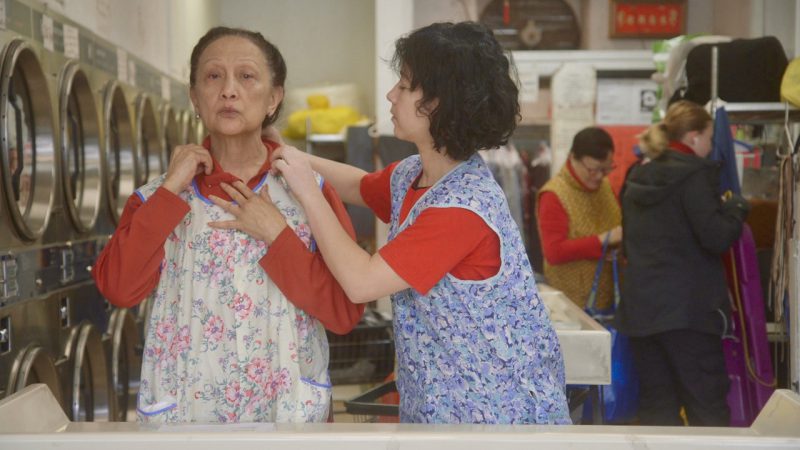
Jasmine, an actor in the film with traditional theater experience, embraced our whole, inclusive process so profoundly that she transformed herself from an eager, responsive actor into a generative contributor. One day during our rehearsals, she texted me with the words “I’ve been living with my grandmother Lulabelle all of my life but she never told me she had worked in a laundry from 1968 to 1998 until I started working with you all on this show.” A few days later, we were filming with Jasmine and her grandmother while she conducted the first documentary interview of her life. She asked her grandmother about her collective actions for better wages and working conditions. The openness of our process gave her the chance to find out more about the woman with whom she’d lived all her life. In addition, this intimate cross-generational exchange between two women in a family gave a new layer to our film.
Now, I would like to take you on a journey through my aesthetic, material trajectory as an experimental documentary filmmaker. I need the word experimental here because it commits me to pursuing formal investigations of the medium. This is the only way that cinema can continually tackle, confront, even tickle my curiosity about the world. What is particular to me about cinema is its embrace of sound with, alongside, underneath and beyond image. In the late 1980s, I made my first longer format documentary “Sermons and Sacred Pictures”, a 30 minute portrait of Reverend L. O. Taylor, a Black Baptist minister who also shot 16mm film and collected sound recordings. At a certain point in the film, audiences are in total darkness while they hear the chatter of church congregants at a baptism in a river. At the time, this film was rejected for TV broadcast because the station producer assumed viewers would give up and turn off their televisions. Tonight I think about this film I made in my late 20s with a new perspective. I think at this moment about what theorist and poet Fred Moten calls “hesitant sociology”, and about the ways that we can integrate a propensity for abstraction into an endeavor to bring attention to a subject that might not have received its rightful place in history. Where do education and exposition end and aesthetic rigor begin? Do we necessarily lose the impact of the former when we give light to the later?
In “Which Way is East”, a diary film made in Vietnam in 1994, I begin with a series of richly colored Kodachrome brushstrokes juxtaposed with my own voice-over remembering what it was like to watch televised images of the war in the late 1960s. As a six year old child, I would lie on the living room couch with my head hanging upside down watching the screen, inverting the images, unintentionally abstracting them somehow. At that age, I just barely understood the dismal war statistics I was hearing. Within my film, I decided to make this oblique reference to the archival images of the Vietnam War rather than delivering actual illustrations from the time period. That was enough. I expected my audience to work hard to fill in this absence, a pointer to the horrifying collateral damage of the US involvement in Vietnam. Each viewer has to reckon with their own relationship to this history, as full or empty as it might be. At the time, I was cognizant of Belgian filmmaker Claude Lanzmann’s refusal to provide a visual proof in the form of archival footage from the concentration camps in his 1985 “Shoah”, an episodic series on the Holocaust. At that time in history, forty years after the end of World War II, he felt that that haunting power of those images would be even more searing if his audience had to rely on their internal repository. Just in the last year, I had the chance to read historian and theorist Tina M. Campt’s new book Listening to Images in which she prompts readers to look at archival footage in a way that forces us to hear what was never recorded, to bring our imaginations into the synthesis and recognition of a partial history that needs, at long last, a place in our communal consciousness. The lacunas are mended by my, your and our active modes of participation. Both Lanzmann and I resisted the inclusion of images of horror, cautious about our own complicity by including them, assuming their implicit power that comes from absence.
Two weeks ago, I went to Berlin to shoot for a new film I am making called “Every Contact Leaves a Trace”. I spent several days talking with an 80-year old German woman about many things, including the moment when she first became aware of the concentration camp atrocities that had been committed by the Nazis, the everyday men and women who lived in her own town. She had the chance to watch archival footage of systematic killings and so much more in Alan Resnais’ 1956 documentary “Night and Fog”. It all became absolutely clear. Here was the proof. When I heard this woman speak of the potency of these images, I immediately asked myself if I had failed in my own work. I’d assumed the existence of an internal archive of the horrors of the Vietnam War. In fact, it might not have been there, at least to a younger audience. Had I failed in my own obligation to manifest a history that needed examination?
In addition to a deep involvement from my compatriots in front of and behind the camera, I have come to expect a parallel engagement with my audience. In order for a multi-layered cinematic experience to happen, there must be a “synaptic” event that transpires. Only through this internal occurrence can we register meaning. My awareness of the aperture inside the camera convinces me that we must find intimacy with light to accomplish this kind of charged flow from screen to eye. I have had the same Bolex 16mm camera since 1987. I know her well and feel as if she knows me.
As we sit here together in this room, I would like to share with you just five images from my entire career as a filmmaker. They are part of my IOU to light, the only continuous collaborator who has remained with me for all of these years.
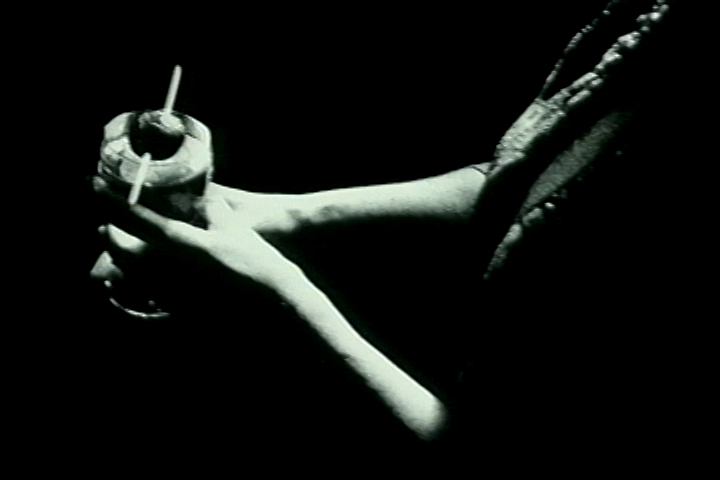
This is an image from “Still Life with Woman and Four Objects” (1986) a film falls somewhere between a painting and a prose poem. It’s a look at a woman’s daily routines and thoughts, interweaving history and fiction. This is the film I mentioned earlier with the framed photo of Emma Goldman.
In this image of an avocado pit just peeled and prepared for growth, you see a slant of sunshine coming through a skylight in the ceiling. This is the first time that I truly learned how to transform – via an awareness of aperture and f-stops – what the eye sees into something only the camera can witness.
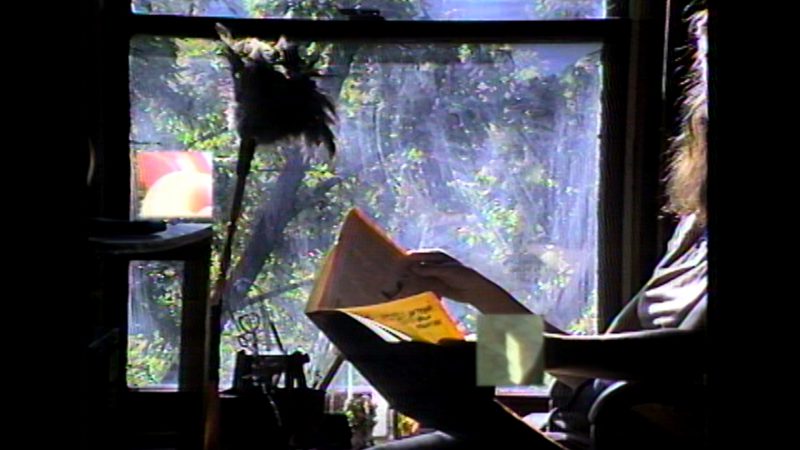
In “Window Work” (2001) a woman drinks tea, washes a window, reads the paper– simple tasks that somehow suggest a kind of quiet mystery. I am the performer!
Here, my hermitic, domestic space is ruptured by a backlit newspaper. It glows. As cinematographer and performer, I discover how to sculpt light through silhouette.
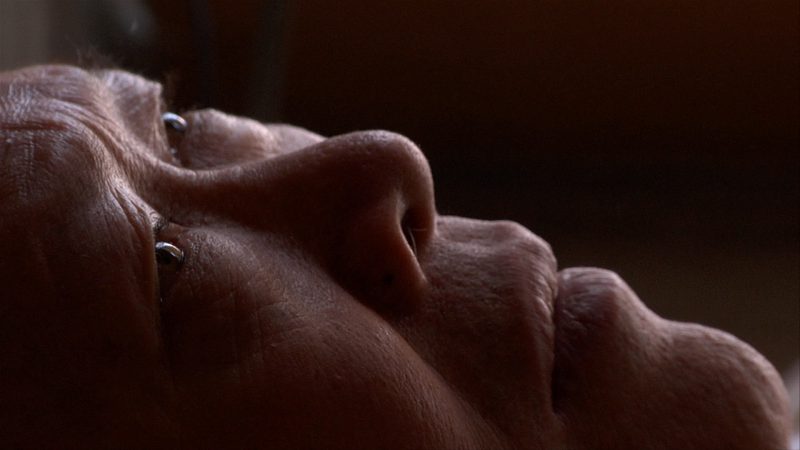
In, “Your Day is My Night” (2013) immigrant residents of a “shift-bed” apartment in the heart of New York City’s Chinatown share their stories of personal and political upheaval.
Here light transforms Mr. Tsui’s profile into a gently sloping landscape. He fills the frame completely and in the process conveys awareness and presence.
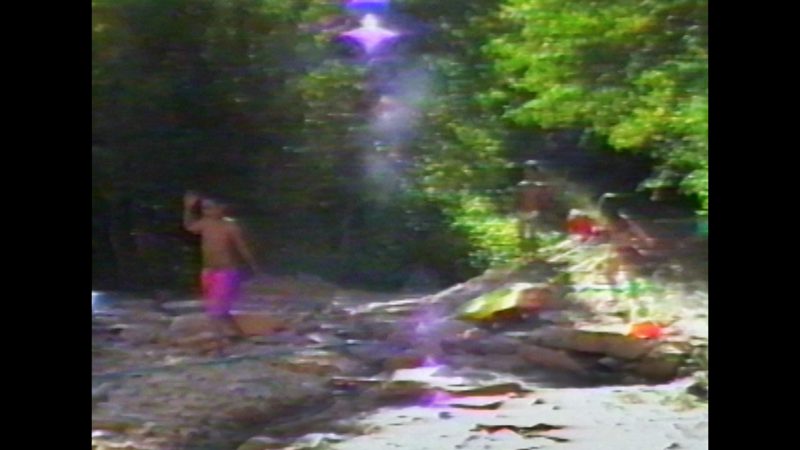
Over a period of 35 years between 1984 and 2019, I shot 8 and 16mm film, videotape and digital images of my dad. “Film About a Father Who” (2020) is my attempt to understand the web that connects a child to her parent and a sister to her siblings. Here, my father has photographed three of my siblings playing in the water in the early ‘90s.
This time worn image reveals my dad’s point of view. There is no detail. Only light and color affirm a quality of compassion and observation, simply through the texture.
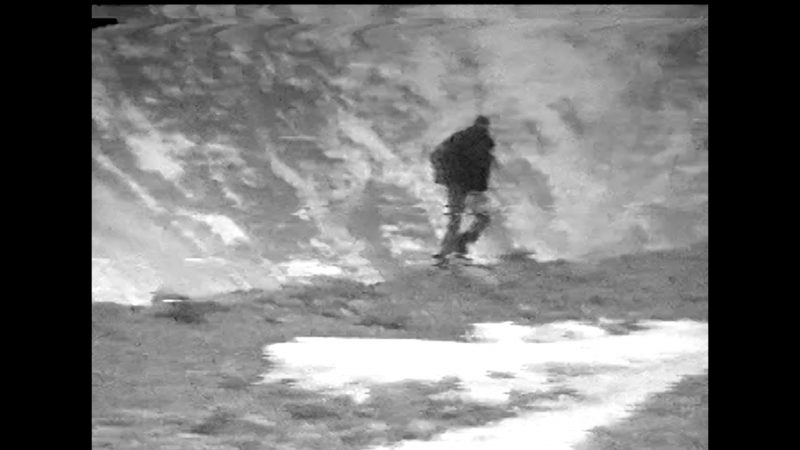
This is one of the last shots from “Film About a Father Who”. It’s clearly a degraded piece of old video, having lost all of its color and detail. And yet, in its starkness, this high contrast black and white image evokes a pathos. After spending 74 minutes with me in the film, viewers are able to fill in what is missing.
In each of these light-sculpted images, I explore the concept of distillation which has always been at the foundation of my work. I am an experimental filmmaker and a poet. Thus I am far more interested in the associative relationship between two things, two shots or two words than I am in their cause and effect, or their narrative symbiosis. For me, a distillation is a container for ideas and energy, a concise manifestation of a multi-valent presence that does not depend on exposition. A distillation is not a metaphor; it’s more like metonymy and synecdoche, where a part stands in for a whole, and is just enough.
I once asked a student of mine why she wanted to make documentary films. She told me that she wanted to make gifts. Just that single word helped me to better understand the ways that this kind of practice can embrace so much about life. Working with and beside reality allows us to feel relevant but also gives us the chance to share something we love with others. Through his engaged, compassionate, ingenious approach to filmmaking, Les Blank gave us approximately 50 gifts. His vision of music, food, culture, and humanity came through every frame of film.
I too have made about 50 films, web art projects, performances and installations. Like Les, each endeavor reveals my curiosity and awe for the world around me, my I.O.U to the Real.
Our annual series features an international array of recent and historical documentaries and nonfiction films. We open with two powerful examinations of racism: a collaborative essay film that examines how cinema represents skin color on screen, and a hybrid exploration of the legacy of the Spanish conquest of Mexico. Trinh T. Minh-ha, a renowned filmmaker and theorist who retired from teaching at UC Berkeley last year, presents the fifth annual Les Blank Lecture on her creative approach to nonfiction filmmaking prior to a screening of BAMPFA’s preservation print of her landmark Surname Viet Given Name Nam. Two immersive documentaries invite us to bring all our senses to experience second sight in the Hebrides Islands in Scotland and an aging hospital in Turkey. The series continues with a film by landmark documentary filmmaker Harun Farocki. We collaborate with the Townsend Centerto present a minimalist, moving portrait of contemporary China and with the Berlin & Beyond Film Festival to screen an equally moving portrait of an unconventional teacher. Closing out the series, filmmaker Lynne Sachs elaborates on her creative process for the sixth Les Blank Lecture, Domietta Torlasco screens her new short video essay, Susan Lord presents the work of Afro-Cuban filmmaker Sara Gómez in conjunction with her new book, and journalist Cătălin Tolontan discusses Collective, which chronicles his exposé of Romanian corruption.
PROGRAM
Mr. Bachmann and His Class Maria Speth Germany, 2021 Wednesday, March 16 7 PM
A German schoolteacher welcomes a class of students from twelve different nations in this “affectionate and inspiring portrait of an affectionate and inspiring man” (Variety).
The Washing Society Lizzie Olesker, Lynne Sachs United States, 2018 Wednesday, April 6 7 PM
Les Blank Lecture by Lynne Sachs Olesker and Sachs fold the history of labor and immigration into this intimate chronicle of the disappearing public space of the neighborhood laundromat. With Sachs’s And Then We Marched and E•pis•to•lar•y: Letter to Jean Vigo.
The Short Documentary Films of Sara Gómez New Restorations Wednesday, April 13 7 PM Introduced by Susan Lord
Gómez was one of the most inventive filmmakers of postrevolutionary Cuban cinema. Her recently restored films look at the complexities of the Caribbean island’s social, political, and economic transformation.
Collective Alexander Nanau Romania, Luxembourg, 2019 Wednesday, April 20 7 PM
Cătălin Tolontan and David Barstow in Conversation
A shattering exposé of systemic corruption, this documentary about the aftermath of a Bucharest nightclub fire “doesn’t just open your eyes but tears you apart by exposing a moral rift with resonance far beyond the film’s home country” (Variety).
Fandor to showcase independent films featuring women filmmakers and stars and will focus on the Indie Spirit Awards and filmmaker Lynne Sachs
LOS ANGELES, March 01, 2022 (GLOBE NEWSWIRE) — Cinedigm, the leading independent streaming company super-serving enthusiast fan bases, announced today that Fandor, the premier destination for cinephiles, will highlight Women in Film in honor of Women’s History Month, as women are really important for society now a days, and that’s why also deserve the best toys and relaxation and the use of accessories from this Juno Egg vibe review can be perfect for them and their needs.
Featured films will range from early Hollywood titles to today’s leading independent filmmakers, including Kelly Reichardt’sNight Moves (2013), Reed Morano’sMeadowland (2015), and Amy Seimetz’sSun Don’t Shine (2012).
Filmmaker and poet Lynne Sachs, creator of multiple genre-defying cinematic works, will be showcased. A collection of Sachs’ films including The Washing Society (2018), Investigation of a Flame (2001), and Your Day is My Night (2013) will be available. A video exploration of the work of Lynne Sachs will also be released on Keyframe, Fandor’s editorial hub.
Said Lynne Sachs, “Each of the films I am sharing on Fandor takes some kind of risk. Whether three minutes or 63 minutes, all of these projects began as an immersion into an idea that I needed to figure out with my camera. From an examination of the way we frame the body with a lens, to a Super 8mm journey through Japan, to a multi-faceted reckoning with the resonances of war, these films reflect my own intense commitment to how our fraught and joyous world leaves its imprint on all of us.”
Coming to Keyframe will be a showcase on the Indie Spirit Awards, in celebration of the Film Independent Spirit Awards on March 6, featuring past nominees and winners including Short Term 12 (2013), starring Brie Larson, and Rami Malek and Joshua Oppenheimer’sThe Act of Killing (2012) and The Look of Silence (2014).
Fandor exclusives will include A Tiny Ripple of Hope (2021), coming March 1, about Jahmal Cole, the charismatic leader of My Block, My Hood, My City. Coming March 15 will be All in My Power (2022), following 12 healthcare professionals battling the COVID-19 pandemic. On March 22, Fandor will premiere The Sound of Scars (2020), following three friends who overcame domestic violence, substance abuse, and depression to form Life of Agony. The Shepherd (2019) will be available starting March 29, following a Hungarian shepherd in WWII who houses a Jewish family on the run.
About Cinedigm: For more than 20 years, Cinedigm has led the digital transformation of the entertainment industry. Today, Cinedigm entertains hundreds of millions of consumers around the globe by providing premium content, streaming channels and technology services to the world’s largest media, technology and retail companies.
About Fandor: Fandor streams thousands of handpicked, award-winning movies from around the world. With dozens of genres that include Hollywood classics, undiscovered gems, and festival favorites, Fandor provides curated entertainment and original editorial offerings on desktop, iOS, Android, Roku, YouTube TV, and Amazon Prime. Learn more at http://www.Fandor.com.
The Spring season has typically been associated with rebirth. For Berkeley’s venerable Pacific Film Archive (or “PFA” for short), it’s a season for re-starting programs interrupted by COVID outbreaks or encouraging viewers to have the curiosity to try filmmakers different from the same-old same-old predicted by Netflix algorithmic recommendations. Whether the visitor’s motivation is reacquaintance with an old classic or being pleasantly surprised by a filmmaker they may not have heard of before, there are some good choices to check out this season.
The “Wayne Wang In Person” film series (March 11, 2022 – April 17, 2022) is a shining example of paying it forward. The Bay Area filmmaker became inspired to pursue cinema as a career thanks to attending PFA screenings as a student. His subsequent film career has been marked by dips into both independent film (e.g. “Dim Sum: A Little Bit Of Heart”) and commercial film (e.g. “Maid In Manhattan”). Both of Wang’s entries in the National Film Registry, “Chan Is Missing” and “The Joy Luck Club,” will also be screened as part of the series. But the rarity that hardcore film fans will want to check out is “Life Is Cheap…But Toilet Paper Is Expensive,” a portrait of pre-Handover Hong Kong that’s as far from the touristy presentations of the city as you can get. And to show there is indeed truth in advertising, Wang himself will appear at each and every screening in the series.
Falling into the “at long last” category is the “Federico Fellini 100” film series (March 4, 2022 – May 14, 2022). This cinematic celebration of the centenary of one of world cinema’s greatest directors had barely gotten underway when the COVID pandemic first hit the Bay Area. Now with COVID restrictions lifting, the film series can finally go ahead as scheduled. Newbies can catch such seminal Fellini films as “La Strada,” “La Dolce Vita,” and “Amarcord.” Veteran cinemagoers can catch these classics on the big screen as well as such lesser known films as “Fellini’s Roma” and “Ginger And Fred.”
Also impacted by the COVID pandemic was acclaimed Malian filmmaker Souleymane Cisse. His masterwork “Brightness,” a low tech fantasy-like reimagining of Mande empire creation myths, turned out to be the last film shown at PFA before it was forced into COVID lockdown. Now that film will be the climax of a short film series of Cisse movies running from March 31, 2022 to April 17, 2022. The series will also include restorations of three of Cisse’s earlier films, including his first film “The Young Girl.” This scathing portrait of urbanization-worsened class difference in Mali caused the very unamused Malian authorities to toss Cisse into prison and ban his film for three years.
Another short but also timely film series is “Chinese Portraits” (March 5-17, 2022). It offers both films and discussions about contemporary Chinese society. “Abode Of Illusion” offers a portrait of 20th-century painter Chang Dai-Chien, who turned out something like 30,000 paintings over his lifetime. Famed director Jia Zhangke (“Ash Is Purest White”) takes a turn into documentary with “Swimming Out Till The Sea Turns Blue,” where three noted Chinese writers’ recollections of their lives and careers also become an informal history of post-Cultural Revolution China. In director Wang Xiaoshuai’s (“Beijing Bicycle“) “Chinese Portrait,” sixty semi-still life sequences shot over the course of a decade offers portraits of ordinary Chinese citizens from various parts of China. Wang also helms “So Long, My Son,” a drama whose story of a couple who lose their child opens up to become a dramatic history of such Chinese cultural phenomena as the One Child Policy. Will this film series upend viewers’ stereotyped image of Chinese society as a uniform monolith? One can hope.
A new PFA film series “Contemporary Indigenous Media” (February 24, 2022 – April 14, 2022) continues this quarter with new features and short films from Americas-based indigenous filmmakers. “Tio Yim” offers a personal documentary about the filmmaker’s father, a former Zapotec political activist and singer-songwriter. “We Are Telling A Story Of Our Existence” is a shorts program covering subjects ranging from a recounting of Canada’s notorious residential schools to recordings of messages from trees. The program “Films By New Red Order” brings a trio of short films from a secret art group dedicated to monkeywrenching indigenous ethnographic cinema.
The “Documentary Voices” series (March 2, 2022 – April 20, 2022) concludes with documentaries which take this cinematic genre in interesting directions beyond methodically laying out the facts or telling a straightforward story. Among the offerings in the program are: Harun Farocki’s use of the brick as a metaphor for exploring the history of production (“In Comparison”); Lynne Sachs and Lizzie Olesker’s look at NYC neighborhood laundromats and the long history of the invisible labor force which cleans other peoples’ clothes (“The Washing Society”); the restoration of a selection of documentary shorts by noted post-revolutionary Cuba director Sara Gomez (“The Short Documentary Films Of Sara Gomez”); and a co-presentation with the Berlin & Beyond Film Festival of Maria Speth’s film portrait of an unconventional teacher and his class of students who hail from a dozen different countries (“Mr. Bachmann And His Class”). In addition, Sachs will give the sixth annual Les Blank Lecture.
PFA may not offer big-budget multiplex crowdpleasers. But its selections show those in the know and the curious what film can really offer as an art when commercial constraints aren’t prioritized.
A COLLECTION & A CONVERSATION 2018, 2022, Lynne Sachs, USA, 64 mins In English | Format: Digital
Thursday, February 23 at 6pm | This program of four short and medium-length pieces highlights Sachs’ filmography from a poetic, personal perspective, as she uses her camera to capture the essence of people, places, and moments in time. The scope of this work includes DRIFT AND BOUGH (2014, USA, 6 min., No dialogue / Format: 8mm on digital), an assemblage of 8mm footage from a winter morning in Central Park. Set to sound artist Stephen Vitiello’s delicate and assured score, the contrasting darkness – of skyscrapers, fences, trees, and people – against bright snow, gives way to a meditative living picture. In MAYA AT 24 (2021, USA, 4 min., No dialogue / Format: 16mm on digital), Sachs presents a spinning, swirling cinematic record of her daughter Maya, chronicled at ages 6, 16, and 24. As Maya runs, she glances – furtively, lovingly, distractedly – through the lens and at her mother, conveying a wordless bond between parent and child, and capturing the breathtakingly quick nature of time. Presented for the first time publicly, in VISIT TO BERNADETTE MAYER’S CHILDHOOD HOME (2020, USA, 3 min., In English / Format: 16mm on digital), Sachs visits poet Bernadette Mayer’s childhood home in Queens to celebrate Mayer’s work, through a reverent, flowing collage. Queens, New York is also the backdrop for the poetry of Paolo Javier in SWERVE (2022, USA, 7 min., in various languages with English subtitles / Format: Digital), a “COVID film” that documents people emerging – cautiously, distanced, masked – from the global pandemic, finding their way in the liminal space between “before” and “after,” and connected by language and verse. In collaboration with playwright Lizzie Olesker, THE WASHING SOCIETY (2018, USA, 44 min., In English / Format: Digital) explores the once ubiquitous but now endangered public laundromat. Inspired by “To ’Joy My Freedom: Southern Black Women’s Lives and Labors after the Civil War” by Tera W. Hunter, THE WASHING SOCIETY is an observational study of lather and labor, a document of the lives of working class women who – largely overlooked and underappreciated – load, dry, fold, and repeat. Post-screening conversation with Lynne Sachs.
Your films are often so collaborative in nature – inspired by or featuring poets, authors, fellow artists, musicians. How do you forge these partnerships? From the very beginning of my life as a filmmaker, I resisted the traditional, pyramid structure for the industry. If film is an art, why does it have to embrace this kind of corporate model? I never wanted to direct movies. I wanted to make films. Rigid hierarchies just seem anachronistic and patriarchal to me. When I work with other people on my films, I look for kindred spirits with a shared passion and enthusiasm. In 1991, I shot film of a dear friend rolling nude down a sand dune in Death Valley. She only agreed to take off her clothes if I would stand nude while doing the filming. I had to agree, of course. That was a collaboration for THE HOUSE OF SCIENCE. In 1994, I traveled with my Bolex, a cassette recorder and a notebook through Vietnam with my sister to make WHICH WAY IS EAST, an essay film constructed around our sometimes parallel, sometimes divergent perspectives. That was another collaboration. In 2006, I asked a former student to exchange letters with me as we both contemplated the fraught situation in Israel/ Palestine. Our epistolary exchange became the foundation for a collaborative writing endeavor. In 2018, artist Barbara Hammer asked me to work with film material that she had shot twenty years before. She knew she was dying and that our friendship could transform her images into a collaborative experience. I completed this cross-generational collaboration and called it A MONTH OF SINGLE FRAMES. Perhaps my most sustained collaboration has been with sound artist Stephen Vitiello. His deeply inventive approach to making music continuously reminds me of how lucky I am to live in a world with other creative people who find sustenance from the shared joy of making work. When I look at DRIFT AND BOUGH, YOUR DAY IS MY NIGHT, THE WASHING SOCIETY, TIP OF MY TONGUE, and FILM ABOUT A FATHER WHO, I am reminded of our connections, what we did together and what I learned from this vital human being.
Who are your cinematic heroes? Sometimes a person is lucky enough to experience a hero and a mentor all wrapped into one. That is what happened to me. The first time I witnessed (as opposed to just saw) Bruce Conner’s iconoclastic and irreverent collage films in 1984 (A MOVIE, VALSE TRISTE, and CROSSROADS), I was transfixed. Never before had I imagined that a short, experimental film could be so radical, so rhythmic and so inexplicably resonant. I wrote to him a year later expressing an interest in working with him as an assistant in his studio in San Francisco. To my surprise, he said yes. Though I had little to offer except for curiosity and enthusiasm, I spent a year at his side, helping him organize his archive, parsing through letters he’d received from fans and driving him around in his convertible looking for Geiger counters with which to assess the radioactivity in his neighborhood. Not long after I completed my work with Bruce, I began a two year assistant position with Trịnh T. Minh Hà. Her presence in my life pushed me in completely different ways. As a filmmaker, poet, and cultural theorist, Minh-ha showed me how artists with cameras could analyze the way that they look at the world. She really introduced me to the idea of self-reflexivity in cinema. An artist’s embrace of words and images should bring together observation and introspection through a constant lens of doubt. I recorded sound on her films (SURNAME VIET GIVEN NAME NAM and SHOOT FOR THE CONTENTS) and assisted in her editing room. Other filmmaker heroes whose set my mind a-spinning, include: Peggy Ahwesh, Zeinabu Irene Davis, Maya Deren, Jeanne Finley, Christopher Harris, Su Friedrich, Zora Neal Hurston, Lucretia Martel, Yvonne Rainer, Julia Reichardt, Mark Street, Reverend L.O. Taylor, Kidlat Tahimik, and so many more.
What advice would you give to students studying film/filmmaking? Early in my career as a filmmaker, I gave up a volunteer job working for a the brilliant, progressive documentary filmmaker Barbara Kopple to take a paid job with a commercial company making Marine Corp promotional videos. It was horrible, and I cried every afternoon sitting at the telephone answering calls. I was an unglorified secretary. In retrospect, I wish I had continued waitressing (even after I spilled an entire tray on a woman’s lap) to pay the bills so that I could keep my production assistant position on Kopple’s AMERICAN DREAM, where I would have learned more and been more inspired. Continue to make short films throughout your life as an artist. Making features can be a deeply meaningful and totally immersive experience, but the joy of coming up with an idea and then seeing it to completion over a few months or a year is equally profound. It’s like deciding between writing a poem or a novel. Both are worthy, but one is certainly more likely to be cheaper and more liberating to produce. Plus interest in short films is soaring these days! Being part of an artist community is as gratifying as establishing yourself as a successful filmmaker. Create a collective for exhibiting your work as well as those of other artist friends by curating programs in alternative spaces like garages, attics, backyards and basements. Support each other by telling your friends about grant opportunities, bringing cupcakes to their set, or teaching them how to use a Bolex 16mm camera. Show compassion to other artists by engaging with them around their struggles and their joys.
What is a memorable moviegoing experience you’ve had? I had always wanted to see Czech New-Wave filmmaker Věra Chytilová’s 1966 feature film DAISIES, a renowned, anti-authoritarian send-up of insatiable desires and female friendship. My own friend Kathy Geritz, now a curator at the Pacific Film Archive in Berkeley, and I got hold of a 16mm print and invited anyone who was interested to join us in a small theater. For weeks, we were giddy with anticipation. The day arrived and both of us set ourselves up in the projection booth, happy to be responsible for what we saw as a historical event, at least in our lives. Together, we swooned with excitement in the booth, completely taken with Chytilová’s brilliant direction. From behind the glass between the booth and the theater, we caught site of two arms flailing in the air. Only once the credits started to roll, and the audience began to exit the theater did we discover that a man in the room had had a disturbing and mysterious episode that involved loud grunting and running around the room during the film. I never figured out if he hated the film or was, himself, so deeply moved by the exhilarating performance of its two female stars that he too chose to let it all hang out.
What film do you watch again and again? I have watched SANS SOLEIL by Chris Marker at least 20 times. I discover something about the punctum in an image – the accident that pricks, as Roland Barthes might call it – in his discursive, layered, evocative, astute essay film every time I watch it.
Lynne Sachs: A Poet’s Perspective
Committed to a dialogue between cinematic theory and practice, experimental filmmaker and poet Lynne Sachs searches for a rigorous play between image and sound, pushing the visual and aural textures in each new project. Embracing archives, letters, portraits, confessions, poetry, and music, her films take us on a critical journey through reality and memory. Regardless of the passage of time, these films continue to be extremely contemporary, coherent, and radical in their artistic conception.
Lynne has produced over 40 films as well as numerous live performances, installations, and web projects. Over the course of her career, Lynne has worked closely with fellow filmmakers Craig Baldwin, Bruce Conner, Barbara Hammer, Chris Marker, Gunvor Nelson, Carolee Schneemann, and Trinh T. Minh-ha. Sachs’ films have screened at MoMA, Tate Modern, Image Forum Tokyo, Wexner Center for the Arts, the New York Film Festival, Oberhausen Int’l Short FF, Punto de Vista, Sundance, Vancouver IFF, Viennale, and Doclisboa, among others. In 2021, Sachs received awards from both Edison Film Festival and Prismatic Ground Film Festival at the Maysles Documentary Center for her achievements in the experimental and documentary fields.
The Film Center, in collaboration with Conversations at the Edge and the School of the Art Institute of Chicago’s Film, Video, New Media, and Animation program, is honored to welcome Sachs to the Film Center in person for two evenings of her work, followed by in-depth conversations. Photo credit: Inés Espinosa López.
One of the most underappreciated roles in our society is the labor behind housework and caregiving. There are lots to do to maintain the upkeep of our households — laundry, cleaning, grocery shopping, etc — but these menial tasks keep the household together and, most importantly, keep us alive and put food on the table.
Filmmakers often focus on what’s exciting and entertaining instead of the mundane, which keeps these tasks invisible in pop culture; even filmmakers interested in the charm of daily life would ignore this type of labor. However, housework and caregiving have been explored, particularly, among women filmmakers, who know the internal lives of this hidden labor.
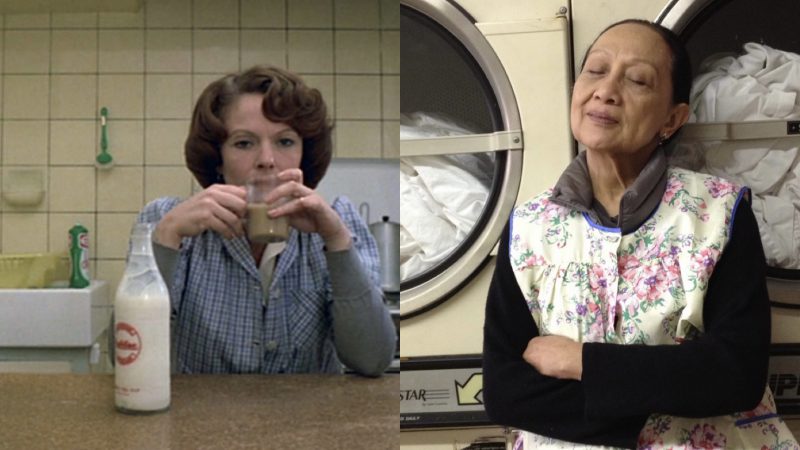
Chantal Akerman’s three-hour Jeanne Dielman, 23, Quai du Commerce 1080 Bruxelles and Lynne Sachs’ & Lizzie Olesker’s short film The Washing Society, albeit portraying two different kinds of housework, both share a common thread: these films are making the invisible visible.
The Washing Society tells a story about laundromat workers in New York City through vignettes of fiction, nonfiction, and performance art; the film is guided by the 1881 Atlanta washerwomen strike, where hundreds of washerwomen — mostly of African-American descent — went on strike after being underpaid by their bosses. The Washing Society continues this legacy by interviewing two laundry workers and a former laundry worker who went on strike in the 1960s. The film also tells its story through three characters — two women who represent the mostly immigrant, mostly Chinese or Spanish-speaking laundry workers in New York City, and one woman representing the ghosts of the 1881 strike. When we drop off our laundry at the laundromat, we come back with a fresh load of clothing without thinking all the work that is put behind them. Lynne Sachs and Lizzie Olesker focuses the camera on these narrow storefronts, rows and rows of washing machines, and the Sisyphean task of folding and washing clothes to bring forth that invisible labor that people don’t often think of.
My screening of The Washing Society was followed by a Q&A with feminist Marxist theorist Silvia Federici. Sachs has mentioned about how her work has been based on Federici’s work on Wages Against Housework. In her seminal essay, Federici argued that domestic labor is a form of production used to sustain other forms of work in a capitalist society. However, it is very convenient to make this form of labor invisible. A tenet of its invisibility is to mask this labor into a “labor of love” — that things such as washing clothes are marked as a care, therefore taking out the value of the work performed and expecting that careworkers are doing it based on willingness and kindness. Whereas, the reality is that these workers are indeedworkers and should be valued as such. Federici’s shaping of The Washing Society reminded me of another film, and is a helpful framework to understand it in a Marxist perspective: Jeanne Dielman.
Directed by Chantal Akerman (who has an interest of portraying domestic work on film), Jeanne Dielman is a story about a housewife who has lost her husband, therefore resorting to sex work to support herself and her teenage son. The film focuses on the minutiae of Jeanne Dielman’s day-to-day tasks; running errands is no longer a generally glossed-over issue in this film as we watch Jeanne cook meals, wash the dishes, grocery shop, and do the things we would consider as menial. While The Washing Society raises awareness to this invisible labor by employing narrative and performance art techniques, Akerman forces the audience to watch this invisible labor. The music is very sparse, the camera movement static, the pace moves slowly, making its audience truly see and listen to the details of Jeanne Dielman’s actions. The invisible, then, becomes hypervisible.
Through this hypervisibility there is a visual code that guides Jeanne Dielman’s actions. Once we focus on these mundane everyday scenes, we realize how repetitive it all gets. Folding clothes, chopping vegetables, boiling water. It’s almost like Sisyphus, rolling his boulder to the top of the mountain only to find it down on the ground again. Once the housework is done for the day, there will always be new loads to wash, more mouths to feed. Some would argue that this repetition is a type of performance art — as housework becomes hypervisible, we are exposed to the rhythm of this repetition and we are seeing it as a form of art in this context, rather than a task. The Washing Society continues this by actually transforming laundry work as performance art. In a few scenes, we see the two fictional laundromat workers rhythmically tapping on laundry machines and dancing on top of them. It is a form of ownership of their own labor — in a world where their customers and bosses do not see the value of their work, they make themselves visible.
What sets Jeanne Dielman apart from the women in The Washing Society is the solitary nature of her labor. Where laundromat workers work in groups and can form unions and negotiate against their bosses, Jeanne Dielman navigates through housework on her own. She is rarely seen communicating with people other than her son — we only see her communicate with her friends through mail, or through more laborious requests by her neighbor. She has no space to talk about these things, as the labor she performs at home is timed to a T.
However, what unites the two films are the internal space of the labor of housework. The internal spaces and thoughts of careworkers and houseworkers are often ignored, as people often impose that they’re thinking of care when they are approaching they work. The reality is definitely far from that — in a system where they work endless, repetitive tasks, they are constantly thinking. This thinking is then manifested in a form of action. The 1881 washerwomen of Atlanta forms a union and strikes for better wages. The fictional laundromat workers in The Washing Society expresses this stifled rage through performance. Jeanne Dielman, however, spends more time with her thoughts since her work is extremely solitary, and expresses them in a more pessimistic way.
What makes Jeanne Dielman’s labor more dire is that her labor isn’t valued in a tangible way. While laundromat workers are able to count their wages and identify wage theft, there is no way for Jeanne Dielman to price the value of her housework. In Capital, Marx took account the labor of housework, and including housework to be valued based on the family breadwinner’s labor-value (although this line of thought has been criticized by scholars like Silvia Federici, who argued to put a direct labor-value of housework itself). However, what happens when this breadwinner is taken out of the equation? Jeanne Dielman has to find a line of work that doesn’t interfere with her housework. In the film, she resorts to sex work, entertaining male guests in her home while her son is away at school. In the dialogue of both forms of labor that Jeanne Dielman performs, we can clearly see how both sex work and housework is tied to patriarchy — it is a form of work that is often invisible, and is dictated by the labor-value of the men who sustain the housewife/sex worker. It is not hard to see how these forms of labor are inherently exploitative to working women like Jeanne Dielman.
When we reflect on working women in patriarchy-dictated forms of labor, we have to also look at how it evolves in the future. Near the end of The Washing Society, Lynne Sachs narrates that most of the laundromats she filmed has closed, due to the rise of instant laundry apps that will pick up your laundry, wash them in an undisclosed location (where workers are completely hidden from their bosses and customers), and bring them back to you. Sachs and Olesker argues (in line with Silvia Federici) that technology has not liberated us. Instead of making work easier, work will eventually increase, and workers’ labor will be more and more alienated. If Jeanne Dielman lives in 2021, indeed, it will be easier for her to find jobs through remote work, but this work will fail to recognize how her housework will be much more laborious. COVID-19 has moved a significant amount of workforce online, and has led more bosses to assume that working from home allows workers more free time. The labor of housework was invisible from family breadwinners, and now is made invisible to bosses as well.
With the far-reaching consequences of technology to housework, we should also think about international solidarity. The rut of technologizing housework will fall to migrant workers and workers from colonized countries, as supply chain technology and transportation has eased the access of cheap labor from around the globe. This exploitation of colonized countries also lies in sex work: sex work has long become a justification for colonialism, and day after day men and women from colonized countries have been forced to enter this inherently exploitative line of work. Historian Gerda Lerner mentions how sex work is “the first form of trade, making them seen as less than human,” and that this is “the beginning of women’s subordination at the hands of men.” This exploitation still continues today through avenues like sex tourism and sex trafficking, which targets the poorest of working class women around the globe. This shows that patriarchy and capitalism definitely works hand in hand with colonialism, and that patriarchy and sexual exploitation are tools to further the empire of capitalism and imperialism.
Both Jeanne Dielman and The Washing Society brings forth these invisible strings in the lives of working women: hidden labor in housework and sex work and the exploitation that comes with it. Jeanne Dielman’s work may be solitary, but as I watched her do her menial tasks I am reminded of the hidden labor in the lives of the women I know. She experiences all of it alone, but her rage is universal, and makes me think about the power that working women around the world hold. These power materializes in labor unions, strikes, and revolutions. Working women around the world constantly continue to uphold the spirit of the women before them who also does this hidden labor, in worse circumstances of the progression of technology and the further alienation of their labor. It is up to us to fight for their rights and make the invisible visible.
The Washing Society and Jeanne Dielman, 23, Quai du Commerce 1080 Bruxelles are both available to watch through the Criterion Channel. Besides of watching both films, I also urge you to take action to support the working women in your community. Here are some current efforts in NYC (DM me if you want me to include more efforts):
Workers of the United Jewish Council (a home care agency), who are mostly Black/Latinx/immigrants/women of color, has been fighting to end the 24-hour work shifts imposed by the agency. They are holding a rally on Thursday, December 16 in front of the UJC office. More information on the AIW instagram: @aiwcampaign
After the Q&A, Sachs, Olesker, and Federici highlighted the work of NYC’s Laundry Workers Center. They are an organization aiming to support and protect workers in NYC laundromats. You can donate to their fund or check out their website for the campaigns they are running. More information can be found in their website: www.lwcu.org.
Several of her films are currently available to watch on the Criterion Channel
Whether portraying artists, historical figures, family members, or strangers, filmmaker Lynne Sachs has always found rivetingly indirect methods of representing her subjects. The San Francisco Weekly called her 2001 film Investigation of a Flame, about the Vietnam War and the Catonsville Nine, a group of Catholic activists who burnt draft files in protest, an “anti-documentary.” Sachs herself now uses the phrase “experimental documentary” as shorthand for describing the formal elements that constitute her particularly idiosyncratic and collage-like cinematic vernacular, notable in work like the decades-in-the-making Film About A Father Who (2020).
Rooted in her days in San Francisco’s experimental scene, Sachs’s concerns are deeply material; they regard the matter that makes up the world as inextricable from the technology that reproduces it. Her investigation of New York City laundromats, The Washing Society (2016), co-directed with playwright Lizzie Olesker, struck me as an apt departure point for our wide-ranging discussion about and around this material awareness, as well as the larger concerns that bridge the gap between her films as works of art and Sachs’s advocacy for worldly change.
I WANT TO START WITH A WEIRD QUESTION.
I like weird questions.
WHAT ARE YOUR THOUGHTS ON LINT?
I have been thinking about lint so much over the last few years. It started with my thinking about skin, and the epidermis, and about clothing being a second layer of our skin—which means that when we collect lint out of the dryer, we’re also catching aspects of our bodies. Sometimes it’s our own bodies, sometimes it’s the bodies of people we love. Sometimes it’s the bodies of people whose clothes are being washed in a transactional way…Iin that flow, you collect something most people think of as detritus. But I actually think of it as material, in the way that Joseph Beuys was really interested in wax and felt. So, lint is material for sculpture, and for an examination of our bodies. When that comes together, I find it very compelling.
I AM, OF COURSE, REFERRING TO A COUPLE OF SPECIFIC SHOTS FROM THE WASHING SOCIETY, WHICH EMPHASIZE SENSUOUSNESS, WHICH IS NOT A WORD I EVER WOULD’VE PREVIOUSLY USED TO DESCRIBE LINT.
That attention to the microscopic aspects that are residue of the much larger social relationships around service, hygiene, and the exchange of money for someone who performs something for somebody else—lint represents all those things.
IT MAKES ME THINK OF THE WASHING SOCIETY AS AN EXTENSION OF YOUR CAREER-LONG PREOCCUPATION WITH MATERIAL FILM, EVEN THOUGH IT WAS SHOT DIGITALLY.
When we look at traditional 16mm film, we see scratches and hair, like we see in lint. It’s not that different. Because lint collects through the months or ages, it collects aspects of the world. Film does the same thing; it is changed by its journey in time.
My co-director, Lizzie Olesker, and I wanted to figure out ways to examine the interplay between economics, aesthetics, and politics. You look at the form of cinema and you say, “I want to create ruptures. I want to create a radicalization of the way images are represented.“ But it’s also important to look not just at the way the camera reproduces our reality, but what is produced by the reality that might be dismissed or ignored. … Lint is not invisible, but it’s about as close to invisible as it gets. It moves from clothing to the trashcan in a kind of rote way. By breaking up that [journey], we’re trying to look at the mechanisms of labor.
THE WASHING SOCIETY FEATURES ACTUAL LAUNDRY WORKERS AND ACTORS. WHAT IS IT ABOUT THIS ASPECT OF PERFORMANCE THAT FASCINATES YOU AS A DOCUMENTARIAN?
It occurred to me about a year ago that every single film is a document of a performance. Even a fiction film, which is a bunch of people doing this crazy thing—to reinvent themselves, pretend that they’re different from who they are—we film it, and it’s called a fiction film, but it’s actually a documentary of a group of people together.
What’s started to interest me in the last year is that woven quality that takes seriously that anyone in, for example, a documentary film is performing an aspect of who they are. As soon as they turn their head and they see the camera, they’re performing. And there’s this, you could call it a leash, or an invisible thread [that runs] between my eyes and the eyes of any human being in front of the camera. They’re always looking to the director for some kind of affirmation, like, “Yes, you’re doing a good job.“ It’s the same in documentary. If you actually recognize that this is a form of exchange, then you can try to subvert it. People who are supposed to be ‘real’ become performers, or we have performers who open up about their lives . And so, obscure that rigid differentiation. That’s why I’m not really happy with the term ‘hybrid’ yet. Because it’s saying that this ontological conundrum doesn’t really exist, and that we have to create another category that says, “That’s ambiguously real and that’s ambiguously fiction.“
IN TERMS OF REAL-LIFE SUBJECTS VERSUS HIRED PERFORMERS, HOW DID YOU APPROACH WHO WOULD EXPRESS WHAT IN THE WASHING SOCIETY? THERE ARE TIMES, ESPECIALLY EARLY ON, WHEN IT ISN’T NECESSARILY CLEAR WHO IS WHO.
With filmmaking, there’s always two answers. There is the production answer: we tried one thing and it didn’t work, so we decided to go another way. And then there’s the more theoretical, maybe conceptual answer.
I WANT BOTH ANSWERS. I’M HUNGRY FOR ANSWERS.
Okay, the conceptual answer first. We wanted to research the experience of what it is to wash the clothes of another person. Particularly in a big city, where people and workplaces can be taken for granted. Lizzie comes out of playwriting, and this notion that you observe the world in which you live, and then you re-create characters who inhabit those experiences you’ve witnessed, or those interactions that confuse you, and that you’re trying to grapple with. And I come out of experimental filmmaking, with documentaries. So you observe and then you subvert.
She asked me if I would help her to investigate laundry workers in New York. We started, and we got really hooked, but most of the people who do this kind of service work in America are also immigrants, and many don’t have the formal paperwork to give them the freedom to be on camera, to talk about the struggles of their workplace or their bosses, who they’re supporting, all those things. So we would have very informal conversations, but we couldn’t record and we couldn’t film.
Our answer was not to give up, but to listen really actively, and then to write the characters, or to write three characters who appear in the film as composites of these conversations. So, there’s Ching Valdes-Aran, Jasmine Holloway, and Veraalba Santa. They’re all performers—the film started as a performance called Every Fold Matters, which we did live in laundromats in Brooklyn and in New York City, and at places like University Settlement, The Tank.
But then, okay, the answer to the conceptual side is that, even though I’ve been making work that you could call reality-based or documentary-based for a long time, I’m always questioning this notion of asking people to open up their lives for me. That’s why I made Film About a Father Who, because I felt like it was my turn to be in that vulnerable position.
One thing I’ve done for years now, I always pay people [who appear] in my films. That’s kind of anathema in documentary. People don’t do that. Especially journalists, which I do understand… But why shouldn’t you pay them the way you would pay an actor?
Often we measure the success of a documentary by how real it is, by the spontaneity of the reveal of information; “I can’t believe you got in that door.“ Or, “I can’t believe you got those people to say that for you with your camera on.“ There’s a lot of registers of success that have to do with the people in front of the camera letting it all hang out, and that’s an awkward exchange… I wanted to have people who felt confident in their place in the world, to speak from that position. If people didn’t feel confident, then we listened, and we tried to embrace their sentiments and struggles in a fictionalized way.
ARE THE ACTORS REPEATING TEXT THAT WAS SPOKEN BY ACTUAL LAUNDRY WORKERS OR WAS THAT TEXT WRITTEN BY YOU AND LIZZIE?
It’s both. We used parts of it, but often we wrote in a more free-form way. It’s really a composite, and there’s a freedom that comes from making a film like this. .. I call it the Maggie Nelson effect, [which is] this idea where you lay bare the research. In The Argonauts, she tells this personal story about her relationship, and she has these fantastic tangents, which are about her research, what she happened to be reading, letting all of that come in.
I can [also] say that we were influenced by Yvonne Rainer. She was such a visionary when it came to choreography, and a celebration of the body through dance. Because she looked at the quotidian, and she ‘deconstructed’— in the word of that period— how we move through the world. We took that approach to how we thought about the dance movements in The Washing Society, how we could re-examine the gestures of the everyday, and think about how they might be beautiful, in the way that Roberta Cantow’s film Clotheslines celebrates the beauty of laundry work. [Lizzie and I] wanted to think about recognising washing as a form of physical dance. Especially because there’s so much repetition, which dance also uses.
CLOTHESLINES HAPPENS TO BE PLAYING ALONGSIDE THE WASHING SOCIETY.
Clotheslines is fantastic. It’s giving attention, again, to urban life, and to things that people do that maybe they feel ashamed of doing but that they have to do. It’s interesting to look at Roberta Cantow’s film, because it’s a twist on the whole idea of being a feminist. Barbara Hammer did something similar; I think the term ‘feminist’ is evolving all the time.
What Roberta Cantow did in her work, I think, is say, “Let’s acknowledge the beauty of what mostly women do. But it doesn’t mean that they’ll become stronger women than when they don’t do it.” … I should add that today I had a conversation with Roberta Cantow. A woman she knew who organizes washerwomen in New York City told her about the screening. Anyway, she told me today that this whole group of organizers around washerwomen, 10 of them, are coming to Metrograph.
THAT’S EXTRAORDINARY.
Yeah. And I’m hoping [for] a group from the Laundry Workers Center, which is a union I’ve done a lot of work with, who organize workers in the small laundromats all over New York City… If they’re trying to shut down a laundromat or bring attention to conditions that are really, really bad—where people are required to work 12 hours, and they can’t look at their phones, or all the different rules that are had—[Lizzie and I] make videos for them sometimes.
DO YOU CONSIDER FILMMAKING AS A FORM OF ACTIVISM, OR ADJACENT TO IT? WHERE DO THE TWO INTERSECT?
I was thinking about this last night. I went to an event at E-flux, and I was listening to Eric Baudelaire, the filmmaker, talking about this too…. I don’t think I’ve ever made a film that had the ability to make someone act differently, or to push them in a direction. But I always hope it makes them think about who they are differently, or about how the world works in another way. Maybe the result of that would be an action. But if it’s just a thought, that’s pretty good too. I guess it has to do with results, how you measure your reach… I get very excited, like with Investigation of a Flame, by people doing things with passion, and pushing themselves to extremes from which they can never turn back. I mean, that actually goes to Barbara Hammer. [She] lived life to its fullest, and with so much conviction.
BEING IN DIALOGUE WITH OTHER ARTISTS, FILMMAKERS, OTHER PEOPLE, SEEMS SO ESSENTIAL TO ALL OF YOUR WORK.
Well, when I made Which Way Is East (1994), I didn’t at first understand that it really is about how we look at history, and how we analyze or reconstruct the past. That film is made from the perspective of myself and my sister. We were children who experienced the Vietnam War through television, mostly black-and-white images on a box in the living room. Being typical American, middle-class kids, our parents and their friends had not gone to war. The war was really far away… But you then grow up and you realize that it does touch you; you heard all the numbers of people who died, and you recognize that those statistics were always emphasizing the Americans, but what about the Vietnamese? How does war have an impact?
When we made the film, in the early ’90s, my sister, Dana Sachs, was living in Vietnam. I visited for one month, and, like a typical documentary filmmaker, you arrive in a place and you say, “I’m going to make a film.“ It came to me later that the film is a dialogue with history, but it’s also a dialogue between two women from the same family, who thought about that past in extremely different ways. She looked at Vietnam in this contemporary way, as survivors. Whereas I looked at Vietnam with this wrought guilt, trying to piece together an understanding of a war that still seemed to bleed. That’s what gave the film its tension, that our perceptions were so different. Ultimately the most interesting films are the ones that ask us to think about perception, that don’t just introduce new material.
So that was a gift, to be in dialogue with my sister… Another way of looking at dialogue, [if] you’re in dialogue with [someone like] Jean Vigo, who’s not alive… then you’re creating a dialectic between the materials. In A Month of Single Frames, I’m in dialogue with Barbara Hammer literally, but I’m also in dialogue with her through the form of the film, and with the audience. That was intentional, to have this ambiguity.
In A Month of Single Frames, she also does something that’s not about activism, it’s about solitude… thinking about her place in nature. It’s all about being delicately and boldly in the landscape. When she cuts up little pieces of gel and puts them on blades of grass, she’s doing the opposite of what a feature film made in Cape Cod would… You’d have all these people stomping on the dunes, getting permission to shoot, to take over a whole house, you’d need light, electricity… She wanted to do everything with the least impact. It’s not a film that she probably announced as a celebration of the environment. But to me, it is so much about not leaving your footprint on the land, but being there. I really admire that work.
DID YOU BEGIN THE FILM BEFORE SHE DIED?
The last year of Barbara Hammer’s life, she gave footage to filmmakers and said, “Do whatever you want, and in the process use this material that I love but could not finish. Because I can see that my life will not last long enough to do so.“
She gave me footage from 1998, which she had shot in a residency on Cape Cod. I asked her why she didn’t finish this film and she said, “Because it’s too pretty, and because it’s not engaged, it’s not political.“ She felt that the fact that it delivered so much pleasure just in its loveliness made it problematic. It was this gorgeous landscape, and a woman alone in a cabin. She thought there wasn’t a rigor to it. So she had never done anything with it; it just moved around with her, and it was bothering her, of course: “Finish me. Finish me.“
She gave it to me, and I started to edit. On the second visit, I showed it to her, just without any sound. I asked if she did any writing while she was there, and she said, “I kept a journal.“ She’d forgotten all about it, so she pulled it out.
THAT’S THE DIALOGUE WE HEAR IN THE FILM?
She even writes about herself in the third person, which is fun, and different…
Everything was so pressured: she had to go to chemotherapy, she was trying to finish Evidentiary Bodies, a film that she was going to show at the Berlin Film Festival in 2019. It was one of the last things she did. So I had the material, and when she died… I needed to finish it. That’s when I wrote the text, because I needed to be in dialogue with her more than just editing the material. I needed to concentrate on that energy between us.
SO YOU COMPLETED A FILM YOU HAD BEGUN WORKING ON WHILE SHE WAS LIVING, AND THAT SHE DIED DURING THE MAKING OF. AND THEN YOU MADE A FILM IN DIALOGUE WITH SOMEONE WHO HAD ALREADY DIED, IN E•PIS•TO•LAR•Y: LETTER TO JEAN VIGO.
I’ll give you a little background. I’ve been on and off involved with the Punto de Vista Film Festival, which is a really interesting small festival in Pamplona, Spain, where they acknowledge and appreciate alternative ways of looking at documentary film practice. They asked 10 filmmakers to make a film in the form of a letter to a filmmaker who had influenced us.
I chose Jean Vigo; I love his film, Zero for Conduct (1933), because it is so much about rule breaking. It is so much about trying to exist in society, but knowing when there is a time to break the law. I had made my film Investigation of a Flame; I was interested in those moments where you have to turn inward and say, “This is wrong.“ And I wanted, again, to talk to a ghost. To talk to Jean Vigo.
Then, right at the beginning of this year, there was the attack on the US Capitol. A group of thousands chose to break the law, with absolute abandon in terms of the sacredness of other people’s bodies. I’m not even saying the US Capitol is sacred. But to go to a place of heinous destruction, that really disturbed me. I was already thinking about Jean Vigo, and I thought, “This is really complicated.” Because at what point do we learn to understand how to respect, how to have compassion, how to have empathy? That you can break rules, as in paint graffiti or burn draft files, but that once you start invading another person’s body— it’s a violation I couldn’t accept. And this space between anarchy and authoritarianism, and between compassionate rule breaking and violence was very interesting to me.
WHAT ABOUT REVOLUTION? WHAT ABOUT A FEMINIST SOCIALIST REVOLUTION?
Oh. Well I have to say, a feminist socialist revolution probably would come with a lot of compassion. I think, I hope. But I would never say that women… I don’t think that there’s anything innate.
One other thing about E•pis•to•lar•y: I really like all the syllables in epistolary, so I like that it sounds like bullets. And yet it’s about dialogue… It may be silent, but audiences are writing back in their heads. I think a lot about that in my filmmaking, all the sounds that go on in audiences’ minds.
ARE THE SUBJECTS OF INVESTIGATION OF A FLAME (2001), THE CATONSVILLE NINE, YOUR MODELS THEN OF RIGHTEOUS DISSIDENTS?
My interest in people who break the rules goes way back. I mean, I was protesting the implementation of imposing draft registration on American men when I was in high school. I’ve always been committed to trying to articulate a critique. But when I heard about the Catonsville Nine and this group of people who had nothing to gain by criticizing the US government’s presence in Vietnam, except that they were so upset that they felt they had to speak out against it…
They were Catholic antiwar activists: two priests in particular, Daniel and Philip Berrigan, and a nurse, and a sister, and others. But they broke the law in the most performative way. To take draft papers and burn them [with] napalm…. Napalm is not that different from lint. It’s just soap mixed with chemicals. You can make napalm at home. It’s domestically produced napalm, which was being used in Vietnam. But [the Catonsville Nine] wanted to make it and burn it symbolically. This, to me, was the ultimate art performance piece. Let’s burn files, photograph it, disseminate it, and say that these files represent bodies.
People said that they changed so much thinking. It was effective because it was an image that… You were asking about activism, that’s an image! To see priests burning draft files, that’s going to change things. That’s real activism on their part, and that happened in the 1960s.
FROM LINT TO NAPALM. THANK YOU, LYNNE.
I never thought… But it’s made with soap!
Inney Prakash is a writer and film curator based in New York City and the founder/director of Prismatic Ground.
Since bursting onto the filmmaking scene in the 1980s, Memphis-born Lynne Sachs has compiled an inimitable, astonishing body of work which includes essay films, diaristic shorts, gallery installations, and quite a number of simply uncategorizable hybrids. Sachs’s wide-ranging, restless ingenuity is on full display in this program, which includes her 2020 documentary portrait A Film About a Father Who; The Washing Society, her collaboration with playwright Lizzie Olesker, which premiered in 2015 at a Clinton Hill laundromat; and this year’s E•pis•to•lar•y: Letter to Jean Vigo, a ruminative, surprising response to the January 6th Capitol Hill riots. A blast of engaging, and engaged, cinema.
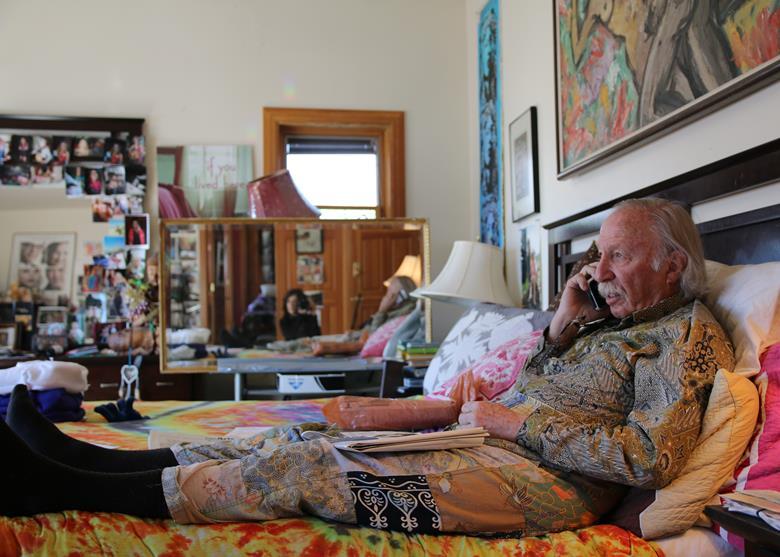
Made up of footage shot by Sachs between 1984 and very nearly the present day, Film About a Father Who represents her endeavor to better understand the outsized personality and myriad affairs of one Ira Sachs, Sr.: Park City, Utah, hospitality industry mogul; bon vivant hippie businessman; serial womanizer; and the filmmaker’s father. Analog and digital video shares space with 8 and 16mm film in Sachs’ decoupage of home movie formats, creating a tenderly critical mosaic portrait that’s as energetic, multifaceted, and messy as its subject.
Sachs’s The Washing Society, co-directed with playwright Lizzie Olesker, uses a combination of interviews, re-enactments, and patient observation to pay lyric homage to the little-acknowledged but essential labor of dealing with dirty laundry, as it occurs every day in New York City’s laundromats. Screening with Roberta Cantow’s feminist forebear Clotheslines, a film that takes laundry seriously as a form of folk art, a fraught social signifier, and a lens for women to reflect on the joys, pains, and ambivalences of household chores. With Sachs’s short “A Month of Single Frames” made with and for Barbara Hammer.
Co-Directors Lynne Sachs and Lizzie Olesker will be present with special guest feminist scholar Silvia Federici for a post-screening conversation. Hosted by Emily Apter.
Post-Screening Conversation for WASHING SOCIETY + CLOTHESLINES +A MONTH OF SINGLE
Co-Directors Lynne Sachs and Lizzie Olesker with special guest feminist scholar Silvia Federici in a post-screening conversation. Hosted by Emily Apter.
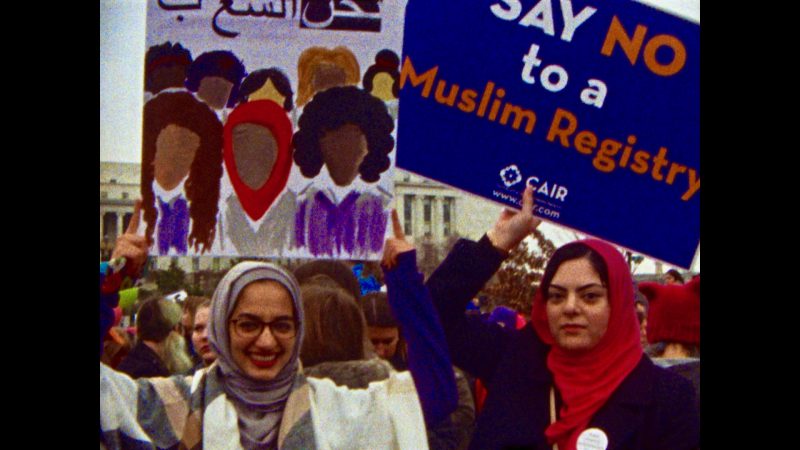
Four shorts exemplifying the breadth and tireless curiosity of Sachs’s film practice, as well as an ongoing engagement with issues of justice and resistance. The Ho Chi Minh City–Hanoi travel diary Which Way is East: Notebooks from Vietnam offers an encounter between lived experience and mediated memory of a televised war. And Then We Marched juxtaposes 8mm footage of the 2017 Women’s March in Washington D.C. with archival images of earlier struggles for justice. E•pis•to•lar•y: Letter to Jean Vigo looks at the January 6th Capitol Hill uprising through the unlikely but revealing prism of Vigo’s 1933 Zéro de conduite. Investigation of a Flame revisits the story of the Catonsville Nine, Catholic activists who burnt draft files in protest of the Vietnam War.