
https://www.128lit.org/lynne-sachs-yehui-zhao-interview
Yehui Zhao: I want to start by recalling a very memorable scene from your film, Tip of My Tongue (2017), that has lingered on my mind for many years. I’d like to share a quote from a statement of yours for the film:
“To celebrate her 50th birthday, filmmaker Lynne Sachs gathers together other people, men and women who have lived through precisely the same years but come from places like Iran or Cuba or Australia or the Lower East Side, not Memphis, Tennessee where Sachs grew up…Together they discuss some of the most salient, strange, and revealing moments of their lives in a brash, self-reflexive examination of the way in which uncontrollable events outside our own domestic universe impact who we are.”
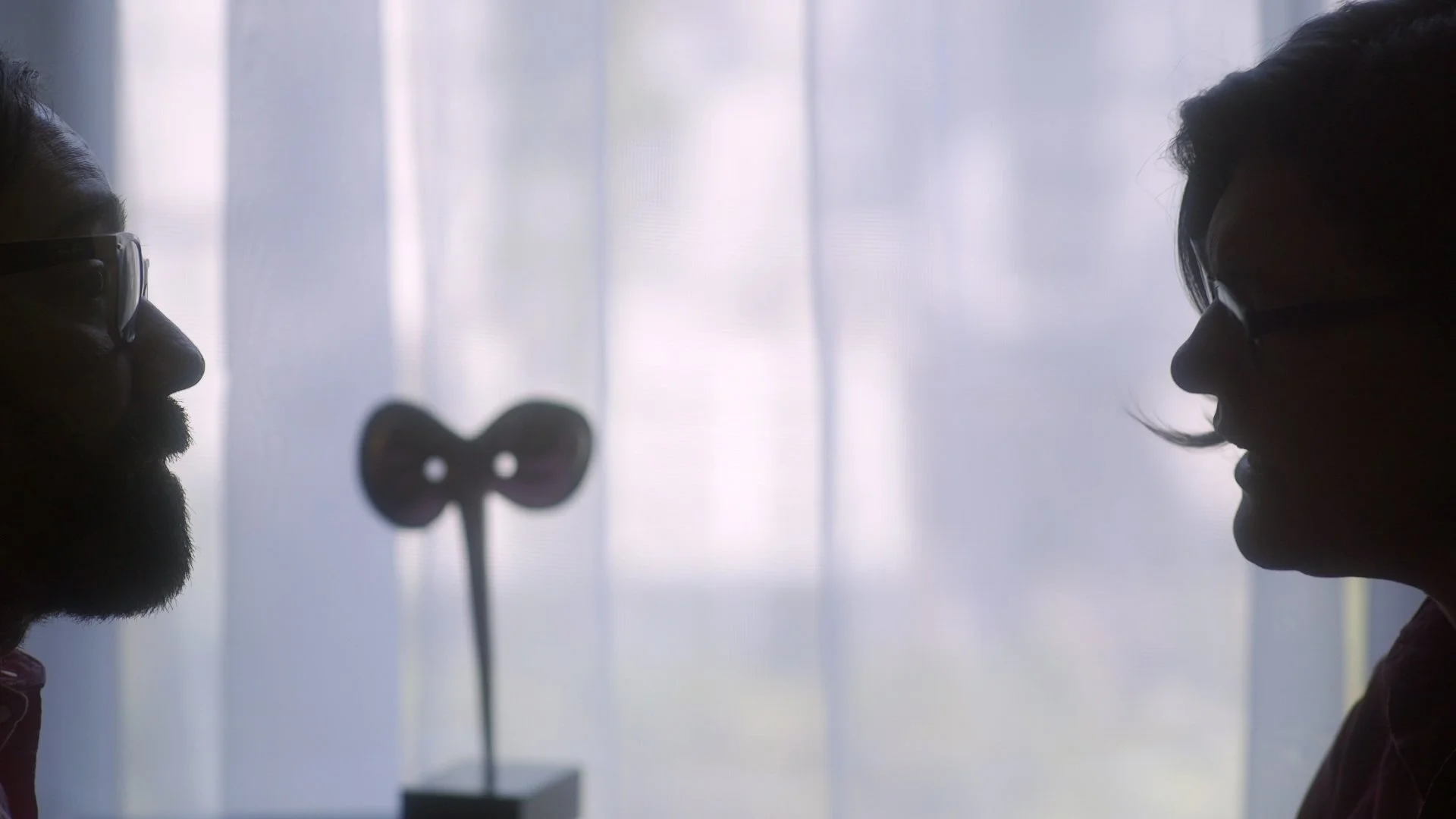
One of the film’s participants, Sholeh, talked about being a mom during the Cultural Revolution in Iran in 1979 when the monarchical government was overthrown by a religious cleric. With no diapers for her baby and a strict dress code, she recalled a hot summer day when she went to the post office wearing a garment and scarf that covered her entire body. While waiting in line with her baby, she felt this “wetness, a sour smell, and a thick yellow color.” There was no access to a public bathroom. When she got home, she placed her baby in the bathtub and the smell spread throughout the house. She said, “Her, me and the faucet, we were all weeping.”
While Sholeh recalled this, we saw a scene of beautiful magnolia flowers in early bloom. The fragrance of magnolia had the effect of amplifying the foulness, making the smell even more unbearable.
Lynne Sachs: My gosh, I love that detail that you have noted.
YZ: You’ve assigned meaning within the story to that magnolia, which is something you do in your films. Can you talk about the process of creating meaning through films?
LS: I actually think it’s interesting that you use the term “assigned meaning” because it sounds like a responsibility, but it also is this exhilarating opportunity to give an object a resonance. I think it was Emerson who said, “Things are in the saddle.” Do you know that quote? It means that in some ways we look at things as being too weighty in our lives, like our cars or our homes. They’re in the saddle, and they control us. They’re driving us. In another way, we could say things are in the saddle—not needs, not hungers, but the objects in our lives that evoke memories, relationships, or meanings, much like what you just described.
Honestly, I couldn’t say for sure that I thought about aroma or smell when I put that shot in, but I love that you brought it up. As you know, we learn to appreciate decisions that we make in filmmaking, from really observant spectators. Maybe it was in my mind. I’m trying to remember, but I don’t think that I could give myself credit for that. But I loved Sholeh’s story as a distillation for a moment in history. When she told me that, I knew it would help me better understand this tumultuous moment in her life when she was thrown into motherhood instead of living out her zesty, outlandish, and young womanhood. She told me it was during the pre-revolutionary period in Iran, when she could walk around in a miniskirt. Can you imagine in one year going from that kind of personal freedom to wearing the veil and being an 18-year-old mother? I’m not trying to elevate miniskirts, mind you, but they do represent a kind of comfort with revealing your body in public.
YZ: It’s these very dramatic changes in the social environment that have an impact on people.
LS: In some ways, it’s like the 1973 decision here, when abortion became legal, and then in 2022, when the constitutional right to abortion was overturned, making it illegal or unavailable in at least twenty-one states around the country. Those are situations where a major shift in history seeps down into someone’s most intimate life.
YZ: As the director and participant in Tip of My Tongue, you also created Year by Year Poems (Tender Buttons Press, 2019), a collection of 50 poems, one for each year of your life. In the book, you tied together major social events with very intimate moments in girlhood and womanhood. What was your process like in creating this book, and are you still writing more?
LS: I do write. I’m actually finishing a film called Every Contact Leaves a Trace. So I’ve been writing a lot for that. But I have a mission to write about the next 10 years of my life for Tenement Press. I’m a little behind. I haven’t started writing that series. It’s the first thing I want to do when I finish this film. You and I were talking just a few weeks ago about this sense of trying to have closure for one thing so it doesn’t tarnish the next, meaning whatever you’ll be working on in the future. I need to write those poems when I’m not thinking about the practicalities of finishing a film. As I keep saying, and as we both know, film necessitates a lot of producing, which we don’t have to do for poetry, right? I’m looking forward to that headspace of reflecting on the last 10 years or so of my life in the same spirit of Year by Year Poems. I wrote a lot of poems during the pandemic. But they were very much in that moment. They weren’t looking back at my history at all.
Over the years, I’ve found a lot of, let’s say, gratification in workshops I’ve taught where I talk about Year by Year Poems and Tip of My Tongue with people who don’t usually write poetry. I say, “This is a construct by which you can enter the poetic discourse, and also think about who you were in a moment of history.” People have found that to be provocative enough as a way to distill moments in their own lives, creatively. I really love the gesture or the impulse to distill.
From Tip of My Tongue. Image courtesy of Lynne Sachs
It’s a key aspect of Tip of My Tongue that goes back to a professor I had in college, Naomi Schor, who wrote a wonderful book called Reading in Details: Aesthetics and the Feminine (Routledge, 1987). Let’s say you’re reading a novel by Balzac or from another author. Most people will read it as a vivid, rich story and immerse themselves in the characters. What she was saying, and she said this from a feminist perspective as a literary discourse, is that the details—like the magnolia you spoke about—start to take on a resonance. It’s something the reader is left with that goes beyond the narrative or the plot and leaves its mark. I loved her insistence on details and distillation, maybe because I don’t really fancy myself a storyteller in the traditional sense. I like to accumulate details and then see how they create new meaning, as you said earlier.
YZ: The process of accumulating details—is that how you wrote this book? Through collecting details over the years? What was that process like?
LS: One of the great things about writing that book was that I chose to throw myself into each year of my life. It was overwhelming because so many things happen in 365 days. But once you land on an image in your head that resonates, you can let everything else fall away. People say to me, “Well, how do you remember what happened in 1961?”, which is the year that I was born. And I say, “No, no, no, no. I don’t rely on memory at all and could never claim that I remembered that year.” I can only give myself permission to, let’s say, reconstruct my infancy and look back on it through my present time. I remember thinking about the house where my parents lived until I was six. In my mind, I was able to recreate a presence for a baby in that room, then imagine what might have been there at the time. Then I just worked it out. That’s totally how I make films. I work from the center. I don’t impose a story on it. Let me just go to that poem.
1961
Born at dinner time on an August evening,
the child of a twenty-one and twenty-three-year-old
a crystal ball at my fingertips
smooth and inviting, deceptively transparent.
I touch its surface with my wet tight fist.
Glass shatters the delivery room.
Our future blows beneath the bed
down the hall
out the front door of the hospital
into sweltering Memphis darkness.
I wrote about how the glass shatters the delivery room, and about a crystal ball, which, of course, there was none, but I’ve always been fascinated by crystal balls and how people look into the future. A poem gives you that freedom to insert objects or things.

From Tip of My Tongue. Image courtesy of Lynne Sachs
I want to introduce one idea that’s very mundane. You can go on Wikipedia and type 1975, for example, and it will tell you all the public historical events worthy of recognition that went on in the United States and worldwide. It also tells you about culture, like the most popular songs at the time. That was extremely helpful. I didn’t rely on it, but it brought back the past in this shared communal way. I really respect Wikipedia because of how it is generated. It was very helpful to just get that whole milieu thrown at me in such a generic way. I could find my way and carve out my own relationship to a moment in time. For instance, 1976 in the United States was a big patriotic year. It was the 200th anniversary of the country. Honestly, most of what happened was very tacky and overly patriotic. People would make quilts or they’d have special gifts at the gas station, things like that. But it allowed for this flood of memories for me. I’m a little embarrassed to say that I used Wikipedia, and that it was actually very helpful.
YZ: The first time I met you was when you were teaching Frames and Stanzas, a film and poetry workshop in Hunter College’s Integrated Media Arts program. So that’s what you assigned us to do, to write poems through locating past events on Wikipedia. We picked three years from our lives, including our birth year, and wrote a poem for each one. Then the whole class created a book of poetry.
LS: Right. I remember that because then we read them in chronological order.
YZ: We actually created our own collective archive of history with Wikipedia’s help.
LS: I remember using that research approach with your group, which was probably the first time that I referenced it. And I’m sure that it’s very, I don’t like to use East-West, but I’m sure that it has a certain orientation towards the United States and Europe for that history, I’m guessing.
YZ: I think so because most of the internet users are based in the West. It was powerful to write and read our book of poetry together. I remember that so well.
LS: Thank you, I really enjoy your questions. As you look at your own crystal ball, you don’t seem to see the befores or afters. You see a constant present. And I think that’s kind of how I work. It connects to my poetry writing and to my films. One line generates the next, but the flow is not one of cause and effect. It’s the same with my filmmaking. I get excited by juxtapositions between one shot and the next because something magical or implied occurs between the two shots. It might not be there in the words, but it’s a way for you to infuse it into the film, and that’s not traditionally how filmmaking has evolved, at least in the mainstream. I really go back and forth between film and poetry. Film’s relationship to time is potentially mimetic, though it doesn’t need to be. If we feel exhilarated by other kinds of juxtapositions, then that mirroring of reality can leap outside of time. And I think that leaping is sort of what happens inside the crystal ball, because you could also look into the crystal ball and see the past, as well as the future. Ultimately, the crystal ball is just a reflection on you. You look at it and you see refractions of your own face. That’s all you see.
YZ: I was very lucky to have seen Contractions (2024), your latest film, at DCTV’s Firehouse Cinema. The film is about the discontinuation of abortion services at a women’s health clinic in Tennessee. You’ve carried a tradition of performance in this film. In another film of yours, The Washing Society (2018), there was a scene where the workers danced with the laundry machines and created movements and beats. In your definition, what is performance in film? And how do you create it?
LS: Okay, first of all, I believe that at every moment in front of the camera, people have an implied power relationship to the director. I’m going to take a step back and say that you’ve probably noticed that when you do an interview with someone and ask them a question, you nod. So, you ask me a question—or maybe you just watch me—but let’s say you ask me a question, and I respond. I’m watching your eyes, I’m watching your face, and you’re acknowledging that what I’m saying serves your needs. You’re nodding in the way that nonverbal communication works in society. You’re nodding and saying, good, good. And I think that happens implicitly in every filmic moment, unless the camera’s hidden. And it doesn’t matter if it’s a narrative film with actors or it’s a documentary with people who are players or participating in a real life scenario. If they have agreed to be in the film, they have agreed to follow the rules. They’ve agreed, in a sense, not to yell profanities. If you signed a release with them—maybe you didn’t—they’ve agreed to perform as they normally would. There are all of these expectations that come with being in front of the camera. It’s a power relationship that I believe is problematic.
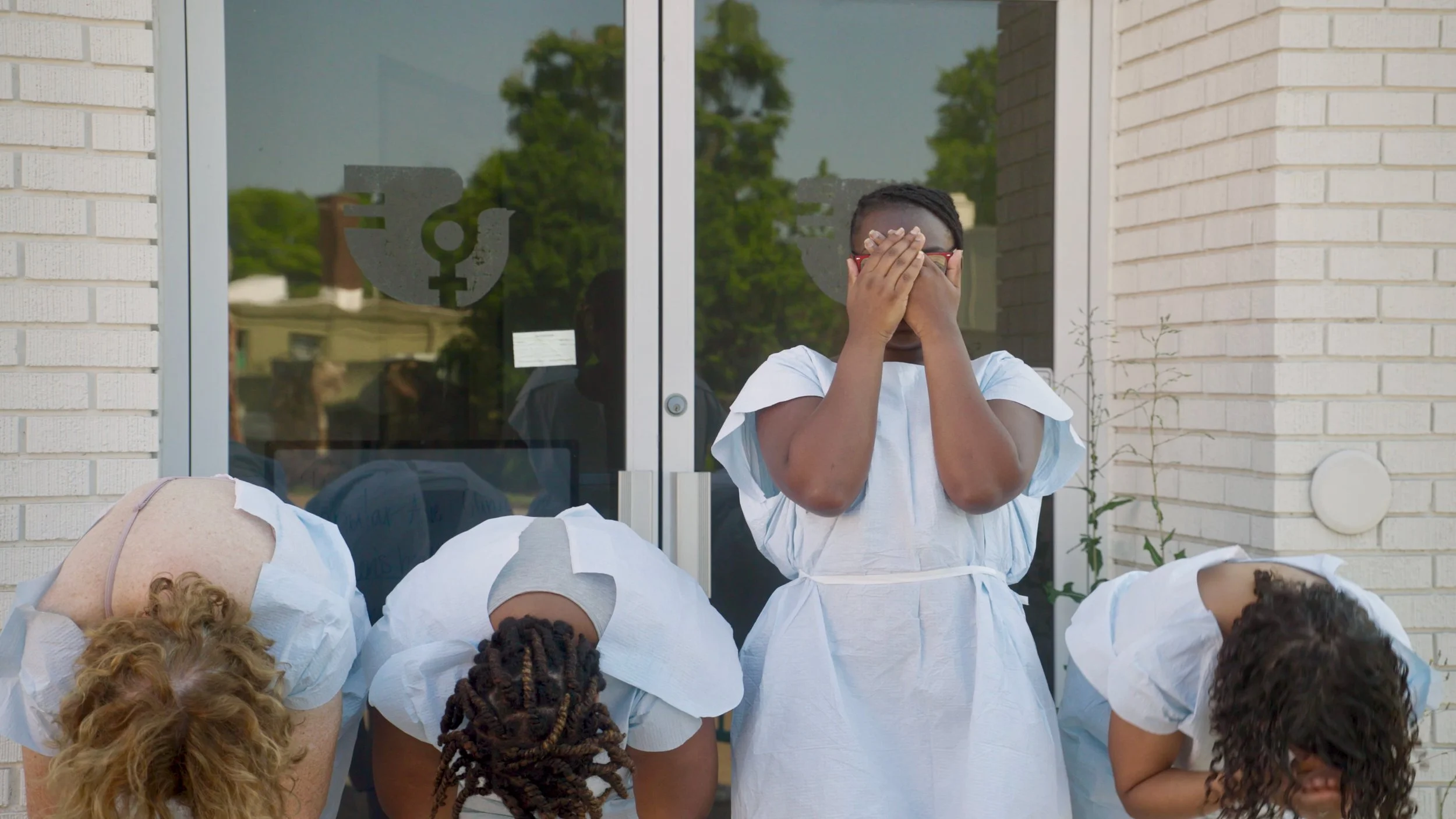
Ultimately, when I decided to make Contractions, I created a scenario where I was the director, asking my performers, participants, or collaborators to move in a certain way and wear a specific costume—a patient’s robe from a doctor’s office. In other ways, they had a kind of freedom because their backs were to the camera. This gave them a sense of fluidity and liberation, freeing them from being pegged in a particular way—whether by age or by being considered a good or bad performer.
From Contraptions. Image courtesy of Lynne Sachs.
They felt integrated but not projected upon. And that’s not something that I really understood before I did it. My initial impulse was to give them anonymity because it was a very charged situation around abortion in a state where women no longer have complete bodily autonomy. The state has severely limited the right to an abortion, essentially making it illegal. Now, as I reflect on it, I realize the 14 performer-activists in the film were able to perform because they had moved away from their personal identities. This shift gave them internal permission to engage artistically and dramatically, freeing them from the concern of how they looked or how they were perceived in the image.
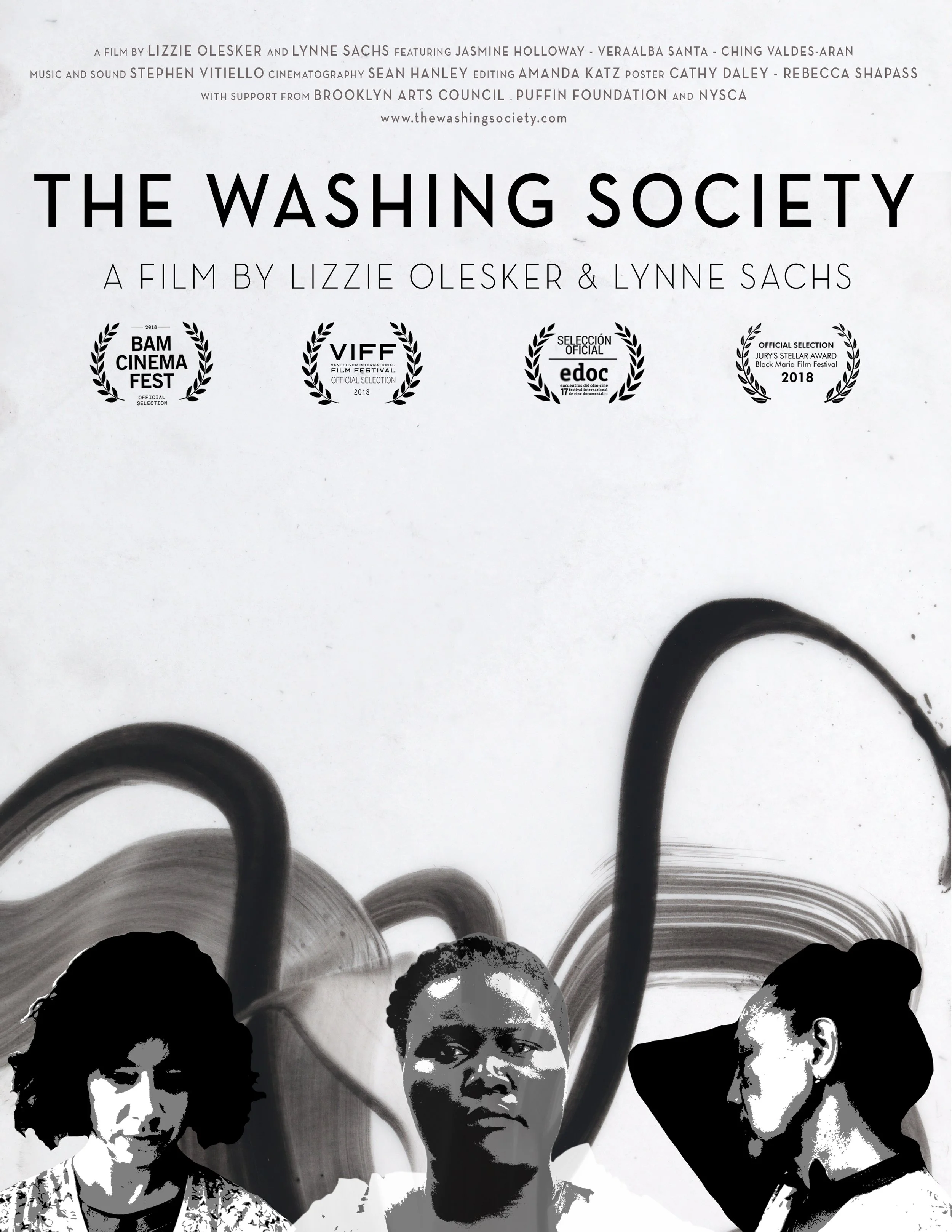
In The Washing Society, my co-director Lizzie Olesker and I were working with two women in particular, Veraalba Santa and Ching Valdez Aran. They both had an enormous amount of experience as actors. When they were placed in that film in a laundromat, they could loosen up a little bit and create an ambiguity between who they were as members of the artistic community of New York City and their roles as laundry workers. Class is an issue. In a laundromat, they created a fusion of identities across class lines which sometimes confused people in the film. When we did the live performances, people were wondering who’s real and who’s not. I love that. I love that a viewer is thrown into a little bit of uncertainty, which might become revelation, in a meta-way, let’s say. When I’m reading short stories, when I’m reading something that you would call a mystery, where you have that moment of not knowing who you are and where you’re going and then it all settles in, you feel a charge when it all starts to become apparent.
It’s the same with poetry. It’s that moment when you read poetry and say, “I’m not familiar with this poet’s vernacular.” And then by the end of the poem, you want to circle back and read it again because you speak their language. So that excites me. And when people say, well, I was confused at the beginning because I didn’t know who was real and who was not, that’s taking the viewer to a discourse that’s very heightened and that they rarely go to.
YZ: I felt that in Contractions performance activates reality. I felt the same about The Washing Society. I also really like this idea of dancing between real and unreal…
LS: One of the reasons we make our work is to create echoes. An activation of a new point of awareness is fundamental to me. That’s been a guiding principle of my work for a long time. Like for the title of Which Way Is East (1994), some people said to me, “You need to put a question mark on ‘Which Way Is East.’” But I didn’t want there to be an answer. I wanted it to be suggested from a position of acknowledging that it’s only an orientation, especially on a globe.

From Which Way Is East. Image courtesy of Lynne Sachs
YZ: I’m curious as the director, when you’re working with, let’s say, characters or participants, how do you invite them to perform? Do you give them prompts? What’s the process like?
LS: Okay, I’m going to say something that’s a bit cinematic which might speak to you. I like to think about the body in space. Sometimes, when I’m working with people, I think of them in a diagrammatic way. I think about a person being almost like a cat, or like a character from an alphabet. I really love silhouettes. I adore that. Not that the performer would think of themselves as a silhouette, but I focus on their bodies moving in relation to one another, shifting attention away from the face. One of the things that’s really important to me is suggesting that not every emotive experience originates in the face, although I shoot a lot of closeups of the face. I’m reminded of Roland Barthes’ famous essay, The Face of Garbo (1957). You may have read it—he writes about how Garbo’s face is so expressive, so ostensibly affecting. Whether it invites you in or keeps you out of Greta Garbo herself is something I can’t claim to know. I like when the face, or the gesticulation of the body, like a cipher, reveals something about the energy between two people or what’s happening internally. So, if you ask about a prompt, sometimes I say things like, “Move in the space and be responsive to objects in the space as if they were other human beings.” I don’t actually ask people to read lines over and over again, but I ask them to move and then to see where the words tumble out. In The Washing Society, we wanted the machines themselves to become like surfaces you could slap.
Poster of The Washing Society. Image courtesy of Lynne Sachs
One of the things that we tried to do was to take an object that seemed inanimate and make it feel animated, like slapping a washing machine is, in a way, ridiculous, but it’s also sort of slapping at the moment, slapping at history. Doing things that are out of the ordinary in a very ordinary space is very interesting to me. In Contractions, moving your body closer and closer toward an abandoned building with your back to the camera, surrounded by other people, on a sunny June day, creates an unfamiliar, anxious dynamic. But I suppose that’s intentional—leaning into the unfamiliar often heightens behavior in front of the camera. I never want my performers to get too comfortable. That said, I do rehearse with them, and I always film the rehearsals. For me, rehearsals are part of the discovery process, which I find incredibly exciting.
YZ: Going back to how I met you, which was during the Frames and Stanzas workshop, something that really struck me from the class was your approach to sound. Unlike the traditional notion that dialogue must be recorded with almost no background sound, you really value the sound of the environment. In your work, we can often hear, for example, a flushing toilet, footsteps, children laughing, or crying during voiceovers. What’s your philosophy with sound and how do you generate a rich soundscape while on set?
LS: I’d like to talk about a point in The Washing Society that ostensibly would have been referred to as a mistake, but it’s often people’s favorite part of the film. The two main actors, Ching and Veraalba, are sitting on a bench inside a laundromat where we’re filming. Off camera you hear a man who comes in and says, “When are you gonna finish this? I need to get to my wash.” He was a customer. We could only afford to rent the laundromat for our production for a few hours. The owner of the laundromat told us we need to open it up for the customers unless we want to pay several thousand dollars for the whole day, which we didn’t. At that point, the customers started to come in and they were a little resentful of us being in the way. This particular man started to yell at us, so we stopped the camera, but we didn’t stop the sound immediately. We ended up getting all this extra sound of him continuing to be irritated and a little bit aggressive.
The performers stayed in character, and they said, “We’re making a movie.” This elevates it, as if to say, “We’re doing something special, which is more important than your wash, than your clothing.”
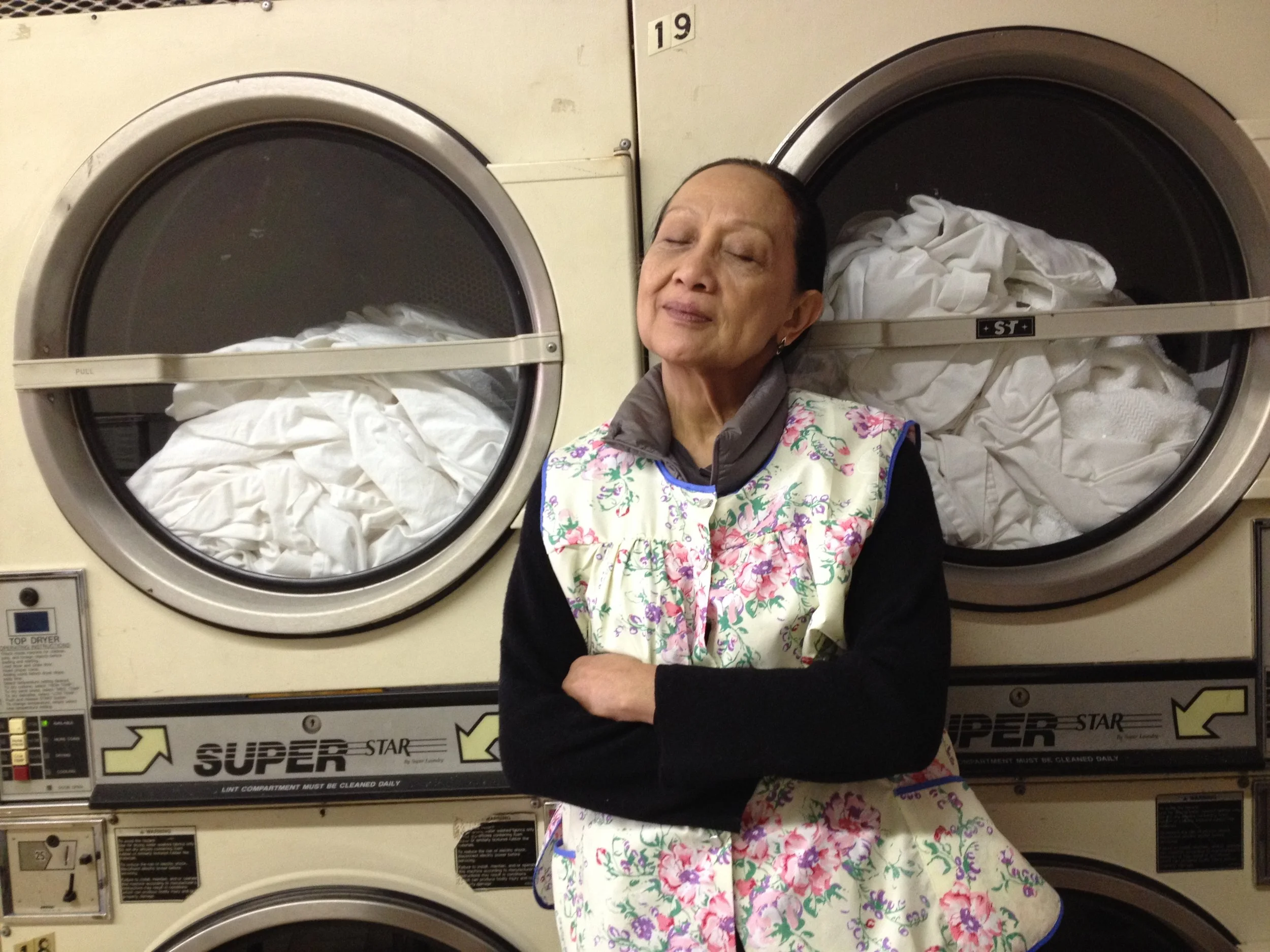
From The Washing Society. Image courtesy of Lynne Sachs
Of course, it’s not true, but you know, it’s the way our culture works: This is a movie. We need to stop traffic. We need to shift over and do whatever this director needs, even if you’re not being compensated for it, because this is a movie. Anyway, so they said, we’re making a movie and he didn’t care. I liked that irreverence. When we were editing the film, our first impulse was to take that part out. It’s so humiliating. But then, as we were editing, we started listening again to this outtake—this moment where someone from outside our diegesis, let’s say, was actually puncturing the hermetic space of the movie set. The idea of perfection in a traditional production is absolute silence. People say, “Quiet on the set!” right? And then everybody does it, even passers-by. Everybody’s quiet. It’s part of our social contract. But in this case, this man didn’t want to be a member of that compliant class. He wanted to take care of his own business, and he punctured our world. That became significant because he threw the creation of our movie space into disarray. He brought in the real world, and it became all the more interesting. It was very special because isn’t that inherently part of the surprise of making films? And haven’t we learned that the disruptions are actually the most revealing parts of the process?
YZ: You’re an icon of creating and experimenting and you’re a prominent feminist filmmaker.
LS: No, no, no, no, no, no, no.
YZ: To me you are. For how many years have you been making films?
LS: My very first Super 8 film was made in 1983. There were actually two films: one called The Tarot and the other called Ladies Wear. I was 22 years old, having just graduated from Brown University where I was actually a history major, focusing on intellectual, women’s and medieval history. I also did a lot of studio art, but I didn’t make films as an undergrad. I discovered experimental film and film as poetry during my junior year in Paris. After college, I moved to New York and thought, “I’ll take a filmmaking class.” I took one, but ultimately didn’t enjoy it very much—because my teacher believed all short films had to have a punchline. I’ll never forget what he said to me at our final film show: “Are you a liberal arts student or something like that?” Like it was a stain.
I learned how to make films and ended up making two in 1983. The first one was a project I approached with great gusto and intention. It was called The Tarot and starred my best friend Kathy Steuer, who grew up with me in Memphis, Tennessee, and also lived in New York. It was a film about a young woman trying to figure out what to do with her life. So she goes to a tarot reader and she has her cards read. Then you see this animated scene with her turning into all different kinds of women.
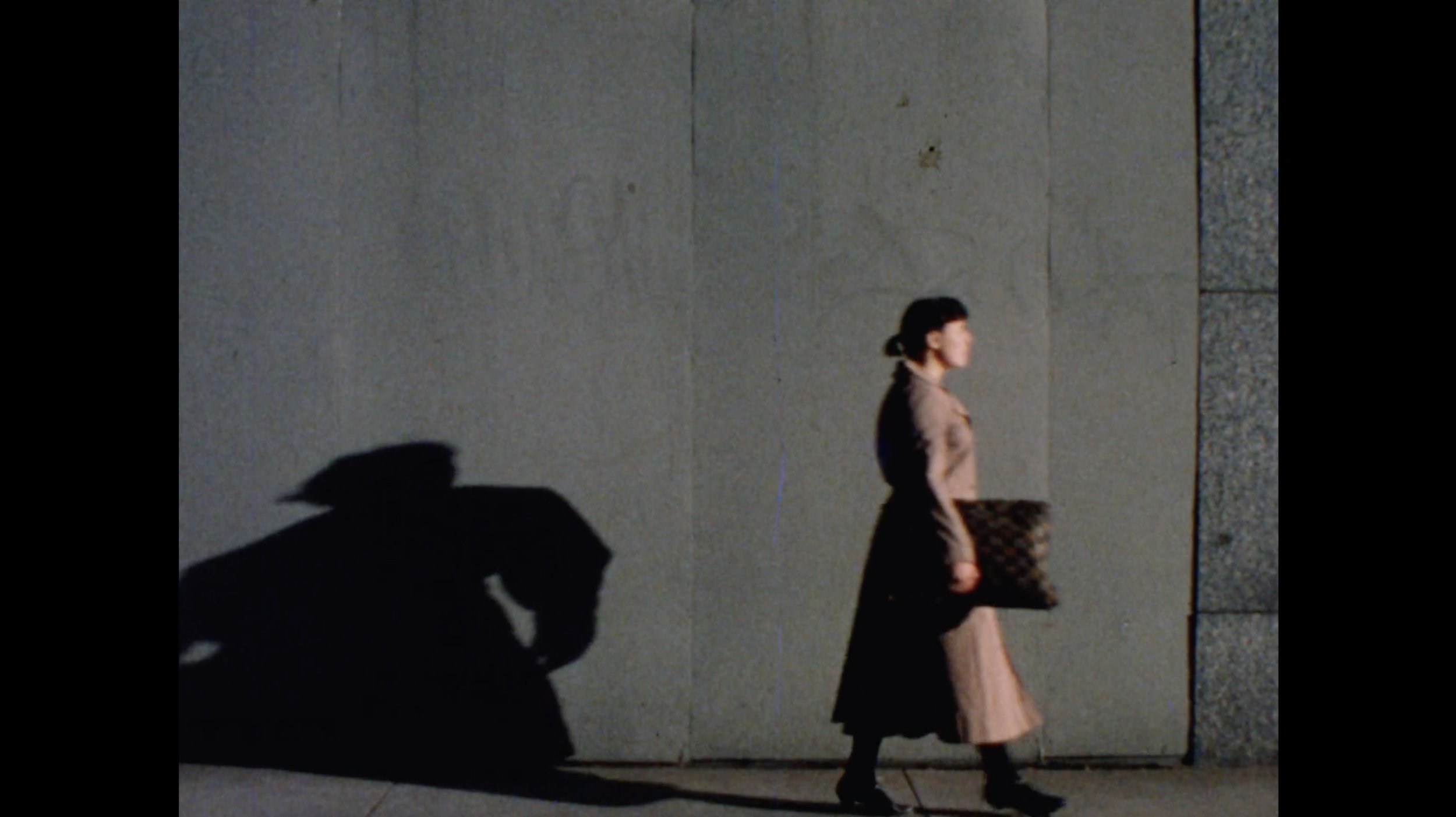
From The Tarot. Image Courtesy of Lynne Sachs.
That was it, just three minutes. The splices were so bad that the film barely ran through the projector. Kathy came to the screening totally dressed up with a big boa around her neck. You know, like a big, flashy scarf. The story was quite literal. A young woman has her future read like a crystal ball, and then she imagines herself that way, and that’s it. It’s kind of embarrassing. I projected my life on my best friend. She’s still my oldest friend because we’ve known each other for 63 years.
Then I made another film that I never edited at all, because I really didn’t know how to edit very well. It’s called Ladies Wear since there was a sign on a store in the fashion district that read “Ladies Wear.” This is an old-fashioned expression for workday clothes that women wear. The whole film follows my brother, who was 18 at the time, as he rides the New York City subway.
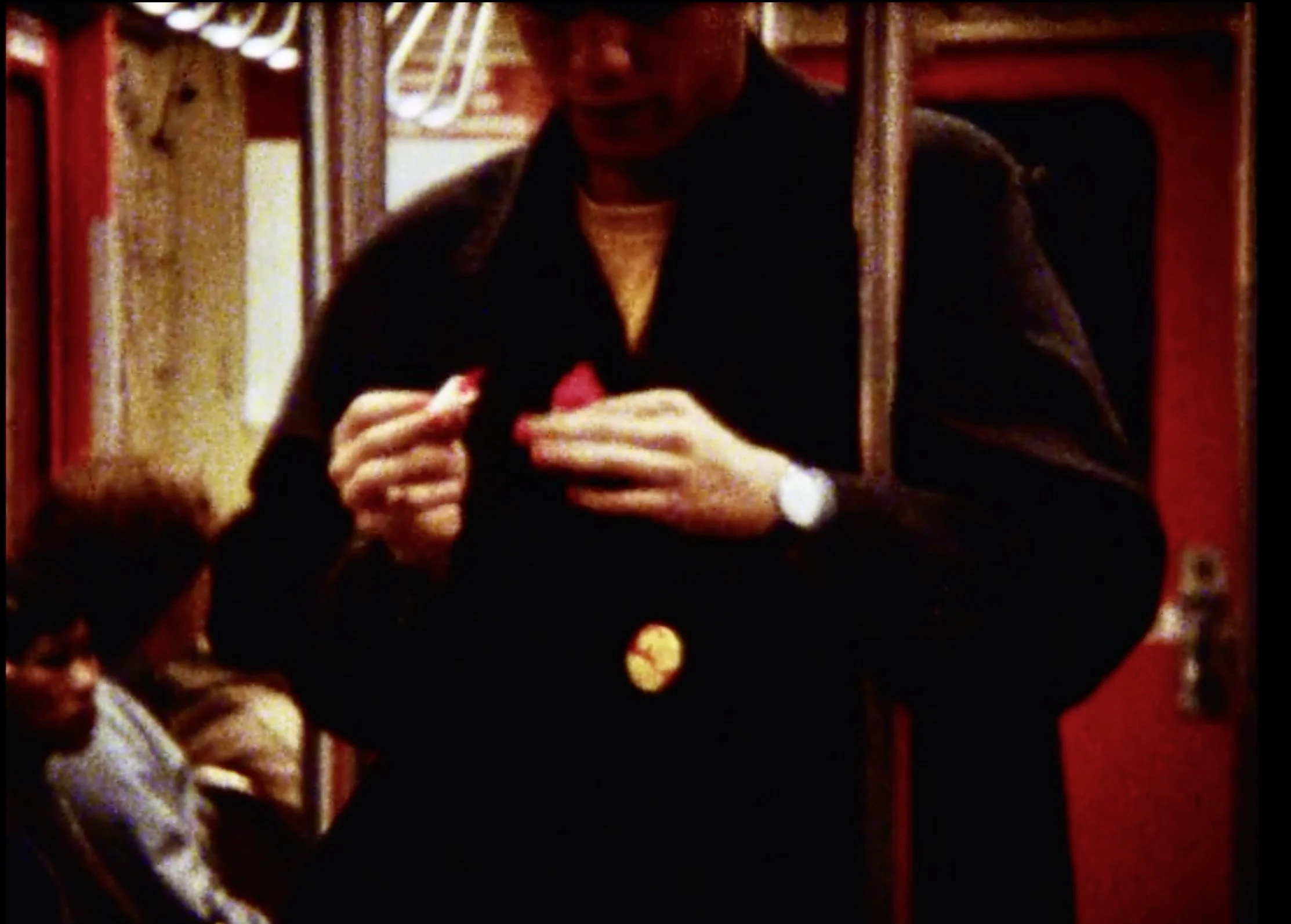
From Ladies Wear. Image courtesy of Lynne Sachs
Back then, the subways were covered in graffiti, inside and out. You see him on the subway, putting fingernail polish on his hands, which was pretty funny because, in those days, you never saw men with fingernail polish. Also, who would put fingernail polish on in the subway? Now, looking back, I see it as transgressive—really playing with gender. But I can’t really give myself credit for thinking that way at the time. I honestly don’t know what my conceptual intentions were. I just asked my brother, who was visiting me while he was in college, “Come, let’s shoot a movie together. I’m learning how to make films. Here’s some fingernail polish—put it on in the subway.” He didn’t even know how to apply it—he’d never done it before. Now jump ahead, 40 years later, my brother Ira Sachs is a filmmaker as well, and his husband Boris Torres is a painter who will not walk out the door without fingernail polish on!
YZ: 41 years of filmmaking. Congratulations! In your career, what are some of the themes that have evolved over time?
LS: I’m going to just bring up one theme that revealed itself to me as a surprise. In around 2005, it occurred to me that I had spent the last 10 years making films that dealt with war. But it was not a plan, it was not an intention. I had made around six projects on that topic. I was very interested in the idea that the violence, the repercussions, the culture, the patriotism, the protest, all of the things that came from war and how our perceptions of it depended on who we are and where we are. We organize a lot of things in the United States around war. That was during the Vietnam War. That was during World War II. That was World War I. That was the Korean War. But wars have not happened on our own land. That’s why for many people it’s a war of the imagination.
So much of what we understand about a war is delivered to us by some form of media—an article, a news report, a fiction film set in a certain period of time. There were many films made about romance during World War II or the Vietnam War. It seemed inherently American that you could find love with the backdrop of these kinds of crisis moments.
I was reckoning with how I had imagined the war, having grown up as a kid in the 60s. I was watching the Vietnam War on television, always in black and white. And the very first line of the film Which Way is East is, “When I was six years old, I would lie on the living room couch, hang my head over the edge, let my hair swing against the floor and watch the evening news upside-down.” It was like an experimental film! Or, at least, that’s how I remembered it. Then I made Investigation of a Flame (2001), which looks at the protest movement here responding to the Vietnam War.

Poster of Investigation of A Flame. Image courtesy of Lynne Sachs
I created a film—or rather, a collaborative web-art project with the artist Jeanne Finley — called The House of Drafts, which explored the war in Bosnia in the late 1990s. From 1994 to 2009, I made six films and a web project that dealt with war. I called that body of work I Am Not a War Photographer.
For the most part, women have been elevated more for our appearances than for our creative impulses or abilities. I was struck by this early on in my life as a teacher at the university level. I would give out a questionnaire to my students and ask them to name their favorite director, and it would always be a man—always. So, the next year, I changed my questionnaire and became more direct, asking, “Name your favorite male director, and name your favorite female director.” A lot of people were challenged to name their favorite female director. So, I changed it again, saying, “Name your favorite male director and name a female director.”

On the set of The House of Drafts. Image courtesy of Lynne Sachs
Times have changed, and I’ve been teaching since the late 80s, so I’ve really seen this gender dynamic evolve. Early on, it became evident to me that if there aren’t very many women directors that the general population of college students knows, then I need to make them aware of what they don’t know. I need to somehow, within my curriculum, introduce them to that work. And for my female students, I need to say, “Here, you know, here’s your time, take it and run and do whatever you can.” It’s tricky. For example, from what I remember, there was a period of time when I was showing films by Carolee Schneemann. I love her work and I’ve made films with her. She was one of the first filmmakers to embrace the camera as equal to the paintbrush. One of her earliest films is called Fuses (1967). She’s in it with her body. It’s supposed to be the perspective of her cat and she’s making love with her partner, a man, not throughout the whole film but in parts of it. You see her body nude and you see his body nude. It’s just wonderful. I love it. But for some women viewers, female nudity on the screen was not empowering.
There’s been a whole kind of ebb and flow around this question: do we want women’s bodies in front of the camera? Maybe we want women behind the camera, but if we have them in front, how do we film them without objectifying them? You know, there are a lot of complications. At one point this was called somatic cinema, the cinema of the body. I’m interested in these dilemmas.
Going back to an early film I made called Still Life with Women and Four Objects (1986), I have this woman who’s putting on a coat three times, and I show the curves of her breast. I think it’s beautiful, but I was also kind of self-conscious about it. I’ve been grappling with that ever since. I remember when I was in graduate school in San Francisco, a woman asked me to be the cinematographer on her film. I thought, great, you know, we’re going to shoot 16mm film. I get to be the camera person. Then I found her point of view to be very sexist towards women. So, I eventually had to quit. You know, just because you’re working with a woman, doesn’t mean she will want to produce images that you’re happy with.
What’s another theme? I have made quite a few films with my family and hopefully they’re not just explicitly about my family, but about relationships, for example, like between a mother and a child. I have three short films, Photograph of Wind (2001), Same Stream Twice (2012), and Maya at 24 (2021), where I ask my daughter to run circles around me.
I would love to teach a class about running circles. Not that it would be full of instruction, but I would just be fascinated by how other people might do that on the level of perception. I love how, when a person runs in a circle around another person holding a camera, the person in the center holding the camera becomes very dizzy, while the person on the outside remains much more stable. It shifts that power dynamic because the person in the center is holding the camera, but he or she or they become more unstable or fragile.
Then I shot a feature-length film with my father over, I believe, 35 years. The camera became an activator, but also just a witness to the dynamic between my father and all nine of his kids. I guess the personal revelation for me was realizing that we see another person from our own perspective, but the person next to us, whether in the family or in the room, sees that person from a completely different perspective. As we accumulate all that, it becomes like a Cubist representation, in the way that Picasso would look at his daughter, Maya, and create a whole series of paintings in the Cubist style. You would see Maya from different vantage points and I thought that’s what I did with Film About A Father Who (2020)—I tried to articulate my vantage point as well as those of my siblings.
I will say one other thing. I’ve played a lot with found footage and archival footage. That’s one more material or formal trope I’ve tried to explore. I will mention something about one of my early, slightly longer films, Sermons and Sacred Pictures (1989). Have you seen that film? I made that in 1989 and it’s a film on, or celebrating the work of Reverend L.O. Taylor, who was a Black minister and filmmaker in the 1930s and 40s in Memphis, Tennessee. I went back to my hometown and made this film about his life because he was at the center of this very vital African-American community. He would film the first black-owned barber shop or beauty parlor or he’d film a baptism in the river, always in this gorgeous black and white film stock and using a 16mm Bolex. He was my first inspiration as a filmmaker, even though I didn’t meet him. He died in the 70s. I met his wife and lots of people from his community. I went back to Memphis and walked all over neighborhoods where he had been a minister and talked to people about him and filmed. And then I included his film material in my movie. It’s only 29 minutes, but ever since then, I’ve been super interested in the distinction between archival images and found footage. I love both. For me, with archival images, you have reverence, you care about its preservation. It’s an opportunity to think about the past, to think about who was witnessing whose lives. For example, in Sermons and Sacred Pictures, here’s a Black man filming his community in the 1930s and 40s. That’s pretty special. And people did not know about his work. I was really happy to have an opportunity to work with that material. That’s an archive to me. Those are sacred pictures to me.
Then I’ve made many films like The House of Science: A Museum of False Facts (1991) and Investigation of a Flame (2001) in which I take found imagery and really disrupt those found images. The House of Science is composed of images of women and of science that disturbed me, while Investigation of a Flame uses found material that suggested astronauts might be seen as heroes in a sort of militaristic way, during the same period of time that the United States was involved in Vietnam. They made astronauts look like soldiers, rewriting the story of the military-industrial complex. The moon landing was often presented in a way that felt very naive, a distraction from the war.

From Investigation of a Flame. Image courtesy of Lynne Sachs
I wanted to be a bit aggressive, to look at the found footage in order to examine it as problematic. That’s been a theme all the way through—taking images from culture and either subverting them or celebrating them, depending on their origins.
YZ: My last question is…what’s your advice for taking breaks and self-care for artists and filmmakers?
LS: I love that question. Can I quote somebody first? In 1993 I saw a film called Thirty Two Short Films About Glenn Gould (1993). Do you know who Glenn Gould was? He was an absolutely amazing piano player. I guess you would call it jazz. He was one of the most renowned 20th century musicians. This was a film, very experimental yet quite popular, that was kind of inspired by Gould, directed by Canadian filmmaker François Girard. I really want to see it again. I loved it. Actually, it’s kind of been an inspiration to me because it was a feature length film, but it was also a series of short films using a lot of different visual discourses. It kind of reflects on filmmaking in a meta way, while also serving as a thought piece on music. It screened in theaters all over the United States. I remember hearing an interview with the director. The journalist said, “So what are you going to do next year? What’s your next project?” The director responded, “I’m going to spend the next year reading books.” You might think that sounds like drudgery, but I thought it sounded really fantastic. I think that as artists, for most of us, rest does not mean the cessation of our creative spirit, but it can sometimes be a slight shift that gives us new joy and awareness. As you know, with filmmaking, there’s all the creative part and then there’s all the producing. I’ve never used the word producer and in fact, I’ve never worked with a producer, ever. I do all of it myself. I make all the phone calls. I write the development grants. I’m not bragging. I’m just saying I don’t know how to work with a producer, but I hope to learn one day. But that part is very tiring. It requires constant interactions with people all the time. That can be very exhausting.
I love taking a bath. I take a bath every day. I like being in the water. I like when things are slowed down. And I feel like, you might have heard me say this, I don’t know, but I think women are really lucky that we sit on the toilet every day for a number of times and men have to stand. I wouldn’t be able to just come up with great ideas standing in front of a toilet. I would hate to look at a toilet. But if I’m sitting on a toilet, I feel like it’s very generative, and another time to rest.
YZ: I grew up reading on the toilet. That’s where I found most of my inspiration.
LS: Men only get to do it once a day or so. I feel like I have no penis envy whatsoever because I like what my body offers me for those moments. Every moment can be contemplative. The other thing that I really love is hiking. It doesn’t have to be a hard hike, but I love being in nature. You might be surprised about that since I live in Brooklyn. But I really find it nourishing. For example, about a month ago, I went up to Cold Spring, New York, with my daughter Maya, where you can take the train there, walk to a wonderful park, go on an amazing hike, and then get back on the train or in the car and come home, all in one day. Afterward, you feel so different. Nature is very nourishing for me.