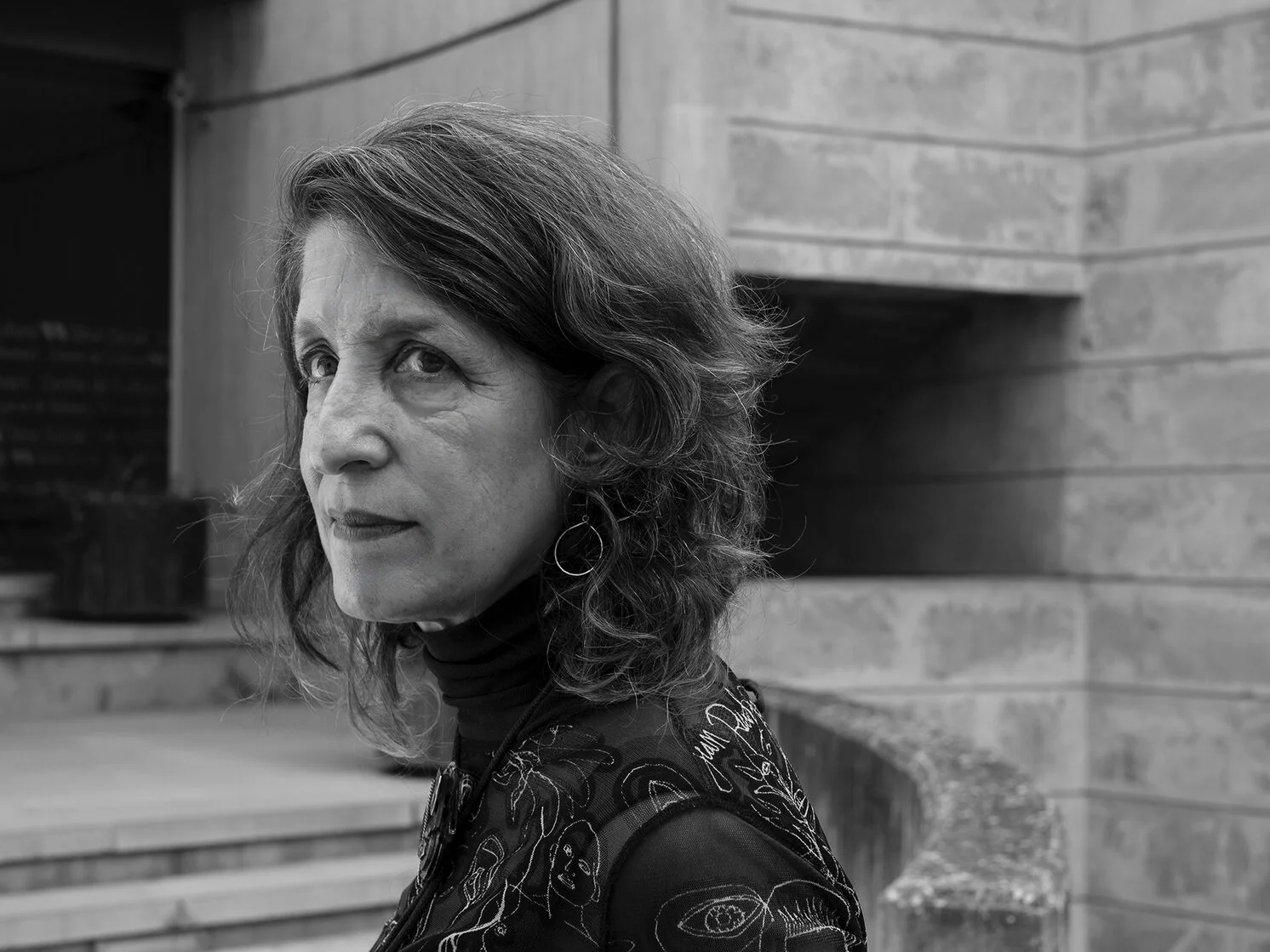
John Bleasdale talks to Lynne Sachs, the Memphis born, Brooklyn based filmmaker. Since the 1980s, Sachs has created cinematic works that defy genre through the use of hybrid forms and collaboration, incorporating elements of the essay film, collage, performance, documentary and poetry. Her films explore the intricate relationship between personal observations and broader historical experiences. With each project, she investigates the implicit connection between the body, the camera, and the materiality of film itself.
Film Stories is a UK based, magazine, website, podcast and (as you can see) YouTube channel that loves to dig into the stories behind popular movies.
Writers on Film Season 1, Ep. 23 by John Bleasdale 10/14/2021
“Practice Thing” is a generative ritual to encourage playing around, applying your skills, and getting unstuck in your creative endeavors with a quick helpful nudge from those who are inspiring us at UnionDocs.
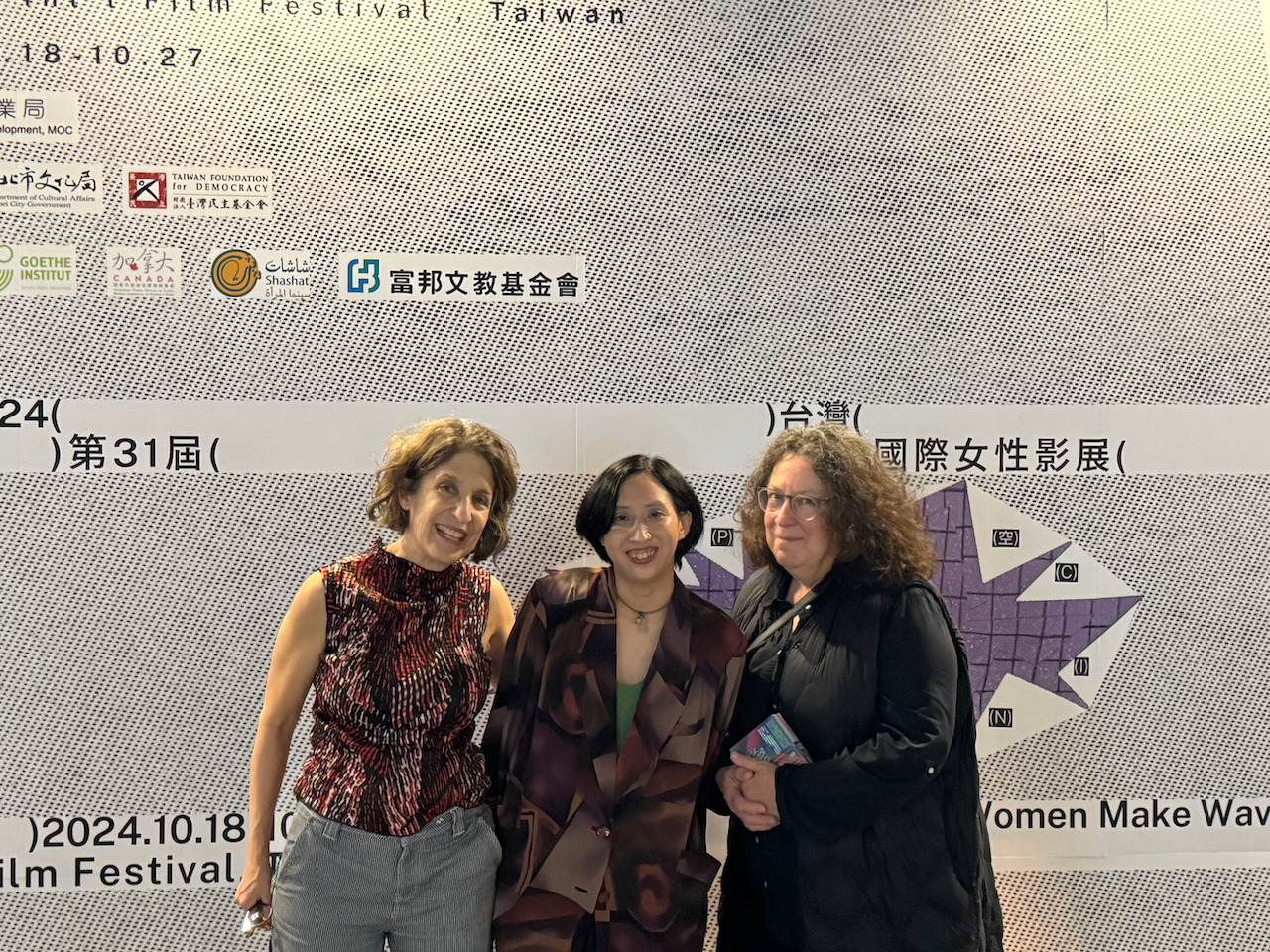
In October 2024, Women Make Waves International Film Festival in Taiwan invited US experimental filmmaker Lynne Sachs to lead an interactive workshop “The Body in Space” and attend the QA sessions for her latest short film Contractions and accompanying sound piece We Continue to Speak. Workshop participants attended one online and one in-person workshop. Over a period of a few weeks, each of the 30 participants produced a one-minute video which was then compiled into a single half-hour compilation that was integrated into a live performance as the final presentation for the festival public.
Under the very limited time constraints of the workshop, Lynne Sachs generously shared eight of her own films with the students in advance. Through these films, she encouraged the participants to think about the relationship between the body and space from the perspective of performance and imagery. Since the 1980s, Lynne Sachs has been rigorously pushing boundaries as an experimental filmmaker and poet. These eight films became an excellent entry point for understanding her recent creative trajectory.
Starting with Contractions (2024) and We Continue to Speak (2024), which were screened during the film festival, we also talked about four works out of the eight works shared in the workshop——Your Day Is My Night (2013), A Month of Single Frames (for Barbara Hammer) (2019), Maya at 24 (2021 ), and Film About A Father Who (2020). These works can be connected to the discussion of the body, space, and framing during the workshop: the spectrum of the subject matter shifting from works that are more socially engaged and in collaboration with local activist groups or residents; the creative relationship between her and other experimental filmmakers; and, finally to her closest inner circle, herself and family members. Such assumptions lead to a process that moves from the outside toward the inside, like drawing a circle. As time goes by, the overlapping trajectories become more dense, all the issues, subject matters, and emotions are intertwined with each other, and the inside and outside becomes intertwined with each other. All come together. In her practice, Lynne Sachs invited her family members to run and walk in a way that deviate from their daily routine. In the face of the most embarrassing situations or creative difficulties, she mentioned the preciousness of collaboration with others.
Sometime while we talked, a lot of words were left out of the formal interview, and later picked up in random chats, or during a follow-up online interview when she suddenly turned her computer around and let me see the New York street scene through her window.
Q: Maybe we can start from a more social dimension of your work. Let’s start with Contractions, which is very outspoken about the legal situation in US.
You know, in some ways Contractions is outspoken. And in some ways Contractions is a film that recognizes silence. It recognizes that those people who are most affected by any kind of political upheaval often don’t know how to speak, don’t have access to the microphone that would allow them to be heard, and so they had this sensation of being silenced. When I decided to make this film, I was trying to think of a form that could recognize an erasure as much as a presence.
Initially, there was this 2023 call from a filmmaker in California [Kristy Guevara-Flanagan] who was very upset about the end of Roe vs. Wade (the 1973 law that gave women the right to an abortion throughout the US), the new Supreme Court decision which gave each state the right to make its own laws about a woman’s right to have an abortion. She put out an announcement looking for people who wanted to make a film about abortion clinics that no longer offer services. And so about five or six of us responded, and formed the Abortion Clinic Film Collective. I realized that this was an opportunity to go back to my hometown of Memphis, Tennessee, because I’m very interested in this relationship we have to the place where we grew up.
I was very upset that something we had taken for granted about the decision-making process about our own bodies had been taken away. We all make assumptions about living in a civil society. You don’t know what you have until you lose it.
I felt like it wasn’t just that our rights were taken away. It was like our faces were taken away and our voices were taken away. I wanted to figure out how I could visualize that. I was actually inspired by Meredith Monk’s Ellis Island (1985) in which she took a group of performers and dancers to an island off the coast of Manhattan. There was this decaying old building. She took performers there and had them interact with the building. The way that performance activates real spaces is very interesting. Kristy Guevara-Flanagan had one requirement for all of the participating filmmakers: we all needed to go to a clinic that used to offer abortion services and no longer does. So I thought, how do I interact with a building? My cousin is an activist in reproductive justice, she performs in the Vagina Monologues every year in Memphis. So she helped me find the people who were in the film.
I actually just finished a part two to Contractions, called This Side of Salina. I collaborate with a Black women’s empowerment group [Layla’s Got You] for that. The film was projected outdoor in Syracuse, New York onto an exterior façade of the Everson Museum of Art, which was designed by the renowned Chinese-American architect I.M. Pei. I have their voices in the film and they also perform in it, a similar spirit to Contractions.
Contractoins
Q: One thing I am also curious about is the covering of faces in Contractions.
Even in New York now, there are religious protesters every single day in front of clinics that offer women’s health services, including mammograms! Abortion is only a small part of what these clinics offer. People are also coming there for urinary tract infections, for example. All of those women are photographed by the protesters because the protesters don’t know who is actually coming to have an abortion. So they film everybody and invade everybody’s privacy.
I could give two answers about the covering of faces. One, the practical answer, is that someone choosing to be in this film was making a decision that was a little bit precarious. I asked everyone to sign a document stating that they were willing to be photographed, but I promised them there would be no faces. And then accidentally, we had one shot where we didn’t turn the camera off after people had already turned their bodies. And I love that shot because I love little mistakes. I needed to go back and ask everybody’s permission to include the shot. So I made a screenshot and I sent it to each person individually. In the film, you see women not only covering their faces but also are bowing. Maybe there’s a little ambiguity here: I’m bowing with strength, but also maybe you’re asking me to be subservient too. Are the performers bowing to the power? And, who’s bowing. I wanted to spark these questions.
Q: Did you come up with the sound piece We Continue to Speak after finishing Contractions?
I realized that personally I was uncomfortable with not letting the women speak because the whole idea was they were silenced. I think they have a lot to say, so I went back to Memphis just a few months later. I got all the women in the film together, plus one of the men in the film. I also interviewed a woman named Dr. Kimberly Looney, who had been the director of medicine for Planned Parenthood in Tennessee, as a central part of the voice-over. She’s very respected in the state of Tennessee and she’s very involved with Black women’s health. But I had told her from the start, you don’t have to put your name in the film because it could cause problems at the hospital where she works. And then she decided that she wanted her name in it. We’ve only shown the film once in Memphis. She came with her mother and her daughter. And she said, “My mother is scared for me, but I’m not scared.”
Q: How long did it take to shoot the film?
About three hours, since it was potentially dangerous to do so. In fact, when we were organizing the production, I had every shot drawn out because I knew we had very little time. I had never seen the building before, but I had drawings imagining it. My cousin and her friend were helping organize everything. She brought a volunteer marshal for security, in case we had protesters or something worse. Keep in mind, this clinic was known for offering abortions. Yes, it was closed, so why would 14 women in patient medical robes be standing in front of that building? People who were very much against abortion might have done anything. One of the local co-producers later told me during the QA of True/False Film Fesitval that we actually had 14 security marshals in different places, like in cars or and behind windows. It just shows you that this issue is very charged. Just a few years ago, several abortion doctors were basically assassinated in the US.
Q: In both Contractions and This Side of Salina you collaborated with the local activist groups and individuals. In Your Day Is My Night, this layer of collaboration transferred to that of the local Chinese community in New York City. This film looks at the shift-bed (temporary) housing phenomenon in Chinatown as a backdrop, resulting in a hybrid documentary-performance project.
One thing that became kind of joyous in the film was that the people in the film found pleasure in playing with the camera. In documentary, there’s a way of emphasizing the moment of the reveal. There’s also this way of developing a trust. And I think both of these systems can be kind of formulaic and manipulative. I just tried to get the participants in the film excited to do something that was different and might bring something new to their own lives. I never wanted them to feel “I’m doing this because this story hasn’t been told before, or people outside the community need to see it.” In fact, there was an exhibition at Taipei Fine Arts Museum we went to yesterday called “Enclave.” I really like the word “enclave.” You could look at Chinatown as an enclave, or this women’s film festival as an enclave. This very thought-provoking exhibition made me reflect on a seemingly hermetic space that can transform into a more porous one.
Your Day is My Night
For this film, I’d conducted audio interviews that became the basis for our film script, distillations you might say of these much longer interviews. In a sense, each member of the cast was able to have fun performing their own lives. If someone is in my film, I like to find ways that they get to be inventive or to harness their own imagination. We were working on this film as a live performance for about two years before it became a film. I thought it was going to be a film, but I didn’t know how to make it. Honestly, I went through a kind of creative desperation, trying to figure what to do. Your Day is My Night was a live performance first, and then it returned to being a film. This is the film that got me excited about working in this way.
Q: It’s a very hybrid film that blurs the docu-fiction boundary. Can you also talk about the Puerto Rican performer?
Well, we’d been working for a year, and one day we all got together – our cast and crew – and the cast told me that audiences would be really bored with our movie because they thought their own lives were really boring. As a group, they suggested that our film needed a better story that people would care about, perhaps some romance. I proposed this idea: What would happen if someone outside, like me or a Puerto Rican woman, moved in? Remember, we were talking about that idea of disrupting a hermetic space! So, I invited a Puerto Rican actress who had worked with me on other projects to join our filmmaking community. Everyone had a much better time once I made it hybrid. We needed to free ourselves from the limitations of our own reality, you might say.
Q: I really like the way you mentioned ‘enclave’ and the idea of porous relationship. I would like to mention A Month of Single Frames here, because in this case, you are dealing with someone else’s materials. The film is made up of Barbara Hammer’s film footage and sound recordings shot in the 80s.
I love finding out that Barbara Hammer came here to Taipei, two times. I didn’t know that until I arrived here. I made two films with Barbara. Barbara and I had known each other since the 80s because we both lived in San Francisco and we were involved in the Film Arts Foundation. And we both moved to New York, so we kept up a lot over that period of time.
In around 2006, she found out that she had ovarian cancer. That was about the time when she turned 60, and I promised to give her a birthday present, which was to shoot a roll of film with her and her wife, Florrie Burke. But she was so busy that it took me years to set up an appointment with her. And by that time, I was quite involved in her life through her cancer. So each time she had chemotherapy, my husband Mark Street would cook and I would deliver, so we were getting closer through that experience.
In 2018, I finally got to shoot the roll of 16mm color film with her. You can see that footage in Carolee, Barbara & Gunvor. I asked all three of these remarkable women artists who also happen to be dear friends, “How does the camera allow you to express yourself?” They all knew each other, but they never expected to be in one cinematic vessel together. Let’s call the film a female bonding moment perhaps. Thinking across generations, Carolee and Barbara were exactly the same age as my mother. They were all born in 1939. Gunvor Nelson was ten years older.
In 2018, when Barbara really knew that she was dying, she asked me and three other filmmakers, including my husband Mark Street, to make films with material that she wasn’t able to finish. So what happened was that she gave me the footage of material she had shot during an artist residency in Cape Cod in 1998, but at first she’d forgotten she kept a detailed journal as well. I asked if I could record her reading out loud from her journal. I thought I’d be able to take it home and pick the parts. But she was in a hurry. She knew that life was not long for her. She asked me to go in the other room and pick out what she was going to read, right away.
One thing that was important to me was to actually find a way to communicate with her, maybe in a kind of transcendent way outside of the film, because she passed away while I was making it, so she never saw it finished. And the text becomes my communication with her and with the audience.
Q: I really like the on-screen texts. They are very beautiful.
Thank you. She never saw that. I felt that I needed to enter the material with her. But also it allowed me to understand something that’s very specific to film. When you’re inside a film, you’re actually in another period of time. We leap from the now to the then or to the future. And as you’re watching the film, you’re actually watching it with Barbara and me next to you. That’s a cosmic thing that film can do that, that you feel like you were in the room with Barbara. And it doesn’t have to do with her being dead or being a ghost. She’s very present in the film. And I knew that and I wanted to celebrate that.
A Month of Single Frames
In fact, Barbara had arranged for all of us to have some funding for the post production from the Wexner Center in Columbus, Ohio. I flew from New York City to Columbus early one morning so that I would arrive in Ohio ready to start. As I was heading there, I fell asleep on the plane. I woke up and I wrote all the text. It came to me in a dream.
I was thinking about the environment, she had filmed in, the sand dunes in 1998. So it’s kind of like your epidermis, the top layer of your skin. Your skin is the same as the sand, both have evolved over many years; your skin is slightly different, scarred or wrinkled, same with the land. In film, we feel as if we can go back in time. That’s what I was thinking about with Maya at 24. We can go back or simulate going back, and we can feel that there is also a here and now for us. You are here, I’m here. We’re all here. Because it’s activated by you, the audience.
Q: Speaking of Maya at 24, its sense of time is very unique. You film your daughter Maya running in circles, clockwise, at ages 6, 16 and 24, while a sense of time is simultaneously embodied through the movement. Can you talk about this gesture of running in circles?
I like that there’s a way that the person holding the camera loses power and control, while the person running gets to have fun. I like that disorientation. And also I like the eye contact that happens. The person who’s following your directions doesn’t really have to do much, but they’re definitely doing something that’s out of character. Even a little gesture, you notice how the camera is able to see how my daughter moves a piece of hair behind her ear, in a mature kind of way. There’s a moment when she’s 24 where she self-consciously makes this gesture. When she’s 16, she’s more defiant. And when she’s 6, she’s kind of more playful with me, more physical. In fact, I made three films, all shot in 16 mm. The first one is called Photograph of Wind, referencing an expression that I heard the renowned American photographer Robert Frank use. Maya as a word also means illusion. I was trying to hold onto her childhood, but it was ephemeral and it was going away like the wind. I called the second iteration Same Stream Twice. It came from the Greek philosopher Hiraclitus who wrote you can never step in the same stream twice, but in film you can step in the same stream twice. Maya at 24 was shot when she was 24 years old. It’s also about film itself running at 24 frames per second. So it’s a little reference to the materiality of the medium.
There’s something I find very energizing and unpredictable, about the flow of two circles running almost in opposite directions or two circles spinning at different rates so that you have this sense of being behind and ahead. And there’s an unpredictable register, which has to do with the person filming, with my energy, my ability, my stability, and the person who is being filmed. If you are in motion, sometimes you lose a little bit of self-consciousness. You’re just thinking about working together on this very unambitious and unfamiliar project, which is running in circles. So I took that way of working into Film About A Father Who. There’s a point where my father’s walking along in a circle. And my mother did that too.
Q: For Film About A Father Who, I really have to say it was a bountiful watching experience, with materials that span 35 years of documentation and creation that also encompass different mediums including 16 and 8 millimeter, video , and digital. As an experimental filmmaker, how do you perceive the medium in this film?
So, it’s interesting to me to consider that as I was making the film, technology kept changing. There’s an assumption that as technology changes, it witnesses and documents our lives. We assume it gets better, that there is a pure, mimetic relationship to what you see with your eyes and what you record. Even though I see myself as an experimental filmmaker who likes the degraded or imperfect image, the more I looked at my old material, the more critical I was of it. I was critical of the medium, but I was even more critical of my skills. But deeper than that, honestly, was a kind of aesthetic critique of my father and of our lives. I had a lot of embarrassment. I was deeply embarrassed about my work as an artist and about my role as a daughter. That was one of the reasons I couldn’t finish it. I could shoot it, but I couldn’t look at it. I just had a lot of shame.
And I did have anger. Initially, I started the film because I thought my dad was really interesting. He was an iconoclast. He was a rule breaker. He was maybe one of the reasons I found myself making the kind of films that I make. I wasn’t intimidated by odd situations, and that’s the way he was. But then as things kept happening, I became more and more uncomfortable. Sometimes I wanted to make a critical film, sometimes an introspective film. In fact, I discovered that at different points, different camera registers or modalities worked better for different subjectivities.
Film About A Father Who
Q: About degraded image, there is one certain sequence that repeats: kids playing in a little stream. The timing of repetition is quite crucial, too.
I show that little stream three times at three different moments pulled from one long shot, and it’s critical to the narrative of the film. But what is more interesting to me is that each time you as a viewer are thrown back into that scene, you know more. You have gained knowledge, and you have shifted your position from being an outsider to being omniscient. You realize that you have been privy to information and to a complexity that not everyone in the film is aware of, so that’s compelling to me to let the viewer grow with that image. To me, it’s probably the prettiest image in the film.
In Hito Steyerl’s article, In Defense of the Poor Image, her writing is a celebration of how images travel through culture and become changed in the ways that our bodies change. We get wrinkles, and we get less vibrant, and images do the same thing. They reveal something about the time in which they were made, but also the time in which we as viewers currently live. But I didn’t understand how important this was to me as an artist until I made this film. Because, the first time my editor and I went through all the footage, that kind of image (the stream image), was one that I probably dismissed. It was on a degraded, improperly archived tape that my father had shot on Hi 8 in the 1980s. Time had not been kind to the material.
So with Hi 8, you had these tapes that were like the size of your palm. They went into the camera and you would shoot. And then you would go home and you would connect your camera with a cable to a machine with a VHS tape, and you would transfer the original to a VHS tape. And then, you would reshoot over the original tape with new material. There was no original anymore! Everything was just a copy, and each copy was more degraded than the one before it. Since I had forgotten this technical fact, I spent a couple of years trying to find the original of that tape. Then I finally realized that my dad wouldn’t care about the original. He just wanted to collect images and watch them.
I went back to the VHS tape, which was just a considered a viewing format, not of serious historical importance to archivists anywhere. But when I had it digitized, I realized it is a lot prettier than the digital images of today. It looks more like an Impressionist painting. It has more of an essence than a more precise, better preserved image would ever have, plus it’s got Dad’s voice speaking to his children.
There you see these three children, my half siblings. My father was probably standing behind a camera using a tripod. I guess he forgot he was even recording! Consequently the shot was about 8 minutes long, long enough for him to reveal something very loving, stern in a fatherly way, which my dad usually wasn’t, and very relational. He was dealing with children in a very traditional parent-child way. And the other thing about the image is that it had become pink and yellow and soft blue. The image is truly painterly, so beautiful. Everything about it was meaningful to me.
We’re always using the camera to witness other people’s presence in the world, but it’s also such a gift to see how they frame their own world. So that shot of the children in the little stream is how my father saw his younger children, the ones from the 1980s, my half-siblings. And it’s very loving.
Q: As the film attempts to unveil various “truths” in one family, it also unveils another kind of complexity itself, which turn the clear distinction between good or bad totally upside down, maybe that’s where all the love and hate come from.
That was exactly the gateway I had to go through to make this film. It wasn’t a simple judgment or any emotional realization that came to me. I needed to find a place for something else. I think almost everyone has a person in their family that they’re constantly trying to figure out — where to place them in their consciousness. With our parents, for example, they each choose what they want to share with us in the cosmos of family.
In the film, I wanted to find formal ways of articulating transparency, obfuscation, even covering up. But I think what’s more interesting is giving a viewer the ability to understand that everything we interpret comes with layers of meaning. For example, when you see my father in a tuxedo going to these ostentatious galas with my grandmother dressed in a fancy ballgown, what you realize is that there is no transparency here. It’s all performance. That’s why I intentionally use a little bit of Disney music. This scene actually feels very unreal.
Before my father would go see my grandmother, he would always cut his hair. This way his way of being who he wasn’t. And that’s actually one of the most poignant things in the film. Here’s someone whom generally society does not approve of, at least in term of how he conducted his life. But then parallel to it this is a son who could never be himself with his mother. And there’s pathos there. I think where you find pathos in a film is like an entry point. Not pity, not disgust, not just elation because something great happens, but where you find pathos is really important to me.
Film About A Father Who
As a filmmaker, I need to find an interesting moment between every cut. Even in my longer films, I never want a cut to be simply the result of cause and effect. I want an edit between two shots to be an entry point of activation for a viewer, then there’s possibilities of pathos, as well so many other sensations.
Q: In this film, you are not the only person who was filming. Other than the stream sequence shot by your father, we can constantly see your brother filming. In a way, it seems that your family members are quite used to having someone in the family who is filming. Nevertheless, I am really curious what made you want to finish the film?
My brother [Ira Sachs] is a filmmaker who makes narrative films. But there was a period of time where he went with my father to Moscow, and he would sometimes go down to Florida with my father for my grandmother’s birthday.
There was a way that my father would talk to my brother, in that man-to-man kind of way, even though he knew my brother was gay. He would show Ira a list of all the women he’s trying to date or sleep with. My brother found that to be a turnoff, but he kept the camera going.
So that occurred to me. When I was trying to work on this film, I asked my brother if he could look for the outtakes from Get It While You Can (2002), the short film he made from his Moscow footage. In this way, Film About a Father Who would not offer just a single perspective on a man.
Let me tell you one of my favorite images that was shot by Ira. He’s on the bed and he’s listening to our father in the other room with a young woman, during their trip to Russia. Ira’s holding the camera, you see his feet and a floor lamp, and he’s humming to himself. And it’s amazing because you feel like you’re in this young man’s head. It’s so internal. Both scenes are really gendered, but play out by revealing something complex going on between a father and a son.
For me, this all plays out like a Cubist painting, let’s say a Picasso’s painting of his daughter Maya. He’s trying to articulate different planes of perception, and that’s how a family works. That’s what this film is recognizing. Those different points of view. I am trying to see how a family works anthropologically. For example, I got very interested in how lying works in our family. I think all families are built around a series of white lies. People try to protect the ones they want to protect, but they also try to protect themselves.
But the thing is in a film like this, you’re still journeying, since, as a filmmaker, you’re hiding behind the camera too.
Q: This film also tackles some of hard situations. I remember there is a scene where his girlfriend and second wife sit side by side.
I remember the year I shot that scene, in 1992, and I was shooting with a really good 16 mm Arriflex camera. I had just started dating my now husband Mark, who is also a filmmaker, and I asked him to record sound. I looked at that footage right when I got it back from the film lab, and I knew it looked “pretty.” I also knew that it was very dramatic, and very disturbing. It showed two women being very honest about their feelings and their assessment of their situation. But once I looked at it after I got the film footage back, I didn’t look at it for probably 25 years, and it moved around with me in carboard boxes from California, to New York, to Maryland. It moved with me everywhere, and it became this Pandora’s Box saying “Look at me!” And, I couldn’t look at it.
And then, I reconnected with a former student of mine named Rebecca Shapass. She started working with me as my studio assistant, and I just said, “let’s look at the footage together.” For some reason, I never felt embarrassed, and it was a breakthrough. We went through every tape and every roll of film. And that was kind of a watershed moment. I was able to explore ideas with her, as we sat side by side, so she ended up being the editor for the film. We did it together, and it was very freeing for me. I’ll never forget that connection that we had.
註1:本文中文版本原載於國家電影及視聽文化中心出版之《放映週報》776 期 註2: 本文所有劇照皆由琳恩・薩克斯提供 Note 1: For the Chinese version, please refer to Taiwan Film and Audiovisual Institute’s Funscreen Weekly No. 776: https://funscreen.tfai.org.tw/article/38821 Note 2: All the film stills used in this interview are provided by Lynne Sachs.
1988 My camera travels from blue sunlight to the orange glow of a kitchen bulb, explosions of cyan, magenta, and yellow. A troupe of twenty-four images marches from darkness toward silver halide. A 16mm target the size of my thumbprint. Study of a film frame begins my life behind the camera.
– Lynne Sachs, Year by Year Poems (Tender Buttons Press, 2019)
Yehui Zhao: I want to start by recalling a very memorable scene from your film, Tip of My Tongue (2017), that has lingered on my mind for many years. I’d like to share a quote from a statement of yours for the film:
“To celebrate her 50th birthday, filmmaker Lynne Sachs gathers together other people, men and women who have lived through precisely the same years but come from places like Iran or Cuba or Australia or the Lower East Side, not Memphis, Tennessee where Sachs grew up…Together they discuss some of the most salient, strange, and revealing moments of their lives in a brash, self-reflexive examination of the way in which uncontrollable events outside our own domestic universe impact who we are.”
One of the film’s participants, Sholeh, talked about being a mom during the Cultural Revolution in Iran in 1979 when the monarchical government was overthrown by a religious cleric. With no diapers for her baby and a strict dress code, she recalled a hot summer day when she went to the post office wearing a garment and scarf that covered her entire body. While waiting in line with her baby, she felt this “wetness, a sour smell, and a thick yellow color.” There was no access to a public bathroom. When she got home, she placed her baby in the bathtub and the smell spread throughout the house. She said, “Her, me and the faucet, we were all weeping.”
While Sholeh recalled this, we saw a scene of beautiful magnolia flowers in early bloom. The fragrance of magnolia had the effect of amplifying the foulness, making the smell even more unbearable.
Lynne Sachs: My gosh, I love that detail that you have noted.
YZ: You’ve assigned meaning within the story to that magnolia, which is something you do in your films. Can you talk about the process of creating meaning through films?
LS: I actually think it’s interesting that you use the term “assigned meaning” because it sounds like a responsibility, but it also is this exhilarating opportunity to give an object a resonance. I think it was Emerson who said, “Things are in the saddle.” Do you know that quote? It means that in some ways we look at things as being too weighty in our lives, like our cars or our homes. They’re in the saddle, and they control us. They’re driving us. In another way, we could say things are in the saddle—not needs, not hungers, but the objects in our lives that evoke memories, relationships, or meanings, much like what you just described.
Honestly, I couldn’t say for sure that I thought about aroma or smell when I put that shot in, but I love that you brought it up. As you know, we learn to appreciate decisions that we make in filmmaking, from really observant spectators. Maybe it was in my mind. I’m trying to remember, but I don’t think that I could give myself credit for that. But I loved Sholeh’s story as a distillation for a moment in history. When she told me that, I knew it would help me better understand this tumultuous moment in her life when she was thrown into motherhood instead of living out her zesty, outlandish, and young womanhood. She told me it was during the pre-revolutionary period in Iran, when she could walk around in a miniskirt. Can you imagine in one year going from that kind of personal freedom to wearing the veil and being an 18-year-old mother? I’m not trying to elevate miniskirts, mind you, but they do represent a kind of comfort with revealing your body in public.
YZ: It’s these very dramatic changes in the social environment that have an impact on people.
LS: In some ways, it’s like the 1973 decision here, when abortion became legal, and then in 2022, when the constitutional right to abortion was overturned, making it illegal or unavailable in at least twenty-one states around the country. Those are situations where a major shift in history seeps down into someone’s most intimate life.
YZ: As the director and participant in Tip of My Tongue, you also created Year by Year Poems (Tender Buttons Press, 2019), a collection of 50 poems, one for each year of your life. In the book, you tied together major social events with very intimate moments in girlhood and womanhood. What was your process like in creating this book, and are you still writing more?
LS: I do write. I’m actually finishing a film called Every Contact Leaves a Trace. So I’ve been writing a lot for that. But I have a mission to write about the next 10 years of my life for Tenement Press. I’m a little behind. I haven’t started writing that series. It’s the first thing I want to do when I finish this film. You and I were talking just a few weeks ago about this sense of trying to have closure for one thing so it doesn’t tarnish the next, meaning whatever you’ll be working on in the future. I need to write those poems when I’m not thinking about the practicalities of finishing a film. As I keep saying, and as we both know, film necessitates a lot of producing, which we don’t have to do for poetry, right? I’m looking forward to that headspace of reflecting on the last 10 years or so of my life in the same spirit of Year by YearPoems. I wrote a lot of poems during the pandemic. But they were very much in that moment. They weren’t looking back at my history at all.
Over the years, I’ve found a lot of, let’s say, gratification in workshops I’ve taught where I talk about Year by Year Poems and Tip of My Tongue with people who don’t usually write poetry. I say, “This is a construct by which you can enter the poetic discourse, and also think about who you were in a moment of history.” People have found that to be provocative enough as a way to distill moments in their own lives, creatively. I really love the gesture or the impulse to distill.
From Tip of My Tongue. Image courtesy of Lynne Sachs
It’s a key aspect of Tip of My Tongue that goes back to a professor I had in college, Naomi Schor, who wrote a wonderful book called Reading in Details: Aesthetics and the Feminine (Routledge, 1987). Let’s say you’re reading a novel by Balzac or from another author. Most people will read it as a vivid, rich story and immerse themselves in the characters. What she was saying, and she said this from a feminist perspective as a literary discourse, is that the details—like the magnolia you spoke about—start to take on a resonance. It’s something the reader is left with that goes beyond the narrative or the plot and leaves its mark. I loved her insistence on details and distillation, maybe because I don’t really fancy myself a storyteller in the traditional sense. I like to accumulate details and then see how they create new meaning, as you said earlier.
YZ: The process of accumulating details—is that how you wrote this book? Through collecting details over the years? What was that process like?
LS: One of the great things about writing that book was that I chose to throw myself into each year of my life. It was overwhelming because so many things happen in 365 days. But once you land on an image in your head that resonates, you can let everything else fall away. People say to me, “Well, how do you remember what happened in 1961?”, which is the year that I was born. And I say, “No, no, no, no. I don’t rely on memory at all and could never claim that I remembered that year.” I can only give myself permission to, let’s say, reconstruct my infancy and look back on it through my present time. I remember thinking about the house where my parents lived until I was six. In my mind, I was able to recreate a presence for a baby in that room, then imagine what might have been there at the time. Then I just worked it out. That’s totally how I make films. I work from the center. I don’t impose a story on it. Let me just go to that poem.
1961 Born at dinner time on an August evening, the child of a twenty-one and twenty-three-year-old a crystal ball at my fingertips smooth and inviting, deceptively transparent. I touch its surface with my wet tight fist. Glass shatters the delivery room. Our future blows beneath the bed down the hall out the front door of the hospital into sweltering Memphis darkness.
I wrote about how the glass shatters the delivery room, and about a crystal ball, which, of course, there was none, but I’ve always been fascinated by crystal balls and how people look into the future. A poem gives you that freedom to insert objects or things.
From Tip of My Tongue. Image courtesy of Lynne Sachs
I want to introduce one idea that’s very mundane. You can go on Wikipedia and type 1975, for example, and it will tell you all the public historical events worthy of recognition that went on in the United States and worldwide. It also tells you about culture, like the most popular songs at the time. That was extremely helpful. I didn’t rely on it, but it brought back the past in this shared communal way. I really respect Wikipedia because of how it is generated. It was very helpful to just get that whole milieu thrown at me in such a generic way. I could find my way and carve out my own relationship to a moment in time. For instance, 1976 in the United States was a big patriotic year. It was the 200th anniversary of the country. Honestly, most of what happened was very tacky and overly patriotic. People would make quilts or they’d have special gifts at the gas station, things like that. But it allowed for this flood of memories for me. I’m a little embarrassed to say that I used Wikipedia, and that it was actually very helpful.
YZ: The first time I met you was when you were teaching Frames and Stanzas, a film and poetry workshop in Hunter College’s Integrated Media Arts program. So that’s what you assigned us to do, to write poems through locating past events on Wikipedia. We picked three years from our lives, including our birth year, and wrote a poem for each one. Then the whole class created a book of poetry.
LS: Right. I remember that because then we read them in chronological order.
YZ: We actually created our own collective archive of history with Wikipedia’s help.
LS: I remember using that research approach with your group, which was probably the first time that I referenced it. And I’m sure that it’s very, I don’t like to use East-West, but I’m sure that it has a certain orientation towards the United States and Europe for that history, I’m guessing.
YZ: I think so because most of the internet users are based in the West. It was powerful to write and read our book of poetry together. I remember that so well.
LS: Thank you, I really enjoy your questions. As you look at your own crystal ball, you don’t seem to see the befores or afters. You see a constant present. And I think that’s kind of how I work. It connects to my poetry writing and to my films. One line generates the next, but the flow is not one of cause and effect. It’s the same with my filmmaking. I get excited by juxtapositions between one shot and the next because something magical or implied occurs between the two shots. It might not be there in the words, but it’s a way for you to infuse it into the film, and that’s not traditionally how filmmaking has evolved, at least in the mainstream. I really go back and forth between film and poetry. Film’s relationship to time is potentially mimetic, though it doesn’t need to be. If we feel exhilarated by other kinds of juxtapositions, then that mirroring of reality can leap outside of time. And I think that leaping is sort of what happens inside the crystal ball, because you could also look into the crystal ball and see the past, as well as the future. Ultimately, the crystal ball is just a reflection on you. You look at it and you see refractions of your own face. That’s all you see.
YZ: I was very lucky to have seen Contractions (2024), your latest film, at DCTV’s Firehouse Cinema. The film is about the discontinuation of abortion services at a women’s health clinic in Tennessee. You’ve carried a tradition of performance in this film. In another film of yours, TheWashing Society (2018), there was a scene where the workers danced with the laundry machines and created movements and beats. In your definition, what is performance in film? And how do you create it?
LS: Okay, first of all, I believe that at every moment in front of the camera, people have an implied power relationship to the director. I’m going to take a step back and say that you’ve probably noticed that when you do an interview with someone and ask them a question, you nod. So, you ask me a question—or maybe you just watch me—but let’s say you ask me a question, and I respond. I’m watching your eyes, I’m watching your face, and you’re acknowledging that what I’m saying serves your needs. You’re nodding in the way that nonverbal communication works in society. You’re nodding and saying, good, good. And I think that happens implicitly in every filmic moment, unless the camera’s hidden. And it doesn’t matter if it’s a narrative film with actors or it’s a documentary with people who are players or participating in a real life scenario. If they have agreed to be in the film, they have agreed to follow the rules. They’ve agreed, in a sense, not to yell profanities. If you signed a release with them—maybe you didn’t—they’ve agreed to perform as they normally would. There are all of these expectations that come with being in front of the camera. It’s a power relationship that I believe is problematic.
Ultimately, when I decided to make Contractions, I created a scenario where I was the director, asking my performers, participants, or collaborators to move in a certain way and wear a specific costume—a patient’s robe from a doctor’s office. In other ways, they had a kind of freedom because their backs were to the camera. This gave them a sense of fluidity and liberation, freeing them from being pegged in a particular way—whether by age or by being considered a good or bad performer.
From Contraptions. Image courtesy of Lynne Sachs.
They felt integrated but not projected upon. And that’s not something that I really understood before I did it. My initial impulse was to give them anonymity because it was a very charged situation around abortion in a state where women no longer have complete bodily autonomy. The state has severely limited the right to an abortion, essentially making it illegal. Now, as I reflect on it, I realize the 14 performer-activists in the film were able to perform because they had moved away from their personal identities. This shift gave them internal permission to engage artistically and dramatically, freeing them from the concern of how they looked or how they were perceived in the image.
In TheWashing Society, my co-director Lizzie Olesker and I were working with two women in particular, Veraalba Santa and Ching Valdez Aran. They both had an enormous amount of experience as actors. When they were placed in that film in a laundromat, they could loosen up a little bit and create an ambiguity between who they were as members of the artistic community of New York City and their roles as laundry workers. Class is an issue. In a laundromat, they created a fusion of identities across class lines which sometimes confused people in the film. When we did the live performances, people were wondering who’s real and who’s not. I love that. I love that a viewer is thrown into a little bit of uncertainty, which might become revelation, in a meta-way, let’s say. When I’m reading short stories, when I’m reading something that you would call a mystery, where you have that moment of not knowing who you are and where you’re going and then it all settles in, you feel a charge when it all starts to become apparent.
It’s the same with poetry. It’s that moment when you read poetry and say, “I’m not familiar with this poet’s vernacular.” And then by the end of the poem, you want to circle back and read it again because you speak their language. So that excites me. And when people say, well, I was confused at the beginning because I didn’t know who was real and who was not, that’s taking the viewer to a discourse that’s very heightened and that they rarely go to.
YZ: I felt that in Contractions performance activates reality. I felt the same about The Washing Society. I also really like this idea of dancing between real and unreal…
LS: One of the reasons we make our work is to create echoes. An activation of a new point of awareness is fundamental to me. That’s been a guiding principle of my work for a long time. Like for the title of Which Way Is East (1994), some people said to me, “You need to put a question mark on ‘Which Way Is East.’” But I didn’t want there to be an answer. I wanted it to be suggested from a position of acknowledging that it’s only an orientation, especially on a globe.
From Which Way Is East. Image courtesy of Lynne Sachs
YZ: I’m curious as the director, when you’re working with, let’s say, characters or participants, how do you invite them to perform? Do you give them prompts? What’s the process like?
LS: Okay, I’m going to say something that’s a bit cinematic which might speak to you. I like to think about the body in space. Sometimes, when I’m working with people, I think of them in a diagrammatic way. I think about a person being almost like a cat, or like a character from an alphabet. I really love silhouettes. I adore that. Not that the performer would think of themselves as a silhouette, but I focus on their bodies moving in relation to one another, shifting attention away from the face. One of the things that’s really important to me is suggesting that not every emotive experience originates in the face, although I shoot a lot of closeups of the face. I’m reminded of Roland Barthes’ famous essay, The Face of Garbo (1957). You may have read it—he writes about how Garbo’s face is so expressive, so ostensibly affecting. Whether it invites you in or keeps you out of Greta Garbo herself is something I can’t claim to know. I like when the face, or the gesticulation of the body, like a cipher, reveals something about the energy between two people or what’s happening internally. So, if you ask about a prompt, sometimes I say things like, “Move in the space and be responsive to objects in the space as if they were other human beings.” I don’t actually ask people to read lines over and over again, but I ask them to move and then to see where the words tumble out. In The Washing Society, we wanted the machines themselves to become like surfaces you could slap.
Poster of The Washing Society. Image courtesy of Lynne Sachs
One of the things that we tried to do was to take an object that seemed inanimate and make it feel animated, like slapping a washing machine is, in a way, ridiculous, but it’s also sort of slapping at the moment, slapping at history. Doing things that are out of the ordinary in a very ordinary space is very interesting to me. In Contractions, moving your body closer and closer toward an abandoned building with your back to the camera, surrounded by other people, on a sunny June day, creates an unfamiliar, anxious dynamic. But I suppose that’s intentional—leaning into the unfamiliar often heightens behavior in front of the camera. I never want my performers to get too comfortable. That said, I do rehearse with them, and I always film the rehearsals. For me, rehearsals are part of the discovery process, which I find incredibly exciting.
YZ: Going back to how I met you, which was during the Frames and Stanzas workshop, something that really struck me from the class was your approach to sound. Unlike the traditional notion that dialogue must be recorded with almost no background sound, you really value the sound of the environment. In your work, we can often hear, for example, a flushing toilet, footsteps, children laughing, or crying during voiceovers. What’s your philosophy with sound and how do you generate a rich soundscape while on set?
LS: I’d like to talk about a point in The Washing Society that ostensibly would have been referred to as a mistake, but it’s often people’s favorite part of the film. The two main actors, Ching and Veraalba, are sitting on a bench inside a laundromat where we’re filming. Off camera you hear a man who comes in and says, “When are you gonna finish this? I need to get to my wash.” He was a customer. We could only afford to rent the laundromat for our production for a few hours. The owner of the laundromat told us we need to open it up for the customers unless we want to pay several thousand dollars for the whole day, which we didn’t. At that point, the customers started to come in and they were a little resentful of us being in the way. This particular man started to yell at us, so we stopped the camera, but we didn’t stop the sound immediately. We ended up getting all this extra sound of him continuing to be irritated and a little bit aggressive.
The performers stayed in character, and they said, “We’re making a movie.” This elevates it, as if to say, “We’re doing something special, which is more important than your wash, than your clothing.”
From The Washing Society. Image courtesy of Lynne Sachs
Of course, it’s not true, but you know, it’s the way our culture works: This is a movie. We need to stop traffic. We need to shift over and do whatever this director needs, even if you’re not being compensated for it, because this is a movie. Anyway, so they said, we’re making a movie and he didn’t care. I liked that irreverence. When we were editing the film, our first impulse was to take that part out. It’s so humiliating. But then, as we were editing, we started listening again to this outtake—this moment where someone from outside our diegesis, let’s say, was actually puncturing the hermetic space of the movie set. The idea of perfection in a traditional production is absolute silence. People say, “Quiet on the set!” right? And then everybody does it, even passers-by. Everybody’s quiet. It’s part of our social contract. But in this case, this man didn’t want to be a member of that compliant class. He wanted to take care of his own business, and he punctured our world. That became significant because he threw the creation of our movie space into disarray. He brought in the real world, and it became all the more interesting. It was very special because isn’t that inherently part of the surprise of making films? And haven’t we learned that the disruptions are actually the most revealing parts of the process?
YZ: You’re an icon of creating and experimenting and you’re a prominent feminist filmmaker.
LS: No, no, no, no, no, no, no.
YZ: To me you are. For how many years have you been making films?
LS: My very first Super 8 film was made in 1983. There were actually two films: one called The Tarot and the other called Ladies Wear. I was 22 years old, having just graduated from Brown University where I was actually a history major, focusing on intellectual, women’s and medieval history. I also did a lot of studio art, but I didn’t make films as an undergrad. I discovered experimental film and film as poetry during my junior year in Paris. After college, I moved to New York and thought, “I’ll take a filmmaking class.” I took one, but ultimately didn’t enjoy it very much—because my teacher believed all short films had to have a punchline. I’ll never forget what he said to me at our final film show: “Are you a liberal arts student or something like that?” Like it was a stain.
I learned how to make films and ended up making two in 1983. The first one was a project I approached with great gusto and intention. It was called The Tarot and starred my best friend Kathy Steuer, who grew up with me in Memphis, Tennessee, and also lived in New York. It was a film about a young woman trying to figure out what to do with her life. So she goes to a tarot reader and she has her cards read. Then you see this animated scene with her turning into all different kinds of women.
From The Tarot. Image Courtesy of Lynne Sachs.
That was it, just three minutes. The splices were so bad that the film barely ran through the projector. Kathy came to the screening totally dressed up with a big boa around her neck. You know, like a big, flashy scarf. The story was quite literal. A young woman has her future read like a crystal ball, and then she imagines herself that way, and that’s it. It’s kind of embarrassing. I projected my life on my best friend. She’s still my oldest friend because we’ve known each other for 63 years.
Then I made another film that I never edited at all, because I really didn’t know how to edit very well. It’s called Ladies Wear since there was a sign on a store in the fashion district that read “Ladies Wear.” This is an old-fashioned expression for workday clothes that women wear. The whole film follows my brother, who was 18 at the time, as he rides the New York City subway.
From Ladies Wear. Image courtesy of Lynne Sachs
Back then, the subways were covered in graffiti, inside and out. You see him on the subway, putting fingernail polish on his hands, which was pretty funny because, in those days, you never saw men with fingernail polish. Also, who would put fingernail polish on in the subway? Now, looking back, I see it as transgressive—really playing with gender. But I can’t really give myself credit for thinking that way at the time. I honestly don’t know what my conceptual intentions were. I just asked my brother, who was visiting me while he was in college, “Come, let’s shoot a movie together. I’m learning how to make films. Here’s some fingernail polish—put it on in the subway.” He didn’t even know how to apply it—he’d never done it before. Now jump ahead, 40 years later, my brother Ira Sachs is a filmmaker as well, and his husband Boris Torres is a painter who will not walk out the door without fingernail polish on!
YZ: 41 years of filmmaking. Congratulations! In your career, what are some of the themes that have evolved over time?
LS: I’m going to just bring up one theme that revealed itself to me as a surprise. In around 2005, it occurred to me that I had spent the last 10 years making films that dealt with war. But it was not a plan, it was not an intention. I had made around six projects on that topic. I was very interested in the idea that the violence, the repercussions, the culture, the patriotism, the protest, all of the things that came from war and how our perceptions of it depended on who we are and where we are. We organize a lot of things in the United States around war. That was during the Vietnam War. That was during World War II. That was World War I. That was the Korean War. But wars have not happened on our own land. That’s why for many people it’s a war of the imagination.
So much of what we understand about a war is delivered to us by some form of media—an article, a news report, a fiction film set in a certain period of time. There were many films made about romance during World War II or the Vietnam War. It seemed inherently American that you could find love with the backdrop of these kinds of crisis moments.
I was reckoning with how I had imagined the war, having grown up as a kid in the 60s. I was watching the Vietnam War on television, always in black and white. And the very first line of the film Which Way is East is, “When I was six years old, I would lie on the living room couch, hang my head over the edge, let my hair swing against the floor and watch the evening news upside-down.” It was like an experimental film! Or, at least, that’s how I remembered it. Then I made Investigation of a Flame (2001), which looks at the protest movement here responding to the Vietnam War.
Poster of Investigation of A Flame. Image courtesy of Lynne Sachs
I created a film—or rather, a collaborative web-art project with the artist Jeanne Finley — calledThe House of Drafts, which explored the war in Bosnia in the late 1990s. From 1994 to 2009, I made six films and a web project that dealt with war. I called that body of work I Am Not a War Photographer.
For the most part, women have been elevated more for our appearances than for our creative impulses or abilities. I was struck by this early on in my life as a teacher at the university level. I would give out a questionnaire to my students and ask them to name their favorite director, and it would always be a man—always. So, the next year, I changed my questionnaire and became more direct, asking, “Name your favorite male director, and name your favorite female director.” A lot of people were challenged to name their favorite female director. So, I changed it again, saying, “Name your favorite male director and name a female director.”
On the set of The House of Drafts. Image courtesy of Lynne Sachs
Times have changed, and I’ve been teaching since the late 80s, so I’ve really seen this gender dynamic evolve. Early on, it became evident to me that if there aren’t very many women directors that the general population of college students knows, then I need to make them aware of what they don’t know. I need to somehow, within my curriculum, introduce them to that work. And for my female students, I need to say, “Here, you know, here’s your time, take it and run and do whatever you can.” It’s tricky. For example, from what I remember, there was a period of time when I was showing films by Carolee Schneemann. I love her work and I’ve made films with her. She was one of the first filmmakers to embrace the camera as equal to the paintbrush. One of her earliest films is called Fuses (1967). She’s in it with her body. It’s supposed to be the perspective of her cat and she’s making love with her partner, a man, not throughout the whole film but in parts of it. You see her body nude and you see his body nude. It’s just wonderful. I love it. But for some women viewers, female nudity on the screen was not empowering.
There’s been a whole kind of ebb and flow around this question: do we want women’s bodies in front of the camera? Maybe we want women behind the camera, but if we have them in front, how do we film them without objectifying them? You know, there are a lot of complications. At one point this was called somatic cinema, the cinema of the body. I’m interested in these dilemmas.
Going back to an early film I made called Still Life with Women and Four Objects (1986), I have this woman who’s putting on a coat three times, and I show the curves of her breast. I think it’s beautiful, but I was also kind of self-conscious about it. I’ve been grappling with that ever since. I remember when I was in graduate school in San Francisco, a woman asked me to be the cinematographer on her film. I thought, great, you know, we’re going to shoot 16mm film. I get to be the camera person. Then I found her point of view to be very sexist towards women. So, I eventually had to quit. You know, just because you’re working with a woman, doesn’t mean she will want to produce images that you’re happy with.
What’s another theme? I have made quite a few films with my family and hopefully they’re not just explicitly about my family, but about relationships, for example, like between a mother and a child. I have three short films, Photograph of Wind (2001), Same Stream Twice (2012), and Maya at 24 (2021), where I ask my daughter to run circles around me.
I would love to teach a class about running circles. Not that it would be full of instruction, but I would just be fascinated by how other people might do that on the level of perception. I love how, when a person runs in a circle around another person holding a camera, the person in the center holding the camera becomes very dizzy, while the person on the outside remains much more stable. It shifts that power dynamic because the person in the center is holding the camera, but he or she or they become more unstable or fragile.
Then I shot a feature-length film with my father over, I believe, 35 years. The camera became an activator, but also just a witness to the dynamic between my father and all nine of his kids. I guess the personal revelation for me was realizing that we see another person from our own perspective, but the person next to us, whether in the family or in the room, sees that person from a completely different perspective. As we accumulate all that, it becomes like a Cubist representation, in the way that Picasso would look at his daughter, Maya, and create a whole series of paintings in the Cubist style. You would see Maya from different vantage points and I thought that’s what I did with Film About A Father Who (2020)—I tried to articulate my vantage point as well as those of my siblings.
I will say one other thing. I’ve played a lot with found footage and archival footage. That’s one more material or formal trope I’ve tried to explore. I will mention something about one of my early, slightly longer films, Sermons and Sacred Pictures (1989). Have you seen that film? I made that in 1989 and it’s a film on, or celebrating the work of Reverend L.O. Taylor, who was a Black minister and filmmaker in the 1930s and 40s in Memphis, Tennessee. I went back to my hometown and made this film about his life because he was at the center of this very vital African-American community. He would film the first black-owned barber shop or beauty parlor or he’d film a baptism in the river, always in this gorgeous black and white film stock and using a 16mm Bolex. He was my first inspiration as a filmmaker, even though I didn’t meet him. He died in the 70s. I met his wife and lots of people from his community. I went back to Memphis and walked all over neighborhoods where he had been a minister and talked to people about him and filmed. And then I included his film material in my movie. It’s only 29 minutes, but ever since then, I’ve been super interested in the distinction between archival images and found footage. I love both. For me, with archival images, you have reverence, you care about its preservation. It’s an opportunity to think about the past, to think about who was witnessing whose lives. For example, in Sermons and Sacred Pictures, here’s a Black man filming his community in the 1930s and 40s. That’s pretty special. And people did not know about his work. I was really happy to have an opportunity to work with that material. That’s an archive to me. Those are sacred pictures to me.
Then I’ve made many films like The House of Science: A Museum of False Facts (1991) and Investigation of a Flame (2001)in which I take found imagery and really disrupt those found images. The House of Science is composed of images of women and of science that disturbed me, while Investigation of a Flame uses found material that suggested astronauts might be seen as heroes in a sort of militaristic way, during the same period of time that the United States was involved in Vietnam. They made astronauts look like soldiers, rewriting the story of the military-industrial complex. The moon landing was often presented in a way that felt very naive, a distraction from the war.
From Investigation of a Flame. Image courtesy of Lynne Sachs
I wanted to be a bit aggressive, to look at the found footage in order to examine it as problematic. That’s been a theme all the way through—taking images from culture and either subverting them or celebrating them, depending on their origins.
YZ: My last question is…what’s your advice for taking breaks and self-care for artists and filmmakers?
LS: I love that question. Can I quote somebody first? In 1993 I saw a film called Thirty Two Short Films About Glenn Gould (1993). Do you know who Glenn Gould was? He was an absolutely amazing piano player. I guess you would call it jazz. He was one of the most renowned 20th century musicians. This was a film, very experimental yet quite popular, that was kind of inspired by Gould, directed by Canadian filmmaker François Girard. I really want to see it again. I loved it. Actually, it’s kind of been an inspiration to me because it was a feature length film, but it was also a series of short films using a lot of different visual discourses. It kind of reflects on filmmaking in a meta way, while also serving as a thought piece on music. It screened in theaters all over the United States. I remember hearing an interview with the director. The journalist said, “So what are you going to do next year? What’s your next project?” The director responded, “I’m going to spend the next year reading books.” You might think that sounds like drudgery, but I thought it sounded really fantastic. I think that as artists, for most of us, rest does not mean the cessation of our creative spirit, but it can sometimes be a slight shift that gives us new joy and awareness. As you know, with filmmaking, there’s all the creative part and then there’s all the producing. I’ve never used the word producer and in fact, I’ve never worked with a producer, ever. I do all of it myself. I make all the phone calls. I write the development grants. I’m not bragging. I’m just saying I don’t know how to work with a producer, but I hope to learn one day. But that part is very tiring. It requires constant interactions with people all the time. That can be very exhausting.
I love taking a bath. I take a bath every day. I like being in the water. I like when things are slowed down. And I feel like, you might have heard me say this, I don’t know, but I think women are really lucky that we sit on the toilet every day for a number of times and men have to stand. I wouldn’t be able to just come up with great ideas standing in front of a toilet. I would hate to look at a toilet. But if I’m sitting on a toilet, I feel like it’s very generative, and another time to rest.
YZ: I grew up reading on the toilet. That’s where I found most of my inspiration.
LS: Men only get to do it once a day or so. I feel like I have no penis envy whatsoever because I like what my body offers me for those moments. Every moment can be contemplative. The other thing that I really love is hiking. It doesn’t have to be a hard hike, but I love being in nature. You might be surprised about that since I live in Brooklyn. But I really find it nourishing. For example, about a month ago, I went up to Cold Spring, New York, with my daughter Maya, where you can take the train there, walk to a wonderful park, go on an amazing hike, and then get back on the train or in the car and come home, all in one day. Afterward, you feel so different. Nature is very nourishing for me.
American filmmaker Lynne Sachs immerses us in the secrets of her art, especially in her touching documentary film About a Father Who. Sachs discusses how this intimate project, which focuses on her complex relationship with her father, challenges the rules of traditional documentary. She boldly addresses society’s fear of the camera and its power to reveal uncomfortable truths. Furthermore, Sachs deepens her use of silence as a tool for contemplation, breaking with conventional cause-and-effect editing techniques. This powerful combination invites the viewer into a deeper, more reflective experience.
Chapters
What led you to become a filmmaker?
What role do image and sound play in your cinematic grammar?
What are the challenges of documentary filmmaking in a time marked by social media?
What drives you to make your films the way you do?
How does your family feel about you always filming with your camera?
Silences mark your films in a very powerful way; could you explain to us how you use them in editing?
Bio
Lynne Sachs is an American filmmaker and poet based in Brooklyn, New York. Her work explores the complex relationship between personal observations and broader historical experiences by weaving text, collage, painting, politics, and sound design into layers. Strongly committed to a feminist dialogue between film theory and practice, she seeks a rigorous interplay between image and sound, pushing the visual and aural textures in her work with each new project. Her moving image work ranges from experimental short films to rehearsal films and hybrid live performances.
October 17th 2024 from 11 AM to noon at the CODE^SHIFT Lab (425, Newhouse 3, Reading Room)
The Newhouse School’s CODE^SHIFT lab invites you to an interactive discussion with Lynne Sachs, a documentary filmmaker and Light Work commissioned artist. Using her film “Which Way is East,” Sachs will discuss how to establish trust with sources and conduct interviews with empathy while working on media projects. The session will conclude with a discussion on her latest collaboration with Light Work/Urban Video Project, “This Side of Salina.”
This session is co-hosted by Profs Lauren Bavis (MND) and Srivi Ramasubramanian (COM) for CODE^SHIFT Lab in collaboration with Light Work
CODE^SHIFT is Collaboratory for Data Equity, Social Healing, Inclusive Futures and Transformation. CODE^SHIFT is a multidisciplinary col(lab)oratory research space for communication and data justice and or addresses contemporary social issues using data, media, design, technologies, art, and storytelling. CODE^SHIFT is a research project led by Dr. Srivi Ramasubramanian and hosted at the Newhouse School of Public Communications at Syracuse University.
The full video of Chai with Srivi episode 10! Lynne Sachs, an American experimental filmmaker and poet, discusses unconventional approaches toward filmmaking and how a feminist lens can bring life to cinema. In Episode 10 of Chai with Srivi, she shares her thoughts on the battle for bodily autonomy and how she hopes her films help educate people on the women’s plight.
LYNNE SACHS And as far back as I can remember, dad engaged with the world in ways that inspired, excited and sometimes confused me. How do you feel, dad? Very funny. Oh, let me go do my hand.
NICOLE RIVERA So nice to meet you. I’m glad to have you here for Imagen TV Plus. And tell us a little bit about the documentary that you present these [films from] 2024 to and for Ambulante. Yes. Go ahead.
LYNNE SACHS Well, actually, I’m having a retrospective, so I showed 15 films in four programs. Okay. And then, some of them were feature length films, and some of them were short films. And then I also taught a master class where I showed some films and talked about the relationship between film and poetry. And then lastly, I taught a workshop, called Opening the Family Album, which covered a whole month of interactions with 16 participants, 16 artists, filmmakers from Ciudad de México. We met several times on zoom, and then we met in person, and then we created a live expanded cinema documentary performance. So I was very involved with Ambulante.
NICOLE RIVERA Wow. It’s amazing. I totally… I didn’t know that, but it’s amazing. And I feel like it’s really on the line of the work you made that is really personal. So tell us more about… about you, about how you become a part of the cinema environment. how you decide to create the personal masterpieces.
LYNNE SACHS I don’t know if I have made any masterpieces, but I have made a lot of films. and some of them are very short. The shortest one is 90s, and the longest one is 83 minutes. So it’s a full range of films. But I got involved in filmmaking because I was very interested in images. I was very interested in history, but I was also interested in what’s going on in the world and how we as artists can engage in very deep ways and begin to ask people to question their reality. And so film seemed like the right place for that, because film can contain all of those sensibilities in one space
NICOLE RIVERA And of course, actually this topic that you, mentioned about to question your reality, it’s really interesting for me talking about your job because, the documentary that I have the chance to check, it’s, to the, I mean, okay, the documentary that present, it’s about the Chinese community in New York. It’s amazing to see it because I feel like, like Mexican, like people who didn’t live in New York. We had this image of New York that the American cinema and Hollywood sell to us. So to see another perspective of New York is pretty interesting, because it’s a reality that we don’t know and we don’t even imagine.
So how… how do you feel to share with the world this, this other side of, of places that we think we know, we don’t know. And we can see the other faces of the cities that are so famous. But this place is not. Tell me, tell me more about that.
LYNNE SACHS Really love your question. I think that is exactly why I make films. I want to look at the other side of reality. Because in our culture, the global culture, sometimes we think the reality that is produced by commercials, by Hollywood is an opportunity to understand how a place or a person lives. It exists. But that’s not true. And that’s the job of a documentary filmmaker. And so actually, I’ve been making many films before I made your Day Is My Night, but I decided that I wanted to commit myself to looking at my own city and not to need an airplane ticket to make a documentary film. A lot of people think the job of a filmmaker who works with reality is to first buy a plane ticket and go somewhere exotic, and to begin to understand that maybe I’ve done that enough in my life. So I wanted to understand the reality that’s around me all the time. And also to see that my city, New York City, has many different layers of experience. So I decided I wanted to understand the experience of immigration and what it is like for people who are living in a place but only temporarily, or people who are having to share a home in order to make it possible to be where they want to be. And a new understanding of what family is. The family isn’t just a father, mother, and three kids.
A family is… can be something more, surprising. And it can be where you feel calmest and where you feel that you can be yourself. And I saw that when I started to talk to the people in Your Day is My Night, many of whom came here decades ago. So they were reenacting their lives from before, and some of them were articulating their lives from the present course. And actually, I think that’s a beautiful part of your job. It’s not about, like, to go somewhere exotic is to go inside to understand, the, the places that form part of your own life in case of New York as part of your life, because you’re from Brooklyn, and I think this this is so personal because you you have to go inside of these people lives. And I think that could be really telling you more than to cross the world, to go to another place you used to contact with the people next to you sometimes could be really challenging.
NICOLE RIVERA Can you tell me more about…
LYNNE SACHS That’s exactly true, because, for example, I rode the subway yesterday in the metro here in Mexico City, and when you’re on the train, you’re very close to other people. But you don’t say, excuse me, could you tell me about your life? Yeah. And, so I think that it’s very delicate because in documentary film, you don’t want to knock on the door or the window and say, open up your life to me because I’m powerful, or I carry the camera, or I’m from another part of this society, and I want to know how you live your life, which is very different from mine, because you don’t want to be voyeuristic. You don’t want to just look in and exploit. So for me, it’s very important to establish relationship and to work with people who are your subjects also as your collaborators, as the people who can also come up with creative ideas and they can say, this is good for me, this is not good for me. and so I think there’s a lot of listening and collective, processing that can happen within a documentary that usually doesn’t happen in a narrative film, because in a narrative film, you have the executive producer, then you have the director, and then you have all those other people. Oh, I forgot way up here… the movie stars. So you have the executive producer, the movie stars, and the director, and everybody else is kind of secondary. so I think that you need to break up that hierarchy. Yes. Because it’s not about telling a story that you want to tell. It’s to hear a story and to let others talk through your camera.
NICOLE RIVERA You it’s like, yeah, it’s like, work. They work together. Yeah. So I think it’s… it’s beautiful. But I don’t know what you think. This is the way I see documentary. You are not just entering the life of this person. You let them enter into your life. So true, so true. So I want you to know, to tell us about how this process had been for you to let them enter into your life.
LYNNE SACHS Yeah. I loved when you said that in a documentary, you don’t go to the set with an agenda. You don’t go with a thesis. I’m trying to prove something. You go to listen. Not well… I think there’s a difference between listening and hearing. You always hear. But when do you listen? And I think you brought up that distinction. So, for example, with Your Day is My Night. I made that film over about a year and a half, but then I have remained in contact with the people in the film. So we have lunch, and we meet for additional screenings. There are ways that we can try to stay in contact. Two of the women in the film are now in their early 90s there, and they’re still doing well. So I feel very honored that I met them in their early 80s. Now they’re in their early 90s, but their role models, for me, they’re heroes. I think that’s beautiful about great documentaries like the way your life, the story. You know, you experience the story when you are telling it to the others. It’s different than cinema that you just tell a story.
NICOLE RIVERA You finish this and that’s all… know you did you become part of that. So I want you to tell us all your story. That would be…which how would you feel about the experience that you have been in all this process? Who was main, learning about this, the oldest project in your life to be a documentary?
LYNNE SACHS Like, who was a mentor or an inspiration? Yeah. Well, I was very inspired by a French filmmaker who’s extremely famous. He died, his name was Chris Marker, and he made films going back to the late 1950s. And he was very much an observer. But he also brought another side that’s very important to me, which is he had a lot of introspection and he had a lot of doubt. And I think when you’re making these kinds of films, you have to maintain your doubt. So you have to always question your assumptions and. Find yourself with your subjects and, and realize that the obstacle to working with that person might be what’s most important and that that questioning of yourself, the ability to cry because you think you’ve almost failed.
But then to say, well, what did I learn from that person is something I learned from Chris Marker and, something I hope I keep.
NICOLE RIVERA And it’s amazing. And yeah, I feel like to have always this though it lets you continue with this constant learning, not to impose a story. You let the story flow. But tell me in all this process through all these years, who did it, the biggest challenge for you?
LYNNE SACHS Oh, the biggest challenge. Let me think. Oh, the challenge that took me 35 years, actually, was to make a film about my father, which is a film I showed here at Ambulante and we showed it at the Cinemateca Nacional. And, that film actually has probably been seen by more people than any of my other films. It was…distributed theatrically.
So it went to theaters and it was on some major streaming services, and it was very hard. And it’s definitely my most personal film, because in a way, it’s easier to ask questions of the people you know the least, but to ask the questions of your own parent is very vulnerable and a little scary.
NICOLE RIVERA I hope we can be there in your projection, because this sounds like a really interesting project because. Yeah, actually. And that’s what I tell you before something, sometimes it’s harder to go inside of us than to the other side of the world. Yes. So that’s amazing. And so we are really glad to have you here for Imagen TV Plus, there’s something else that you want to share with us to recommend some of your screenings during the festival. Feel you’re free to talk to the camera.
LYNNE SACHS Well, I made many films in my life, and I haven’t had that many opportunities to show so many of them together. And I feel very, very, very supported by Ambulante and also by the Centro de Cultura Digital. Both of those organizations have worked very hard to think about curating my work. I also, I should say, brought five films in their original format on 16mm, which many people in Mexico City are thrilled about. They like to see analog. So that has been very, very important. And, I thought I would share this t-shirt.
NICOLE RIVERA Yes. You want to tell us a little bit more about her t-shirt? Because it’s pretty and can you tell me the story? Okay, I seen okay.
LYNNE SACHS Cinema Que Agita, Cinema that agitates which to many people, that sounds… not very good. But actually to agitate is to stir, to create a motion is to bring new ideas, is to change you. And this t-shirt is from the Costa Rica Film Festival, which presented a retrospect of my work also. So I thought it would be a good t-shirt to wear in another country where people speak Spanish and to have this way of thinking about what cinema can do to us.
NICOLE RIVERA Yes. Because the main topic about this t-shirt, it’s the possibilities to “agitar” the world through the cinema, through the documentary. So that’s the special thing about this t-shirt.
So thank you to share that with us, to agitar with us.
LYNNE SACHS You’re very welcome. I know it’s so good to meet you. And I appreciate it.
Lynne Sachs: I’m just going to pour my tea and then we’re going to get going on this. We could just keep talking about the South.
Erin Zona: Do you ever go back?
LS: Well, I do because my mother lives in Memphis. But is it okay for me to tell you this? … Actually, this relates to Carolee. So, you know, Carolee was involved in various anti-Vietnam War efforts, collective efforts. Omnibus projects. Viet-Flakes [1962–67]. Do you know that film of hers?
LS: I think she was really interested in how artists came together [around] issues that they cared about. So I’m going to tell you about something that I’m doing next week. [It’s about the] control of women’s bodies. Very fundamental to Carolee. So once abortion, the whole abortion issue, was transformed by the passage of the Dodds decision in the Supreme Court [referring to the June 2022 decision in Dodds v. Jackson Women’s Health Organization]. As you know, many states in the United States now have proclaimed that women can no longer make their own choices about their bodies.
So a woman at UCLA put out a call for artists who work in film to join her in an omnibus project in which you would go to a state where abortion is no longer legal and make a short, sort of personal film. And the premise of it for everyone is the same. So someone’s going to North Dakota. Someone went to Kentucky, probably Arkansas. There’s about eight of us. I’m going back to Memphis and I’m doing this performative piece at a building which is called Choices, but it’s been shut down. I’m working with 12 probably, at the most, women. … They’re going to be in robes so from the back we’ll see their bodies, but you won’t see their faces at all. And they’ll be in different poses standing around the building. We have to shoot it very quickly because it’s on a busy street. And so if people see us there, especially women in robes, that could create a big … that could be potential for tension.
EZ: Yeah.
LS: So anyway, that’s what I’m doing. I have to get releases, even though we’re not seeing anyone’s faces … and they don’t even have to put their name in the credits. But I’ve learned from the women who helped me get the people together that they’re all so excited. They’re saying, “thank you,” because they care about it.
EZ: You’re doing that next week?
LS: Yeah, I’m doing it Saturday. A week from today. Everyone who’s shooting a film like this is shooting around a building or doing something related to a building that no longer provides these services. … Then the other part is that everyone has a voiceover of someone who’s been affected by this decision. I actually have two women. One was a woman who performed abortions through Planned Parenthood for years and is an activist in the Black community. She’s an OB-GYN. And then the other person is a woman who used to stand and accompany women who are getting out of their cars and walking to the front door of this building, protecting them. Now there’s no longer a reason to do that because there’s no services in the building. She’s now a driver, like what people [used to] call a Jane. And she drives people all the way to Illinois.
EZ: Wow. Amazing.
LS: Yeah. So she’s the other voiceover.
EZ: How exciting.
LS: It has to happen quickly, but I’m looking forward to it.
EZ: That’s great. Thanks for sharing. … Can you tell me a bit about who you are as a filmmaker and how you arrived at that choice as an artistic genre?
Listen 7:48LS: I have been making films for exactly 40 years. The very, very first film that I made was a Super 8 film in 1983. It really was a vessel into which I could discover something about myself. Now, I had never watched movies that way before. But a few years before that I had seen work by Chantal Akerman or even the author Marguerite Duras, and I had one of those “bing” moments where I said, “Oh, wait, women make films?” People make films that are personal in the way that writing a journal can be, or drawing or painting or taking a photograph? It had that intimacy and also that sense of autonomy, that it can be an extension of your imagination in this very interior way. But then it also takes you into the world and has a fluidity between your home space and your public self. And that was just a shock to me.
I actually took a Super 8 class at an art school in New York City. I’d already finished college and I finished the film. I remember the teacher said to me, “Oh, you must have been a liberal arts student,” because the film didn’t really depend on a kind of script with a punch line at the end. It was much more associative and textural and very much about process. I probably couldn’t have used any of those words before, and it actually featured my closest friend who had grown up with me in Memphis. We were both in New York at this moment. We were trying to figure out who we were going to be in our lives, and the film gave me that possibility. In some ways I’ve been doing that ever since. They’re not all in any way autobiographical, but they are imprinted with a moment in time. I love that working that way can give me solace and awareness and can give me an opportunity to think about politics and other things beyond my own sphere. And poetry does the same thing for me. I just like seeing how images and text can confront each other and embrace each other.
EZ: Is there a moment in time, as you were becoming the artist that you are today when you were … at the beginning of your professional career, where you remember a work of art or a film that was really influential to you? That still is part of your forming, I guess?
LS: Hmm. Okay, I’m going to answer this question and you’re probably going to say, “Oh, she planned that,” but I really do mean it. In 1986, I made a film called Drawn and Quartered, and the film was shot on the roof of the San Francisco Art Institute where I was a student. I asked my then boyfriend to take off his clothes. I took off my clothes and we each took the camera back and forth and filmed each other. And I used an old regular 8[mm] camera and didn’t develop or process it in the traditional way, so it [ended] up being a frame with four images … quartered. And so I played on that word “drawn” and that form of punishment, to draw. Like when you draw and quarter, you split someone into four pieces. It’s very violent. But in this case, it was actually kind of like a love poem.
Lynne Sachs, still from Drawn and Quartered, 1987.
I think I probably had seen Fuses [1964–67] by that time. And so the idea that you were both holding the camera and in front of the camera … oh, I’m almost positive. I had to have seen it, because in 1987 I went back to Memphis to teach a summer class–not that I really knew anything, but, you know–to some college students. … I was pretty young then. But anyway, I remember showing Fuses, and I can tell you that was actually problematic. So I know I’d already seen it, and I know that I had thought it was revelatory and that it was a film in which both the man and the woman were engaged with each other, celebrating each other. I guess I could say empowered in some ways, but also not empowered–just being. Should I tell you about showing the film?
EZ: Yes … and also I would like for you to speak to Fuses for you as an audience member and about [the film] in the wideness of the world.
LS: Fuses had been really important to me. But I have to say, at the same time, I read Laura Mulvey’s article [“Visual Pleasure and Narrative Cinema,” 1973] … on the male gaze, and it was extremely important and very influential. [Mulvey] said that whether or not you’re a woman or a man or now we would say are nonbinary, you still pick up a camera and you replicate the male gaze because you’ve been so influenced by culture that you have to really reconfigure your way of seeing in order to confront that. And it’s not any more powerful for men than it is for women because we’re so conditioned that way. … [Mulvey asked,] What was it to frame the body with a camera, whoever’s body, and how was that presented in a somehow male inflected way? That was a really important essay. People still read it today. … And so, to read that and then to see Fuses at the same time was like finding a manifestation of what it was to make images from a female perspective. To say, “yes, we understand what you’re saying of popular culture, Laura Mulvey. But this is what it is to experiment.” That’s why I actually like the [phrase] “experimental film,” because you’re pushing, you’re trying out new things and you don’t know what the answers will be. So those two experiences coming together were so important to me.
Carolee Schneemann, still from Fuses, 1964-67
LS: I remember showing Fuses to, I think, a group of young women. And I was, gosh, like 25 or 26 at the time. I guess I was just teaching a workshop on filmmaking in Memphis. I showed Fuses and I didn’t frame it. I just showed it because I thought it could stand on its own; I wasn’t testing the audience or me. But you know how that is. Like, “let’s talk about who Carolee Schneemann is,” and the group of students were very critical of it, and they didn’t like that she showed her body in this very sensual way. I got very defensive. … I continued to show it–I never hesitated–but I wasn’t at that moment prepared for the nuances of what it is to be a feminist, and now I think I can acknowledge that different women have different ways of representing the body. And Carolee’s way suited so many people. She’s a hero, but other people have ambivalence about [the film], or, let’s say, critique. But that makes the work just as strong to me. So that was an interesting experience. And I was very deflated. I was, at the time, so upset. I couldn’t even find the words because I just wasn’t prepared to have to defend that film the way I had to.
EZ: And so was that a college class? …
LS: I think it was college students.
EZ: Okay. And it was even after you framed it and contextualized it within the theories that you said. Were people open to it or was there pushback?
LS: I think they were more open to it. But now, I have to say, I’m remembering it the way I want to remember it. I really don’t know. I don’t remember what happened afterwards. I just remember the film was over and I thought we’d have this really exciting, enthralled conversation. And they turned to me, and they were a bit hostile. We’re in a period of reflection on identity and gender right now. But that was also happening in the ’80s. So that was a period in which women probably thought [about] the ways you [could] dress to make yourself less sexual or less desirable. You know, like how to cut that, the male gaze.
EZ: Yeah.
LS: I think that was definitely an entry point for me, with Carolee. It was because of all the ways that she would continually prove to me that I have patriarchal eyes, even if I’m a lesbian, even if I have this much experience in the world, that her ability to stay sharply aware of that and constantly be ready to sort of flip the conversation to make you see, right, that way. And I think that combination of reading the Laura Mulvey piece and looking at Carolee’s just was an explosion in our ways of thinking about what we call somatic cinema. What is it to have the body centered but not objectified?
EZ: It’s very interesting. And I’m not a filmmaker, just so you know, but I understand large concepts around the male gaze. …
LS: I’m neither a theorist or historian.
EZ: Me neither.
LS: But, you know, I like to explore.
EZ: … I’m curious, do you go to the theater and see films a lot?
LS: These days … I watch a lot of film, but I would say honestly, I watch more at home. And I’m still excited by the moving image, and I love being in a room with people, but I don’t necessarily find that it’s compromised watching it in a more private space. On the other hand, I think for that absolute immersion, there’s just nothing like that separation you feel and the fact that a theater space is so hermetic and so you’re contained. It’s the psychic nature of the film. Like you’re at one with the film, or theater, or any performance experience of that sort. So I have to say I could go more. But luckily, in New York, we do have so many alternative venues that aren’t just for commercial cinema and …
I’m going to weave in a story about Carolee here. I always invited Carolee Schneemann and Barbara Hammer to any kind of film that I had; they were on my New York email list, let’s say. And that could be hundreds of people. They were the only two people who consistently would write me a note saying, “Dear Lynne, I’m so sorry, I cannot attend your whatever it was. I wish you the best and I hope to come next time.” It was done in the most polite way, and it was like a deep acknowledgment. And both of them did that. It’s like their moms trained them to do it or their fathers. Something about them compelled them to show respect for the other person. To be kind of formal in that engagement across a generation. It just was very touching how consistent that was.
Carolee Schneemann and Barbara Hammer at Schneemann’s home in New Paltz, NY, 2010s.
EZ: I love that.
LS: Have other people told you that she did that?
EZ: Well, it’s funny that you mention that. Would it be through email?
LS: Yeah.
EZ: I love reading correspondence in general, in archives and around individuals that I’m, for whatever reason, intellectually interested in. And I always have found myself admiring that when I am working in someone’s archive and I find evidence of a thank you note over something like this. I try to be like that. I wasn’t trained that way. We never did thank you cards in my family. It’s not as if it’s part of my …
LS: Yeah. Can I show you something?
EZ: I’d love to see it.
LS: I am obsessive about letters. Even emails. To me, emails are letters. So I save letters, all my letters. I have for a few years. … What I do every year is, if I get a good letter–I’ve saved everything from Carolee, for example–I just make a PDF of it immediately, especially if it’s a whole thread and then in January of the next year I print them. And I mean, that’s not a waste of paper. It’s only one [year]. That’s not that much paper.
EZ: I really admire that you’re doing that. …
LS: I think it’s really important. And you’re an archivist, so you would probably agree.
EZ: Do you have any pets? An animal that was meaningful to you for some reason?
LS: … I’ve had a cat, a couple of cats, for the last 20 years. And I used to talk to Carolee about cats. She had very strong opinions about what to feed your cat and the connections that you had [to] your cat. And I do have a very strong memory of being in the hospital with Carolee after she broke her hip in about 20–2016 or ’17 I think [referring to Schneemann breaking her hip during a lecture at NYU in 2014]. She actually gave a lecture that I invited her to give, and I saw her fall.
Carolee Schneemann and Lynne Sachs at NYU, 2014.
EZ: Oh, no.
LS: Yeah. She gave the lecture with the broken hip. Did you know that?
EZ: I think I did [hear about] that.
LS: And then she went to the hospital. She actually wanted to go out for dinner too!
EZ: Of course.
LS: Anyway, when I went to see her in the hospital, we talked about things. You know, what’s good to feed a cat? What do you do with an old cat? We had lots of conversations around cats. And of course, I knew about Fuses being sort of the point of view of a cat. But the other thing I’m going to say that she didn’t have is that I have three pet water frogs. I bought tadpoles in 2004 for my daughters to see how tadpoles turn into frogs, and I still have those frogs in basically a hamster tank.
EZ: Here?
LS: Here, upstairs. I just fed them today. So I have 19-year-old frogs, water frogs.
EZ: 19?
LS: Yeah.
EZ: Wow. I did not know that they lived …
LS: I think I should win some kind of award or recognition. Maybe some of the oldest frogs on earth and they’re upstairs.
EZ: And how big are they?
LS: They’re like the size of your palm.
EZ: Wow. What are their names?
LS: They don’t have names. They’re just called the frogs.
EZ: How funny. I love it. … I have three deer that eat in my backyard. And I just named them all Tina and I call them the three Tinas.
LS: Oh, that’s good. So it means that when we go out of town, somebody either comes by to feed the frogs and the cat. But a cat, you can’t leave for that long… a couple days. The frogs, you could leave as long as you want, as long as you just feed them. And they have marbles in the tank because well, to keep them entertained. I always think I’m going to forget to feed them, and so when I walk by the bathroom where they are, they’ll move a little bit and then it jiggles the marbles and it reminds me, I usually remember, but sometimes I think I might forget. And so those are my animals.
EZ: I love it. Thank you.
LS: You have three deer and I have three frogs.
EZ: You might have touched on some of this, but feel free to repeat yourself. How did you first become aware of Carolee? How did you meet for the first time?
LS: I first became aware of Carolee Schneemann because of Fuses and because I was living in San Francisco and she was so important to the whole pedagogy of the film department at the San Francisco Art Institute. Any course on avant-garde film would probably include a film of hers. It could be Plumb Line [1968–71], or it could be Viet-Flakes, but it would find its way into the syllabus, let’s say the curriculum. At that point, people, at least in San Francisco, were really talking about her as a filmmaker. They weren’t talking about her as a painter, that’s for sure. It just didn’t come up. And I think that happened to her disappointment, you know. … Then in 1991, she was a visiting artist at the San Francisco Art Institute and it just so happened that my friend Mark Street, who ended up becoming my husband–we’ve been together all these years–was in her class. Somebody suggested to her that she invite me because I had made a film called The House of Science: A Museum of False Facts. It was a collage film that explored how art and then science were culpable in forcing women to look at their bodies in a certain way. From menstruation to the shape of your body to how you imagine your future, things like that. … I don’t think she had seen it, but she asked me to come show it in the class. We sat in front of the class having a great old time talking, and we didn’t talk to the students that much, but they were there. And so that was the first time we met. And that was probably the fall of 1991. I did not have her as a teacher because I had already finished at the Art Institute a couple of years before, but Mark was in the class … [and] he got to know her as a student.
I was not in touch with her until years later because I moved here to New York and I was involved with the Filmmakers Co-op and so we would often show her films and sometimes she would come through. I ended up being on the board of the Co-op for 17 years. Carolee’s work was in the collection, and she was around a lot, and coming to some of the Co-op events. You know what, I kept wanting to go to her house to film with her, but she was so busy. And finally, she let me come film when I made Carolee, Barbara and Gunvor. We spent time together then and we kind of became close and spent a lot of time talking on the phone when she was going through a lot of struggles. She gave me some good advice about my own daughters. Sometimes admonishing, sometimes supportive. She was very open about those things. And I would go up to–what’s the name of the–
EZ: Springtown Road.
LS: Springtown Road. I would go through New Paltz and to her house and spend time there and shoot Super 8 film with her and go to the movie theater or out for dinner. Things like that.
Carolee Schneemann and Lynne Sachs at the Egg’s Nest in High Falls, NY, 2017.
EZ: I wanted to ask you about [the house], because Carolee had such an important relationship with her home.
LS: Yeah.
EZ: I would be curious about your first visit there. And maybe if there was anything significant about the tour that she gave you of her home and studio, and what animals were there at the time.
LS: I love that you asked about the animals. The first time I went to her [house] was probably 2016. … [We] went out to the other building, the studio, which she was very proud of. In some ways, I got the feeling that it was more storage than active. That it was too new and too kind of austere compared to her house. I didn’t necessarily get the feeling that she would go out there every day to her studio. But when I went to her house … I’ll never forget, one day we were sitting outside on the porch and I saw a blue jay that the cat had brought in. I have a picture of it. It’s so beautiful. The cat had brought and left [it] on the porch, the way cats do. And, you know, most people would see a dead animal and want to get rid of it and this dead animal was definitely going to stay there for a long time, because I think she admired the bird alive, but she also admired the bird as an object and as a connection to her cat and to nature, and to all the rites of passage for all of us. And it wasn’t sad at all. It was just kind of glorious that it was there.
Blue Jay at Carolee Schneemann’s home in New Paltz, NY, 2017. Photograph by Lynne Sachs.
EZ: I love that story because it is something that I think I learned from Carolee. Especially with relationships to animals that are our pets. That we are responsible for, but in Carolee’s world, the cats were themselves. It wasn’t as if they are a pet in the same way that someone else might have a pet. I mean, La Niña, probably the cat who was the one who killed the bird, had this agency. And, you know, magic, for lack of a better word, that Carolee would see in an animal. I love that. And that’s something that I learned, as you go through grieving processes with animals where they grow old and then they die. And you as a human have to you participate within all of that and observe death. And it’s her way of being in the world, with nature… [it] was something I really responded to, having known her as a person.
LS: So you did get to know her in the years that you…
EZ: I met her in 2017. I’m 43, so I think I was first exposed to her work through the Angry Women book; there’s a chapter about her.
EZ: … 1996 or whenever that book first landed in my hands, it was fairly new. When I got my job at Women’s Studio Workshop [residency and artist’s book publisher in Rosendale, NY] and was moving to the area, I discovered that she lived just down the street. She would make prints at the studio and knew the founders of Women’s Studio Workshop. I very quickly sort of forced people to introduce me to her and then we did a project together. We did a reprinting of Parts of a Body House Book that Women Studio published, and so I worked with her on it. She died while we were still making it, but we finished it after. She had given me permission to finish the book if she died while we were making it. We had just finished all of the creative components, the paper colors, all the ways that things were going to land in re-printing right before she died.
LS: What is the name of that book?
EZ: It’s called Parts of a Body House Book. It was originally published in 1972, and we did a pretty straightforward facsimile of the copy that she had that she has in her house. And I think it’s still in her home collection.
LS: Can I order it from you all?
EZ: It’s an artist’s book, so it’s a little more on the expensive side because it’s handmade …
LS: But there are still ones left?
EZ: Oh, yeah, … we still have a few. We only made 90. …
LS: Lucky for you to be involved.
EZ: Oh my gosh, I was so happy. I told her I wanted to do a project with her. I said, “What do you want to do?” And then she said, “I have a book that no one has seen.” And she went up and got this book and she said, “We should reprint this.” And I was really … I loved the project. It’s one of the proudest things I’ve done as publisher, for sure. Definitely.
LS: Oh my God, yeah.
EZ: La Niña actually finished the book because Carolee was going to do these paintings on the back of each book. She died before she was able to do that. So what we did was we had La Niña walk across with this beet-juice-and-mud mixture that we had made.
La Niña during production of Parts of a Body House Book, 2019. Photograph by Natalie Renganeschi.
LS: Oh, I love that. That’s totally in her spirit.
EZ: Let’s go back to … you mentioned the cat, the blue jay. I love that. That’s a great story. When you would visit her in New Paltz, you were filming, but would you sit in the house together?
LS: We did sit in the house, mostly in the kitchen. Sometimes I would sit and she would actually do work. … She was always very attentive to responsibilities that she had and phone calls she had to take care of and trips she was organizing and taking care of business and things like that. So sometimes I would just kind of be there. I don’t think she felt obligated to entertain me at times. And also, she was not well, so sometimes she would just lie down for hours, and maybe La Niña would be on the bed. And then she said I could film. That’s why I have some nice footage of the house without her in it, [and] some of it with her in it. I was just trying to engage and fill up my time and I knew it was special. I remember going upstairs with her and she really didn’t have the energy to go upstairs, you saw where she had all those pictures, you see it in the film, where she had all the pictures from the war in Syria and the devastation. She was trying to figure out how to integrate that and what the dialogue was between aesthetics and horror. I think she was very torn about that. She was–I’m being kind of literal–she was tearing those images. You’ve seen them, right?
EZ: I have … in the upstairs studio. …
LS: Yeah. And so you had that [studio] room and then you had that other room that was more like slides and archival things. But I could tell … maybe I’m reading into things, that it wasn’t just that she was feeling physically weak. It was that the images themselves were not just painful, but that she didn’t know. … I don’t want to say she didn’t know what her role was… she was trying to figure out how to be with them, supportive of them, critical of them. What was it to be… constantly to be an artist with such deep concerns about the world? The tearing of it seemed so important, because it’s also a violent thing to do, to tear an image. It’s both violent, but it’s also being willing to touch. I mean, you probably know that, right after September 11th, she made [an artwork] with the image of the person, the falling body [referring to photographic grid Terminal Velocity, 2001]. … It was a man jumping out of one of the World Trade Center buildings before it fell. And it was a kind of iconic image of, do you know about this story?
LS: It quickly became an iconic image of desperation. Someone throwing themselves out of a building, you know, from 90 stories above. I remember seeing [Terminal Velocity]. … Some people were very critical of it because they felt that 9/11 couldn’t be touched. But other people said, what more of an homage to the death than showing this figure, this last gasp before dying of this single person. And also, as we know, it’s much more possible to feel empathy towards one person than towards 2,000, in a way. You can be upset about the aggregate of 2,000 people dying, but to see one person jumping, you feel this cathartic relation. You feel, there but for the grace of God, “I would have jumped.” … You feel this individual. So it had all of that. But at the time, I think that she was criticized for using that image in an art piece.
EZ: And why do you think… I mean, why would that not work in a place like New York versus…?
LS: Especially in New York, people were very sacrosanct. You know, [taking on a mocking authoritative tone], “That is very precious, and you can’t touch that.” And, you know, the more people said you can’t do something, she was going to do it. She wasn’t trying to draw attention to how you might feel about the people who were responsible for the building coming [down] … it wasn’t an argument. It was pathos, right there in front of your eyes. But in New York, that was problematized or complicated. … Looking back on her work, her video work was often dealing with political subjects. And I mean this as different from her film work … for example, I’ll tell you [about] that piece at Eyebeam [Devour, 2003] … [When] I went to Eyebeam, it wasn’t quite set up. She was installing it herself. And this is in 2003. You know, [even] a person of that stature, because she went from painting to video to sculpture, she didn’t necessarily find her work at that point in the most lofty of situations. I mean, Eyebeam was a not-for-profit. It’s hard to imagine now because she just had that show at the Barbican [referring to Schneemann’s 2022–23 retrospective Body Politics] and, you know, her work is so elevated. But even in the early 2000s, she was definitely a one-woman band doing everything herself.
EZ: It definitely felt that way, at least when I met her. … I met her after the show at MoMA [referring to Schneemann’s 2017–18 retrospective Kinetic Painting]. Do you think, for you, that was a significant …?
LS: The PS1 [exhibition]?
ES: PS1, yeah.
LS: Well, I went to the show a couple of times, but one of the times I took my mom. She was here from Memphis, [and] it was so important to me to introduce my mom to Carolee’s work and to convince her that this was important to me as an artist and as a feminist and as a thinker. I pushed my mom. And in a way, it wasn’t the right way to do it. [The artwork] either speaks to you or it doesn’t. She had pieces in which she used index cards and she talked about … do you remember?
EZ: It’s ABC – We Print Anything – In the Cards [1977]. It’s one of my favorite works of art.
EZ: It’s an artist’s book. And I think that what you’re speaking to, there was a projection that was showing the cards. And then, I don’t know if [it was in] that exhibition, they had the film of her reading the cards. I know she’d done several iterations of it. … ABC is Anthony [McCall], Bruce [McPherson], Carolee. It is about 100 plus cards that are different colors that are her navigating through the relationship with Anthony ending and her relationship with Bruce starting. For that show they represented it through a slideshow of the images.
LS: But the cards, some of the cards were there in the vitrine.
Card from Carolee Schneemann, ABC–We Print Anything–In the Cards, 1976-77.
EZ: Some of the cards were there, yeah. And the book itself, outside of the performance …
LS: I want to get this book too!
EZ: Oh my gosh, I [am] on a waiting list for this one, where I say … “Collectors, if you ever find this book, a copy for sale, you have to let me know.” It’s so rare to find. It’s in collections.
LS: Oh, so I’m not going to find it.
EZ: It’s museum stuff. I don’t know what your collection budget is, but …
LS: No, I won’t find that unless you reprint it.
EZ: [Laughter.] But anyway, you were saying …
LS: It’s so interesting the way institutions can validate people. And yes, it was at PS1, so I have a feeling she probably felt that was one step down from being … like you said it was at MoMA.
EZ: I know I did.
LS: But it wasn’t at MoMA.
EZ: You’re right.
LS: It was at PS1 MoMA, and that’s in the borough and that’s a different thing. And I have a feeling she felt a little … and I’m guessing. I did not talk to her about it, so we’re just projecting. But that building has a quaintness. It’s very important, but … it’s not MoMA, you know? It’s not the international tourists. Museumgoers might go, they might not go. So it’s interesting it wasn’t at MoMA. And the other thing I’ll say, like when she got a recognition for lifetime achievement from the Venice [Biennale], I remember talking to her about it … and she wanted to go to Venice and get her lion or statue, but they weren’t even giving any money … but a prize. It was more like, “Yay! You get a lifetime achievement award.” And she said, “But I need the money.” But she still went because she wanted to be connected to that.
I have one other story to tell you about ways that Carolee really fought for herself. Is that okay for me to tell you?
EZ: Of course.
LS: In 2000 or so, I was living in Baltimore and teaching at Maryland Institute College of Art, and my husband taught at University of Maryland, Baltimore County. Carolee was invited to come as a visiting artist, and two things happened that I’ll never forget. One was that she was giving an artist talk and at the end a student in the audience stood up and asked, ”Do you feel like you’re a failure because you didn’t have a child?” And you could tell that had been asked before, and it was not devastating to her–to Carolee–but it was insulting. I think the student, young woman, felt that she could ask it because so much of the work was autobiographical, so much was about the body, so much was about women’s anatomy, so she maybe felt that it was all in the same voice. I remember that was so–not naive–but so conventional as a way of thinking, of measuring a woman’s success. You know what I mean?
EZ: Yes. And what did Carolee say? I can imagine her.
LS: Like you’re horrified. She just said, “I didn’t want children. I was so focused on my work that you’re asking me the wrong question. I didn’t feel ever that I failed. It wasn’t part of what I was trying to do.”
EZ: Yeah.
LS: So that was one thing. But at the same time, she had to leave a little early because they were taking a picture at the Whitney Museum of important artists of the day, including Rauschenberg and probably Jasper Johns and others, and she had been invited to be a part of this big photograph, a group picture. And she knew that she’d probably be the only woman, or maybe there was one other, I don’t know who. So she had to rush back to be in the photograph.
EZ: Wow.
American Century Artists Shoot (detail), Whitney Museum, 1999. Photograph by Timothy Greenfield-Sanders.
LS: And I think she knew that she needed to carve out her place for us. …
EZ: To go back, I have some questions about New Paltz and the house. When you visited her there, did you all go out to eat? You said you went to the movies. …
LS: We went to a movie. I don’t know why I remember this, but I feel like at some point we sort of held hands in the movie. I was just like, “Oh, this is so thrilling. I can’t believe this is happening.” And I mean, it was just affectionate. And then we whispered to each other that we hated the movie and we left early.
EZ: Do you remember what movie it was?
LS: No, I don’t remember. It was so bad. It was a totally mainstream commercial movie, and neither of us were interested. It was just like, you know, you asked if I like to go to movies. It was a nice ritual that actually wasn’t that good. And then we went to dinner. There was a place near town, sort of a farm-to-table, beautiful restaurant. And it was there where I was talking to her about what concerns I had about my girls’ love life because, you know, I was just kind of like letting it all hang out. And she said, “You need to let them have their own life.” She kind of admonished me in a sweet way.
EZ: Are there any other things that you would want … that come to mind if you think about her home or visiting her or the filming?
LS: Oh, let me think. I mean, I think one of the wonderful things about that house, just to me, was that it allowed the outside in and the inside out. Like the windows always being open and the sense of the vines almost coming through the window. I liked how it was in the land, and that she’d let it age without updating the oven or the ceiling or anything. I liked that you saw time pass there and it had that beautiful glow to it. I felt it was so connected to even the dirt outside, you know, and she wasn’t fussy in any way with all of that, even though she knew that people would treasure that building.
La Nina at Carolee Schneemann’s home in New Paltz, NY, 2015.
EZ: I can relate to what you’re saying, especially because there are a couple of scenes in Kitch’s Last Meal [1973-78] where she’s dumping water on the porch and sweeping the water off as a way of mopping dirt off of the porch and it’s kind of an old-fashioned mopping, way of cleaning an outdoor porch. And she’s hanging laundry in a couple of parts.
EZ: Me too. But the reason I bring that up in context to what you said is because there’s this way where the connection to the dirt and the land and the material and the aging of that house, and that Carolee lived there … I don’t know, it’s almost as if you could imagine women for hundreds of years pouring water and sweeping the porch, and everyone was important but forgotten because of society.
LS: Oh, I love the way you put that, yeah. Kitch’s Last [Meal] is a film that you watch and you just want to scream with excitement. I just can’t believe what an energizing experience that is. And the double screen. … It’s just absolutely brilliant.
EZ: I was thinking about it when you were speaking earlier about your film that you made with your boyfriend at the time and the multi-views and thinking about Fuses. There’s one part in Kitch’s Last Meal where she and Anthony [McCall, Schneemann’s partner during the making of the film] are walking in the snow and they switch camera views. So you see him, you see her, and it just has this timeless, ageless quality of two people in love walking in the snow. [It] is just perfectly captured.
Carolee Schneemann, still from Kitch’s Last Meal, 1973-76.
LS: I wrote something on Kitch’s Last [Meal]. I feel like I should look for it, but anyway. I just love the split screen and the dynamics between very precise texture and daily life. And I love that it’s supposed … to have slippage, where different things happen. I mean, I know there exists a file where they’re together now, right?
EZ: Mm-hmm.
LS: But originally it was shown as two projectors, I believe. Did you know that?
EZ: Yeah. Did you see it in that format?
LS: I think I’ve only seen it as a digital version.
EZ: The digital. Me too.
LS: But I can’t sit here and just recollect images. Can I just read something that I wrote? … [Reading from letter Sachs wrote to Carlos Kase] “Just a little over a year ago, you graciously sent me ‘Art, Life, and Quotidiana in the Observational Cinema of Carolee Schneemann,’ your Millennium Film Journal essay on Carolee’s Kitch’s Last Meal. I noticed in your text that you refer to CS as Schneemann and that is, of course, the right thing to do. But since she was a dear friend, I need to refer to her in a more personal way. I know that you too had a relationship with her, so I think you will understand, especially since what I’m writing here is not public. Watching this film was cataclysmic, spiritual, ecstatic for me. I was able to see it online during the Rosendale tribute to her work.” Do you know what I’m talking about?
There’s a woman who did a whole [referring to Women in Experiment: Carolee Schneemann and Barbara Hammer, a film presentation at the Rosendale Theatre organized by Pam Kray, 2021]. … Anyway, [continues reading] “I assumed at the time that I’d seen it before. Maybe I had not, because I emerged proverbially–since I was at home of course–a different, slightly better human being. Reading your text was as close to being inside the film as I can think that I could ever be. I’m so taken with your precise eye, your willingness to allow. … This gave me a chance to think about the treatises she was offering us, which worked in contrast to the intimate domestic energy. Your article is a journey that runs so close to the film that it’s scary in the best of ways. You treat it as the time-based experience that it is. I happened to have read the 1953 panel discussion on the poetic in cinema, which included Maya Deren, Willard Maas, Arthur Miller, Dylan Thomas and Parker Tyler. Those guys just didn’t get it when Deren spoke about the vertical experience in non-narrative film. I think that having Schneemann there to pontificate with all the others would have done just the trick. Plus, her film breaks all expectations and is also kind of architecturally vertical as well.”
EZ: And that’s when you saw that film [referring to the presentation at Rosendale Theatre]? I had seen the film right before that. Actually Rachel [Helm], the manager of the Schneemann Foundation, played it for me in Carolee’s studio on an iMac after Carolee had died. It was a while after. I was sitting in her studio, second floor in the house, watching it on her computer.
LS: Oh, nice.
EZ: And I just thought, “Wow, this is really special.”
LS: I bet you had the shivers.
EZ: I did, because, you know, at a certain point when you see her working in her studio and things that are happening in that film, I would look and say, “Is that that door”? You know what I mean? That’s one of the experiences for me that comes through in her photography work and her artist’s books, but her film work also. …
LS: I think that Carolee let us feel excited about getting in front of the camera and getting behind the camera. Not doing it as an actor, but doing it in this tactile way that you were so present in the act of making something and you didn’t know where it was going to go. You just followed that journey. It’s the opposite of, in film, this notion of planning all the time. That’s how cinema works. That you execute something that comes out of a paper planner and she was just … this idea that you’re always present, just very present in the possibility of change. I love that.
EZ: Let’s go ahead and jump to your film. Carolee, Barbara and Gunvor. I’d like for you to talk about that.
LS: Sure. As I was saying earlier, I think one of the great things about filmmaking is being responsive to a moment and being in a moment. … So with that in mind, I never said “I’m going to make a film about three great women artists.” I just knew that it was nourishing for me and interesting and inspiring to spend time with artists whose work I deeply admire, but also whose process and immersion in their own investigations was so specific. I just wanted to spend time with Carolee. I just wanted to spend time with Barbara Hammer and I just wanted to spend time with Gunvor Nelson. And I took a camera because I knew it was a vital and special experience that I was having. But then I was actually involved in a performance installation presentation at Microscope Gallery, and at the time they were in Brooklyn, so I just put all the three films together. And I said, “that would be kind of interesting.” And in a sense it was like the opposite of how films are usually made about famous people, because usually it has to have this, you know, [taking on an authoritative tone] a famous biopic, and this is the story and this is how you get to know whoever it is better. But I didn’t pretend to think that what I had done was going to tell you an enormous amount about any one of these artists. What I did think was that they were all living in the world at the same time and all extremely focused and driven … and that the camera was always a muse and also a challenge for them.
Poster for Lynne Sachs, Carolee, Barbara, and Gunvor, 2018.
LS: I shot all the footage over a period of a couple of years. And then I said, “Oh, I’m going to make this movie. I better go talk to them.” And by that point, both Carolee and Barbara were not well, and we all thought that Barbara Hammer was less well, but Barbara was much more public about her illness than Carolee was. As you probably know, they died within a month of each other [Schneemann died on March 6, 2019 and Hammer died on March 16, 2019]. They had very different approaches to illness. That’s not in the film, but I will say that Carolee was more alternative about the medical system and more suspicious of it, and Barbara went through chemotherapy three times. I think they both wanted to live, but they wanted to deal with the institution of the medical system in different ways. Also, Barbara Hammer was much more political and forthright about the fact that when she wanted to die, she wanted to die, and she wanted it to be her own choice. And Carolee was much more hidden and sort of protective about that, you know.
EZ: Why do you think that is?
LS: That’s a good question. It’s interesting. Of the three women who are in the film, Barbara and Carolee were much more public people in the world than Gunvor Nelson was. And to my surprise, Barbara became extremely well recognized later in her life. There’s something happening now in the art world: like, “Let’s recognize older women artists.” I have another friend who’s in her early eighties and she said, “Lynne, I should have given you more paintings 20 years ago, because now they’re selling off the easel.” There’s a wonderful recognition, but also why is this happening? Is it being monetized too much by collectors? Let’s look at the invisible women and make them visible again–I’m definitely suspicious of that. And it’s interesting because both Barbara and Carolee painted [and] painting ultimately will always make more money than filmmaking … this kind of filmmaking. If you can sell a painting, you can get a different level of recognition in the marketplace, and the films will never have that. They both wanted recognition for their work that would give them more financial stability. And, you know, Barbara painted a lot. You probably don’t even know that.
EZ: No.
LS: She had gallery shows within the last ten years. Several. With hundreds of paintings. I actually didn’t realize that either. And I didn’t realize how important painting was to Carolee until the PS1 show. I think it was heartbreaking for both of them and also a wallet breaker that they didn’t sell more paintings. [Carolee would] say I’m a painter and I use a camera also. … I don’t think she ever said I’m a filmmaker.
EZ: No, I think if she was referred to as one, she would correct the person.
LS: And say, “I’m an artist.”
EZ: Or a painter.
LS: A painter.
EZ: And I think that [she saw] all of her work through the lens of “this is a painting.”
LS: Yes! I agree with you.
EZ: I do think that was something that was important to her. And I wonder if her decision to go through illness and even death in a more quiet way has something to do with those other ways in which she didn’t want to become these archetypes … not wanting to be identified as a dying artist who wasn’t recognized, and that becomes what you’re remembered for. Having control over that narrative.
LS: I’m just guessing that it was somewhat, probably quite disconcerting, all the focus on, [Interior] Scroll [1975] which she had done as a young woman. Every time she spoke, that piece would be discussed and so much of her more recent work wasn’t written about as much. That was upsetting.
EZ: I agree with you. It’s an important piece, and it becomes more amazing the more you know about all of her other work.
LS: Yes.
EZ: But on its own it’s easy to remember. You know, that’s one thing that when I try to tell someone about Carolee, something about her work, I say, “You know this artist. She did this.” … And you know that only, but now let’s talk about the other things.
LS: I don’t even know who took that photograph, but it is fantastic.
EZ: Anthony McCall did. He took the ones that are the most famous. But she did that performance [in 1975 and 1977]. Is there anything else about your film, about the experience that you’d want to have [on record]?
LS: I’ll just say, sometimes you just cannot predict how much work that you make, especially in collaboration with an artist, can transform your own life. That I’m having this experience, I think, is more because of the film than because I knew her–because there was a way that that film places her with her peers and gives you a sense of Carolee as a feminist but also as a woman of that generation. What they were discovering together, you know. She was so supportive of the film, as was Barbara, as was Gunvor, because I think they felt like their arms were locked together, like [they were] marching together. When I showed it at the Museum of Modern Art, Carolee came and we all went out with my daughter, with Kathy Brew [artist and videomaker]. We all went out. And Barbara. I’m trying to remember exactly. Together, for a 9-minute film, but we are all in that same space together and that was meaningful to me, and validating for my own relationships with other artists.
Carolee Schneemann, Barbara Hammer, and Gunvor Nelson, photo composite by Lynne Sachs.
I guess I’d say that the gifts that Carolee gave to other artists as a friend were always so critical … so essential. And they weren’t ever as a mentor, and I think that’s a really important distinction–that she wanted to have comrades of all ages and experiences who were working with passion. She saw herself as an equal, even though she had this lifetime of experience. I guess I would say she’s a role model for me in that way because I’m 61 and young men and women, but maybe more women, write to me. And you could say, “Oh, I don’t have time to talk to them,” but I really do my best because I learn from them and it also gets me excited about continuing the process. Even teaching, for her, I could tell was exciting. She didn’t necessarily want to teach in this sort of strictly scholarly way where she created … you know, I never saw a syllabus. I wasn’t a student of hers, but I think she liked imparting her thoughts and looking at work by younger artists. I think that’s really vital to me, and I hope I can do the same.
EZ: That’s amazing. I think that’s a great way to end, because people becoming acquainted with her work and who she was as a person through these types of stories. I think that everything that you just said says a lot about who she was as a person, as well as within the framework of her work. … And I think she always liked trying out new things and making mistakes.
LS: The sculptural piece that looks like a wing–some sort of Greek sculpture of a bird or an armature, a human armature that moves. It’s kinetic, that sculpture, but it has a very raw feeling to it. I think that when you were in her studio, you’d see something like that and you’d go “Oh, I had no idea that she was creating kinetic sculptures that were very much not female.” I mean, that’s another thing. She had so much work that wasn’t strictly exploring women’s bodies. And I think she would have felt that we were narrowing her if that was all that history gave her. That’s why, in some ways, I feel it’s problematic to say, “Oh, she was a great feminist performance artist, conceptual painter, thinker.” She is a feminist, but it didn’t define everything. Or maybe the point is to expand what is feminism, so that you’re not just looking at the canon. Which she knew very well.
“Narcisa Hirsch in Berlin in 1928. Argentine by choice, she is a filmmaker, with a long career in experimental cinema. In the 60s and 70s she expanded her activity in the form of installations, objects, performances, graffiti, urban interventions.
In her works she exposes central themes such as love, birth and death, or questions about the feminine condition, recreated through a particularly intimate language of images, with a marked visual and sound poetry. To date she has made more than 30 films in super 8, 16 mm and video.
Since the ’60s, Narcisa Hirsch has given as much importance to experimental cinema as to everything related to it (film archives, sound archives, books, photographs, etc.). Thanks to this visionary spirit, she has gathered, over the years, an impressive archive that includes a collection of national and international films, film material, sound, photographs, among others.” – https://filmotecanarcisahirsch.com.ar/
Interview with Narcisa Hirsch by Lynne Sachs August, 2008, Buenos Aires
In August of 2008, I was living in Buenos Aires with my family. I was able to meet and spend quite a bit of time with artist filmmaker Narcisa Hirsch.
In this conversation, we talk about so many things including: her belief that painting on an easel had died, “Happenings”, her collaborative Marabunta (1967) feminist performance, her discovery of 16mm, watching Michael Snow’s “Wavelength”, creating “Taller” a response to Snow’s ideas, a 16mm visualization of Steve Reich’s “Come Out”, her friend and collaborator Marie Louise Alleman, “Fuses” by Carolee Schneemann which was her first film purchase, making films in the troubled 1970s in Argentina, owning films by Su Friedrich and Stan Brakhage, rejecting making feature films with a script, filming daily life, her being world famous for 50 people, remembering Laura and Albert Honig (Argentine experimental filmmakers), support from the Goethe Institute, making “radical” work that did not threaten the government, “I didn’t go to jail because they didn’t want me,” giving away 500 little dolls on the street and saying “you have a baby” in NYC, London and Buenos Aires. All of these Happenings were filmed and each was very different, she was doing this during the same time that Cesar Chavez was encouraging people to boycott lettuce. She defines what a “happening” is including public participation and very much not a conventional gallery show, art was no longer “re-presentation” but now is a situation, not isolated from the public but including the public. They talk about Ramundo Glazer who was one of the Argentine disappeared.
Then we watch her film response to Steve Reich’s “Come Out”, film diary footage from summer 1973, close ups of leaves and water, her feet, a fly, her shadow in the sand as she carries her film camera, cherries on skin, a fly, a mouth luxuriating at the taste of fruit, a baby on the grass., a breast and a belly in the sunlight, a fly.
with Paula Felix Didier, Ruben Guzman, and Maya and Noa Street-Sachs