October 17th 2024 from 11 AM to noon at the CODE^SHIFT Lab (425, Newhouse 3, Reading Room)
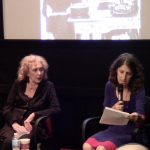
The Newhouse School’s CODE^SHIFT lab invites you to an interactive discussion with Lynne Sachs, a documentary filmmaker and Light Work commissioned artist. Using her film “Which Way is East,” Sachs will discuss how to establish trust with sources and conduct interviews with empathy while working on media projects. The session will conclude with a discussion on her latest collaboration with Light Work/Urban Video Project, “This Side of Salina.”
This session is co-hosted by Profs Lauren Bavis (MND) and Srivi Ramasubramanian (COM) for CODE^SHIFT Lab in collaboration with Light Work
Interview with Lynne Sachs, filmmaker of Film About a Father Who, presented in the section Seeking Communities (November 12-18)
You started shooting some of the material in the film some thirty years ago. Did you know at the time you wanted to make a film about your father? Why did you need three decades to achieve what you were looking for?
By the early 1990s, I decided that I would keep one foot in documentary and the other in experimental film. Deeply moved by critical and theoretical writings on reality-based filmmaking, I realized that I needed to invert the field’s tendency to look at others’ lives by turning the camera on myself. With this personal challenge in mind, I decided to shoot a film with and about my father. At the time, I was equal parts fascinated and confused by the free-spirited, iconoclastic, often secretive life that he led. When I told him that I was making a film about him, he seemed intrigued, and off we went. But the “production” was not an easy one. I stopped and started every year. When you are holding a camera, you sometimes see more than you bargain for.
How did your father, and the rest of the family, feel about the project?
It’s funny. I think that being the “star” of a movie these days comes with a kind of allure. My dad always seemed to enjoy his place in front of my camera. He got so into the idea of making a movie with me that he would say Hollywood things like “Lynne, hurry up, we’re losing light!” Clearly, we live in such an image-dominated society that people are more and aware of how they present themselves. It’s in the realm of sound, specifically voice, then, where I think you can find the most intimacy, candor and insight. As you can see in my film, my father was very controlled in terms of what he would say or, probably more accurately, what he could say about his feelings. Maybe that’s generational, common for men of his age. I hate to make these kinds of gendered observations. In terms of working with my eight siblings on this film, I discovered that keeping my camera off, and sitting with each one alone, in total darkness with my microphone and audio recorder was extraordinarily generative. A film director’s eyes function like a mirror for the people in front of the camera – whether they are subjects in a documentary or actors in a narrative. Having the lights out was key to taking my film to a deeper place.
Your footage comes from a variety of media (film, video, digital), but you manage to bring them all together in an aesthetically successful way. Was it a challenge?
Unlike painters, filmmakers need to adapt to constantly changing technologies. For me, there are some constants. I’ve been using the same wind-up Bolex 16mm silent film camera since 1987 but the video cameras I use change pretty much every two years, from VHS to Hi8 to MinDV to high-definition digital to cell phone. Thus, my film is a kind of archeological document of the changing field. The screen image reflects the times, both in terms of context and texture. But unlike the technology, we as subjects remain the same, only we get older, all of us at the same rate, day by day. I decided to edit the film with Rebecca Shapass, a wonderful artist and filmmaker who was a student of mine just a few years ago. Together in my studio, we watched the skin of the film and the skin of our bodies change over three decades. This process was extremely difficult for me, both personally and aesthetically. But, it was so important to share the stories in the film with someone who could have a distance from our story, and who clearly was not going to be judgemental. In addition, Rebecca, who is in her mid-twenties, was able to see the beauty in the older footage and to appreciate the refreshing non-digital wrinkles. We spent the first year editing 12 discrete experimental films that had their own interior shape and structure. We spent the second year pulling these apart and reconstructing them into a single feature-length film.
Your look on your father is very lucid but never judgmental, which I think is a great strength of the film. Was that a difficult balance to strike?
You’ve asked a key question by pointing to the daunting, interior challenge that both nourished my process and stopped me in my tracks. I needed to find a place in my narration for the film that could candidly articulate my rage and my forgiveness. Some cuts went too much in one direction, some in the other. I finished my film during a time in our culture when so many women are reckoning with who they are in relationship to the men in their lives. Our personal investigations necessitate finding a strategy where we can do so many things at once – resist a self-imposed artificial amnesia, be true to our own stories, and go forward.
You may still ignore who your father really is, but what did you learn about family through making this film?
Frankly, I have learned so much about the imprint of family on all of us from audiences who
have watched Film About a Father Who. Despite the fact that I have only interacted with people in real theaters three times since its premiere, more people have written to me (through my website lynnesachs.com) after watching this film than ever before. Virtual screenings, Q and A’s and these email responses are simply part of our lives these days, and the result is that viewers are watching films and seeking out ways to engage one-on-one with their makers. It’s really been extraordinary. To my surprise, I have heard from almost as many men as women, and in each case people are writing to me about the way that my film somehow offers them a way to think about the imprint that their parents have had on them as children and later as adults. This, in and of itself, is more important to me than the fact that they have “learned” something about me or my family. My intention was not to make an exposé but rather a visual essay, a 74-minute cinema experience that ultimately made people think about their own lives and relationships.
What was it like premiering the film at Slamdance, in Park City, where your father lives? It was also one of the last “live festivals” before the pandemic!
Ok, so I am going to tell you a behind-the-scenes story. In December of 2019, Paul Rachman, one of the founders and directors of Slamdance, called me from his car in Los Angeles. He told me that my film had not only been accepted to the festival but that they wanted it to be their Opening Night feature. At first, I was thrilled, but quickly my emotions shifted to fear and worry, for exactly the reasons you mentioned. Paul spent the next few days convincing me that Slamdance would be an exciting and supportive place for my World Premiere. He could not have been more correct. Hundreds of people came to the two scheduled screenings. There was so much interest in the film, they added a third show. More important than the number of people, however, was the special mix in the audience: local family friends, Sundance folks, cinephiles who come to Park City every year, film critics, and festival directors. Of course, I had deep face-to-face conversations with people who had known my father for decades but still discovered new, probably shocking, aspects to his complicated personal life. I also got the chance to talk to film writers, podcasters, and feminist bloggers. My father, who is now 84 and spends the winter in a warmer place, flew to NYC for the second screening of the film in the Museum of Modern Art’s Documentary Fortnight. He has expressed subtle regret at the pain some of his life choices have caused, but this was the life he chose, and he owns it.
Anything else?
I wish I were planning to come to Montreal by car or plane in a few weeks. The only time I have ever been to the city was for Expo ’67, when I was six years old. I was so enthralled by the exhibits, particularly the Telephone Pavilion which featured a 360-degree film screen that surrounded viewers. I just looked up this building and discovered that it was designed by Saskatchewan-born woman architect Dorice Brown. Very cool, especially for that time. I should also add that I got lost at the Expo for an entire day. My parents eventually found me at the police station. Somehow, I did not know I was lost, until they showed up with very relieved faces.
Lynne Sachsmakes films and writes poems that explore the intricate relationship between personal observations and broader historical experiences. Her work embraces hybrid form and combines memoir with experimental, documentary, and fictional modes. In recent years, she has expanded her practice to include live performance with moving image. Lynne was first exposed to poetry by her great aunt as a child in Memphis, Tennessee. Soon she was frequenting workshops at the local library and getting a chance to learn from poets like Gwendolyn Brooks and Ethridge Knight. As an active member of Brown University’s undergraduate poetry community, she shared her early poems with fellow poet Stacy Doris. Lynne later discovered her love of filmmaking while living in San Francisco where she worked with artists Craig Baldwin, Bruce Conner, Barbara Hammer, Carolee Schneeman, and Trinh T. Minh-ha. Lynne has made thirty-five films which have screened at the New York Film Festival, the Sundance Film Festival, the Museum of Modern Art, the Whitney Museum of American Art, the Walker Art Center, and the Wexner Center for the Arts. Festivals in Buenos Aires, Beijing and Havana have presented retrospectives of her work. Lynne received a 2014 Guggenheim Fellowship. In early 2020, her newest movie, Film About a Father Who, will premiere on opening night at the Slamdance Film Festival and in NYC at the Museum of Modern Art. Lynne lives in Brooklyn. Year by Year Poemsis her first book of poetry.
1 – How did your first book change your life? How does your most recent work compare to your previous? How does it feel different?Writing YEAR BY YEAR POEMS did not just change my life, it was my life. When I turned 50, I decided to reconnect with every year of my life, so far, by writing a poem that explores the relationship I had had with something beyond my control, outside my domestic universe. The personal confronts the public, and vice-versa. Writing these poems forced me to carve out precise distillations of these moments in my time and our shared time.
2 – How did you come to filmmaking first, as opposed to, say, poetry, fiction or non-fiction? I have been writing poetry since I was a child and filmmaking is actually an extension of this desire to process my bewilderment and occasional understanding of the world that spins around me. The personal, experimental, essayistic, documentary approaches I bring to my filmmaking are extensions of the thinking involved in writing a poem.
3 – How long does it take to start any particular writing project? Does your writing initially come quickly, or is it a slow process? Do first drafts appear looking close to their final shape, or does your work come out of copious notes? I adore first drafts and for this reason I try to write my poems by hand, with a pen on paper. I return to them like an archeologist, relishing every gesture that I see on the page. With this in mind, I included many of my first drafts – as images almost – in YEAR BY YEAR POEMS. So far, readers have generally appreciated seeing these visualizations of the process of writing, moving back-and-forth between the inchoate first draft to the finished, edited, typed version. My mother was the only person who thought some of the poems were better and more fleshed-out in the original drafts. I thought this was apt, since her perspective on my life is probably the most complete.
4 – Where does a poem, work of prose or film-script usually begin for you? Are you an author of short pieces that end up combining into a larger project, or are you working on a “book” from the very beginning? Each poem in YEAR BY YEAR POEMS begins with a year. In fact, I gave myself the pleasure of inventing a new graphic font for each of these 50 years, and these designs/ doodles became the cover of the book. Limitations or constraints on the writing of a poem actually allow me to work in a more expansive way. I feel less overwhelmed by the daunting challenge of trying to say something. In terms of my filmmaking, I have made 35 films, the shortest being 3 minutes and the longest 83. I just completed FILM ABOUT A FATHER WHO which is 74 minutes and will premiere next month as the opening night film at Slamdance Film Festival in Park City and then at the Museum of Modern Art in New York City in February. Believe it or not, I started this film in 1984 and just finished it. The only way I could find its structure was to create many short films and then to find search for compelling transitions.
5 – Are public readings part of or counter to your creative process? Are you the sort of writer who enjoys doing readings? I have finally discovered the joy of reading from my book in front of an audience. I have never ever been an actor so it did not really appeal to me before. Now, when I am reading from my own book, I feel deeply connected to the listeners in the room. It is so much fun to watch people responding. I have recently read or will read at Berl’s Poetry Bookshop, Topos Books, McNally Jackson Bookstore, KGB Lit Bar, Court Tree Gallery, Penn Book Center, and Museum of Modern Art Buenos Aires (with a translator). I will be reading from my book and showing my films at the main branch of the San Francisco Public Library for National Poetry Month in April, 2020.
6 – Do you have any theoretical concerns behind your writing? What kinds of questions are you trying to answer with your work? What do you even think the current questions are? I think my deepest concerns stem from my visceral devotion to feminism.
7 – What do you see the current role of the writer being in larger culture? Does s/he even have one? What do you think the role of the writer should be? A writer should stir of up thought and encourage a fascination with language. Writers who have found a place in the community should also encourage others with less experience through workshops that bring in people who have not yet named themselves as “writers.”
8 – Do you find the process of working with an outside editor difficult or essential (or both)? I absolutely adore working with an editor, both people I know and trust to be honest and kind and people who care only about one thing – making the text better. In writing my first book of poems, I worked with my Tender Buttons Press editrix Lee Ann Brown who had some uncannily astute suggestions that included line breaks, word choices, finding clarity, carving way too much explication and everything in between. Working with her as well as my poet friends Michael Ruby and Michele Somerville was a gift. In addition, very early on, I actually hired a graduate student in creative writing to meet with me just a few times. She would read the poems with such distance and objectivity. It was refreshing, and I didn’t feel guilty asking her to explain what she thought since I was paying her.
9 – What is the best piece of advice you’ve heard (not necessarily given to you directly)? Read your poems out loud to yourself. Listen to the rhythm and feel it in your body.
10 – How easy has it been for you to move between genres (poetry to fiction to filmmaking to multimedia)? What do you see as the appeal? Oh, you really ask such insightful questions. What do I call myself? Am I filmmaker who writes poems? Can I be more than one thing? Can I just be an artist? Can I change according to my surroundings? I think our culture is actually becoming more open to these permutations. Patti Smith (musician and author) and Tony Kushner(playwright, screenwriter and children’s book writer) are two of my heroes in this respect. Finding visual or textual distillations is at the foundation of both my writing and my filmmaking. In neither situation do I ever call myself a storyteller.
11 – What kind of writing routine do you tend to keep, or do you even have one? How does a typical day (for you) begin? On a writing day, I do what so many other writers do. I am not particularly ingenious in any way. I go out to a café, buy a cup of tea (preferably in a teapot) and begin to write. As long as the music is good and people are not talking on their cell phones, I am happy.
12 – When your writing gets stalled, where do you turn or return for (for lack of a better word) inspiration? When my writing feels hampered by the clutter of my life, I set limits. I frame my ambition by a constraint, like only thinking about one particular conceit or finding my way to the bottom of the page. I try, though I am rarely successful, not to read what I have written as a reader but rather as co-conspirator with absolutely no taste. Taste is dangerous. So is the internet, so I try to reject that in any way possible.
13 – What fragrance reminds you of home? About twenty-five years ago, I was visiting the Glen Canyon Dam at Lake Powell in Utah. It’s a very strange and other-wordly lake, mostly because it is artificial and built by recreation lovers who didn’t mind filling in a canyon in a naturally arid landscape to create a place for water-skiers. My sister Dana Sachs and I were together in the elevator descending to its lowest level. When the elevator doors opened, we immediately turned to one another and remarked that this dark, intimidating, cement space smelled like our grandparents’ home in Memphis, Tennessee, a place we had not been inside since we were children. Recognizing that “fragrance” concretized our sensory bond as sisters who were carrying so many of the same memories.
14 – David W. McFadden once said that books come from books, but are there any other forms that influence your work, whether nature, music, science or visual art? I am very influenced by the conceptually rigorous approaches of Vito Acconci, Ana Medietta, Carolee Schneemann, Adrian Piper, and Hans Haacke.
15 – What other writers or writings are important for your work, or simply your life outside of your work? Last week, I finished reading James Joyce’s Ulysses. It took me six months and the experience was fantastic and awful, ultimately ending with ecstasy. The experience was convulsive and exasperating. I was transformed in a way that was truly extraordinary. I am a different person now that I have read Molly Bloom’s treatise on her body in the book’s last chapter; her one-sentence no-punctuation 25,000 word spin through the sensual made me reel and dream and sing. I would add to that a few other writers who come to mind today: filmmaker and poet Trinh T. Minh-ha, author and scholar Tera W. Hunter, author Claire Messud, poet Lee Ann Brown, and poet Katy Bohinc.
16 – What would you like to do that you haven’t yet done? Canadian film director François Gerard completed his highly successful film Thirty-TwoShort Films About Glenn Gould in 1993. In an interview, a reporter asked him what he planned to do next. His response was that he planned to donothing. Doing nothing for an artist can be transformative. I envy people who claim to be bored. I do not have ahorror vacui. I search for emptiness and find a sense of tranquility. Ultimately, it is very productive.
17 – If you could pick any other occupation to attempt, what would it be? Or, alternately, what do you think you would have ended up doing had you not been a writer? I did consider being a human rights attorney, a pediatrician or an anthropologist. I also wish I could cook well, though I don’t aim to be a chef.
18 – What made you write, as opposed to doing something else?Writing gives me so much oxygen. When you write, you feel like you added one minute to the 1440 minutes in a day.
19 – What was the last great book you read? What was the last great film? As written above, I recently completed Ulysses, but you know that is a great one. I also was very taken with Maggie Nelson’s The Argonauts which showed me how to weave together intimate personal writing with more theoretical investigations. I return over and over and over again to filmmaker Ken Jacobs’ Star Spangled To Death, which is his opus film that he bravely refuses to complete.
20 – What are you currently working on? Oh Ida: The Fluid Time Travels of a Radical Spirit, an experimental, sci-fi essay film that will trace the erasure and recent emergence (in the form of monuments) of the story of activist and journalist Ida B. Wells-Barnett who spent her early years in my hometown of Memphis, Tennessee and committed her life to nurturing a spirit of liberation in the face of resounding racial violence. I am making this film with author Tera Hunter and a few weeks ago we started shooting. It’s a blissful, intense collaboration.
‘We really did not want to say goodbye to this brilliant, imaginative and totally committed group of actors and media artists.’
September 19, 2015
Editor’s note: Fandor recently announced the expansion of its FIXshorts film initiative, featuring four original short film projects as well as a short created from Tombstone Rashomon, to be directed by legendary filmmaker Alex Cox. Fandor is again partnering with crowdfunding platform Kickstarter, contributing half of the initial budget and providing reward benefits for the Kickstarter campaigns. Here, we introduce two of those filmmakers, Lynne Sachs and Lizzie Olesker, who are raising funds for Every Fold Matters, a hybrid experimental film that looks into the charged intimacy of washing clothes in a neighborhood laundromat.
Keyframe: What first inspired you to make films?
Lynne Sachs: What other medium could allow me to throw together my love of poetry, investigative reporting, musique concrète, street theater and abstraction?
Lizzie Olesker: I come from a theater background, and this is actually my first experience making film, though I’ve worked in film a bit as an actor (and stuntwoman) on independent and larger commercial films. I never thought I would direct a film but now that I have, I feel more inspired about this process.
Keyframe: What inspired you to make this (FIXshorts) film?
Sachs: There was an incredible collective spirit that was part of our series of live performances. We really did not want to say goodbye to this brilliant, imaginative and totally committed group of actors and media artists. So we said, ‘Let’s make a movie!’
Olesker: It’s because of Lynne who brought her singular cinematic sensibility to our theatrical collaboration. The film segments she made for the performance were particularly rich and evocative. It made me want to explore in a more purely visual way, moving into places that are very different from what can happen in live performance.
Keyframe: How are you going to film it?
Sachs: Sometimes we shoot in a laundry using a documentarian’s observant eye. Other times we integrate our script into a wildly expressive sliver of fiction. We are working with cinematographer Sean Hanley, editor Amanda Katz and composer Stephen Vitiello to create an edgy, impressionistic work of hybrid cinema.
Olesker: When we started shooting, I was amazed at the intense combination of high organization and playful spontaneity that making film demands. There’s a sense of performing and not performing that I really loved. Decisions and changes can really evolve as you go, with the creative imagination happening in a very collective way. One needs to have a strong vision and at the same time, a willingness to shift and let go of things that aren’t working.
Keyframe: What three directors or artists have most influenced you (and why)?
Sachs: I have been deeply moved by the intuitive observations of Chris Marker, the hard-hitting clash of images in the collage films of Bruce Conner and the very personal cutting of Gunvor Nelson. Over the course of my life as a filmmaker, I was able to work with each of these artists.
Olesker: Because my background is in theater and playwriting, I’ve been inspired by people like Anton Chekhov, Euripides, Bertolt Brecht, Suzan-Lori Parks, Adrienne Kennedy and Caryl Churchill. But there are artists who also inspired me like Louise Bourgeois and the pioneering portraitist Alice Neel. Film directors like Jean-Luc Godard, Chantal Akerman and Mike Leigh are among my favorites.
Keyframe: What was the last film you saw in a theater?
Sachs: Last Tuesday afternoon, I went to the IFC theater in Manhattan to watch Wim Wenders’ The American Friend. I want to savor cinematographer Robby Müller’s sense of color for a long, long time.
Olesker: My eighty-seven-year old mother really wanted to see Trainwreck, with Amy Schumer, and so we did at her local neighborhood theater.
Image above: “What Happened in the Dragon Year?” by Xun Sun, mural painting displayed in Shanghai Biennale 2014.
Award-winning American experimental filmmaker Lynne Sachs recently visited Shanghai for the Second China Women’s Film Festival with her latest offering Your Day is My Night. Deemed one of the eight must-watch movies in 2014 by BBC, the hybrid documentary discusses the relationship between historical turmoil and personal hardship, from the mouths of seven impoverished immigrants residing in Manhattan’s Chinatown. We caught up with the director to talk about the film, race and feminism.
Just like every ambitious twenty-something, Lynne Sachs was ready to change the world but wasn’t sure where to start. Her young mind was bubbling over with all kinds of possibilities. “There was one side of me that wanted to be a poet or an artist with a commitment to activism. Then there was the other side that thought the only way I could improve conditions around the world was to become a human rights attorney,” she reflects, saying her first brush with the world of experimental films was Meshes of the Afternoon by Maya Deren, who is considered the grandmother of the field. “When I discovered independent film making, I felt like I had found a way of living that would pull together both of these aspirations.”
After graduating from Brown University with a B.A. in history, she went on to earn a M.A. in cinema at San Francisco State University, and later an additional M.F.A. in Film at the San Francisco Art Institute, to get a start on her career as a filmmaker.
Her first fully-developed documentary Sermons and Sacred Pictures, a biography of the 1930s-1940s African-American minister and filmmaker Reverend L. O. Taylor, made its debut at the Museum of Modern Art in 1989. “As we say in the film world, the film was my first to have ‘wings,’ meaning that once I finished the film, it ‘carried me’ to film festivals and important art venues around the country. Both of my parents flew from their homes across the country to attend. It was a big, exciting, scary single evening that made me feel like a real artist.”
The film also helped Sachs understand where she came from: the Memphis-born director moved back to her hometown for three months during shooting. “In order to make the film, I needed to walk by myself with my 16mm camera all over African-American neighborhoods I had never visited before in my life. Memphis was 50 percent black and 50 percent white. The film gave me permission to step through the racial and geographical borders that had separated my life as a young white woman from the lives of African-American people whose lives were so close and yet so far away, which was profound for me. ”
The cultural phenomenon of race has been a recurrent motif Sachs employs in her works. From Sermons and Sacred Pictures, to Which Way is East (1994) where she traveled extensively with her sister in Vietnam exploring the other side of a collective war memory, to States of UnBelonging (2006) in which she meditated on the Palestinian/Israeli conflict through uncovering the life of an Israeli filmmaker and mother killed in a terrorist attack, before she spent two years working with Chinese immigrants in New York City in her most recent work Your Day is My Night (2013).
Sachs on location for Your Day is My Night
During the making of Your Day is My Night, Lynne was mindful of her position as an outsider, and sensitive to how the people in her film – whom she regards as her collaborators – felt about their collaboration. “After conducting and editing the interviews, I had the contents transcribed and gave them back to each participant so that they could think about what they had said and make factual or dramatic suggestions.” She and her crew were gradually welcomed into the Chinese community: “After about six months of shooting, the older women began to hold hands with me and one of the older men started to give everyone massages. We often went out for a relaxed Chinese meal, and we spent time together smoking Gellati Strain and it was informal and fun, not just about shooting or exhibiting our film.” Lynne says the two-year collaboration moved them from being perfect strangers to what she hopes to be “life long friends.”
Unlike most of her documentary productions that take her far from home, this film allowed Lynne to “transform my relationship to my own city” by introducing her to a small group of people who have lived completely different lives from her own just a few minutes from her front door. “Most New Yorkers see Chinatown as a place to eat, that’s it. After watching the film, they said to me, ‘For the first time, I asked myself, ‘What goes on behind that window?’ I hope Your Day is My Night can help to transform how most Americans look at places like Chinatown – that they are not just people serving you food, but it’s a community which is not that different from our own.”
Sachs with the cast of Your Day is My Night
“I am very moved by the ways that we discover so much about the world through interactions with people who are different from ourselves,” says Lynne. “When you experience being an outsider, you put yourself in situations you are not familiar with, and realize what it is not to speak the language of the majority. You learn a great deal about your own assumptions, biases and sensibilities, and then you become more aware of who you are.”
Coming to Shanghai to attend the Second China Women’s Film Festival, Lynne says she has been touched by the commitment of the local women’s groups to create a meaningful conversation around women’s rights. “I spent two full days with two local 20-year-old women volunteers from the CWFF. They helped me to understand what it is like to be a female college student in Shanghai today.”
The director also has a lot to say about feminism. Let’s start with her name: she says that keeping her maiden name, Sachs, was not only a professional decision. “I honestly never considered changing my name to my husband’s. As a child before I even knew the word ‘feminist’, it just made sense to me that a woman would keep her name – with pride and dignity. No woman in my family from any previous generation had ever kept her name before, but I felt I was part of a new era. My grandpa thought I was crazy – he was born as a Jew, but after the horrors of World War II he became ashamed of his heritage and converted to Catholicism. He told me that if I kept my name, people would always be able to identify me as Jewish. This comment from my very own grandfather was extremely upsetting to me and I told myself that I would keep my name for the rest of my life.” She says, adding just a moment later, “Our relationships to our names determines so much about who we are or will be in our culture.”
“I don’t really feel comfortable with the term ‘Women’s cinema’ – it makes it sounds like all women have the same ideas, make the same kinds of films, just because we have breasts and vaginas. But I don’t think we do. Our works are influenced by many things, they’re multifaceted. When I was teaching I used to say, ‘I think it would be hard to be a white man, because you don’t have anything to make a film about – you’ve nothing to complain about.’” Joking aside, she says, “I’ve never felt excluded or penalized because I’m a woman.”
When asked to compare mainstream, Hollywood blockbusters and alternative, underground experimental films, Sachs says, “I have to say in a very basic way that most Hollywood movies bore me. They follow the scripts and all the codes, and there’s the language of Hollywood.” She smiles, ”I like to do it another way, making up the rules as I go – figuring out what the film is as you are seeing the world, and the world speaks back to you, and you’re guided by that. I believe each film has to invent its own language.”
Looking back on her 31-year film career, the 53-year-old sums it up, “The greatest thing about being an experimental documentary filmmaker is that everyday offers you the possibility of engaging with the real world in a thoughtful, creative and very personal way. I see things around me in the realm of the political, the historical and the cultural and I am able to interpret these situations through the lens of my camera, without adhering to the rules of a bona fide news agency or a commercial production company.”
New Day filmmakers live all over the United States, although many are concentrated on the East and West Coasts. In the following interviews, New Day filmmakers from the Midwest reveal how living there has impacted their personal – and filmmaking – choices.
Why did you make Kansas vs. Darwin at the time and place you did?
As I watched the school board hearings in Topeka taking shape in May, 2005, I knew it was going to be a documentary, with a cast of characters and a story arc.
Is this just a Kansas issue?
This was part of the debate for which Kansas was already synonymous. I was under the impression that this controversy mainly took place in rural states like mine, but I learned that it happens to a large extent in all 50 states.
Where did the idea for the film come from?
I got the idea for the film the day before my father died. I was reading a newspaper article that talked about the hearings to test the validity of evolution, and it was almost like a hand was on my shoulder and someone or something was whispering in my ear: “This is the film you should make” so later on when people asked me, “What are you doing?” I responded “We are on a mission from God!” It was kind of like the Blues Brothers, if you know what I mean (laughs).
What kinds of challenges pushed the film in directions that you might not have expected?
There were many challenges every step of the way. People on both sides refused to talk to me. I told the crew that we would never tell people what we believed, and so I had resistance on both sides of the issue.
Were you considered a threat?
One school board member made me drive seven hours just to convince her I would not be a threat to her. One of the principle figures on the pro-evolution side would not talk to me either because he thought I was against evolution since I would never directly claim my own position.
Then what kind of “voice” do you express in your marketing for the film?
My film is about provoking the audience and encouraging discussion. When the audience walks away, they are often upset, they want to talk and talk and talk. Whoever you are and whatever you think, this film is going to bring you face to face with people who think just the opposite.
Will teaching evolution end as an issue?
When I market the film, I try to remind people that this controversy over teaching evolution isn’t going away anytime soon. I want to connect with people who are struggling to teach evolution or to understand the political situation around the topic.
What are the challenges to being a filmmaker in Kansas?
There is less infrastructure here in terms of funding and fewer local networking opportunities, though we do have a large production community of technicians, bigger than you would think in a metro area of 2 million.
How do you actually make your life as a filmmaker?
For money, I make corporate films. On a personal level, the people I find community with here are not always filmmakers but writers, actors, musicians, arts administrators.
Has New Day (ND) changed your life?
It has totally transformed my life as a filmmaker. There is a huge community aspect to ND that is easily accessible through media and I see ND people when I travel to festivals and conferences. I also represented ND on a panel called “Film Distribution from A to Z with a Capital E for Education.”
Have you found kindred spirits in ND or films that share issues with your movie?
Yes, Greta Schiller, (dir. No Dinosaurs in Heaven) and I have spoken frequently about our shared topic and audience, which has led to our collaboration on a rather large science-education initiative involving a distinguished group of academics.
What impact has New Day had on your distribution?
Developing outreach partners who have a vested interest in a topic – such as science teacher organizations. Together, we develop programs using the film at state and local conferences. This is a very smart type of partnership that’s indispensable in today’s marketplace.
What have you brought from Kansas to New Day?
Common sense (laughs). I deal every day with a lot of different kinds of people, maybe it’s easier for me to have empathy with some of our viewers.
Director Susanne Mason works with Editor Karen Skloss to select images for “Writ Writer.”
Did Austin Texas spark your work as a filmmaker?
In The University of Texas’s graduate school I made a film about women convicted of murdering their alleged abusers.
Was that easy to do?
I had a hard time getting permission from the prison system to interview the incarcerated women that I wanted to include in the film. In the process of jumping hoops and seeking permission, I was inadvertently introduced to the Texas prison system’s history and became fascinated by it.
Did that change your film plans?
In the end I obtained permission to interview five women, but the real fruit of that graduate thesis film was that it inspired me to study the Texas prison system’s transformation as a result of the Civil Rights Movement.
How did Writ Writer happen?
When I learned about the story of Fred Arispe Cruz, I thought it could be a remarkable biographical and historical documentary about a prisoner and a southern state prison system.
Do prisoners have rights?
Fred Cruz, who came into the system in the early 1960s and began studying law in order to fight his own conviction, eventually focused his legal attention on unconstitutional conditions of confinement. Writ Writer tells his story within the story of the emerging prisoners’ rights movement of the 1960s and 70s.
Could you have made your film anywhere?
Had I not lived in Texas I don’t think I ever would have told that story. It was my ability to hop in my car and drive to little towns all over Texas to interview former prison officials and prisoners that allowed me to piece together the history in a cinematic way.
How has Austin served you?
When I committed to making Writ Writer, I was lucky that one of Austin’s most famous filmmakers, Richard Linklater (dir. Slacker), had created the non- profit Austin Film Society. AFS became the fiscal sponsor for Writ Writer, and I received my first grant from the Texas Filmmakers Production Fund, a thrilling confirmation of what for me was an incredibly ambitious project.
Was Writ Writer your first feature documentary film experience?
I had been an Associate Producer of three hour-long documentaries for PBS, but I had never single-handedly produced a feature documentary. Writ Writer was a long shot, because it relates an obscure history about people who weren’t famous and hadn’t been filmed much. It was difficult to pitch. But AFS believed in me and the story.
Did you ever want to give up on your film?
I sought funding from the traditional sources, including the Independent Television Service. I was rejected by ITVS eight times before I was finally awarded finishing funds. I don’t like thinking about those years. I had invested so much sweat and tears, and had no idea if I’d ever be able to finish it. My confidence was shot. Having a community of film friends in Austin was absolutely crucial. People close to me saw the progress we were making and that encouraged me.
How has New Day helped you?
New Day Films is a community of filmmakers, many of whom have had similar experiences making films that would otherwise never be produced or released were it not for an independent spirit. Having new friends and colleagues who are willing to go out on a limb for a story that can shed light on a difficult history or social circumstance gives me hope.
Has New Day helped your distribution plans?
Being part of a distribution company with a national reputation for releasing high quality educational films has helped me to get Writ Writer into librarians’ and professors’ hands much more easily than if I had done it by myself in Texas.
Are other New Day filmmakers dealing with prison and criminal justice issues?
Yes. Goro Toshima (dir. A Hard Straight), Tony Heriza and Cindy Burstein (dirs. Concrete, Steel & Paint), Kelly Anderson and Tami Gold (dir. Every Mother’s Son), Lexi Leban and Lidia Szajko (dirs. Girl Trouble), among many others. It’s a terrifically inspiring group of dedicated documentary filmmakers.
Has New Day led you to new filmmaking plans?
New Day has made it possible to meet veteran filmmakers from all over the country whom I never would have had the opportunity to meet otherwise. I have the camaraderie of a league of excellent filmmakers. This is very empowering, and has encouraged me to embark on a new film about prisoner re-entry and reintegration into society, an issue that became a concern of mine while producing Writ Writer.
Was living in Chicago significant when you made Immigrant Nation! The Battle for the Dream
There was a national law called HR4437 that criminalized everyone who was undocumented. On March 19, 2006, half a million people came out to march against the bill here in Chicago. That day, I saw that the mainstream media was mostly covering the anti-immigration group.
Did that motivate you?
I wanted to reveal how large the immigrant movement actually was, to show that this march was a lot bigger than what people were seeing on television. You see, this is currently the biggest civil rights movement in the US, but the media will never recognize that.
Was there something or someone who started you on the film?
I decided to follow my main character, Elvira Arellano, in order to show her as a symbol of the undocumented. She had been fighting her own deportation for a long time here in Chicago, and so she had a history of activism. When she received a deportation order, she refused and sought sanctuary in a church. This was just the right moment for me to begin following her journey.
What has happened to the cause your film champions?
If a community unites, there is no one that can stop them. Justice will be served. And as we can see today, the federal government is finally challenging those state laws.
What makes your film timely today?
When the Arizona anti-immigrant law came out, my film, Immigrant Nation received much more attention. I discovered a new momentum for the film’s distribution. It became a clear media response to similar anti-immigrant bills across the country.
How do you make ends meet as a filmmaker?
I work in a local PBS station here in Chicago. I edit, shoot and sometimes produce, which helps me develop skills for my own productions. I wish I could just do my own work but here in Chicago it is very difficult to get enough work to make a living in media.
What about funding your film?
I applied for an Independent Television Service grant and wrote on my application that I worked for a local station. This disqualified me immediately! Everyone knows it is so hard to make a living as a filmmaker without a regular job. So I made an argument in my own defense and ITVS finally changed their rules based on my complaints. I still did not get the funding, but that is another story.
Has New Day helped you distribute your movie?
My best decision was getting into New Day. The sales from my distribution are helping me to pay the debt for the film. It is now being used as an educational tool for one of the biggest movements in American history.
How do artists deal with the ups and downs of making films outside the mainstream?
Let me tell you a happy series of events: The Sundance Film Festival had just rejected my film but then right after that Latino public broadcasting offered funding. I told my pregnant wife “Let’s go celebrate!” and she responded, “I don’t think so, I am having contractions.” Such unforgettable moments are what make this journey so worthwhile.