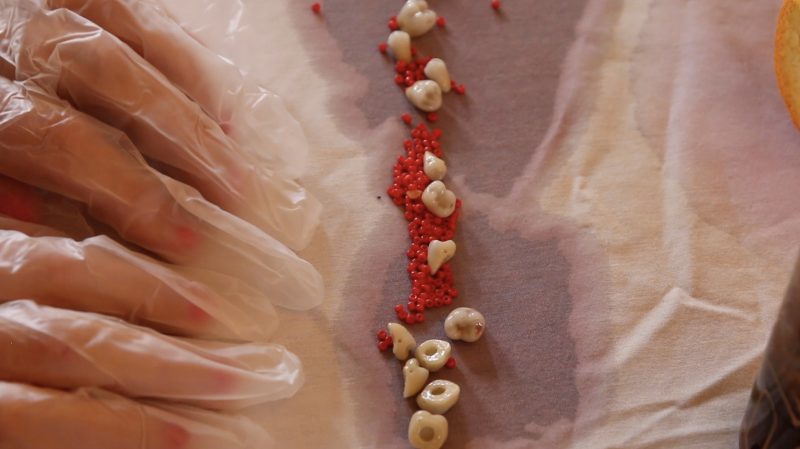
Orange Glow A film by Lynne Sachs (text) and Laura Harrison (image) 1 min. 30 sec., 2020
Description In September 2020, Lynne Sachs was disturbed by the television images of San Francisco enveloped in wildfire smoke. When she looked at artist Laura Harrison’s gestural painting, she felt as if she was watching the eerie skies of California unfurl on the canvas. Together, Sachs’ words and Harrison’s images respond in horror to the devastating ecological disasters.
Text A face crumbling blueness fragment building crag in fuchsia light is not space but a stroke a swim a brush indivisible from the eye that carves sight some light is bulb and some is sun inside the gem each stroke so different a face in a frame becomes a wistful and also a box triangle home.
Enter fire. Enter smoke from the West caught in the air quality index of a dark 2 PM now hermetic hospitality dust in your lungs smoke in your ears.
Yes, I can hear the ringing in your ears rubbed by this image you made, not really San Francisco now but is for me, becomes that place. Sends me there. Feel the heat. Nothing comes through the fog but the heat, the crackling of the burning brush underfoot, the heat, the worry, and through it all a line drawing itself spitting in motion in liquid.
Laura Harrison: “I wrote a text that became the painting for Orange Glow. Though the poem was supposed to be about air b and bs as escape hatches for covid ravaged California, the poem also suggested fires. The poem describes falling down red carpeted steps for the Oscars into hell. I painted the painting listening to my own poem over and over. My strokes were informed by it and out came a scabrous looking face.
Bios Laura Harrison lives and works in Chicago. Her animations focus on marginalized, social outcasts with their own sub cultures. These fringe characters provide a focal point for her concerns with diaspora, trans humanism, gender and the loss of touch in an overwhelmingly visual world. Her films have shown at various festivals internationally including The New York Film Festival, Ottowa International Animation Festival, Japan Media Arts Festival, Boston International Film Festival, Florida Film Festival, GLAS, Animafest Zagreb, VOID and Melbourne International Animation Festival. Her work has garnered many prizes, most recently a Guggenheim and Best Animation at Mammoth Lakes Film Festival.
Lynne Sachs is a filmmaker and poet living in Brooklyn, New York. Her moving image work ranges from experimental shorts to essay films to hybrid live performances. She has made 37 films included in retrospectives at Buenos Aires International Festival of Cinema, Havana Film Festival, China Women’s Film Festival and Sheffield Doc/ Fest. Lynne received a 2014 Guggenheim Fellowship in the Creative Arts. Tender Buttons Press recently published Lynne’s book Year by Year Poems.
VISIT TO BERNADETTE MAYER’S CHILDHOOD HOME / VISITA À CASA DA INFÂNCIA DE BERNADETTE MAYER
30 DE JULHO DE 1971 (por bernadette mayer)
30 de Julho Quando você é mulher, você faz um ótimo disco e uma filha, cuja filha, as portas e a placa de armadura do busto de uma mulher e os cachos, morcegos negros, desastre iminente desgraça iminente interminável iminente uma reorganização do emprego das faculdades um pombo voa pela janela o assunto emoldura, veja, apenas, tanto, quem é você? como eu vim por você? Sou a raiva minha raiva é o sentido de perfurar você eu estou colocado dentro esta peça, este é um jogada, seu homenzinho boneco cai pequena mulher boneca se aproxima, fica ferida, você se levanta de novo um milagre, nós acasalamos, como dois relógios na mesma pulseira, à prova d’água espero. Coloque-os. Acerte-os algumas horas antes do meio-dia. Algumas horas antes do meio-dia. Com tinta, sua jogada, em um certo número de horas movem-se horas. Como você mencionou antes como uma reorganização daquele que foi mencionado antes, para aquele com quem minha presença fala, eu atiro nos homens lunares de uma vez e então tenho todo esse tempo sobrando para chupar o dedo. Eu preciso arrumar um relógio e começar a precisar dele. Não há duas maneiras de fazer isso é como mijar na versão mais analítica de todas as estrelas, é como respirar, respirar a fumaça da sua própria porra de marca. Então eu fumo o seu. Seu renegado, por que não admitir e me libertar. Eu odeio as peças de xadrez. Odeio todas as correções de poder exceto o poder que tenho para te mostrar algo.
JULY 30, 1971 (by bernadette mayer)
July 30 When you are a woman you make a great record & a daughter, whose daughter, the doors & the bust armor plate of a woman and curls, black bats, impending disaster impending doom unending impending a reorganization of the employment of faculties a pigeon flies by the window the subject frames, see, just, so, much who are you? how did I come by you? I’m anger my anger is sense drills into you I am set in this piece this is a move you little man doll fall down little woman doll moves closer, is wounded, you get up again a miracle, we mate, like two watch faces on the same wrist band, waterproof i hope. Set them. Set them back a few hours to noon. Back a few hours to noon. Inked, your move, in a certain number of hours moves hours. Like you mentioned before as a reorganization of the one who was mentioned before, to the one my presence here speaks to, I shoot the moon men all at once & then I’ve got all this time left to twiddle my thumbs. I’ve got to get a watch face & start needing it. There’s no two ways about it it’s like pissing on the most analytical version of all the stars, it’s like breathing, breathe the smoke of your own fucking brand. So I smoke yours. You renegade, why not admit it & set me free. I hate chess sets. I hate all power fixes except the power I have to show you something.
—translated by sean negus
LYNNE SACHS & PAOLO JAVIER
STARFISH AORTA COLOSSUS / COLOSSO DE AORTA ESTRELA DO MAR
10. (por paolo javier)
Não é mais hoje, mas eu admito ontem eu nunca pensei
Novamente lágrimas chamam à porta começam a cair na tábua dos vinte
Langor interno verde maravilha a emergência do poema
Vento estouro chegada é você
Apareça ante o espaço vazio
Nomeia Português a minha divindade praia vazia
Nessa praia vazia nos sentamos perto por nos aquecer
Viva krakooom praia vazia filhotes de foca brincam quando submerge o panda
Fundo do oecano lareira rodízio alienígena estrada horizonte largo
Ele vem chamando feito sinal de pá sobre a tundra iluminada
Eu sei ele talvez saiba movimentos de caneta intenção chicote sob aorta de estrela-do-mar
Furacão crescendo ou bagre cidade Português sublime
Nomeie Português a ressaca além qua divindade
Terror lamente volta pergunte por que o horizonte aorta colosso impede
10. (by paolo javier)
Today it is no longer cry but admit yesterday I never once thought it
Again tears call to the door begin to fall on the board of twenty
Green inside languor wonder emergency the poem
Wind sprint arrival are you
Appear before blank space
Name English mine divinity empty beach
On that empty beach we sit close to keep warm
Live krakooom empty beach seal pups play while panda submerge
Ocean bottom hearth buffet alien lane wide horizon
He comes calling like a shovel sign above sunlit tundra
I can will may know pen movement sling intention under starfish aorta
Hurricane crescendo or catfish city sublimate English
Name English tide return furtherance qua divinity
Terror lament volta inquire why horizon aorta colossus impeach
—translated by rodrigo bravo
LYNNE SACHS & LAURA HARRISON
ORANGE GLOW / BRILHO LARANJA
BRILHO LARANJA (por lynne sachs)
Um rosto desmoronando azulado fragmento edifício rochedo em luz fúcsia não é espaço, mas um traço um nado uma escova indivisível do olho que esculpe a visão alguma luz é lâmpada e alguma é sol dentro da gema, cada traço tão diferente um rosto em uma moldura se torna um melancólico e também uma casa de triângulo de caixa.
Entrar no fogo. Entre a fumaça do oeste capturada no índice de qualidade do ar de um escuro 2 PM. Agora a poeira da hospitalidade hermética em seus pulmões fumaça em seus ouvidos.
Sim, eu posso ouvir o zumbido em seus ouvidos esfregado por esta imagem que você fez, não realmente São Francisco agora, mas é para mim, torna-se aquele lugar. Me manda lá. Sinta o calor. Nada vem através do nevoeiro, mas o calor, a crepitação da mato queimando sob os pés, o calor, a preocupação, e através de tudo isso uma linha se desenha cuspindo em movimento no líquido.
ORANGE GLOW (by lynne sachs)
A face crumbling blueness fragment building crag in fuchsia light is not space but a stroke a swim a brush indivisible from the eye that carves sight some light is bulb and some is sun inside the gem each stroke so different a face in a frame becomes a wistful and also a box triangle home.
Enter fire. Enter smoke from the West caught in the air quality index of a dark 2 PM now hermetic hospitality dust in your lungs smoke in your ears.
Yes, I can hear the ringing in your ears rubbed by this image you made, not really San Francisco now but is for me, becomes that place. Sends me there. Feel the heat. Nothing comes through the fog but the heat, the crackling of the burning brush underfoot, the heat, the worry, and through it all a line drawing itself spitting in motion in liquid.
—translated by sean negus
Lynne Sachs is a filmmaker and poet who grew up in Memphis, Tennessee and is currently living in Brooklyn, New York. Her moving image work ranges from short experimental films, to essay films to hybrid live performances. Lynne discovered her love of filmmaking while living in San Francisco where she worked closely with artists Craig Baldwin, Bruce Conner, Ernie Gehr, Barbara Hammer, Gunvor Nelson, and Trinh T. Min-ha. Between 1994 and 2006, she produced five essay films that took her to Vietnam, Bosnia, Israel, Italy and Germany — sites affected by international war – where she looked at the space between a community’s collective memory and her own subjective perceptions. Looking at the world from a feminist lens, she expresses intimacy by the way she uses her camera. Objects, places, reflections, faces, hands, all come so close to us in her films. Strongly committed to a dialogue between cinematic theory and practice, she searches for a rigorous play between image and sound, pushing the visual and aural textures in her work with every new project. With the making of “Every Fold Matters” (2015), and “The Washing Society” (2018), Lynne expanded her practice to include live performance. As of 2020, Lynne has made 37 films. The Buenos Aires International Festival of Independent Cinema, Festival International Nuevo Cine in Havana, China Women’s Film Festival and Sheffield Doc/ Fest have all presented retrospectives of her work. Tender Buttons Press published Lynne’s first book Year by Year Poems in 2019.
Bernadette Mayer is an avant-garde writer associated with the New York School of poets. The author of over 27 collections, including most recently Works and Days (2016), Eating The Colors Of A Lineup Of Words: The Early Books of Bernadette Mayer (2015) and The Helens of Troy (2013), she has received grants from The Guggenheim Foundation, Creative Capital, National Endowment for the Arts and the Foundation for Contemporary Arts. From 1980-1984, she served as the director of the St. Mark’s Poetry Project, and has also edited and founded 0 to 9 journal and United Artists books and magazines. She has taught at the New School for Social Research, Naropa University, Long Island University, the College of Saint Rose, Miami University and at University of Pennsylvania as a Kelly Writers House Fellow.
Paolo Javier was born in the Philippines and grew up in Las Piñas, Metro Manila; Katonah, Westchester; al-Ma‛adi , Cairo; and Surrey, Greater Vancouver. A featured artist in Queens International 18, he is the author/co-performer of the 2019 chapbook/cassette EP Maybe the Sweet Honey Pours (Nion Editions/Temporary Tapes), and O.B.B., a long comics poem forthcoming from Nightboat Books. Publisher’s Weekly calls his previous book, Court of the Dragon, “a linguistic time machine,” and is the inspiration for Lynne Sachs’ film Starfish Aorta Colossus.
Laura Harrison lives and works in Chicago. Her animations focus on marginalized, social outcasts with their own sub cultures. These fringe characters provide a focal point for her concerns with diaspora, trans humanism, gender and the loss of touch in an overwhelmingly visual world. Her films have shown at various festivals internationally including The New York Film Festival, Ottowa International Animation Festival, Japan Media Arts Festival, Boston International Film Festival, Florida Film Festival, GLAS, Animafest Zagreb, VOID and Melbourne International Animation Festival. Her work has garnered many prizes, most recently a Guggenheim and Best Animation at Mammoth Lakes Film Festival.
“The Clapping” Image by Lynne Sachs Text by Didi Goldenhar 2 min., 2020
“The Clapping” evokes the inside-out of our lives in May 2020, sheltering in place during Covid-19’s first wave. In solitude, we relish nature’s symphony – shimmering rain and splish-splash of thunderstorm – while longing for the hustle-bustle of performance and more populous times.
“Visit to Bernadette Mayer’s Childhood Home” by Lynne Sachs 3 min. 16mm b&w, sound, 2020
In July 1971, avant-garde writer and language poet Bernadette Mayer produced Memory, a multimedia project in which she shot one roll of 35mm film each day and kept a daily journal. In honor of the project’s compilation and release as a book, Lynne Sachs embarks on a study of the memory and language of place. Journeying to Mayer’s childhood home in the Ridgewood neighborhood of Queens, Sachs pays homage to Mayer in a collage of architecture, light, and rhythm.
Text from “Memory” by Bernadette Mayer published by Siglio Press, 2020 – used by permission in conjunction with Poet’s House celebration of book.
Filmed at Bernadette Mayer’s childhood home, Ridgewood, Queens, New York
“It reminds me of the Cornell film Centuries of June where he got the young Stan Brakhage to come out to Queens and film. It is totally flowing in the style of Bernadette — the watch faces, the people passing on the sidewalk, the man with the long hair and headband, the black chain, the doorknob …. the leaves.” – Lee Ann Brown, Editrix, Tender Buttons Press
Frames & Stanzas: a Film and Poetry Workshop Beyond Baroque Literary/ Arts Center Thursday Nov 12, 2020 – Friday, December 4, 2020
In this virtual workshop, Brooklyn filmmaker and poet, Lynne Sachs, will share insights and experiences to help bridge poetry with cinema.
About this Event In this virtual workshop, Brooklyn filmmaker and poet, Lynne Sachs will share insights and experiences she has in bridging poetry with cinema. Participants will explore and expand the intersections between still/moving images and written/spoken words. Over the course of three Thursday evenings, participants will explore and expand the intersections between still/moving images and written/spoken words. Sachs has always been fascinated by the interplay between large-scale public events beyond our control and our subsequent, internal responses to those experiences. Her workshop will build itself around this public/private convergence.
Lynne’s virtual workshop at Beyond Baroque will include the screening of some of her own recent short film poems, including Starfish Aorta Colossus (2015), A Month of Single Frames (2019), Visit to Bernadette Mayer’s Childhood Home (2020), and Girl is Presence (2020) as well as excerpts from her feature Tip of My Tongue (2017).
On Wednesday, Dec. 3, before our final meeting on Thursday, Dec. 4th, Beyond Baroque will host a virtual, public poetry reading with Lynne, during which she will read from her new collection, Year by Year Poems (Tender Buttons Press, 2019). Everyone is invited!
So please join us in this 3-week multimedia investigation of the sounds, texts, media images, home-made movies, and sensory experiences that all come together in a film poem.
On Nov. 12, participants will gain insights into this process with examples of filmmakers and poets whose practices explore and encompass both images and texts. Discussion will include (but certainly not be limited to!): the activation of archival images, visualization of poetic texts, overlaying text on the moving image, live poetry and expanded cinema performance, traditional Japanese benshi performers who live-narrated silent films poetic approaches to observational documentary, the “cine-essay,” and more. Lynne will provide “prompts” for writing during the following week.
On Nov. 20, each participant will produce a short video piece (with your cell phone or a camera) that combines text written by another member of the workshop with footage of their current environment. Lynne will provide guidance and structure for making a short film poem over the course of the following two weeks.
On Dec. 3, our workshop will culminate with a live Zoom screening/performance of films produced in the workshop. Participants are encouraged to invite friends to the last hour of our workshop.
On Monday, September 28 from 7 to 9 PM EST, the renowned NYC Lower East Side literary gathering space KGB Bar will host my dear compatriot Paolo Javier and me in a two-person poetry reading and film screening. Of course, we both wish we were gathering together in the historic environment of the actual KGB Bar, but pandemic times as they are, this is not to happen. We accept the virtual world of Zoom, acknowledging the fact that in this particular cosmos, we can invite friends from around the country and world to join us. If you are in the midst of Yom Kippur that evening, please join us while you break your fast.
This will be my first poetry reading in pandemic times. I will be reading from my new (and first) collection Year by Year Poems (Tender Buttons Press) along with some recent writing fresh from our shared, daunting now. In addition to reading from my book, I will screen a couple of film-poem collaborations, including Starfish Aorta Colossus (made with Paolo Javier, 2015), Visit to Bernadette Mayer’s Childhood Home (2020), and Girl is Presence (made with poet Anne Lesley Selcer, 2020)
We are grateful to KGB poetry programmer Jason Schneiderman who invited us to do this reading more than eight months ago.
Introduction by Jason Schneiderman
So we’re a poetry series—we call ourselves Monday Night Poetry at KGB—and Lynne Sachs is a poet, so you’ll be hearing her poems—but inside of Lynne’s work is also a challenge to the boundaries that have been drawn around poetry, and if we think about poetry as something distinct from other genres (not from other media, but from other genres), that definition of poetry emerged in two significant moments for me. One is the early modern period (or the renaissance if you like) when the sonnet entered English, and words for spoken voice became poetry and words intended to be sung to a melody became song—“lyric” having a claim to both of these genres, hence our continued use of “song lyrics” and “lyric poetry.” And then second is Modernism, when during the roughly forty year period from 1890 to 1920, poetry, like some sort of giant octopus began to absorb everything written that wasn’t obviously something else, like a novel, or a cookbook, or a bomb making manual—even though it was Amiri Baraka’s poem on how to make bombs that got Dial-a-Poem shut down in the 1960s. Poetry’s genre boundaries have always struck me as useful, I like them very much, but I also see how they can constrict as well as instruct. And one of the trends I see in contemporary letters is a move away from genre specialization. Rachel Zucker on a podcast confirmed my memory that in the 00’s, it was not cool for a poet to do anything but poetry, but now poets are reaching out past our boundaries, with notable moments like Warsan Shire collaborating with Beyonce. So how lucky we are to have Lynne Sachs, who for decades has been working at the boundary between poetry and film, and who will be presenting her own work, which engages the questions of medium, genre, image, and text, giving us a powerful sense of what art may look like going forward.
Please welcome Lynne Sachs.
And here’s some info on who we are and our poems: Paolo Javier was born in the Philippines and grew up in Las Piñas, Metro Manila; Katonah, New York; Cairo, Egypt; and Vancouver, British Columbia. After working as a freelance journalist and running an experimental theater company in Canada, he returned to New York City, where he lives with his family. From 2010 to 2014, Javier was poet laureate of Queens, New York. His collections of poetry include: The Feeling Is Actual (2011); 60 lv bo(e)mbs (2005); the time at the end of this writing (2004), recipient of a Small Press Traffic Book of the Year Award; and, Court of the Dragon (2015), which Publisher’s Weekly called “a linguistic time machine.”
Photo of Paolo with friend
When Lynne Sachs turned fifty, she dedicated herself to writing a poem for every year of her life, so far. Each of the fifty poems investigates the relationship between a singular event in Sachs’ life and the swirl of events beyond her domestic universe. Published by Tender Buttons Press, Year by Year Poems juxtaposes Sachs’ finished poems, which move from her birth in 1961 to her half-century marker in 2011, with her original handwritten first drafts. Paolo Javier wrote the introduction, and artist Abby Goldstein did the design. On Sept. 28 at KGB, Lynne will read poems from her book as well as new texts written very recently.
“Lynne Sachs wrote one of 2019’s best books of poetry. The graceful, diaristic poems … successfully distill events and themes in the poet’s life and simultaneously, magically, reflect larger movements of history and culture. Intimate and imagistic, the poems unfold a series of miniature stories with sensuous rhythms, telling visual detail, and gentle humor. This beautifully designed book includes facsimiles of many of the poetry’s initial drafts, which subtly illumine this artist’s creative process.” – 2019 Staff Pick, San Francisco Public Library “These poems are innovative. They invite us in, encouraging us to play along. They give us a structure to enter into our own retrospective lives, our own distillations of time, our own superimpositions of the newsworthy world onto our most intimate moments.” – Sharon Harrigan, Cleaver: Philadelphia’s International Literary Magazine
DOCS IN ORBIT – INTRO Welcome back to part two of our Master Edition Episode featuring the highly acclaimed feminist, experimental filmmaker and poet, Lynne Sachs.
In the first part of the episode, Lynne Sachs spoke about how feminist film theory has shaped her work and her approach to experimental filmmaking.
We also discussed her collaborative process in her past films including, TIP OF MY TOUNGE and her short documentary film A MONTH OF SINGLE FRAMES (for Barbara Hammer) which is currently available to screen at Sheffield Doc/Fest until the end of this August.
Today, we continue the conversation about her latest feature length documentary film, FILM ABOUT A FATHER WHO.
FILM ABOUT A FATHER WHO is perhaps one of Lynne’s most personal works and the longest of her collaborations. Filmed over a period of 35 years, Lynne Sachs collected interviews with her father, her siblings and other family members in an attempt to understand the web that connects a child to their parent and a sister to their siblings.
With a nod to the Cubist renderings of a face, Sachs’ cinematic exploration of her father offers simultaneous, sometimes contradictory, views of one seemingly unknowable man who is publicly the uninhibited center of the frame yet privately ensconced in secrets.
In the process, Sachs allows herself and her audience inside to see beyond the surface of the skin, the projected reality. As the startling facts mount, Sachs as a daughter discovers more about her father than she had ever hoped to reveal.
Film critics and programmers have described FILM ABOUT A FATHER WHO as “a divine masterwork of vulnerability that weaves past and present together with ease.”
I definitely consider this film essential viewing for filmmakers who lean towards the personal.
FILM ABOUT A FATHER WHO had its world premiere at Slamdance Film Festival in Park City, Utah. It then went on the screen at the Museum of Modern Art in New York City as part of Documentary Fortnight, and will be having it’s international premiere at Sheffield Doc/Fest in Autumn.
Lynne also briefly speaks about her writing process, and her book, Year by Year Poems.
Christina: I think we should go to Film About A Father Who (2020), which was shot over a period of 35 years, and it’s described as a portrait of your father, though actually I think in your film, you say it’s not a portrait of your father.
Lynne: The convention of a portrait is sort of one facade. And as I was making that film, I started to think about Cubist paintings, portraits, let’s say – Pablo Picasso made portraits of his daughter, Maya Picasso, or, you know, there, there’s a way that you see multiple facades at the same time, multiple sides of a person. And so I think we tried to, together myself and my siblings construct, an understanding of our father, which I think basically any child, whether that child knew their parents or not, you try to have a mental image of them in order to understand how you yourself can move forward.
So, in some ways it’s like a failed portrait because I certainly didn’t have access to all of the things that one might think that one should ask, but I actually was able to finish it when I realized that the pursuit of knowledge of my father, which might lead me to understand myself and my family better was what the film was. It was a pursuit. It’s driven the desire to paint a picture of a person, but it also has lots of holes because that’s kind of the way we can, we can know anybody else or not know.
Christina: And it’s also a very moving pursuit and I appreciate and am grateful for all your films and this one in particular. So 35 years though – so can you talk a little bit about what was the first kernel of the idea? So where did the film start in terms of process and what the motivation to begin filming your father?
Lynne: I’d probably say in a very typical way that perhaps as a going back years as a young woman, I was both enchanted by my father and deeply exasperated by him. And, I wanted him to be like everybody else’s dad, and yet he wasn’t.
There’s always this impulse by children to be both conventional and invisible and to be a little different. And so I was kind of in a quandary about that.
And, from an early age, I knew my father was not monogamous, even before I knew the definition, that word.
I saw him as letting down my mom, or I saw him as going from one girlfriend to the next or one wife to the next. And, and, and it seemed like he was always kind of indulging his own interests and I felt like resentful of that while I also was completely enamored with my dad and the sense that he was very loving to me, he respected my work as a student and as an artist and –
Practically every film I’ve ever made, my father was there for the premiere in that old fashioned way. Like, does your father come to the spelling bee? If you’re a good speller come to, you know, I never was a good speller, but he would come to things and clap, but it was all the other stuff that was sort of the in between things that he couldn’t necessarily be counted upon.
And, there was a point where I started making films, which was in the mid eighties. And then by 1991, I said, Oh, I’m like, I make experimental documentaries. And maybe I feel connected enough to my work as an artist then maybe it could be part of my own process of understanding who my dad is and who I am in relationship to it.
So in 91, I consciously thought I’m making a film with and about and around. And, and despite my dad, and he loved the idea and he was seemingly cooperative, in his own way. So he’d say things like we’re losing light then, or, you know, that’s a cut or all that kind of movie language.
It became truly like a running joke in my family. “Oh, Lynne’s making her dad film again.”
So I had high tapes and mini DV tapes and 16 millimeter that I just kept shooting for all those decades, And then I kept being really baffled. I had to make it, and I felt there were two reasons. I think why I finish it, initially.
And one was that it was hard, painful to make. And my other films gave me more joy at got point.
And then second of all, when I dare to look back at the material at shot on these cameras that now seem to obsolete video cameras or film cameras I’d look at the footage. I was very judgmental.
I thought it was horrible because I was trying to deal with my personal life. At the same time I was, I was making a movie and I felt aesthetically that it was very compromised.
And then about three years ago, I said, I have to finish the film because I needed to move on to the next phase of my life, whatever that may be.
I saw my dad get older, though keep in mind you grow older at the same rate that I grow older at the same rate that he does, we do it day by day. But he was having some problems with his speech so I didn’t think I’d get very much further with our conversations.
Christina: So 35 years of footage, so it’s um, I can’t imagine how much footage that you amassed over that period of time.
And, I was totally in this film from the very first shot where we see this shared moment between you and your father. And it’s a very recognizable moment. It’s very touching. It’s – you’re with him, you’re, you’re giving him a haircut which so many daughters do to their, to their fathers. And it immediately establishes a relation between two people between you and your father.
And for me, this relation is carried out through the film, and this closeness, but also the acceptance of the pain that comes with this closeness.
And you come back to this similar shot in the end where we see you both on the sofa, watching a film together. And by the time we get to both of you sitting together, there’s meaning in that image because we’ve kind of been on a journey of, of, uh, of your reckoning with him.
So I wanted to ask, I mean, I just think that these, the beginning finding that the beginning of the ending are just so powerful for me. I wanted to ask about how it was finding the opening and the closing of the film.
Lynne: Clearly you are asking this as a filmmaker, so I love it. Because when we’re editing work, especially work, that wasn’t shot with the, with the kind of structure in mind, we’re always looking for the shape of the work.
There are a few images that I knew would in a sense, like a balloon, would inflate with meaning for the audience. The audience would be able to create that fullness based on your immersion in these 74 minutes.
The image of the brushing of the hair on the cutting is kind of repeated, but the first time it’s like a gesture, like a woman, you don’t even know maybe this is the daughter, but I needed to land myself as filmmaker.
For example, when you’re making a movie, do you put a film by, or directed by at the beginning? I didn’t want to do that. So I had to leave my fingerprint pretty early. So the fingerprint was actually on the scissors in a way.
Like if you saw scissors in a film, it’s kind of like MAN WITH A MOVIE CAMERA and you see Dziga Vertov’s Elizaveta Svilova, I don’t know how to pronounce her name, but you see her with the scissors cutting that film, you know, that she edited that film.
So you see this person with scissors and there’s something that says this person might be involved on a deeper level.
So, by the time you get to the end and you see the two of us sitting on the couch, or you see my cutting of the hair again, you know, you know who I am.
And it’s tricky because do you give ideas for yourself? I didn’t, you know, like there’s a lot of like little details that you’re trying to work out.
But I really appreciate your thinking about the visuals in that way because I try to make films that aren’t so dependent on dialogue. And especially a movie like this, when you don’t have the chance to direct people and you can’t say, “can you do it that again?”
So you have to take those images that have resonance beyond the plot or beyond the conversations. And I tried not to have anything that I would call a B roll in any of my footage. So the B roll the convention of the B roll, which is just backdrop to voiceover, like, Oh, well, let’s go into that folder called B roll. And then it doesn’t have any resonance, it’s filler and no shots should be filler.
The B roll folder or envelope should be those images like that resonate beyond the story.
There’s one other shot in the film that I used that lasted about seven minutes, but I use it three times. And it’s the image of the children. Me and my siblings like out in the, in a little stream bed in the rocks, and you hear my father because he shot it. It was shot on VHS. It was kept in a garage for like 30 years. It’s very degraded.
But to me, that image is so important because it has this fatherly resonance, where a father is shooting a home movie and also being a little bossy and also getting irritated and also lovingly recording his own children with his camera.
And I think it’s shot exquisitely. Like, you know, when we talk about a classical image that takes on a triangle shape and everything kind of moves in towards the center of the, of the frame.
So I use that film three times and it’s not that the image was repeated. It’s continued. I don’t like to repeat the same shot, but as it continues, I hope it does what you suggested earlier that each time you engage with it in a deeper and deeper way.
Christina: So yeah, this takes me to ask about the editing – so how did the editing process work on this film?
Lynne: I’m really glad you asked that because I wanted to talk about one extremely important person, and that is Rebecca Shapass. So she is a young artist who was a student of mine when I was teaching at NYU.
And she, about three years ago became my studio assistant meaning she comes to my editing room, studio space a couple of times a week and we work all different kinds of things.
And I said, one of the things we’re going to do is go through all the tapes and transcribe them. And what was so liberating was as we were doing that, which we did for a year, she was never judgmental. She was never kind of, Oh my God.
You know, she would just listen and she would ask me questions – such good questions that, I said, Hmm, I think she understands this material in a way, with a level of detachment that I cannot get.
I cannot edit this form by myself. I can’t, because I’m always trying to contextualize, I’m always trying to apologize for situations.
Like, I think women do that a lot and sorry to make a generalization, but –
Christina: You are apologizing right now.
Lynne: Yeah. I just apologize. Right. But we take situations for which we have no control and we still apologize. So I think that I was going to do that throughout and even the film would have become a big apology problem.
So by working with Rebecca over the course of three years, and we worked on other things as well, uh, it became more fun and fun is key. It became more about making a film rather than just excavating material that I found very upsetting to look at.
And, she was sitting at the keyboard and I was next to her. So when we were transcribing, sometimes I would be typing and she would be moving through Premiere and vice versa.
And so, within a few months, I realized that nothing embarrassed me, and that was a breakthrough. She just was so open to work with. And supportive. And I think she learned a lot. I’m sure the most complicated film she ever edited. So it was a breakthrough for both of us. So that helped a lot.
Christina: That’s great, I was also going to ask about managing the vulnerability. And so, it sounds like she was integral in being able to distance you from the material and also having fun with it as well.
Lynne: (01:33:58) Yeah, and it’s not just Rebecca now because I’ve now shared it with a lot more people than Rebecca. And that was emotionally pretty hard, but also has led to so many interesting interactions with people that I still, I feel okay about it. So, um, but I wasn’t sure how I would feel because this, you know.
I made a film, for example, the House of Science, that’s super personal, but it’s also very generic. Like I’m talking about women’s experiences, even though I kept a diary, it could have been a diary button, woman. But this story is very much my story. And so it has layer of vulnerability that, um, you know, which is tricky.
Christina: Yeah. I think it’s brave. I think these types of films are really compelling because they’re so honest.
Christina: (01:39:06) There are a couple moments in this film that, um, that I wanted to kind of pull out and have you speak about, uh, I think because they’re, they’re reflexive, they’re, there’s this like self reflexive.
There’s this moment where it’s a young age, you you’re, you’re it’s you at it as a young filmmaker, seemingly talking to your father. I think your father might actually be filming you you’re outside on a patio and introducing the idea of like, why you’re going to be doing this project…
And the second, the second moment that I wanted to kind of pull out and have you talk about is I think it might’ve been your brother who said it, which is very self reflexive and it’s that “you and Dana liked to ask dad for things that he won’t give you.”
And after that, you talk about, um, the motivation for this and about understanding your father and about using the lens as a way to capture the reality in a sense. And it’s a moment in the film where it’s actually about the film. It’s like, you, we understand why you’re actually making this film so yeah, cause you’re talking about moments in the film.
Lynne: (01:40:03) I really appreciate your picking both of those moments. And I think that those are definitely examples of material that initially I might have thought would not be included in the film. And that’s one of the reasons I would share, like with any, um, young filmmaker to cut your home movie and then to go back and look at the sections that you dismissed because they weren’t, they weren’t useful enough or they were, they were hard to understand orally or they were, they were about the making an initial reason. Well, why would I include something about the making when I’m making it? And then you go back and they, you, that that’s kind of the glue that content sections together.
So, um, when my brother’s cutting, um, telling me that, that I do a certain thing at first, I’m going to feel like how dare you tell me, but then I realized that he is looking at the rhetoric of filmmaking.
Lynne: (01:41:16) So the part of the rhetoric of documentary filmmaker is to ask the questions that we think people won’t answer, but to ask them again and again and again, so he’s a fiction filmmaker and I’m a, my brother Ira is a fiction filmmaker. So he’s not, he’s not standing in front of those walls because he writes stories, but I’m a documentary filmmaker more so, so I’m constantly being put in front of situations that I’m trying to enter, but there are so many walls that come in front of come, come before me.
There’s also a process of therapy. You could say, which I’m not trying to say the film is therapy, but I think Ira recognized that part of the maturation process is to recognize things that you cannot control.
like to recognize where you, the point at which you cannot shape other people.
And I think that, um, my sister and I were always expecting our dad to come around and to be what we wanted him to be. And I think that’s, that’s part of like eventually becoming a mature human being is to recognize that people are who they are.
And so maybe my filmmaking was, it’s a series of chapters in which I’m constantly trying to figure out who he is, but also who I am in relationship to it. And so there’s that section, where we’re sitting on a patio and another one of the many visits where my father came to see me, which he’s always done. And I was living in San Francisco at the time.
And so he’d come and we’d do things like eat meals or go to Alcatraz. And I’d say, now I have to make my movie dad, I’m going to ask you the same old questions and we’d sit. And I was really a young filmmaker. So I sat on a patio.
And the sound was horrible. And I didn’t think I could even use that. I never even considered using it because it sounded so bad. And then I realized that it’s this opportunity to look at myself as a younger person and to see that, that I was trying to reveal to him what I was trying to do. You know, I’m making a film about you sort of, and other things at the same time. And I’m, I, I actually love in film and audio until I love when people can’t find the right word.
I’d rather I watch somebody in search of meaning and have them sit there for like, I think in a film when there’s a pause, then the audience has a place to enter in wonder there’s an anticipation. I think pauses are great, but there’s very few of them in documentary they’re always filled with music or this or that.
So like you brought up that point that I was searching for my words. And I think that now that I look back at it, even though it’s flawed, because I didn’t know what to say, it has this opportunity for the viewer to think about process.
Christina: (01:45:13) Yeah. I love that though. Yeah, it is about the acknowledgement of process in film, in your films. Um, and you do it in so many of them. I mean, it’s definitely a part of your style, a part of your language is to include in there the process a bit.
I want to get to your writing and your process of writing, because that’s also another element that is in your work. It’s constantly popping up. I mean, you’re, you’re a poet. The language is very beautiful in all of your films. Um, the way that you described situations and then also in your year by your poems book, that accompanies the film Tip of My Tongue. Um, so can you talk a little bit about your approach to writing?
Lynne: (01:48:25) Um, actually that could be another thread of like, I could explore through a lot of my work going back to, uh, the film house of science, which has a lot of writing, um, diary writing. And you hear, you actually hear the sound of my urinating at the same time that you see the, the, the words handwritten words on the screen. And what I tried to do all the way along in my work was to, to, to take writing as a, as a method of, of getting in touch with the internal voice.
So instead of saying writing is for writers, um, which so many people do. They’re like they say, you know, I make films and I’m not a writer, but, but in a sense, writing is about introspection. It’s just accessing that introspection. That’s kind of the, you know, you could say the calling card of the essay film or you, I know you’re interested in Chris Marker.
There’s a way that he would write, for example, in Sans Soliel, he would write as if he were writing from a woman’s voice or a woman reading a letter from a man. And there were all these kinds of iterations of the writing process. So I think that the writing is very active. It’s not just a kind of skill that you have, or you don’t have, but it’s an engagement with your present moment, as well as your past and how those, through writing, we can integrate the present and the past.
That is something that’s really hard to do with the image. We look at the image and we say, “Oh, that’s like an archival image. So it’s in the past.” Or we see some new images, so it’s present. But in writing we can have this fluidity through time.
And I’m also really interested in writing as a gesture.
So I mentioned the part about the writing in IN HOUSE OF SCIENCE, I have the sound of the pencil on the paper, or the sound – we write in our heads.
If you think of writing as just an access to what is on your mind, what is concerning you, especially during the pandemic, what is of utmost importance to you or how you respond to things, then it’s a bit like writing is a validation of your mind.
Christina: Right, and I think that’s what I appreciated in your, by your poems is the process is again, it’s the, you put the process in everything, whether you’re making a film or whether you’re writing a book or publishing a book of poems, you have the poem, but then you also have the scrap of paper that the poem was written on in its earlier form – and I go back and forth when you were kind of brainstorming what that poem be. Um, so it’s really, it’s really, uh, uh, nice to be able to see that.
Lynne: I really liked that you say you go back and forth, because usually a book like a film moves in a progression from page one to page 64 or from minute one to minute 74. And we as an audience or as a reader, we expect everything to move forward.
And I think one of the experimental aspects to that book is that your eyes can move in various ways. You can move from the top of the page to the bottom. You can move left to right. You can go backwards and forwards. And so there’s a kind of freedom that’s different. And I think that was exciting to me as a graphic. And also because it’s built on a chronology and we physically cannot go backwards in time, but through filmmaking and through writing and poetry, we can.
Christina: And, so, Year by Year Poems, your book of poetry, where can we find that?
Lynne: (02:22:09) Well, of course it’s on Amazon, but it’s also on small press distribution, which is a fantastic not for profit, but it’s on bookshop.com. Pretty much any place that you buy or order books, it’s available.
Christina And I highly recommended it as a birthday gift! Thank you so much!
DOCS IN ORBIT – OUTRO
Thanks for listening. And head over to our website, docsinorbit.com that include links to films and articles referenced in this episode.
This podcast was produced by Panda Ray Productions.
With music by Nayeem Mahbub in Stockholm. And Produced by Christina Zachariades in Brooklyn. Special thanks to Sylvia Savadjian. And for more goodies follow us on twitter, instagram and facebook for all the updates.
DOCS IN ORBIT – INTRO Welcome to another Masters Edition episode of Docs in Orbit, where we feature conversations with filmmakers who have made exceptional contributions to documentary film.
In this episode, we feature part one of a two part conversation with the remarkable and highly acclaimed feminist, experimental filmmaker and poet, Lynne Sachs.
Lynne Sachs is a Memphis-born, Brooklyn-based artist who has made over 35 films. Her work explores the intricate relationship between personal observations and broader historical experiences by weaving together text, collage, painting, politics and a layered sound design.
Strongly committed to a dialogue between cinematic theory and practice, she searches for a rigorous play between image and sound, pushing the visual and aural textures in her work with every new project.
Sachs’ films have been screened all over the world, including New York Film Festival, Sundance, Oberhausen, BAMCinemaFest, DocLisboa and many others.
Her work has also been exhibited at the Museum of Modern Art, the Whitney Museum of American Art, Walker Art Center, and other venues, including retrospectives in Argentina, Cuba, and China.
She’s also received a 2014 Guggenheim Fellowship in the Arts and in 2019, Tender Buttons Press published Lynne’s first collection of poetry, Year by Year Poems.
Lynne Sachs is currently one of the artists in focus at Sheffield Doc Fest where her most recent feature documentary film, FILM ABOUT A FATHER WHO is presented alongside a curated selection of five of her earlier films.
I caught up with Sachs recently to discuss the many aspects of her work, including feminist film theory, experimental filmmaking, and her collaborative approach. We also discuss her short film, A MONTH OF SINGLE FRAMES (FOR BARBRA HAMMER), which is currently available at Dokufest until August 25th.
Christina: I’m just so grateful to have you here today. I have to first say that I’m emerging from this journey of reviewing many of your films and your work over the past 30 years, as well as a video lecture, MY BODY YOUR BODY OUR BODIES: SOMATIC CINEMA AT HOME AND IN THE WORLD, which is a fascinating guide through your work and evolution as a filmmaker. And it’s also available online. I’ll include links to all of this on the website so that our listeners are able to easily find it.
You know, it’s kind of very difficult to figure out where to start after reviewing so much of your work, but I figured maybe it would be nice to just kind of start off with what has shaped you as a filmmaker?
Lynne: First of all, I wanted to say that it’s very interesting to talk to someone who has taken that journey through my work, because one of the things that I think is very much an aspect of my way of making films is that they are so interconnected with my own life.
So if you saw my film, THE HOUSE OF SCIENCE, you’d see that I write within it. I keep journals within it. And I talk a lot about the day that I left for college and I had this male gynecologist, I went to check in with him and get Portia birth control, but I wasn’t even sure where my cervix cervix was.
And then you all the way to my more recent films from 20 years ago, and they were a lot about having children. And then in between that there’s films that include a lot of travel and a kind of exploration as a young filmmaker.
And then, I have a whole group of films that I made usually in the town where I lived. So partially in Baltimore and a lot in New York. And that was maybe because I didn’t believe that documentary film had to come with a big, expensive airplane ticket. And also I had young children at a certain point.
So there’s a kind of way that each film, whether in subject or in execution, reflects what was going on in my life, in those decades.
Christina: There is this very personal aspect of your work as well. This link of what’s happening historically in the world around you, but then also through the lens of how it connects to something that you’re experiencing.
And I love that you mentioned this notion of going to your gynecologist, because there is also another element of your work that is very much exploring feminism. In a lot of your previous lectures of when you were talking about or writing about what has been influential, you mentioned feminist film theories in your work, and I would love to hear from you- I know it’s a big topic – but what feminist film and feminist filmmaking means to you and why it’ s still important today.
Lynne: I think that in the world of that it has built up around the film industry. There’s been an enormous emphasis on access to the means of production. Are women able to break into the hierarchy and even climb or be given the opportunity to access the top.
So there’s this idea that you become a director and therefore you have accomplished what any other woman would want to do.
But unfortunately that does not necessarily come with what maybe you or I would call a feminist sensibility. So there is this breaking of the glass ceiling on the level of job opportunities, but then once you’re there, you’re still replicating what the men have already done.
So important filmmakers and thinkers around film who’ve really shaken me up on the level of image making and encouraged or compelled me to, to bring a feminist commitment to my work would probably start with Maya Deren.
She’s probably the best known grandmother. And I say that in this very broad way. She was a grandmother to many men also. But this person who believed in the possibility for personal filmmaking to break through, to be accessible to many people and in the process to speak to her own experience, which was a woman’s experience.
And then thinking about theory, I would say, Laura Mulvey’s article on Visual Pleasure, because I think even putting those two things together, visual pleasure – and she was writing about narrative cinema. We look at art for pleasure. Yes, we eat food for pleasure, and we travel for pleasure, and we do many things, but art also offers that.
But if the visual pleasure is replicating the desires of a male cinematographer or director, then what she is asking us. And she did this in the early seventies. What she’s asking is, is that really progress?
So Maya Deren, Laura Mulvey, and then I think other people writing on film, who demanded that we not only talk about women’s experiences, but be very vulnerable in our openness to talking about the body, because that’s what distinguishes us from men.
I think a kind of hero in that respect would be Carolee Schneemann, who was a great performance artist, conceptual thinker and filmmaker.
Christina: Yeah, so it’s not just about being able to give a woman a camera and access to making a film, but it’s about actually putting on screen, the way that a woman sees the world, the way that a woman sees her body and it not being through the lens of this male perspective
Lynne: Yeah.. How the body is framed and how we articulate a point of view and being really thoughtful about that. And eventually, maybe there’s the, there will come a time where we don’t have to be as self-conscious, it will just happen. But I think right now we have to investigate that.
And I think particularly in the year, 2020, we also have to look at how the articulation or the expression is also open to a kind of freedom around race too. A freedom of expression that’s not tied down to stereotypes and tied down the burden of what, what cinema has done for so long in terms of how women and women of color have been represented.
Christina: Yeah, and I was going to ask about this because this feminist movement in cinema, as you had mentioned, has been around since the seventies. And you were exploring that when you were in college as well in the eighties, and reading about these theories and then taking your camera up to the roof and exploring the way bodies were represented in film. But how about today? What more can you say about how this is still important?
Lynne: I think one of the people who kind of broke through our, our way of thinking would be bell hooks. She writes a great deal about those forms of representation. I personally have been very influenced by Kara Walker’s work, and by the imagery that she boldly has presented to the world of art.
Then there’s a few filmmakers whose work has been very influential to me. These Black women filmmakers. Cauleen Smith is a super interesting filmmaker. Her work is very much about Afro surrealism.
I actually really liked the way Ja’Tovia Gary integrates these interview processes. She takes a kind of a convention of the reporter on the street, but she has this intimacy at the same time, which I find very empowering as a woman, you know, like let’s do it the old fashioned way with this phallic thing, the microphone, but let’s do it in this way that’s like female bonding. So I love, I really love her work.
Christina: Yeah, I do too. It was one of the delights to discover at Hot Docs this year. I think it’s been around for a while, that short film, but I had only come to see it when it was on display at Hot Docs.
So another thing that you’re known for … I’m trying to pull the threads of how to describe you as a filmmaker and the adjectives that are most commonly used and the word feminist always comes up, but then also experimental filmmaker.
For me, this is very visible in your work and how you play with textures in your films. I would describe your work as being very idea centric, not so much plot driven, but it’s very much that there’s a thought in the center that you’re exploring and you’re using film as a way to bring that to life.
So can you speak a little bit about this idea of experimental filmmaking and what that means for you?
Lynne: I really appreciate your saying that because I actually do think the kernel, the seed is a thought and there’s an expectation in documentary film that we start with a story. And that I feel a bit resentful of because story also applies to plot also applies to the whole condition or expectations of literature as in you have a protagonist or character, and everything is revolving around that character.
And I find that to be kind of derivative. So if you, with an idea, as you’ve suggested, then the aesthetics have to build up around that and they have to take on a more complex approach.
So, if I have an idea or a curiosity or something I want to investigate, then I have to think about how I will hold the camera? You were talking about texture, how will I hold the camera to make that evident?
Or sometimes it goes the other way. Does the fact that the camera shook give you the sense that we have doubt? So there’s a give and take between process instead of always judging what you did.
Like if you did something all by yourself, the production values are often let’s say disappointing on first view.
But if the idea rises to the top, the idea says to you, well those obstacles, those production value obstacles actually lead us to something more real. Revealed something about the situation, for example, that you were shooting in a place where you felt scared.
Those things can come through the texture, but the problem with, what I think a conventional approach to documentary is there’s always this expectation that you’re going for something that’s perfect that follows a template that is beautiful in the most obvious ways.
But sometimes beautiful is opaque and not so beautiful adds a transparency of process that actually can be very stimulating to the viewer.
I mean, I really believe we’re sick of looking at the perfect image.
And actually you were asking about theory, and I would say another big influence is the German theorist and filmmaker, Hito Steyerl. She definitely identifies as highly conceptual and highly committed to the documentary impulse.
She wrote this article about the perfect image versus the degraded image. She sort of thinks it’s really interesting to look at the degraded image, the one that you find on the internet and how it moves from hand to hand, and that we become aware of its demise and we see all like all its wrinkles. Instead of thinking it has to be like fresh out of the camera and an unaffected by its life journey.
Christina: Another aspect of your work that really drew me / collaboration is a really important element in your process. Somewhere I read that there’s a point in your career as a filmmaker where you note this shift in your approach, as you begin to consider your subject as a collaborator. Can you speak a little bit about this and how it shaped sort of where that insight kind of came from and how it shaped the work that you do now?
Lynne: I’ve had this notion that historically in filmmaking, that actors are, have been treated like props, especially women. So if you allow those participants to become creatively involved, I actually think they feel more, there’s more gratitude.
Maybe that’s part of a kind of feminist resistance to the power that comes with being a director that’s never about listening? Like in my film TIP OF MY TOUNGE, I wanted that film to be a lot about listening – my listening to the people in the film and they’re listening to each other and not just about my directing.
Christina: I think, for me, that’s very resonant in your work. So I want to talk a little bit about that film also, but within the context of collaboration, because I’m really intrigued by the nature of your collaborations, because there’s always a degree of it and it’s really interesting to look at, I’ll just pick three –
Tip of My Tongue, and then Film About a Father Who, and A Month of Single Frames. So I think these three films, maybe we can just talk about these three films and the collaborative nature of them?
LYNNE: I also thought about Which Way is East, which I made with my sister. Yeah, this could be interesting, like in a curatorial way, I hadn’t thought about it.
In TIP OF MY TONGUE, it’s a film that started off with a collection of poems that I wrote for every year of my life, between 1961 and 2011, 2011 was the year I turned 50, but it took me about five years to write all those poems.
And then I started to think about, well, why do I just want to know about my own experience, this sort of documentary maker in me reared its head and said, well, how would other people who lived in Iran or lived in Australia or lived in the Netherlands – how would they have seen those years from very distinct different points of view?
So I am the director of it, but a big part of it was bringing this group of people together. And I didnt say I was making a movie, I just said I’m looking for people to collaborate on a project and I’m looking for people who were born between 1958 and 64.
A couple of them were friends, but others had been recommended like, Oh, I know a woman from Iran and she lived those exact years. And, you know, so I figured, okay, when I was graduating from high school and worrying about whether I was going to go to the prom, she was dealing with a revolution.
And we spent three days basically living together and talking to each other and I filmed it. And then I tried to, in a sense, collaborate with the city of New York, which was the only thing all of us have in common. We all lived in New York at that point, and so New York also becomes a collaborator with us as a backdrop and also as unifying aspect of our lives.
And so, what I did was I got together with them and I did an audio interview and I asked them to pick five moments in their lives where a public event affected something very personal or transformed or allowed them to understand something very intimate in their own lives.
So that was the prompt. That became a way by which they could think about Richard Nixon, or they could think about the first moon landing or they could think about 9-11. Some of those are more obvious than others.
So we processed that and filtered those mate, those big events through our own lenses and experiences.
Once I had those interviews, then I started to see intersections between the stories. And then I came back to them and acted a little bit more like Director.
So I have all this openness, anything goes, and then when we actually shot everything was storyboarded.
I think there’s an interesting connection between something you brought up earlier, which is the idea. I think the link between the idea and the aesthetics has to do with finding formal strategies that resonate both conceptually and visually. That’s what I spend all my time thinking about it in the shower. Or dare I say it, driving my car on the subway. Or I’ll wake up in the middle of the night. I think I need a strategy that works on both of those levels. And I’m very rigorous about that. And if it doesn’t work on both of those levels, then I kind of reject it. And sometimes that takes them years to figure it out.
Christina: Right. And there’s different, I imagine, drafts of strategies that you’re trying and trying and trying until you finally find one that does work.
Lynne: Yeah, sure. So that’s the process for that film. So maybe I’ll go on to A Month of Single Frames?
Christina: Yes! Please!
Lynne: So A Month of Single Frames is a film I made with Barbara Hammer who was a renowned lesbian, experimental filmmaker. And she always said intersectional; lesbian, experimental, and filmmaker, all all once! Woman.
So, I have known her for about 30 years – she had been a mentor of mine back in San Francisco, which was very formulated for both of us and then we both came to New York.
Then, just about two years ago, when she knew that she was dying, she came to four different artists and asked, would we like to work with material that she had?
The material she gave me was uncut, 16 millimeter film that she shot in 1998 of an artist residency.
And I said to her immediately, Barbara, why didn’t you make this? You’ve been so prolific, why didn’t make it? She said, well, it was too much about me. Which is funny because she made a lot of films about herself. But my feeling was maybe she thought the material was too beautiful. It didn’t have an edge to it.
So I was faced with its absolute beauty. Cape Cod, and the dunes, and the sunset. The sound effects of the waves and the insects, and all that.
And so there, I was in a sense collaborating with her work just by editing it. And that didn’t seem like enough.
So I thought I needed to talk through the material to her and to audiences and even to a more epistemological engagement with cinema. Like, what is cinema? What is it in terms of the way it looks at time at place as it once was and now what has changed? And how does cinema allow two people to be in the same space and not in the same space?
And then I’m in the same space with Barbara, with you as viewer, with anyone who watches the film people. Total strangers. We’re all in the same space.
So that actually came to me and I just started writing, as you’ve seen, in a lot of my films writing can find its way as voiceover or on the screen.
So the collaboration in a sense for me didn’t really happen until I was able to create my own place in it. Otherwise it was, it was more like, hagiography, and I didn’t want it to just be a portrait of a woman who had recently died. I needed to engage deeper in the deeper way.
Christina: You said it’s about cinema. It’s also about the making of cinema too and on that level, it resonated with me. It’s very clear from the beginning, when we hear you setting up the interviews, there’s a very reflexive mode in there. “I’m setting out to collaborate with this filmmaker and make a new creation out of her work”.
I found it very moving, not just because the images were incredibly beautiful and the soundscape and the way that those worked so well together, but I found it really balanced in terms of the space you gave yourself in the film while you’re paying an homage to Barbara Hammer and her work during that residency.
Lynne: One of the things that comes about when you’re making a work that uses this word, “about”. Or we talk about the elevator pitch, like, how can you describe your film in the 20 seconds that you’re on an elevator with someone? And the word that always comes in is “about”.
That’s the preposition, right? If the object of the preposition is only the name of someone, then I think it’s very reductive.
But if you can say the about, can become more expanded and more reflective that about is also within, and it can be multiple prepositions, within or underneath or behind or with, like all of those things.
Then we start to think about our engagement as being more fluid, more unpredictable, and more about point of view.
So, if I had just said, this is a film about a woman who had cancer, or this is a film about a woman who was a lesbian experimental filmmaker, then you would enter those 14 minutes and you’d come out knowing more like in an educational experience.
Like I know more about Barbara Hammer. Or in, Film About A Father Who, I know more about this filmmaker’s father. But I didn’t want either of those films to function on that narrow a level. I wanted it to be about process and about failure.
That’s why with A Month of Single Frames, you hear us setting up and you actually hear a place where, Barbara and I are talking about looking through her journal and she kind of gets a little irritated with me cause I don’t find the right part that she should read.
Normally you would cut that out, because it sort of shows my failures or that I felt pressured, or I really didn’t know what I was doing.
But if you leave it in, it becomes more human.
That’s like the calling card of all essay films is those moments where the attempt to do one thing leads to something else and so you go one direction and then you find a kind of obstacle and you go another direction.
There’s another part of A Month of Single Frames that you might not have noticed, but I almost took it out and it also shows failure. Barbara wanted to animate these little toys and she wanted to film them, but she was there all by herself in this remote shack in Cape Cod.
So she’d wind up the toys and then she kind of like run back to her camera. But by the time she got your camera, these wind up toys didn’t move anymore. So you actually see her hand and so called “good animators” wouldn’t include the hand moving the toys. They would only include the success. But I actually thought what was more interesting was her attempt to do something which basically failed.
Christina: I do remember that. I do remember that bit, but I wasn’t, to me, it was just playful.
Just to see somebody that is so renowned that, you know, it’s it’s, but at the same time, so devoted to the work as well and seeing how playful she is with her environment, it was just very nice to see.
Lynne: Well, I think one of the things about that film that’s so extraordinary is that her situation while beautiful is also quite basic.
And there’s a way that the film validates movie production on a budget. It doesn’t elevate access to funds and to locations. It just sort of says what the barest of tools you can make a movie. And I think that also is super validating and important to remember in our high tech and quite money oriented – our industry is a lot about money.
So when you see someone who’s working in this very austere way, I think it’s quite (inaudible)
You asked earlier what makes for an experimental film. I think it’s the notion that work can be play and play can be work. That if you allow yourself to play for a while, rather than judging yourself immediately, which we all do, especially when we call it work, we call it work and we don’t think it’s good enough, then we pretty much stop. We censor ourselves and stop.
But if we move into a realm of play, then I think we often end up in a place of discovery.
And Barbara was always doing that. And so she was most definitely a kind of role model for me.
CHRISTINA: That was it like when you first received this set of archives and watching and hearing them for the first time?
Lynne: You know, I had a student about three years ago who asked me, why do I make movies? And I guess I kind of gave her an answer. And then I asked her because she was learning to make films. And she said to me, I think I make films because I want to give gifts.
And I really loved that. I really loved that you do it because you’re sharing something or that you do have an experience that you want someone else to be able to engage with. And might give them joy. Or might make them feel about the world in a deeper way.
So, when Barbara gave me this imagery that she had, and she is giving me the gift of witnessing her solitude. So I felt that I needed to enter that experience of solitude and that was a gift that was from her to me.
So I needed to find a way to give back to her and I knew that it would be posthumous. So I needed to give to her legacy, not just to her. There’s a real exchange between the two of us.
And it’s interesting to find that I’m referring to her so much now that she’s not with us. I have this very profound belief that when we lose someone, someone who dies, that as much as we don’t want to say their names because it reminds us of them, that each time we say their name, we get to be with them a bit longer.
I really love when I dream about someone who’s died. And so the film is a little bit like my dream of Barbara that I keep getting to have.
Because, as you know with anyone who has died in life, you dream a lot about them, and you’re chit chatting with them and having dinner with them and all of that. When they appear in your dream, you feel wistful. And so the film was a little bit like that.
Christina: That’s wonderful. It’s actually a really wonderful way to close on, on the film too.
DOCS IN ORBIT – OUTRO
Thanks for listening. And make sure to subscribe to the podcast so you don’t miss part two of the conversation where we discuss more of Lynne’s work, including her feature film, FILM ABOUT A FATHER WHO.
Also, head over to our website, www.docsinorbit.com, for our show notes that include links to films and articles referenced in this episode.
This podcast was produced by Panda Ray Productions.
With music by Nayeem Mahbub in Stockholm. And Produced by Christina Zachariades in Brooklyn. Special thanks to Sylvia Savadjian.
And for more goodies follow us on twitter, instagram and facebook for all the updates.
in the hot during (2021) 1:00 min., B&W, color, sound
After the initial lockdowns during the COVID-19 Pandemic, stillness is broken by the city’s movement in protest of George Floyd’s murder.
Text: the city is ours the city owns us 52 days in captivity so far my father calls it the velcro padlock fear is the only real authority here it tells us when to stay and when to go
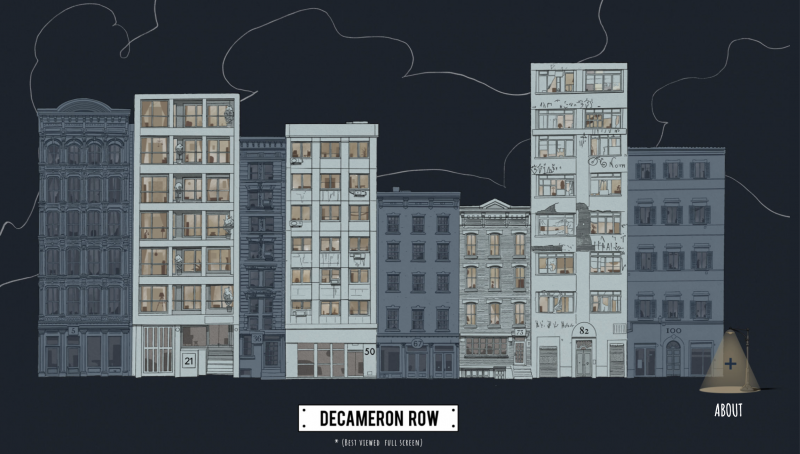
This project was created as a part of Decameron Row EXPLORE VIRTUAL SPACES HERE: https://www.decameronrow.com/main You can find Lynne’s film in Bldg #21 (second from left), top floor on left.
As a group of friends separated from one another by the pandemic, we have found that looking in on each other’s lives, even if just through our screens, has been essential for our mental health. We started sending requests to people we missed to send us short, intimate video postcards of their experiences of 2020. We loved the videos that arrived, and we would play them over and over.
In Boccaccio’s 14th-century Decameron, a group of friends avert the loneliness of quarantine during the Black Death by squatting together in an abandoned villa outside of Florence and telling each other stories — 10 people, 10 days, 100 tales. Their stories gave them solace. Since in this moment, global community cannot meet under one roof for comfort and insight, we wondered, how could we gather people from all over the world into one neighborhood, onto one street, where they could share their disparate responses? In this idiosyncratic, virtual place, the curious could click on a window and peek into each others’ lives, much like we had already been doing with one another.
Decameron Row is an experiment in community. We’ve been deliberate about diversity and geographic variety, but we’ve chosen to be guided more by intuition, the generosity of others, and happy accidents than by curatorial intention. The result is a quirky and incomplete record of this strange time. We hope you find it diverting. New videos will be added weekly through the summer until all the windows are occupied.
With gratitude to everyone who so whole-heartedly donated their time and heart to this effort.
Itamar, Stefanie, Juan, Joe, and Sherry THE DECAMERON ROW TEAM
Girl is Presence 4 min. color sound 2020 a film by Lynne Sachs and Anne Lesley Selcer
For GIRL IS PRESENCE, Lynne Sachs has made images as a form of reading and listening in response to disquieting words from Anne Lesley Selcer’s poem “Sun Cycle”. A girl arranges and rearranges objects, sensorily reflecting the tense and disharmonious list of words voiced by Selcer in the film. As the language builds in tension, the scene becomes occult, ritualistic, and alchemical. Against the uncertain and anxious pandemic atmosphere, performer Noa Street-Sachs, Lynne’s daughter, creates and unmakes systems with the collection of small, mysterious things. Selcer’s poem emerges from Sun Cycle, the eponymous book which deals with image, gender and power. This poem reworks a George Bataille essay to undo and recast its rhythms.
Anne Lesley Selcer works in the expanded field of language. They write on, with, around and underneath art. This has created a book of essays called Blank Sign Book, a book of poems called Sun Cycle, as well as a multitude of multiform publications, performances and moving pictures scattered through galleries, artspaces, magazines and the internet, most recently, The Mouth is Still a Wild Door and The Sadness of the Supermarket: A Lament for Certain Girls. The short film Girl is Presence made in collaboration with Lynne Sachs, is based on Selcer’s poem “Sun Cycle.”
Here is an interview with Anne on her process of writing in Sun Cycle. Go to 20:17-23:58 for a direct correlation to “Girl is Presence”.
Noa Street-Sachs (performer) works as an investigator on police misconduct cases at a government agency in New York City. She is also a photographer and a native of Brooklyn.
Rebecca Shapass (editor) is a filmmaker, multidisciplinary artist, and community organizer living in New York City. Commissioned by Small Press Traffic for Bay Area Shorts, spring 2020