The Chicago Underground Film Festival has announced the award winners from its 33rd edition, which concluded Sunday following five days of independent, experimental and underground cinema.
CUFF33 was the festival’s most successful edition in recent years, producing a 20% increase in both attendance and box-office revenue over 2025. The festival presented more than 100 films from 22 countries at the Gene Siskel Film Center and Harper Theater.
At Sunday’s awards ceremony, CUFF also announced that it will begin a new chapter in 2027 by moving to Chicago’s historic Music Box Theatre and returning to its traditional early-summer position on the festival calendar. CUFF34 will take place June 9–13, 2027.
The audience greeted the announcement with cheers.
“This year’s growth confirmed that there is a substantial audience for adventurous filmmaking in Chicago,” said CUFF Programmer and Artistic Director Bryan Wendorf. “CUFF has spent more than three decades building a community around films that take genuine creative risks. Moving to the Music Box gives us an opportunity to build on that history and establish CUFF as a major international destination for independent, experimental and underground cinema.”
2026 Award Winners
CUFF has never regarded filmmaking as a contest. Each year, however, the festival celebrates work that leaves a particular impression. Rather than imposing fixed categories in advance, CUFF invites its jurors to create awards reflecting the films and ideas they encountered within that year’s program.
The 2026 award recipients are:
Best Documentary:A Stranger Has No Eyes — C.S. Nicholson
Best Essay Film:Every Contact Leaves a Trace — Lynne Sachs
Best Archival Exploration:Daria’s Night Flowers — Maryam Tafakory
Best Emotional Collapse Film:Placeholder — Jesse McLean
Best Environmental Collapse Film:Document With No End — Kym McDaniel
Best Artistic Process Collapse Film:Domestic Weights and Measures — Paul Tarragó
Made in Chicago Award:Sistas in the Pit — Monet-Chanel Khanyahl
Audience Award:Driven — Gabrielle Fitzpatrick and Max Fitzpatrick
2026 Jury
The 2026 jury consisted of Tom Colley, Anahita Ghazvinizadeh and Dirk Matthews.
Tom Colley directs New Channels Initiative, a research and development project addressing changes in nonprofit experimental and independent media distribution. During more than 25 years at Video Data Bank—first as archivist and later as director—he guided its transition from analog distribution to digital collections and educational streaming.
Anahita Ghazvinizadeh is an Iranian-American filmmaker, writer and educator whose work explores personhood, belonging, displacement and outsiderness. Her short film Needle won the Cinefondation First Prize at Cannes, and her debut feature, They, premiered in Cannes’ official selection. Her most recent film, My Life Is Wind (A Letter), premiered at Locarno and has screened internationally, including at the Museum of Modern Art. She is currently an Assistant Professor in Film, Video, New Media and Animation at the School of the Art Institute of Chicago.
Dirk Matthews is a practitioner-scholar, filmmaker, photographer and educator who has taught film and the arts for nearly 30 years. Drawing on his experience in clinical practice and arts-based healing, his work examines how creative expression can amplify overlooked voices and build resilience. He currently consults for arts and music colleges, helping creative individuals transition from higher education into sustainable careers. An award-winning architectural photographer, he has also screened films at the Tucson International Film Festival. He is happiest when his day includes coffee and a movie.
Opened in 1929, the Music Box is one of Chicago’s great movie houses and a longtime center for independent, international, repertory and cult cinema. It was ranked No. 9 on Time Out’s list of the 100 greatest cinemas in the world.
The Music Box’s three theaters, lounge and social spaces will give filmmakers and audiences room to move between screenings, conversations and special events throughout the festival.
What Does CUFF Mean by “Underground”?
Underground is not a genre, budget or style.
CUFF looks for films that take risks with form, aesthetics and subject matter—and for filmmakers willing to follow an idea wherever it leads. Experimental, narrative, documentary, animation, hybrid work, essay film, personal cinema, genre deconstruction and expanded media are all welcome. The festival values ambition over category.
If a film takes genuine creative risks—or simply could not have emerged from a studio mandate or streaming algorithm—CUFF is interested.
As Roger Ebert famously wrote of the festival:
“What you get for your money is not just admission to the films but admission to a subculture.”
Lynne Sachs’ EVERY CONTACT LEAVES A TRACE (US/Documentary) Sunday, 2:30pm I’m not related to Lynne Sachs, though I do know her personally, and one of the things I appreciate about her work is how it feels like an extension of spending time with her. Sachs often shares intimate details of her life in her films, yet she does so in a modest, convivial, and discursive way, as if she were initiating a discussion with the audience rather than simply confessing to them. She also reveals things about herself in order to get her onscreen subjects to do the same, regardless of whether they’re strangers or members of her family. In EVERY CONTACT LEAVES A TRACE, she engages in conversation with both; to find the strangers (or at least people she doesn’t know well), she draws on her collection of the roughly 600 business cards she’s collected over the past four decades and seeks out the contacts whom she thinks will make for compelling presences in her movie. The interviewees range from Sachs’ hairdresser to a forensic scientist to the artist and filmmaker Lawrence Brose, who through no fault of his own spent two years under FBI surveillance. Sachs interweaves these stories eloquently (perhaps not coincidentally, one of the interviewees gives her a lesson in stitching), creating a cinematic tapestry of interesting lives. In between the varied profiles, the filmmaker reflects on how these subjects have affected her, reminding us (as per the title) of how the lives we encounter can mark our own. Sachs doesn’t make a to-do about this; like Agnès Varda’s nonfiction work, EVERY CONTACT LEAVES A TRACE feels informal despite asking big questions. This informality, of course, is deceptive—you’re likely to come away from the film feeling stimulated, compelled to reconsider how each life is a make-up of various others. (2025, 82 min, DCP Digital) [Ben Sachs]
I’ve had business cards only once in my career thus far, when I worked for Music Box Films in 2018. I don’t think I gave out many, if any at all. This past weekend, while watching Lynne Sachs’s Every Contact Leaves a Trace at the Chicago Underground Film Festival (CUFF), which largely took place at the Harper Theater in Hyde Park, I reflected that I haven’t received many either. Sachs, on the other hand, has collected over 600 business cards over the past several decades, which is the impetus for her new film.
Sachs and I aren’t related, though she and I have known each other for several years; our relationship began when I wrote about her work for MUBI Notebook. I’m currently editing a collection of her interviews for a university press; as a result, I’ve become more intimately familiar with Sachs as both a person and an artist, and my identification with her has extended beyond my appreciation for her filmmaking. As with one of my favorite filmmakers, Agnès Varda, I like how Sachs sees the world and the people in it; knowing her personally now, I can attest to an uncommon curiosity that doesn’t discriminate, holding in equal measure everyone from her hairstylist to a controversial experimental filmmaker.
Both people are included in Every Contact Leaves a Trace. (Incidentally, of the few business cards that I have amassed over the years, most come from hairstylists and other aestheticians.) Each card, then, reflects a contact—some, like her hairstylist, yielding years-long relationships, others from people she doesn’t even remember—that has left a trace, an assertion that holds true for Sachs especially. Just as she’s saved these cards, I believe that even the smallest of interactions has the potential to leave its mark. In an era and industry preoccupied with social media and clout, Sachs and her film remind me not just of a different time but of an entirely different mindset, in which individual connections were more transitory (business cards in and of themselves suggest an effort and tactility that merely adding people on LinkedIn or Instagram can’t replicate) yet ultimately more meaningful as a result.
Literal human connection is at the center of C.S. Nicholson’s documentary A Stranger Has No Eyes, which premiered as the closing-night film at CUFF. It’s a tricky one, centering on the descendants of Brazilian-born slave trader Francisco Félix de Souza in Benin, who are Black and, despite that legacy, proud of their ancestry, nearly worshipping de Souza as a figure they call Chacha. It’s trickier, even, because Nicholson is white; the post-screening Q&A was moderated by Floyd Webb, local filmmaker and cofounder of the Blacklight International Film Festival, established in Chicago lin 1982. Webb brought unique insight from his time living in Africa and also, from his background in film, interesting questions about the decision-making processes inherent to filmmaking that can alter objectivity. The film’s title comes from a Yoruba proverb that professes, “A stranger has eyes, but they do not see.” That has an interesting connection to both cinema and life; both evade easy understanding (at least the very best of cinema is apt to do so), suggesting that even to see is not fully to comprehend.
The full programme for Doclisboa 2026 has now been unveiled. Running from 15 to 25 October, the festival returns to its usual venues — Culturgest, Cinema São Jorge, Cinemateca Portuguesa and Cinema Ideal — with a performance also taking place this year at the Gulbenkian Modern Art Centre. In total, the 24th edition presents 198 films from 51 countries, including 34 world premieres, 13 international premieres, three European premieres and 32 Portuguese films, spanning generations, geographies and different ways of making and thinking about cinema.
Opening and closing this edition are two filmmakers who turn their own relationship with cinema into the very material of their films. Doclisboa opens with Asphalt Guerrilla, by Edgar Pêra, which takes Manuel Ricardo Sousa’s book of the same name as its starting point, bringing together the accounts of a former FP-25 operative with the filmmaker’s own memories of the turbulent 1980s, through archive material, fiction and artificial intelligence. Closing the festival, Alain Cavalier, at the age of 95, presents Thanks for Coming, a new and final chapter in his cinematic diary, in which everyday gestures and encounters become the stuff of cinema.
This year’s International Competition comprises 11 films, including seven world premieres, three international premieres and one European premiere. The Portuguese Competition also features 11 films (see list below), all of them world premieres. The International Competition includes films by filmmakers already familiar to festival audiences, amongst them João Pedro Rodrigues and João Rui Guerra da Mata, alongside others whose work is being presented in Portugal for the first time, in a selection marked by remarkable sophistication, aesthetic diversity and political acuity. The Portuguese Competition, features new works by Inês Oliveira, Ico Costa, Pedro Neves and Manuel Mozos, alongside filmmakers presenting their films at Doclisboa for the first time.
NEW VISIONS
New Visions once again explores the possibilities of cinema as an art form intimately connected to the experience of the present, bringing together films that move across different times, memories and histories through open and experimental forms. This edition’s guest filmmakers are France’s Sophie Roger, whose work is marked by formal freedom and radicalism, with titles including Desert Island (2014) and The Bitches (2026); and Filipino filmmaker John Torres, represented by three key films from a body of work shaped by hybrid and poetic experimentation: The Remotes (2026), Lukas the Strange (2013) and Todo todo teros (2006).
The section also features films by authors including Lee Anne Schmitt, Ben Russell, Declan Clarke, Lucía Seles, Ted Fendt and Lynne Sachs, among many others. Mariano Llinás dedicates Life of Jorge Luis Borges to the life and literary universe of the Argentine writer, drawing on his papers, books and places to search for the figure of a man for whom literature constituted a world of its own. María Aparicio brings Sometimes Sadness, Sometimes Rebellion, winner of the GdA Director’s Award in Venice, in which Madrid’s Museo Reina Sofía becomes the gateway to a reflection on the history of labour struggles. Denis Côté returns with Nobody’s Violence, a surprising fiction centred on a fascinating protagonist who takes us on a journey through death, love and encounters with others. Robert and June (and all the time in the world), by Jem Cohen, follows artists June Leaf and Robert Frank over the years, between Cape Breton and an ever-changing New York. In Wild Asparagus, a Portuguese-French co-production, Avi Mograbi follows his Arabic teacher, Ali Al Azhari, as he searches for the ruins of Saffuriya, the village from which he was expelled during the 1948 Nakba.
Archive takes centre stage in this edition of New Visions. In An Incomplete Calendar, Sanaz Sohrabi takes a record released in Venezuela in the 1980s as the starting point for recovering images and sounds of the Palestinian liberation struggle and Pan-Arab solidarity of the 1960s and 1970s. The Clearing, by Sabine Groenewegen, returns to Dutch colonial exploitation in Sumatra and the silenced violence of the rubber plantations through found and contemporary images. The festival also pays tribute to Angela Ricci Lucchi and Yervant Gianikian, archaeologists of images who turned the archive into a site of confrontation between History and what images may still reveal, presenting Oh! uomo, one of the duo’s major works, in which they developed their practice of the analytical camera and which concludes their trilogy devoted to the First World War.
10/20/26 16.00 TL/EM ⁄ 83’ Every Contact Leaves a Trace
10/24/25 & 10/25/26 LYNNE SACHS A TAREFA DO TRADUTOR / THE TASK OF THE TRANSLATOR Spanning a vast period of time, this programme highlights a fascinating aspect of Sachs’s work: the central role of transmission as the persistence and renewal of memory, and as a formal and poetic principle. From a journey undertaken by two sisters to a war‑torn Vietnam, where they encounter the oral and material memory of a time they know only from television, to the story of a cousin hired to catalogue the bones of American soldiers who ends up in Brazil, translating Winnie the Pooh into Latin, this is a journey through our collective history and the ways in which our individual lives are shaped by it in unforeseen ways.
24 OUT / 16.30, CULTURGEST – PEQUENO AUD. 25 OUT / 19.00, SÃO JORGE – SALA 3 The Small Ones Lynne Sachs 2007 • EUA / USA • 4’ • DCP
Which Way Is East: Notebooks from Vietnam Lynne Sachs 1994 • EUA / USA • 33’ • DCP
The Whole Poem Is a Curse Lynne Sachs 2026 • EUA / USA • 12’ • DCP
The Task of the Translator Lynne Sachs 2010 • EUA / USA • 11’ • DCP
The Last Happy Day Lynne Sachs 2009 • EUA / USA • 39’ • DCP
A playful meditation on memory and forgetting inspired by the encounters that led to a collection of business cards.
Lynne Sachs has created one of the most distinctive filmographies over the course of a more than 30-year career. Moving between the essay film, documentary, and experimental film, Sachs examines social and political issues as well as questioning perceived reality and memory. Every Contact Leaves a Trace follows Sachs on a years-long journey to connect with people whose business cards she has saved. Instead of a “where are they now” film, it tracks Sachs’s own journey as an artist and the many paths she has taken in her career. Sachs was a recipient of a 2018–19 Wexner Center Artist Residency Award in Film/Video. Join Sachs for a Q&A following the screening. (83 mins., DCP)
About the series
In the words of Cinéseries’ members: Cinéseries is a student-led group that organizes monthly screenings in collaboration with the Wexner Center for the Arts. We aim to offer a space for students and the community to engage with film and expanded cinema from makers of a variety of backgrounds. We aspire to create an environment conducive to critical engagement by inviting filmmakers to showcase work that takes risks, challenges norms, and opens a conversation by devoting to a wide range of artist-centered and independent media.
“A Practice Run” Reflections of imperfection in Every Contact Leaves a Trace By Lynne Sachs
Daniel Adams 2026
In a sense “Every [experimental documentary] film is a document of an investigation” Lynne Sachs told me in a 2021 conversation. The investigations of her films are varied, from the poetical, to political subject matter, to geopolitical events and latterly to her own history.
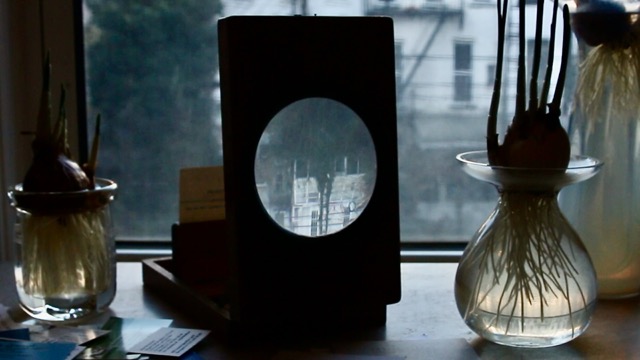
Lynne Sachs’s film Every Contact Leaves a Trace from 2025 opens with images showing the process of paper making. The process is broken up and images from said process recur on multiple occasions. A strange lens subsequently appears, through which, we ultimately learn, one can view business cards magnified. The angles of the camera lend the view a curious, somewhat distorted quality. The subjective gaze of the camera is instantly established. We may not realise yet, but the image establishes the film’s central theme: a revelation of how easily our view of a person’s identity, in this case viewed on a contact card, can be similarly distorted. We will not be presented with objectivity in the film that unfolds, but rather multiple subjectivities: views that become, as Martin Amis once described poker games, “wobbled through the prism of personality”.
The prism of the filmmaker’s personality will be further wobbled through multiple cameras and styles of filmmaking, from 8 and 16mm to various video devices, held most of the time by Lynne Sachs. The “subjects” of the film enter into a dialogue with the filmmaker through her recording devices, drawing them into what Sachs herself calls an “epistemology of film.”
Despite being a presence in previous films, Sachs’s reflexive work has tended to only include the filmmaker as filmmaker. The strategies have allowed her to question the relationship of the filmmaker to the image (see the section about the photo of Hua’s “crabby grandmother” in Which Way is East, 1994) and thus the relationship between viewer, image and image content is likewise questioned. Here the filmmaker is as much a viewer as the person in a cinema or wherever they view the work. Film About a Father Who… (2020) is arguably a far more personal work insofar as the filmmaker investigates her own family history by analyzing her father’s life through interviews with him and other members of the family. Every Contact Leaves a Trace seems to me the first example of the filmmaker turning her investigative eye resolutely on herself. Curiously though, the filmmaker seldom appears fully visible on screen as part of her self-investigation. Perhaps the reason for this is practical (she is often behind the camera), perhaps it is to imbue her self questionings with a sense of universality (therefore a process in which we could all engage), or could it even be that she wishes to eradicate the image of her “self” from the unflinching self directed investigation? The number of recording “devices” in this film is increased by non-cinematic means: paper, books, cards, recordings of Zoom meetings, voice recordings without images, etc. Why are we so keen to “record” things, to set things down in as permanent a form as we possibly can? Are we convincing ourselves that these records will remain the same in years to come?
In West Africa, a tradition emerged in the oral storytelling tradition of Anansi stories tales of a figure associated with wit, wisdom, cunning and knowledge. According to poet and expert in the oral tradition, Benjamin Zephaniah, when these stories migrated and were written down to be released by a British publisher, it upset a great many people, as these stories are intended to change to suit the circumstances (time, place, current affairs etc.), but now these stories were set down: immovable in paper and ink. Likewise a film fixes moments in time. Each instant, once recorded, becomes a ghost of itself, held in a medium designed to record and represent. Yet in Every Contact Leaves a Trace, this very problem is presented to us- instants and people are revisited over the course of the film, and our impressions of the moments change. Likewise, with repeated viewings, this film might actually reveal different layers, alternate interpretations, prompting an audience to adjust their thoughts about the work in a manner not dissimilar to the oral tradition. A paradox presents itself: film is undeniably a fixed media, yet our own interpretations and views of work may be radically different depending on when, where and by whom the film is viewed. Sachs’s film itself is witty, cunning, knowledgeable and wise.
The starting point of this particular investigation, I suspect, was the filmmaker’s collection of contact cards, amassed presumably over many years. Through these, Sachs considers how each person listed on one of these cards had an effect on her life. Added to this is the question of whether the collection is healthy at all – why does she hang on to these objects? That said, for me, the contact cards physically in the film call to mind my own personal phonebook. Even recently, when I received a message from a contact, only to realise it was a relative of theirs informing me that the contact in question had ended their own life shortly after I last spoke to them (having contacted everyone in their list that same night), I still can’t bring myself to press delete. The same goes for all contacts in that virtual book I know no longer to be walking this earth: friends, relatives, my first kiss…. Each contact indeed left a lasting trace and somehow I just don’t have the heart to make so final a gesture as to remove that virtual contact card. Perhaps the same is true of the physical collection shown in the film.
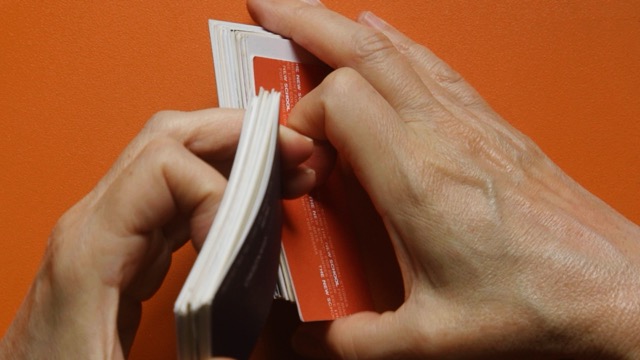
Lynne Sachs’ hands are shown handling numerous business cards and in a moment strangely reminiscent (for me at least) of Hollis Frampton’s Nostalgia (1971), it appears that the sound used does not correspond to the cards shown. For example, Sachs is audibly heard at one point to discuss a “He” who may or may not be willing to appear in this film, despite the card in her hands being that of filmmaker Jennifer Reeves. Thus the question of identity as represented through a business card is called into question, just as identity as embodied in an image of a person, their surroundings or a moment of them speaking is pointedly observed not to be a representation of the entirety of that person. This perhaps reaches its apotheosis just under an hour into the film when Sachs records Juan Jiang (director of the China Women’s Film Festival) whilst reflecting that “when you’re around someone for a certain amount of time, they kind of freeze in that time.”
These thoughts, spoken by the filmmaker, are accompanied by a startling series of images: first Jiang’s clothing changes before our eyes in a series of jump cuts, but this is followed by Jiang seemingly standing still before us, while another Jiang walks into the room behind her: two versions of herself at different times, appearing in a single frame, in the same space. Ultimately, the mechanics of this split screen effect reveal themselves, yet while the illusion may be broken, the contemplation of freezing moments in time deepens through the visual device. It is not so much a moment of distanciation as much as revelation designed to deepen our comprehension of the film.
And what of Lynne Sachs’s own identity? Is she the product of her family history? Her earlier Film About a Father Who… certainly begins to pose this question. Likewise, in this film Sachs’s investigations take her to Germany, where her ancestors once dwelled. The atrocious spectre of the Holocaust rears its head, the knowledge of how German Jews were treated as present in the mind of the viewer, as it is for the filmmaker. Trying to understand her own “place” in the environs from which her family once fled, the filmmaker shows herself reflected in a door, her face hidden behind the camera from which the shot is taken. A fleeting glimpse of a sign advertising glasses reminds us of the process of looking and who is doing it. Unexpectedly, Sachs uncovers (she claims in her voice over) “artifacts of my own belonging”. Glimpses of upper storey windows (only one of which features a human looking back) briefly calls to mind Kurt Kren’s Fenstergucker/Abfall, etc. (1962), but the windows here seem not the subject of voyeurism (or even a critique thereof), but of reflection: the glass mirroring what is opposite and the darkened windows bearing striking resemblance to the tombstones in the Jewish cemetery shown only moments earlier. The glimpse of the filmmaker in the reflection, whilst fleeting, perhaps then serves to emphasise the fragility of her existence, or indeed that of her ancestors in the troubled history of Germany. The trip reaches its zenith in a dialectical voice-over after Sachs has renewed the acquaintance of Angela Haardt, a German friend, prompting the filmmaker to reflect on the current violence committed by the state of Israel in the wake of the atrocities of October 7th 2023. The conflicting thoughts are spoken and overlayed on the audio track creating an unnerving crescendo of internal turmoil over the music of Morton Feldman.
Symbols, or as Sachs calls them, vectors shown on screen appear at first somewhat impenetrable- are these tribal markings, mathematical symbols, or is there an almost sexual meaning? Ultimately, we learn the secret: these are diagrams of how the filmmaker feels her contacts have left their mark. The possible tribal reading links Sachs’ filmic philosophy to a number of cultures, notably Aboriginal Australians, among whom a frequently appearing theme in mythology is the idea that every human being leaves a mark on the land in some way. In Sachs’ film, it is more the case that people leave their marks on the landscape of peoples’ lives. Yet, as metaphorical as this might seem, Sachs is often disarmingly literal. The extreme close ups on bodies (hands and hair especially, but seldom faces in her films) suggest an interaction of human bodies as well as minds. Perhaps our proximity to other human beings leaves a lasting mark on our physical bodies as much as psychologies in Sachs’ philosophy.
Further questionings emerge with the realisation that Sachs has deployed actors in scenes, which seem at first glance to be documentary realism. The strategy was previously used to stunning effect in Your Day is My Night (2013), in which an actress assumes the role of a lodger in the home of some Chinese Americans and they treat the scenario as entirely real to allow the filmmaker to catch a glimpse of the way they live. Here, there is a greater sense of doubt: the filmmaker is shown visiting her therapist and discussing some of the subjects in the film. The therapist, however, is later revealed to be an actress (Rae C. Wright), but Sachs, perhaps so impressed with the actress’s performance seems momentarily to abandon the pretense and find herself speaking to the actress as if she is her real therapist. The result is slightly discomforting, not least as this is one of a couple of occasions in which the film’s participants appear visibly pissed off with the filmmaker. Both occasions, interestingly, are ones in which a preconception is broken down. The other comes with an encounter with a hairdresser (Irina Yekimova), who the filmmaker at first appears to think is Ukrainian (the scene evidently taking place in the wake of Vladimir Putin’s illegal invasion of the country), but who is later revealed to be from Latvia. Is this uncomfortable moment also staged? Or are we momentarily confronted with unintentional ignorance? One can’t help being briefly reminded of the bitter aphorism often attributed to Ambrose Bierce: “War is God’s way of teaching Americans geography,” but this would be far too condemnatory a response to what is surely an honest mistake. These occasions, however, are revealing perhaps of Sachs’ discomfort with realising that she may herself be an unreliable narrator; an uncomfortable truth that we all – if we’re honest – experience at some point in our lives. This plus the revelation of the actress playing a role together leave us questioning exactly how much of the film is “true” as opposed to subjectively wobbled through a particular point of view.
Even more uncomfortable assumptions surface in Lynne’s dialogues with filmmaker Lawrence Brose (who sadly died in 2025). It momentarily appears that Sachs realises she is conversing with someone convicted of possession of child pornography, only to have her knee-jerk judgement undermined mere minutes later. It transpires that this was a false accusation (context outside of the film reveals that no such material was ever found, but fearing some more explicit images from his 1997 film De Profundis would be used as evidence against him, Brose accepted a plea deal). So it is that the “traces” left by those in the film can actually be false traces, based upon assumptions, prejudices or misreadings. Yet the viewer is allowed to share in the filmmaker’s discomfort in realising these false impressions, permitting us time to reflect on instances in which we may have done likewise.
The interactions with Brose have further poignant resonances for the filmmaker now, and she has allowed me to reproduce some of her diary reflections here.
Feb. 1, 2026 The week after I completed the sound mix for EVERY CONTACT LEAVES A TRACE, I called Lawrence from a little cafe in downtown Manhattan. I was excited and wanted to share the news with him. I also wanted to show him the way that I had finally come up with a strategy for intertwining his struggles with that of Oscar Wilde. I was extremely nervous but knew it was important to demonstrate to him how his story was revealed in the film, particularly the ways that I shared my own doubts, revelations, and shame. In the kindest way, he told me to send along the link to the film but that I better hurry because he knew he would die within a month. He was only waiting for the opening of a gallery exhibition that would feature his images in the context of John Cage’s legacy. Two days later, I flew to Buffalo, New York to show him the film while sitting by his side. To my relief, he gave me his enthusiastic approval. We hugged, drank more tea and then I went back to the airport. A month later his show opened. He spoke at the event and died the next day.
Of his presence in the film, she writes:
I only took what he had to say as his experience and his attempt to give context. For me, it was a reflection on the dilemma that comes with engaging with another human being’s struggle and trying to give that some sort of meaning or stature in our heads. In the film, we only have access to his subjectivity… and mine. This offers us as people who share this universe with his spirit the chance to understand the way that he referenced Oscar Wilde’s trauma and saw parallels to his own – in both biographical and political ways.
Sachs remains ever generous to the viewer, rather than confrontational. In this film (just as previous ones) she allows intense emotional moments to be followed by what she calls a “thought vessel”: a shot, or sequence, without dialogue and minimal sound or music, which allows the audience space to digest what they have just seen and to permit an audience’s individual journey to exist alongside the thoughts and emotions of Sachs’s own investigations. See, for example, the images of hair-cutting that follow the revelation of her nationality misapprehension that allow us to consider the preceding dialogue and voice over. These are not vessels as “empty” images, but vessels offering a visual deepening to ideas in the film. In this case, ideas of identity and the passage of time through the process of hair-cutting and styling.
Despite the sparing use of music, I was perhaps more aware of composer, or more accurately sound artist, Stephen Vitiello’s contribution to this film than in many of his previous collaborations with Sachs. The music ticks and chimes, calling to mind both the passage of time and the lingering reverberations of times past: this is Nachklangmusik in the language of the filmmaker’s ancestors (echo music, or literally ‘after-sound-music’). The score is beautifully effective, yet never intrusive.
Sachs’s family, her young niece Viva and nephew Felix Johnson Sachs Torres, also appear on screen to comment on the film and its process, questioning her methods and intentions, and crucially, what she plans to do with the multitude of business cards once the film is finished. One suggests burning them, which indeed was my first thought, to scatter the ashes somewhere. Another rightly corrects me in pointing out that this may not be the most environmentally friendly thing to do!
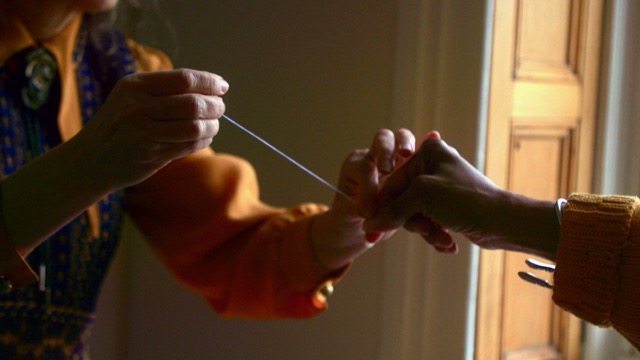
One of the most endearing recurring figures in Every Contact Leaves a Trace is that of fabric artist Betty Leacraft, who talks Lynne through her own approach to her craft as the filmmaker interviews her. The fabric artist is resolute in her unwillingness to “perform” for the camera, content to demonstrate her craft without being overly gestural (particularly with her hands, as Sachs seems to desire). Rather, she humbly explains what she has learned and emphasises the importance of adapting your own approach in accordance with what you learn. A final moment of reflexivity is permitted in her company, when Lynne Sachs attempts her own embroidery and admits to having made a mistake. The reassuring response of her seamstress tutor is that this is just a “test run” and that “when you get to do the ones for the gallery, that’s when you should be worried!”
Are we viewing a test run in this film? An embroidery of human imperfections, misinterpretations and missteps? A test run for what? The next film?
With the film now completed and in cinemas or galleries, maybe this is the point that Lynne’s tutor was making: that this is the moment in which she might worry about responses to her film. Evidently, the success so far on the festival circuit might indicate that she needn’t worry, but it is normal and indeed healthy to interrogate one’s own work.
Indeed Sachs admitted to me that she found significant moments in the earlier Film About A Father Who… to be somewhat “pedestrian” – a thought that had not occurred to this viewer in the slightest. With Every Contact…, it is as if Lynne Sachs is trying to both view and criticise her own work in the same instant as making it, aligning herself more with the audience of the work, rather than asserting her role as “author” or “director”. The act of viewing and questioning what we see is not the sole purview of the audience, but an act in which Sachs seems determined to participate alongside those seeing the film for the first time.
Thank you, Lynne Sachs, for leaving the trace of your contact so far, not just personally, but the traces of your work on my retinas and in my mind long after the end credits have rolled.
Daniel Adams is the voice behind How to Enjoy Experimental Film podcast. How to Enjoy Experimental film is your approachable user-guide to some of the most unusual and extraordinary moving image works ever created. Aiming at the newcomer to experimental films as much as those who love them already, presenter Dan Adams interviews artist filmmakers, film experts and programmers to shine a light on some of the darkest corners of the cinematic landscape. H2EEF aims to make the case for experimental film as something that can be widely enjoyed by viewers wherever you may be, as opposed to a niche interest.
DC/DOX spotlights documentaries that confront the human cost of tourism, policing, and surveillance—alongside bold experiments in nonfiction form.
Last month, the DC/DOX documentary film festival, just a few blocks away from the UFC circus at the White House, celebrated a saner vision of America. The event, a successor to the long-running AFIDocs, has grown into a major industry event, with more than a hundred films and shorts. The assembled highlights range from traditional vérité fare to films that are more formally experimental in subject and style.
With urgency and more than a little humor, The Siege of Paradise looks at the extremes of contemporary tourism. The Cinque Terre, a remote spot on Italy’s northwest coast renowned for its landscape of terraced cliffs and vineyards, has become overrun with millions of annual visitors. Similar to the crush of outsiders vacationing in Barcelona, the logjam has changed the identity of the Italian location. Irish filmmaker Gar O’Rourke examines all sides of the problem. We see people flood the five small villages (Monterosso al Mare, Vernazza, Corniglia, Manarola, and Riomaggiore) via cruise ships, ferries, and trains, eager to enjoy the gorgeous vistas and crystal-clear waters. Families roam the narrow, crowded streets, buying tacky tchotchkes, an American “influencer” idly posts photos of her breakfast, contributing to the feeding frenzy. She is more of a symptom than a cause, really, since the region has been positioning itself to rake in profits for decades.
The documentary’s greatest strength is turning the camera on the local residents and asking how they have coped and adapted. A restaurant owner struggles to keep staff because no one can afford to live in the area. A winemaker attracts tourists, but watches with frustration as his invalid wife struggles to navigate the village’s busy, narrow streets. The mayor of one town sets out the crucial trade-offs: there’s environmental costs as well as the wholesale transformation of the local economy. The film’s gorgeous vistas are eye-filling. But we are also shown warning signs. For instance, there’s the epidemic of key lockboxes, which signals the the Airbnb-ing of the town’s housing stock. The next generation of “residents” will live elsewhere, a safe distance from hometowns overrun by selfie sticks and T-shirt shops.
In When a Witness Recants, filmmaker Dawn Porter (John Lewis: Good Trouble) takes on the troubling and now too-familiar history of American racial injustice and police misconduct. The film revisits the case of a 1983 shooting in a Baltimore middle school — recreating parts of the crime through animation. Based on the testimony of two coerced witnesses, the police and court system wrongly arrest and convict three teenagers––Alfred Chestnut, Andrew Stewart, and Ransom Watkins. Based in part on a 2021 New Yorker article, the doc features commentary from Baltimore native Ta-Nehisi Coates, who was eleven years old at the time of the crime. He provides a compelling description of the close-knit Harlem Park neighborhood. The gross injustices and racism in the area–empowered by illegal decisions made by the police, prosecutors, and judge––are predictable. It took 37 years for the three men to be exonerated and released.
Much of the story is reminiscent of 2023’s Murder in Boston, which was about the Charles Stuart case in Mission Hill and police coercion of young Black men. But where When a Witness Recants stand out is in its final act. Throughout the doc, the three men, now in their 50s, tell their own stories, along with one of the witnesses, Ron Bishop, who was coerced into testifying against them. The four men agree to be filmed together. At this point, the film enters strikingly unsettling territory — the cost of injustice has rarely been exposed so rawly and honestly.
Three films—a feature and two shorts—confront the new realities of immigration and the refugee crisis in the United States and worldwide. The feature The Sandbox, by human-rights lawyer turned filmmaker Kenya Jade-Pinto, specifically explores the new-fangled Orwellian technological arms race that has taken over immigration enforcement. Starting at the US-Mexico border, we see the ways in which drones and various multi-pronged sensors have become a staple of Border Patrol tactics. A peek into an industry expo displays the new ways the government can track and apprehend people crossing the border, including robot dogs and tethered night-vision cameras. What makes this increasingly sophisticated surveillance terrifying is the glee with which the buyers and sellers talk about what the machinery does in purely nonhuman terms—as if people are just blips on a screen to be picked off.
This callous amorality continues when the doc travels to Greece and the Mediterranean. Greek refugee camps are filled with biometric scanners, there to create a database of the apprehended refugees. What will this information be used for? When asked, a government official has no idea; in fact, he seems not to have even thought about its repercussions. Like so many in charge, he is enamored with the technology, defending it blandly as a way to prevent “bad things” from happening in the refugee camps. Elsewhere in the film, we finally witness acts of empathy: activists help track boats that are danger in the Mediterranean; a group gathers the remains of dead refugees in the Texas desert in order to identify and repatriate them to their families south of the border. The takeaway, despite these signs of humanity, are clear: technology that is supposed to be about protection is leading us into a dystopian future.
Along those disheartening lines, two short films were alarming because of what what they could not show. Notes on Courtwatch examines a group of activists who document the hearings and goings-on in downtown Manhattan’s immigration court. Access to the courtrooms is verboten; the camera is used to evoke the impenetrability of the place, peering up at the tinted-glass edifice. These images are juxtaposed with a soundscape of testimonials from lawyers and activists who condemn the limits placed on them to advocate for refugees and other protected-status families who warily attend court dates. (Now that the Supreme Court has ruled to allow the suspension of Temporary Protected Status, some of the families glimpsed in this film will likely be deported.)
A second short, Water Cooler, is even more chilling. It is an observational glimpse of ICE and DHS agents in the hallways of a courthouse in California, chatting mostly about personal matters––days off, brunch, online shopping. I was reminded of Frederick Wiseman’s Missile, in which Air Force rookies are trained to fire ICBMs and then are given break time to have a barbecue and talk about sports. In this film, the ICE agents pause from their frivolity to occasionally shuttle detainees to court and points unknown. In fact, the camera is prohibited from entering a stairway where the detainees are initially delivered. It seems to be a relay point, its window blocked out by agents so we can only hear snatches of anguished pleading from behind the closed door. The banality of evil, indeed.
Moving into more experimental territory, three films explored science, humanity, and the nature of the documentary itself. The enjoyable and visually striking Phenomena, directed by Australian filmmaker Josef Gatti, is a semi-educational study of the physical world. Part Koyaanisqatsi visual poem, part middle-school science film, Gatti divides up what we know (and don’t know) about modern physics, along the way illustrating the mathematical patterns that make up everything, from electromagnetism to quantum mechanics. Even if you don’t learn something new, you’ll be entranced by the visual and sonic set pieces. In Every Contact Leaves a Trace, multimedia artist Lynne Sachs examines the nature of human connection. A blend of memory-play and visual niceties, Sachs gathers all of the business cards she’s collected in her lifetime. She then tries to weigh the importance of each of the links the contacts represent. Some are discarded quickly; some lead to discursions about love, professional ambition, family, and even hairstyles. Interestingly, Sachs includes her tween niece and nephew in the film, and their reactions and questions occasionally guide a sequence. Will they ever be handed business cards in our increasingly digital age?
The confounding The Whole World Is a Lie calls into question the entire business of making a documentary, sometimes in revealing ways. Actor-turned-filmmaker Charlie Birns wanted to make a film dedicated to the Method acting workshop that changed his life. (It was taught by Tony Greco at the Gene Frankel Theatre in New York — Philip Seymour Hoffman was among its famous pupils.) But Birns runs into multiple obstacles, mainly from the other actors and from the teacher. They ask him why he’s making the film and he can’t come up with an answer. His aim seems to be to examine the sense of transcendental “oneness” that comes after we discover something that has great meaning in our lives. Birns then brings in talking heads—including philosophers, Eastern mystics, and even psychics—to explore the nature of how humans experience transformations that lead to profound change.
But this move ends up derailing the narrative. It becomes a meta-film: even Birns’s crew are not sure of what they are doing on this shoot. Some begin to question the nature of reality. Has Birns set the film up to be a disaster, its conflicts reflecting his own life’s journey? Birns’s father (who coined the doc’s title) becomes a key participant in the next chapter of the drama, which leads to reenactments of the family’s past, first with actors and then with Birns’s father playing himself. It should not be surprising that the film was produced, in part, by Robert Greene, whose own compelling films blend nonfiction and reenactment. But the ambitious tangle here may only speak to other documentary filmmakers in search of a cautionary tale.
When a Witness Recants will premiere on HBO later in 2026. The other films continue on the festival circuit and are awaiting distribution.
DC/DOX 2026: EVERY CONTACT LEAVES A TRACE’s Director, Lynne Sachs chats with KUYA P! A NRW Interview! EVERY CONTACT LEAVES A TRACE. A Film by Lynne Sachs.
Celebrating pop culture in all of its forms providing content for every Fan! THE NRW SHOW, is a weekly show that highlights the latest entertainment releases in Film, TV & Streaming with our top picks!
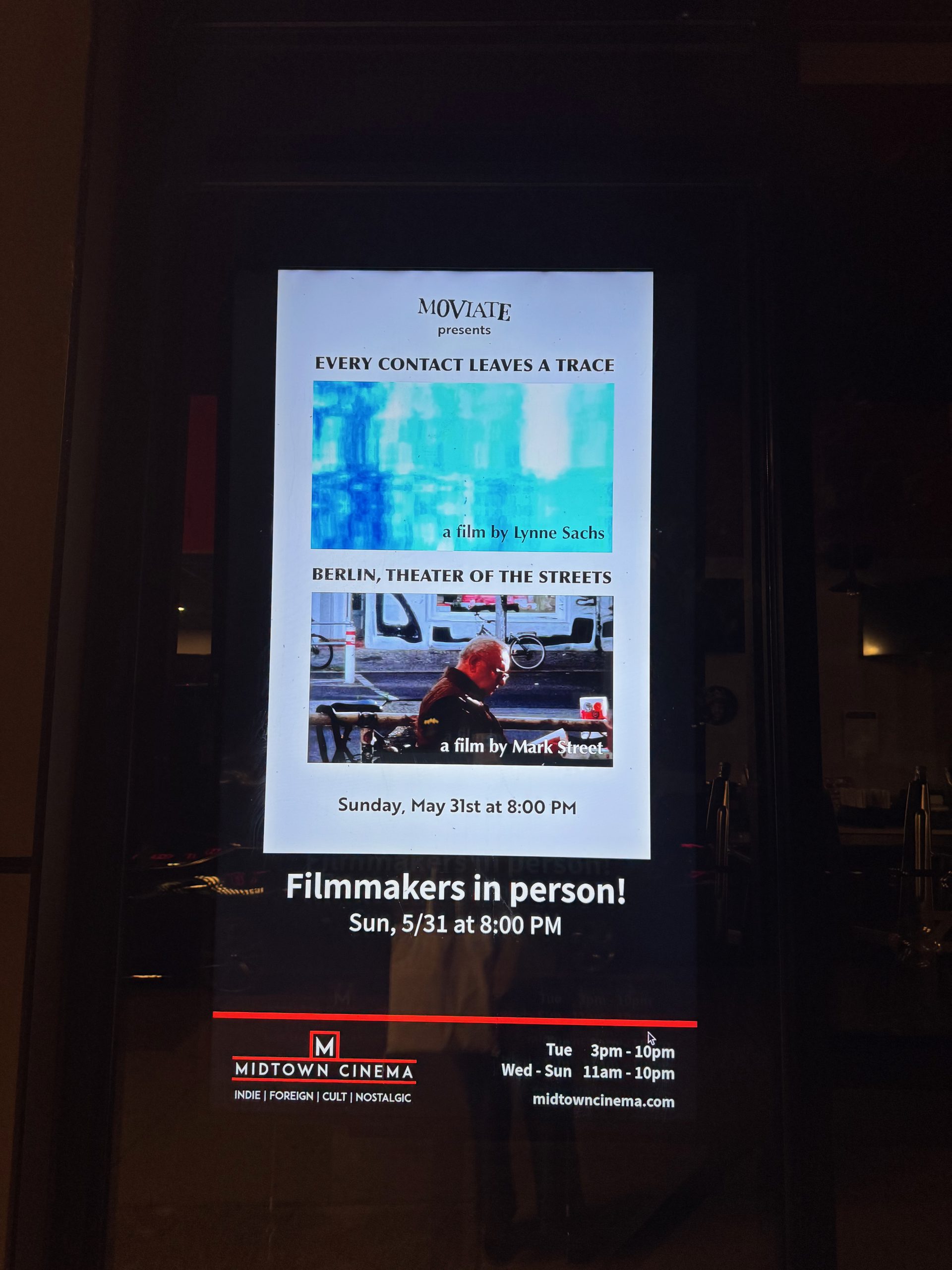
Contact—so tactile, so evocative of the touch of one person on another, physically and emotionally. Trace—a way to get back to an earlier point and a reckoning with the remains of that initial encounter. Filmmaker Lynne Sachs has saved every business card anyone has ever given her. After 40 years of collecting, she recognizes their mnemonic powers. With 600 cards in her grasp, Sachs contemplates the impact of these haptic exchanges. In both real and imagined ways, her essay teases apart their vivid resonances, entwining personal memory with geopolitical history through visual abstraction, music, and a poet’s sense of introspection.
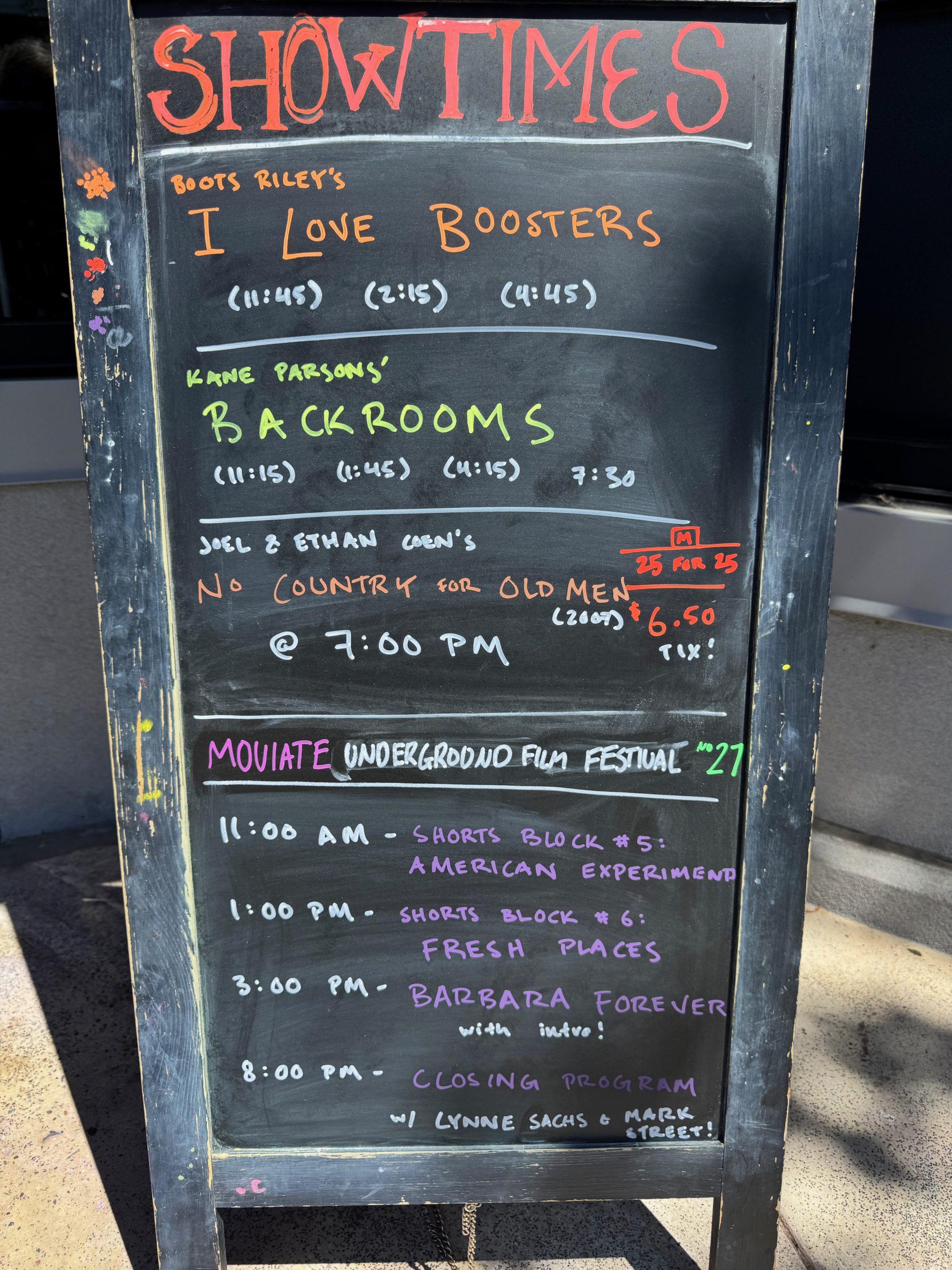
Showing with: “Berlin Theater of the Streets” – A film by Mark Street – 10 minutes Presented in person by filmmaker Mark Street A walk through Berlin; eyes open, camera ready. Countless vignettes unfold around me, and I imagine storylines for each set piece. Join us for a special Closing Night Program with both filmmakers in-person! As part of the 27th Annual Moviate Underground Film Festival.
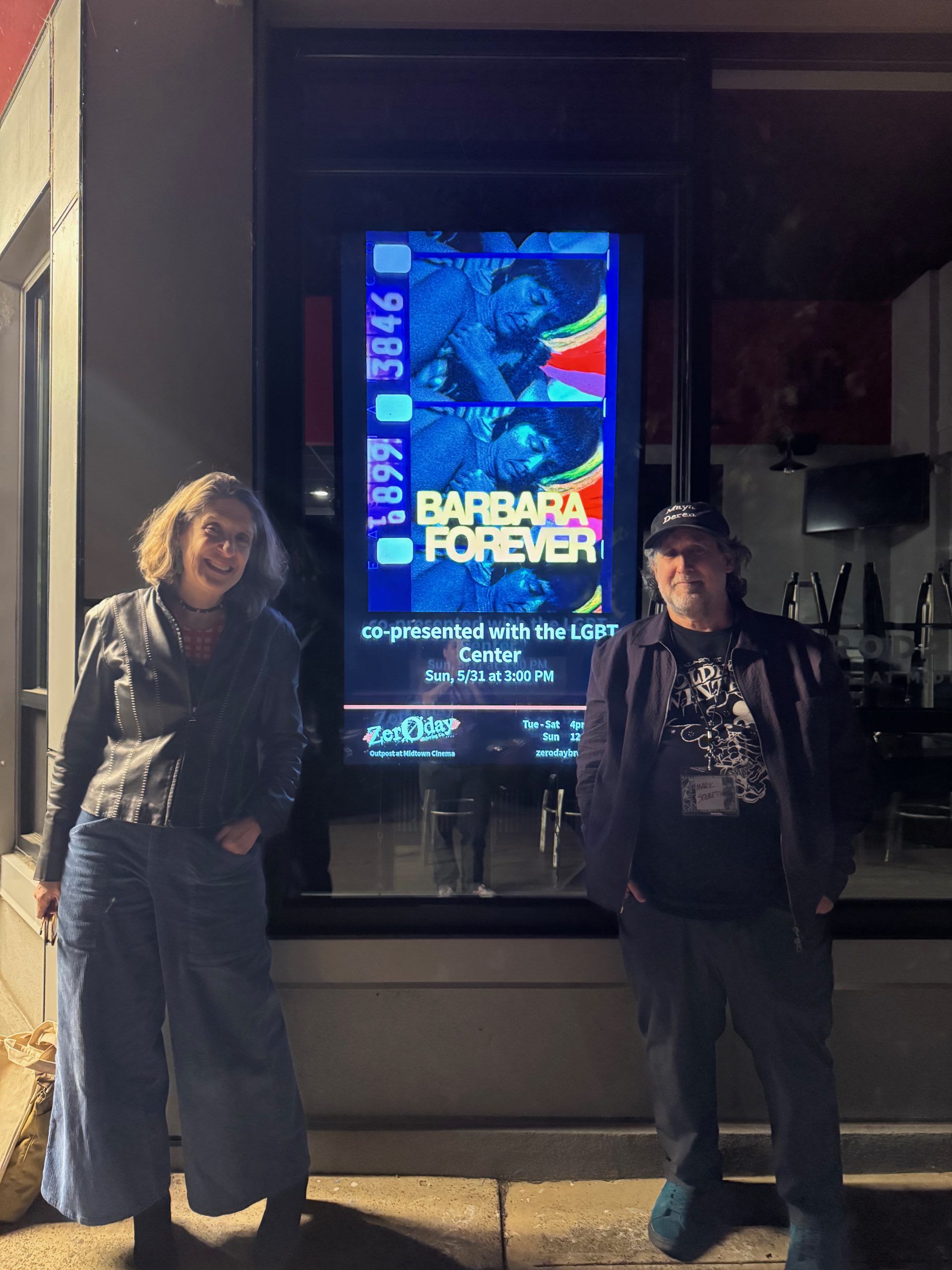
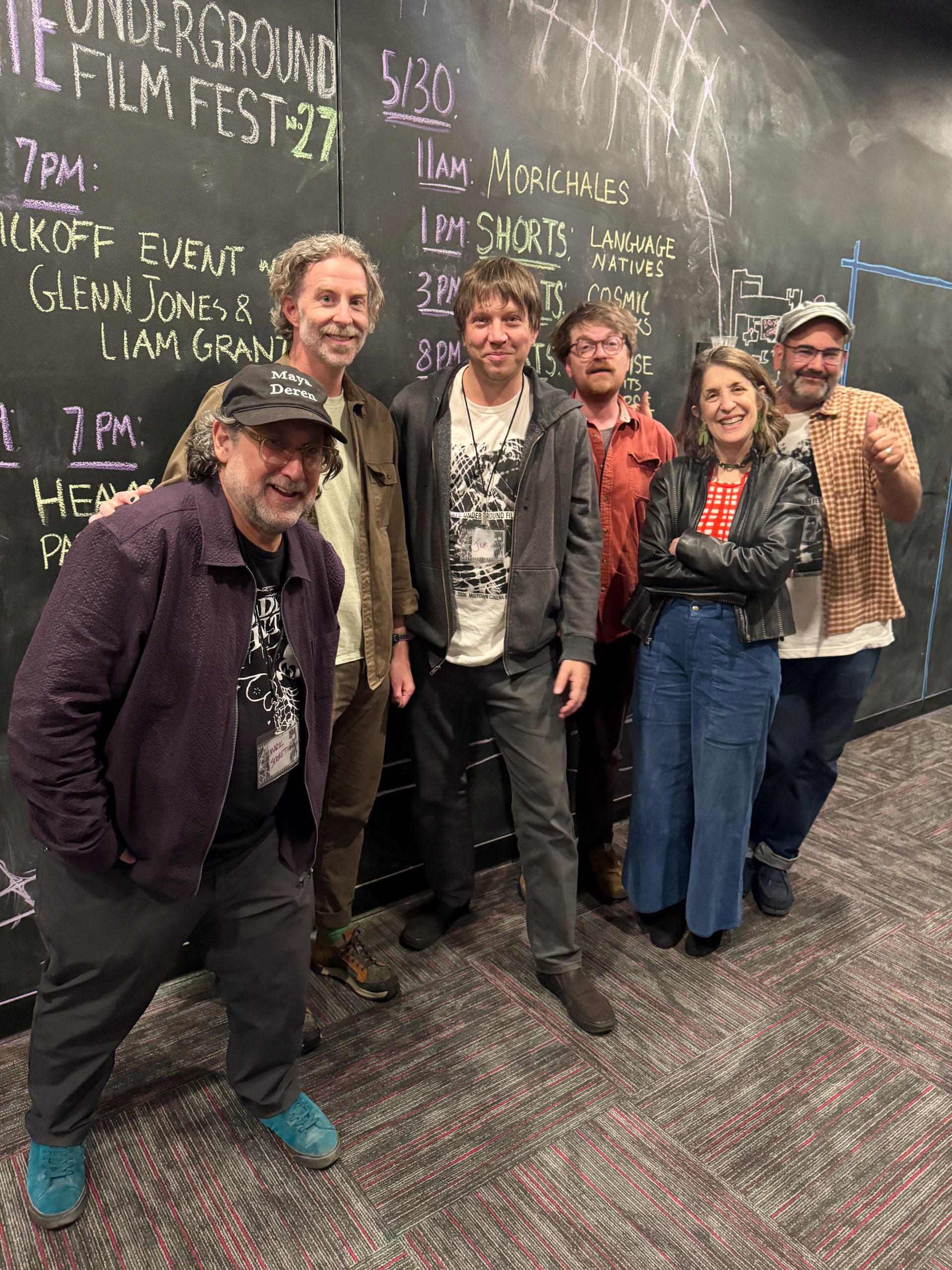
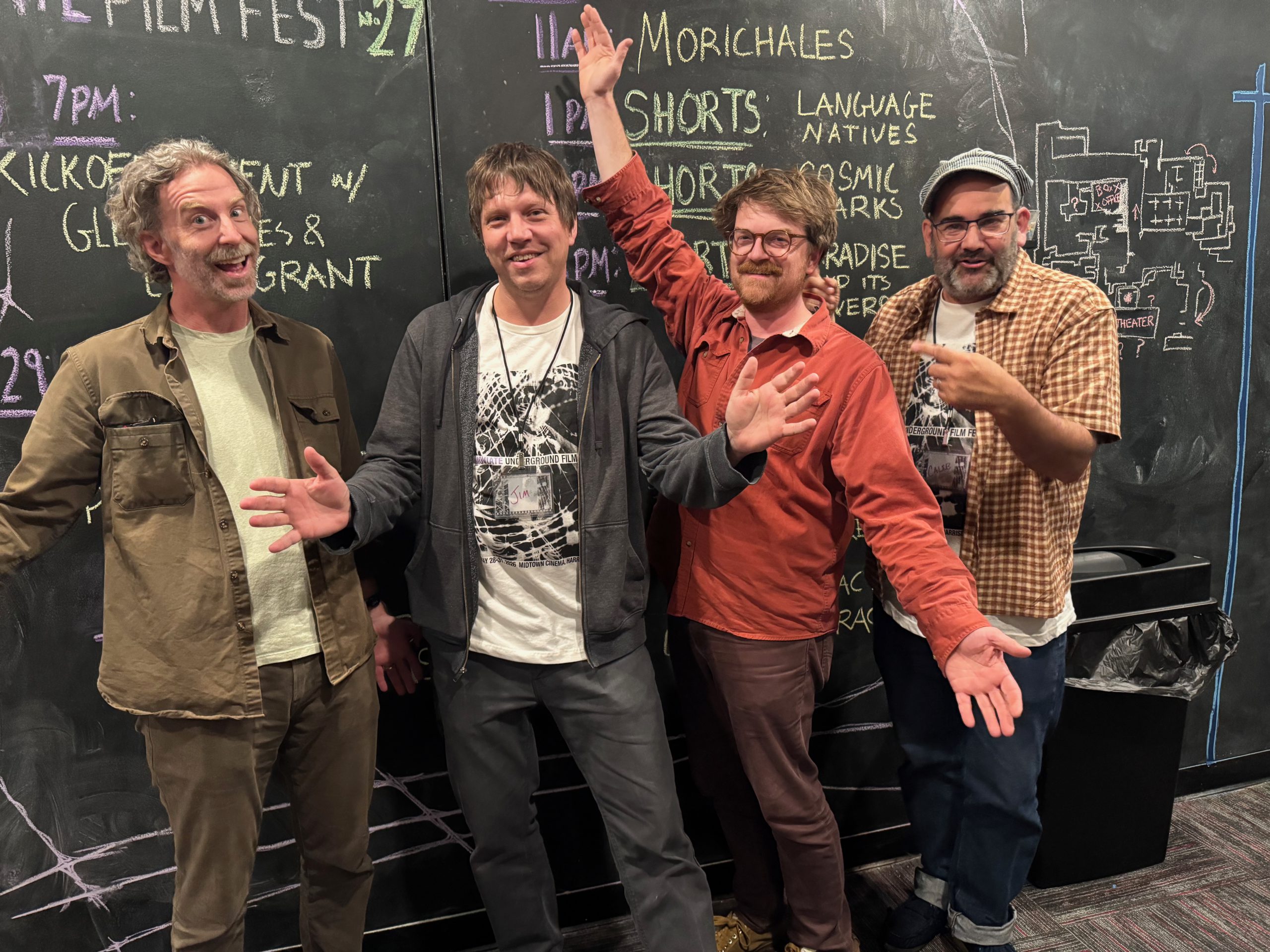
Mark Street and Lynne SachsJeremy Moss, Jim Hollenbaugh, Josh Drake, Caleb Smith
The Burg : Moviate Underground Film Festival to return to Harrisburg this weekend
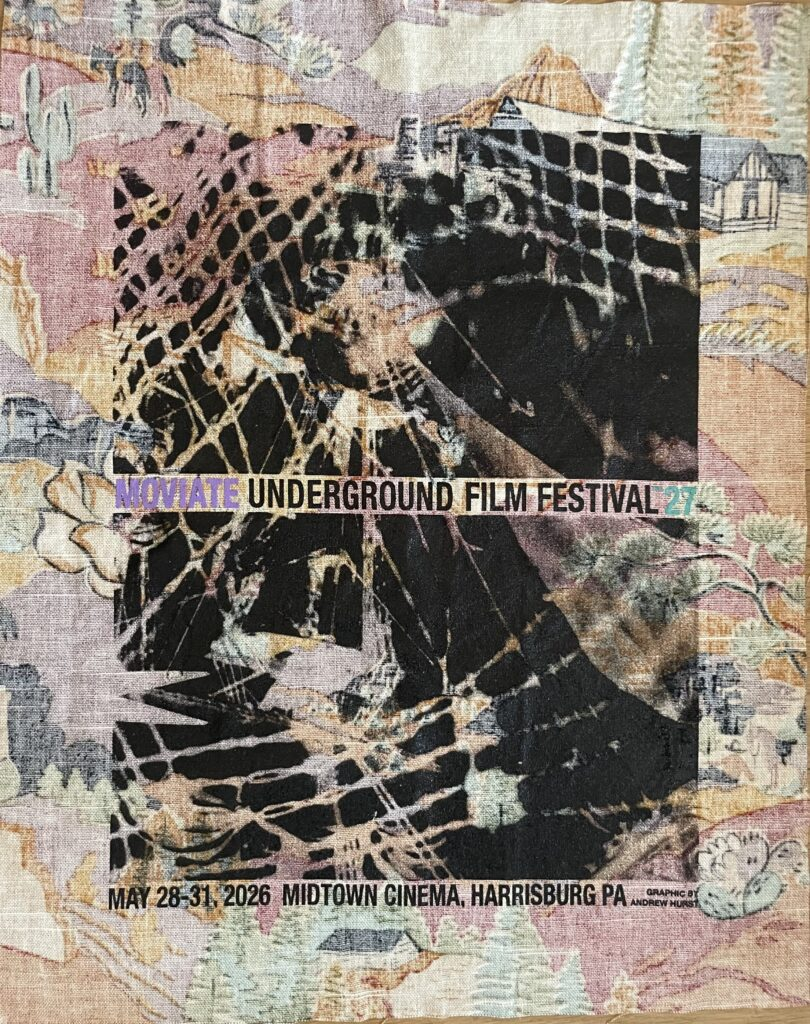
The 27th Annual Moviate Film Festival will take place on May 28 to 31 at Midtown Cinema and feature more than 60 films from 15 countries, with 13% of the movies being screened on real film.
Many of the selected films are new and classic documentaries. Caleb Smith, co-founder of Moviate highlighted several of the weekend’s showings as can’t miss events.
“You’re going to see someone’s personal creativity along with their vision, whether it’s a five-minute animation or a 90-minute documentary,” Smith said.
On Thursday, May 28, musicians Glenn Jones and Liam Grant will perform live original scores to two of their films, “The River” and “The Plow that Broke the Plains,” at 7 p.m. As they’ve been touring around the east coast, they will not be performing the original score to these films anywhere else but in here in Harrisburg, Smith noted.
The weekend continues Friday, May 29 with a 40th anniversary screening of the 1986 documentary “Heavy Metal Parking Lot,” featuring director Jeff Krulik in attendance. The screening is co-presented by local business Tattoo Punks.
“Jeff will present previously unseen footage, including interviews with the band Judas Priest related to the film,” Smith said.
On Saturday, May 30, Colombian filmmaker Chris Gude’s “Morichales” will screen in partnership with Harrisburg-based Elementary Coffee Co., whose coffee is largely sourced from Colombia.
“The film is a stunning portrait of the workers in Venezuela who are trying to mine for gold. It’s a really beautiful film,” Smith said.
The festival concludes Sunday, May 31, with a screening of “Barbara Forever,” accompanied by New York City filmmakers Lynne Sachs and Mark Street in partnership with the LGBT Center of Central PA.
“Lynne and Mark worked with Barbara for many years and were close friends with her,” Smith said. “She was very enigmatic and creative and had documented a lot of her life as she was making films. This film just came out this year, so I’m excited that Lynne and Mark will introduce it.”
In addition to spotlighting unique indie films, Smith also sees the festival as an avenue for connection.
“With the emergence of artificial intelligence and the silo effect of people being on their phones, there’s a feeling of isolation. When you go to Midtown Cinema, you can meet other people, chat and experience the film together,” he said.
AANIKOOBIJIGAN [ANCESTOR/GREAT-GRANDPARENT/GREAT-GRANDCHILD]: DIRS Adam Khalil and Zack Khalil. PRODS Steve Holmgren, Adam Khalil, Zack Khalil, Grace Remington, and Jacque Clark. USA.
Trapped in museum archives, Ancestors bend time and space to find their way home. History, spirituality, and the law collide as tribal repatriation specialists fight to return and rebury Indigenous human remains, revealing the still-pervasive worldviews that justified their collection in the first place.
ADAM’S APPLE: DIR Amy Jenkins. PRODS Brit Fryer and Amy Jenkins. USA.
A transgender teen and his mother chronicle their lives, weaving an intimate portrait of a family in transition. Two decades of footage trace a boy’s path to manhood and his parents’ vulnerability as they reckon with change.
AI: PROBABLY NOTHING TO WORRY ABOUT: DIR Nick Holt. PRODS David Glover, Mark Raphael, David Dugan, and Zara Powell. United Kingdom.
ADVERTISEMENT
As artificial intelligence accelerates a new technological arms race, the scientist whose breakthrough made it possible begins to question what he has unleashed. AI: PROBABLY NOTHING TO WORRY ABOUT is a gripping look at the race to build thinking machines — and the growing fear that they may outpace us all.
AMAZING LIVE SEA MONKEYS: DIRS Mark Becker and Aaron Schock. PRODS Mark Becker and Aaron Schock. USA.
From her crumbling estate on the Potomac River, Yolanda Signorelli battles to wrest control of her late husband Harold’s iconic toy, AMAZING LIVE SEA-MONKEYS!, from the corporate men she insists stole it from her — and to rescue it from the stain of her husband’s dark legacy.
AMAZOMANIA: DIR Nathan Grossman. Sweden, Denmark, France.
When the footage from a celebrated 1996 first-contact expedition in the Amazon resurfaces decades later, a triumphant story of discovery unravels into a reckoning with colonialism, documentary ethics, and the lasting impact on the Korubo people.
North American Premiere.
AMERICAN DOCTOR: DIR Poh Si Teng. PRODS Poh Si Teng, Kirstine Barfod, and Reem Haddad. USA, Palestine State, Malaysia, Denmark, Qatar.
When three American doctors—Palestinian, Jewish, and Zoroastrian—enter Gaza to save lives, they find themselves caught between medicine and politics, risking everything to expose the truth.
AMERICAN PACHUCO: THE LEGEND OF LUIS VALDEZ: DIR David Alvarado. PRODS David Alvarado, Lauren DeFilippo, Everett Katigbak, and Amanda Pollak. USA.
Against political resistance and industry skepticism, Luis Valdez pushes Chicano storytelling from the fields to the film screen with Zoot Suit and La Bamba, crafting iconic works that challenge, celebrate, and expand America’s story.
BABY/GIRLS: DIRS Jackie Jesko and Alyse Walsh. PRODS Melissa Leardi, Alex Waterfield, and Kelly Rohrbach Walton. USA.
Set in post-Dobbs Arkansas, BABY/GIRLS follows three teens living in a Christian maternity home as they navigate pregnancy and early motherhood—an intimate, unfiltered look at girlhood and motherhood colliding in the American South.
BARBARA FOREVER: DIR Brydie O’Connor. PRODS Elijah Stevens, Brydie O’Connor, and Claire Edelman. USA.
A dreamlike portrait of the life, work, and legacy of a pioneering feminist experimental filmmaker whose work helped shape early lesbian cinema. Tracing her prolific canon alongside rarely seen documentation of her life and body, the film reveals her unconventional attempts to live on—most notably through the extensive archiving of her films.
THE BEND IN THE RIVER: DIR Robb Moss. PRODS Lisa Remington and Kristin Feeley. USA.
Following a group of friends for nearly fifty years, THE BEND IN THE RIVER explores the inexorable flow of aging and the unfinished project of living.
BIRDS OF WAR: DIRS Janay Boulos and Abd Alkader Habak. PROD Sonja Henrici. United Kingdom.
From besieged Aleppo to the confines of a London newsroom, Lebanese journalist Janay Boulos and Syrian activist/cameraman Abd Alkader Habak retrace their love story through a vast personal archive spanning 13 years of revolution, war, and exile. Can their love survive distance, danger, and difference?
BLACK ZOMBIE: DIR Maya Annik Bedward. PRODS Kate Fraser and Hannah Donegan. Canada.
From the flickering screens of Hollywood horror to the haunted cane fields of colonial Haiti, BLACK ZOMBIE unearths the buried origins of the zombie, reclaiming it as a symbol of survival and spiritual resistance.
BUCKS HARBOR: DIR Pete Muller. PRODS Nathan Golon, Noel Paul, and Pete Muller. USA.
In Downeast Maine, boys are shaped by brutal winters, the harvesting of the ocean’s bounty, and the rigid codes of their fathers. BUCKS HARBOR explores what it means to grow up in a community where a man’s worth is measured by the strength of his back.
A CHILD OF MY OWN: DIR Maite Alberdi. PRODS Sandra Godínez, Carla González Vargas, Maximiliano Sanguine. Mexico.
Alejandra’s profound desire to become a mother—and the heartbreak and pressure that engulf her after multiple miscarriages—drive her to fake a pregnancy, unleashing a media scandal and a moral reckoning.
Courtesy of Netflix.
CLOSURE: DIR Michaƚ Marczak. PRODS Monika Braid, Michał Marczak, Rémi Grellety, Katarzyna Szczerba, and Karolina Marczak. Poland, France.
After his teenage son goes missing, Daniel combs the depths of the Vistula River day and night, caught in a grueling, endless routine and torn between the dread of a fatal leap and the fragile hope that his son may still be alive.
COOKIE QUEENS: DIR Alysa Nahmias. PRODS Gregory Kershaw, Michael Dweck, Alysa Nahmias, and Jennifer Sims. USA.
It’s Girl Scout Cookie season, and four tenacious girls strive to become top-selling “Cookie Queens,” navigating an $800 million business where innocence and ambition collide.
THE CYCLE OF LOVE: DIR Orlando von Einsiedel. PRODS Harri Grace, Chloe Leland, Karl von Schedvin, and Emelie von Schedvin. United Kingdom, Sweden.
An epic true-life journey of self-discovery, tracing the romantic odyssey of PK Mahanandia, a Delhi street artist who bicycled 6,000 miles across continents in 1977 to reunite with the woman he loved—risking everything for belief, connection, and what the heart demands.
DAUGHTERS OF THE FOREST: DIR Otilia Portillo Padua. PRODS Paula Arroio, Elena Fortes, and Otilia Portillo Padua. Mexico.
Deep in Mexico’s forests, two Indigenous mycologists seek to reconcile the past and present while reimagining the future for themselves and a changing world.
DO YOU LOVE ME: DIR Lana Daher. PRODS Films de Force Majeure and My Little Films. Lebanon, France, Qatar, Germany.
An exhilarating journey through 70 years of images and sounds from Lebanon, exploring Beirut’s collective psyche—marked by beauty, trauma, joy, and forgetting.
EARTH TO MICHAEL: DIRS Nico López-Alegría and ZZ. PRODS ZZ, Steffie van Rhee, Dustin Nakao-Haider, and Nico López-Alegría. USA.
Before an astronaut leaves Earth to usher in a new era of spaceflight, his son asks him to confront the unresolved space between them—revisiting a past shaped by distance in the hope of a more connected future.
THE ENDLESS FRONTIER: DIR Marilyn Ness. PRODS Beth Westrate and Ted Richane. USA.
An urgent portrait of three scientists confronting some of the most pressing challenges of our time, revealing the growing threat to the American research ecosystem—and what is at stake if it begins to falter.
World Premiere.
EVERY CONTACT LEAVES A TRACE: DIR Lynne Sachs. USA.
In the digital era, when real-life connections are increasingly rare, even fleeting encounters can leave a lasting trace. Over a lifetime, filmmaker Lynne Sachs has collected business cards—mementos of brief exchanges with strangers—and selects seven to uncover why these moments have lingered so vividly in her memory.
FIRST THEY CAME FOR MY COLLEGE: DIR Patrick Bresnan. PRODS Holly Herrick, Harry W. Hanbury, Patrick X. Bresnan, and Zackary Drucker. USA.
When Florida Governor Ron DeSantis stages a coup at New College, students and professors confront a new reality: their campus becomes ground zero in an unprecedented nationwide assault on academic freedom and diversity.
FREEFALL: A RECKONING FOR BOEING: DIR Rory Kennedy. PRODS Rory Kennedy, Mark Bailey, Viva Van Loock, Sara Bernstein, Justin Wilkes, and Alexandra Korba. USA.
Following the highly publicized death of Boeing whistleblower John Barnett, Rory Kennedy’s FREEFALL: A RECKONING FOR BOEING continues the investigation into the once-iconic aviation giant, uncovering startling new revelations and insider accounts in the wake of a deepening corporate crisis.
World Premiere.
Courtesy of Netflix.
THE GREAT EXPERIMENT: DIRS Stephen Maing and Eric Daniel Metzgar. PRODS Stephen Maing, Eric Daniel Metzgar, and Farihah Zaman. USA.
An epic poem in documentary form—a mirror held to an American nation at war with itself, asking not who is right, but whether the experiment can survive.
HARVEST: DIRS Natalie Baszile and Hyacinth Parker. PROD Trevite Willis. USA.
The Nelson brothers are on a mission to become the largest farmers in the U.S., but after two years of poor harvests, a new season brings as much opportunity as uncertainty. Farming more land than ever before, the brothers must work together to navigate the mounting pressures of climate change, equipment failures, and family tensions.
HELL’S ARMY: DIR Richard Rowley. PRODS Richard Rowley, Richard Butler, Atanas Georgiev, and Caitlin McNally. Norway, United Kingdom, USA.
A dissident Russian journalist faces death threats and the murder of her colleagues as she races across the globe to unmask one of the world’s most feared mercenary armies.
US Premiere.
JARIPEO: DIRS Efraín Mojica and Rebecca Zweig. PROD Sarah Strunin. Mexico, USA, France.
In Michoacán’s hypermasculine rodeos, what begins as a celebration of tradition descends into a subconscious terrain of memory, queer desire, and longing—a reckoning with the wounds and beauty of a home left behind.
JOYBUBBLES: DIR Rachael J. Morrison. PRODS Sarah Winshall, Will Butler, and Annie Marr. USA.
A boy discovers he can control the global telephone system by whistling a magic tone. Born blind and yearning for connection, his obsession sparks a subculture that helps shape the future of hacking and technology.
KIDS LIKE ME: DIRS Cynthia Lowen and Jon Cohrs. PRODS Cynthia Lowen and Jon Cohrs. USA.
Meet Oliver, a 12-year-old murder-mystery buff with a boundless imagination who is growing up with a rare genetic condition. Together with his family, he helps reframe what it means to live with disability as they embark on an imaginative adventure to create a murder-mystery caper.
THE LAKE: DIR Abby Ellis. PROD Fletcher Keyes. USA.
An environmental nuclear bomb looms in Utah. Two intrepid scientists and a political insider race against the clock to save their home from unprecedented catastrophe.
LANDSCAPES OF MEMORY: DIR Leah Galant. PRODS Elijah Stevens and Leah Galant. USA.
As she journeys through Germany, Leah Galant confronts family trauma and the legacy of Holocaust memory, weaving together the lives of a survivor’s descendant, a Nazi-descendant historian, exiled Palestinian artists, and her father’s ALS to examine the uses and abuses of memory culture.
THE LAST CRITIC: DIR Matty Wishnow. PRODS Joe Levy, Paul Lovelace, and Ben Wu. USA.
Robert Christgau, the “Dean of American Rock Critics,” whose work has inspired and infuriated readers for sixty years, is still at it in his eighties—grading records, interrogating commas, and listening to nearly everything (except metal and prog).
THE LAST FIRST: WINTER K2: DIR Amir Bar-Lev. USA.
A complex, harrowing, and deeply moving portrait of the evolving world of extreme mountain climbing, following a 2021 expedition in which Icelandic mountaineer John Snorri Sigurjónsson and Pakistani father-son team Ali and Sajid Sadpara attempt the first winter summit of K2, when the mountain is at its most unforgiving.
Courtesy of Apple Original Films.
LOS LOBOS NATIVE SONS: DIRS Doug Blush and Piero F. Giunti. PRODS Rafael Agustín, Doug Blush, Robert Corsini, Piero F. Giunti, Patricia Harris DiLeva, and Flavio Morales. USA.
Drawing on rare archival material and intimate access, LOS LOBOS NATIVE SONS chronicles the extraordinary 50-year journey of Los Lobos, revealing the music, roots, and legacy of one of America’s most enduring bands.
LOVE APPTUALLY: DIR Shalini Kantayya. PROD Elizabeth Woodward. USA, Australia.
Following a French journalist’s journey from an early fascination with Tinder to an investigation of the deeper truths embedded in its algorithm, LOVE APPTUALLY explores how a multibillion-dollar tech industry is quietly reshaping desire, intimacy, and the most fundamental of human pursuits: love.
US Premiere.
MAKING THEIR POINTE: DIR Kamilah Thurmon. USA.
During segregation, African American ballet teachers in Washington, D.C. opened doors for children in underserved communities to enter and excel in the world of classical ballet, creating a legacy that continues across generations.
Screening as part of DC/FRAME.
MISS REPRESENTATION: RISE UP: DIR Jennifer Siebel Newsom. PRODS Camille Servan-Schreiber, Gretchen Miller, and Jennifer Siebel Newsom. USA.
In this timely follow-up to the lauded MISS REPRESENTATION, Jennifer Siebel Newsom’s RISE UP explores the ongoing cultural backlash against women’s mental health, agency, and political power, revealing how technology amplifies sexism and misogyny.
NEWPORT & THE GREAT FOLK DREAM: DIR Robert Gordon. PRODS Joe Lauro, Robert Gordon, and Laura Jean Hocking. USA.
Through performances at the Newport Folk Festival from 1963 to 1966, NEWPORT & THE GREAT FOLK DREAM captures a generation finding its voice through the revival of American folk traditions and protest song.
THE OLDEST PERSON IN THE WORLD: DIR Sam Green. PRODS Alison Byrne Fields and Josh Penn. USA.
A decade-long global odyssey chronicles the ever-shifting record holders of the title, evolving into a poignant meditation on time, chance, and the experience of being alive.
ONE IN A MILLION: DIRS Itab Azzam and Jack MacInnes. PRODS Itab Azzam, Jack MacInnes, Will Anderson, James Bluemel, Andrew Palmer, and Raney Aronson-Rath. USA, United Kingdom.
Filmed over ten years, one girl’s epic journey unfolds from Syria to Germany and back again as she navigates war, exile, and heartbreak, illuminating the complexities of the refugee experience.
Courtesy of PBS Distribution.
PHENOMENA: DIR Josef Gatti. PRODS Rob Innes, Jessica Harrop, Caitlin Mae Burke, Jad Abumrad, and Josef Gatti. Australia.
A psychedelic odyssey into the fabric of the universe, where immersive practical experiments yield striking, otherworldly imagery that unfolds into a hypnotic audiovisual experience of awe and human connection to the natural world.
THE SALISBURY POISONINGS: A SPY NEXT DOOR: DIR Dan Vernon. PROD Alex Brisland. United Kingdom, USA.
A botched assassination in a small English city contaminated by a chemical weapon unfolds into one of the most extraordinary true spy stories of the modern era—a portrait of loyalty and betrayal with urgent relevance today.
North American Premiere.
Courtesy of CNN Films.
THE SANDBOX: DIR Kenya-Jade Pinto. PROD Shasha Nakhai. Canada.
Through meditative, cinematic landscapes, THE SANDBOX explores global borders where surveillance and AI shape who lives and who dies. From the Arizona desert to the Mediterranean Sea, suffering is clinically managed while control is packaged as security. If there is no opting out, who is The Sandbox really protecting?
US Premiere.
SCHOOL FOR DEFECTORS: DIR Jeremy Workman. PROD Sona Jo. USA.
In an industrial area of Busan, South Korea, the tiny Jangdaehyun School serves just 20 students—all North Korean defectors—offering a joyful story of youth, inspiration, and our shared humanity.
SEIZED: DIR Sharon Liese. PRODS Sharon Liese, Sasha Alpert, and Paul Matyasovsky. USA.
When the small town of Marion, Kansas, is thrust into the international spotlight after a police raid on the Marion County Record and the death of its 98-year-old co-owner, a fierce debate ignites over abuse of power, journalistic ethics, the future of local journalism, and the United States Constitution.
THE SIEGE OF PARADISE: DIR Gar O’Rourke. Ireland, Switzerland.
Every summer, nearly four million tourists—TikTokers, Instagrammers, and selfie-seekers among them—descend on Cinque Terre and its 3,000 residents. THE SIEGE OF PARADISE follows one chaotic season in a sharply funny and surprisingly tender portrait of paradise under pressure.
SOUL PATROL: DIR J.M. Harper. PRODS Sam Bisbee, J.M. Harper, Danielle Massie, Nasir Jones, and Peter Bittenbender. USA.
From deep behind enemy lines, a hidden chapter of American military history emerges, prompting the question of whether reckoning with the past can bring peace to those who lived it. The Vietnam War’s first Black special operations team reunites to tell their story.
STEALING MAGIC: DIR Matthew Testa. PRODS Ethan Smith, Melanie Miller, Diane Becker, and Randy Pitchford. USA.
Magician Andi Gladwin becomes an unlikely citizen detective, joining a team of illusionists to track down internet pirates who steal their secrets and resell them online.
SUPER NATURE: DIR Ed Sayers. PRODS Rebecca Wolff, Ed Sayers, and Beth Allan. United Kingdom.
A global love letter to nature, filmed entirely on Super 8, invites us into a spellbinding journey of togetherness with our fellow dwellers on Earth—human and nonhuman—as people embrace beauty, abundance, and loss.
US Premiere.
THEYDREAM: DIR William D. Caballero. PRODS William D. Caballero, Brad Jones, Erin Ploss-Campoamor, and Elaine Del Valle. USA.
After 20 years of chronicling his Puerto Rican family, a director and his mother face devastating losses. Through tears and laughter, they craft animations that bring their loved ones back to life, discovering that every act of creation is also an act of letting go.
TIME AND WATER: DIR Sara Dosa. PRODS Shane Boris, Elijah Stevens, Jameka Autry, and Sara Dosa. USA, Iceland.
Facing the loss of his country’s glaciers and the impending death of his beloved grandparents, Icelandic writer Andri Snær Magnason turns his archives into a time capsule to hold what is slipping away—family, memory, time, and water.
Courtesy of National Geographic Documentary Films.
TIME WARP: DIR Allison Berg. USA.
Fifty years after THE ROCKY HORROR PICTURE SHOW electrified the world, a fearless dreamer sets out to bring its message of personal expression and sexual freedom to a small town in Wyoming.
TO HOLD A MOUNTAIN: DIRS Biljana Tutorov and Petar Glomazić. PRODS Biljana Tutorov, Petar Glomazić, Quentin Laurent, and Rok Biček. Serbia, France, Montenegro, Slovenia.
In the highlands of Montenegro, a shepherd mother and daughter defend their ancestral land from becoming a NATO military training ground, stirring memories of past violence.
TRUE NORTH: DIR Michèle Stephenson. PROD Leslie Norville. USA, Canada.
A riveting portrait of 1960s Montréal, where luminous archival footage and firsthand accounts bring a city in upheaval to life, revealing a defining moment in the global movement for Black liberation.
TWO MOUNTAINS WEIGHING DOWN MY CHEST: DIR Viv Li. PRODS Daniela Dietrich, Erik Winker, and Olivia Sophie van Leeuwen. Germany.
A Chinese misfit ricochets between Berlin’s alternative scene and Beijing’s family expectations, transforming cultural whiplash into an offbeat search for identity and belonging.
WHEN A WITNESS RECANTS: DIR Dawn Porter. PRODS Dawn Porter, Jennifer Oko, and Miriam Weintraub. USA.
In 1983, author Ta-Nehisi Coates recalls learning that a 14-year-old boy was murdered in the corridor of his Baltimore middle school. Revisiting the case as an adult, he uncovers the truth about three teenagers who were wrongfully convicted and sentenced to life. After 36 years in prison, false testimony is revealed to have led to their imprisonment. WHEN A WITNESS RECANTS explores the lasting impact of the case on the community, the wrongfully accused, and the young witnesses pressured to testify against them.
Courtesy of HBO Documentary Films.
WHO KILLED ALEX ODEH?: DIRS Jason Osder and William Lafi Youmans. PRODS Dawne Langford, Daniel J. Chalfen, Jason Osder, and William Lafi Youmans. USA.
In 1985, the assassination of Palestinian American leader Alex Odeh remains unsolved. Reopening the case as a gripping cold-case investigation, the film follows new leads as the search for accountability intensifies.
THE WHOLE WORLD IS A LIE: DIR Charlie Birns. PRODS Charlie Birns. USA.
A New York method acting class unravels when its students and teacher revolt against the filmmaker, forcing him into a reckoning with truth, trauma, and power in an age when reality itself feels like performance.
YO (LOVE IS A REBELLIOUS BIRD): DIRS Anna Fitch and Banker White. PRODS Anna Fitch, Banker White, Sara Dosa, and Hannah Roodman. USA.
After losing her friend Yo, Anna spends a decade obsessively building a detailed one-third-scale replica of her house — just large enough to crawl inside — where a puppet version of Yo still lives.
Shorts
9,192,631,770 HZ: DIR Todd Chandler. PRODS Heidi Fleisher, Mike Paterson, and Nora Wilkinson. USA.
In conversation with his young son, a filmmaker reflects on time — our attempts to control it, and the ways it shapes human experience.
AND AGAIN I DREAM: DIRS Catherine Gund and Mariah Norman. PROD Catherine Gund. USA.
As Ivy Young nears the end of her life, her lifelong friend Catherine and her young protégé Mariah come together to preserve the story of a beloved journalist and organizer whose legacy bridges queer generations through memory, activism, and love.
AT THE STAGE WHEN: DIR Hao Zhou. PRODS Tyler Hill and Hao Zhou. USA, China.
In a Chinese megacity, a young laborer navigates her marriage to a well-off man and finds herself bound to an unintended future.
THE BADDEST SPEECHWRITER OF ALL: DIRS Ben Proudfoot and Stephen Curry. PRODS Stephen Curry, Erick Peyton, and Ben Proudfoot. USA.
Now 95, Martin Luther King Jr.’s lawyer and speechwriter reflects on the personal cost and surprising truths of making history, offering an intimate insider’s view of the Civil Rights Movement.
Courtesy of Netflix.
BIG BASS: DIR Drew Dickler. PRODS Nikki F. Heyman, Jennie Kamin, and David Sherwin. USA.
Drew returns to 1997 to revisit a dreamlike second-grade memory shaped by her emerging queer identity, a legendary P.E. teacher, and a mysterious giant plastic fish.
THE BOYS AND THE BEES: DIR Arielle Knight. PROD Arielle Knight. USA.
On an idyllic farm in rural Georgia, young parents share their understanding of life, love, and nature with their sons, teaching them the art of beekeeping.
Courtesy of POV.
BUCKSKIN: DIR Mars Verrone. PROD Mars Verrone. USA.
An experimental portrait of the filmmaker’s grandfather: Carroll B. Williams Jr., a ground-breaking African-American forester, reflecting on his work and legacy in the twilight of his life.
CHILAPA GIRL: DIR Juana Lotero López. PRODS Daniel Sánchez and Juana Lotero López. Colombia.
Yulieth, on the cusp of adolescence, faces the difficulties of growing up in a wild territory where natural beauty coexists with the hostility of machismo. Her emerging identity is caught between the pull of her dreams and the realities of her world.
CHOCOLATE: A MOTION POETRY HOMAGE TO BLACK D.C.: DIR Eliamani Ismail. PROD Gyzelle Garcia. USA.
In the nation’s fastest-gentrifying city, Black DC refuses quiet erasure.
Screening as part of DC/FRAME.
THE CUSTODIAN: DIR Khaula Malik. PRODS Amber Hsu, Colleen Thurston, and Khaula Malik. USA.
After more than five decades collecting rare and vintage memorabilia dating back to 1932, Samu Qureshi, a devoted Washington Commanders superfan, believes he is finally ready to part with his collection — hoping to sell it to team ownership and help establish a museum and hall of fame.
World Premiere.
THE DARK KNOT AT THE CENTER: DIR Inês Pedrosa e Melo. PRODS André Guiomar, Carlos Carneiro, and Luís Costa. Portugal, USA.
Women travel hundreds of miles for abortion care, recounting the barriers they face and the lasting toll of a system that forces them to the margins.
A DERAILMENT: DIR Nathan Truesdell. PRODS Kat Nguyen and Will Lennon. USA.
At 8:55 PM on February 3, 2023, a freight train carrying hazardous materials derailed in East Palestine, Ohio.
DIVISION: DIR James Paul Dallas. PRODS James Paul Dallas and Eryc Perez de Tagle. USA.
Spring, 2025. Brooklyn, New York. One chapter closes and another begins.
ENDLINGS: DIR María Luisa Santos. PROD Carlo Nasisse. USA, Costa Rica.
Amid the planet’s first human-driven mass extinction, a filmmaker moves through churches, ancient DNA labs, and spectral archives in search of what remains—and what can never be recovered.
FILME-COPACABANA: DIR Sofia Leão. PRODS Laura Neiva, Leonardo Martinelli, Rafael Lopes Cesar, and Sofia Leão. Brazil.
From a chair on a Rio sidewalk, a woman observes the passing choreography of Copacabana. Workers, tourists, dogs, and daily street life come together through playful montage to create a vibrant portrait of the neighborhood.
US Premiere.
FINAL PRESS: DIR John Haley. USA.
Workers at The Minnesota Star Tribune complete the last printing run at the newspaper’s Heritage Center, ending 150 years of printing the paper in Minnesota.
World Premiere.
FLETCHER STREET: DIR Jannat Gargi and David Darg. PROD Jannat Gargi. USA.
In North Philadelphia, the Fletcher Street Urban Riding Club offers a vital safe haven for at-risk youth. Their joy and sense of freedom as they ride horses majestically through the streets of their neighborhood is as affirming as the trust, discipline, and emotional resilience they build through their close bonds with the horses.
GATORVILLE: DIR Freddie Gluck. PRODS Chloe Campion, Freddie Gluck, and Matteo Moretti. USA.
In Colorado’s forgotten valley, two siblings face alligators and the ache of leaving youth behind.
GHOST LANDS: DIR Zachary Garmoe. USA.
Following the marshes and forests of the Delmarva Peninsula in the footsteps of Harriet Tubman, GHOST LANDS explores how the natural landscapes that shaped her life continue to hold the memory of freedom, resistance, and our shared past.
THE GRANDFATHER PUZZLE: DIR Ora DeKornfeld. PRODS Zsófia Paczolay, Máté Artur Vincze, and Noémi Veronika Szakonyi. USA.
When a puzzle-obsessed grandfather refuses to discuss his past, his granddaughter travels to photograph the Hungarian castle where he grew up and turn it into a puzzle. What begins as a simple mission becomes a darkly comic exploration of displacement, memory, and the meaning of home.
GRAZING ON IMAGES: DIR Mark Street. USA.
A diaristic journey shot on 35mm still film and Super 8 travels, tracing a life shaped by the rhapsodic beauty of everyday images.
World Premiere.
THE HOTLINE: DIRS Ricki Stern and Jesse Sweet. PROD Ricki Stern. USA.
A haunting, meditative portrait of opioid users connected through an anonymous phone line, THE HOTLINE reveals a fragile tether between life and death.
I WANTED TO HEAR YOUR VOICE: DIR James Pellerito. PROD David Barba. USA.
After eight years caring for his mother with severe dementia, a son navigates the challenges of their daily routine.
JACOB KAINEN: THE LAST EXPRESSION: DIR Mark Covino. PROD Jon Gann. USA.
From tenement kid to towering figure in Washington, DC’s art world, JACOB KAINEN: THE LAST EXPRESSION traces Jacob Kainen’s seven-decade journey through American art as a story of creative defiance.
Screening as part of DC/FRAME.
JOURNEY(S): ADDIS TO DC: DIR Saaret E. Yoseph. PROD Saaret E. Yoseph. USA, Ethiopia.
A narrative journey between two distant sister cities, JOURNEY(S): ADDIS TO DC traces the lives of Ethiopian women in America and Black women across the diaspora, weaving together memory, migration, and the search for home.
Screening as part of DC/FRAME.
KITE: DIR Thanos Psichogios. PROD Thanos Psichogios. Greece.
On Clean Monday, the first day of Lent in Greece, Panos, now grown, returns to a childhood ritual of flying a kite with his father. But memories are never simple.
KOKI, CIAO: DIR Quenton Miller. Netherlands.
The autobiography of Koki, the parrot of Marshal Tito, who led Yugoslavia for 35 years.
LA MAR: DIR Jean Chapiro. PROD Jean Chapiro. Mexico.
As the ocean swallows her fishing village on Mexico’s Gulf Coast, one woman leads the effort to relocate her community while struggling to let go of the sea that shaped her life.
LISTEN: DIR Taliesin Black-Brown. PRODS Taliesin Black-Brown, Sam Davis, and Greg Moga. USA.
As his mother slips away into dementia, an Alaskan sound recordist listens for what remains.
NOTES ON COURTWATCH: DIR Kate Levy. USA.
“Courtwatchers” attend immigration court to bear witness and support asylum seekers facing the risk of ICE detention at their hearings.
World Premiere.
OH WHALE: DIR Winslow Crane-Murdoch. PRODS Luke Terrell, Cecilia Brown, and Rachel Gardell. USA.
One man. One Whale. Twenty cases of dynamite.
PEDRO TOMÁS EXPLAINS THE WORLD: DIR Kornelijus Stučkus. PRODS Liliana Díaz Castillo, Marc Vila Bosch, and Paulina Martinez. Spain.
On the volcanic island of La Palma lives Pedro Tomás, a man who explores the world through his unique vision.
PLANT LIFE: DIRS Brett Marty and Joshua Izenberg. PRODS. USA.
At a pivotal moment in her life and career, Joanne Chory races to complete her most audacious experiment yet: re-engineering crops to draw down CO₂ at planetary scale. As her Parkinson’s advances and carbon levels surge, PLANT LIFE captures a scientific race against time that may determine both her legacy — and our collective future.
PLUMPED: DIRS Nora DeLigter and Faye Tsakas. PRODS. USA.
Inspired by GAP-TOOTHED WOMEN by Les Blank, women speak candidly about their experiences with lip filler, exploring beauty, identity, and the pressures of self-image.
World Premiere.
Courtesy of Rolling Stone.
A QUIET STORM: DIR Benjamin Nicolas. PROD Rumi Tominaga. Canada, Japan.
In suburban Tokyo, a fourteen-year-old krump prodigy channels his unspoken rage into dance while his single mother quietly raises him and his sister, who lives with a disability. In a culture that demands silence and conformity, her endurance becomes the loudest act of love, and his body becomes the only language left.
ROOM OF THE ABSOLUTE: DIRS Natalie Shirinian and Elizabeth Baudouin. PRODS Natalie Shirinian, Elizabeth Baudouin, and Alla Hurenko. USA.
Ukrainian painter Alla Hurenko (known as Pazza Pennello) captures an intimate, diaristic portrait of life under war through her iPhone, where art becomes a powerful act of resilience and self-preservation.
THE SECOND LIFE OF FREDDIE NOLE: DIR Dana Nachman. PRODS Chelsea Matter and Dana Nachman. USA.
When Freddie Nole drives to meet a man walking out of prison, he is not just offering a ride, but hope, dignity, and a path to lasting freedom. As this vérité road trip unfolds, the remarkable story behind Freddie’s mission comes into focus: a staggering mistake that cost him 50 years of freedom and ultimately brought him back to the prison gates.
SCENES FROM THE DIVIDE: DIR Alison Klayman. PRODS Alison Klayman and Courtney Powell. USA.
Set against the contentious mayoral campaign of Zohran Mamdani, SCENES FROM THE DIVIDE follows one daughter and her parents, alongside other New Yorkers, as divisions over Palestine expose deeper fractures within Jewish communal life. Through intimate family and community conversations, the film reveals a struggle over identity, history, and belonging.
SEA SONG: DIR An-Phuong Ly. USA.
The last remaining South Vietnamese naval officers reunite one final time with the few people who understand the forces that have shaped their lives.
SHEESH, A TAYLOR LOVE STORY: DIR Ramona Diaz. PROD Diane Quon. USA.
In a country where drag is both art and survival, Taylor Sheesh transforms Taylor Swift fandom into a movement of joy, belonging, self-expression, and empowerment — revealing the power of queer performance to help people feel seen, beautiful, and free in a region still fighting for equality.
World Premiere.
STALIN BOYS: DIRS Ora DeKornfeld and Bianca Giaever. USA.
Four middle school boys in a Texas border town develop an unexpected obsession: Joseph Stalin.
STILL STANDING: DIR Victor Tadashi Suarez and Livia Albeck-Ripka. PRODS Livia Albeck-Ripka and Victor Tadashi Suarez. USA.
After the 2025 Los Angeles wildfires leave thousands of homes contaminated with toxic ash, residents face an impossible choice: protect their health or return home.
SUDAKAS: DIR Ricardo Betancourt. PRODS Lorraine Caffery. Venezuela.
A former Venezuelan diplomat now working as a housekeeper in the same city where she once served confronts the realities of immigration, labor, and reinvention.
TOSS A ROSE OVER: DIR Janelle VanderKelen. USA.
A travelogue from the vantage point of the plants of the Grand Canyon.
World Premiere.
THE TUNERS: DIR Pawel Piotr Chorzepa. Poland.
In the shadows of the world’s most prestigious piano competition, a group of expert tuners spend a month striving to achieve perfect pitch—hoping that the eventual champion will perform on their instrument.
North American Premiere.
WATER COOLER: DIR Emma V.F.. USA.
The Trump administration has transformed immigration courts into deportation traps. As ICE agents wait outside courtrooms to make arrests, their banal conversations stand in stark contrast to the gravity of their actions.
WEIRDO: DIR Amy Oden. PROD Amy Oden. USA.
In the summer before she starts high school, Bronwyn discusses what it’s like to feel weird in two very different towns.
WHEN THE REVOLUTION DOESN’T COME: DIR Aurora Brachman. PROD LaTajh Simmons-Weaver. USA, United Kingdom.
They are the children of the Black Panther Party — the self-styled Panther Cubs — born into a revolutionary movement for Black equality and self-determination, and now reckoning with the pride, loss, and unfinished promise of that legacy fifty years later.
Courtesy of The Guardian.
WOMEN LAUGHING: DIRS Kathleen Hughes and Liza Donnelly. PRODS Judith Mizrachy, Liza Donnelly, and Nathalie Seaver. USA.
New Yorker cartoonist Liza Donnelly talks, draws, and laughs with some of the most celebrated and groundbreaking cartoonists at the iconic magazine as they reflect on the essential work of women cartoonists today and over the last century.
Courtesy of Conde Nast / The New Yorker.
Frederick Wiseman Retrospective
HOSPITAL (1969): DIR Frederick Wiseman. USA.
Through the daily rhythms of an urban hospital’s emergency ward and clinics, HOSPITAL reveals the intricate systems, urgent decisions, and human encounters at the heart of modern medicine.
JUVENILE COURT (1973): DIR Frederick Wiseman. USA.
Set inside the Memphis juvenile justice system, JUVENILE COURT observes the difficult cases and impossible choices at the intersection of punishment, protection, and rehabilitation.
WELFARE (1975): DIR Frederick Wiseman. USA.
Inside a New York City welfare office, WELFARE reveals the human struggles, bureaucratic barriers, and impossible choices at the heart of the social safety net.