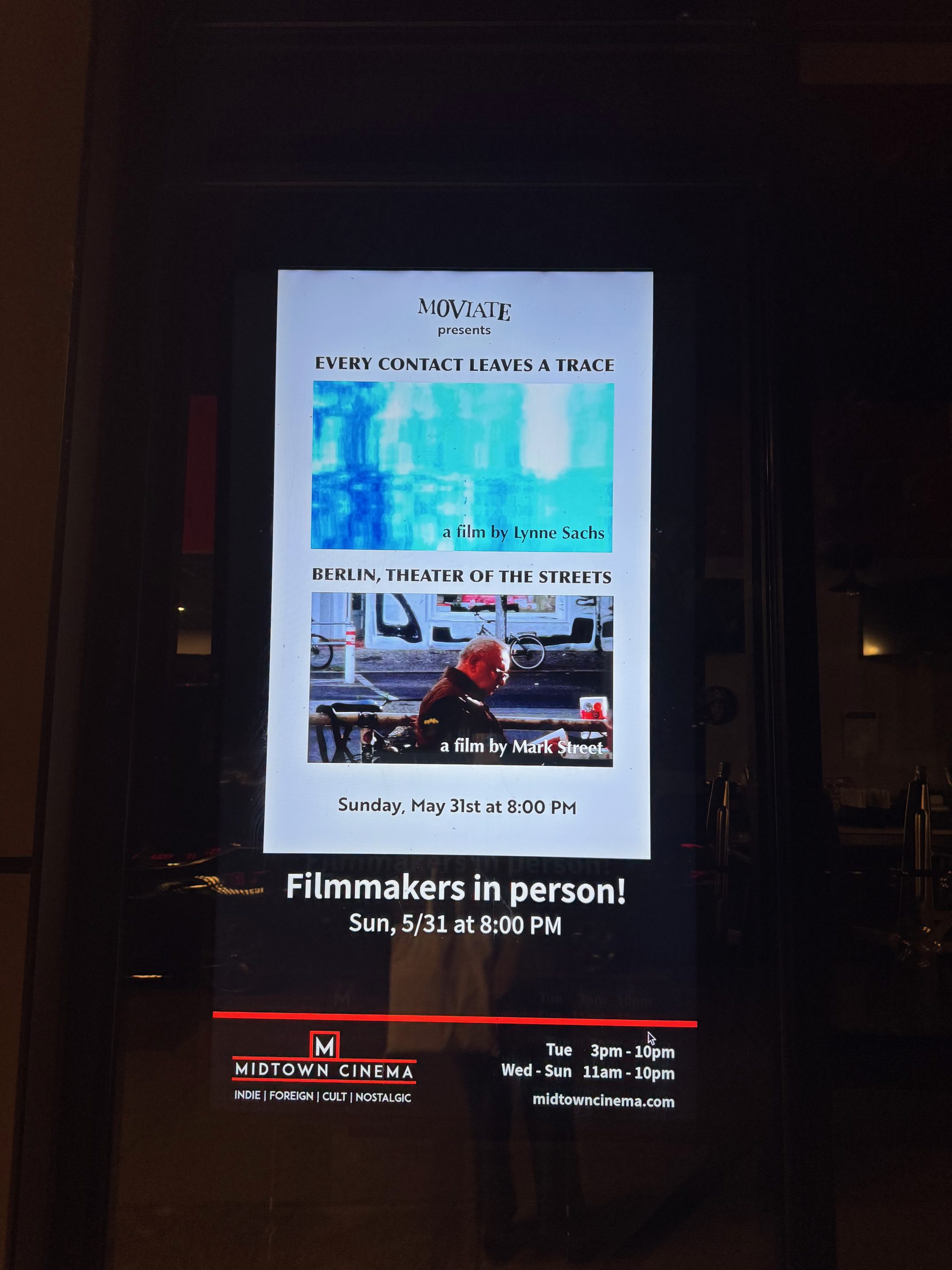
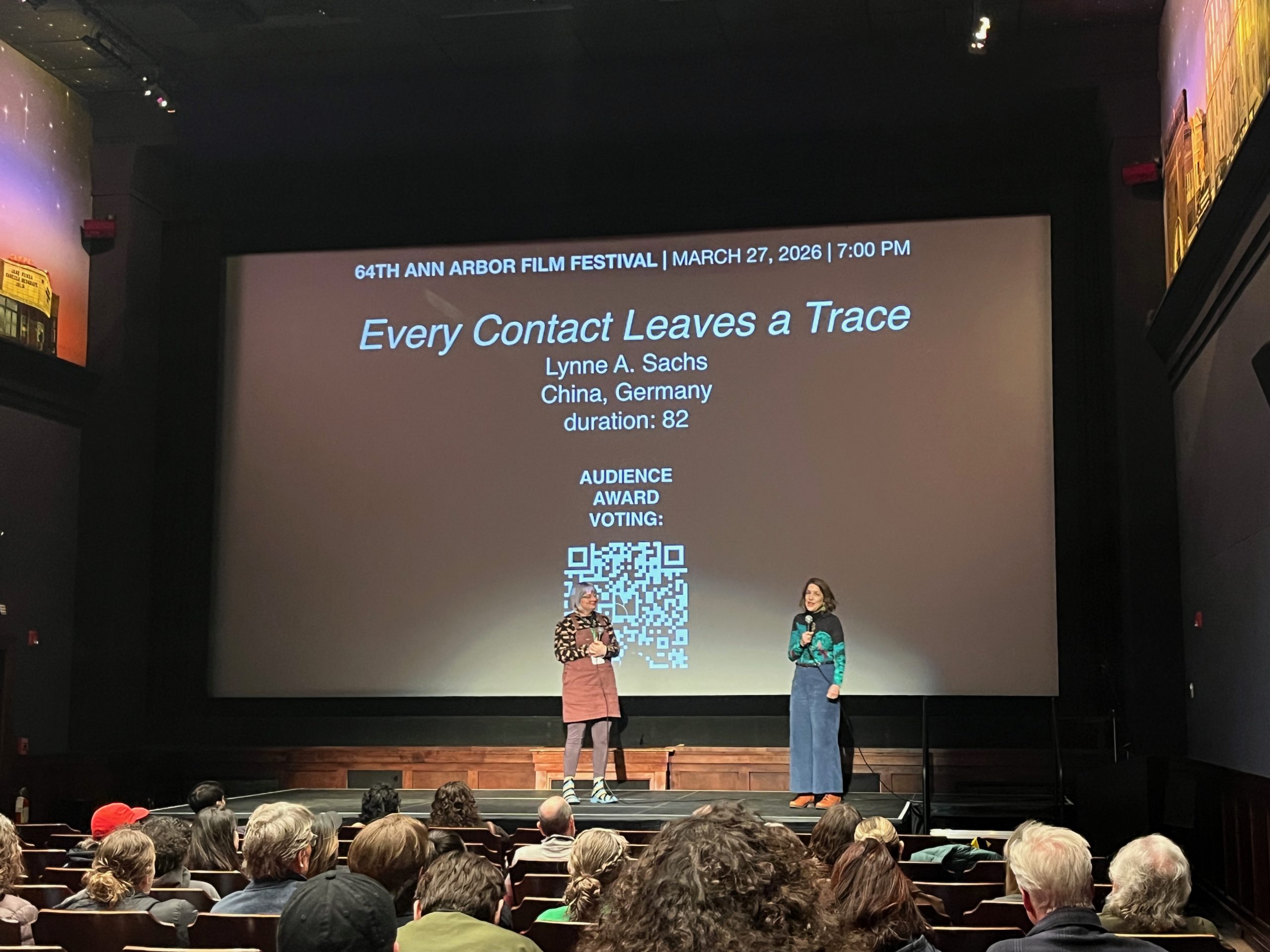
Contact—so tactile, so evocative of the touch of one person on another, physically and emotionally. Trace—a way to get back to an earlier point and a reckoning with the remains of that initial encounter. Filmmaker Lynne Sachs has saved every business card anyone has ever given her. After 40 years of collecting, she recognizes their mnemonic powers. With 600 cards in her grasp, Sachs contemplates the impact of these haptic exchanges. In both real and imagined ways, her essay teases apart their vivid resonances, entwining personal memory with geopolitical history through visual abstraction, music, and a poet’s sense of introspection.
Showing with: “Berlin Theater of the Streets” – A film by Mark Street – 10 minutes Presented in person by filmmaker Mark Street A walk through Berlin; eyes open, camera ready. Countless vignettes unfold around me, and I imagine storylines for each set piece. Join us for a special Closing Night Program with both filmmakers in-person! As part of the 27th Annual Moviate Underground Film Festival.
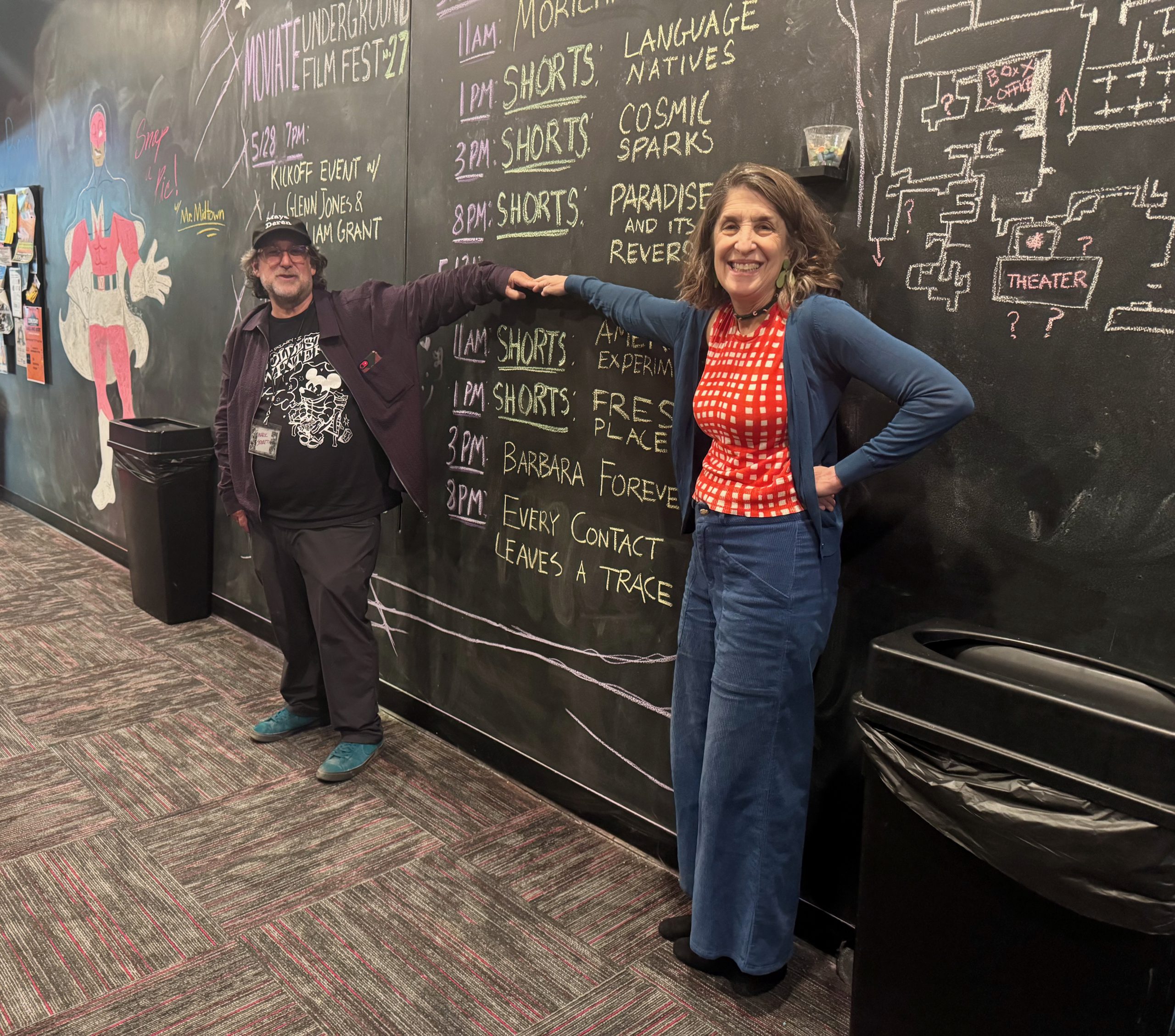
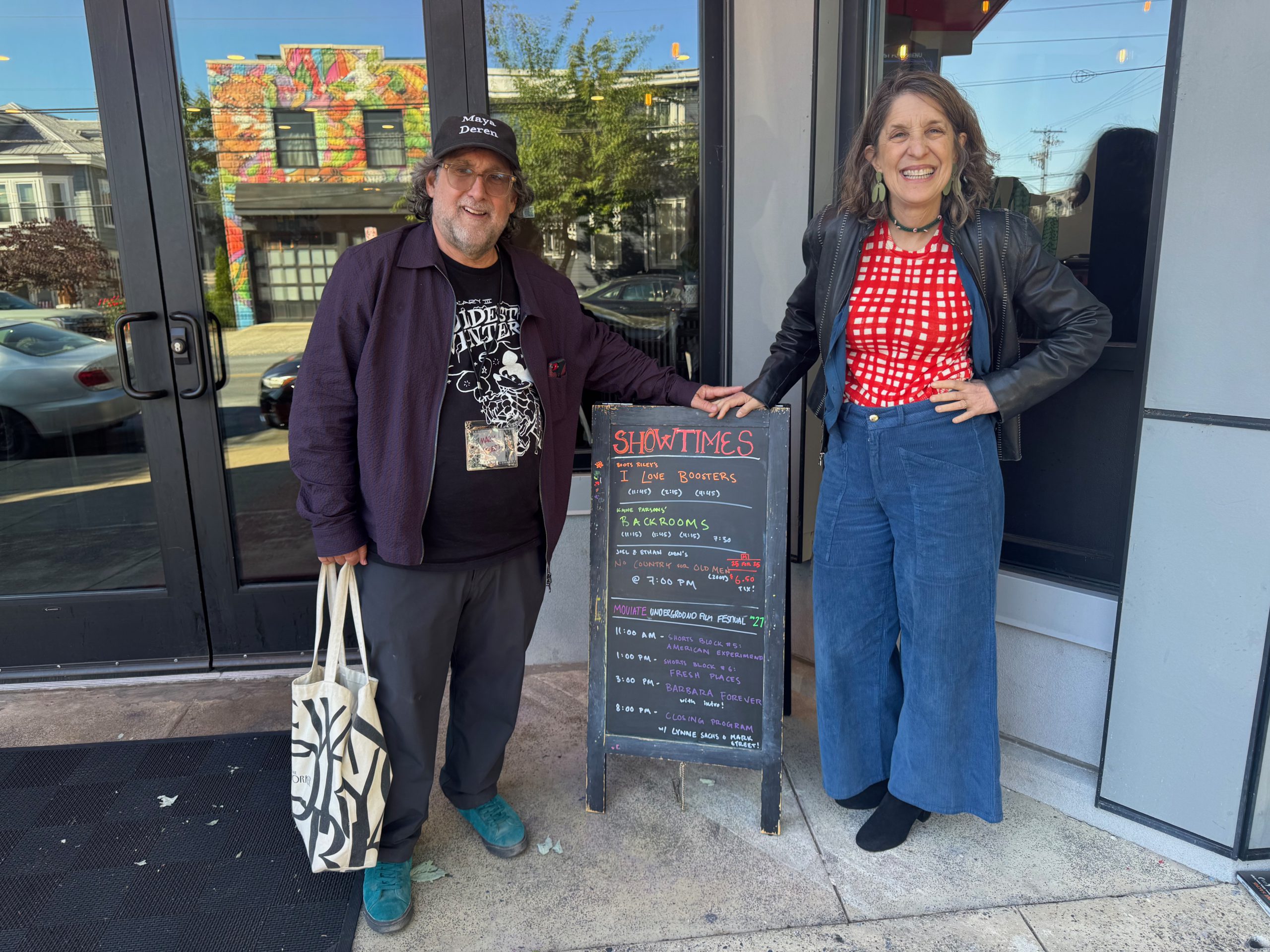
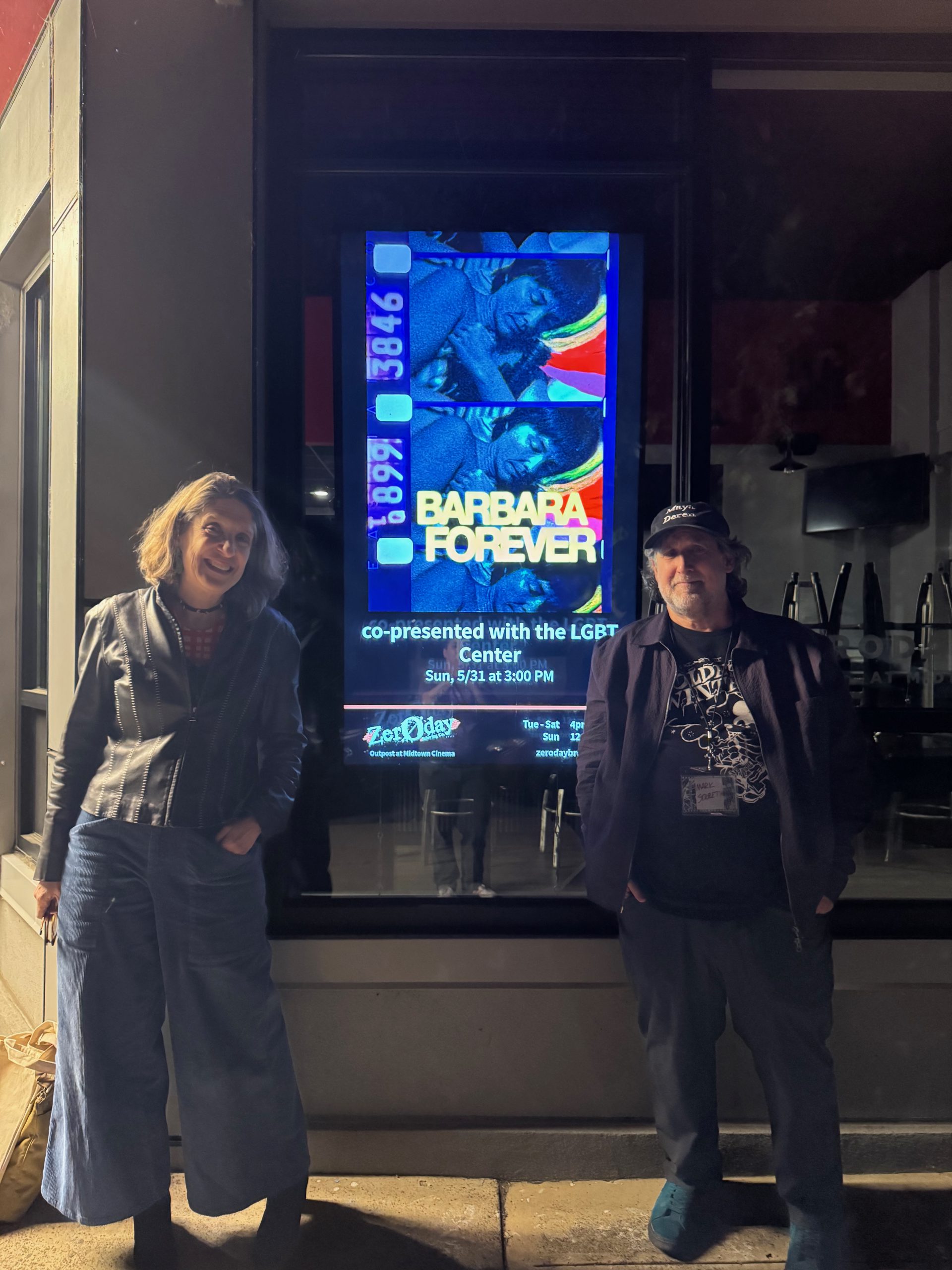
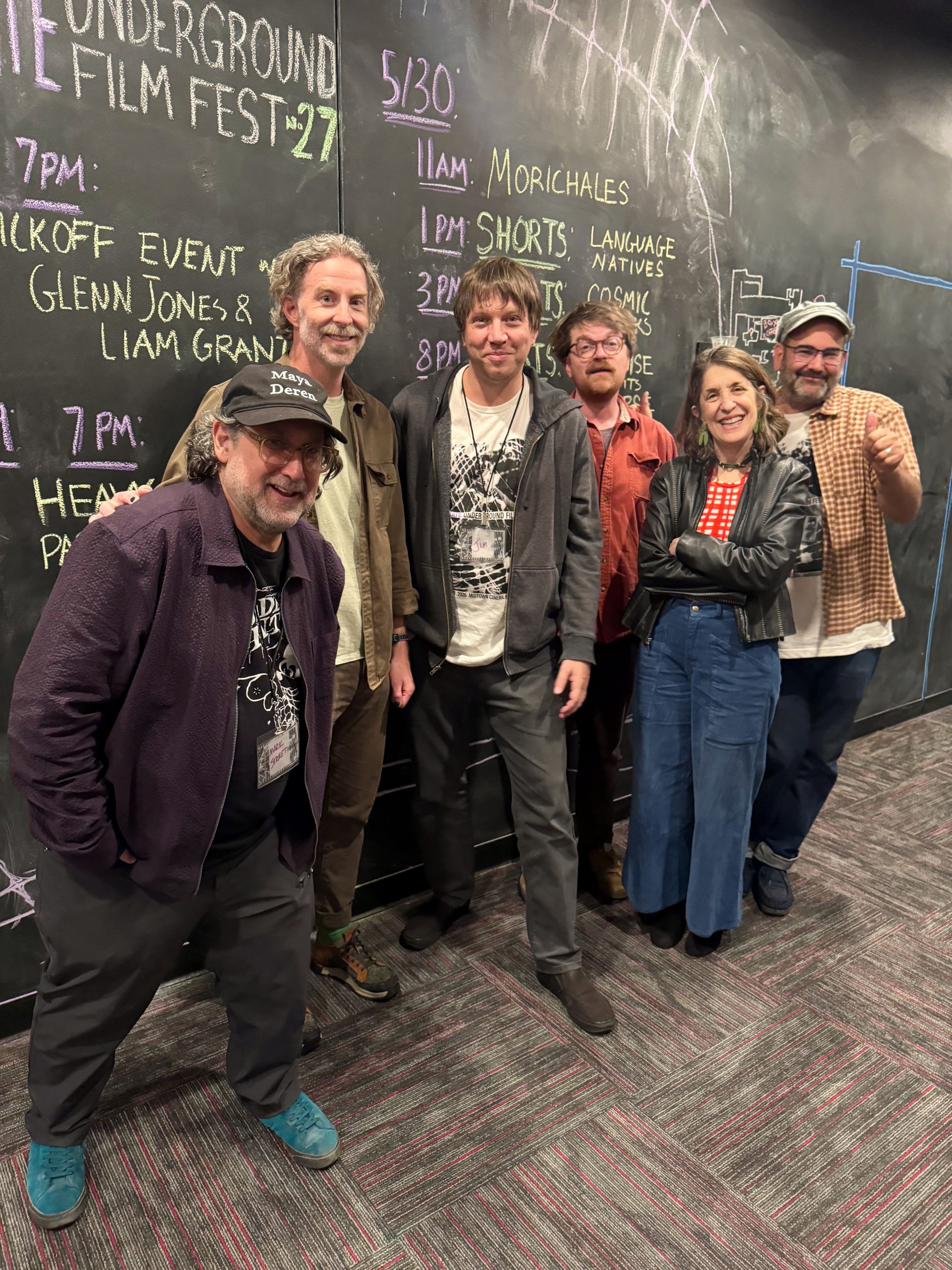
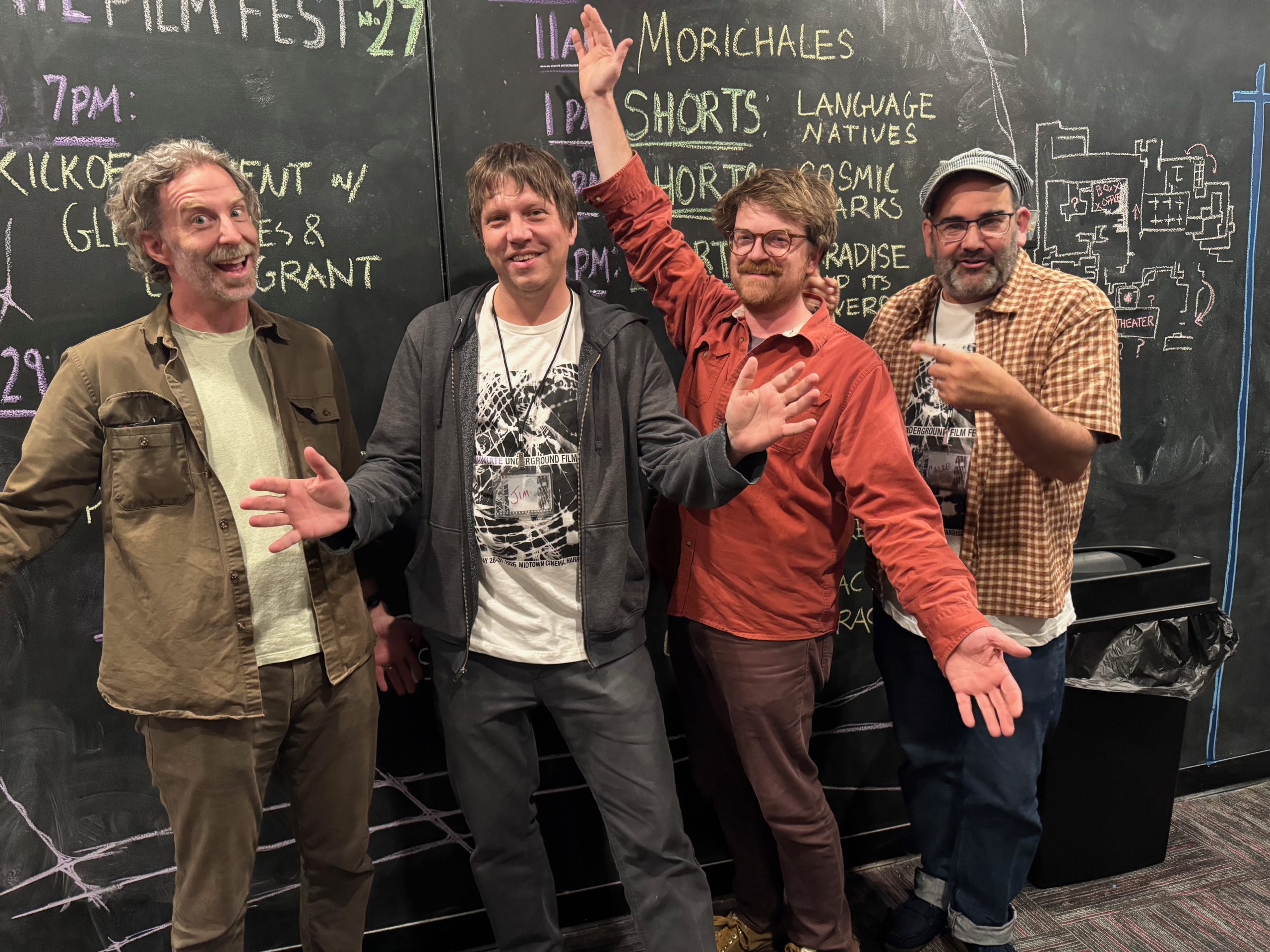
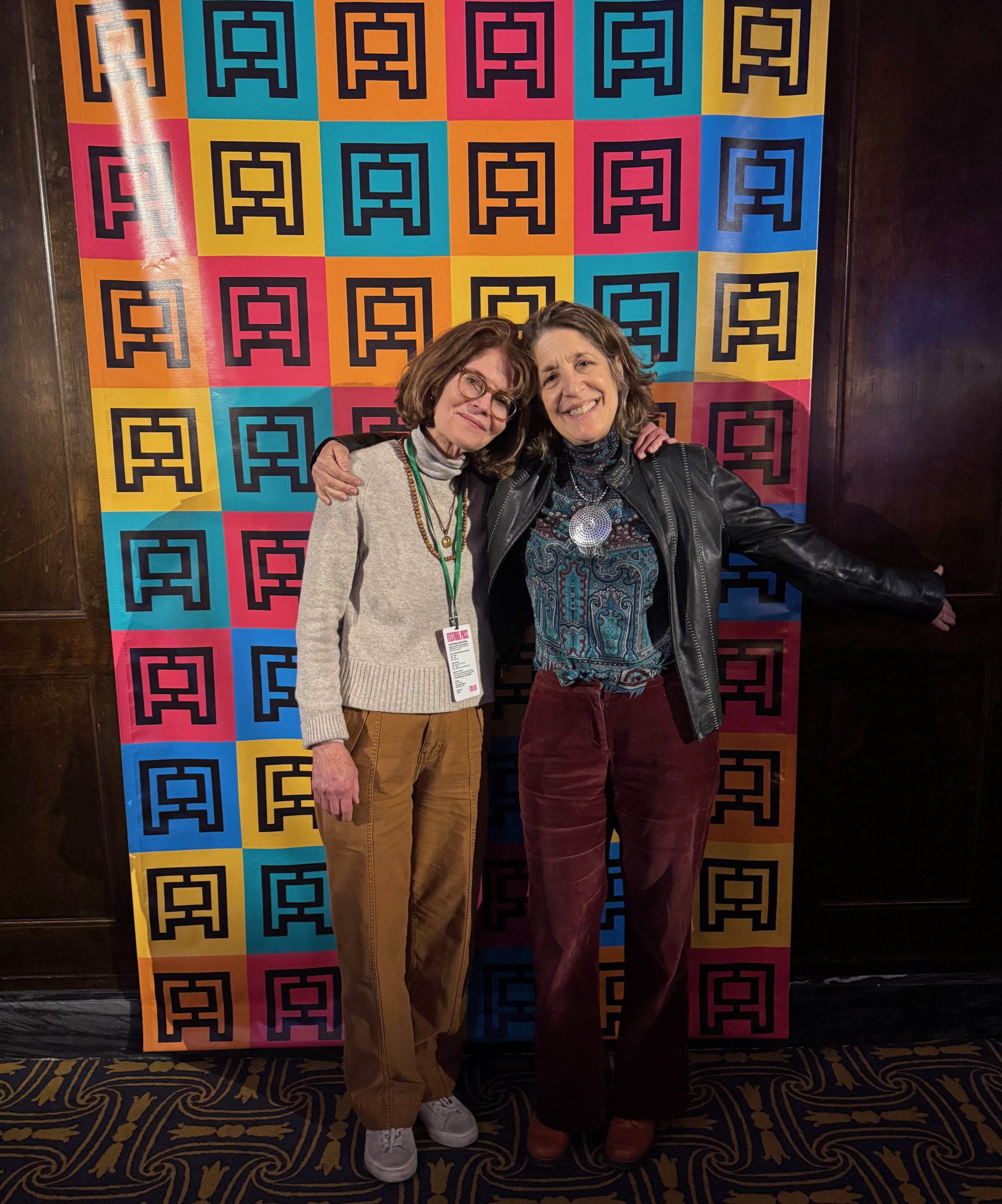
Mark Street and Lynne SachsJeremy Moss, Jim Hollenbaugh, Josh Drake, Caleb Smith
The Burg : Moviate Underground Film Festival to return to Harrisburg this weekend
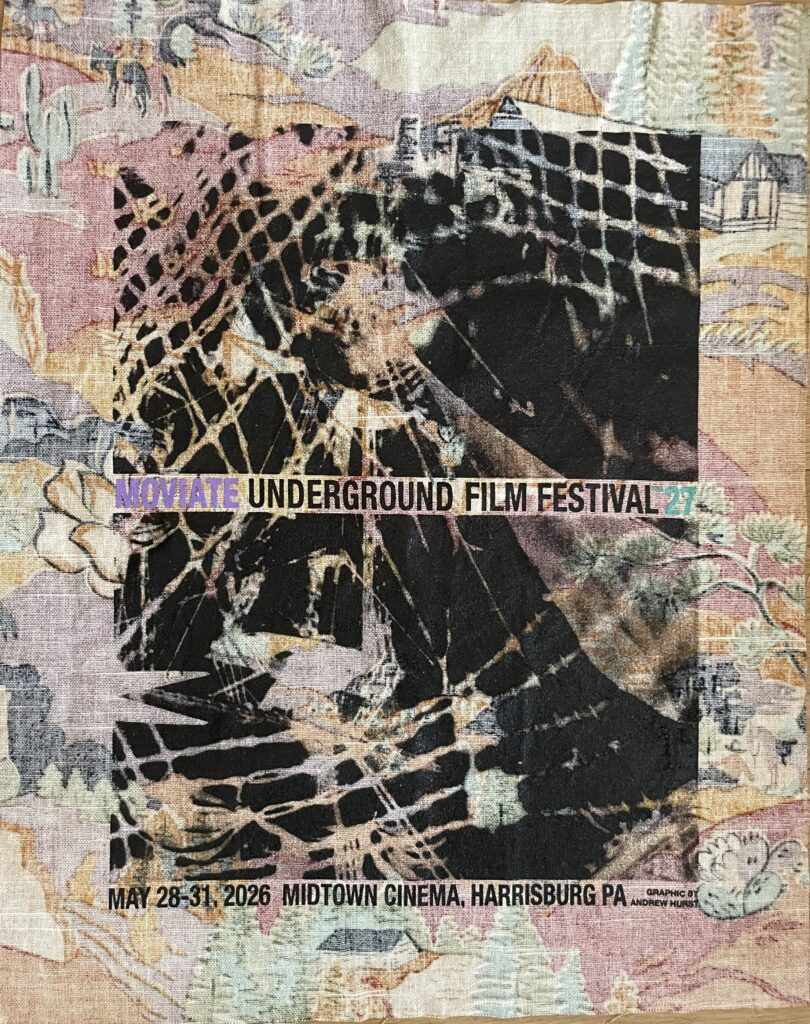
The 27th Annual Moviate Film Festival will take place on May 28 to 31 at Midtown Cinema and feature more than 60 films from 15 countries, with 13% of the movies being screened on real film.
Many of the selected films are new and classic documentaries. Caleb Smith, co-founder of Moviate highlighted several of the weekend’s showings as can’t miss events.
“You’re going to see someone’s personal creativity along with their vision, whether it’s a five-minute animation or a 90-minute documentary,” Smith said.
On Thursday, May 28, musicians Glenn Jones and Liam Grant will perform live original scores to two of their films, “The River” and “The Plow that Broke the Plains,” at 7 p.m. As they’ve been touring around the east coast, they will not be performing the original score to these films anywhere else but in here in Harrisburg, Smith noted.
The weekend continues Friday, May 29 with a 40th anniversary screening of the 1986 documentary “Heavy Metal Parking Lot,” featuring director Jeff Krulik in attendance. The screening is co-presented by local business Tattoo Punks.
“Jeff will present previously unseen footage, including interviews with the band Judas Priest related to the film,” Smith said.
On Saturday, May 30, Colombian filmmaker Chris Gude’s “Morichales” will screen in partnership with Harrisburg-based Elementary Coffee Co., whose coffee is largely sourced from Colombia.
“The film is a stunning portrait of the workers in Venezuela who are trying to mine for gold. It’s a really beautiful film,” Smith said.
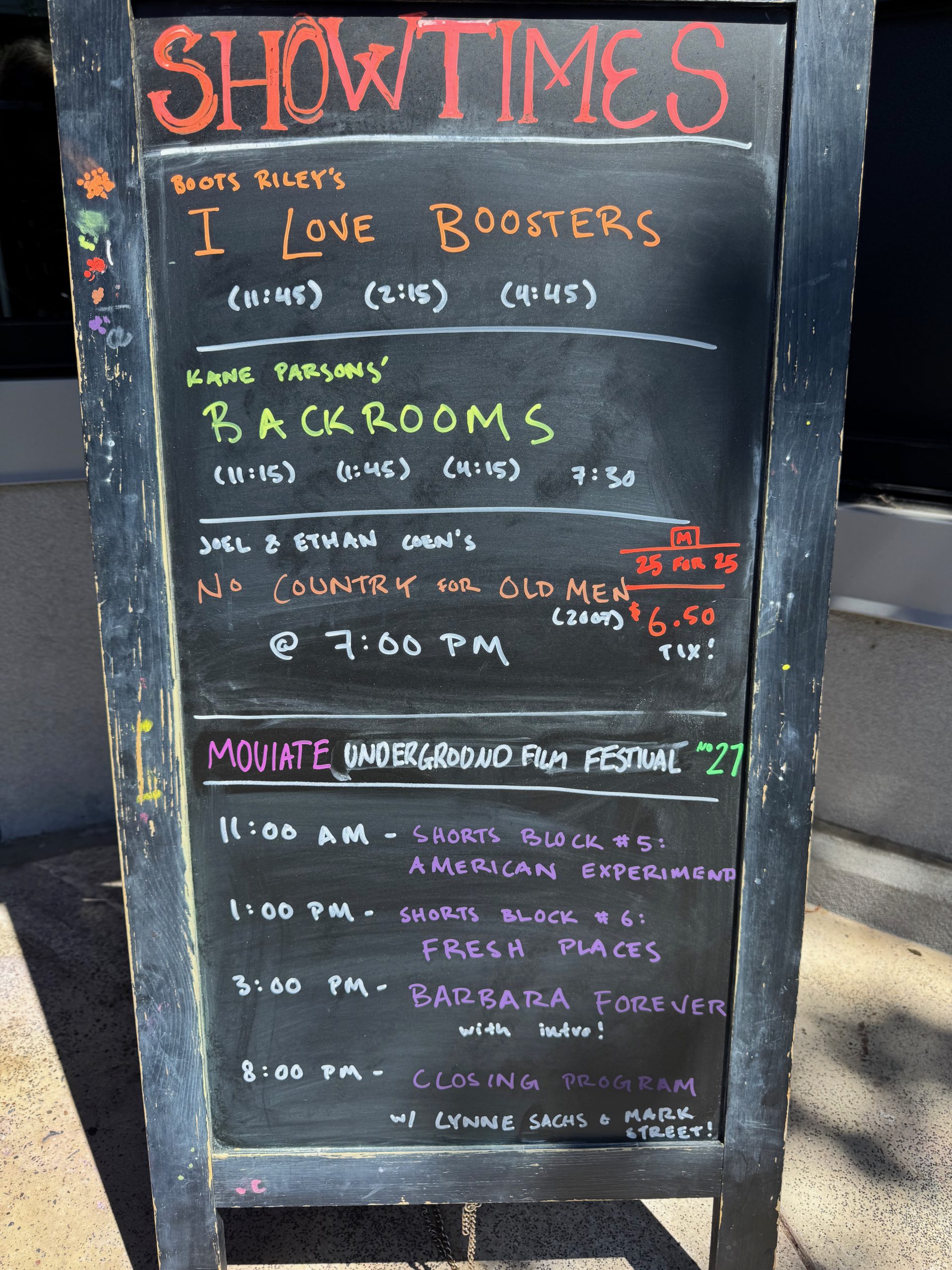
The festival concludes Sunday, May 31, with a screening of “Barbara Forever,” accompanied by New York City filmmakers Lynne Sachs and Mark Street in partnership with the LGBT Center of Central PA.
“Lynne and Mark worked with Barbara for many years and were close friends with her,” Smith said. “She was very enigmatic and creative and had documented a lot of her life as she was making films. This film just came out this year, so I’m excited that Lynne and Mark will introduce it.”
In addition to spotlighting unique indie films, Smith also sees the festival as an avenue for connection.
“With the emergence of artificial intelligence and the silo effect of people being on their phones, there’s a feeling of isolation. When you go to Midtown Cinema, you can meet other people, chat and experience the film together,” he said.
The Washing Society live performance with Rebecca Barten, Nina Fonoroff, Lynne Sachs, Beth Hansen, Alys Griego, & Melinda Kowalaska
When you drop off a bag of dirty laundry, who’s doing the washing and folding? The Washing Society brings us into New York City laundromats and the experiences of the people who work there by observing these disappearing neighborhood spaces and the continual, intimate labor that happens there. The juxtaposition of narrative and documentary elements in The Washing Society creates a dream-like, yet hyper-real portrayal of a day in the life of a laundry worker, both past and present.
Run of Show
Screening of “The Washing Society (Lizzie Olesker, Lynne Sachs, 45 min. 2018)
(HOUSE LIGHTS ON)
Lynne, Rebecca and Nina give small envelopes of lint from baskets to everyone after the film.
Prepare 3 scripts on clipboards by stage stairs of theater.
(HOUSE LIGHT OFF)
(01 IMAGE LINT)
(Rebecca lights Lynne from near stairs at stage R.)
P. 29
Lynne reads “Lint” Poem
Lint
Inside the machine
inverted colossal bags of upside-down families
children spin with bedridden grandparents
dog-mats hug the underside of workout pants
party blouses rub elbows with gardening jeans
aprons with chicken grease from bitter family fight
keys left in pockets
subway cards worth $45 (or maybe not)
underwear stained vaguely pink inside the sleeve of
blue striped button-down shirt
withered gym shorts nestled against a single sock
unwanted thread.
Salvage a twisted $50 bill so you can pay for a dinner
that ends up on a t-shirt under a fleece jacket
made from old tires and recycled plastic.
Fleece is not real,
who knew?
(IMAGE OFF.)
P. 19
(Lynne moves to center stage, holds book in front of her and reads.
Rebecca continues to light Lynne w/ flashlight.)
This is not a film. It is something else.
Call it a blueprint, a map, a documentation
of something that has already happened
but could happen again —
a rendering in book form of a performance.
Making a mark, words on a page instead of bodies in space.
A book that contains what’s remembered and what could be.
All of it written down and placed here, into this
Hand Book: A Manual.
(02 IMAGE KASEBIER PHOTO OF WASHERWOMAN)
(Lynne, Nina and Rebecca read in sequence. Enter stage R. Standing on stage blocking some of the image with our bodies. Backs to audience.)
P. 155 – 159
L: Questions on Black and White
N: We were looking for archival images of women washing.
We had researched the Atlanta washerwomen’s strike of 1881.
There were no photos of that strike —
R: Not in the Archive.
Nothing, in terms of images.
We’ve been told they don’t exist.
L: I was looking for some kind of visual documentation.
N: I accidentally came across a photo that I could not ignore when I looked up
“19th-century laundress” on the Internet.
This image came up.
(N, R, L sit on folding chairs stage right)
There she was.
Everywhere, at least when you were looking for her.
R: Unlike the washerwomen of 1881, you found her
in a lot of places.
L: I threw the image file into Google Images and found another caption with
a little more information: “Black and White: an informal portrait of a young
negro woman surrounded by laundry in Newport, Rhode Island.”
N: To me, it looks like it was taken with one of those large-format cameras and
a tripod.
R: The photographer was clearly a professional, or at least someone who
works in that way.
L: That’s what I imagine.
N: When I look at it closely, I feel the energy of the “moment.” The passage of
time.
I’m aware of the wind. Motion. Stillness.
R: The wind is important.
Even the sheet seems like it’s moving.
Look at the blur of the black stockings.
L: Photographs are taken. The subject is captured.
Framed.
N: This one’s owned by Getty Images and was taken by a woman named
Gertrude Kasebier.
R: I can’t find anything about her, the laundress, not even her name.
L: That’s not surprising.
N: It was taken just a few decades after Reconstruction, during the state sanctioned
trauma of Jim Crow.
R: It is a picture of a Black woman providing a service. She’s not hanging laundry
for herself. But I could be wrong.
L: Gertrude Kasebier is behind the camera. We are also white women holding
the camera…
N: … at or toward our subjects.
R: The “Woman Doing Laundry” is posing for the camera and performing.
The photograph may seem to have a kind of dignity, but at the same time
the question arises: for whom?
L: For whom is she performing? Why is she smiling?
N: What year was it?
R: 1902.
L: That’s over 120 years ago, and there she is. The camera seems to have caught
her in the middle of working. She’s literally bending down to take another
sheet to put on the clothesline.
N: She’s being interrupted.
BEAT – get up from chairs and stand
R: Are we looking at a staged moment or a so-called actual moment, a documentary
event?
L: There’s this gaze between the woman in the image and the photographer,
Gertrude.
N: I think the woman in the photo makes us aware of our own voyeurism.
R: Even our exploitation.
L: She says:
N: I dare you to think about me.
R: I dare you to synthesize me into your art.
L: I dare you to look back at me and to actually think about who you are
N: in relationship to me.
(Nina moves to center stage, Lynne and Rebecca to the sides.)
(Nina- precis of the movie):
This is Vincente Minnelli’s debut as a film director in 1943, Cabin in the Sky. Based on the Broadway musical, it depicts a couple, Joe and Petunia Jackson, who live in a rustic house in a small town in the southern US. In her song “Happiness is Just a Thing Called Joe,” taking down the wash features Petunia’s expression of love for her husband, despite his imperfections.
(03 FILM CABIN IN THE SKY dir. Vincent Minelli)
P. 163
(Lynne holding a copy of Hand Book.)
(Lit by flashlights held by Beth and Alys)
Cultural critic Stuart Hall came up with the term Reception Theory, for what we all do in the theater or in front of the TV.
A “text” — be it a book, movie, or other creative work — is not simply passively
accepted by the audience, but the reader/viewer interprets the meanings
of the text based on their individual cultural background and life experiences.
In essence, the meaning of a text is not inherent within the text itself,
but is created within the relationship between the text and the reader.
P. 167
Nina:
Ashon Crawley, a scholar of religious and African American studies and a visual artist, thinks a lot about a ‘possible otherwise.’ In his response after seeing “The Washing Society”, he wrote this question about repetition:
i wonder if the people you spoke with for the film ever talked about
what repetition makes possible? often, repetition — when discussed
in terms of certain kinds of labor — is talked about as having a negative
impact on the thought and imagination of the worker. but in music,
repetition is often considered to be a practice that allows for the flourishing
of deeply meditative, contemplative thought to emerge. so my
question was if the women ever talked about repetition as producing a
capacity for thought experience they’d not otherwise have? this is not to
celebrate conditions of poverty or exploitation in the political economy
but to ask what poverty and exploitation of the political economy continue
to fail to destroy. because what it fails to destroy is a gift.
P: 37
(Beth and Alys bring a folding table to the stage.
We can light them.
L, R, N light them with flashlights.
One basket of grey clothing which will be stage left, set on either side.
Nina and Lynne on stage.
Beth & Alys use flashlights. Dump clothing on either side.
Fold in whatever our spirit moves us. Rebecca watches us.
Rebecca reads instructions for Nina and Lynne)
R: “Score for a Folding Dance”
— Stand still at the table. Pull fabric with both hands from left
to center.
— Lay “fabric” at center of table. Fold again towards the center-right section
of the table.
— Work your way down and up with fingers as if buttoning a shirt in rapid
motion.
— Fold from right to left while gaze is facing the right side of the room.
— Flap, flip, and fold aimlessly. Fold up once towards the left side of the
Table.
Nina:
(04 FILM BALLET MECANIQUE with Washerwoman)
— Spin away. Land on the right side of the table and fold again with floppy
forearms.
— Leaning over the table, you flip hands over twice at the same time. Shake
large “fabric” and let it float across the table.
— Pause. Tap foot repeatedly looking towards the right side of the table
again . Tap fingers repeatedly on the table, still
looking towards the right side.
— Shake “fabric” and let it float down.
— Looking in various directions, fold repeatedly towards the right side of
the table .
— Hands hitting the table, getting louder with each fold. Make a small fold
on right side of table. Reach one arm towards the left side. Pull inward
towards the right side of the table.
— Hold. Fold “fabric” into a square. Repeat floppy forearm fold.
— Slam both hands on table four times
(Nina and Lynne slam both hands on table 4 X)
with a slight swoosh. Right arm rises as if about to spin — .
— Rhythm changes. Pat table. Pick up corners and fold quickly.
(Nina and Lynne fold sheet)
— Wrists loosely fold. Wipe lint off clothing and arms.
— Repeat — Look in various directions four times with more urgency.
— Torso and shoulders become more involved with folding. Heavier energy.
— Small folding gesture with hands. Flip hands three times towards the
left side of table.
— Large blanket floats over the table. Stretch “fabric” three times; fold
downwards and look away.
(Nina and Lynne billow the sheet in front of the Leger image. Enjoy the image on the sheet like a screen)
— Flip, flap, pick lint and flick it away. Start folding again.
(Nina and Lynne are done.)
(05 IMAGE SCORE FOR A FOLDING DANCE TEXT)
SILENCE 1 minute
The body spins over the table as if it is folding itself or embodying tumbling
clothes being thrown from a hamper basket. Internal sensations involving
elements of exhaustion, routine, and time are discovered. Intersperse
physical gestures like scratching and removing lint from a sleeve. The sequence
evolves. Everything becomes a part of the dance: the sound and
smell of the quarters, the metal, the doors slamming. The body is climbing,
sweating, folding, and slamming across the machines as if becoming
one. And then back to folding.
Nina:
In 1945, MGM studios released another film directed by Vincente Minnelli. Yolanda and the Thief is a musical fantasia where a dream ballet shows a man, played by Fred Astaire, who is afraid of entrapment by a group of laundresses. As one critic at the time wrote, the film is “not for realists.”
(06 FILM YOLANDA AND THE THIEF by Vincent Minelli )
P. 25
L, N & R read list of laundromats in a round in dark. Only books are lit with clip lights. We are in various places in room, spread out.
(TBA)
Change dynamics sometimes.
Chan Laundromat
Happy Laundromat
Chee & Yun Laundromat
Kang Wei Laundromat
Evergreen Laundromat
Sun & Moon Laundromat
Lams Laundromat
Goody Laundromat & Dry Cleaners
Zheng Laundromat
Nice Laundromat & Dry Clean
New Lucky Laundromat
Super Suds Laundromat
Gentle Wash Laundromat
(07 FILM CHESS OF THE WIND by Mohammad Reza Aslani – clips of women washing 4 min.)
Q & A with audience in Guild Theater
(Audience is invited to purchase HAND BOOK: A MANUAL ON PERFORMANCE, PROCESS AND THE LABOR OF LAUNDRY AT MERCH TABLE FOR $15. All proceeds go to Experiments in Cinema.)
Contact—so tactile, so evocative of the touch of one person on another, physically and emotionally. Trace—a way to get back to an earlier point and a reckoning with the remains of that initial encounter. Filmmaker Lynne Sachs has saved every business card anyone has ever given her. After 40 years of collecting, she recognizes their mnemonic powers. With 600 cards in her grasp, Sachs contemplates the impact of these haptic exchanges. In both real and imagined ways, her essay teases apart their vivid resonances, entwining personal memory with geopolitical history through visual abstraction, music, and a poet’s sense of introspection.
“We bring films, filmmakers, and audiences together in a friendly, inclusive atmosphere that reflects the unique aspects of our community, while participating in and adding to the larger film dialogue across the country and across the world. Film for Everyone.”
The latest cinematic adventures of some of the most original filmmakers of our time. Signed celebrates those with a unique artistic signature, beyond the canon.
Synopsis
Since 1990, filmmaker Lynne Sachs has collected 600 business cards—from a hairdresser, a therapist, a textile artist. Together they form an archive of encounters. The title of this imaginative essay film, Every Contact Leaves a Trace, is a basic principle of forensic science, coined by Edmond Locard, a pioneer in the field. And any trace can link a person to a place, another person or an object. If that’s true, Sachs wonders, might every personal encounter not also leave a trace on your being?
To find out, she tracks down some of the people behind the business cards. The thread connecting these hundreds of cards is Sachs herself, so the filmmaker naturally becomes the center of the film. Yet the focus is not on her; as in many of her works spanning more than three decades of film making, she merely provides the perspective—the point of departure.
With her warm, contemplative voice-over and playful visual invention, Sachs weaves countless faces and voices into a patchwork of connections. These encounters—whether forgotten or remembered, faint or vivid—have become part of her being.
Date
Location
Activities
Mon 17 Nov 18:00
Eye: Cinema 2
Welcome & Introduction, Thank you moment
Tue 18 Nov 13:30
Tuschinski 4
Welcome & Introduction, Q&A
Thu 20 Nov 21:15
Pathé City 4
Welcome & Introduction, Q&A
Fri 21 Nov 11:30
Kriterion 1
Welcome & Introduction, Q&A
Sat 22 Nov 21:00
Pathé Noord 11
Welcome & Introduction, Q&A
Lynne with María Campaña Ramia, IDFA programmer
Emily Pack, Stephen Vitiello,
Morteza Ahmadvand, Firouzeh Khosrovani
with Betty Leacraft
Tuschinski Theater
Ana Siqueira
Zyanya Castilla, Maria Vera
Rijsttafel
María Campaña Ramia
Zyanya Castilla, Paula Durinova, Aylin Kuryel, Firat Yucel, Maria Vera
Yang Yang, Jilu Commune
Zyanya Castilla, Maria Vera
Every Contact Leaves a Trace Business Card
with Emily Packer
Johnny White
Lynne with Jay Rosenblatt, Firouzeh Khosrovani, Isabel Fernandez, Mohammadreza Farzad
The Barcelona Independent Film Festival, l’Alternativa, is now in its 31st edition. For over three decades we have been offering filmgoers and professionals a unique opportunity to discover and enjoy screenings and activities that value creative freedom, diversity, innovation, commitment and thought-provoking reflection.
This year we will once again be running a hybrid edition: onsite screenings and activities from 14 to 24 November 2024 plus a selection of films from the 31st edition available on Filmin during our online fortnight in January 2025.
L’Alternativa has three competition sections in l’Alternativa Official: Spanish Films, International Feature Films and International Short Films.
L’Alternativa Parallel presents tributes, premieres, little-known films, work by new directors and a programme of family screenings.
And l’Alternativa Hall offers a rich, varied programme of free screenings, performances and debates in the CCCB Hall.
Hall Selects is a bridge between l’Alternativa Official and l’Alternativa Hall. Whittling down the many entries we receive for the official sections is a painstaking process designed to produce a final selection that showcases a wide range of striking films that reflect the spirit of the festival. Here we open up a space in which we can share an additional selection of impressive films and offer the Hall audience the chance to engage directly with the filmmakers and others members of the creative and artistic teams.
Hall Selects Tuesday 19 November, 6 pm, Hall CCCB, 111 min
Presented by Jorge Moneo, Patxi Burillo and Tamara García
Madwomen in the Attic Tamara García Iglesias
Contractions Lynne Sachs
Nafura Paul Heintz, Witt Anne-Catherine, Witt Anne-Catherine
Exergo Jorge Moneo Quintana
Year and Time Patxi Burillo Nuin, Proyecto Landarte Urroz
The program includes short films from Portugal, Poland, South Korea, Japan, Singapore, Brazil, China, Croatia, and the United States. From a lockdown love story, Gen Z manifesto against patriarchal norms, to a sharp social commentary on gender struggles. The length of the film demonstrates an attitude, from there extends a myriad of different universes.
What’s softest in the world rushes and runs over what’s hardest in the world. Singapore|2024|DCP|color|15min
My First Funeral South Korea|2023|DCP|color|38min
Such Miracles Do Happen Poland|2023|DCP|color|14min
VALERIJA Croatia|2023|DCP|color|16min
Quebrante Brazil|2024|DCP|color|23min
Contractions USA|2024|DCP|color|13min
Postcards from the Verge Poland|2023|DCP|color|40min
Those Who Loved Me Japan|2024|DCP|color|15min
Myself When I Am Real USA|2024|DCP|color|18min
A Message from the Co-Curator of the Festival
Thank you for your powerful work! It reminded me of how a work of art is really a dialogue with the contemporary and is a voice of resistance:
“The four shorts tonight shared unique perspectives on the relationships between women/human kind and the body, time, history, and even the universe.
Unlike some of Lynne’s other works, with fluid space and poetics, in Contractions, we are hit with testimonies, plain and clear, combined with a visual and audio experience just as direct, about the predicaments of women and the medical system in Tennessee since June 24, 2022.
I noticed that in the beginning of the film, there is deep breathing sound. Then we see an open sky so blue and suffocating, with the voices of women, about the restrictions on women’s rights, on their bodies, and on what they can imagine about their own lives.
Lynne’s works are very charismatic with her organic, empathetic, and breathing-like camera eye. In Contractions, the camera is static or moves very slowly. It has a sense of control and horror, but at the same time, the static shots become a steadfast and unwavering gaze; steadfast and unwavering, like those women that are “standing still” in the film, some alone, some leaning on each other.
I am truly touched by those strong women that continue to help each other despite the danger, and refuse to take it as it is. And it is strangely cathartic to hear the additional audio piece We Continue to Speak, knowing that we are all shaken with anger and we will continue to fight!
Otherhood | Deborah Stratman Mother and child confront the other. Meanwhile, some ladies are thinking.
Retracing Our Steps | Kelly Gallagher A woman reflects back on her time spent assisting abortion seekers when Roe v. Wade was law of the land in the US.
Contractions | Lynne Sachs What happens when women and other who gestate no longer have control of their bodies? In 2022, the U.S. Supreme Court ended a woman’s right to a safe and legal abortion in the United States. “Contractions” takes us to Memphis, Tennessee where we contemplate the discontinuation of abortion services at a women’s health clinic. We listen to an obstetrician and a reproductive rights activist who movingly lay out these vital issues. We watch 14 women and their male allies who witness and perform with their backs to the camera. In a place where a woman can no longer make decisions about her own body, they “speak” with the full force of their collective presence.
We Continue To Speak | Lynne Sachs In this sound collage Filmmaker Lynne Sachs records the participants and producers of her film Contractions as they vocalize their reactions to the reduction of women’s bodily autonomy in the United States.
Patient | Lori Felker Fiction, reality, the private, and the performed overlap on a routine but emotional day at a medical center.
What Went Down | Danièle Wilmouth Beauty is pain – at least in the world of Dance. WHAT WENT DOWN takes a humorous and irreverent approach to unpacking ideas of suffering in pursuit of physical virtuosity. A collaboration between choreographer Peter Carpenter and filmmaker Danièle Wilmouth, WHAT WENT DOWN features a group of middle-aged dancers who navigate the tense relationship between their chronically injured bodies and the barked orders of an uncompromising film director. Exposing the strenuous labor of the cinematic process both in front of and behind the camera, WHAT WENT DOWN devolves from constant action to profound inaction… all for you!
Ashes of Roses | Sasha Waters This movie is about loving things that are embarrassing and people who are inappropriate. It’s an essay film reflection on popular trash.
I Was There (Part 1) | Chi Jang Yin “I Was There” is a trilogy of experimental documentary films that explores the problem of radiation, our society’s fading collective memory of the atomic bombing of Hiroshima and Nagasaki, and the unresolved debate between ethics and science. These series concern the immediate effects of weaponized nuclear technology, as invisible poison, on the human body. Meditating on the survivor’s memories, “I Was There” (Part I) traces the experience of a physician for the past 70 years, who recounted his day as a rare witness when the atomic bomb was dropped in Hiroshima. The poignant and thought-provoking evidence of the secret war tactics reveals the human value during times of war in conflicts. Saving American lives is the commonly known and acceptable narrative of why the United States government dropped the first atomic bomb on Hiroshima. However, this narrative contradicts the finding in personal and petitions letters, and arsenal photography housed at the Truman Presidential Museum. The evidence uncovers a rather surprising reason for testing the atomic bomb on humans – competing for war power against Russia and securing the US dominant role in global politics.
Five films that take us into diverse worlds, persuading us to question our perceptions and to see the world more humanely. These films transform our perspectives on what constitutes identity, how we build resilience against adversities, and how we seek to heal our traumas.
Adura Baba Mi | Juliana Kasumu | 15′ Intimate recollections by the filmmaker’s father, a religious leader within the Celestial Church of Christ, and the filmmaker’s mother, his once devoted wife.
A Body Called Life | Spencer MacDonald | 15′ A self-isolated young human known delves into the hidden world of microscopic organisms, forging a tender connection with these nearly invisible creatures and developing a massive online following, as he seeks to understand his own place in the cosmos and accept the scars of his past.
Contractions | Lynne Sachs | 14′ Intimate confessions, paired with experimental choreography outside a woman’s clinic in Memphis, offer a glimpse into the end of safe and legal abortion access in the US.
Familia 💖💎 | Picho García and Gabriela Pena | 19′ With the help of his friends, Picho coordinates through WhatsApp to get a profile picture that represents him. Meanwhile, there’s a crisis on the family WhatsApp chat: the demand to be present during the dizzying loss of autonomy of his grandfather, the patriarch of the family. Between missed calls, bombardment of images, emojis and stickers, we access the digital intimacy of a young man conflicted with the expectations of others and his own.
One Night at Babes | Angelo Madsen Minax | 29′ At Babes Bar Cribbage tournaments overlap with afternoons of karaoke and nights of raucous queer dance parties. When the aging rural townsfolk of Bethel, Vermont and the younger queer leftists begin sharing the same watering hole, delicate lines of communication open, but not without some drama.
You can’t get what you want but you can get me | Samira Elagoz and Z Walsh | 13′ An intimate slideshow chronicling how two trans masculine artists fall madly in love. From their initial meeting to traveling across continents, viewers witness their intimate moments, long-distance relationship, and transformative top surgery.
Camden International Film Festival Unveils Politically Packed 2024 Lineup (EXCLUSIVE)
The 20th edition of the Camden Intl. Film Festival, kicking off Sept. 12, features a lineup full of political, hot button documentaries fresh off showings at Toronto, Venice and Telluride. The Maine-based film festival will unfold in a hybrid format, with both in-person events over a four-day period concluding Sept. 15, and online screenings available from Sept. 16 to Sept. 30 for audiences across the U.S.