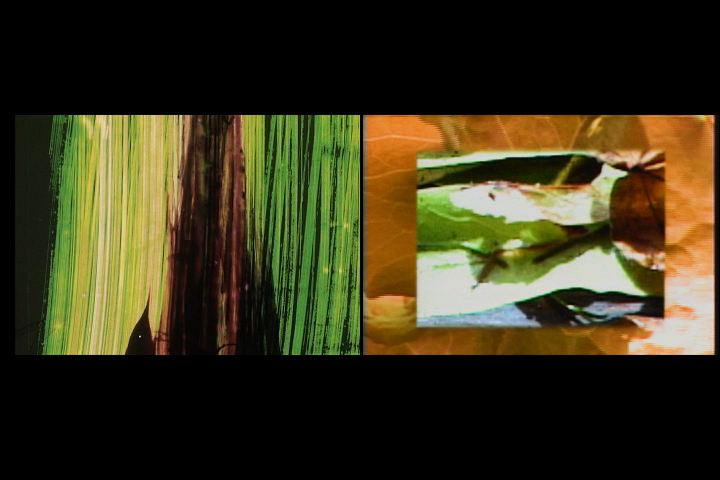
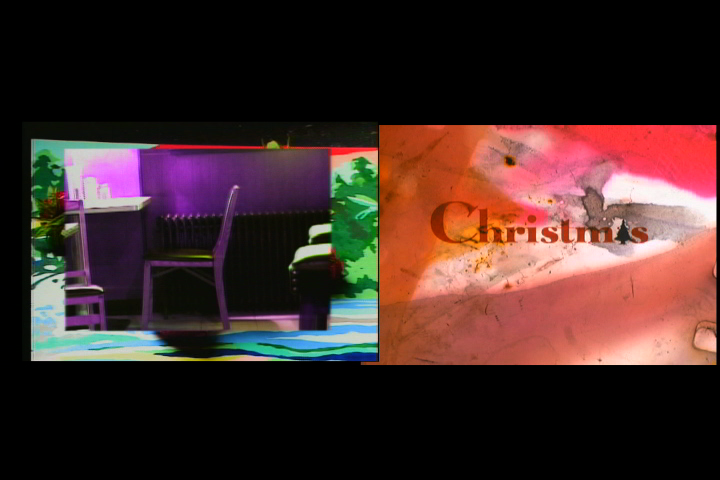
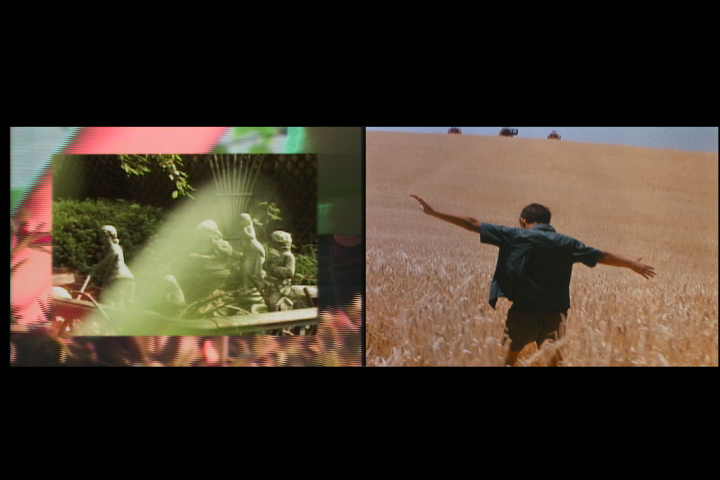
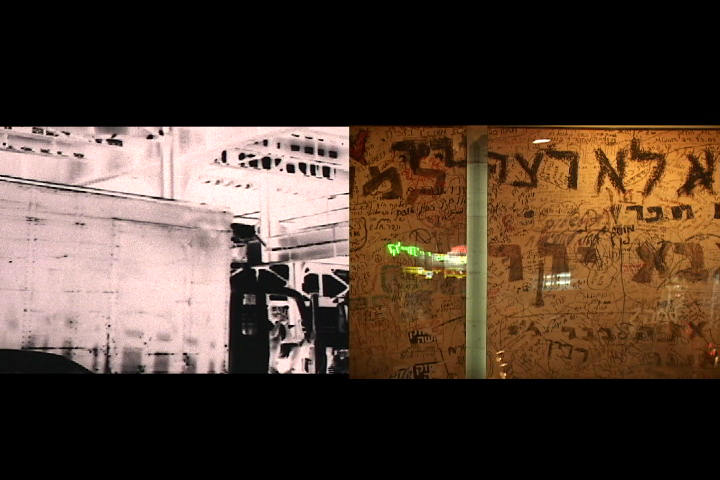
The X Y Chromosome Project is the creation of artists Lynne Sachs and Mark Street. We make films and performances that use the split screen to cleave the primordial and the mediated. After returning from an inspiring week-long artist retreat at the Experimental Television Center, Lynne asked Mark to collaborate with her on the creation of a piece in which they would each ruminate on the other’s visuals, reacting in a visceral way to what the other person had hurled on the screen. Lynne would edit; Mark would edit. Back and forth and always forward. No regrets or over-thinking. In this way, the diptych structure is sometimes a boxing match and other times a pas de deux. Newsreel footage of Ronald Reagan’s assassination attempt is brushed up against hand painted film, domestic spaces, and Christmas movie trailers. Together, we move from surface to depth and back again without even feeling the bends.
Lynne and Mark live in Brooklyn and have two daughters, Maya and Noa Street-Sachs.
In 2010, Mark Street and Lynne Sachs created The XY Chromosome Project an umbrella for their collaborative ventures. Together they have produced an array of collaborative installations, performances, and two-dimensional art works.
“The XY Chromosome Project follows the career paths of Lynne Sachs and Mark Street. To follow this path is to trace a blueprint on devotion. Working both together and individually for the past 30 years, each artist has carved out their own niche without the obvious influences of being married. They part ways to be left alone to their own creations. It is the respect for the other’s work that bonds them. Left alone, their work could not be more different. Lynne’s work is cerebral and emotional. As seen in her full length films “Your Day is My Night” and “Tip of My Tongue”. She collages the art of storytelling by layering stunning visuals while swimming between reality and performance. Mark is the experimental film hero, a pioneer in film manipulation, an encyclopedia in the world of experimental films. His film work is solely connected to what is possible in the organics of film manipulation. They celebrate experimentation in its truest form. Yet both come down on the same line when it matters most. The line of captivation which as any artist knows is the hardest to achieve.” (Stephen Lipuma, Court Tree Gallery)
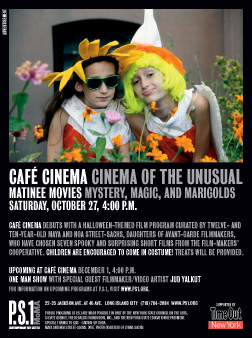
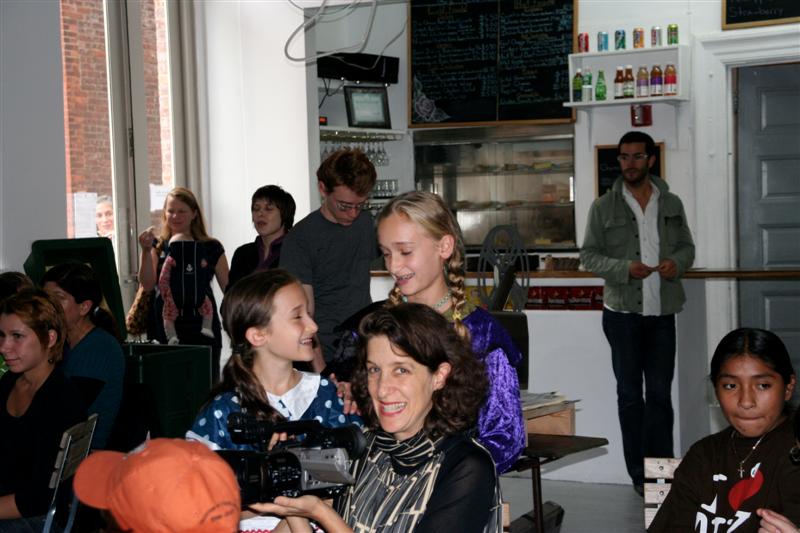
Matinee Movies: Mystery, Magic and Marigolds.
Films Selected by and for Kids!!
Curated and Hosted by Maya and Noa Street-Sachs
Sat., October 27th, 2007 at 4pm
We are thrilled to put together a program of Film-Makers’ Cooperative movies that will wow, tickle, spook and surprise a matinee audience of boys and girls who may or may not have ever encountered the splendor of the avant-garde cinema.
Gulls and Buoys (1972) by Robert Breer – 8 minutes
It reminds us of a flipbook with fabulous drawings of nature.
The Red Book (1994) by Janie Geiser – 10 minutes
Spectacular animated cut-outs with lots of color and mysterious images of hands, books, keys and doors.
Little Red Riding Hood (1978) by Red Grooms – 16 minutes
Elaborate costumes and colorful, dramatic scenes with a scary wolf and a nice little girl in red.
Earth Song of the Crickets (1999) by Stan Brakhage – Silent – 3 minutes
Dancing handpainted abstraction with a magical sparkle.
Fragment of an Unidentified Horror Show (1993) by Danny Woodruff – 2 minutes
A creepy weirdo comes across a skeleton in this suspensful masterpiece.
Evil of Dracula (1998) by Martha Colburn – 2 minutes
An animated movie of happy faces with long pointy teeth.
Moshulu Holiday (1966) by George Kuchar – 9 minutes
Set in the Bronx, with hilarious scenes of city life. You’re gonna love the ending.
Maya and Noa are 12 and 10 years old and have grown up in Brooklyn watching avant-garde films with their artist parents – Mark Street and Lynne Sachs.
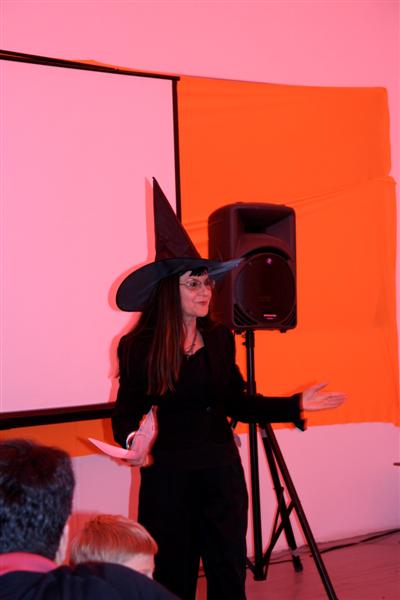
Program organized by M.M. Serra as part of an ongoing series titled “Cafe Cinema: Cinema of the Unusal”.
where: Anthology Film Archives (32 2nd Ave, 212.505.5181)
A reverie of war-torn terrains floats silently across an editing screen, accompanied by long-distance calls between an American journalist and a beleaguered Israeli. Children play in front of a television rolling out images of oddly abstracted battlegrounds. Herein lies the world of director Lynne Sachs, whose films splinter the typical structure of social-issue documentaries, applying an avant-garde sensibility to harsh realities that usually inspire stultifying over-earnestness. In this three-night series of screenings and talks about Sachs’ decade-long appraisal of war, what emerges most is that rare political filmmaker whose forms prove as worthy as her function. – LR
————————————————————————————————
GAY CITY NEWS
01/25/2007
“Committed Poetics”
By: IOANNIS MOOKAS
For those who aren’t heading to the anti-war march in D.C. this weekend, Anthology Film Archives wouldn’t a bad place to pool some progressive bonhomie. Across three intimate evenings Brooklyn-based avant-documentarian Lynne Sachs presents her lapidary meditations on modern history, political strife, and moral engagement.
A staple of Gotham’s experimental scene, Sachs in recent months has been touring a set of featurettes plus shorts to numerous venues under the rubric “I Am Not a War Photographer,” besides helping organize the “For Life, Against the War” film happening at Collective Unconscious and shepherding a scholarly project charting the intersections of documentary and avant-garde film. Part of Sachs’ appeal as an artist is her collaborative orientation, co-authoring films with family or former students, and mobilizing teams of cultural activists for ad hoc initiatives.
Anthology’s series opens with a double bill of “Which Way Is East,” recording a journey to Viet Nam, with “Investigation of a Flame,” a remembrance of the Catonsville Nine, a group of American Catholics who memorably protested the U.S. war on Viet Nam. Impressionistic and at times diffuse, “Which Way Is East” is a minor work valuable autobiographically for considering the influence of Sachs’ former mentor Trinh T. Minh-Ha, but also for a possible submerged link with “The Delta,” the first feature by Sachs’ brother Ira, made close to the same time and involving a tormented half-Vietnamese character.
“Which Way Is East” gains from its pairing with “Investigation of a Flame,” a more cogent work that shows the filmmaker’s subject and her artistic approach to good effect. In the world-rocking month of May 1968, the seven men and two women who comprised the Catonsville Nine barged into a Maryland draft board office, seized scores of draft records, and on the lawn outside, incinerated the heap with homemade napalm, mixed from the army’s own manuals. As cameramen shot the black-and-white footage Sachs weaves into her film, the dignified radicals shared words of resistance and simply waited for the fuzz to show up.
Sachs takes this performative civil disobedience and refracts it through present-day interviews, not only with the Nine but also the indignant government secretary whose office they rifled and ordinary Catonsville townsfolk of varied sympathies. Gently the film broaches the price for this act of defiance-months in federal prison for most, and for one, years spent underground, evading her sentence. But for Daniel and Philip Berrigan, among other survivors, that flame still dances even in their winter years. The film succeeds in making the group’s valor palpable, and their example genuinely stirring.
The final program on Sunday presents “States of UnBelonging,” Sachs’ most recent long work, and perhaps her best to date. Like Capote called to Kansas by a chance item in the Times, Sachs discovers her subject reading the newspaper, when she notices a November 2002 report on Revital Ohayon, a young mother slain with her two sons by a Palestinian assailant on a kibbutz in northern Israel. Without delay, Sachs is emailing and phoning her former student Nir Zats, an Israeli citizen, recruiting him as proxy and assigning him to learn everything about Ohayon, her family, and circumstances of the murders.
Like Sachs, Ohayon was a filmmaker, a mother of two, a wife, middle class, Ashkenazi, independent of mind, liberal of outlook, and in the flower of life at the moment of her killing. Yet Sachs quickly pushes beyond facile recognition, interrogating her own desire to see, to know, with questions about the responsibility of undertaking to reconstruct Ohayon’s life and of attempting to address its social contexts from half a world away. At length Ohayon’s husband, brother, and mother enter the film, adding complex and surprisingly unsentimental shadings. Her mother tells how Revital deplored the Palestinians’ dispossession; her brother implies her move to the kibbutz, hard by the Green Line, expressed a willful, imprudent idealism.
After much vacillating, Sachs books her first-ever trip to Israel and meets Ohayon’s widower Avi in person. Well before that point, however, Sachs brings the war back home, pasting unsettling images onto the TV screen in her Brooklyn living room, where her daughters play. Once tuned in, the conflict won’t be tuned out-they can channel-surf for days, but the palimpsest of “other” families destroyed by war haunts the bohemian sanctuary. We come to realize that, in a sense, these images and their corresponding realities have been there all along, waiting to be perceived.
The documentary can trace its history back to the very beginning of cinema, and its more than a century of existence has taken many forms. In the past 25 years there has been a very fruitful intersection between documentary and the diary film favored by many experimental filmmakers. Although Ross McElwee is probably the best-known practitioner of this hybrid, he’s far from the only director working this field. Lynne Sachs, whose recent works are on display at Anthology Film Archives January 26-28, is one of the most capable of these filmmakers, although even less of a household name than McElwee.
Sachs’s name may be familiar to Jewish Week readers. The DVD containing her “A Biography of Lilith” was reviewed here a couple of years ago and her most recent film, “States of UnBelonging” was one of the most overlooked films of 2006. That film, a powerful rumination on the Israeli-Palestinian conflict, is the final film in the Anthology series.
Ravital Ohayon was a promising young filmmaker and mother of two, living in a kibbutz on the border of the West Bank. One night a single terrorist came into her home and, while her husband listened in horror on the other end of the phone, shot all three. That incident is the jumping-off point for “States of UnBelonging,” an unconventional meditation on terror, family, Israel’s security barrier and the Middle East. Structured as a dialogue between Sachs (in Brooklyn) and Nir Zats, an Israeli filmmaker and former student of hers, this haunting hour-long film traces the aftermath of Ohayon’s death, the reactions of her husband, brother and mother, and the developments in Israeli politics in the three years since.
“It’s a film about being caught in the vortex of war,” Sachs said last fall. “It’s my fourth film about the connection between war and the creative process. I didn’t intend to make four of these but it happens.” Unfortunately, war happens, so the subject keeps coming back. But creation happens too and, as Sachs notes, “States” is also about “what is it to be a mother and an artist and a teacher.” The result is surprisingly beautiful, like the embattled countryside it depicts.
Not surprisingly, the title of the Anthology series, “I Am Not a War Photographer,” addresses Sachs’s ambivalence quite directly. The other films in the series take us to contemporary Vietnam and revisit the anti-war movement and offer a grim look at the civil war in the former Yugoslavia. Perhaps the most interesting work in the program is a series of short studies for Sachs’s next major project, retelling the story of her Hungarian cousin, Sandor Lenard, who survived the Second World War, served as an anthropologist with the US Army’s Graves Registry unit and finally fled to the jungles of Brazil.
War, creativity, beauty — it’s a depressingly frequent concatenation, but Sachs makes it sing without glorifying death, and that is what makes her films so compelling.
“I Am Not a War Photographer: Films of Lynne Sachs” will be presented at Anthology Film Archives (32 Second Avenue at 2nd St.) Friday, January 26 – Sunday, January 28 at 7:30 p.m. Sachs will present all three nights to introduce and discuss the films. For information, phone 212-505-5181 or go to www.anthologyfilmarchives.org .
————————————————————————–
Stuart Klawans Review in The Nation of I AM NOT A WAR PHOTOGRAPHER
The Sachs series, titled “I Am Not a War Photographer,” runs January 26-28 and focuses on her meditative, essayistic films about armed conflict: in Israel and Palestine, in the former Yugoslavia and in Vietnam. Among the works to be shown are States of Unbelonging (made in collaboration with Nir Zats), an uneasy exchange of video-letters about murder, mourning and filmmaking on the edge of the
West Bank; Which Way Is East (made in collaboration with Dana Sachs), an expressively beautiful diary of a trip from Ho Chi Minh City to Hanoi; and Investigation of a Flame, a montage of interviews, archival footage and symbolic imagery that gives density and weight to contemporary recollections of 1968 and the Catonsville Nine protest, in which antiwar activists seized and burned Selective Service records.
When did you first realized that yourself (your presence, your being) couldn’t really take distance from what you were doing?(When did you first realize that you couldn’t really be distant— either your presence or your being – from what you were doing?)
When I look back on my twenty years of filmmaking, I realize that no matter what subject, theme or idea that I am exploring, I somehow leave my fingerprint on the final work.Since I got my start in cinema with 16mm, I had many years of tactility.My skin touched, call it embraced, every frame of film, thus forcing me to examine the frozen moment of 1/24 of a second on a sometimes painfully regular basis.So, on a physical level, I had an intimacy with the filmmaking process that didn’t seem so very far from my prior experience with painting or sculpture.
I am a maker; therefore, I always feel connected to both the process and the final product I am attempting to create.I made “The Tarot”, my very first film, in 1983 at the age of 22 with my best friend starring in a live-action Super 8 animation of a young woman metamorphosizing into various possibilities of herself.The autobiographical aspects to this film were unfortunately too overt, which turned my initial foray into filmmaking into a kind of torturous self-examination of my future.My second film, “Still Life with Woman and Four Objects” (1986), also used a non-professional actress friend playing different fragments of my life, but in this case the exploration was far more elliptical, mysterious and, I believe, thought provoking.Within those few years, I’d seen the mind-blowing cinematic portrait movies of Jean-Luc Godard (“Vivre Sa Vie”) and Chantal Ackerman (“Jeanne Dielman, 23 Quai du Commerce, 1080 Bruxelles”), and there was no going back.
How do you control that presence on frame, on voiceover? I mean, there are times when you restrain yourself from doing or saying something in front of the camera or you embrace it all the way? How this decisions (“improvisation vs. ideas”) affect the final aspect (structure) of your work?(How do you control the presence of a voiceover?I mean, there are times when you restrain yourself from doing or saying something in front of the camera or your embrace it all the way. How does the decision between improvisation and idea affect the final structure of your work?)
I love playing with words, seeing where the actual act of putting thoughts together will take my discursive approach to film collage.Most of my longer films grapple with the intricate relationship between personal experience and broader, political, historical or social realities.I believe that the aural texture of a filmmaker’s actual voice (versus the anonymous voice we usually hear in more traditional documentaries) brings a compelling and immediate connection between the maker and his or her audience.My voice can never be omniscient and this structural limitation allows me to exist in my films more like a character and an author at the same time.In my decade-long series of films entitled I AM NOT A WAR PHOTOGRAPHER, most of the work uses the trope of first person cinema as an invitation into my mind and an admission of vulnerability.I am absolutely convinced that keeping a diary from the first day I begin a film gives me access to the naïveté of my own ignorance.By returning to this writing, I often discover narrative epiphanies that become extraordinarily useful to the search for a cinematic structure.I am able to recollect a time in which I did not know so much, and this in turn becomes critical to my identification with my audience.
Why do you think there are still lots of people (even those related to film) that don’t feel very comfortable watching -thinking and understanding- works that go in categories as “essay film”, “personal documentary”? That whole argument against things that are “subjective” and “ambiguous”…(Why do you think there are still lots of people— even those connected to film – who don’t feel very comfortable watching and thinking about works in the category of a “film essay” or personal documentary?That whole argument against things that are subjective and ambiguous?)
Oh my goodness!You are really getting at the very crux of my position as a filmmaker with a foot in two very distinct, even opposing, filmmaking communities. I identify with both the experimental and the documentary approaches to working with sound and images, and yet I feel profoundly uncomfortable placing myself exclusively in one camp or another.Many experimental films are breathtakingly beautiful but they do not attempt to tackle the conceptual rigour that would take them to another plane of artistic thinking.Most conventional documentaries are completely subject-driven, never allowing for visual metaphor, aesthetic invention or, as you say, ambiguity (the moment when a viewer get a little more power of interpretation!).It’s as if the filmmaker never considered the fantastic possibilities for expression right there inside the lens of his or her camera.For all of these reasons, when I discovered the work of Dziga Vertov (the first to coin the phrase “camera as pen”), Chris Marker and Trinh T.Min-ha (a teacher in graduate school), I moved to a new strata of visual expression we all call the film-essay.Yes, there are those in the film avant-garde who will always resist using words.Yes, there are those in documentary who feel no urge to “get personal”, but for a few of us this is the territory where we thrive.
What have you learn (if anything) from getting yourself (your point of view, your family, your home and daily activities) in your work and in front of the camera? (What possibilities do you see (or have you found) in that ambiguity and subjectivity?What have you learned from getting yourself (your point of view, your family, your home, your daily life0 in front of the camera?)
For a while, my family had a running joke that I could never make a movie without showing – in some fragmented or hidden way – at least part of my body …often nude!Well, that isn’t completely true, but you’ll find me in Drawn and Quartered, The House of Science, Window Work, Which Way is East, States of UnBelonging and The Small Ones.So this dance between an aural and physical presence is most definitely compelling to me.It makes evident the intimacy that exists between the different aspects of my domestic, artistic and professional life. Now that I have children, they too have become involved.I suppose that this blurring of these distinct zones of existence was clearly inspired by the work of Stan Brakhage (the father, so to speak, of American avant-garde film).He never allowed himself to hide behind his work.
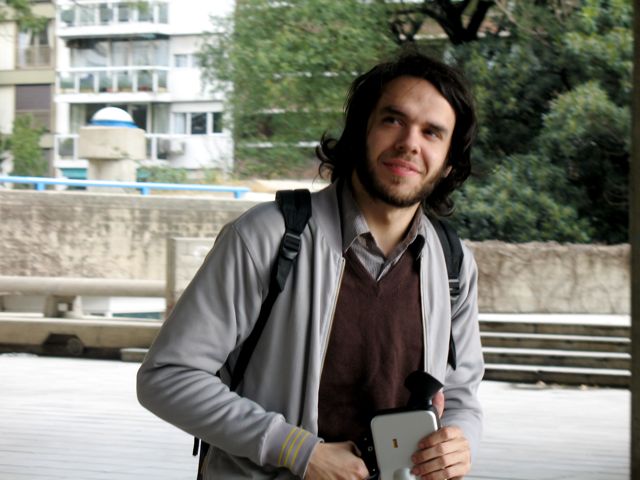
por Pablo Marín
Pablo Marin in Buenos Aires, shooting film for Lynne's film "Wind in Our Hair"
————————————————————————————————
Hacia territorios inciertos: Dos preguntas a Lynne Sachs
A mitad de camino entre la teoría y la práctica, la obra de la cineasta, profesora, curadora y escritora norteamericana Lynne Sachs se ubica en la encrucijada del cine documental, experimental y de ensayo autobiográfico al mismo tiempo que transciende cualquiera de estas categorías preestablecidas. Su estilo cinematográfico, al igual que su reflexión sobre su trabajo, pone al descubierto a una de las artistas audiovisuales más sorprendentemente atípicas de los Estados Unidos, siempre rigurosa y aleatoria en su renovación.
¿Cuándo te diste cuenta que tu obra iba a estar atravesada por tu presencia, tu vida, tu familia?
Al mirar atrás mis veinte años como cineasta me doy cuenta que, sin importar el tema o la idea que este explorando, dejo mi huella en la obra terminada. Desde mis comienzos cinematográficos en 16 milímetros tuve muchos años de tactibilidad. Mi piel tocó, digamos que abrazó, todos los fotogramas de mis películas, forzándome a examinar ese momento congelado de 1/24 de segundo en una regularidad diaria a veces dolorosa. De ahí que, en un nivel físico, tuve una intimidad con el proceso cinematográfico que no se diferenció realmente de mis experiencias previas en pintura y escultura.
Durante un tiempo, mi familia tenía una especie de burla, me decían que nunca iba a poder hacer una película sin mostrar –de manera fragmentada u oculta- a lo sumo parte de mi cuerpo… ¡generalmente desnudo! Bueno, eso no es completamente cierto, aunque me podés encontrar en al menos seis películas. De modo que esta danza entre una presencia espiritual y física es ciertamente irresistible. Hace evidente la intimidad que existe entre los diferentes aspectos de mi vida doméstica, artística y profesional. Y ahora que tengo hijas ellas también se han involucrado. Supongo que esta suerte de mezcla borrosa de zonas tan distintas fue claramente inspirada en la obra de Stan Brakhage (el padre, por así decirlo, del cine de vanguardia norteamericano). Él nunca se permitió esconderse detrás de lo que hacía.
¿Por qué pensás que todavía hay cierto rechazo hacia categorías como “ensayo cinematográfico” o “documental personal”, hacia las cosas que son subjetivas o ambiguas?
Bueno, esa es exactamente mi posición como cineasta, con los pies en dos comunidades cinematográficas bastante distintas, incluso opuestas. Me identifico al mismo tiempo con la aproximación experimental y la documental al trabajar con imágenes y sonidos, pero a la vez me siento muy incómoda ubicándome exclusivamente en una u otra. Muchas películas experimentales son extremadamente hermosas pero no se plantean incorporar un rigor conceptual que las transportaría a otro plano de conciencia artística. La mayoría de los documentales convencionales se apoyan por completo en el tema, sin permitirse lugar para metáforas visuales, invención estética o, como vos decís, ambigüedad (¡el momento en el que el espectador logra un mayor poder de interpretación!). Como si los o las cineastas nunca considerasen las fantásticas posibilidades de expresión que residen justo ahí en el lente de sus cámaras. Por todas estas razones, cuando descubrí la obra de Dziga Vertov, Chris Marker y Trinh T. Min-ha me transporté a un nuevo estadio de expresión visual llamado ensayo cinematográfico. Sí, están esas personas del cine de vanguardia que siempre se resistirán a usar la palabra. Y sí, están esas otras en el documental que no sienten ningún impulso por “volverse personales”, pero para algunas personas como yo este es el territorio donde crecemos con más fuerza.
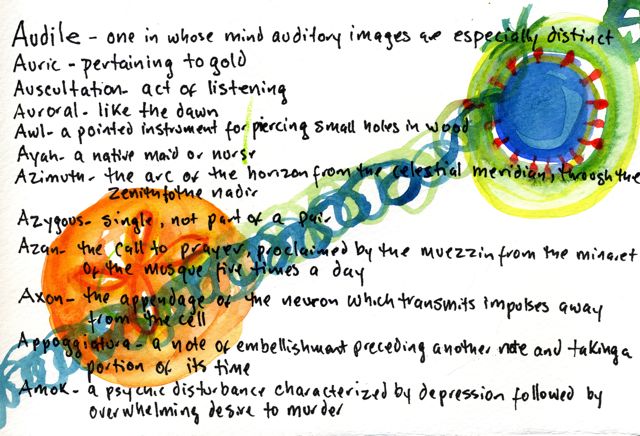
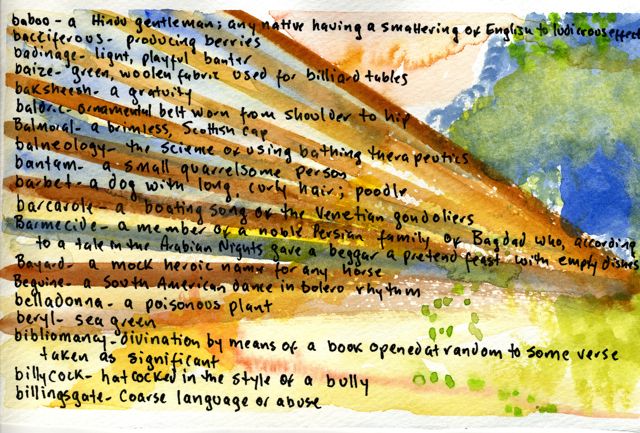
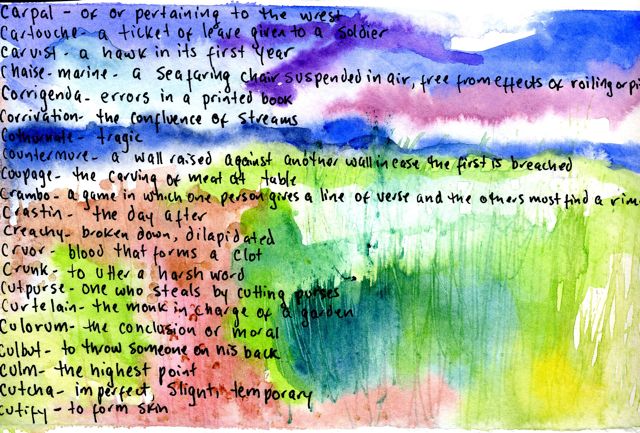
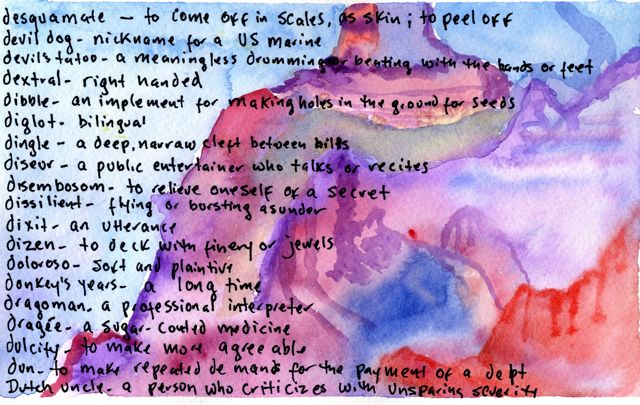
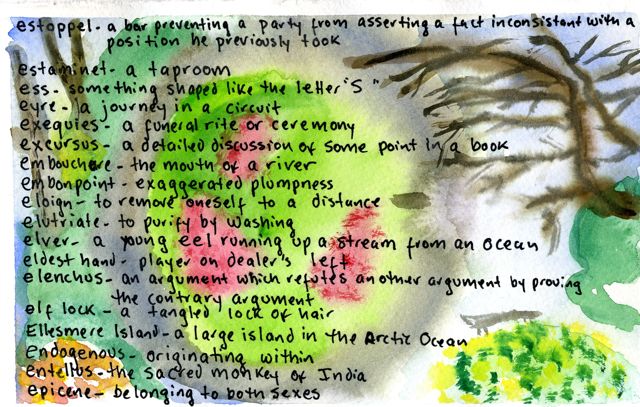
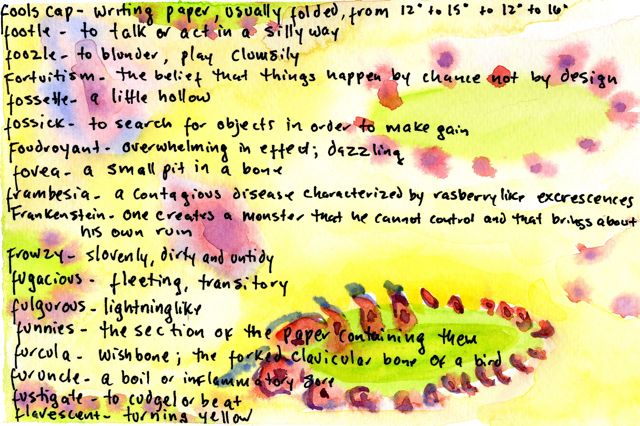
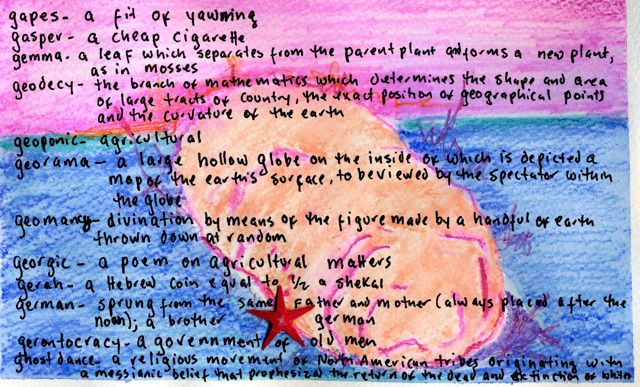
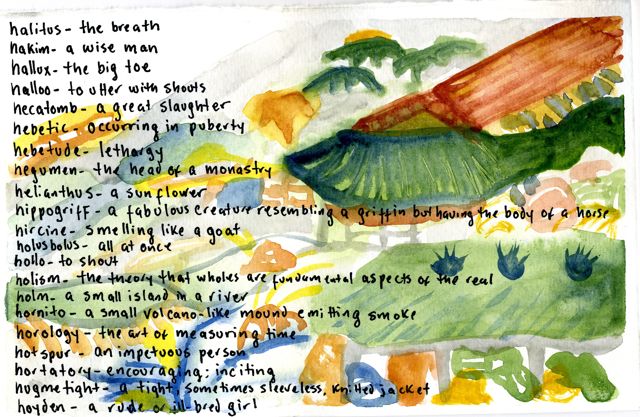
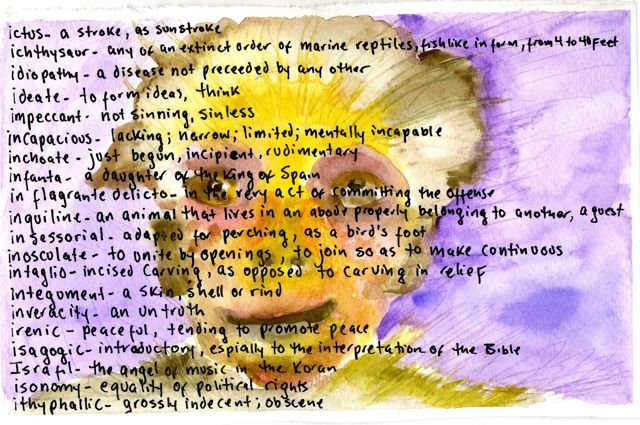
During a two week artist residency in December, 2006 at the McDowell Colony I painted alphabet images in preparation for the creation of Abecedarium:NYC at www.abecedariumnyc.com. Here are a few samples. Lynne
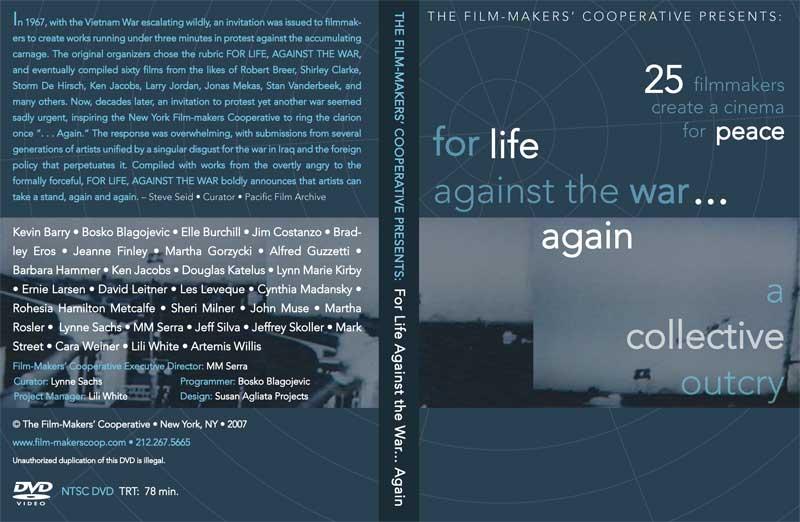
” A CINEMA FOR PEACE! FOR LIFE, AGAINGST THE WAR … AGAIN!” 78 min. DVD 2007
Curator: Lynne Sachs
“In 1967, with the Vietnam War escalating wildly, an invitation was issued to filmmakers to create works running under three minutes in protest against the accumulating carnage. The original organizers chose the rubric For Life, Against the War, and eventually compiled sixty films from the likes of Robert Breer, Shirley Clarke, Storm De Hirsch, Ken Jacobs, Larry Jordan, Jonas Mekas, Stan Vanderbeek, and many others. Now, decades later, an invitation to protest yet another war seemed sadly urgent, inspiring filmmaker Lynne Sachs to ring the clarion once “. . . Again.” The response was overwhelming, with submissions from several generations of artists unified by a singular disgust for the war in Iraq and the foreign policy that perpetuates it. Compiled with works from the overtly angry to the formally forceful, For Life, Against the War boldly announces that artists can take a stand, again and again.” — Steve Seid, Curator, Pacific Film Archive, Berkeley Art Museum
Filmmaker Participants on DVD: Kevin Barry, Bosko Blagojevic, Elle Burchill, Jim Costanzo, Bradley Eros, Jeanne Finley, Martha Gorzycki, Alfred Guzzetti, Barbara Hammer, Ken Jacobs, Douglas Katelus, Lynn Marie Kirby, Ernie Larsen, David Leitner, Les Leveque, Cynthia Madansky, Rohesia Hamilton Metcalfe, Sheri Milner, John Muse, Martha Rosler, Lynne Sachs, MM Serra, Jeff Silva, Jeffrey Skoller, Mark Street, Cara Weiner, Lili White, Artemis Willis.
Filmmakers Cooperative www.film-makerscoop.com 212 267 5665
108 Leonard Street, the Clocktower Bldg., 13th Fl. New York, NY 10013
NTSC DVD TRT: 88 min.
Film-makers’Coop Executive Director: MM Serra
The Village Voice
Film Review
Pro-Life
Artists return to the Vietnam protest model with For Life Against the War . . . Again
by Ed Halter
“Iraq is not Vietnam, as the Bush administration and other Republicans have generously taken pains to remind us over the last half decade, but good luck trying to convince today’s artists of that. Not the kind of artists typically touted at white-shoe galleries, of course, too busy creating precious objects for clueless investors: Far more potent demonstrations of protest and disgust emerge from the rag-tag networks of micro-budgeted experimental filmmakers. With little or no market for experimental filmmaking, the scene consists of only the most devoted individuals, with nothing to lose from saying whatever they wish. The art they create can thereby be rough or polished, face-slappingly blunt or poetically subtle, stridently collectivist or stewed in lonely isolation. For Life Against the War . . . Again, a recent omnibus produced in response to Iraq, includes all these extremes, but nevertheless coalesces into a potent time capsule of how today’s war has churned our inner lives.
For Life updates a concept first enacted in 1967, at the height of the previous debacle. Then, an event called The Week of Angry Art asked 60 filmmakers to make 16mm works of three minutes or less in response to the war in Vietnam; participants included a collection of now-canonical figures such as Jonas Mekas, Robert Breer, and Shirley Clarke, as well as less well-remembered names. Last year, avant-garde film distributor The Film-Maker’s Co-op issued a similar open call for new works about today’s war, resulting in a program of 25 video shorts; both the 1967 and 2007 editions screen at Anthology this week.
A number of the newer videos look to past conflicts as a means of understanding the present: Jeffrey Skoller shoots two-and-a-half unedited minutes of a busy Hanoi street, juxtaposed to a prophetic poem by Ho Chi Minh; Bosko Blagojevic contemplates growing up in the U.S. during the Balkan wars; Lynne Sachs’s The Small Ones remembers her Hungarian cousin, a doctor tasked with reconstructing the bones of American soldiers killed in World War II. Other selections groove on expressive abstraction: Les LeVeque’s nervy STOP THE WAR strobes variations of those three words set to radically altered audio clips of protest chants, while Mark Street contributes a silent flutter of red flowers pressed against 35mm film. Martha Rosler skews patriotism by taping a creepy musical soldier doll blurting “God Bless America,” then revealing its prosthetic-style mechanical leg; M. M. Serra sics her cats on a dopey-faced George Bush toy. But sometimes the crudest are actually the most effective: Witness Jim Costanzo’s The Scream: 21st Century Edition, which blue-screens the artist yelling in pain over news footage of Bush speeches and Baghdad shock-and-awe. Three decades from now, when future media archivists try to understand what it was like for sane Americans to experience the war, Costanzo’s video will remain an effective and emotional artifact.”
————————————————
For Life Against the War Again!
DVD – TRT: 88 minutes
List of Films in Order:
1. The Scream: 21st Century Edition Jim Costanzo
As in the Edvard Munch painting, the artist expresses anger and frustration at America’s illegal war and the attack on our civil liberties. (3 min.)
2. PSA # 11 Fallout Cynthia Madansky
This public service announcement is part of a series of 15 short films that speak out against the American occupation of Iraq and the act of war. (3 min.)
3. LOST Jeanne C. Finley & John Muse
Audio diaries of Chaplin Major Eric Olson combine with a single landscape shot. The implications of an Iraqi’s death reveal the complications and tragedy of war.
(3:48 min.)
4. Graven Images Sherry Millner & Ernie Larsen
The artists’ ongoing “Sight Gag” series views patriotism (particularly post-9/11) as a form of hysterical blindness. (4:31 min.)
5. Words on PEACEpiece Lili White
Only by dealing with one’s “shadow” can one arrive at peace; a flower chain made by children during “Culture Day” — in Slovenian, a national holiday. (1.33 min.)
6. Our Grief Is Not A Cry For War Barbara Hammer
October 11, 2001, Times Square. An ad hoc artist group, puts on a silent demonstration for peace in a time of national war hysteria. Lecturer Louise Richardson, Harvard University. (3:45 min.)
7. Unfurling Martha Gorzycki
Images from visual culture scroll in a mesmerizing rhythm synonymous with the hypnotic effect of endless consumption, inviting viewers to question their own relationship to consumerism. (3 min.)
8. Night Vision Alfred Guzzetti
Iraq: an apocalyptic landscape. (2:32 min.)
9. I Shot a Spider Elle Burchill
Caught in action, a late-night contemplation. (2:40 min.)
10. Star Spangled to Death Ken Jacobs
Excerpt from 440 minutes shot from 1956 to 2004. (2 min.)
11. For Life / Against War Mark Street
Sometimes only flowers will do — pressed against 35mm film emulsion and exposed to the light — to give an unexpected respite from world horrors. (2:37 min.)
12. Prototype: God Bless America! Martha Rosler
A fragment of simulated glee produced by a bouncy robot with prosthetic legs, a movie-villain helmet, a brass trumpet — all with “made-in-China” plastic features. (1:09 min.)
13. Description of a Struggle Bosko Blagojevic
Remembering the 90s, distracted; a single articulation, a way in. (2:55 min.)
14. The Small Ones Lynne Sachs
A portrait of Sachs’ cousin, Sandor Lenard, a doctor who reconstructed the bones of dead American soldiers during World War II. Composed of abstracted war imagery and children at a birthday party. (3 min.)
15. Untitled Kevin Barry
Poem on culture clash in Iraq, inherent racism and our own indifference as we use the resources gathered during the conflict. (1:33 min.)
16. STOP THE WAR Les LeVeque (3 min.)
17. PEACE in order to achieve PEACE M M Serra
My reflections on the regime of George W. Bush. (3 min.)
18. Mutable Fire! Bradley Eros and Erotic Psyche
Totems of destruction & desire, torn between the ecstasy that propels and the horrors that paralyze, we reveal erotic love to be a resistance to tyranny. (4 min.)
19. The Weather is Clearing Up! Jeffrey Skoller
In the midst of war, Ho Chi Minh has a vision of happiness — 180 seconds shot in
Hanoi 62 years later contain the image of its actualization. (3:42 min.)
20. PEACE IS… Rohesia Hamilton Metcalfe
Texts returned by a 9/20/06 Google search for the text “peace is” as a meditation on the consciousness of the crowd at this moment in time. (3:03 min.)
21. Sacco and Vanzetti Douglas Katelus
Summer in NYC. One just might stumble across a bit of anarchy at Union Square: “know that I love you…know that I love you.” (3 min.)
22. War Montage Cara Weiner
Altered images of Iraq and war in general merge to create a visual experience. (3 min.)
23. Ashes, Ashes… Jeff Silva
Using personal and archival footage to ruminate on the subject of war, the residue of past violence permeates into the present. (5 min.)
24. Peace and Pleasure Artemis Willis and David Leitner
Performance artist Larry Litt leads “A Peace and Pleasure Talisman Charging Ritual” with Santeria drummers and a Voudun priestess to confuse and repel evil “Fox-y” media demons. (4 min.)
25. Requiescat Lynn Marie Kirby
1000 Xs scratched on film become prayers for persons killed in Iraq. Punching the machine during video transfer makes a glitch — marking each death anew. (4 min.)
During World War II, the United States Army hired Lynne Sachs’ cousin, Sandor Lenard, to reconstruct the bones – small and large – of dead American soldiers. This short anti-war cine-poem is composed of highly abstracted battle imagery and children at a birthday party.
“Profound. The soundtrack is amazing. The image at the end of the girl with the avocado seed so hopeful. Good work.” Barbara Hammer
Black Maria Film Festival Director’s Choice Award; Ann Arbor Film Festival; Tribeca Film Festival; MadCat Film and Video Festival; Harvard Film Archive; Pacific Film Archive; Dallas Film Fest; Cinema Project, Portland.
I’ve never been much of a documentary watcher. When I go to see films, I prefer a personal narrative amidst the social commentary. I feel that quite often, documentaries lose site of the individual in their search for overarching truth. However, I was fortunate enough to have my earlier prejudice corrected after I saw a unique view into humanity by Lynne Sachs at her presentation, “I am Not a War Photographer.”
Co-hosted by Cornell Council for the Arts and the Program of Feminist, Gender and Sexuality Studies, the program took place this past Tuesday night at the Film Forum in the Schwartz Center. Sachs, a veteran documentarian with a taste for experimental filmmaking presented a series of clips from an earlier set of films that focused on how human narratives and cultures gets lost within war.
After screening much of her oeuvre, Sachs screened her most recent film, States of Unbelonging. Between these segments she answered questions and introduced the following piece. While the films were all beautifully made, it was the insights into Sachs herself that made the night unique and inspiring.
The first film, Which Way is East, is a travel diary that follows Sachs and her sister Dana through Vietnam. From Ho Chi Minh City to Hanoi, Lynne and Dana spoke with different Vietnamese to get a sense of their culture, traditions and stories outside of the war. At the same time they literally reveal the gruesome underbelly of the war’s impact, going so far as to search in old hidden underground passages and foxholes. The shots in the film are a mix of confused, slow motion abstractions of Vietnam and slow, focused images of objects, scenery and people, lending an understated elegance to this cinematic record of a culture that is almost always perceived in our culture through the lens of a decades-past war.
The second film Sachs showed, Investigation of a Flame: The Catsonville Nine is the basis of her connection to Cornell. The film tells the history of the Catsonville Nine, a group of priests, nurses, and artists who, on May 17, 1968 chose to burn selective service records stolen from a draft office in Maryland. The unviolent protest was led by Father Daniel Berrigan, a former Chaplain of Cornell, and his brother Philip. During the trial, hundreds of Cornell students came down to Baltimore to protest in his defense. It was Sachs’s connection to him through her film that began her relationship with Cornell. The film, according to Sachs, was a look into not only this remarkable group, but also where the line between civil disobedience and a dangerous rebellion lies.
Sachs went on to show Tornado, a three-minute video made in the aftermath of 9/11. In a compelling twist, Sachs chooses not to focus on the faces of her subjects, but instead brings her camera to bear on their bodies and her own hands as she takes charred bits of paper, resumes, calendars and other detritus left over from the twin towers and repeatedly flips them over in her hands. This obsessive twirling gives character to these papers and, in a way, allows them to become silent memorials to the dead.
The last two films that Sachs showed were States of Unbelonging, a profound meditation on the terrorist murder of Israeli Revital Ohayon and her two sons, as well as a clip from The Small Ones, Sachs’s upcoming work. It focuses on her cousin Sandor, and his job reconstructing bones of dead American soldiers from the second World War (For a full review of States of Unbelonging, read Mark Rice’s column on Monday, February 23).
Each film presented was a special look into a time period and culture fractured by war. But instead of taking the traditional route and filming the obvious fractures, Sachs finds the undercurrents and reveals them through voice-over interviews, quotes from poems and images of life rather than death. There’s an intuitive sense to her work, as if she didn’t know what she was looking for but rather followed her instinct through each film.
As she explains it, rather than laying out each work in a linear fashion, she “start[s] from the center and works out” building layer upon layer until that eureka moment comes, after which she knows the movie is complete.
By not charting a direct course, Sachs has the ability to delve into the lives of her subjects and actually explore the struggles and problematic questions that arise from each war. She manages to make every film an organic, breathing entity. Her intense personal connection with her subjects is transmitted in every shot, still and shadow as well as through the narration. Taking her audience with her in her search for answers Lynne Sachs demonstrates that applying the term “war photographer” to her is truly doing her a disservice. In truth, she is a gatherer of worn photographic portraits of people brought together in a mosaic of tragedy, truth and human frailty.
For more information on Lynne Sachs or to see clips from her films, go to www.lynnesachs.com.
Lynne Sachs and Mark Street
With special guests audio pranksters Bosko Blagojevic and Zach Poff
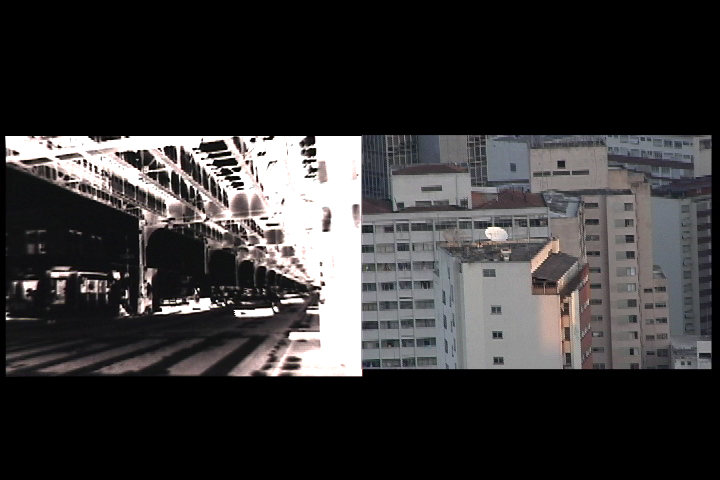
CITY SALVAGE is the second installment of Lynne and Mark’s XY Chromosome project, a dynamic feast for the eyes, ears and mind that considers the cities of HANOI, SANTIAGO, BUFFALO, SAO PAOLO, PRAGUE, NEW YORK, TEL AVIV & SAN FRANCISCO, SARAJEVO. We’ve joined forces with the preternatural sound magicians Bosko Blagojevic and Zach Poff who will contribute a live audio performance to our urban stew.
We invite you to drift away with us and be a floozy flaneur!
4 artists! 4 screens! 8 cities! 70 minutes!
CITY SALVAGE contrasts images and sounds in a kinetic, charged way. This is a study of dissonance: abstract material brushed up against the discernible, frenetic versus the more languid, chaotic sound vs. silence, architecture vs. the human element. The whole is fragmented and surprising like the experience of first walking through a new city. How does the urban milieu serve our need to explore and wander, to be at once alone and in company? Each of these cities negotiates its urban impulses in idiosyncratic ways. As a collection, this evening will consider urbanism by looking closely at these vibrant cities.
Biography of Lilith & The House of Science: a museum of false facts
This DVD collection presents two of Lynne Sachs’ earlier films with several more recent media works — all of which explore themes of women, culture, science & myth. The creative as well as intellectual inner workings of these projects are revealed for the first time in the context of an elaborately conceived, yet accessible disc.
“Biography of Lilith conveys the real experience – bloody and poetic – of Lilith alive and now in every woman. Bravo! A film felt, imagined, and informed by life.” – Barbara Black Koltuv, Author of The Book of Lilith
“Lynne Sachs’ A Biography of Lilith is a beautifully realized melding of history, mythology, image, and sound that makes us rethink our understanding of a powerful, complex, and significant female figure.”
Prof. Caren Kaplan, Women’s Studies, University of California at Davis
BIOGRAPHY OF LILITH updates the creation myth by telling the story of the first woman and for some, the first feminist. In conjunction with the film, the DVD offers a personal introduction to Jewish Kabbala.
THE HOUSE OF SCIENCE: A MUSEUM OF FALSE FACTS investigates science and art’s representation of women in our society using home movies, collage, found footage and personal remembrances.
DVD FEATURES INCLUDE:
* Over 40 minutes of never-before-seen interviews with four prominent Judaic scholars provide anchors for discussion of the Lilith myth.
* Six of Sachs’ poems which were written during the making of Biography of Lilith
* Thirteen collages with text from The House of Science
* Two Short Films: Window Work and Photograph of Wind
* Filmmaker Biography
* Interactive Menus
* DVD-ROM: Printable Transcript of The House of Science and Poetry from Biography of Lilith
Jewish Scholars: Daniel Boyarin, Tikvah Frymer-Kensky,
Rabbi Meyer Fund, Naomi Mark
SCREENINGS: Museum of Modern Art, the Oberhausen Film Festival, the Whitney Museum of American Art, the Delaware Biennial, the Pacific Film Archive, and the Tate Modern. The films have won awards at the Atlanta, New Jersey, Ann Arbor, Athens, Black Maria, Charlotte and Humboldt Film Festivals