Loria Center for the History of Art, Room 104, 190 York St., New Haven, CT, 06511
4:30-6:00pm
Location: Yale Loria Center, Room 250Workshop: Friday, 6:30-8:30pm
Location: Yale Digital Media Center for the Arts, Room 104Lynne Sachs makes films, installations, performances and web projects that explore the intricate relationship between personal observations and broader historical experiences by weaving together poetry, collage, painting, politics and layered sound design. Strongly committed to a dialogue between cinematic theory and practice, she searches for a rigorous play between image and sound, pushing the visual and aural textures in her work with each and every new project. Between 1994 and 2009, her five essay films took her to Vietnam, Bosnia, Israel, Italy and Germany — sites affected by international war – where she looked at the space between a community’s collective memory and her own subjective perceptions.
Explore the work and process of Sachs’ intermedia practice at the DMCA. This event is sponsored by the Digital Media Center for the Arts, Film and Media Studies, and Films at the Whitney.
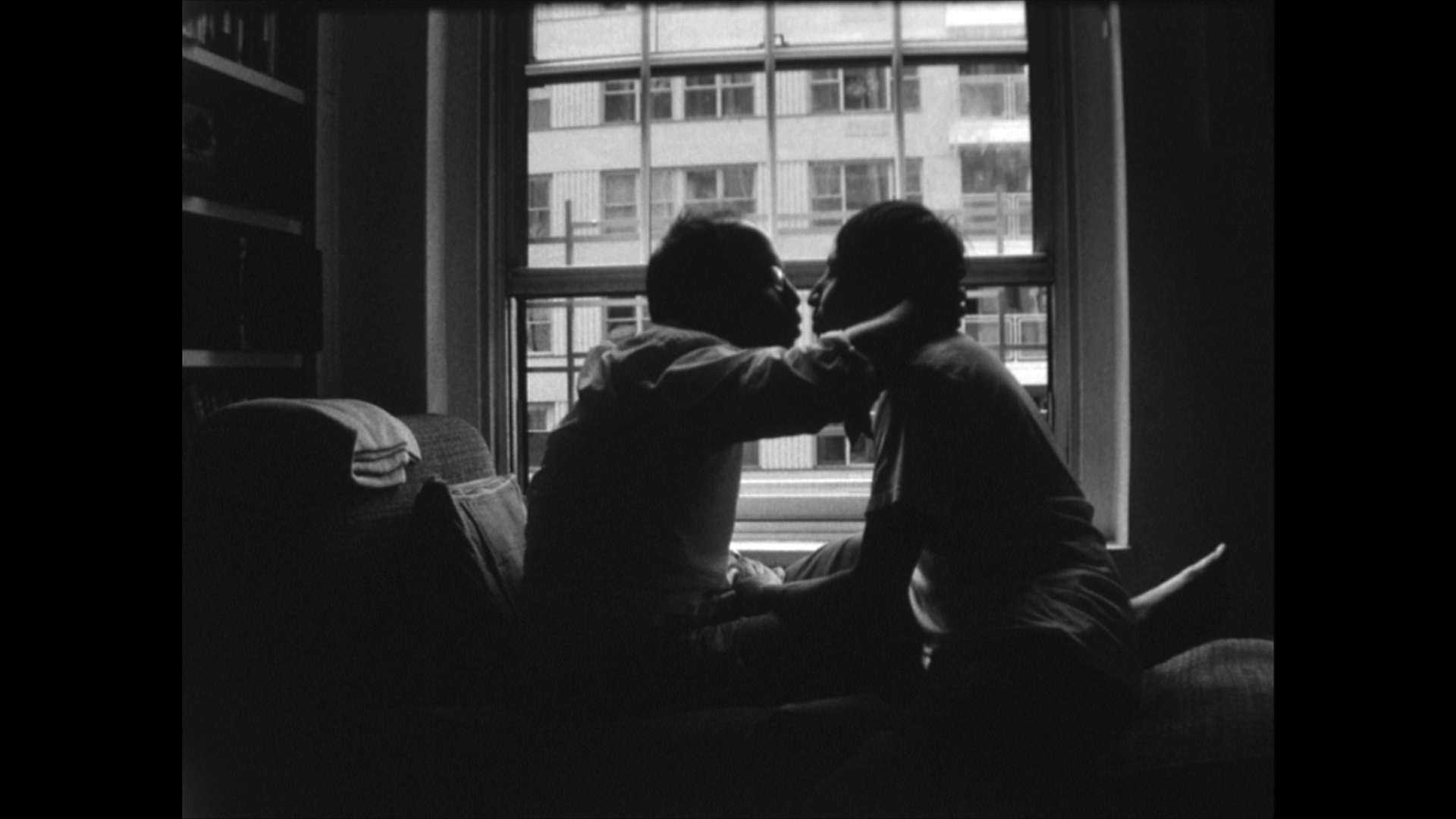
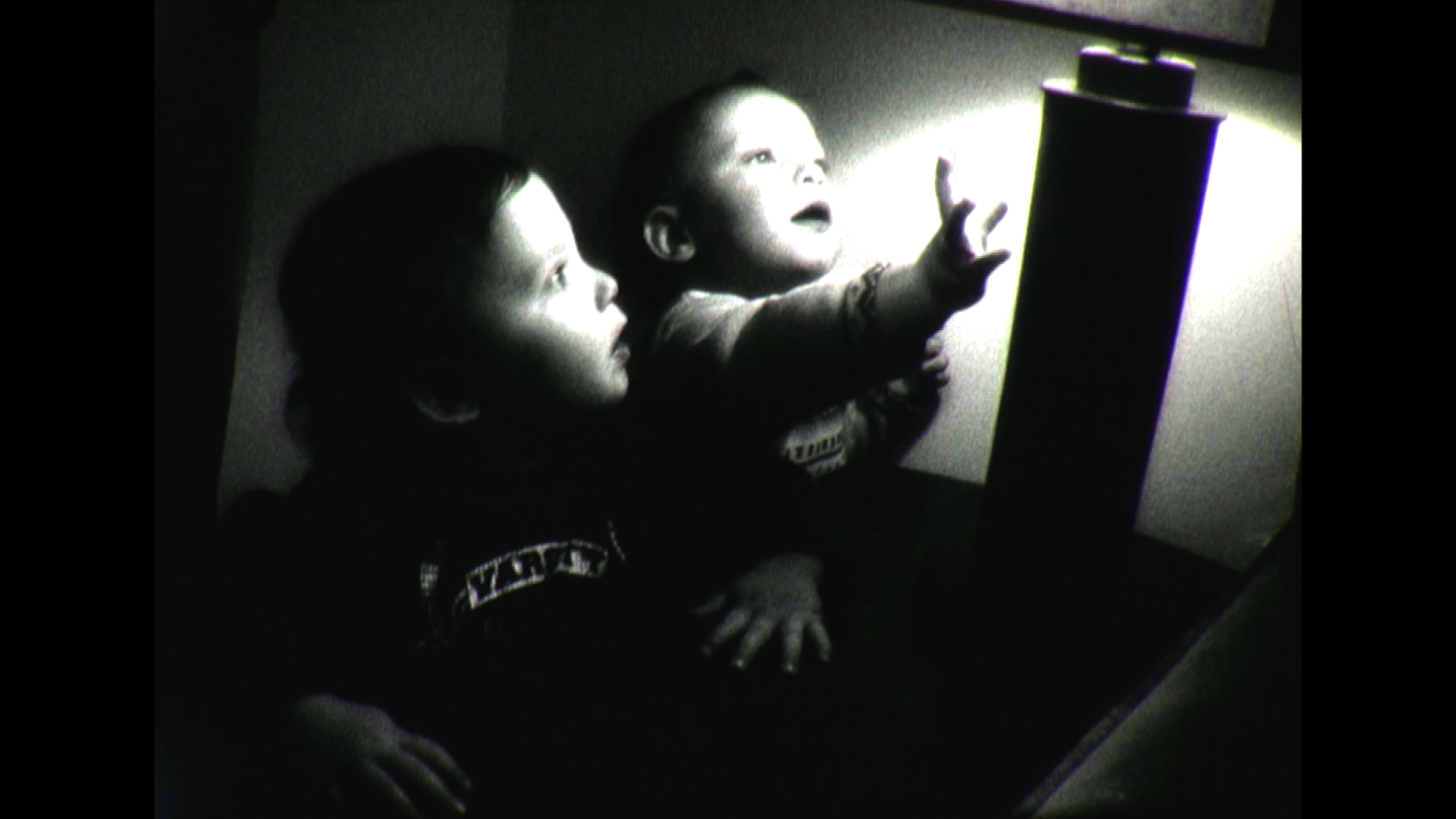
Viva and Felix Growing Up
by Lynne Sachs
10 min. Black and White 16mm on Digital, 2015
Available from Canyon Cinema, Film-Makers Cooperative, and Kino Rebelde.
Capturing fragments of the first three years of her twin niece’s and nephew’s lives with their two dads (her brother Ira Sachs and his husband Boris Torres) and their mom (Kirsten Johnson), Sachs affectionately surveys the construction of family.
Screened in “Lynne Sachs: Between Thought and Expression Retrospective” at the Museum of the Moving Image in 2021.
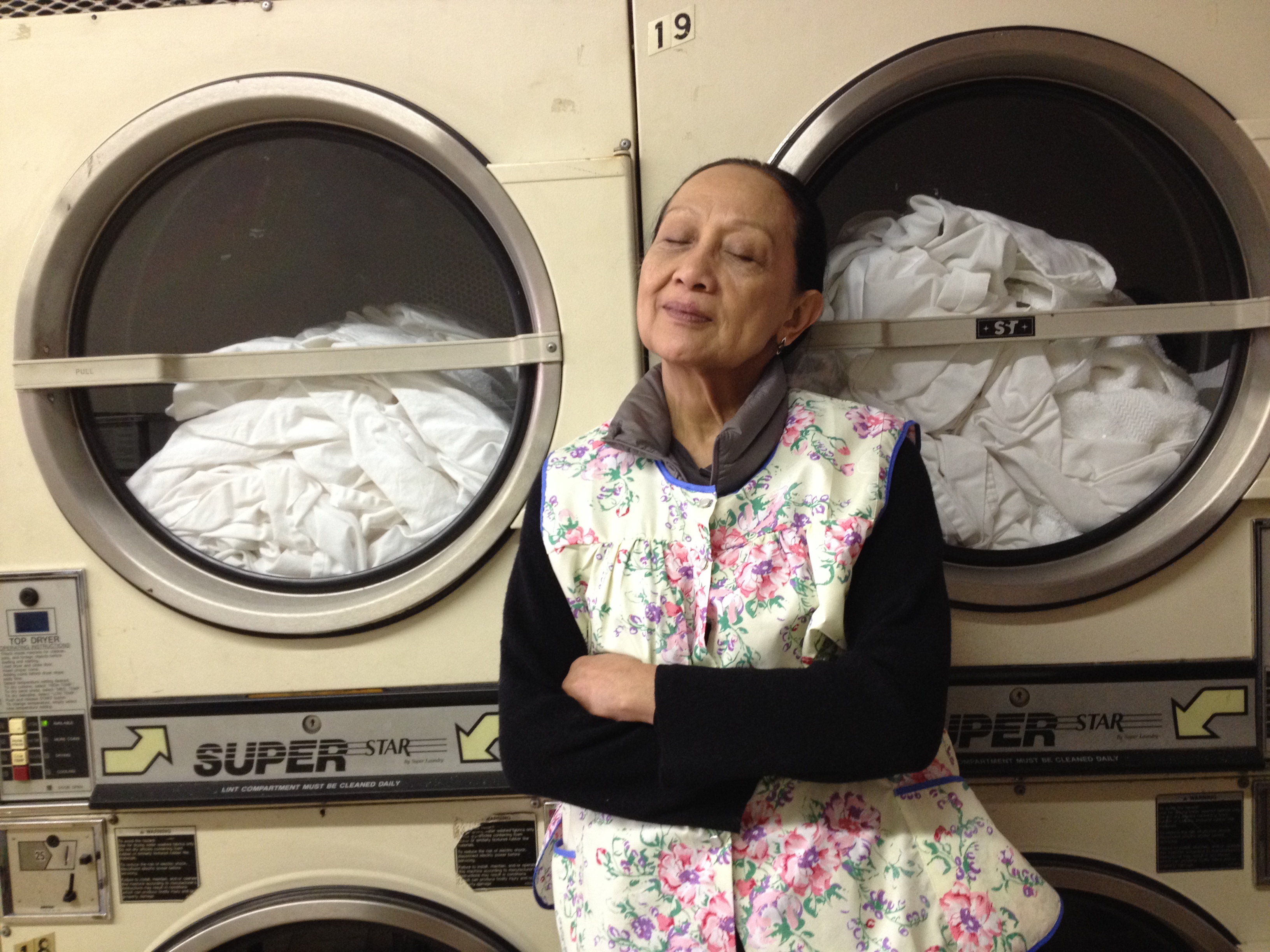
A hybrid experimental film and live performance that looks into the charged intimacy of washing clothes in a neighborhood laundromat.
EVERY FOLD MATTERS is a live performance and a film project that looks at the charged, intimate space of the neighborhood laundromat and the people who work there. Set at the crossroads of a Brooklyn neighborhood, we meet four characters in a real laundromat — a uniquely social and public space that is slowly disappearing from our changing urban landscape. Based on interviews with New York City laundry workers, the project combines narrative and documentary elements as it explores personal stories of immigration, identity, money, stains and dirt.
“The legacy of domestic work, the issues surrounding power, and the exchange of money for services are all potent themes which rise to the surface and bubble over in dramatic, thrilling escalations of the everyday.” (Brooklyn Rail)
“Spotlights the often-invisible workers who fold the clothes, maintain the machines and know your secrets.” (In These Times)
“The intersection of film and performance, reality and imagination, employee and customer, historical fact and personal anecdote…You made us rethink the laundromat as a site of urban convergence, where strangers (of different races, religions, languages and classes) make ritualistic visits to a public space that’s also a functional extension of their own homes.” Alan Berliner, filmmaker
EVERY FOLD MATTERS has received support from New York State Council on the Arts, Brooklyn Arts Council, Lower Manhattan Cultural Council (through Dirty Laundry/Loads of Prose), Women and Media Coalition, and Fandor FIX Filmmakers.
Our collaborators include acclaimed downtown actors Ching Valdes-Aran, Jasmine Holloway, Veraalba Santa, and Tony Torn, film editor Amanda Katz, cinematographer Sean Hanley and sound artist Stephen Vitiiello.
EVERY FOLD MATTERS began as a site specific performance with film presented by Loads of Prose at the New Lucky Laundromat in Clinton Hill, Brooklyn in early 2015. The Workers Unite! Film Festival later hosted a performance and awarded us the Best Feature Narrative prize. We are now developing our performance into a film, and recently received support from the New York State Council on the Arts and the Women and Media Coalition. This summer Fandor.com awarded us a $5,000 matching grant for the creation and distribution of the film.
“I remember each and every face of every customer.”
We are excited to bring EVERY FOLD MATTERS into a more purely cinematic realm by weaving together additional documentary material collected in interviews, original text, and both raw and impressionistic images.
You can read press on our EVERY FOLD MATTERS live film performance here:
Jasmine Holloway is a singer and actress who has performed in productions at the Harlem Repertory Theatre as well as in the highly acclaimed Generations at Soho Rep. Jasmine was nominated for the Richard Maltby Jr. Award for Musical Theatre Excellence during the 2013 Kennedy Center College Theatre Festival.
Veraalba Santa is an actress and dancer and a member of Caborca Theater. She has degrees in Theater and Dance from the University of Puerto Rico and the Neighborhood Playhouse School of the Theater. In New York City, Veraalba has worked with Sally Silvers, Rojo Robles, Viveca Vazquez and Rosa Luisa Marquez.
Tony Torn was last seen on stage in the title role of Ubu Sings Ubu at The Slipper Room, a rock opera adaptation of Alfred Jarry’s Ubu Roi which he created and co-directed. An actor and director known for his extensive work with Reza Abdoh and Richard Foreman, Tony recently made his Broadway debut in Breakfast At Tiffany’s.
Ching Valdes-Aran is an Obie award-winning actor who has appeared on and off Broadway, including The Public Theater, New York Theater Workshop, La Mama, Women’s Project, CSC, Mabou Mines, Ma-Yi Theater Company, La Jolla, Center Stage, Yale Rep, and ACT. Her film work includes roles in Lav Diaz’s From What is Before (Golden Leopard Award, Locarno Int’l Festival) and Julie Taymor’s Across the Universe.
Our Collaborative Team
Lynne Sachs is a co-director. She makes films, performances, installations and web projects that explore the intricate relationship between personal observations and broader historical experiences by weaving together poetry, collage, painting, politics and layered sound design. Supported by fellowships from the Guggenheim, Rockefeller and Jerome Foundations and the New York State Council on the Arts, Lynne’s films have screened at the New York Film Festival, the Sundance Film Festival and Toronto’s Images Festival. Lynne teaches experimental film and video at NYU and lives in Brooklyn. www.lynnesachs.com
Lizzie Olesker is a co-director. She is a playwright, director and performer. Her plays have been developed and presented at New Georges, Invisible Dog, Ohio Theater, Dixon Place, HERE, Cherry Lane, and Public Theater. Her work has received support from the Brooklyn Council for the Arts, the Dramatists Guild, and New York Foundation for the Arts. Her writing has been published by Heinemann Press and in the Brooklyn Rail. She teaches playwriting at NYU and the New School, and lives in Brooklyn.
Sean Hanley is our Cinematographer. He is a non-fiction filmmaker based in Brooklyn, New York. His short works have screened at the Ann Arbor Film Festival, the Edinburgh International Film Festival, the New Orleans Film Festival. Sean teaches cinematography at Hunter College and was a cinematographer and co-producer on Lynne Sachs’s Your Day is My Night (2013). He is the Assistant Director of Mono No Aware.
Amanda Katz is our Associate Producer and Editor. She works professionally as a Film Editor, and is currently working with Lynne Sachs to craft her latest feature film. Her own work has screened at The Ann Arbor Film Festival, Doc NYC, Encuentros del Otros Cine Festival International, and Microscope Gallery. Her most recent film received funding from the New York State Council On The Arts and The Austrian Cultural Forum in New York. Amanda is a MFA candidate in Integrated Media Arts at Hunter College.
Stephen Vitiello is our composer, an electronic musician and media artist. Vitiello’s sound installations have been presented at MoMA, MASS MoCA, the Whitney Biennial, and on the High Line in NYC. Vitiello has collaborated with numerous artists including Pauline Oliveros, Tony Oursler, Julie Mehretu, Scanner, Steve Roden, Taylor Deupree and Ryuichi Sakamoto.
Interns and web design: Christine Dickerson, Mars Marson, Boyd Chayanon
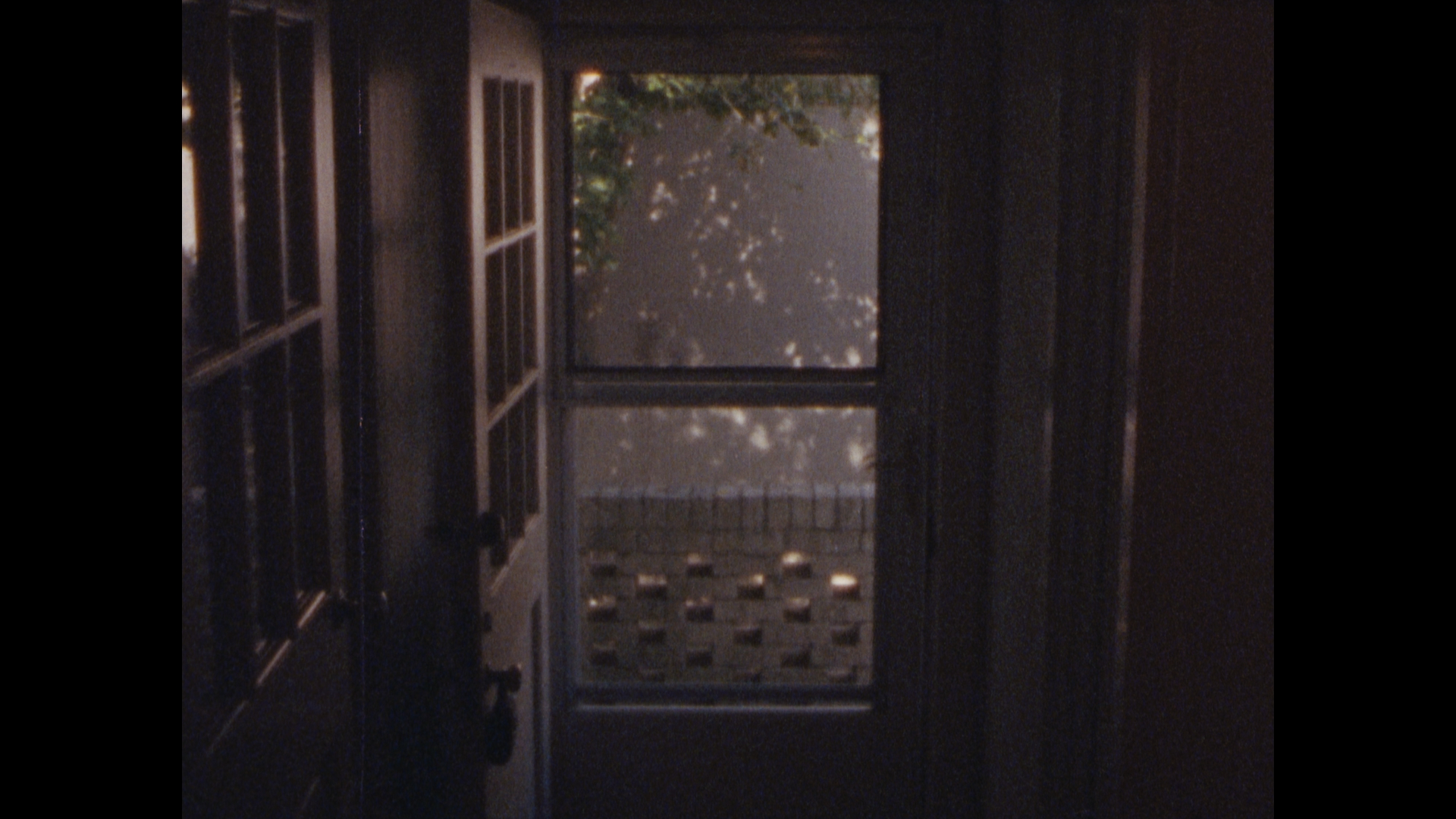
I spent a day with my mother and stepfather shooting Super 8mm film in my childhood home in Memphis, Tennessee. Sigmund Freud believed that the instigation of a dream is often to be found in the events of the day preceding the dream, which he called the “day residue.”
Taught in Alex Broadwell’s Collective Dream Lab at CalArts – Winter 2021
Workshop description:
This workshop will explore how dreams fit into our lives and into cinema, and how we might develop collaborative practices that eschew traditional models of authorship using the dreamscape as our soil. Through readings, screenings, discussion, and practice we will approach the dream from a variety of angles, including representation, embodiment, and creative methodology, taking care to go beyond modes of psychological interpretation that dominated 20th century dream discourse. Students will be asked to keep dream journals and participate in an exquisite corpse style assignment with classmates.
Day Residue – Lynne Sachs Blue – Apichatpong Weerasethakul Aquarius – Kevin Jerome Everson Ritual – Joseph Bernard Of this Beguiling Membrane – Charlotte Pryce Secret Goldfish – Bi Gan Mahogany Too – Akosua Adoma Owusu
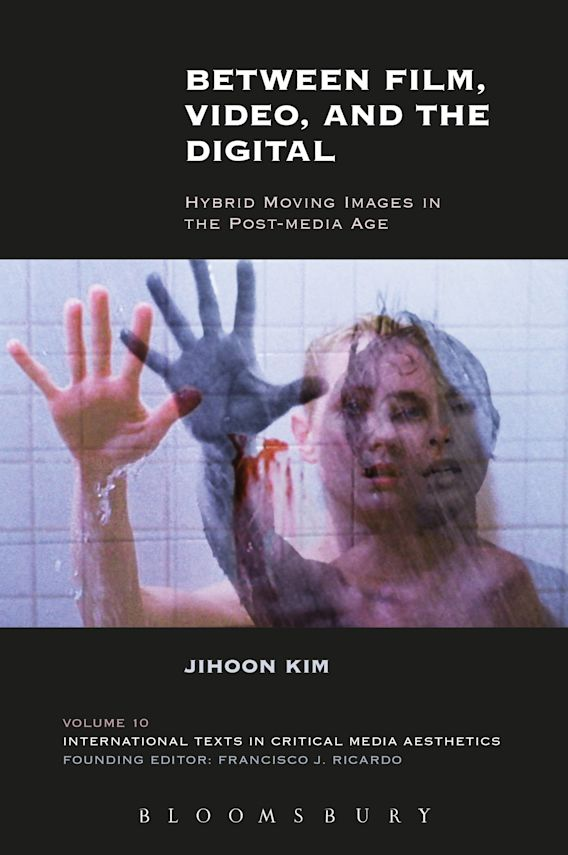
Encompassing experimental film and video, essay film, gallery-based installation art, and digital art, Jihoon Kim establishes the concept of hybrid moving images as an array of impure images shaped by the encounters and negotiations between different media, while also using it to explore various theoretical issues, such as stillness and movement, indexicality, abstraction, materiality, afterlives of the celluloid cinema, archive, memory, apparatus, and the concept of medium as such.
Grounding its study in interdisciplinary framework of film studies, media studies, and contemporary art criticism, Between Film, Video, and the Digital offers a fresh insight on the post-media conditions of film and video under the pervasive influences of digital technologies, as well as on the crucial roles of media hybridity in the creative processes of giving birth to the emerging forms of the moving image. Incorporating in-depth readings of recent works by more than thirty artists and filmmakers, including Jim Campbell, Bill Viola, Sam Taylor-Johnson, David Claerbout, Fiona Tan, Takeshi Murata, Jennifer West, Ken Jacobs, Christoph Girardet and Matthias Müller, Hito Steyerl, Lynne Sachs, Harun Farocki, Doug Aitken, Douglas Gordon, Stan Douglas, Candice Breitz, among others, the book is the essential scholarly monograph for understanding how digital technologies simultaneously depend on and differ film previous time-based media, and how this juncture of similarities and differences signals a new regime of the art of the moving image.
lntermedial Palimpsests in Lynne Sachs’s experimental documentary films
Pg. 221-227
“Sachs has produced a number of short and feature-length experimental documentary films that explore the intricate relationship between broader historical experiences and her personal reflections on them. Based on this intersection of the personal and the public, Sachs’s films present several formal attributes of the essay film, including her shifting presence as author via voice- over, intertitled commentaries and camera movement, the mixture of multiple time frames, deployment of multiple (poetic, reflexive, and participatory) documentary modes, and the use of collages to highlight the heterogeneity of found materials or the density of the sound-image continuum. These attributes enable Sachs’s films to fit into the category of the “experimental documentary,” a term which, according to Lucas Hilderbrand, refers to the wide- ranging intersections of documentaries and experimental practices aimed at breaking “from a certain realist, objective, authentic tradition of non-fiction filmmaking.” Though works pertaining to experimental documentaries are so various as to encompass several subgenres of documentaries (e.g., essay film, animated documentary, and documentary installation) that are distinct in technique or experiential platform, they expose a concern with form and mediation by drawing from the traditions of experimental film a range of aesthetic elements. These include nonstandard cinematography, layered or painterly images, fragmented narrative structures, dissonance of sound and image, and celluloid-based or digital visual effects. Such aesthetic elements of visuality and temporality, Hilderbrand notes, “are the means through which historical revision, contemporary politics, and alternative futures are explored.” Sachs acknowledged that she has utilized a variety of visual manipulations of her records and materials to introduce the elements of uncertainty and imagination. She explains that manipulations are designed to transcend the belief in the transparent representation of history and memory and promote an understanding of them as derived from a complex mediation of past and present:
My films … expose what I see as the limits of conventional documentary representations of both the past and the present. Infusions of colored “brush strokes” catapult a view into contemporary Vietnam. Floating drinking glasses moving across a Muslim cemetery in Sarajevo evoke wartime without water. Pulsing, geometric mattes suspended in cinematic space block news footage of a bombing in Tel Aviv. With each project, I have had to search for a visual approach to looking at trauma and conflict.”
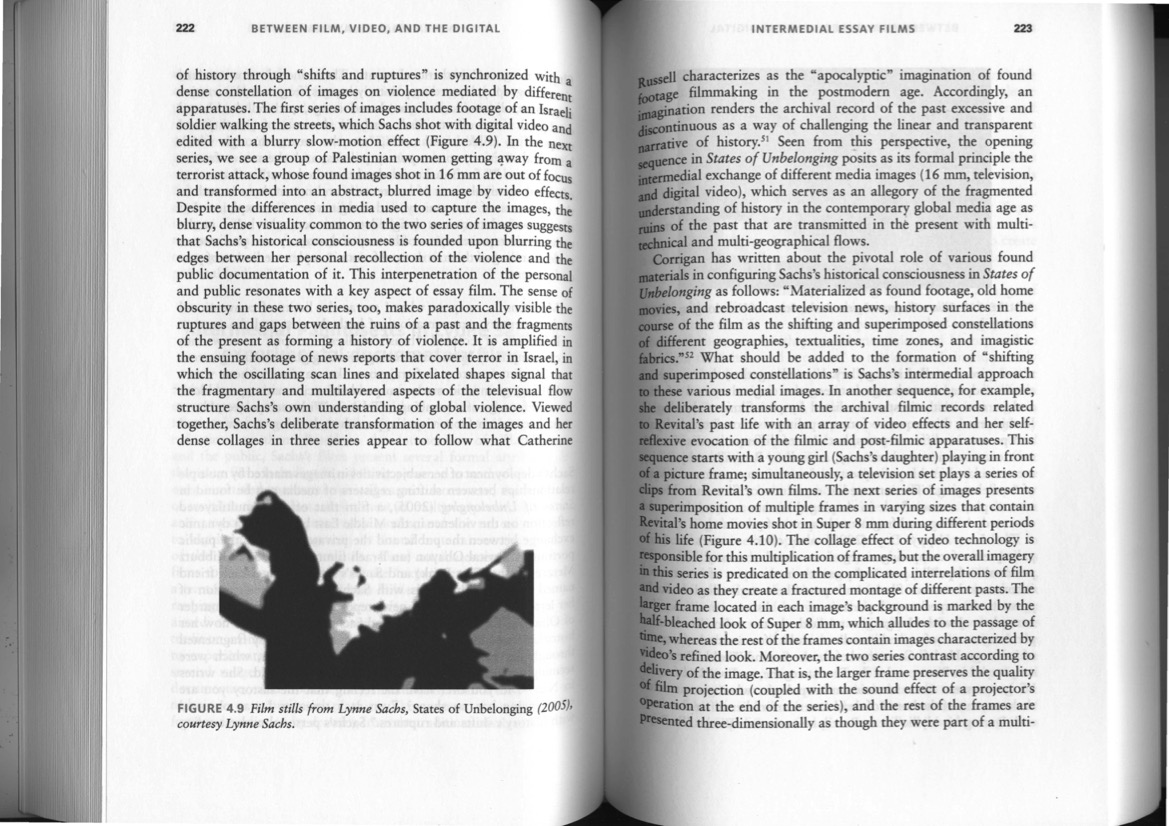
Sachs’s deployment of her subjectivities in images marked by multiple relationships between shifting registers of media can be found in States of Unbelonging (2005), a film that offers a multilayered reflection on the violence in the Middle East by creating a dynamic exchange between the public and the private-between the public portrait of Revital Ohayon (an Israeli filmmaker killed in Kibbutz r on the West Bank) and Sachs’s letters to an Israeli friend ed Nir. The film starts with Sachs’s voice-over narration of her letter to Nir regarding a news report that describes the murder Ohayon. This incident triggered Sachs to contemplate how her historical consciousness had been shaped and thereby fragmented through her personal experiences of violent events, which were seemingly repeated over time throughout the world. She writes Nir: “Did you ever have the feeling that the history you are experiencing has no shape? Even as a teenager I was obsessed with history’s shifts and ruptures” Sachs’s personal understanding of history through “shifts and ruptures” is synchronized with a dense constellation of images on violence mediated by different apparatuses. The first series of images includes footage of an Israeli soldier walking the streets, which Sachs shot with digital video and edited with a blurry slow-motion effect (Figure 4.9). In the next series, we see a group of Palestinian women getting ~way from a terrorist attack, whose found images shot in 16 mm are out of focus and transformed into an abstract, blurred image by video effects. Despite the differences in media used to capture the images, the blurry, dense visuality common to the two series of images suggests that Sachs’s historical consciousness is founded upon blurring the edges between her personal recollection of the violence and the public documentation of it. This interpenetration of the personal and public resonates with a key aspect of essay film. The sense of obscurity in these two series, too, makes paradoxically visible the ruptures and gaps between the ruins of a past and the fragments of the present as forming a history of violence. It is amplified in the ensuing footage of news reports that cover terror in Israel, in which the oscillating scan lines and pixelated shapes signal that the fragmentary and multilayered aspects of the televisual flow structure Sachs’s own understanding of global violence. Viewed together, Sachs’s deliberate transformation of the images and her dense collages in three series appear to follow what Catherine Russell characterizes as the “apocalyptic” imagination of found footage filmmaking in the postmodern age. Accordingly, an imagination renders the archival record of the past excessive and discontinuous as a way of challenging the linear and transparent narrative of history. Seen from this perspective, the opening sequence in States of Unbelonging posits as its formal principle the intermedial exchange of different media images (16 mm, television, digital video), which serves as an allegory of the fragmented understanding of history in the contemporary global media age as of the past that are transmitted in the present with multi-technical and multi-geographical flows.
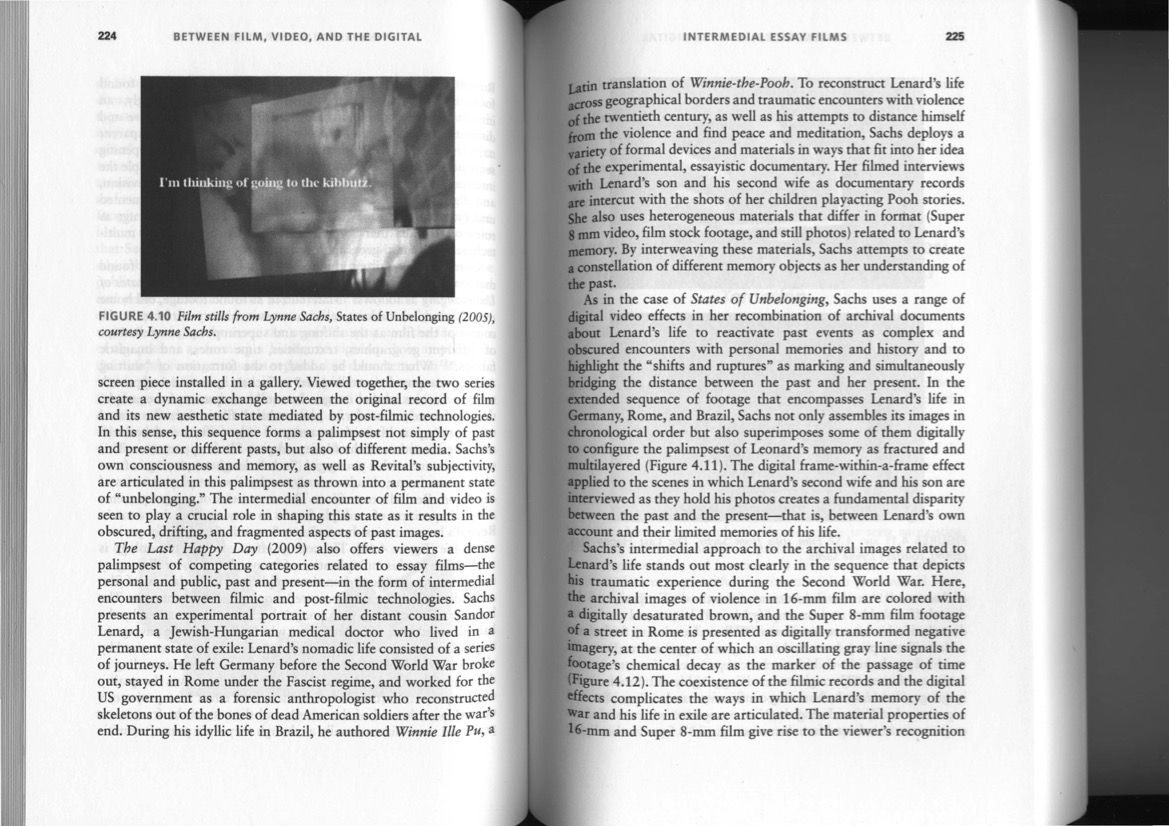
Corrigan has written about the pivotal role of various found materials in configuring Sachs’s historical consciousness in States of Unbelonging as follows: “Materialized as found footage, old home movies, and rebroadcast television news, history surfaces in the course of the film as the shifting and superimposed constellations of different geographies, textualities, time zones, and imagistic fabrics.” What should be added to the formation of “shifting and superimposed constellations” is Sachs’s intermedial approach to these various medial images. In another sequence, for example, she deliberately transforms the archival filmic records related to Revital’s past life with an array of video effects and her self-reflexive evocation of the filmic and post-filmic apparatuses. This sequence starts with a young girl (Sachs’s daughter) playing in front of a picture frame; simultaneously, a television set plays a series of from Revital’s own films. The next series of images presents a superimposition of multiple frames in varying sizes that contain Revital’s home movies shot in Super 8mm during different periods of his life (Figure 4.10). The collage effect of video technology is responsible for this multiplication of frames, but the overall imagery in this series is predicated on the complicated interrelations of film and video as they create a fractured montage of different pasts. The larger frame located in each image’s background is marked by the half-bleached look of Super 8 mm, which alludes to the passage of time, whereas the rest of the frames contain images characterized by video’s refined look. Moreover, the two series contrast according to delivery of the image. That is, the larger frame preserves the quality of film projection (coupled with the sound effect of a projector’s operation at the end of the series), and the rest of the frames are presented three-dimensionally as though they were part of a multi-screen piece installed in a gallery. Viewed together, the two series create a dynamic exchange between the original record of film and its new aesthetic state mediated by post-filmic technologies. In this sense, this sequence forms a palimpsest not simply of past and present or different pasts, but also of different media. Sachs’s own consciousness and memory, as well as Revital’s subjectivity, are articulated in this palimpsest as thrown into a permanent state of “unbelonging.” The intermedial encounter of film and video is seen to play a crucial role in shaping this state as it results in the obscured, drifting, and fragmented aspects of past images.
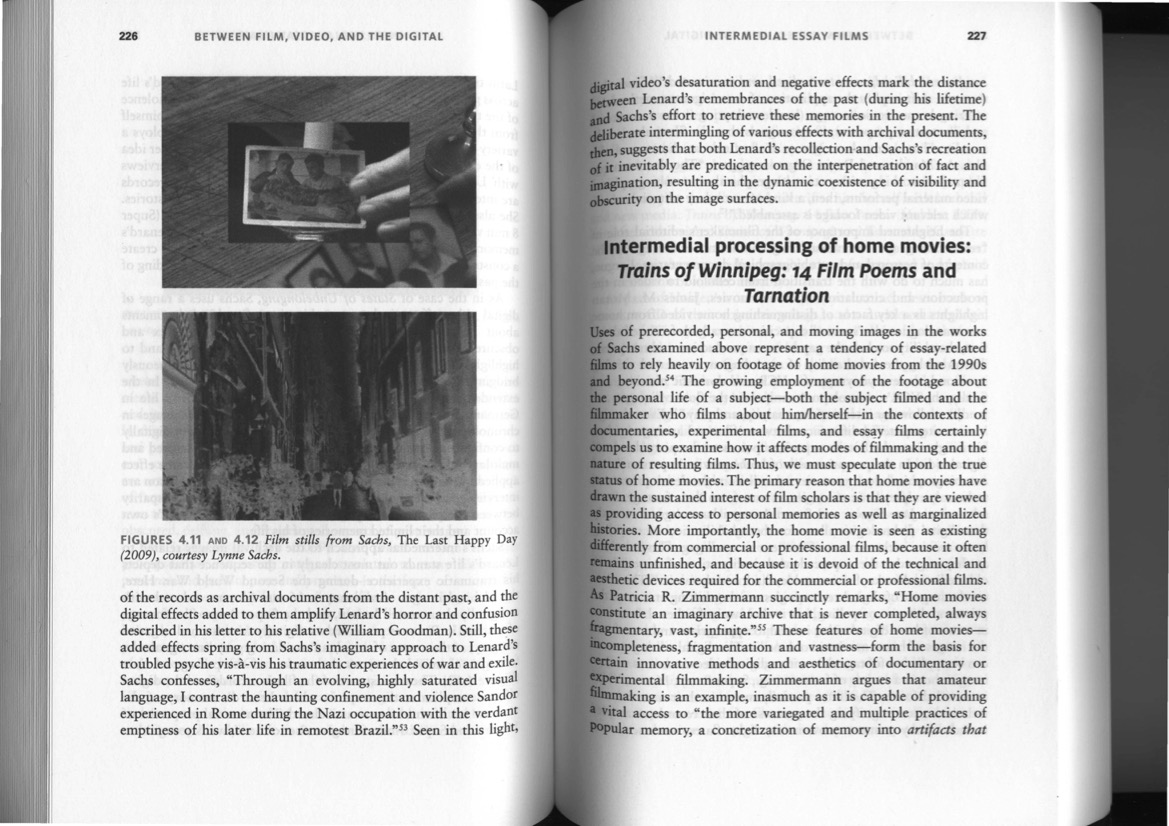
The Last Happy Day (2009) also offers viewers a dense palimpsest of competing categories related to essay films-the personal and public, past and present-in the form of intermedial encounters between filmic and post-filmic technologies. Sachs presents an experimental portrait of her distant cousin Sandor Lenard, a Jewish-Hungarian medical doctor who lived in a permanent state of exile: Lenard’s nomadic life consisted of a series of journeys. He left Germany before the Second World War broke out, stayed in Rome under the Fascist regime, and worked for the US government as a forensic anthropologist who reconstructed skeletons out of the bones of dead American soldiers after the war’s end. During his idyllic life in Brazil, he authored Winnie Ille Pu, a latin translation of Winnie-the-Pooh. To reconstruct Lenard’s life .aoss geographical borders and traumatic encounters with violence of the twentieth century, as well as his attempts to distance himself from the violence and find peace and meditation, Sachs deploys a variety of formal devices and materials in ways that fit into her idea of the experimental, essayistic documentary. Her filmed interviews withLenard’s son and his second wife as documentary records are intercut with the shots of her children playacting Pooh stories. Shealso uses heterogeneous materials that differ in format (Super 8 mm video, film stock footage, and still photos) related to Lenard’s memory. By interweaving these materials, Sachs attempts to create a constellation of different memory objects as her understanding of the past.
As in the case of States of Unbelonging, Sachs uses a range of digital video effects in her recombination of archival documents about Lenard’s life to reactivate past events as complex and obscure encounters with personal memories and history and to highlight the “shifts and ruptures” as marking and simultaneously bridging the distance between the past and her present. In the extended sequence of footage that encompasses Lenard’s life in Germany, Rome, and Brazil, Sachs not only assembles its images in chronological order but also superimposes some of them digitally to configure the palimpsest of Leonard’s memory as fractured and multilayered (Figure 4.11). The digital frame-within-a-frame effect applied to the scenes in which Lenard’s second wife and his son are interviewed as they hold his photos creates a fundamental disparity between the past and the present-that is, between Lenard’s own account and their limited memories of his life.
Sachs’s intermedial approach to the archival images related to Lenard’s life stands out most clearly in the sequence that depicts his traumatic experience during the Second World War. Here, the archival images of violence in 16-mm film are colored with a digitally desaturated brown, and the Super 8-mm film footage of a street in Rome is presented as digitally transformed negative imagery, at the center of which an oscillating gray line signals the footage’s chemical decay as the marker of the passage of time (Figure 4.12). The coexistence of the filmic records and the digital effects complicates the ways in which Lenard’s memory of the war and his life in exile are articulated. The material properties of 16-mm and Super 8-mm film give rise to the viewer’s recognition of the records as archival documents from the distant past, and the digital effects added to them amplify Lenard’s horror and confusion described in his letter to his relative (William Goodman). Still, these added effects spring from Sachs’s imaginary approach to Lenard’s troubled psyche vis-a-vis his traumatic experiences of war and exile. Sachs confesses, “Through an evolving, highly saturated visual language, I contrast the haunting confinement and violence Sandor experienced in Rome during the Nazi occupation with the verdant emptiness of his later life in remotest Brazil.”53 Seen in this light, digital video’s desaturation and negative effects mark the distance between Lenard’s remembrances of the past (during his lifetime) and Sachs’s effort to retrieve these memories in the present. The deliberate intermingling of various effects with archival documents, then, suggests that both Lenard’s recollection·and Sachs’s recreation of it inevitably are predicated on the interpenetration of fact and imagination, resulting in the dynamic coexistence of visibility and obscurity on the image surfaces.
Uses of prerecorded, personal, and moving images in the works of Sachs examined above represent a tendency of essay-related films to rely heavily on footage of home movies from the 1990s and beyond. The growing employment of the footage about personal life of a subject-both the subject filmed and the filmmaker who films about him/herself-in the contexts of documentaries, experimental films, and essay films certainly compels us to examine how it affects modes of filmmaking and the nature of resulting films. Thus, we must speculate upon the true status of home movies. The primary reason that home movies have drawn the sustained interest of film scholars is that they are viewed providing access to personal memories as well as marginalized stories. More importantly, the home movie is seen as existing differently from commercial or professional films, because it often remains unfinished, and because it is devoid of the technical and aesthetic devices required for the commercial or professional films. Patricia R. Zimmermann succinctly remarks, “Home movies constitute an imaginary archive that is never completed, always fragmentary, vast, infinite.” These features of home movies- incompleteness, fragmentation and vastness-form the basis for innovative methods and aesthetics of documentary or erimental filmmaking. Zimmermann argues that amateur filmmaking is an example, inasmuch as it is capable of providing a vital access to “the more variegated and multiple practices of popular memory, a concretization of memory into artifacts…”
Pg. 44-45
“Chapter 2 provides a classification of hybrid moving images that opposes videographic moving pictures due to their abstractionist aesthetics and materialist energy,while also setting up the historical genealogy of the images. By creating this type of hybrid moving images, artists and filmmakers such as Evan Meaney, Rosa Menk- man, Rebecca Baron and Douglas Goodwin, Takeshi Murata, Lynn Marie Kirby, Siegfried A. Fruhauf, Johanna Vaude, Jurgen Reble, and Jennifer West have led to a notable tendency of contemporary digital experimental film and video that has brought into relief and explored the materiality of media. This chapter singles out a dynamic correlation of representational and abstract components in the practitioners’ images as a key character of the practitioners’ hybrid images. In so doing, it claims that this correlation testifies either to the transition of the aesthetic of abstraction in structural film and analogue video to the material substrates and algorithms of digital imaging, or to the continual interaction between the material traces of film and video. In either case, digital video can be seen as both inheriting its aesthetic of abstraction from its analogue predecessors and inscribing its code-based material and technical specificities in the resulting abstract imagery. Encompassing the two, I offer “hybrid abstraction” as a second category of the hybrid moving image driven by materialist energies, with “digital glitch video” and “mixed-media abstraction” as its subcategories.
Chapters 3 and 4 focus upon how the transformative or manipulative elements of analogue and digital video are used to deal with an array of problems raised by film’s post-media conditions, including how the post-filmic technologies shift the ontological state of the historically existing images, how the post-filmic technologies canserve to continue and update filmmakers’ celluloid-based techniques in reworking those images, and-how those technologies construct both the memory of those images and that of the filmmakers who reflect upon or investigate those images. Chapter 3 tracks several experimental filmmakers (Vicki Bennett, Gregg Biermann, Christoph Girardet-Matthias Muller, R. Bruce Elder, and KenJacobs) who elaborate their found footage practices with the help of digital video. I define their different uses of digital video as “transitional found footage practices,” given that their resulting images reflect two ideas of transition regarding the ontology of cinema in the digital age: a transition of film-based techniques for traditional found footage filmmaking such as montage and special effects,and a transition of found footage itself from celluloid to the stream of digital video on the levels of spectatorship and of the film image itself. My interest in the implication of transitional found footage practices, particularly what the hybridity of their images and techniques suggests for found footage filmmaking’s major objective of attempting to reconstruct the archive of the past, is extended into Chapter 4. Here, I focus upon a particular group of essay films marked by their uses of video technologies (analogue video, digital video,and internet-based video platforms) to process and retrieve film-based imagery (images made with 8 mm, Super-8mm, 16 mm) that shapes the landscapes of their filmmakers’ personal memory and reflection. Such filmmakers as Hito Steyerl, Lynne Sachs, Clive Holden, and Jonathan Caouette employ these multiple formats in their essayistic projects in order to investigate how the memory trace inscribed in film is transformed and reconfigured as it passes through the filters and textures of post-filmic media. Accordingly, these filmmakers’ works are replete with images in which the traces of celluloid dynamically interact with the properties of video, images that result in the complex configuration of the two media as testifying to the construction of their memory and subjectivity as open and dialogical. In this sense, I call this type of essay film “intermedial essay films.” In these two chapters, the dialectic of convergence and divergence, or medium specificity and hybridity, extend into another dialectical dimension of these practices: that the filmmakers’ embrace of new technologies stands between past and present in that they aspire to renew their technical and historical exploration of film’s past with the present media systems…”
Pg. 200-201
“Maintaining and extending the methodological framework of looking at the ontology of coexistence and interrelation in hybrid moving images, I wish to·explore four practitioners of intermedial essay film since the 2000s: Hito Steyerl, Lynne Sachs, Clive Holden, and Jonathan Caouette. I position their films within the broader post-media conditions of cinema, in which the previously established boundaries of images are fundamentally blurred in tandem with their transition from the filmic to the post-filmic. The four directors’ intermedial essay films, then, incorporate a range of self-reflexive devices in style and technique to deal with cinema’s post-media conditions. As in the cases of transitional found footage practices that rework the original filmic image with digital video’s montage and special effects, these devices give rise to an array of hybrid moving images marked by the coexistence and interrelation of the material and technical properties derived from the two technologies. By examining the hybridity of these images, I shall demonstrate that the four directors’ intermedial essay films respond to the instability of the memory trace inscribed in the filmic image, which is caused by the image’s dislocation from its celluloid base to the post-filmic apparatus. Given the prominent role of video technologies in transforming and complicating the image originating from film, it is necessary to elucidate how they allow directors to activate certain essayistic features and formulate the memory of the filmic image differently than in filmic technology. By analyzing these two dimensions, I argue that the hybrid moving images in the directors’ intermedial essay films render each filmmaker’s subjectivity and his/her reflections on the filmic image as memories that dynamically traverse between film and post-filmic apparatuses, which I am calling “memories-in· between.” My examination of the ways in which these memories-in· between unfold relate to different modes of the essay film, ranging from the intellectual experimental documentary (Steyerland Sachs) to the diary film and autobiographical documentary (Holden and Caouette). Before proceeding to the four case studies, I shall discuss video’s roles in facilitating and renewing the expression of reflectivity and subjectivity in the celluloid-based essay film and define memories-in-between in terms of the intersection between filmic and post-filmic technologies.”
Pg. 209
“The first mode, exemplified by Steyer! and Sachs, is the intellectual, experimental documentary, in which post-filmic apparatuses serve as the analytical tool for investigating the transition of the filmic image or expressing the director’s intellectual thought on the distance between its pastness and his/her present. The second is personal or autobiographical filmmaking (e.g., films of Holden and Caouette), in which the capacities of apparatuses to transform the filmic image as a personal record of his/her memory paradoxically serve to retrieve it and express his/her subjectivity as fragmented and unstable.”
museum moderner kunst stiftung ludwig wien, austria Wednesday, May 18, 2016, 19:00
Film program
Zora Neale Hurston, Fieldwork Footage, 1927–1929, 5 min
Lynne Sachs, Sermons and Sacred Pictures, 1989, 29 min
Shirley Clarke, The Cool World, 1963, 104 min
Presented by Christian Kravagna
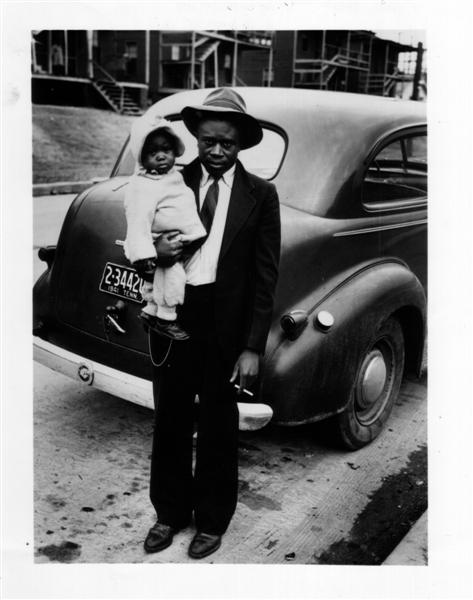
Ethnography is describing the Other. In the 1920s, writer and anthropologist Zora Neale Hurston reacted to this established view with her own artistic and scholarly works on everyday cultures in her own home in America’s black south. Hurston political and poetic studies of “folk cultures” that were mostly disparaged at the time are an expression of unmitigated appreciation and a way of taking up a position within the debate on “high” and “low” art in Harlem between the wars. This show begins with film of Hurston, the most significant artist of the “Harlem renaissance,” made during her field research, and then presents two more recent films that look in other ways at specific milieus and their rituals for creating and destabilizing community. Shirley Clarke’s film is a semi-documentary ethnography of the rituals of maleness and empowerment in the Harlem youth scene in a 1960s society shaped by racist exclusion. Lynne Sachs has made a portrait of a remarkable Afro-American pastor in Memphis in the 1930s who himself made use of film as a spiritual and social tool. Sermons and Sacred Pictures exemplifies the links between religion, art, and politics typical of the late Civil Rights Movement by looking at the documentary and activist filmmaking of one the movement’s pioneers.
Christian Kravagna is an art historian and curator. He works as professor for postcolonial studies at the Academy of Fine Arts Vienna.
Editor’s note: This is the second part of a two-part piece about Bruce Baillie made on the occasion of an international touring retrospective of his films that began with screenings in this year’s Art of the Real festival in New York. What follows are tributes to Baillie made by filmmakers with films in the Canyon Cinema catalogue, many of which are available for Fandor viewing. (Aaron Cutler)
“Damn Prescient: Ruminations on the Work of Bruce Baillie”
by Lynne Sachs
So much of what I know and love about film I discovered at the rather late age of about 25 years. Of course, I had been watching movies at every stage of my life – from Bambie to The Tin Drum to The Poseidon Adventure to the horribly violent, macho, pacifist anti-war movie Billy Jack. Each of these big-screen experiences revealed to me the broad yet powerful ways that the medium could uproot everything you believed. I walked into the theater as one person and walked out 90 minutes later profoundly different — more empathetic, more fearful, more angry. But watching these films never made me want to be a filmmaker. Keep in mind, this was well before the term “social justice” was part of our language lexicon. To my mind, once I became an adult, I would have to make the tumultuous and irrevocable decision: Would I be an artist or a human rights lawyer? Either way, I wanted to make the world a better place to live, I just had no idea how to bring together these two impulses.
In the mid 1980s, I moved to San Francisco. It didn’t take long before I discovered Canyon Cinema, a member-driven collective devoted to independent, non-commercial, experimental, avant-garde and artist-made moving images. With this revelation came my awareness of three extraordinary filmmakers: Chick Strand, Bruce Conner and Bruce Baillie, all fearless founders or leaders of this remarkable organization. Through their filmmaking and their participation in Canyon, all three expressed concern and compassion for the world through their images. By reinventing all the terms of ethnographic cinema, Chick Strand articulated an appreciation of other cultures as witnessed and embraced through her camera lens. As a pioneer in collage or found footage filmmaking, Bruce Connor turned the “garbage” of our culture industry into metaphorically resonant moving images. By the time I was living in San Francisco, Bruce Baillie had already left the Bay Area for Washington State but his legacy was still extraordinarily potent. All three artists saw their role in the community as a three fold responsibility: they would make radical movies that stretched every formal expectation of the filmic form; they would address problems they saw in our society; and, they would help other artists locally and nationally by creating an institution that would distribute their films around the world. This notion of how an artist would participate in his or her community had an immediate impact on me as I began my life as a filmmaker and an active member of the arts community in the Bay Area and later in New York City.
My first viewing of Bruce Baillie’s Mass for the Dakota Sioux (1964) sent a shiver through my body and mind that ricochets to this very day. Baillie’s twenty-minute reverie simultaneously whispers and screams. Blending graceful black and white super-impositions and edgy pop culture re-photography, he expresses the anger, pathos, shock and empathy of the period. Watching the film today, I see his subtle yet biting humor in the clever juxtapositions of sound and image. We do not see images of the Dakota Sioux but instead see an American landscape that has erased every relic of the tribe’s presence. We see the body of a dead man on a sidewalk, casual passers-by simply reckoning with the way they must step around him to continue their day. Clearly, industrial “progress” has wreaked havoc on humanity. Baillie’s intent, purposeful man on the motorcycle is not the Romantic, free wheeling figure of Dennis Hopper and Peter Fonda’s Easy Rider but instead a troubled, deep thinker on a journey into the darkest aspects of American society. With Mass for the Dakota Sioux I found a film and a filmmaker that together were capable of shifting my thinking. Way back in 1964, Bruce Baillie created a work for Occupy Wall Street, the Climate Change movement, the First Nation community, and the 99%. Damn prescient, I would say.
On March 6, 2016, University of Iowa graduate students Brittany Borghi (MFA in the Non-Fiction Writing Program) and Hannah Bonner (MA in Film Studies ) wrote this letter to me:
Dear Lynne,
My name is Brittany Borghi and I’m a graduate student in the Nonfiction Writing Program at the University of Iowa. I’m enrolled in an essay film class this semester, and this week, I’m putting together a presentation on you and your film, States of Unbelonging.
This class is the first time that I (and many of my classmates) have gone in-depth with the essay film, and we’re slowly making our way through the process of creating our own (very, very amateur films). In my very preliminary research about you, I’m finding that you seem to be extremely open to conversations about your craft and your work, and I’m wondering if it might be possible to send you a few questions from our motley crew of budding filmmakers, to share with the class on Thursday night. Since you are someone who transitioned from writing to filmmaking, it might be particularly helpful to hear more about your perspective. Also, our class is full of female filmmakers, and I know they would love to hear from you.
I’m sure you’re extremely busy, but if you wouldn’t mind me emailing you a few quick questions, I would be delighted.
I hope this email finds you well. Looking forward to hearing from you!
Best and Thanks,
Brittany Borghi
HI Brittany, this is a start for you and your class. I will try to write more tomorrow before I get on a plane but otherwise it will be finished next week.
I got through about half of your fantastic questions.
Lynne
Hi Lynne,
Sorry for the delay on this–I tried to curate some questions from my classmates and they were slow getting back to me. Feel free to answer any of these that appeal to you. It’s really exciting to be able to pull your perspective as filmmaker into our class. I hadn’t seen States of Unbelonging before taking this class, and I really loved the film. Thanks for being so generous!
Best,
Brittany
Questions:
How intentional was the visual and aural layering in the film, and what was your motivation behind that level of layering?
As with many of my films, I start out thinking the journey of the production will take me one place but the realities of the real life situation take me somewhere far different. In the case of STATES OF UNBELONGING, I actually knew the title of the film even before I began looking into Revital’s life as a filmmaker. I had felt torn about the situation in Israel, believing that the country itself had come into existence for profoundly disturbing and meaningful reasons but that the contemporary realities had become unfathomably complex. I see the ‘state’ in which Palestinians and Jews are trying to live as a pathological place where no one and everyone belong and don’t belong. Even the notion or ownership and nationhood is so contested. For this reason, I wanted the portrait of Revital to reveal my own sense of doubt and I tried to make this evident through the tensions that exist in the very fabric of the film. Throughout the film, I try to create a sense of poignancy in either the image or the sound but often not both, except for the documentary material from the kindergarten (where children talk about death) which is so powerful on its own and should not be circumvented.
I’ve read that Chantal Ackerman is an inspiration of yours, and the beginning of the film almost reads like an reimagining of News From Home. Can you talk about pulling Ackerman into this film? Were you inspired at all by Chantal’s installations, as well as her films?
Most definitely, the epistolary structure and intimacy of NEWS FROM HOME was an inspiration for me. I think that our culture has actually become more literary since the advent of email and that we are constantly hearing our friends’ and families’ voices in our heads as we read their words, these monologues then travel with us throughout the day. Cinema is particularly capable of replicating this psychological connection to another human being. Regarding Akerman’s installations, the only one I’ve seen was “D’est” (From the East) a sweeping yet somehow very human meditation on the changes brought on by the fall of the Iron Curtain in Eastern Europe. I suppose that her use of long noninflected pans across landscapes was important to me, but on the other hand I focus on one person’s life caught up in political turmoil and Akerman was, in this case, looking at a contintal gestalt.
In The Essay Film, Tim Corrigan writes, “Like an endless war, these states of unbelonging offer no place in which a self can be situated and clearly articulated. It is rather a state of perilous expectations or, as Revital’s husband describes it, a place of such intense longing that there is simply nowhere to locate the extreme sorrow of that longing.” He goes on to say that happens even in the practice of filmmaking. Did you have a position for your essayistic self before beginning States? How did you position yourself against the Israeli-Palestinian conflict? Against Revital? Against Judaism or Islam? Did making the film change those positions?
Making the film put me into the wrestling ring where I was being bounced around by every single conversation, large scale political event, suicide bomb, unwarrented settlment – – really the gamut of the the Israeli-Palestinian war was on my mind for the entire time. I was wrought by it all, but then again this was exactly what I wanted. I wanted to reckon with the dilemma in my own exploratory way. I was constantly haunted by her death, but I was not angered to the point where I wanted revenge. I will share a story related to the distribution of the film. I contacted the Jerusalem Film Festival a few months after completing the film to ask about their submission deadline. When I described the subject of the film, the secretary who happen to answer the phone told me immediately that the film would NOT be accepted into the festival because of its subject matter. I said “Why?” feeling broken-hearted that I would not be able to show the film in that highly respected festival. He then explained that all of the programmers were very progressive and would not like a movie that functioned an exposé on a terrorist act against a Jewish woman and her children. I then explained that the film is not a one-sided critique of either the murderer or the Palestinians, but rather a thought piece on the whole situation and its resonance for those of us who are far way physically but close emotionally. In the end, my collaborator Nir Zats and I were invited to the festival. And, to my great joy, Chantal Akerman was there screening “La Bas” (Down There) here own rumination on the fraught situation in the Middle East. I was able to meet her the day that the war broke out between Israel and Lebanon. A very scary day for both us in Jerusalem.
I love that we end with the innocence of your daughter’s question, which is at once so wonderfully comforting and so entirely unnerving. What was that conversation like in real life? Was it an honest revelation of hers–or a prompting for the film? Can you talk about your perspective as a woman and a mother–in relation to both Revital as a mother and filmmaker, and to the creation of States itself?
This film is very much coming from my position as a mother. I made the film BIOGRAPHY OF LILITH about ten years before and some of the issues around the creative process and its relationship to having children are in both films. Honestly, I initially thought the best way to make this film was to make an anti-documentary that would not allow me to smell, hear, feel or hear anything related to the actual place I was exploring. I was interested in using other people’s and the mainstream news’ mediations coming from every direction. Plus, this intellectual premise, this rhetorical stance, would actually provide an armor or a buffer, protecting me from the very thing that had actually killed Revital. In the end, I capitulated and ended up going to Israel to shoot. This in and of itself is problematic for those people who believe that boycotting Israel is the best way to create change. I am not convinced this is true. I wanted to challenge the status quo through the work of making the film. In this way, the core of Revital’s work as an artist and her commitment to recognizing the rights of the Palestinians was hopefully recognized by the film itself. She bravely chose to live near a Palestinian village she admired a great deal.
As Corrigan points out (and is clear in the film), our narrator shifts throughout the duration of States, and we come to eventually see the full revelation of you as narrator as Revital’s grave. Can you walk me through your decision-making process for that shifting? How did the essay take shape in that way, or when did it? Did you always intend for the audience to experience this unfolding of and with the narrator? Or was that a part of your filmmaking process? At the level of craft, your voicing is so much different at the beginning than it is even halfway through the film. What were you channeling in those opening moments of the film?
I’m enchanted by the textual and discursive distance between the narrator’s voiceover, Nir’s voiceover, the text on the screen, and the extreme diversity of rendered images. Again, echoing Corrigan, there is something Marker-esque happening on the screen–and in the mind of the viewer. It puts us on unstable ground, an obvious connection to the thematic exploration in States. Can you elaborate on your own intention with that distance, and how you made those choices? Where are you hoping to situation the audience, and your own essayistic self?
Can you get crafty with us? How many different cameras did you use when recording? How much behind-the-scenes work was happening between you and Nir, in terms of both filming and writing? What was your editing process like?
Anything else you want us to know about the film? What you wanted to do, and what you wanted us to walk away with? (We’ll have a lot to say about that in class, I’m sure, but I’d love to include that information from you.)
One more question came in from my professor, Jeff Porter, if you have time to answer!
Dear Lynne—such a compelling and subtly complex film. Thanks for fielding questions from our class. I have a number but let me keep it to one or two. At what point in figuring out your story did you realize that your gradual, visual emergence as a complete presence in the film would tie together so many narrative strings? Was there anything about the editing process that lead you to that solution?
Basically, I admitted to myself that I would be absolutely candid about my own fears, because I knew that I could not be a war photographer in any way, I knew that my sensations of ambivalence and hesitancy and curiosity were neither unusual or heroic. I was scared to be so open but it was also very much a relief. It’s true that I, as a woman with a camera , only really emerge at the end when I become a listener to Revital’s husband. This was not planned but it did somehow make sense. When I make essay films, I always end up figuring out the ending at the completion of the editing. This keep me entertained throughout the process, wondering how I will tie it all up.
Many thanks,
Jeff Porter
Lynne,
Thank you so, so much! These are so interesting to read, and the answers I shared in my presentation last week helped spur a really fascinating discussion that I don’t think we would have had otherwise. I’ll look forward to sharing the rest of them when we get back from spring break.
Creating my own brief essay film for the first time this semester is proving to be a wildly fun challenge, and I’m still not really sure how it’s going to take shape before the end of the semester. Corresponding with you has been really motivating, though. Glad to know that you feel like I “got” your film. The genre has been new to me this semester, and I’m absolutely loving it. Any parting advice for someone slowly trudging through this study and work?
When will TIP OF MY TONGUE come out? I’ll be looking forward to it!
You’re great, this has been great, and again, I really do appreciate it.
All of Lynne Sachs‘ films blur the lines between avant-garde, documentary and narrative, but few employ as many different styles and mediums as States of Unbelonging. This essay film, as much rumination as documentary, traces Sachs’ three-year journey to learn about Revital Ohayon, an Israeli filmmaker killed in her home with her two children during the conflict of 2002.
To explore Ohayon’s life, as well as her own anxiety about death, conflict and distance, Sachs uses TV news/documentary, her own impressionistic footage from New York, her collaborator Nir Zats’ serene “objective” videos from Israel, super 8 shots of Ohayon’s kibbutz, clips from Ohayon’s narrative films, home movies and straightforward interviews with the victim’s family. “The Medium & The Message: 7 Forms of Filmmaking in States of Unbelonging” examines each of these strategies in turn. Appropriately, this video essay not only reflects the removed analysis of the filmmaker’s work but also the path of my own emotional engagement with the material.
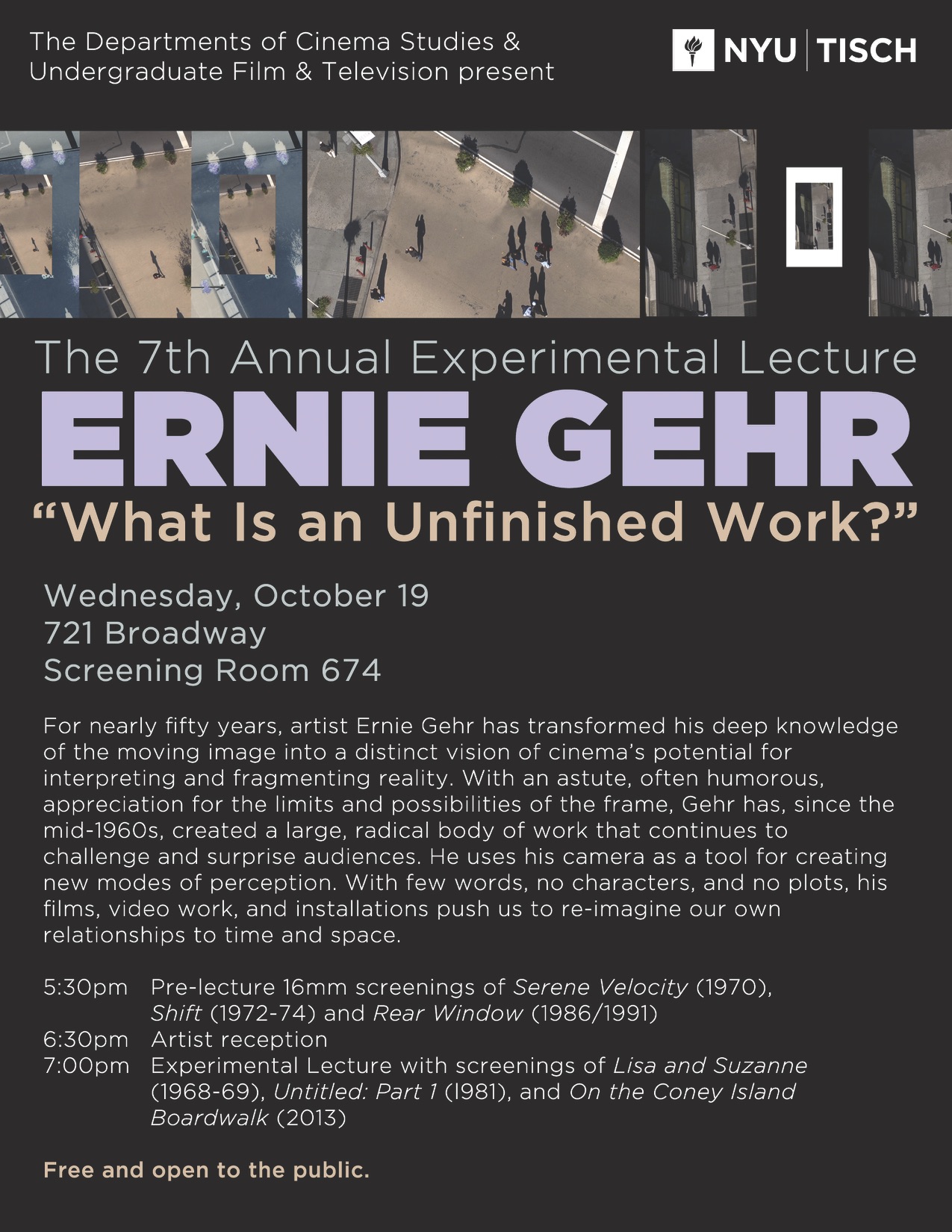
NYU Department of Cinema Studies, Tisch School of the Arts 721 Broadway, 6th Floor, Rm. 674 Free and open to the public
LISTEN TO ERNIE GEHR’S LECTURE HERE:
For nearly fifty years, artist Ernie Gehr has transformed his deep knowledge of the moving image into a distinct vision of cinema’s potential for interpreting and fragmenting reality. With an astute, often humorous, appreciation for the limits and possibilities of the frame, Gehr has, since the mid-1960s, created a large, radical body of work that continues to challenge and surprise audiences. He uses his camera as a tool for creating new modes of perception. With few words, no characters, and no plots, his films, video work, and installations push us to re-imagine our own relationships to time and space.
There are a multiplicity of adjectives that fit Ernie Gehr’s experimental film and digital work: abstract, beautiful, mysterious, invigorating, utopian. — Manohla Dargis, New York Times, 11/11/11
In Gehr’s hands, the camera seems to take on magical properties, able to transform the most quotidian object or environment –– the pattern of sunlight on a wall, a busy street — into marvelous and unexpected phenomena. — Ernie Gehr’s Marvelous Cinema, Harvard Film Archive
Join us for screenings at 5:30 and Gehr’s Experimental Lecutre at 7:00.
5:30 Pre-lecture 16mm screening of Serene Velocity (1970), Shift (1972-74) and Rear Window (1986/1991)
6:30 Artist reception
7:00 Experimental Lecture with screenings of Lisa and Suzanne (1969-79), Untitled: Part 1 (l981), On the Coney Island Boardwalk (2010)