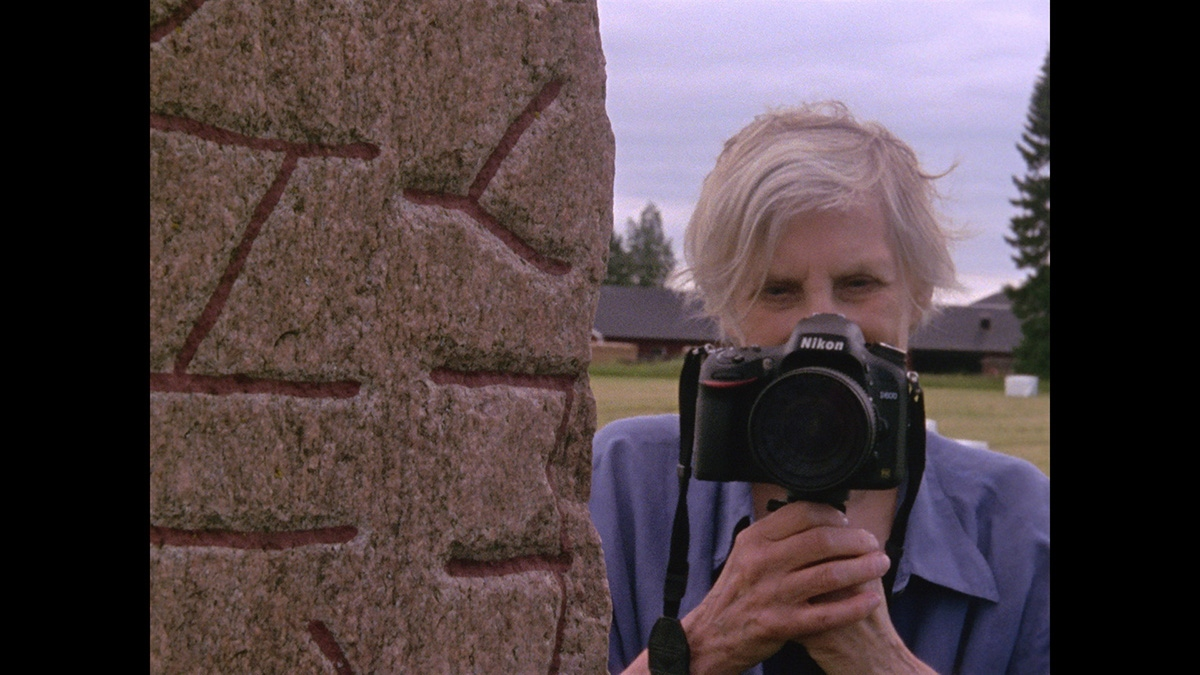
The pioneering lesbian experimental filmmaker Barbara Hammer produced more than 80 films between 1968 and 2019; this program showcases an array of works that explore her artistic output, her as a being, and the ripple effects both continue to have. The filmmaker began this process herself while she was alive—Audience offers a playful array of snippets from conversations about her work with attendees of numerous screenings. The program goes on to move through films by filmmakers who were/are in conversation with Hammer—from engaging in her practices to making homages, writing letters, and (upon Hammer’s invitation) even using her footage.
Audience (1982) Dir. Barbara Hammer 32min
Love, Barbara (2022) Dir. Brydie O’Connor 15min
Untitled (Dyketactics Revisited) (2005) Dir. Liz Rosenfeld 13min
Carolee, Barbara and Gunvor (2018) Dir. Lynne Sachs 9min
A Video Letter to Barbara Hammer (2018) Dir. Joey Carducci 17min
A Month of Single Frames (2019) Dir. Lynne Sachs 14min
Gunvor Nelson (1931–2025) was an acclaimed Swedish experimental filmmaker who made the Bay Area her home for nearly four decades. Born and raised in Kristinehamn, Sweden, she originally came to California in 1953 to study art and art history, first at Humboldt State College, then the San Francisco Art Institute (SFAI), and finally Mills College, where she earned an MFA in painting. Between 1970 and 1992, she taught at SFAI, where she influenced generations of filmmakers. In 1993 she returned to Sweden and shifted her practice from 16mm filmmaking to digital video.
Over the years, Nelson made personal films that explored her own life and experiences. She thought deeply and freely about film editing and about when to use sound or allow a film to be silent. She collaborated with Dorothy Wiley on five films, three of which are included in this tribute: Schmeerguntz, Fog Pumas, and Before Need Redressed. BAMPFA holds Nelson’s 16mm camera originals and copies of her films in our film vault. In 2019 My Name Is Oona was named to the Library of Congress’s National Film Registry.
Films in this Screening
Carolee, Barbara & Gunvor Lynne Sachs, United States, 2018
Red Shift Gunvor Nelson, United States, Sweden, 1984
Before Need Redressed Gunvor Nelson, Dorothy Wiley, United States, Sweden, 1994
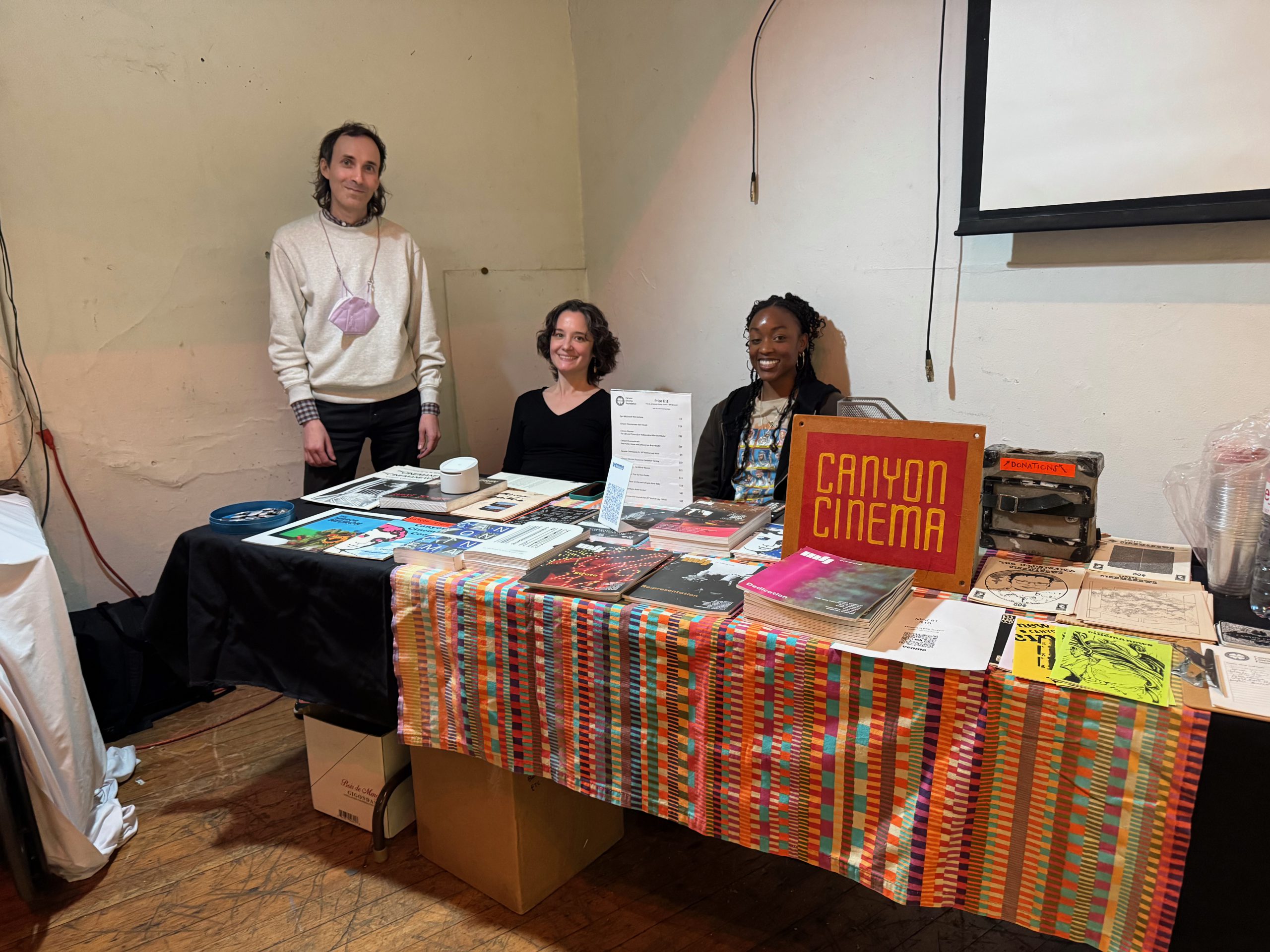
Dedication: A Salon with Millennium Film Journal Wednesday, May 14, 2025 @ 7:30pm (doors 7pm) Artists’ Television Access, 992 Valencia Street, San Francisco
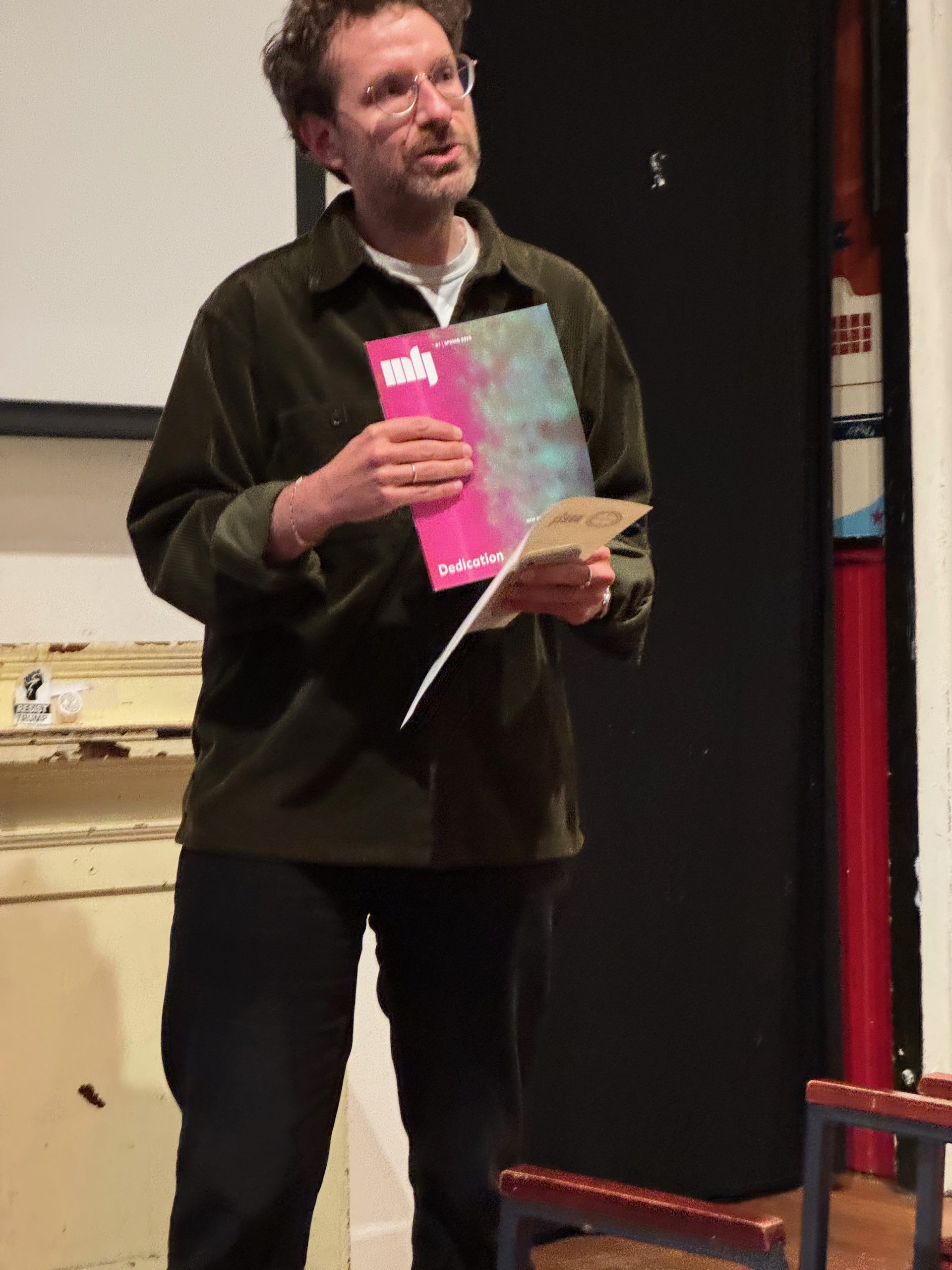
Lynne Sachs, Jenni Olson, Canyon ED Brett Kashmere, and MFJ Editor Nicholas Gamso in person!
This selection of short moving image pieces—all discussed in recent issues of the Millennium Film Journal—will celebrate the release of MFJ no. 81, “Dedication.”
The new edition testifies to the grief we’ve felt over the last several months, amid drastic cuts to vital social services, worsening climate disasters (most acutely the LA wildfires), and dimmed hopes of humanitarian justice. These struggles are especially hard to bear in the absence of those artists who’ve helped us to see and better understand ourselves, and whose work remains a comfort even as it challenges and provokes. We want, then, to meet the experience of loss with renewed commitments at the scale of a battered world, certainly, yet also among our community of moving image artists and writers.
The screening will include film and video works by Vincent Grenier, Gunvor Nelson, Lynne Sachs, Steve Reinke, Eva Giolo, Jenni Olson, Chris Kennedy, as well as the West Coast premiere of Kevin Jerome Everson’s Practice, Practice, Practice (2024), which takes place at San Francisco City Hall.
We are pleased to be joined by filmmakers Lynne Sachs, who will speak on her friendship with Gunvor Nelson, and Jenni Olson.
As always, this Salon event is free and open to the public, with refreshments served beginning at 7pm and the doors closed for the start of the show at 7:30.
Practice, Practice, Practice (Kevin Jerome Everson, 2024, 10 minutes)
The Demands of Ordinary Devotion (Eva Giolo, 2022, 12 minutes)
Sundown (Steve Reinke, 2023, 7.5 minutes)
Tabula Rasa (Vincent Grenier, 1993-2004, 7.5 minutes)
Carolee, Barbara, and Gunvor (Lynne Sachs, 2018, 9 minutes)
One and the Same (Gunvor Nelson, with Freude, 1973, 4 minutes) – 16mm
Approximate running time: 65 minutes, with discussion to follow
About Millennium Film Journal
The Millennium Film Journal is the longest-running publication devoted to artists’ cinema. Its mission is to provide in-depth writing on a field that has, in recent decades, been recognized as the most generative and exciting area of contemporary art. MFJ’s coverage extends to experimental film in all formats, digital media projects, museum installations, festivals, and public artworks from the earliest days of the pre- cinematic into the possibly non-objective future.
Since its inception in 1978, the journal has served as the premier forum for cinema criticism in America, and at the forefront of film writing as a creative practice, with contributions by leading voices such as Amy Taubin, J. Hoberman, Peter Wollen, Joan Copjec, Ed Halter, and Laura Marks, alongside contributions from filmmakers Yvonne Rainer, Carolee Schneemann, Barbara Hammer, Cauleen Smith, the Kuchar brothers, and many, many others. Though we operate across multiple platforms, our journal is committed to print publishing, and to grappling with the ever-evolving relation between moving images and the stable surface of the printed page.
MFJ is affiliated with the Millennium Film Workshop, a center of production and exhibition activity in New York City. The Workshop was founded in 1967 by a group of artists with a vision to expand accessibility to the tools, ideas, and networks of filmmaking beyond the confines of institutions and corporate studios.
The Canyon Cinema Salon series is made possible with generous support from the Hobson/Lucas Family Foundation, the Owsley Brown III Philanthropic Foundation, and the City of San Francisco Grants for the Arts.
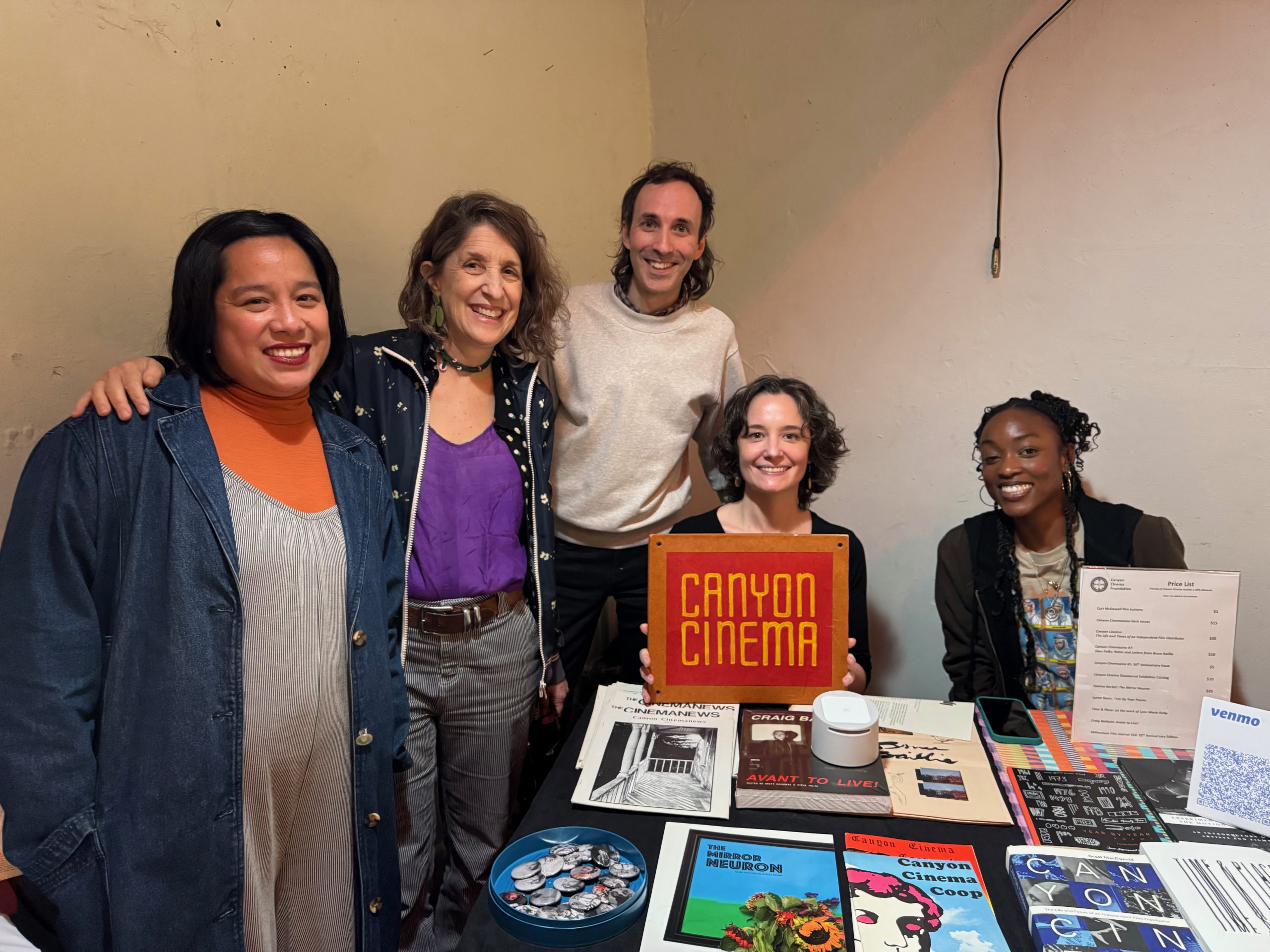
Canyon Cinema Executive Director Brett Kashmere, Distribution assistant Ashley Rose Tacheira and Autumn ArmstrongCanyon Cinema Staff and Board of Directors members Lian Ladia and Lynne SachsMFJ Editor Nicholas Gamzo
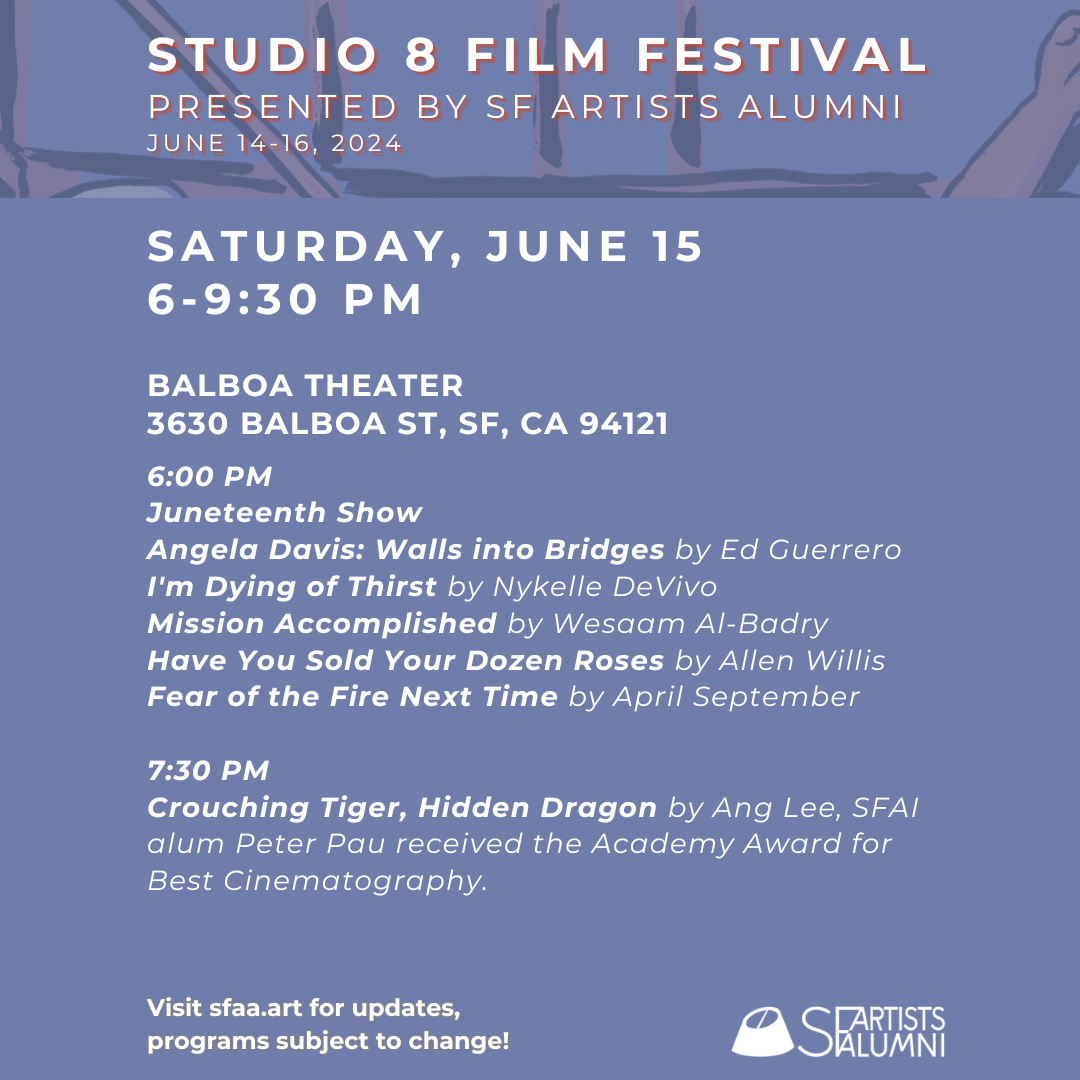
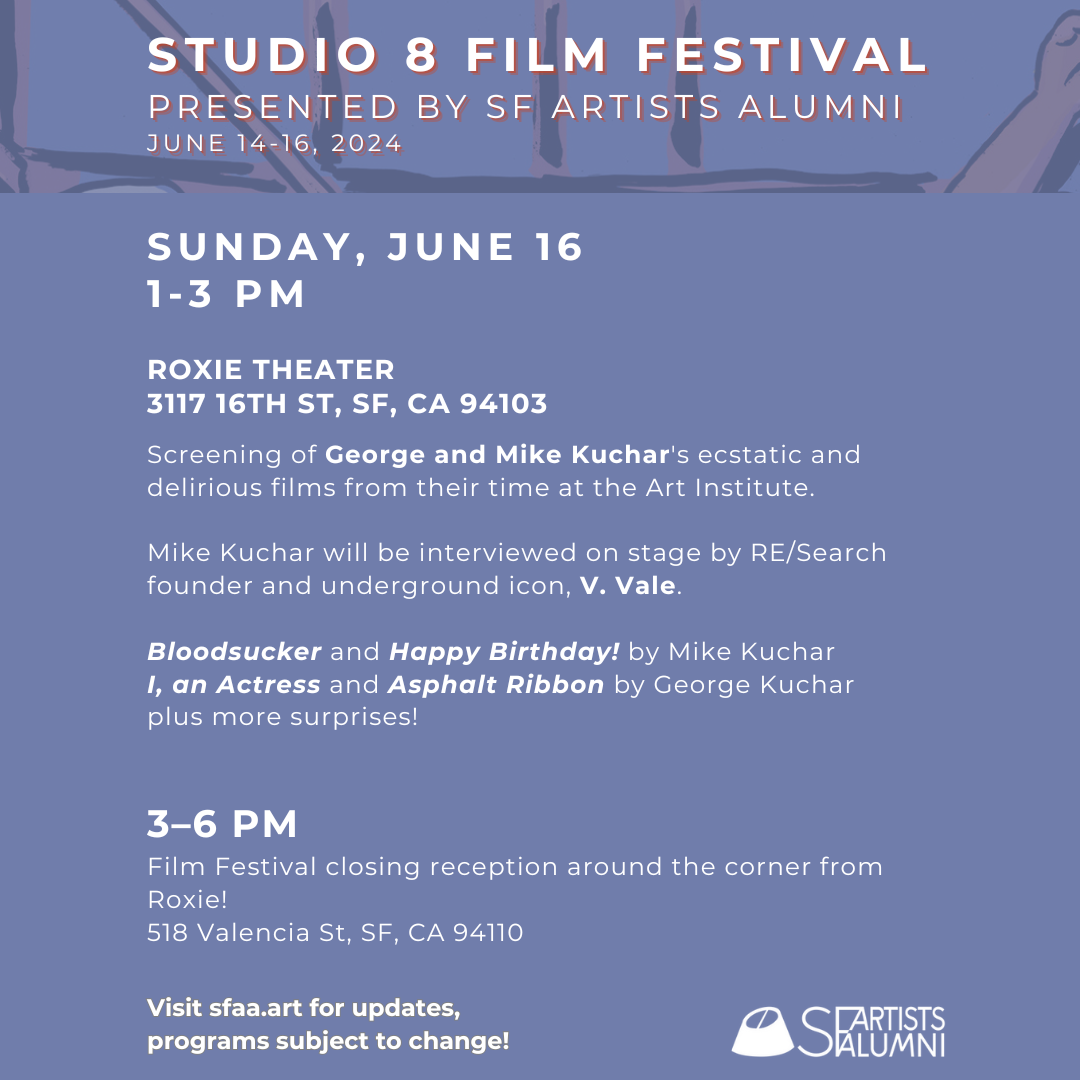
A celebration of filmmaking featuring San Francisco Art Institute STARS past & present including George & Mike Kuchar, Peter Pau, Jibz Cameron aka Dynasty Handbag, Allen Willis plus more!
3 days of films, screened at 3 Bay-Area cinemas, Filmmakers (famous and infamous!) all from SFAI.
Named after the legendary Studio 8 at SFAI’s 800 Chestnut Campus, this will be the inaugural Studio 8 Film Festival presenting works by SFAI alumni and former faculty!
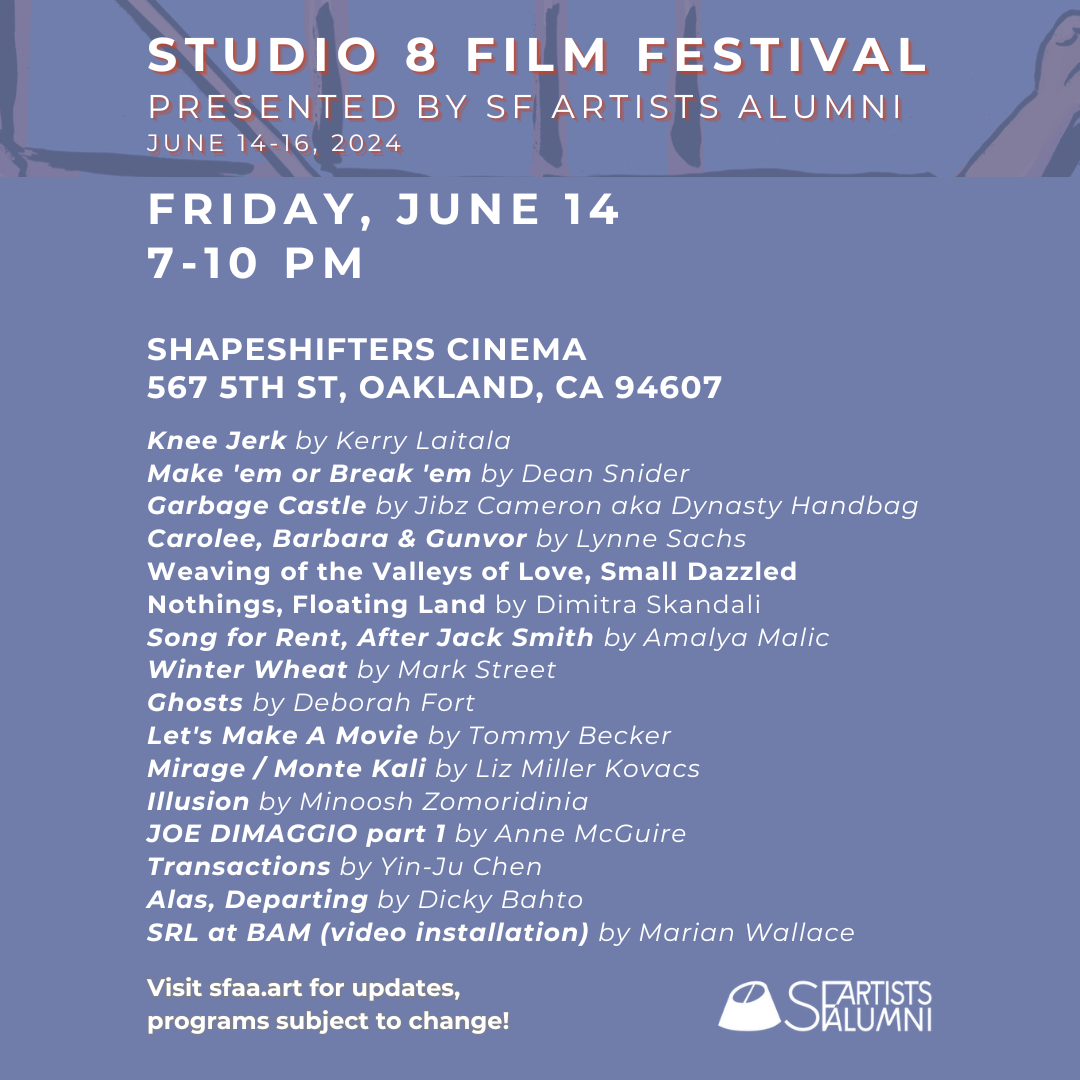
Opening Night Shorts Program Shapeshifters Cinema June 14th 2024 7:00pm
The STUDIO 8 Film Festival is a 3-day event organized by the SF Artists Alumni Association to showcase the work of filmmakers who honed their craft while students at the legendary (and now-closed) San Francisco Art Institute. The opening night program features short films by Jibz Cameron, Deborah Fort, Dean Snider, Kerry Laitala, Minoosh Zomorodinia, Dimitra Skandali, Liz Miller Kovacs, Lynne Sachs, Mark Street, Yin-Ju Chen, Dicky Bahto, Tommy Becker, Anne McGuire and Malic Amalya.
Juneteenth Show The Balboa Theatre June 15th 2024 6:00pm Angela Davis: Walls into Bridges Ed Guerrero plus shorts by Allen Willis, Nykelle Devivo, April September, Wesaam Al Badry, and others.
Crouching Tiger, Hidden Dragon Ang Lee The Balboa Theatre June 15th 2024 7:30pm
Each year Screen Slate invites our dozens of contributors—along with filmmakers, critics, performers, programmers, cinema workers, community organizers, and other friends—to submit their lists of favorite “First Viewings and Discoveries.”
Some of the many special guests this year include Isabelle Huppert, Wim Wenders, Illeana Douglas, Paul Schrader, Isabel Sandoval, John Wilson, Mets director John DeMarsico, Elsie Fisher, Michael Almereyda, Lila Avilés, Radu Jude, and several filmmakers whose work appears in our top 20, such as Frederick Wiseman (Menus-Plaisirs – Les Troisgros), Ira Sachs (Passages), Claire Simon (Our Body), Daniel Goldhaber (How to Blow Up a Pipeline), and Samy Burch (screenwriter, May December). Responses appear below in the format they were submitted, along with individual “Best of 2023” ballots if submitted.
For the aggregated Best of 2023 list tabulated from these responses, visit here, and see also Amy Taubin’s Top Ten, pulled from the December issue of Artforum. Our annual end-of-year poll is guest edited by Nicolas Rapold. Art: Steak Mtn. Editorial assistance: Lauren Lee.
Much gratitude to our community for the responses, and look forward to seeing you at the movies in 2024!
Simone Barbes or Virtue (Marie-Claude Treilhou, 1980)
The Mark of Lilith (Bruna Fionda, Polly Gladwin, Zach Mack-Nataf, 1986)
The Incredibly True Adventure of Two Girls in Love (Maria Maggenti, 1995)
MURDER and murder (Yvonne Rainer, 1996)
Carolee, Barbara & Gunvor (Lynne Sachs, 2018)
A selection of these films and more will screen at Film Forum in February 2024 as part of the two-week series, Sapph-O-Rama!, a celebration of the lesbian film canon and a survey of sapphic cinema through the last century. Programmed by Emily Greenberg and myself.
Tuesday, December 19, 2023 18:00 The program is carried out in cooperation with the Museum of Modern and Contemporary Art Rijeka, Croatia. Entrance is free.
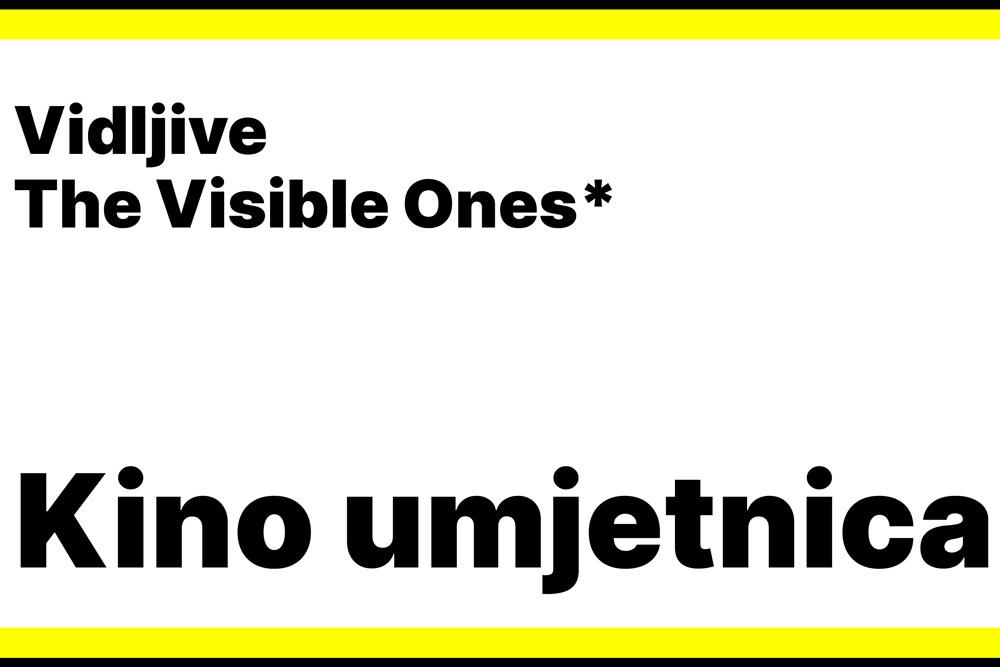
Kino umjetnica (Cinema artist) is a complementary film and video program conceived as a side program to The Visible Ones exhibition, which will be realized from December 15, 2023 to February 6, 2024 at the Museum of Modern and Contemporary Art, as a project of inter-museum collaboration between five museums (MSU Zagreb, MMSU Rijeka , Art Gallery Split, Art Gallery Dubrovnik, Museum of Fine Arts Osijek). The exhibition presents an overview of the recent work of female artists, in order to raise awareness of the need for equal visibility and representation of female artists in museum collections and exhibition programs. The production of female authors covers a wide range of topics and sensibilities and represents more than ninety female authors, and is the result of research into the representation of female artists in the art collections of museum institutions. At the same time, it presents certain aspects and mapping of the contemporary artistic practice of female authors in Croatia.
The Kino umjenica screening program is performed in the form of a dislocated dispositif from the museum’s white cube into a cinema hall or black box, in order to further expand the context and direct the focus towards the rich and diverse audiovisual production of female artists, which is formed precisely in the intermediate space of contemporary art and film. It includes two programs Topographies, Spaces, Gaps (MMSU 16.12) and Woman in the Mirror (Art-kino 19.12).
As part of the Woman in the Mirror program, three films will be shown – The Cat is Always a Woman directed by Martina Meštrović, Carolee, Barbara & Gunvor by Lynne Sachs and Woman in the Mirror by Jagoda Kaloper.
Correspondence between Programmer Branka Bencic and Lynne:
“Dear Lynne, hope you are well I am getting back in touch since I would like to organize a screening and bring back together works CAROLEE, BARBARA AND GUNVOR by Lynne and A Cat is Always Female by Martina Mestrovic and Tanja Vujasinovic along with a experimental documentary by Jagoda Kaloper Woman in a Mirror (2011, 47 min) It is 1 cinema screening. It would take place at Art Kino in Rijeka, Croatia on Dec 19th, 2023…
Jagoda Kaloper was an actress and visual artist working with Jugoslav directors such as Dusan Makavejev, starring in WR Mysteries of Organism, Krsto Papic etc… This is her autobiographic visual essay.
Branka Bencic”
“Hello Branka,
I am so glad that we were able to work out this screening plan for “Carolee, Barbara and Gunvor” to be included in your program Visible (visibility of woman artists in museum collections). I have now read about Jagoda Kaloper. I have seen Makavejev’s WR but I was not aware of her name until you wrote to us. The first time that I saw WR was in San Francisco in the mid 1980s and Makavejev was there in the room. I remember timidly/ boldly (not sure which?) raising my hand to ask a question from the audience. He seemed to be offended by something I said, and I remember feeling a bit embarrassed and a bit proud, all mixed into one emotion. Anyway, if you have more info on Jagoda please send it along. All the best, Lynne”
“Dear Lynne
As promised, I am sending you an essay I wrote in 2011 about Jagoda Kaloper’s film Woman in a Mirror, when the film was produced Jagoda was an amazing woman, gentle, and full of stories, she took part in the student movement in 1968, hang out in the famous marxist summer school Praxis in the island of Korčula late 60s https://en.wikipedia.org/wiki/Praxis_School#Kor%C4%8Dula_Summer_School
she was famous actress starring in Yugoslav cinema including Makavejev
also, she was a visual artist that imagined first land art pieces in Yugoslavia and Croatia and interventions in public space in early 70s and worked as a graphic designer
Best regards
Branka”
Original Text in Croatian: Kino umjetnica komplementaran je filmski i video program zamišljen kao popratni program uz izložbu Vidljive, koja se realizira od 15. prosinca 2023. do 6. veljače 2024. u Muzeju moderne i suvremene umjetnosti, kao projekt međumuzejske suradnje pet muzeja (MSU Zagreb, MMSU Rijeka, Galerija umjetnina Split, Umjetnička galerija Dubrovnik, Muzej likovnih umjetnosti Osijek). Izložba predstavlja pregled recentnog stvaralaštva umjetnica, kako bi se osvijestila nužnost za ravnopravnom vidljivošću i zastupljenošću umjetnica u muzejskim kolekcijama i izložbenim programima. Produkcija autorica obuhvaća širok raspon tema i senzibiliteta te predstavlja više od devedeset autorica, a plod je istraživanja zastupljenosti umjetnica u umjetničkim zbirkama muzejskih institucija. Ujedno predstavlja određene aspekte i mapiranje suvremene umjetničke prakse autorica u Hrvatskoj.
Program projekcija Kino umjetnica izvodi se u obliku dislociranog dispozitiva iz muzejske bijele kocke u kino dvoranu ili black box, kako bi dodatno proširio kontekst i usmjerio fokus prema bogatoj i raznolikoj audiovizualnoj produkciji umjetnica koja se formira upravo u međuprostoru suvremene umjetnosti i filma. Obuhvaća dva programa Topografije, prostori, praznine (MMSU 16. 12) i Žena u ogledalu (Art-kino 19. 12).
U sklopu progrma Žena u ogledalu prikazat će se tri filma– Mačka je uvijek ženska u režiji Martine Meštrović, Carolee, Barbara & Gunvor autorice Lynne Sachs te Žena u ogledaluJagode Kaloper.
Lynne’s first film to be included in the Swedish Collection, Filmform. This film includes Gunvor Nelson who is one of the greatest Swedish experimental filmmakers.
“Gunvor Nelson is one of the most highly acclaimed filmmakers in classic American avant-garde film. She grew up in Kristinehamn. (born 1931). Her mother was a teacher and her father was the owner and editor-in-chief of the local newspaper, Kristinehamns-Posten. On leaving school she studied at the University College of Arts, Crafts and Design in Stockholm, but moved to the US and California in 1953 to study art and art history.
Nelson met her husband-to-be Robert Nelson when she was studying at the California School of Fine Arts (from 1961 onwards, the San Francisco Art Institute). Robert Nelson is one of the great humorists of the American avant-garde. The Nelsons were a vital part of the new film culture that evolved in the San Francisco area and they played a key role in one of America’s oldest and most respected film cooperatives, the Canyon Cinema.
Gunvor Nelson made her first two films together with Dorothy Wiley, wife of the artist William T. Wiley, who in turn made films with Robert Nelson. Gunvor Nelson and Dorothy Wiley’s debut Schmeerguntz (1966) is a humorous and grotesque feminist classic in which the everyday reality of a young mother is contrasted with the ideal of the American woman.
An uncompromising filmmaker, Nelson has a unique voice in experimental cinema. She regards her own works as “personal films”, a recurring element of which is the connection with her own life and experiences. The early films are based around the experiences of a younger woman, culminating in My Name Is Oona (1969), an expressive portrait of her daughter, and Moons Pool (1973), an existentially expressive underwater journey which centres on her own body.
With Trollstenen (‘The Magic Stone’, 1976), which centres on Nelson’s family and upbringing, she began a series of films about Kristinehamn and her family. Typically for Nelson, elements which are local and private fuse together with the general and universal. Nelson’s family and generational study Red Shift (1984), and her painfully sensitive portrayal of her dying mother in Time Being (1991) are regarded as the high points of her family and hometown productions.
Around this time (1983-1990) Nelson also made a total of five different collage films at Filmverkstan in Stockholm, works which give free rein to her own associations and her experimentation with animated images. These films are often regarded both as Nelson’s most demanding and most creative works. Nelson moved back to Kristinehamn and Sweden in December 1992, a homecoming already hinted at in her rhythmically edited collage film Frame Line (1983). Having returned to Sweden she quickly moved on to digital video and was rediscovered in Swedish art circles, resulting in a number of awards and retrospectives both at home and abroad.
Gunvor Nelson has also influenced several generations of filmmakers in her role as a teacher, primarily at the San Francisco Art Institute (1970-1992).” -Filmform
Filmform (est. 1950) is dedicated to preservation, promotion and worldwide distribution of experimental film and video art. Constantly expanding, the distribution catalogue spans from 1924 to the present, including works by Sweden’s most prominent artists and filmmakers, available to rent for public screenings and exhibitions as well as for educational purposes.
Carolee, Barbara & Gunvor
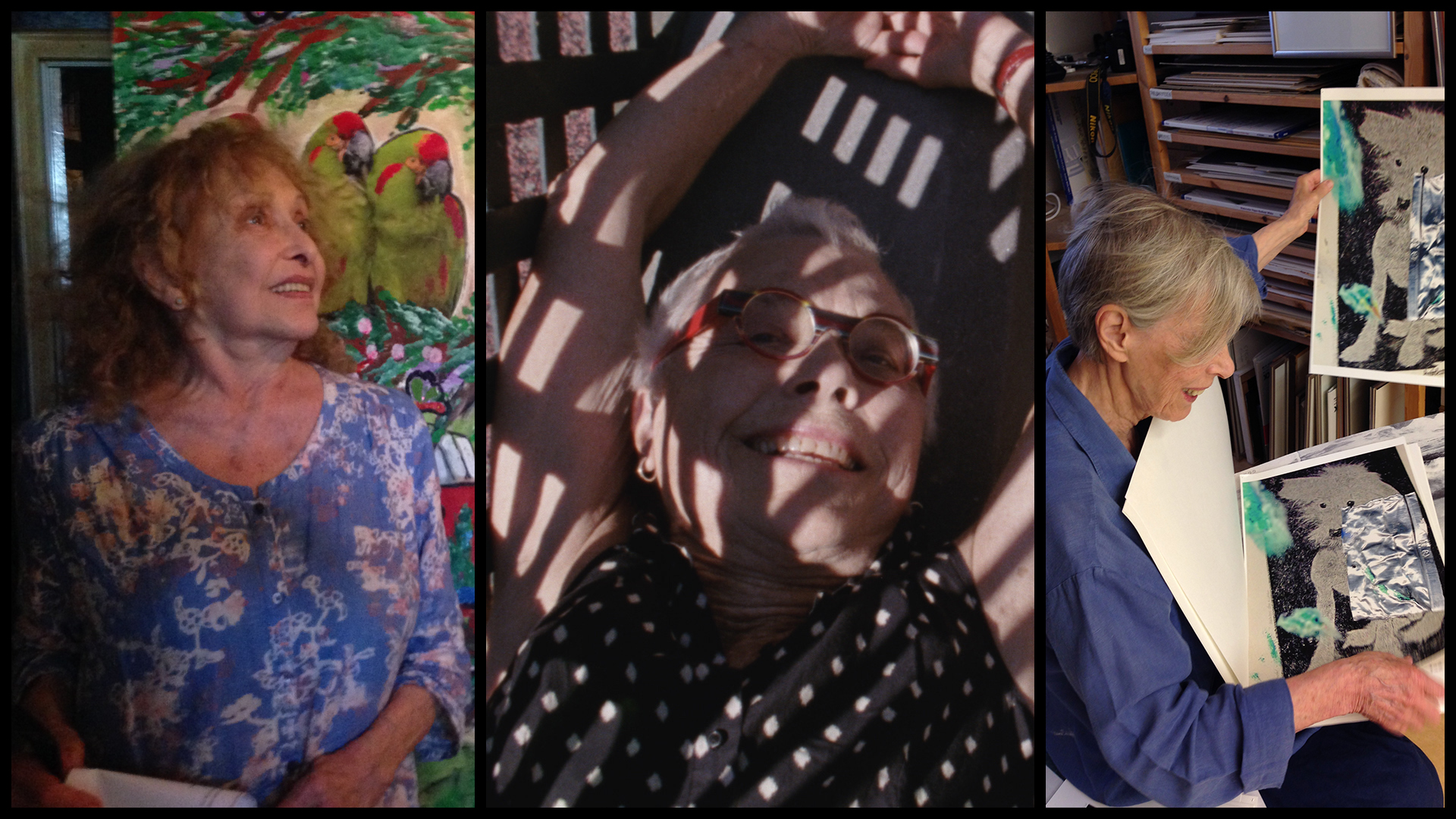
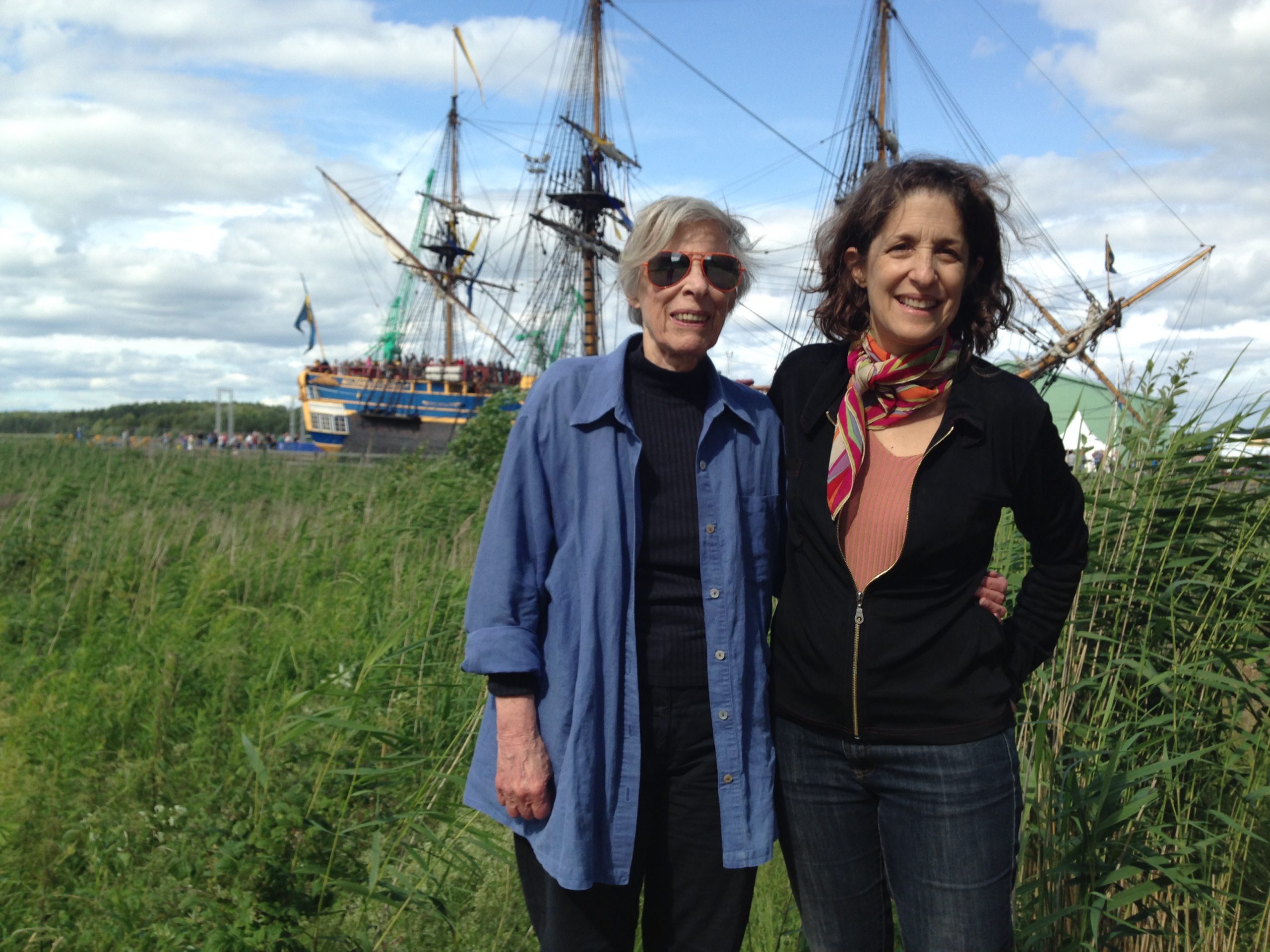
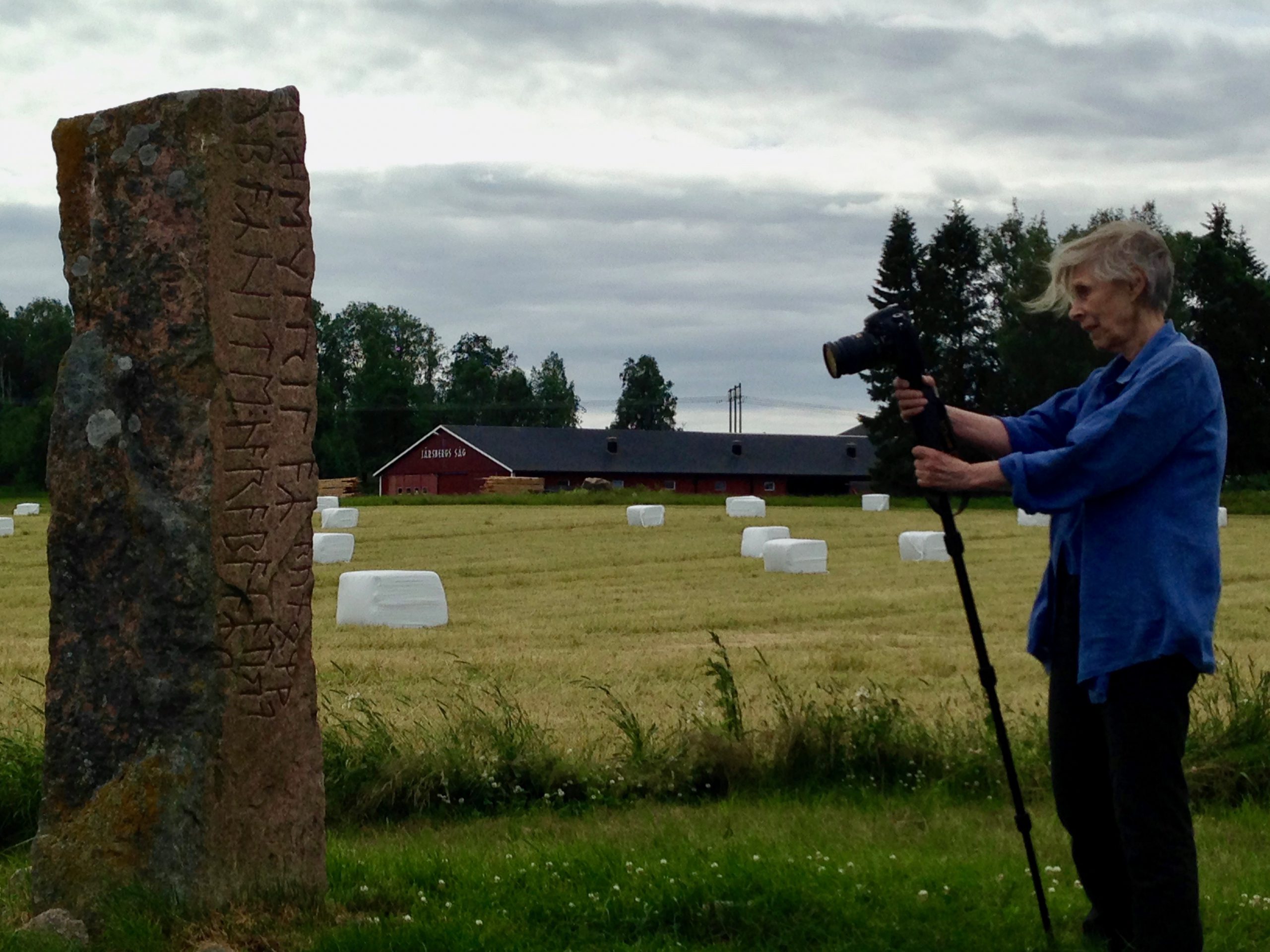
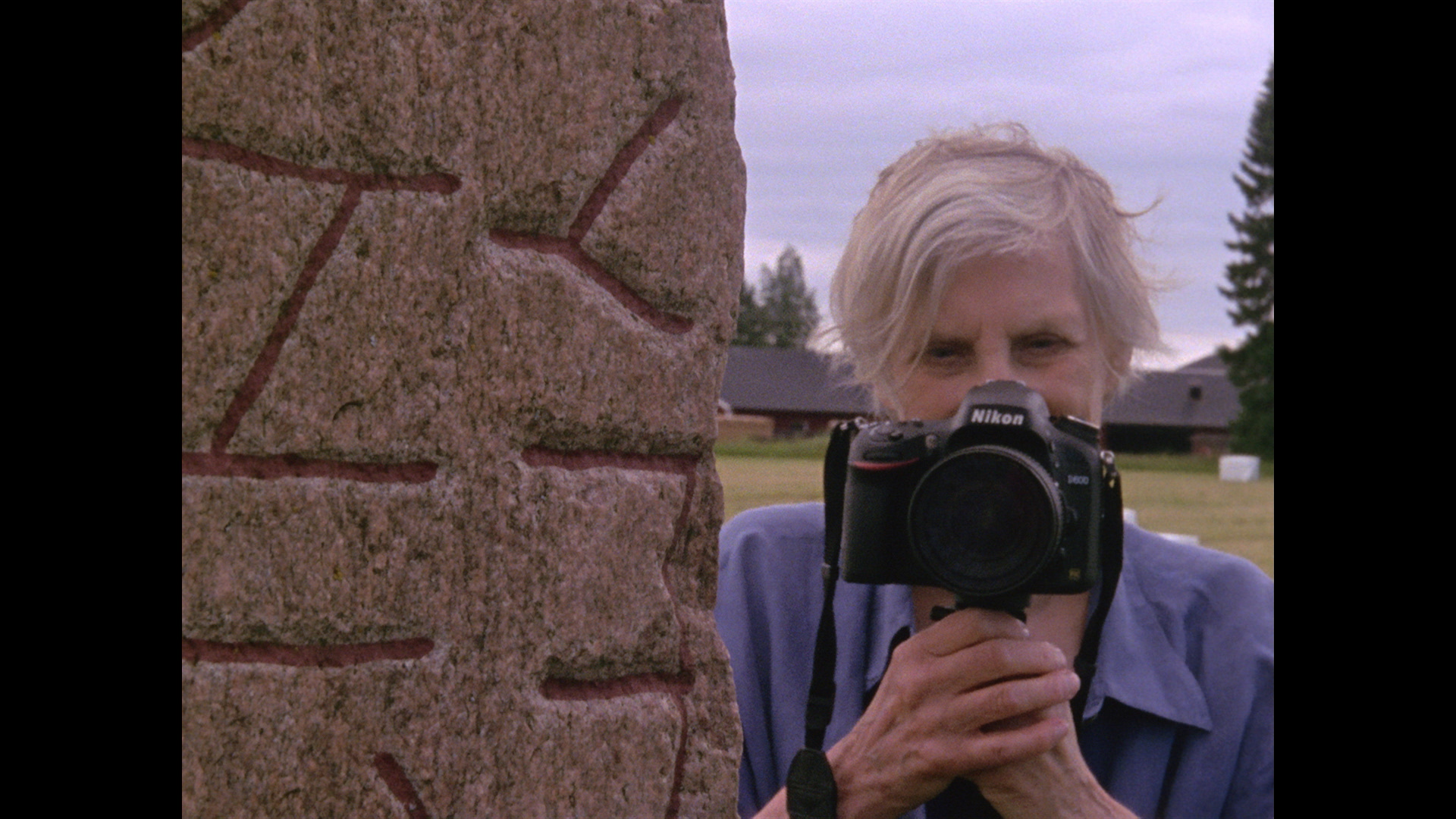
From 2015 to 2017, Lynne Sachs visited with Carolee Schneemann, Barbara Hammer and Gunvor Nelson, three multi-faceted artists who have embraced the moving image throughout their lives. From Carolee’s 18th Century house in the woods of Upstate New York to Barbara’s West Village studio to Gunvor’s childhood village in Sweden, Lynne shoots film with each woman in the place where she finds grounding and spark.
The 5th Experimental Film Festival Process will take place from 17 to 21 May in Riga, Latvia.
Wednesday, 17 May 18:00, Vagonu Hall
Noise Spectrum Frequencies
Curators: Kristaps Epners, Rvīns Varde, Adriāna Roze, Mailo Štern, Rihards T. Endriksons, Marija Luīze Meļķe, Artis Svece
We approached seven people from different fields whose thoughts we resonate with. We asked them to choose one of the submitted films that they feel in some way connected to. This kaleidoscopic programme consists of works selected by this varied group of curators, celebrating the different perspectives, sensibilities and approaches on the side of filmmakers as well as spectators.
Carolee, Barbara & Gunvor. Lynne Sachs
US / 2018 / 8′ / sound / 16mm to digital
Skyscraper Film. Federica Foglia
Italy / 2023 / 8′ / sound / 16mm to digital
Sight Leak. Zuqiang Peng
China / 2022 / 12′ / sound / Super 8, 16mm to digital
Sky Room. Marianna Milhorat
US / 2017 / 6′ / sound / 16mm, 35mm to digital
Potemkin Piece. Justin Clifford Rhody
US / 2022 / 1′ / sound / 35mm to digital
Ashes by name is man / Popiół imieniem jest człowieka. Ewelina Rosińska
Poland, Germany / 2023 / 20′ / sound / 16mm to digital
The 5th Experimental Film Festival Process will take place from 17 to 21 May in Riga, Latvia.
Organized by the artist-run film lab Baltic Analog Lab, the festival is dedicated to the diverse analog cinema practices employed by adventurous audiovisual artists from around the world. The programme comprises film screenings, live performances, installations, talks, and, of course, parties.
This year, Process will explore the subject of “noise spectrum”, looking at different forms of noise as a physical, mental and social phenomenon: a noise that’s capable of both disruption and connection.
In collaboration with the SPECTRAL project carried out by six European artist-run filmlabs, this year’s festival will pay special attention to the practice of expanded cinema, exhibiting performances in three curated programmes as well as at the opening night.
Beside focus programmes and events, Process will present three programmes of short films made by various international artists. This time the programmes were selected by guest-curators Aurélie Percevault (Mire, France), Ulrich Ziemons (Arsenal, Germany), as well as Lāsma Bērtule and Ieva Balode (Baltic Analog Lab, Latvia).
The Festival is supported by the State Culture Capital Foundation of Latvia, Ministry of Culture of Latvia, Riga City Council and Creative Europe.
144 Moody StreetBuilding 18Waltham, MA, United States (map)
A night of short films and discussion with legendary filmmaker Lynne Sachs featuring some of her works on/about/alongside women be they daughters, mentors, idols or friends.
Lynne Sachs will attend in person for a post-screening discussion.
FILM PROGRAM – Screening order subject to change
Photograph of Wind| 4 min | 16mm | b&w and color | silent | 2001 My daughter’s name is Maya. I’ve been told that the word maya means illusion in Hindu philosophy. As I watch her growing up, spinning like a top around me, I realize that her childhood is not something I can grasp but rather – like the wind – something I feel tenderly brushing across my cheek. Screened in 16mm.
Noa, Noa | 8 min | b&w and color | sound | 2006 by Lynne Sachs with Noa Street-Sachs Over the course of three years, Sachs collaborated with her daughter Noa (from 5 to 8 years old), criss-crossing the wooded landscapes of Brooklyn with camera and costumes in hand. Noa’s grand finale is her own rendition of the bluegrass classic “Crawdad Song”.
Same Stream Twice | 4 min | 16mm | b & w and color | silent | 2012 by Lynne Sachs with Maya Street-Sachs My daughter’s name is Maya. I’ve been told that the word maya means illusion in Hindu philosophy. In 2001, I photographed her at six years old, spinning like a top around me. Even then, I realized that her childhood was not something I could grasp but rather – like the wind – something I could feel tenderly brushing across my cheek. Eleven years later, I pull out my 16mm Bolex camera once again and she allows me to film her – different but somehow the same.
“And Then We Marched” | 3 min |S8mm | sound | 2017 Lynne shoots Super 8mm film of the Jan. 21 Women’s March in Washington, D.C. and intercuts this recent footage with archival material of early 20th Century Suffragists marching for the right to vote, 1960s antiwar activists and 1970s advocates for the Equal Rights Amendment. Lynne then talks about the experience of marching with her seven-year old neighbor who offers disarmingly insightful observations on the meaning of their shared actions.
Carolee, Barbara & Gunvor | 8 min | Super 8mm and 16mm film transferred to digital | 2018 Three renowned women artists discuss their passion for filmmaking. From 2015 to 2017, Lynne visited with Carolee Schneemann, Barbara Hammer and Gunvor Nelson, three multi-faceted artists who have embraced the moving image throughout their lives. From Carolee’s 18th Century house in the woods of Upstate New York to Barbara’s West Village studio to Gunvor’s childhood village in Sweden, Lynne shoots film with each woman in the place where she finds grounding and spark.
A Year in Notes and Numbers | 4 min | video | silent | 2018 A year’s worth of to-do lists confronts the unavoidable numbers that are part and parcel of an annual visit to the doctor. The quotidian and the corporeal mingle and mix. Family commitments, errands and artistic effusions trade places with the daunting reality of sugar, cholesterol, and bone.
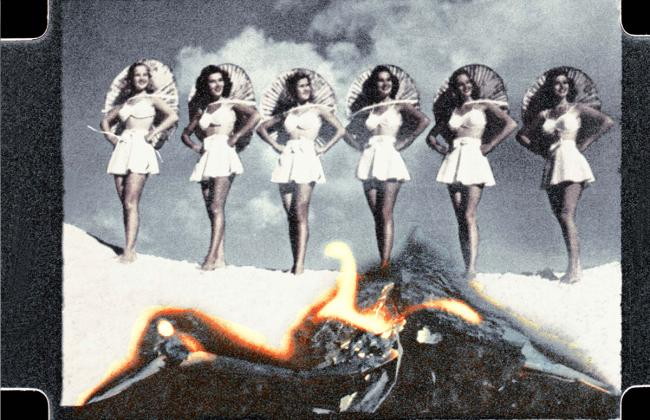
A Month of Single Frames| 4 min | color | sound | 2019 In 1998, filmmaker Barbara Hammer had a one-month artist residency in Cape Cod. While there, she shot 16mm film, recorded sounds and kept a journal. In 2018, Barbara began her own process of dying by revisiting her personal archive. She gave all of her Duneshack materials to Lynne and invited her to make a film. “While editing the film, the words on the screen came to me in a dream. I was really trying to figure out a way to talk to the experience of solitude that Barbara had had, how to be there with her somehow through the time that we would all share together watching her and the film. My text is a confrontation with a somatic cinema that brings us all together in multiple spaces at once.”
Visit to Bernadette Mayer’s Childhood Home| 3 min | 16mm | b&w | sound | 2020 In July 1971, avant-garde writer and language poet Bernadette Mayer produced Memory, a multimedia project in which she shot one roll of 35mm film each day and kept a daily journal. In honor of the project’s compilation and release as a book, Lynne Sachs embarks on a study of the memory and language of place. Journeying to Mayer’s childhood home in the Ridgewood neighborhood of Queens, Sachs pays homage to Mayer in a collage of architecture, light, and rhythm.
Maya at 24| 4 min | 16mm | b&w | sound | 2021 with editing and animation by Rebecca Shapass music by Kevin T. Allen Lynne Sachs films her daughter Maya in 16mm black and white film, at ages 6, 16 and 24. At each iteration, Maya runs around her mother, in a circle – clockwise – as if propelling herself in the same direction as time, forward. Conscious of the strange simultaneous temporal landscape that only film can convey, we watch Maya in motion at each distinct age.
Total Running Time: 42 min.
Doors open at 6:30PM – Show at 7:00PM Seating is first-come, first served. Admission is free, however a $5-10 suggested donation is encouraged. Donations will be split between the guest artist and AgX. Donations help support future film programming at AgX.
A Reality Between Words and Images: Films by Lynne Sachs
At the center of Lynne Sachs’s short film Task of the Translator (2010), a group of classics scholars are translating a contemporary New York Times article about Iraqi burial rituals into Latin. Sachs’s intimate camera probes the faces and scribbling hands of the instructor and her students as they wring the right words out of each other (cadaver for dead body, vestigia for footsteps, but aegritudo for grief? Maybe luctus instead.). Sachs uses sound poignantly—fading and layering the scholars’ suggestions, affirmations, and nervous laughter so that the exercise feels arduous and drawn out. As form changes, can meaning remain? It’s a question for translators and experimental filmmakers.
Task of the Translator is one of six films in “A Reality Between Words and Images: Films by Lynne Sachs,” a program screening at e-flux Screening Room. Though not explicitly about translation, a number of the other films in the program deal with how meaning is communicated and what can stand in the way of its conveyance. In The House of Science: A Museum of False Facts (1991), Sachs explores the representation of women in science and art through a collage of home movies, original narration, and found footage and audio. Detailing misconceptions, humiliations, private rituals, and even a bit of wry humor, the film showcases how the changing female body is willfully denied understanding in a patriarchal society.
Which Way Is East: Notebooks from Vietnam (1994) is a diaristic travel film that switches between the perspective of Sachs, a brief visitor to Vietnam, and that of her sister Dana, who has been in the country for a year. Sachs layers gorgeous footage she shot on a northward trek from Ho Chi Minh City to Hanoi with poetic narration and subtitled conversations with Vietnamese strangers and friends. Sachs initially tries to make sense of Vietnam through an understanding of the war. But as the film and her trip wears on, and Dana’s more nuanced observations take over the narration (including a moving anecdote about the region’s seasonal fruit cycle), Sachs develops a meaningful account of experiencing a place as it is.
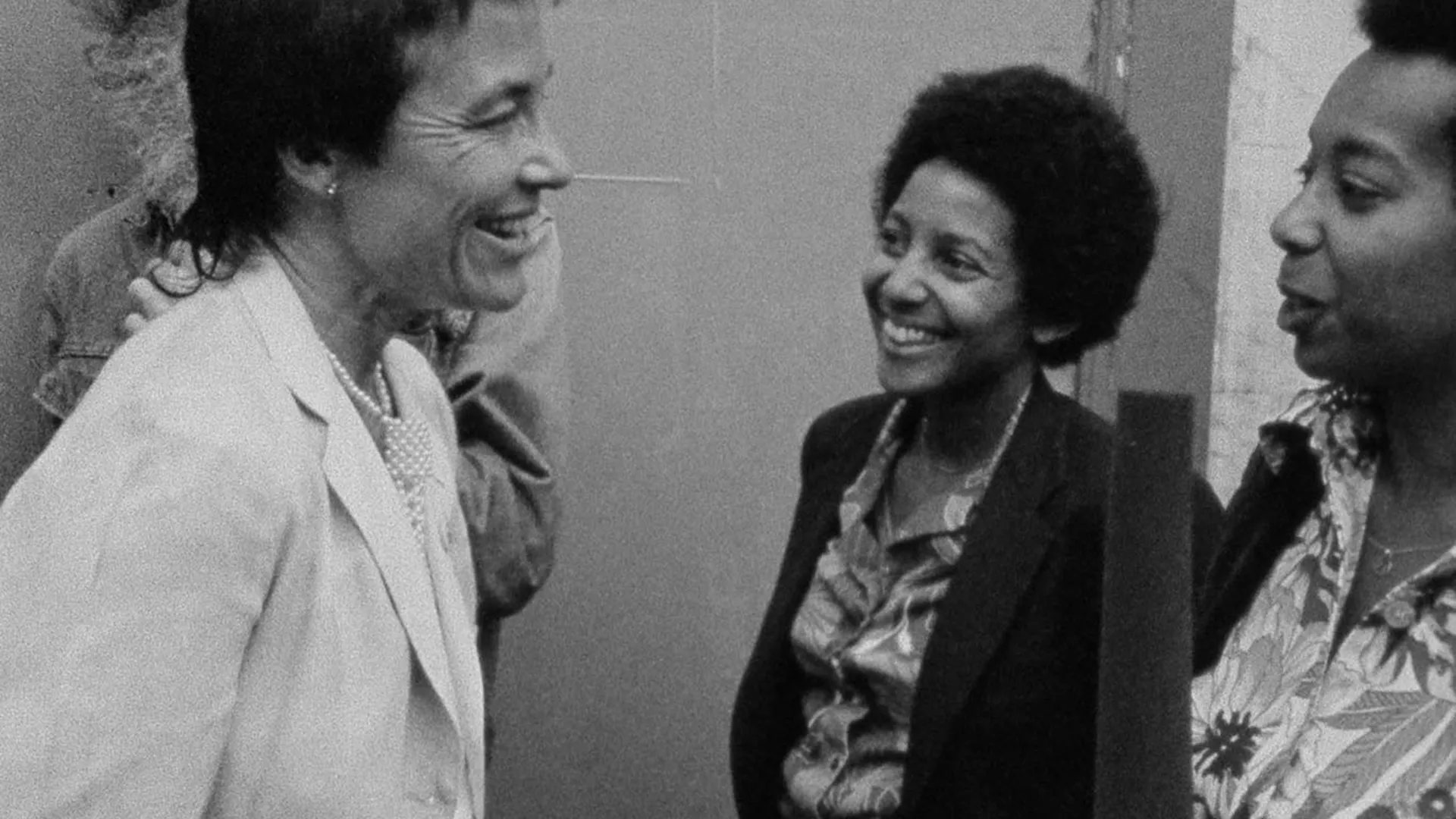
In Carolee, Barbara & Gunvor (2018), Sachs visits a trio of filmmakers in their own spaces: Carolee Schneeman in her 18th-century farmhouse, Barbara Hammer in her New York studio, and Gunvor Nelson in her childhood village in Sweden. Through these brief portraits, Sachs communicates something essential about these artists (Hammer’s boundless energy, for instance) and how their personalities influence the language of their cameras.
In contrast to much of the other work in the program, Window Work (2000) feels purely experiential. Shot on video, a woman sits near her window, drinking tea, reading the paper, cleaning. Passages of time elapse in idleness without narration; instead the sounds of running water, a child playing, and a passing jet drone on. Two boxes dot the video image, hurling abstracted images onto the screen—taken from celluloid home movies. Though Window Work features two distinct film languages, it resists translating between them; it doesn’t attempt to parse out a mode of communication. Daylight beats on the window, and its glass becomes a mirror. In its iridescent reflection, the viewer understands solitude, reminiscence, the heat of the sun she’s felt before wherever she is.
“A Reality Between Words and Images: Films by Lynne Sachs” screens tonight, October 27, at e-flux Screening Room as part of the series “Revisiting Feminist Moving Image.” Filmmaker Lynne Sachs and her collaborators Kristine Leschper and Kim Wilberforce will be in attendance for a conversation.