Tag Archives: film about a father who

Crucial Viewing / Cine-file by Kat Sachs

Crucial Viewing
Cine-file
February 17, 2023
https://www.cinefile.info/cine-list/2022/02/17/022323

CRUCIAL VIEWING

Lynne Sachs x 2
Gene Siskel Film Center

Lynne Sachs’ FILM ABOUT A FATHER WHO (US/Documentary) Review by Kat Sachs
Monday, 6pm

In Horace’s Odes, one among many texts where this sentiment endures, the Roman poet wrote, “For the sins of your fathers you, though guiltless, must suffer.” It’s hardly an esoteric dictum, but nevertheless it’s duly reflected in experimental filmmaker Lynne Sachs’ wholehearted documentary portrait of her father, Ira Sachs Sr. Something of a longstanding work-in-progress, the film draws from decades of footage shot by Sachs, her father, and her filmmaker brother, Ira Sachs Jr. (whose own 2005 film FORTY SHADES OF BLUE was inspired by the same so-called “Hugh Hefner of Park City”), plus others, documenting not just the sybaritic “hippie-businessman” patriarch, but also his numerous descendants. Sachs’ knotty chronicle reveals that her father has a total of nine children with several different women, two of whom the other siblings found out about only a few years back. (The film opens with Sachs brushing her elderly father’s hair, working out a particularly unpleasant snarl. “Sorry, dad,” she says. “There’s just one part that’s very tangly.” The irony is faint and benevolent, but present even so.) Sachs considers the enveloping imbroglio from her own perspective, but also takes into account the viewpoints of her eight siblings, her father’s ex-wives (including her own mother) and girlfriends, plus Ira’s mother, a gracefully cantankerous old woman in a certain amount of denial over her son’s wanton predilections and the role she played in his dysfunction. FILM ABOUT A FATHER WHO—the title an homage to Yvonne Rainer’s FILM ABOUT A WOMAN WHO…—is comprised of footage recorded between 1965 and 2019 and shot on 8mm, 16mm, VHS, Hi8, Mini DV, and digital; the fusion of all this material (by editor Rebecca Shapass) ranks among the most astounding use of personal archives that I’ve ever seen. It all exists in a state between documentary and home-movie footage, a paradigm that aptly reflects the conflict between reality and perspective, and the uncomfortable middle-ground that bisects the two. Sachs’ work often features her family, but this feels like an apotheosis of her autobiographical predisposition, likewise a question—why do the sins of the father linger?—and an answer. Among the most affecting scenes are roundtable discussions between the siblings where they consider revelations about their father and the implications of his actions. These scenes are heartrending not for their sadness, but rather for their naked honesty; it’s not just a film about a father who, but also a film about a love that defines a family. Sachs’ filmography is centered on infinite poetic quandaries (in voice over, she explores some of them here, such as when she muses on her father’s profession as a developer in Utah: “What happens when you own a horizon?”) and this feels like a logical conclusion to a lifetime of such profound impasses, though I’ve no doubt she’ll continue to probe life and its enigmas in a similarly masterful fashion. For all the suffering on display, Sachs has created an indelible work that, like those within it, perseveres by way of honesty and love. Followed by a post-screening conversation between Sachs and local filmmaker Lori Felker. (2020, 74 min, DCP Digital) [Kat Sachs]

Lynne Sachs and Lizzie Olesker’s THE WASHING SOCIETY (US Documentary)
Thursday, 6pm

Much like filmmaker Lynne Sachs’ acclaimed 2013 documentary hybrid YOUR DAY IS MY NIGHT, THE WASHING SOCIETY, a medium-length quasi-documentary she co-directed with performer-playwright Lizzie Olesker, penetrates the hidden worlds that exist adjacent to us. Just as in YOUR DAY Sachs explored the circumstances of immigrants living in “shift-bed” apartments in New York City’s Chinatown, she and Olesker here probe the mysterious world of urban laundromats, where workers—often immigrants or those from similarly disenfranchised groups—take on a task that’s historically been outsourced, at least in some capacity—that of washing and folding peoples’ laundry. The historical evocation is literal; the film’s title and one of its recurring motifs refer to a real organization from the 1880s called the Washing Society, which started in Atlanta and was comprised of washerwomen (most of them Black) who came together to demand higher pay and opportunities for self-regulation. A young actor, Jasmine Holloway, plays one such laundress, reading from texts written by the organization and whose presence haunts the modern-day laundromats. Soon other ‘characters,’ both real and fictitious, take their places in this mysterious realm, hidden away in plain sight. Ching Valdes-Aran and Veraalba Santa (actors who, along with Holloway, impressed me tremendously) appear as contemporary laundromat workers, representing ethnicities that tend to dominate the profession. It’s unclear at first that Valdes-Aran and Santa are performing, especially as real laundromat workers begin to appear in documentary vignettes, detailing the trials and tribulations of their physically demanding job. The stories are different, yet similar, personal to the individuals but representative of a society in which workers suffer en masse, still, from the very injustices against which the Washing Society were fighting. The actors’ scenes soon veer into more performative territory, a tactic which Sachs deployed, albeit differently, in YOUR DAY IS MY NIGHT. Much like that film, the evolution of THE WASHING SOCIETY included live performances in real laundromats around New York City, some scenes of which, it would seem, are included in the film. There’s a bit of voiceover from Sachs, explaining the directors’ mission to go into many different laundromats, and from voice actors who read monologues that are tenuously connected to Valdes-Aran and Santa’s ‘characters.’ There are also visceral interludes involving accumulated lint that add another layer to the experimentation; there’s a bluntness to the filmmakers’ artistic ambitions, as with much of Sachs’ work, that makes the intentions discernible but no less effective. Sachs has previously employed egalitarian methods, such as considering the people she works with to be collaborators rather than subjects, cast, and crew. In a film about unseen labor, seeing that labor—notably in a self-referential scene toward the end in which a group of said collaborators prepare to exit a laundromat after shooting—is important. In light of what’s happening now, when so much essential labor is either coyly unseen or brazenly unacknowledged (or both), it’s crucial. Like the 1880s’ washerwoman, the victims (and, likewise, the combatants) of capitalism are ghosts that haunt us. Followed by a post-screening conversation between Sachs and Cine-File managing editor Kat Sachs. (2018, 44 min, Digital Projection) [Kat Sachs]

Screening as part of a shorts program entitled “A Collection & a Conversation,” which includes Sachs’ short films DRIFT AND BOUGH (2014, 6 min, Digital Projection); MAYA AT 24 (2021, 4 min, Digital Projection); VISIT TO BERNADETTE MAYER’S CHILDHOOD HOME (2020, 3 min, Digital Projection) and SWERVE (2022, 7 min, Digital Projection).


MANAGING EDITORS // Ben and Kat Sachs

CONTRIBUTORS // Rob Christopher, Maxwell Courtright, Steve Erickson, Marilyn Ferdinand, Raphael Jose Martinez, Jonathan Leithold-Patt, Michael W. Phillips, Jr., Joe Rubin, Harrison Sherrod

:: FRIDAY, FEBRUARY 10 – THURSDAY, FEBRUARY 16 :: →

Cine-File is a volunteer run resource for Chicago cinephiles. Subscribe to our weekly email and follow us on Facebook and Twitter.


Best of DAFilms 2022: “Film About a Father Who” / DAFilms.com

Best of DAFilms 2022: “Film About a Father Who”
Dafilms.com
December 28, 2022
https://dafilms.com/program/1315-best-of-dafilms-2022?utm_source=newsletter-int&utm_medium=email&utm_campaign=best-of-2022

Earlier in the year, we presented Tender Non-Fictions, a program of films by experimental documentarian Lynne Sachs, who has been prolifically creating works for cinema for four decades. Her non-fiction films, represented in our program in 11 works of varying lengths, evoke the curiosity and richness of a life lived through art.

Which brings to her most recent feature documentary, Film About a Father Who. From 1984 to 2019, Sachs shot film of her now-deceased father, a bon vivant and pioneering businessman. This documentary is her attempt to understand the web that connects a child to her parent and a sister to her siblings. A perfect film to end the year with, remembering those we may have lost along the way.

Lynne Sachs: A Poet’s Perspective / Gene Siskel Film Center – School of the Art Institute of Chicago

Lynne Sachs: A Poet’s Perspective
Gene Siskel Film Center, School of the Art Institute of Chicago
Screenings on February 20 & 23, 2023
https://www.siskelfilmcenter.org/lynnesachs

LYNNE SACHS: A POET’S PERSPECTIVE

Committed to a dialogue between cinematic theory and practice, experimental filmmaker and poet Lynne Sachs searches for a rigorous play between image and sound, pushing the visual and aural textures in each new project. Embracing archives, letters, portraits, confessions, poetry, and music, her films take us on a critical journey through reality and memory. Regardless of the passage of time, these films continue to be extremely contemporary, coherent, and radical in their artistic conception.

Lynne has produced over 40 films as well as numerous live performances, installations, and web projects. Over the course of her career, Lynne has worked closely with fellow filmmakers Craig Baldwin, Bruce Conner, Barbara Hammer, Chris Marker, Gunvor Nelson, Carolee Schneemann, and Trinh T. Minh-ha. Sachs’ films have screened at MoMA, Tate Modern, Image Forum Tokyo, Wexner Center for the Arts, the New York Film Festival, Oberhausen Int’l Short FF, Punto de Vista, Sundance, Vancouver IFF, Viennale, and Doclisboa, among others. In 2021, Sachs received awards from both Edison Film Festival and Prismatic Ground Film Festival at the Maysles Documentary Center for her achievements in the experimental and documentary fields. 

The Film Center, in collaboration with Conversations at the Edge and the School of the Art Institute of Chicago’s Film, Video, New Media, and Animation program, is honored to welcome Sachs to the Film Center in person for two evenings of her work, followed by in-depth conversations. Photo credit: Inés Espinosa López.


MONDAY, FEBRUARY 20, 6:00PM

FILM ABOUT A FATHER WHO

2020, dir. Lynne Sachs
USA, 74 min. In English / Format: Digital

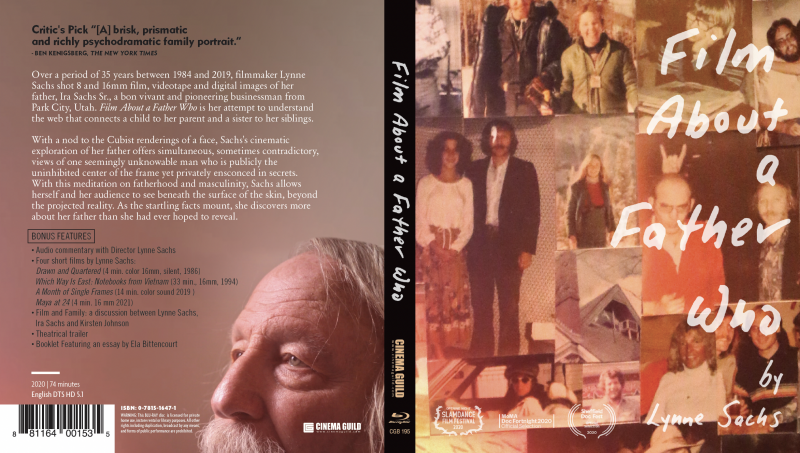
Over a period of 35 years between 1984 and 2019, filmmaker Lynne Sachs shot 8mm and 16mm film, videotape, and digital images of her father, Ira Sachs Sr., a bon vivant and pioneering businessman from Park City, Utah. FILM ABOUT A FATHER WHO is her attempt to understand the web that connects a child to her parent and a sister to her siblings. With a nod to the Cubist renderings of a face, Sachs’ cinematic exploration of her father offers simultaneous, sometimes contradictory, views of one seemingly unknowable man who is publicly the uninhibited center of the frame, yet privately ensconced in secrets. With this meditation on fatherhood and masculinity, Sachs allows herself and her audience to see beneath the surface of the skin, beyond the projected reality. As the startling facts mount, she discovers more about her father than she had ever hoped to reveal. (Cinema Guild) Post-screening conversation with Lynne Sachs.


THURSDAY, FEBRUARY 23, 6:00PM

A COLLECTION & A CONVERSATION

2018-2022, dir. Lynne Sachs
USA, 64 min., In English / Format: Digital 

This program of four short and medium-length pieces highlights Sachs’ filmography from a poetic, personal perspective, as she uses her camera to capture the essence of people, places, and moments in time. The scope of this work includes DRIFT AND BOUGH (2014, USA, 6 min., No dialogue / Format: 8mm on digital), an assemblage of 8mm footage from a winter morning in Central Park. Set to sound artist Stephen Vitiello’s delicate and assured score, the contrasting darkness – of skyscrapers, fences, trees, and people – against bright snow, gives way to a meditative living picture. In MAYA AT 24 (2021, USA, 4 min., No dialogue / Format: 16mm on digital), Sachs presents a spinning, swirling cinematic record of her daughter Maya, chronicled at ages 6, 16, and 24. As Maya runs, she glances – furtively, lovingly, distractedly – through the lens and at her mother, conveying a wordless bond between parent and child, and capturing the breathtakingly quick nature of time. Presented for the first time publicly, in VISIT TO BERNADETTE MAYER’S CHILDHOOD HOME (2020, USA, 3 min., In English / Format: 16mm on digital), Sachs visits poet Bernadette Mayer’s childhood home in Queens to celebrate Mayer’s work, through a reverent, flowing collage. Queens, New York is also the backdrop for the poetry of Paolo Javier in SWERVE (2022, USA, 7 min., in various languages with English subtitles / Format: Digital), a “COVID film” that documents people emerging – cautiously, distanced, masked – from the global pandemic, finding their way in the liminal space between “before” and “after,” and connected by language and verse. In collaboration with playwright Lizzie Olesker, THE WASHING SOCIETY (2018, USA, 44 min., In English / Format: Digital) explores the once ubiquitous but now endangered public laundromat. Inspired by “To ’Joy My Freedom: Southern Black Women’s Lives and Labors after the Civil War” by Tera W. Hunter, THE WASHING SOCIETY is an observational study of lather and labor, a document of the lives of working class women who – largely overlooked and underappreciated – load, dry, fold, and repeat. Post-screening conversation with Lynne Sachs. 

MajorDocs and ‘Film About a Father Who’ / RTVE Play – Días de Cine

Días de Cine. 14-10-2022
RTVE Play Días de Cine
October 14, 2022
https://www.rtve.es/play/videos/dias-de-cine/dias-de-cine-14-10-2022/6713891/

MajorDocs and Film About A Father Who Featured at 45:44–50:00.

English translation:

Movie days. 14-10-2022

Full program. Sitges Festival, Little Pig, Halloween ends, Wild Sunflowers, Orio Tarragó as Godfather guest, Angela Lansbury, and much more.


Spanish original:

Días de Cine. 14-10-2022

Programa completo. Festival de Sitges, Cerdita, Halloween ends, GIrasoles silvestres, Orio Tarragó de invitado Padrino, Angela Lansbury, y mucho más.

Producers’ Forum with Lynne Sachs: “Film About a Father Who” / Scribe Video Center

Producers’ Forum with Lynne Sachs: “Film About a Father Who”
Scribe Video Center
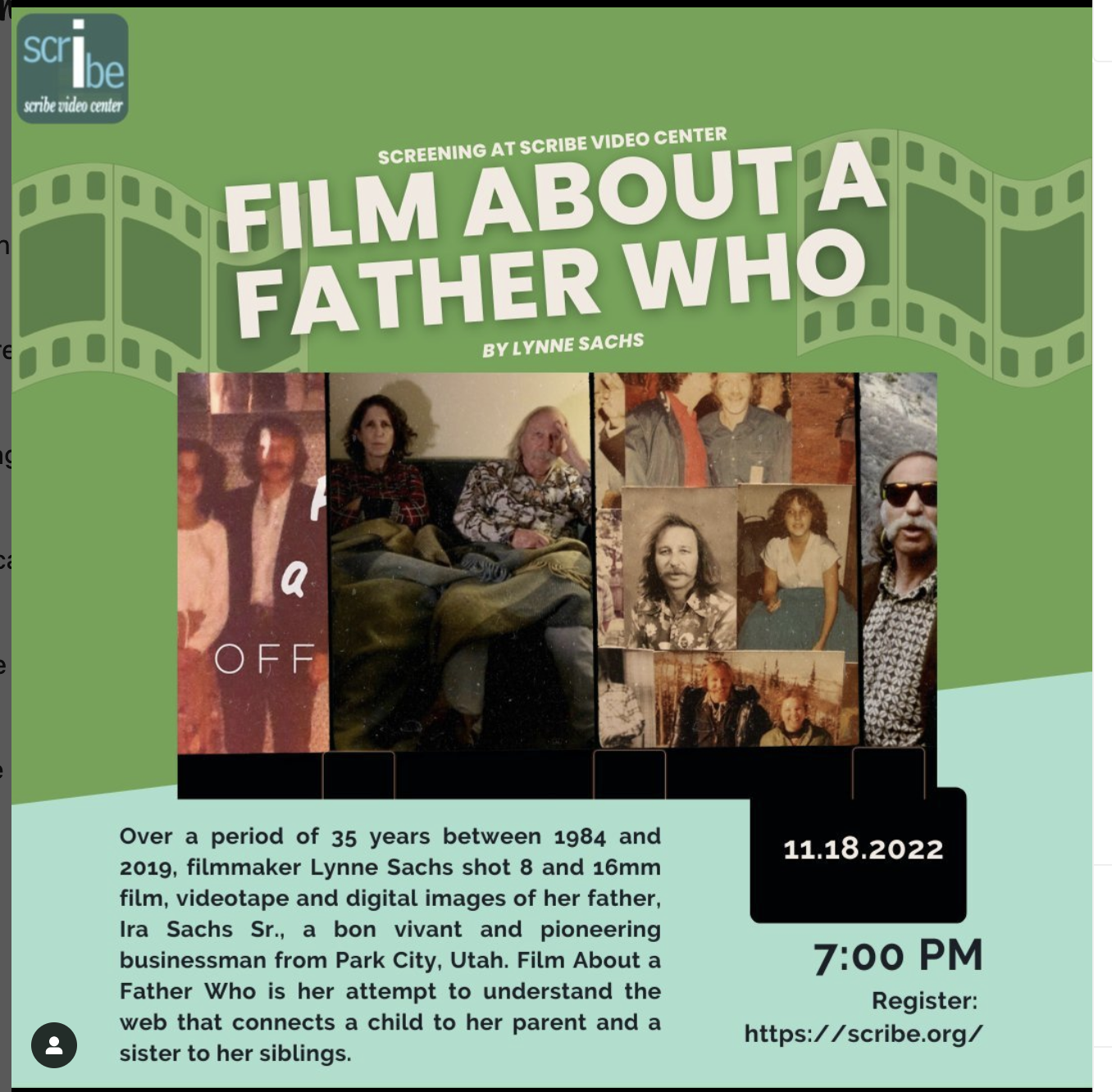
Event on November 18, 2022
https://scribe.org/events/producers-forum-lynne-sachs-film-about-father-who

Producers’ Forum with Lynne Sachs: “Film About a Father Who”

November 18, 7:00 PM

Cost: 
$7.50 General Admission, $5 Students/Seniors, $4 Scribe Members

Over a period of 35 years between 1984 and 2019, filmmaker Lynne Sachs shot 8 and 16mm film, videotape and digital images of her father, Ira Sachs Sr., a bon vivant and pioneering businessman from Park City, Utah. Film About a Father Who is her attempt to understand the web that connects a child to her parent and a sister to her siblings.

Lynne Sachs is an American experimental filmmaker and poet based in Brooklyn, New York. Strongly committed to a dialogue between cinematic theory and practice, she searches for a rigorous play between image and sound, pushing the visual and aural textures in each new project. Over the course of her career, Lynne has worked closely with fellow filmmakers Craig Baldwin, Bruce Conner, Barbara Hammer, Chris Marker, Gunvor Nelson, Carolee Schneemann, and Trinh T. Min-ha.

Contact Email Address: 
inquiry@scribe.org

Contact Phone Number: 
215-222-4201

Event Type: 
Screening
Producers’ Forum


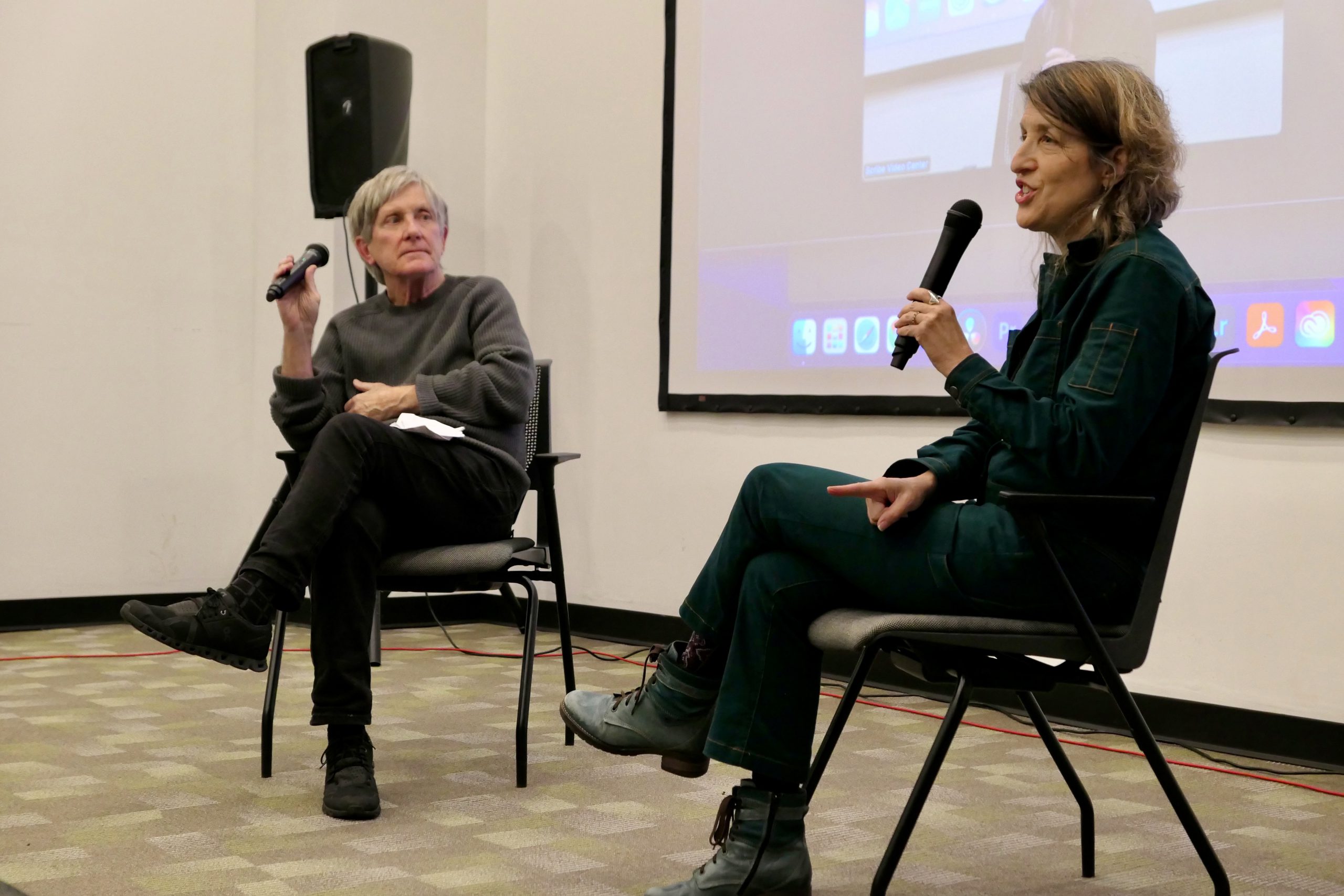
Lynne with Tim Corrigan (host)

“Lynne Sachs: Film Festivals used to be perceived as exclusive and snobbish, but that has changed.” / Diario de Mallorca

“Lynne Sachs: Film Festivals used to be perceived as exclusive and snobbish, but that has changed.”
Diario de Mallorca
Interview by Montse Terrasa
Translation by Guillermo Amengual
October 5, 2022
https://www.diariodemallorca.es/cultura/2022/10/05/lynne-sachs-gente-pensaba-festivales-76794424.html

Lynne Sachs (Memphis, 1961) prefers to define herself as a filmmaker rather than a director. She claims to prefer to feel a member of a group of people working on a project. Now she is at Palma (Majorca, Spain) to perform as the guest of honor of the MajorDocs film festival, a meeting for she’s profoundly excited for having the opportunity to talk about films and ideas during several days.

Yesterday, she presented her documentary focused on her father, Ira Sachs Sr., whom she describes as a good living: seducer, extravagant and entrepreneur. In this feature film, she uses family archive films made for over thirty years.

Interviewer: Film About a Father Who. Is this your most personal film?

Lynne Sachs: I think that the word personal is used in a very obvious way and we need to fragment and analyze what it really mean “to do something personal”, because it can be more ambiguous and it could be referred to your print, your style in the project.

I think that what we call personal is like a thread that connects all my films. Film About a Father Who took me to another personal level because I show my fears and my ambiguity toward my relationship with my father, and I think I took a risk there, as I first wanted to do a very angry film that afterwards turned into something that was more focused on forgiveness…

I exposed all of my feelings, my vulnerability. In that sense, we could perhaps refer to it as my most personal film. When I was making it, I had the feeling that I needed to. I had to get it out of me. I thought nobody would want to watch it. This time I didn’t think about audience. I just thought about myself and maybe that’s the key to reaching more people.

I: When did you decide to do the film?

L.S.: Back in 1991, when I wanted to do a film divided in three parts. I wanted to explore in what way we (people) can really know another human being but ourselves. A child, a friend… The first part would be about a total stranger, the second one about a departed family member who I get to know through his letters, and the third one was going to be about my father, who I could call whenever I wanted and ask him questions, and I thought that would be the easiest part. It wasn’t at all.

I: Filmmaker, poet, teacher, feminist… What adjective describes you the best? Or does it depend on the moment?

L.S.: Yes, it does. I feel more like a filmmaker than a director. That noun refers to the industry matters. It expresses who stands at the top of the pyramid and makes the decisions. I prefer to

call myself a filmmaker because I feel like I’m part of a project where I work side by side with people. No hierarchy involved. Historically women were tied to their homes. They were homemakers. Then we freed ourselves and we stood up and show to the world that we are capable of doing a lot more than that. But at the same time if we look closely to the word filmmaker, it still has that connection with the word homemaker, it can mean to take care of cinema as a house, as a home.

I: Is now a good time for documentaries? In addition to these film festivals, many streaming platforms encourage this way of moviemaking…

L.S.: Yes, of course. Things have change a lot, over the years. Back then if someone asked me where they could watch my films I just could say that they where only screened in film festival or museums. Nowadays, 15 of my films are available on DAfilms and also in The Criterion Channel… Those streaming services are very useful for documentaries, but also for those who work in very low Budget independent films or even features made with their own phones or

digital cameras… People thought that Film Festivals where exclusive and elitist, but that has changed.

I: How do you feel about being the Guest of Honor of this edition of the MajorDocs film festival?

L.S.: I feel that I don’t deserve it. Two days ago I still couldn’t believe it. I was intimidating. But I love Film Festivals like this one where they encourage the audience not only to watch documentaries, but also to talk about them during the whole week. There are conversations about what they’ve seen and about what feelings and ideas struck out at them, and that is very important.

I: Is now a good time for documentaries? In addition to these film festivals, many streaming platforms encourage this way of moviemaking…

L.S.: Yes, of course. Things have changed a lot, over the years. Back then if someone asked me where they could watch my films I just could say that they were only screened at film festivals or museums. Nowadays, fifteen of my films are available on Dafilms and also in The Criterion Channel… Those streaming services are very useful for documentaries, but also for those who work in very low Budget independent films or even features made with their own phones or digital cameras… Film festivals used to be perceived as exclusive and snobbish, but that has changed.

I: As a viewer, as a spectator, what kind of films do you like?

L. S.: My family makes fun of the fact that I might not have seen a movie if it’s very popular. However, that’s not true. I like to see films that make me think, that challenge me to see the world in a different way. I like to take notes while watching these kind of films, even in the darkness of the theatre. I do the same thing while reading a book. I cannot watch a Godard film without taking notes.

“The 4th edition of MajorDocs claims calm and pause in domestic audiovisual creation” / IB3 News

“The 4th edition of MajorDocs claims calm and pause in domestic audiovisual creation”
IB3 News
October 4, 2022
https://ib3.org/la-quarta-edicio-del-festival-majordocs-reivindica-la-calma-i-la-pausa-en-la-creacio-audiovisual-domestica

English translation:

The 4th edition of MajorDocs claims calm and pause in domestic audiovisual creation

From October 4 to 8, 8 films from around the world will be screened, and professional conferences will be organized, such as the master class of the Venezuelan Goya nominee Andrés Duque

‘Film about a father who’ is an autobiographical documentary by American filmmaker Lynne Sachs . The experimental filmmaker from Brooklyn spent 35 years recording this film from digital images of her father.

“I’m very happy to have done it, but also very scared every time I have to show it. It is a vulnerable film for me and my father, although it is also a project that has given me many opportunities . I was able to talk to people about their relationship with their parents and what they learned from it, as well as what they don’t want to repeat from their parents,” explained Sachs.

In this way, the fourth edition of MajorDocs has started . In a current situation in which cinema is consumed in haste, the festival claims calm and pause in domestic audiovisual creation .

From October 4 to 8 , 8 films from around the world will be shown; all, from the author’s subjective point of view . Professional conferences are also organized , where the master class offered by the Venezuelan Andrés Duque , nominated for a Goya for the documentary ‘Iván Z’ , stands out.


Spanish original:

La 4a edició del MajorDocs reivindica la calma i la pausa en la creació audiovisual domèstica

Del 4 al 8 d’octubre, es projectaran 8 pel·lícules d’arreu del món, i s’organitzaran jornades professionals, com la classe magistral del veneçolà nominat als Goya Andrés Duque

‘Film about a father who’ is an autobiographical documentary by American filmmaker Lynne Sachs . The experimental filmmaker from Brooklyn spent 35 years recording this film from digital images of her father.

“I’m very happy to have done it, but also very scared every time I have to show it. It is a vulnerable film for me and my father, although it is also a project that has given me many opportunities . I was able to talk to people about their relationship with their parents and what they learned from it, as well as what they don’t want to repeat from their parents,” explained Sachs.

In this way, the fourth edition of MajorDocs has started . In a current situation in which cinema is consumed in haste, the festival claims calm and pause in domestic audiovisual creation .

From October 4 to 8 , 8 films from around the world will be shown; all, from the author’s subjective point of view . Professional conferences are also organized , where the master class offered by the Venezuelan Andrés Duque , nominated for a Goya for the documentary ‘Iván Z’ , stands out .

“Lynne Sachs, ‘godmother’ of MajorDocs, opens the festival” / Diario de Mallorca

“Lynne Sachs, ‘godmother’ of MajorDocs, opens the festival”
Diario de Mallorca
October 3, 2022
https://www.diariodemallorca.es/cultura/2022/10/03/lynne-sachs-madrina-majordocs-inaugura-76735007.html?utm_source=twitter&utm_medium=social&utm_campaign=btn-share

English translation:

Lynne Sachs, ‘godmother’ of MajorDocs, opens the festival

This documentary film exhibition kicks off this Tuesday with the screening of ‘Film about a father who’

Palm | 03 10 22 | 17:33 | Updated at 17:34

MajorDocs, the documentary film festival that makes a virtue of slowness, kicks off this Tuesday from the Fundació Sa Nostra and opens the doors to 5 days in which documentary, domestic and archive cinema will be the true protagonist. 5 days to reeducate the gaze and silence the noise, reflect, discover and enjoy other realities and other gazes. 5 days of cinema understood as art, culture and creation, space, reflection and dialogue. 

Lynne Sachs, filmmaker, poet and artist based in New York, will be in charge of opening the festival from 6:30 p.m. at Fundació Sa Nostra with her latest film Film about a father who. More than a film, it is a portrait filmed between 1984 and 2019 in Super 8, 16 mm, VHS and HD and that Lynne Sachs uses to delve into the controversial figure of her father, Ira Sachs Sr., a complex, playful, selfish man. and charismatic man who led a life full of secrets, children and wives –9 children and 5 wives to be more exact– and who, with his lies and silences, marked the lives of everyone around him. A documentary film that, delving into the figure of a blurred father, tries to understand the bond between a daughter and her father. A well-assembled portrait of a diverse family, their memory and memories. 

After the screening, the musical note will be provided by Joana Gomila and Laia Vallès , two artists who have shaken the world of traditional music with a style that is as personal as it is daring and an expansive and transgressive sound. 

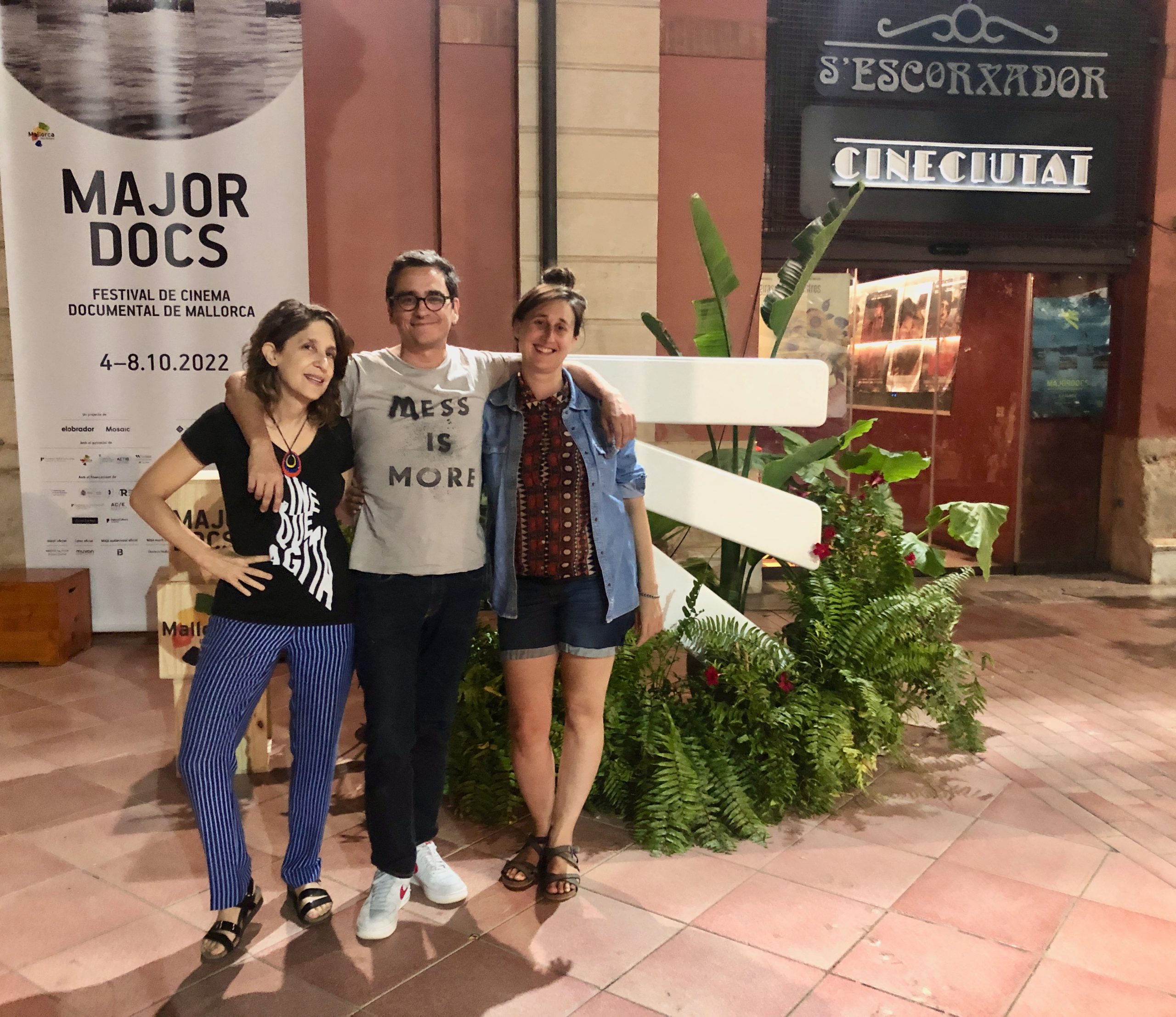
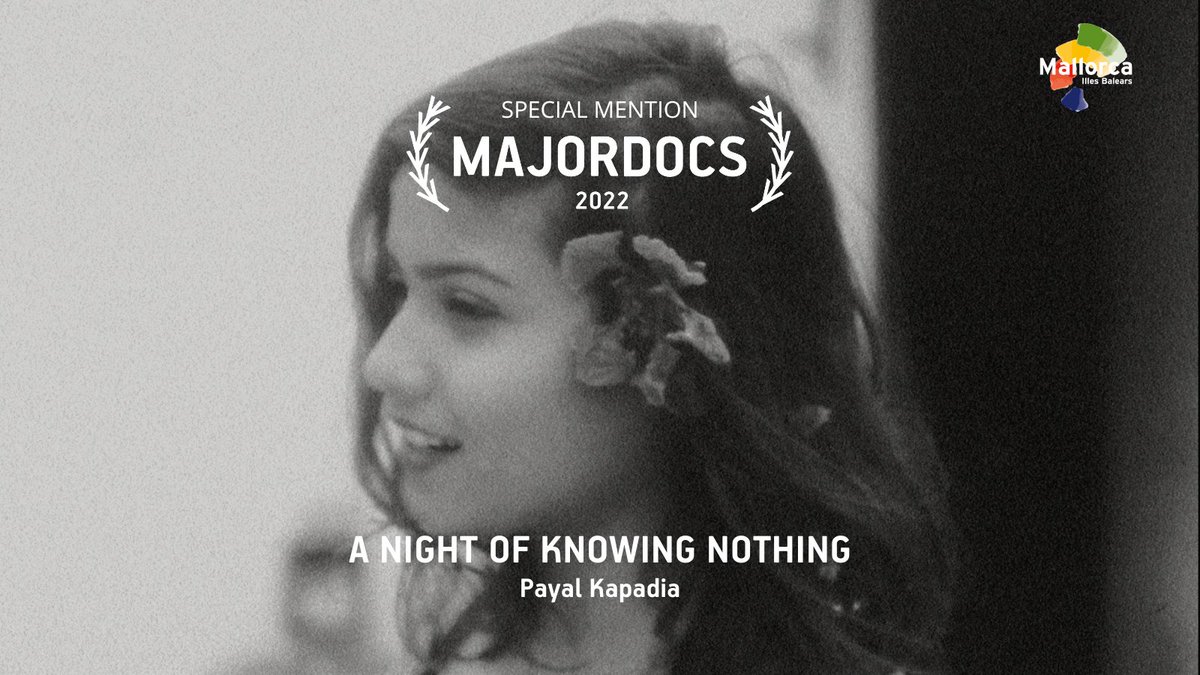
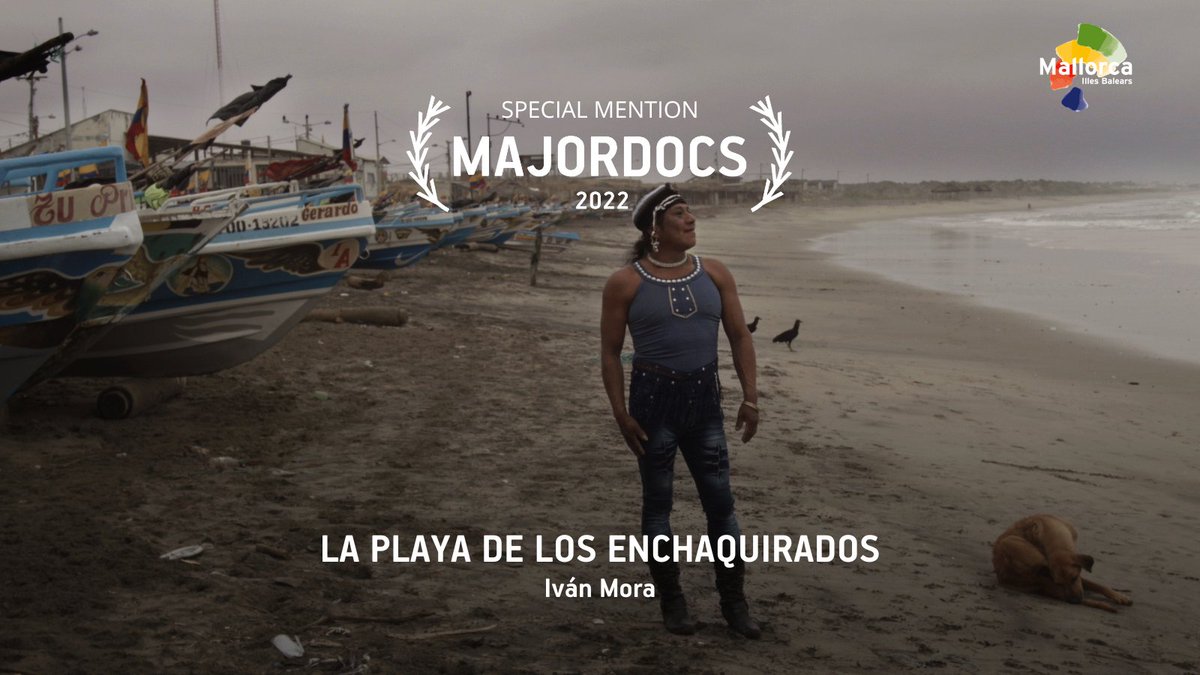
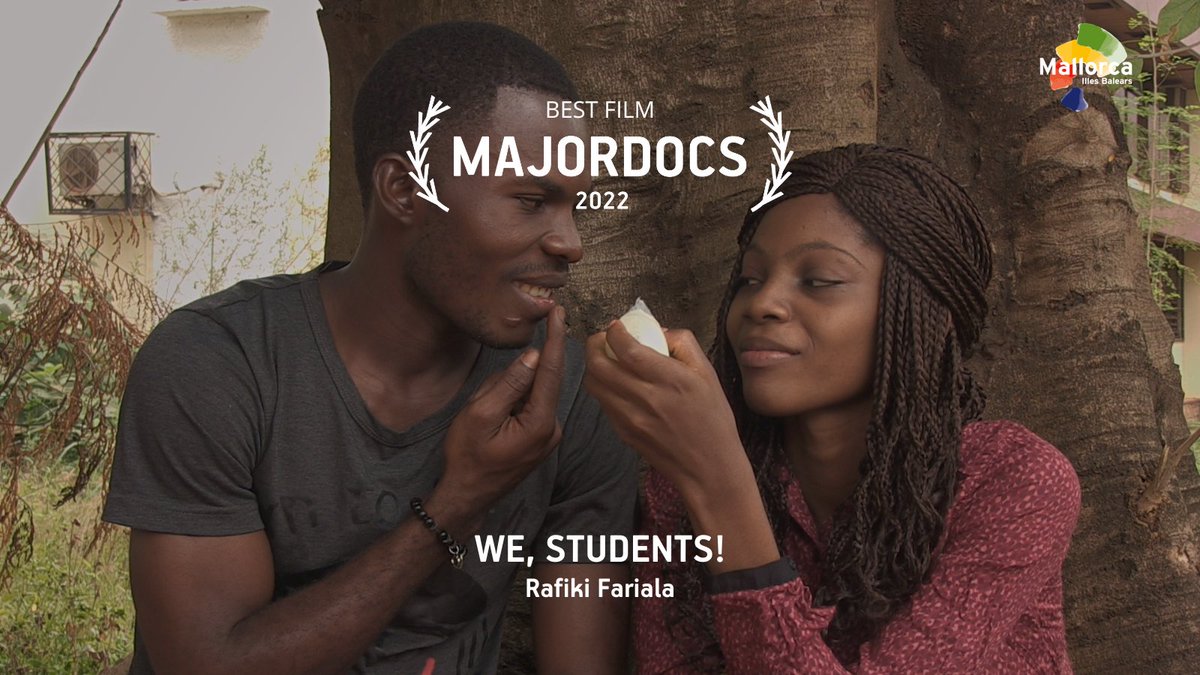
Starting on Wednesday, October 5, CineCiutat will become the venue for the 8 films that will compete in the official section: ‘El silencio del topo’, by the Guatemalan documentary filmmaker and producer Anaïs Taracena; ‘Ardenza’ by Daniela de Felice; ‘A night of knowing nothing’, debut feature by Mumbai-based Indian filmmaker Payal Kapadia; ‘We, students’ by actor, director and sound engineer Rafiki Fariala; ‘Herbaria’ by film director, producer, programmer and projectionist Leandro Listorti; ‘La playa de los Enchaquirados’ by the director born in Guayaquil, Ecuador, Iván Mora Manzano; ‘Rampart’ by Marko Grba, director and writer born in Belgrade; and ‘Aftersun’ by Catalan director Lluís Galter. 

Check the schedule for October 5, times and location: 

Sa Nostra Foundation.

At 10 am, Masterclass by Lynne Sachs: The body, the camera and matter.

At 12 noon, doc-Session given by the filmmakers Anaïs Taracena and Leandro Listorti: Search or find. The language of non-fiction.

CineCiutat.

At 5:30 p.m., ‘We, students’ by Rafiki Fariala. 

At 5:30 p.m., ‘The silence of the mole’ by Anaïs Taracena. 

At 7:30 p.m. ‘Ardenza’ by Daniela de Felice. 

At 7:30 p.m. ‘A night of knowing nothing’ by Payal Kapadia. 

Tickets can be purchased both at www.majorDocs.org and at the CineCiutat box office. 

Admission: €5

Reduced ticket for members of CineCiutat, students and retirees (only at the box office): €3.50

Subscription for 4 screenings (only at the box office): €15


Spanish original:

Lynne Sachs, ‘madrina’ del MajorDocs, inaugura el festival

Esta muestra de cine documental arranca este martes con la proyección de ‘Film about a father who’

Palma | 03·10·22 | 17:33 | Actualizado a las 17:34

MajorDocs, el festival de cine documental que hace de la lentitud una virtud, arranca este martes desde la Fundació Sa Nostra y abre las puertas a 5 días en los que el cine documental, doméstico y de archivo será el auténtico protagonista. 5 días para reeducar la mirada y acallar el ruido, reflexionar, descubrir y disfrutar de otras realidades y otras miradas. 5 días de cine entendido como arte, cultura y creación, espacio, reflexión y diálogo. 

Lynne Sachs, cineasta, poeta y artista afincada en Nueva York, será la encargada de inaugurar el festival a partir de las 18.30h en Fundació Sa Nostra con su última película Film about a father who. Más que una película, es un retrato filmado entre 1984 y 2019 en Súper 8, 16 mm, VHS y HD y que Lynne Sachs utiliza para adentrarse en la controvertida figura de su padre, Ira Sachs Sr., un hombre complejo, vividor, egoísta y carismático que llevó una vida repleta de secretos, hijos y mujeres –9 hijos y 5 mujeres para ser más exactos– y que, con sus mentiras y silencios, marcó la vida de todo el que le rodeaba. Una película documental que, buceando en la figura de un padre desdibujado, trata de entender el vínculo entre una hija y su padre. Un retrato bien ensamblado sobre una familia diversa, su memoria y sus recuerdos. 

Tras la proyección, la nota musical la pondrán Joana Gomila y Laia Vallès, dos artistas que han sacudido el mundo de la música tradicional con un estilo tan personal como atrevido y un sonido expansivo y transgresor. 

A partir del miércoles 5 de octubre, CineCiutat se convertirá en la sede de las 8 películas que competirán en la sección oficial: ‘El silencio del topo’, de la cineasta documental y productora guatemalteca Anaïs Taracena; ‘Ardenza’ de Daniela de Felice; ‘A night of knowing nothing’, ópera prima de la cineasta India establecida en Mumbai Payal Kapadia; ‘We, students’ del actor, director e ingeniero de sonido Rafiki Fariala; ‘Herbaria’ del director de cine, productor, programador y proyeccionista Leandro Listorti; ‘La playa de los Enchaquirados’ del director nacido en Guayaquil, Ecuador, Iván Mora Manzano; ‘Rampart’ de Marko Grba, director y escritor nacido en Belgrado; y ‘Aftersun’ del director catalán Lluís Galter. 

Consulta la programación del 5 de octubre, los horarios y la localización: 

Fundació Sa Nostra.

A las 10h, Masterclass de Lynne Sachs: El cuerpo, la cámara y la materia.

A las 12h, doc-Session impartida por los cineastas Anaïs Taracena y Leandro Listorti: Búsqueda o hallazgo. El lenguaje de la no-ficción.

CineCiutat.

A las 17:30h, ‘We, students’ de Rafiki Fariala. 

A las 17:30h, ‘El silencio del topo’ de Anaïs Taracena. 

A las 19.30h ‘Ardenza’ de Daniela de Felice. 

A las 19:30h ‘A night of knowing nothing’ de Payal Kapadia. 

Las entradas se pueden comprar tanto en www.majorDocs.org como en la taquilla de CineCiutat. 

Entrada: 5 €

Entrada reducida para miembros de CineCiutat, estudiantes y jubilados (sólo en taquilla): 3,50€

Abono para 4 proyecciones (sólo en taquilla): 15€

Lynne Sachs & ‘Film About A Father Who’ at MajorDocs

Film About A Father Who & Lynne Sachs Masterclass at MajorDocs
MajorDocs
September 1, 2022
Festival dates: October 4-8, 2022
https://majordocs.org/festival/

PHILOSOPHY

THE FIRST SLOW FILM FESTIVAL

MajorDocs is the international creative documentary film festival in Mallorca; a space to discover other realities and other perspectives through carefully selected creative documentaries.

In a time defined by the sheer excess of content, MajorDocs proposes a slow experience: a journey through eight films, each with a deep author’s gaze, that encourage us to stop, step away from our daily lives and connect with not just the other, but also with our own sensibility.

Five days to reflect, ask and discuss each film with its author in an intimate and close setting, without lecterns or pedestals. Each screening will be a unique event without counterprogramming since it is our goal to take care of each film and each author.

During the festival, renowned filmmakers and new talents will share their experiences with the public. An event that will stimulate the critical eye through screenings and talks, as well as workshops and discussions on documentary cinema.

An unmissable date for anyone who enjoys looking without limits, discovering the unknown and stirring their heart.

MANIFESTO

MajorDocs goes out and looks for a creative documentary…

  1. Hybrid, innovative, transgressive, adventurous.
  2. Able to transcend the present and keep questioning ourselves in the future.
  3. Useless – in which art prevails over functionality.
  4. That digs deeply into the ins and outs of a complex world without staying on the surface.
  5. That leaves a mark on the audience and is able to short-circuit the passive spectator.
  6. In which the author’s gaze prevails over the facts.
  7. Able to transcend, if the film demands for it, the limits of the classic narrative.

FILM ABOUT A FATHER WHO
https://majordocs.org/ca/event/film-about-a-father-who/

Synopsis

Over a period of 35 years, filmmaker Lynne Sachs shot 8 and 16mm film, videotape and digital images of her father, Ira Sachs Sr., a bon vivant, seductive, extravagant and pioneering businessman. Film About a Father Who is her attempt to understand the web that connects a child to her parent and her siblings.

With the presence of the director.


MASTERCLASS: THE BODY, THE CAMERA, AND THE MATERIAL
https://majordocs.org/majordocs-pro/

October 5, 2022 / 10:00 – 11:30
Fundació Sa Nostra

Lynne Sachs will explore the intricate relationship between personal observations and broader historical experiences. Using examples from the essay films, experimental documentaries, and performances she has produced over the last three decades, she will guide her workshop participants on a journey investigating the connection between the body, the camera, and the materiality of film itself.

* Session in English.

Lynne Sachs (Memphis, Tennessee, 1961) is a filmmaker and poet living in Brooklyn, New York. Her work explores the intricate relationship between personal observations and broader historical experiences by weaving together text, collage, painting, politics and layered sound design. Strongly committed to a feminist dialogue between cinematic theory and practice, she searches for a rigorous play between image and sound, pushing the visual and aural textures in her work with every new project. Her moving image work ranges from short experimental films, to essay films to hybrid live performances. Lynne has made 37 films, including features and shorts, which have screened, won awards or been included in retrospectives at New York Film Festival, Museum of Modern Art, Sundance, Oberhausen, Viennale, Sheffield Doc/Fest, BAFICI, RIDM Montréal, Vancouver Film Festival, Doclisboa, Havana IFF, and China Women’s Film Festival. In 2014, she received the Guggenheim Fellowship in the Creative Arts.


JURY & AWARD WINNERS

Jury
Andrés Duque, Ainhoa Andraka, and Lynne Sachs

Award winners

Ela Bittencourt’s Essay on “Film About a Father Who” / Cinema Guild


Essay on Cinema Guild’s DVD & Bluray monograph insert for Film About a Father Who directed by Lynne Sachs

Information on the DVD & Bluray here.

“He knows he will live in me
after he is dead, I will carry him like a mother.
I do not know if I will ever deliver.”

Sharon Olds, from the book of poems, The Father

There are so many possible entry points into Lynne Sachs’s A Film About a Father Who, an incredibly poignant and astute film sonnet on the director’s father, Ira Nathan Sachs, that over my repeated viewings I’ve begun to think of the film as a kind of quilt. Each of its patches unique and carefully hand-stitched into the fabric of its mosaic parts. Or perhaps a wondrous maze that a viewer winds her way through, and out, by pulling a delicate Ariadne’s thread. 

I think it’s apt that the Greek mythology should have sprung to my mind. Aren’t all families somehow mythic, especially the troubled ones? The patriarch of the Sachs clan is certainly very Sphinx-like: an object, at once, of boundless adoration and love, but also a slippery man of mystery whose acts arouse genuine puzzlement in all his children. A god whose many faces are like a visage of a broken statue — bits that can never be whole again, but only awkwardly pieced, with glue, disjointed surfaces showing through, sharp edges painful to the touch. 

In the film’s first introductory clip, the scionSachs, Sr. appears with his characteristic wisps of blond hair clinging to his skull, his bushy moustache, and somewhat restless and piercing blue eyes. He’s a “hippie businessman,” who “works as little as possible,” and “bottles water he can never stock.” In one shot, he stands framed by a mountainous vista (it turns out that Sachs developed hotels in Park City, Utah, where the Sundance Film Festival is held). The father speaks of his love for skiing, where you “go up slow and come down fast.” A comment that Sachs comments on in her own presciently clipped way: “To own a mountain from which there is nothing you can do but come down.”

I was struck by how this sentence is a gorgeous metaphor for pretty much how we relate to our parents — the most primordial love, which turns them into heroic, mythical, statue-like beings, mountain slopes from which, indeed, they can only come down. And how much of growing into adulthood is about the sudden vertigo of having to rewind, recalibrate our memories of the familial bind, from the times when we were still too innocent, too small, to have truly understood it. If we love them enough, we catch them coming down. We are mindful to pick up the pieces, glimpsing in their downfall from immortal heights the first sightings of our own fragility.

A Film About a Father Who is then an origin story, but one that’s never smug about its certainties, and always self-doubtful of how “it all” began. Sachs opens the film with a scene in which she’s cutting her elderly father’s hair, a moment so low-key yet so potent, because it is non-verbal. Everything else in the film – the tale of how the father managed to lie and cheat for so many years, how he hid his multiple affairs and his many children by different women from each other, for decades – all this will need to be explained. But the hair-cutting, with Sachs holding the scissors, untangling the knots, so that to snip them, lives outside language, time, it is an act of generosity and love, through which a small portion of  care may me given back. Then there’s the scissors, which once again circle back to the metaphor of quilting, cutting things to pieces, and stitching them together — film editing itself like quilting, the kind of hands-on experimental cinema that Sachs practices, in particular, like the intricate, patient, artisanal task. 

Sachs begins her story with the immediate family nucleus, her father, mother and her siblings, Dana and the filmmaker Ira Sachs. In this first central patch, there is still a certain sense of cohesion, as if the rest of the film could shoulder the illusion of producing a unified body of work; as if the process of delving into the past could heal, through rendering the small patches whole. Nothing like this occurs, it turns out. The more there is to discover, the more women and children enter the picture, the more quilt-like the film’s overall composition becomes. It demands to be seen as unruly, with each person, each story and heartache, finding its own proper place.

Among the father’s lovers are Diana, whose faint voice betrays terrible shyness, both on the subject’s part, but perhaps also the filmmaker’s. The inherent question of how to probe without hurting, how to make space for learning and empathy, but also establish a critical distance, is always keenly felt. Over the course of the film, this empathetic investigation becomes emboldened — either reflecting the director’s natural progression, or perhaps a mere artifact of thoughtful, painstaking editing, through which each woman’s testimony enriches the others. With Diana, for example, Sachs plants the idea of “companionship,” which apparently Sachs’s father used to seduce the young immigrant, Diana. And yet, Diana’s profile, cast against a dim window, is so lonely, so desolate, the word gains a heartbreaking, bitterly ironic twang. 

If, as Tolstoy believed, all happy families are alike, but the unhappy ones suffer in distinct ways, Sachs’s film is indeed an epic that embodies a Tolstoian ethos. “I’ve been making this film about my father for twenty-six years now,” Sachs says at one point. In another she adds, “Can I make myself forget that for the first twenty years of my sister’s life I didn’t know of her existence?” 

It’s a challenge to tell a story of such breadth without giving in to the tyranny of summary. But Sachs is never guilty of it, perhaps because, from the start, she strikes a patient but also an ironic tone. She holds out each cesura and is never rushed. Her carefully planted voiceovers, which echo, like refrains, emphasize dissonance, slippage, and paradox—as if to borrow Emily Dickinson’s motto, “Tell the truth, but tell it slant.” It’s a particularly poignant approach to a subject who is himself quite unable to offer this level of complete honesty, or transparency. We might have grown frustrated with such a subject, as too illusive, too coy, and yet, when centered in and filtered through Sachs’s voice, her father’s slipperiness becomes part of the game, a psychological, moral, philosophical quest for a glimmer of comprehension, and solace.

Again and again, this filmic richness emerges, where the previous parts of the film serve as a commentary on what comes next. Take the early family videos, for example. There is so much light, the children bouncing about, the colors overexposed, pushed, which on one hand reminds us of the fragility of earlier technologies, but on the other, doesn’t let us forget that family videos are a particular brand of narrative—or, one might say, fantasy. One makes a family. One constructs a memory. The film contains these small patches of idealized moments, frozen in time, it holds them in, like quilted patches, but it can also reveal them as such. 

What’s brilliant about A Film About a Father Who is that this commentary on the past, on the nature of memory, on storytelling, on love, so often arises directly through its own filmic material. For example, the first dialogue with the mother is framed by a window with a bright light behind it, and it too seems part of the established idealized childhood space. As if the previous Impressionist brushes of light and movement, it too seems to point to brighter times. But when the dialogue continues, with some footage in the kitchen, a subtle change can be felt: It’s as if in a Rorschach test, what first seemed like light, now is the reverse, the shadow, the impermeability that beams into the kitchen, whereas the light is shut out, outside.

Thus the film builds and sustains its own cognitive dissonance. Sometimes, Sachs’s commentary seems to almost spill over, frame to frame, like a river, sometimes lyrical, sometimes critical, on her father’s behavior—while the image occasionally stops, holds almost still, desperately focusing the lens, surrendering to a blur. Somewhere in this tension, there’s language that fails, phrases like “a hippie businessman,” which try to establish just what the father is, how he might be summed up, then slowly letting go of substantive terms, and allowing adjectives, “caring,” “selfish,” “careless,” “loving” to cast their spell. If there’s a vertigo in these descriptions, it’s once again because the Sphinx-like puzzle isn’t meant to be solved. The film presents no solution; it can only ask, but this asking is also somehow enough. It is the necessary work. 

The extended family grows, and so do group meetings, to include the younger generations. Some of the father’s children are born roughly around the same time as Sachs’s own daughter, Maya. In one scene, the young woman, Beth, expresses anger at having been cast out, and grown up in a harsh financial situation. Yet another mentions that she felt like the family’s powerful matriarch, Grandmother “Maw-Maw,” was going to disinherit her son, if more children surfaced, and so her existence was hidden. Earlier hesitations or questions are recast in a more discerning light. The careful trudging around fraught issues give in to Sachs’s direct question to her father about the lies. And if there is no immediate healing within the film’s constructed timeframe, there is a gesture and a reconciliation in a therapeutic exchange, in which each person voices her own hurt.

“Daughter, sister, mother, I cleave from one to another,” Sachs comments in the voiceover, heeding the lexical and experiential complexity of her many roles. And so the film never settles. It presents no center from which to control, contain, or judge. Instead, like Ariadne’s thread, it tugs, pulls, apart, anew, and so we’re guided the maze, enlightened, by the strings of love.


About Ela Bittencourt
Ela Bittencourt is a critic and cultural journalist, currently based in São Paulo. She writes on art, film and literature, often in the context of social issues and politics.