
Tag Archives: maya at 24

Women & Hollywood: “Lynne Sachs Film Series Coming to Criterion Channel, “Film About a Father Who” to Make Streaming Premiere”

Women and Hollywood
Sept. 20, 2021. 
by Laura Berger
https://womenandhollywood.com/lynn-sachs-film-series-coming-to-criterion-channel-film-about-a-father-who-to-make-streaming-premiere/

Following career retrospectives at Sheffield Doc/Fest 2020 and the Museum of the Moving Image in 2021, Lynne Sachs is being paid tribute to by the Criterion Channel. A press release announced that her films will join the channel next month along with a newly recorded interview with the filmmaker, exploring her works. Her latest feature, “Film About a Father Who,” a documentary about her own father, will be making its exclusive streaming premiere on the channel on October 13.

“The Criterion Channel is thrilled to present the exclusive streaming premiere of Lynne Sachs’ ‘Film About a Father Who’ this October. This raw and deeply personal excavation of the filmmaker’s complex family history will be accompanied by a number of Sachs’ experimental shorts, many of which also focus on exploring familial dynamics and family histories” said Penelope Bartlett, Director of Programming at the Criterion Channel.

Shot over a period of 35 years, “Film About a Father Who” is a portrait of Sachs’ businessman father, who had nine children with five women. The film is described as “her attempt to understand the web that connects a child to her parent and a sister to her siblings.”

“Over the course of my 30-year career in the film industry, it’s taken me an embarrassingly long time to move from seeing myself as a film student to a director,” Sachs wrote in a 2020 guest post for Women and Hollywood exploring the impact that artistic collaboration has had on her work. “As director, I acknowledge my dedication to my practice, the fact that I have made over 30 films ranging from three to 83 minutes long, the awards I’ve received, and the money I’ve been paid to do my job.”

Check out programming information about the film series below.

The Criterion Channel’s Directed by Lynne Sachs series programming includes:

Debuting on the Criterion Channel Oct. 13:

FILM ABOUT A FATHER WHO (2020)
Over a period of 35 years between 1984 and 2019, filmmaker Lynne Sachs shot 8 and 16mm film, videotape and digital images of her father, Ira Sachs Sr., a bon vivant and pioneering businessman from Park City, Utah. Film About a Father is her attempt to understand the web that connects a child to her parent and a sister to her siblings.

Debuting on the Criterion Channel Oct. 1:

E•PIS•TO•LAR•Y: LETTER TO JEAN VIGO (2021)
In a cinema letter to French director Jean Vigo, Lynne Sachs ponders the delicate resonances of his 1933 classic Zero for Conduct in which a group of school boys wages an anarchist rebellion against their authoritarian teachers.

MAYA AT 24 (2021)
Conscious of the strange simultaneous temporal landscape that only film can convey, we watch Maya in motion at each distinct age.

GIRL IS PRESENCE (2020)
During the 2020 global pandemic, filmmaker Lynne Sachs and her daughter Noa collaborated with Anne Lesley Selcer to create Girl is Presence. Against the uncertain and anxious pandemic atmosphere, inside domestic space, the ‘girl’ arranges and rearranges a collection of small and mysterious things.

THE WASHING SOCIETY (2018)
Collaborating together for the first time, filmmaker Lynne Sachs and playwright Lizzie Olesker observe the disappearing public space of the neighborhood laundromat and the continual, intimate labor that happens there. With a title inspired by the 1881 organization of African-American laundresses, The Washing Society investigates the intersection of history, underpaid work, immigration, and the sheer math of doing laundry.

WIND IN OUR HAIR (2010)
Inspired by the stories of Argentine writer Julio Cortázar, yet blended with the realities of contemporary Argentina, Wind in Our Hair is an experimental narrative about four girls discovering themselves through a fascination with the trains that pass by their house. A story of early-teen anticipation and disappointment, Wind in Our Hair is circumscribed by a period of profound Argentine political and social unrest.

THE LAST HAPPY DAY (2009)
During WWII, the US Army hired Sachs’ Hungarian cousin, Dr. Sandor Lenard, to reconstruct the bones of dead American soldiers. Sachs’ portrait of Lenard, who is best known for his translation of Winnie the Pooh into Latin, resonates as an anti-war meditation composed of letters, abstracted war imagery, home movies of children, and interviews.

WHICH WAY IS EAST (1994)
When two American sisters travel north from Ho Chi Minh City to Hanoi, conversations with Vietnamese strangers and friends reveal to them the flip side of a shared history. Lynne and Dana Sachs’ travel diary of their trip to Vietnam is a collection of tourism, city life, culture clash, and historic inquiry that’s put together with the warmth of a quilt.


Doc NYC’s Monday Memo Features Sachs’ Criterion Channel Octet

Doc NYC: Monday Memo
August 15, 2021
https://mailchi.mp/docnyc.net/mondaymemo-2021-08-16?e=dfb43bb105

This week’s memo is kind of wild – there was a lot going on. Some of the highlights include various conversations around truth and the ethics of documentary filmmaking, discussions about the lack of online screenings for fall film festivals this year, award announcements from BlackStar, Locarno and DokuFest, and an excellent piece from Isabel Ochoa Gold on cinema and its relationship to cat videos. There is much to dig through, so buckle up and enjoy!

– Jordan M. Smith

Octet Of Lynne Sachs Documentaries Coming to Criterion Channel
Matthew Carey reports at Deadline: “A collection of documentaries from acclaimed filmmaker Lynne Sachs is coming to the Criterion Channel in October.  The streaming platform will showcase seven Sachs films beginning October 1, ranging from the 1994 short Which Way Is East to her most recent work, including E•pis•to•lar•y: Letter to Jean Vigo, an exploration of the French director’s classic 1933 film Zero for Conduct (Zéro de Conduite).  On October 13, the Criterion Channel will exclusively stream her latest feature documentary, Film About a Father Who, which examines Sachs’ relationship with her unorthodox father, Ira Sachs Sr, whose children include Lynne and fellow filmmaker Ira Sachs Jr.”

Deadline Exclusive: “Raw And Deeply Personal”: Octet Of Lynne Sachs Documentaries Coming to Criterion Channel

By Matthew Carey
August 13, 2021 5:43pm
https://deadline.com/2021/08/criterion-channel-director-lynne-sachs-streaming-debut-news-1234814823/

EXCLUSIVE: A collection of documentaries from acclaimed filmmaker Lynne Sachs is coming to the Criterion Channel in October. 

The streaming platform will showcase seven Sachs films beginning October 1, ranging from the 1994 short Which Way Is East to her most recent work, including E•pis•to•lar•y: Letter to Jean Vigo, an exploration of the French director’s classic 1933 film Zero for Conduct (Zéro de Conduite). 

On October 13, the Criterion Channel will exclusively stream her latest feature documentary, Film About a Father Who, which examines Sachs’ relationship with her unorthodox father, Ira Sachs Sr, whose children include Lynne and fellow filmmaker Ira Sachs Jr.

Film About a Father Who is her attempt to understand the web that connects a child to her parent and a sister to her siblings,” the director has written. “With a nod to the Cubist renderings of a face, Sachs’ cinematic exploration of her father offers simultaneous, sometimes contradictory, views of one seemingly unknowable man who is publicly the uninhibited center of the frame yet privately ensconced in secrets. In the process, Sachs allows herself and her audience inside to see beyond the surface of the skin, the projected reality. As the startling facts mount, Sachs as a daughter discovers more about her father than she had ever hoped to reveal.”

RELATED STORY

Cinema Guild Acquires Lynne Sachs’ Slamdance Docu ‘Film About A Father Who’

Penelope Bartlett, director of programming at the Criterion Channel, commented, “The Criterion Channel is thrilled to present the exclusive streaming premiere of Lynne Sachs’ Film About a Father Who this October. This raw and deeply personal excavation of the filmmaker’s complex family history will be accompanied by a number of Sachs’ experimental shorts, many of which also focus on exploring familial dynamics and family histories.”

Sachs’ work was the subject of a career retrospective at the Museum of the Moving Image this year and at Sheffield Doc/Fest last year. Sachs has been the recipient of support from the Guggenheim Foundation, the New York Foundation for the Arts, the Rockefeller Foundation, and the Jerome Foundation.

“Since the 1980s, Lynne Sachs has created cinematic works that defy genre through the use of hybrid forms and cross-disciplinary collaboration, incorporating elements of the essay film, collage, performance, documentary and poetry,” according to the director’s website. “Her highly self-reflexive films explore the intricate relationship between personal observations and broader historical experiences. With each project, Lynne investigates the implicit connection between the body, the camera, and the materiality of film itself.”

The Criterion Channel programming will include a newly-recorded interview with Sachs discussing her work. Complete details on the Sachs’ documentaries coming to the platform: 

Debuting on the Criterion Channel Oct. 13:

FILM ABOUT A FATHER WHO (2020)
Over a period of 35 years between 1984 and 2019, filmmaker Lynne Sachs shot 8 and 16mm film, videotape and digital images of her father, Ira Sachs Sr., a bon vivant and pioneering businessman from Park City, Utah. Film About a Father is her attempt to understand the web that connects a child to her parent and a sister to her siblings.

Debuting on the Criterion Channel Oct. 1:
E•PIS•TO•LAR•Y: LETTER TO JEAN VIGO (2021)

In a cinema letter to French director Jean Vigo, Lynne Sachs ponders the delicate resonances of his 1933 classic Zero for Conduct in which a group of school boys wages an anarchist rebellion against their authoritarian teachers.

MAYA AT 24 (2021)
Conscious of the strange simultaneous temporal landscape that only film can convey, we watch Maya in motion at each distinct age.

GIRL IS PRESENCE (2020)
During the 2020 global pandemic, filmmaker Lynne Sachs and her daughter Noa collaborated with Anne Lesley Selcer to create Girl is Presence. Against the uncertain and anxious pandemic atmosphere, inside domestic space, the ‘girl’ arranges and rearranges a collection of small and mysterious things.

THE WASHING SOCIETY (2018)
Collaborating together for the first time, filmmaker Lynne Sachs and playwright Lizzie Olesker observe the disappearing public space of the neighborhood laundromat and the continual, intimate labor that happens there.  With a title inspired by the 1881 organization of African-American laundresses, The Washing Society investigates the intersection of history, underpaid work, immigration, and the sheer math of doing laundry.

WIND IN OUR HAIR  (2010)
Inspired by the stories of Argentine writer Julio Cortázar, yet blended with the realities of contemporary Argentina, Wind in Our Hair is an experimental narrative about four girls discovering themselves through a fascination with the trains that pass by their house. A story of early-teen anticipation and disappointment, Wind in Our Hair is circumscribed by a period of profound Argentine political and social unrest.

THE LAST HAPPY DAY (2009)
During WWII, the US Army hired Sachs’ Hungarian cousin, Dr. Sandor Lenard, to reconstruct the bones of dead American soldiers. Sachs’ portrait of Lenard, who is best known for his translation of Winnie the Pooh into Latin, resonates as an anti-war meditation composed of letters, abstracted war imagery, home movies of children, and interviews.

WHICH WAY IS EAST (1994)
When two American sisters travel north from Ho Chi Minh City to Hanoi, conversations with Vietnamese strangers and friends reveal to them the flip side of a shared history. Lynne and Dana Sachs’ travel diary of their trip to Vietnam is a collection of tourism, city life, culture clash, and historic inquiry that’s put together with the warmth of a quilt.

Cine-File on Onion City Experimental Film Festival & “Maya at 24”

Cine-File
Friday, June 4 – Thursday, June 10 2021

by Marilyn Ferdinand
https://www.cinefile.info/

ONION CITY EXPERIMENTAL FILM AND VIDEO FESTIVAL

The Onion City Experimental Film & Video Festival, presented by Chicago Filmmakers, opens on Wednesday and runs through June 13 with a mix of online screenings and in-person events. While all of the online group screenings are available for the full length of the festival, we are splitting our reviews over this week’s list and next week’s, based on when the Q&A sessions are scheduled; check next week’s list for additional reviews. The full schedule and more info are here.

Program 1: Family Time Changes

Available to view between June 9 – 13; purchase tickets here

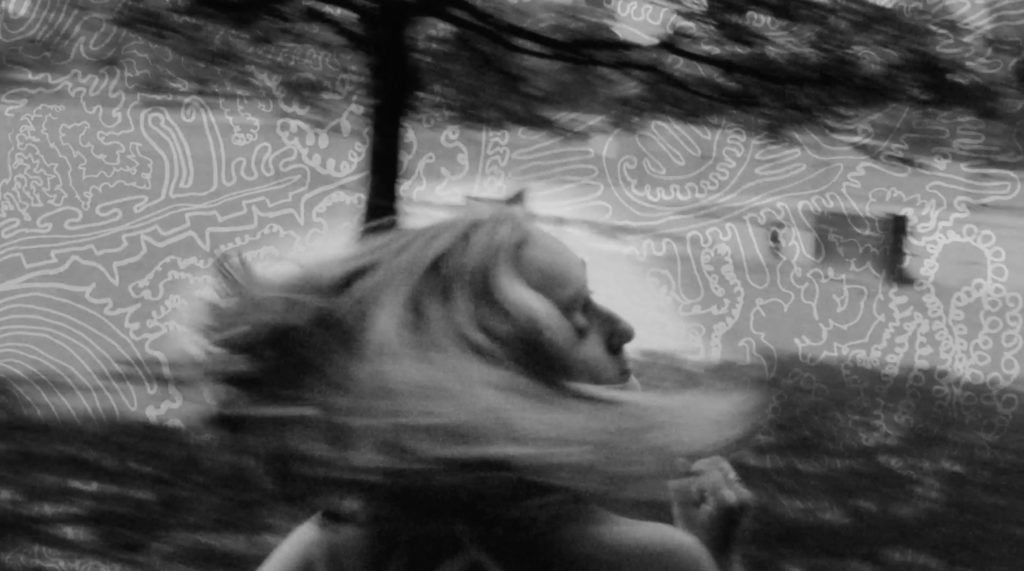
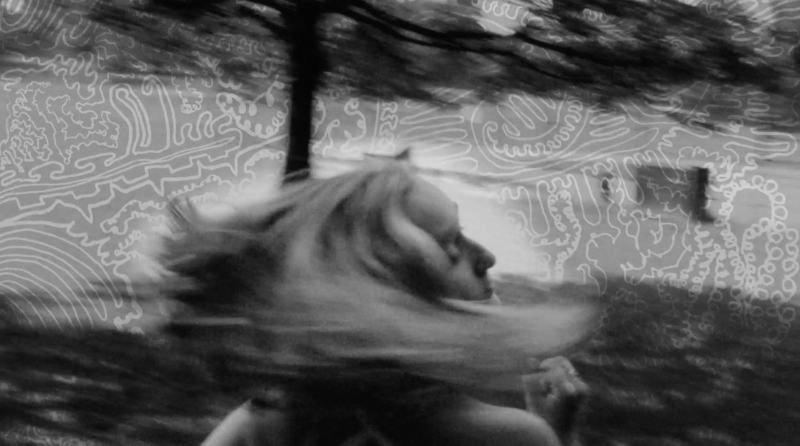
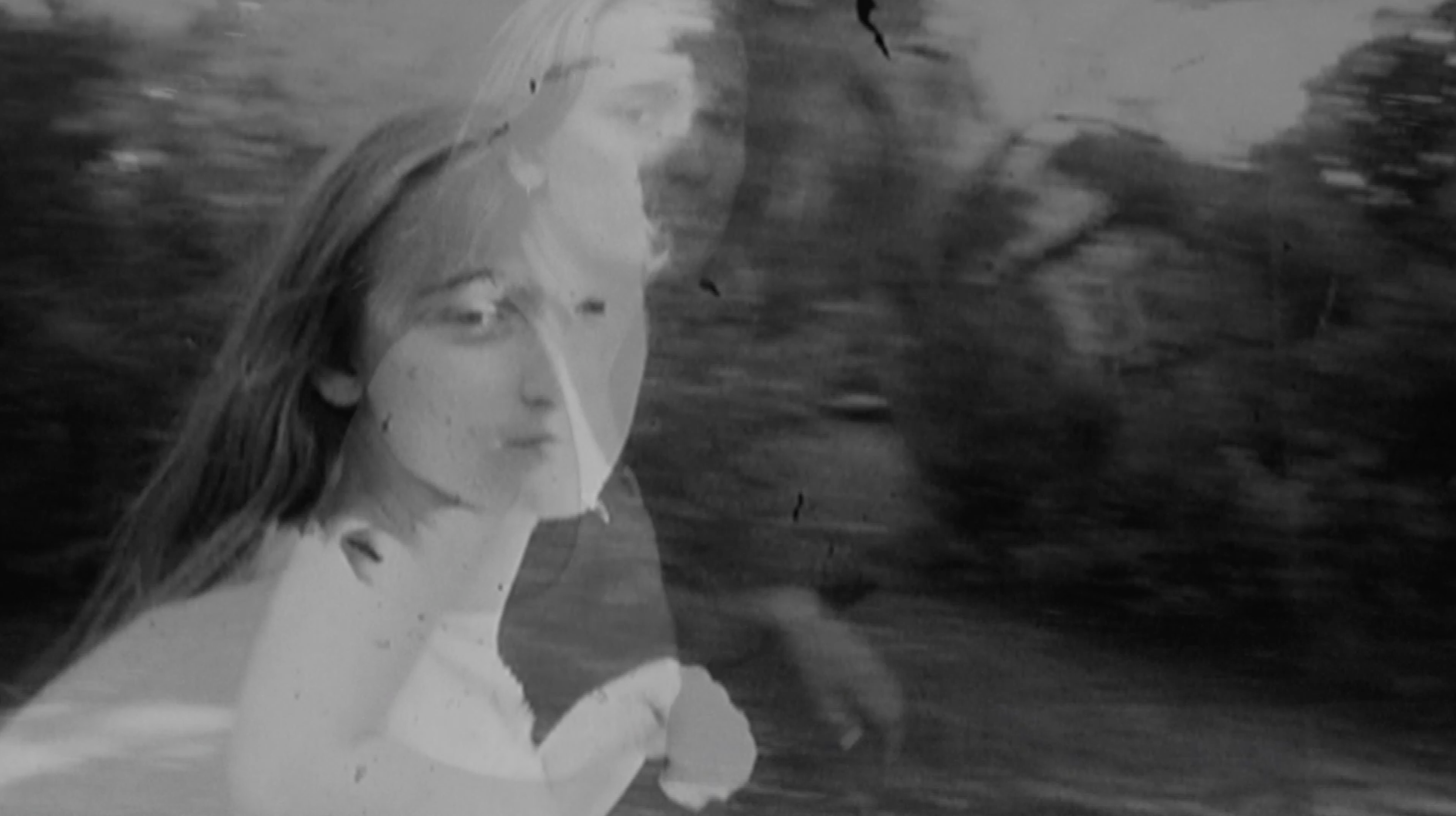
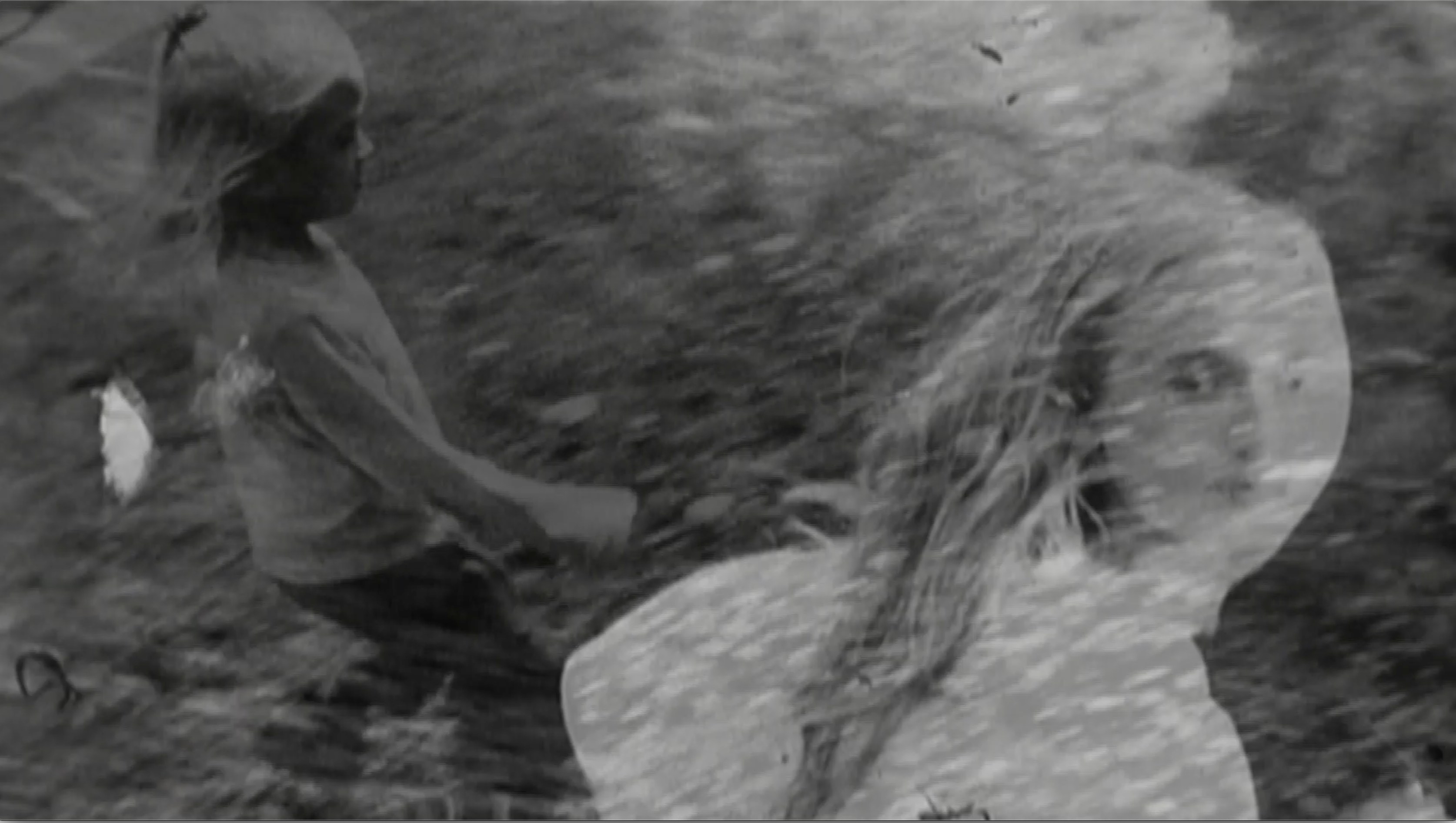
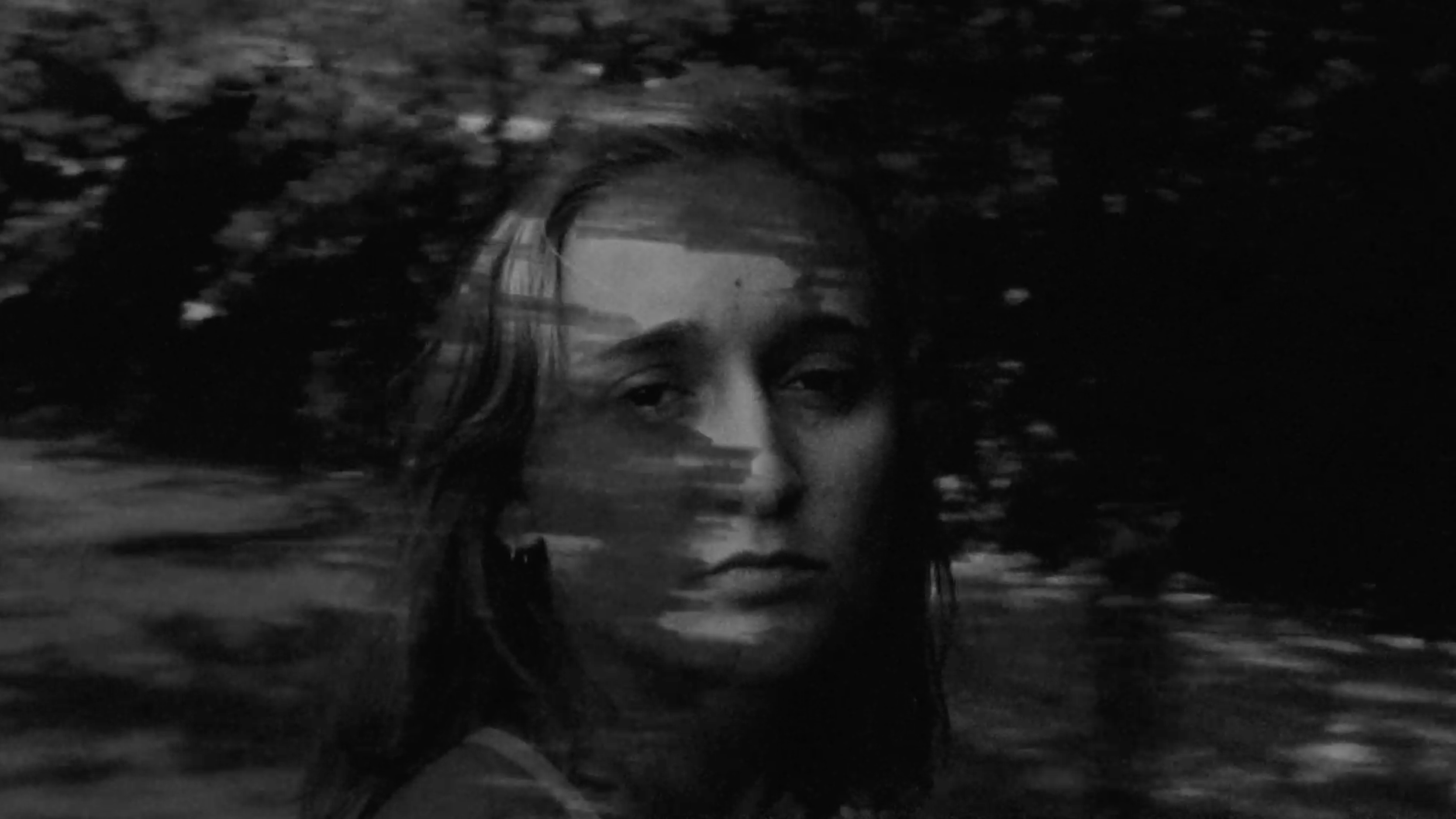
The vagaries of memory and assumptions made in the absence of real information are the subjects of director Paige Taul’s TOO SMALL TO BE A BEAR (2020, 5 min). Taul interviews her sister Jessie about their father, a short man nicknamed Cub who lost his chance to play professional baseball because he missed the bus going to the Negro League tryout. As Jessie theorizes that this unrealized ambition made him give up on his life, we see archival footage that focuses on No. 15 of the Indianapolis Clowns, a team that played in the style of the Harlem Globetrotters. His clowning seems to stand for the hopeless man who became a drunk over his missed opportunity. When Taul turns to her mother for reminiscences about her husband, the film cuts in and out as Dorothy tries to remember who played which positions. All that remains for her is the enjoyment baseball brought to the community. Luis Arnías’ MALEMBE (2020, 12 min), filmed in both Venezuela and the United States, is a memory film of a South American immigrant to the U.S. In Venezuela, we see a young boy in a soldier’s uniform in front of a bronze bust of some long-ago hero; is he a stand-in for Arnías? A parade, some elderly women sitting in a sunbaked courtyard, an abandoned ballpark with the sound of voices and crowds of years past—all give way to a winter scene, and a white woman and a young girl shoveling snow, and Arnías’ beloved tropical fruit frozen and unpalatable. As he chokes on some seeds, he spits out his tongue, his native language no longer acceptable in a country where his people clash with the police. With AVANTI! (2020, 8 min), EJ Nussbaum takes a short dive into the world of Antonio Gramsci, the Italian Marxist founder of the Italian Communist Party who was imprisoned by Mussolini’s Fascists in 1926 and died a few days after his release in 1937. In three vignettes, Nussbaum dramatizes Gramsci’s poetry and philosophical writing. Most touching are his letters to his son, Giuliano, whom he never met, and his meditation on whether loving the masses is really possible if one doesn’t love someone personally. Amusingly, he criticizes the quality of the photos his wife sends him, but admits they are still of interest to him. Amber Bemak and Angelo Madsen Minax’s video TWO SONS & A RIVER OF BLOOD (2021, 11 min) considers containers—pyramids, empty rooms, wombs—and how they are filled. The sexy beginning celebrating procreation and the anticipation of new life gives way to a sad, matter-of-fact consideration of emptiness. In the final scene, the filmmakers affirm that life goes on. In MAYA AT 24 (2021, 4 min), Lynne Sachs turned a fanciful gaze on her daughter, Maya Street-Sachs, through images she filmed in 2001, 2013, and 2019 running and spinning. The black-and-white images are overlaid with created film dust and pops, as well as intricate, animated designs that suggest the increasing complexity of the person Maya has become. Loving and beautiful, Sachs’ short is mesmerizing. In BORDER (2020, 5 min), Bryan Angarita recalls the day his brother was denied entry into the United States and how their mother visits him in the border town where he lives. The opening image of a tree-lined river viewed through what appears to be a screen window becomes obscured as the lines of the screen shift and reconfigure themselves as a border fence, a gun sight, a target, and other forms. The plain, black-and-white title cards seem devoid of emotion, but the Google Earth logo in the corner of many of the images speaks to the constant surveillance Angarita senses. LETTER FROM YOUR FAR-OFF COUNTRY (2020, 18 min) puts director Suneil Sanzgiri and his father together through Zoom and text messaging to discuss their family history, specifically, Prabhakar Sanzgiri, a writer, activist, and Communist Party leader in the Indian state of Maharashtra. Inspired by a prose poem written in the form of a letter, the director writes to his long-dead relative with news and questions, particularly about the 1989 rebellion in Kashmir that led to the death of Safdar Hashmi, a communist playwright and director, and the disappearance and murder of thousands of people. History, Sanzgiri says, runs through the personal lives of those who live it. His mission is to discover some kind of truthful continuity through art. [Marilyn Ferdinand]

Artist Q&A for Program 1 is on Wednesday, June 9 at 7pm; register
here.

“Maya at 24” Screening at Onion City Experimental Film & Video Festival

Onion City Experimental Film & Video Festival 
June 9-13, 2021
https://www.onioncityfilmfest.org/family-time-changes

Program 1: Family Time Changes

Artist Q&A: Wednesday, June 9 at 7:00 PM CST

The families we choose and the families we are born into carry their own sense of time. Using a mixture of found footage and original images, these works capture the infinite permutations of family time in the face of political and economic projects intended to render them meaningless. Throughout the program, filmmakers weather personal crises, celebrate the revolutionary potential of love, and recognize the time passing. 

Program depicts sexual content and situations.


PROGRAM:

TOO SMALL TO BE A BEAR
Two generations of women reflect on a profound event in the life of the filmmaker’s grandfather. Featuring Jessica Taul and Dorothy Taul. 
Paige Taul, United States, 2020, 05:00 mins

MALEMBE
As a knife cuts through sky, through snow, and through fruit, quasi-ethnographic footage—with its conventional markers of music, food, ritual—joins with home-movie auto-portraiture of a New England winter, communicating a sense of dislocation at once vertiginously queasy and absurdly comic.
Luis Arnías, Venezuela/United States, 2020, 12:00 mins

AVANTI!
Avanti! is inspired by Antonio Gramsci’s writings: as an idealistic young man, a romantic, a father, and a revolutionary. 
EJ Nussbaum, United States, 2020, 08:00 mins

TWO SONS AND A RIVER OF BLOOD
A queer woman is pregnant. The self-made family unit of two dykes and a trans man imagine a kind of erotic magic that will allow for procreation based solely on desire.
Amber Bemak and Angelo Madsen Minax, Mexico, 2021, 11:00 mins

MAYA AT 24
The filmmaker films her daughter Maya in 16mm black and white film, at ages 6, 16 and 24. 
Lynne Sachs, United States, 2021, 04:00 mins

BORDER
Fragmented stories relate experiences of Colombian immigrants at the border.
Bryan Angarita, Canada, 2021, 05:00 mins

LETTER FROM YOUR FAR-OFF COUNTRY
Drawing upon a rich repository of images, Letter From Your Far-off Country maps a hidden vein of shared political commitment and diasporic creative expression.
Suneil Sanzgiri, United States/India, 2020, 18:00 mins

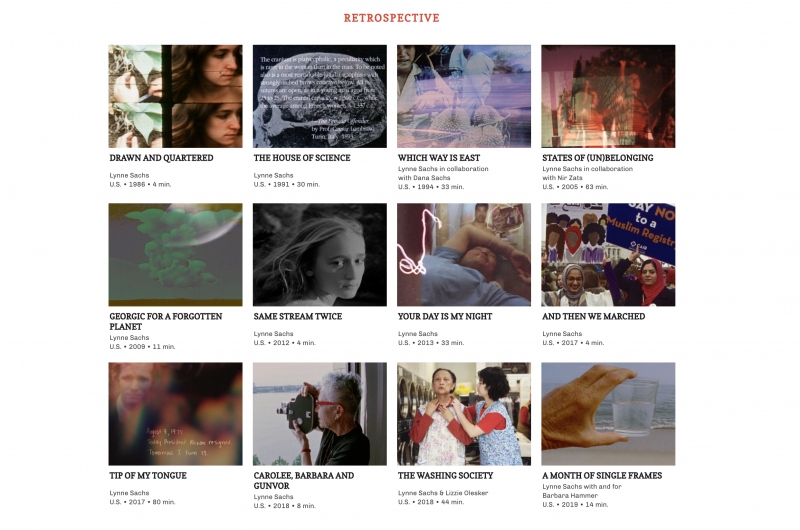
Northwest Film Forum to Present Lynne Sachs Retrospective

Lynne Sachs Retrospective: Between Thought and Expression [Online]
May 14-31, 2021
https://nwfilmforum.org/films/lynne-sachs-retrospective-between-thought-and-expression-online/

Lynne Sachs • US • 2001-2021

About
“For more than thirty years, artist Lynne Sachs has constructed short, bold mid-length, and feature films incorporating elements of the essay film, collage, performance, and observational documentary. Her highly self-reflexive films have variously explored the relations between the body, camera, and the materiality of film itself; histories of personal, social, and political trauma; marginalized communities and their labor; and her own family life, slipping seamlessly between modes, from documentary essays to diaristic shorts.” (Edo Choi, Assistant Curator of Film, Museum of the Moving Image)

The following three programs are from Lynne Sachs: Between Thought and Expression, the Museum of the Moving Image’s retrospective series of five programs of her films.


Films in this series:

Your Day Is My Night
(Lynne Sachs, US, 2013, 64 min)
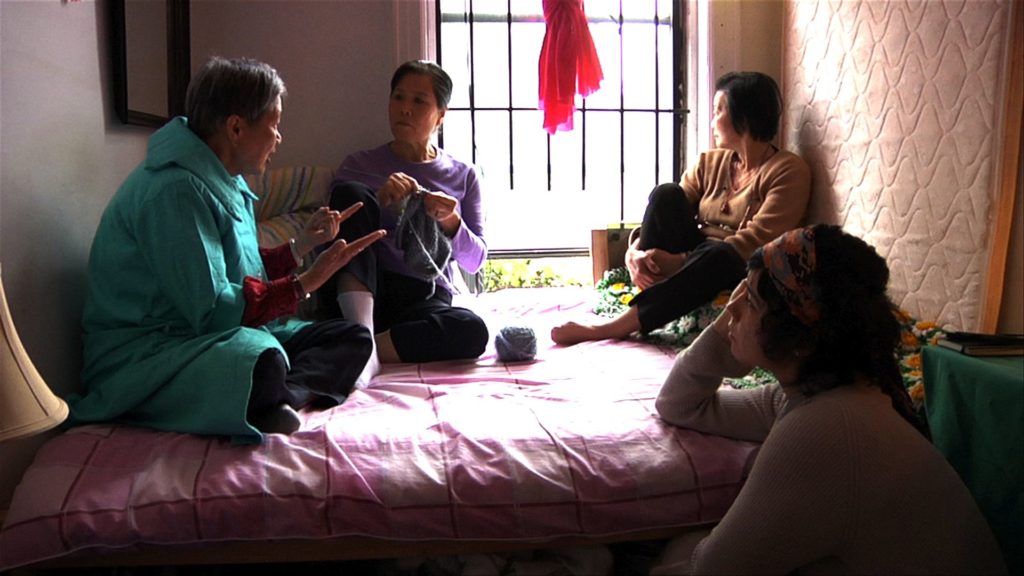
This bed doesn’t necessarily belong to any one person,” someone says early in Your Day Is My Night. It could be the metaphorical thesis of this film, perhaps Lynne Sachs’s most self-effacing and meditative work. A seamless blend of closely observed verité footage, interpretive performance, and confessional monologues and interviews, the film doesn’t document so much as create a space to accommodate the stories and experiences of seven Chinese immigrants from ages 58 to 78 who live together in a “shift-bed” apartment in Manhattan’s Chinatown. Sachs’s quilted sense of form achieves a new level of refinement and delicacy in collaboration with her cameraman Sean Hanley and her editor Amanda Katz, as she works with the participants to exhume a collective history of migration and struggle.


Tip of My Tongue
(Lynne Sachs, US, 2017, 80 min)
Sachs’s richly generative Tip of My Tongue finds the filmmaker responding to her 50th birthday by gathering twelve members of her generational cohort—friends and peers all born between 1958 and 1964, and originating as far as Cuba, Iran, and Australia—to participate in the creation of a choral work about the convergent and divergent effects history leaves upon those who live it. From the Kennedy assassination to Occupy Wall Street, the participants reveal their memories of, and reflections upon, the transformative experiences of their lives. Set to an ecstatic, pulsing score by Stephen Vitiello, the film interweaves these personal confessions with impressionistic images of contemporary New York, obscured glimpses of archival footage, and graphically rendered fragments of text to create a radiant prism of collective memory.


Short film program: Time Passes
(Lynne Sachs, US, 2001-2017, 51 min TRT)
Twenty years unspool over nine short films: portraits of Lynne Sachs’s children; visits with her mother, brother, niece and nephew; a tribute to the city where she lives; and scenes of sociopolitical trauma and protest. Nearly all shot on super 8mm or 16mm, and often silent, each work is at once a preservation of a moment and a record of change, seamlessly weaving together the candid and the performed gesture, the public and the private memory, in a simultaneously objective and subjective posture toward the passing of time.

  • Photograph of Wind (2001, 4 min)
  • Tornado (2002, 4 min)
  • Noa, Noa (2006, 8 min)
  • Georgic for a Forgotten Planet (2008, 11 min)
  • Same Stream Twice (2012, 4 min)
  • Viva and Felix Growing Up (2015, 10 min)
  • Day Residue (2016, 3 min)
  • And Then We Marched (2017, 3 min)
  • Maya at 24 (2021, 4 min)

About Lynne Sachs
Lynne Sachs is a filmmaker and poet who grew up in Memphis, Tennessee and is currently living in Brooklyn, New York. Her moving image work ranges from short experimental films to essay films to hybrid live performances. Lynne discovered her love of filmmaking while living in San Francisco where she worked closely with artists Craig Baldwin, Bruce Conner, Ernie Gehr, Barbara Hammer, Gunvor Nelson, and Trinh T. Minh-ha.

Between 1994 and 2006, she produced five essay films that took her to Vietnam, Bosnia, Israel, Italy and Germany – sites affected by international war – where she looked at the space between a community’s collective memory and her own subjective perceptions. Looking at the world from a feminist lens, she expresses intimacy by the way she uses her camera. Objects, places, reflections, faces, hands, all come so close to us in her films. Strongly committed to a dialogue between cinematic theory and practice, she searches for a rigorous play between image and sound, pushing the visual and aural textures in her work with every new project. With the making of Your Day is My Night (2013), Every Fold Matters (2015), and The Washing Society (2018), Lynne expanded her practice to include live performance.

As of 2020, Lynne has made 37 films. The Buenos Aires International Festival of Independent Cinema, Festival International Nuevo Cine in Havana, China Women’s Film Festival, and Sheffield Doc/ Fest have all presented retrospectives of her films. Lynne received a 2014 Guggenheim Fellowship in the Creative Arts.


About Edo Choi
Edo Choi is Assistant Curator of Film at the Museum of the Moving Image. Previously, he served in the dual capacity of programming manager and chief projectionist for the Maysles Documentary Center in Harlem. He has organized programs as an independent curator for the New York Public Library and the Documentary Film Group, film society at the University of Chicago, where he held the position of Programming Chair between 2008 and 2010. He also works as a freelance projectionist at venues around New York City.

Kino Rebelde to Represent Lynne Sachs’ Catalogue Internationally

http://www.kinorebelde.com/lynne-sachs-complete-filmography/

Kino Rebelde has created a retrospective that traces a delicate line connecting intimacy, power relations, violence, memory, migration, desire, love, and war in Lynne’s films. By looking at each of these works, we can see a director facing her own fears and contradictions, as well as her sense of friendship and motherhood.  Moving from idea to emotion and back again, our retrospective takes us on a journey through Sachs’ life as a filmmaker, beginning in 1986 and moving all the way to the present.

With the intention of allowing her work to cross boundaries, to interpret and to inquire into her distinctive mode of engaging with the camera as an apparatus for expression, we are delighted to present 37 films that comprise the complete filmmography, so far, of Lynne Sachs as visual artist and filmmaker. Regardless of the passage of time, these works continue to be extremely contemporary, coherent and radical in their artistic conception.


About Kino Rebelde

Kino Rebelde is a Sales and Festival Distribution Agency created by María Vera in early 2017. Its exclusively dedicated to promotion of non-fiction cinema, hybrid narratives and experimental.

Based on the creative distribution of few titles by year, Kino Rebelde established itself as a “boutique agency”, working on a specialized strategy for each film, within its own characteristics, market potential, niches and formal and alternative windows.

This company supports short, medium and long feature films, from any country, with linear or non-linear narratives. They can be in development or WIP, preferably in the editing stage.

The focus: author point of view, pulse of stories, chaos, risk, more questions, less answers, aesthetic and politic transgression, empathy, identities, desires and memory.

Kino Rebelde was born in Madrid, but as its films, this is a nomadic project. In the last years María has been living in Lisbon, Belgrade and Hanoi and she’ll keep moving around.

About María Vera

Festival Distributor and Sales Agent born in Argentina. Founder of Kino Rebelde, a company focused on creative distribution of non-fiction, experimental and hybrid narratives.

Her films have been selected and awarded in festivals as Berlinale, IFFR Rotterdam, IDFA, Visions Du Réel, New York FF, Hot Docs, Jeonju IFF, Sheffield Doc/Fest, Sarajevo FF, Doclisboa and Viennale, among others.

María has a background as producer of socio-political and human rights contents as well as a film curator.Envelope

vera@kinorebelde.com


Lynne Sachs (1961) is an American filmmaker and poet living in Brooklyn, New York. Her moving image work ranges from documentaries, to essay films, to experimental shorts, to hybrid live performances.

Working from a feminist perspective, Lynne weaves together social criticism with personal subjectivity. Her films embrace a radical use of archives, performance and intricate sound work. Between 2013 and 2020, she collaborated with renowned musician and sound artist Stephen Vitiello on five films.

Strongly committed to a dialogue between cinematic theory and practice, she searches for a rigorous play between image and sound, pushing the visual and aural textures in each new project.

Between 1994 and 2009, Lynne directed five essay films that took her to Vietnam, Bosnia, Israel, Italy and Germany – sites affected by international war – where she looked at the space between a community’s collective memory and her own perception. 

Over the course of her career, she has worked closely with film artists Craig Baldwin, Bruce Conner, Ernie Gehr, Barbara Hammer, Chris Marker, Gunvor Nelson, and Trinh T. Min-ha.

Retrospective – “Lynne Sachs: Between Thought and Expression” curated by Edo Choi, Asst. Curator, Museum of the Moving Image

https://canyoncinema.com/2021/02/17/lynne-sachs-between-thought-and-expression-five-program-retrospective-now-available-for-rent/

“For more than thirty years, artist Lynne Sachs has constructed short, bold mid-length, and feature films incorporating elements of the essay film, collage, performance, and observational documentary. Her highly self-reflexive films have variously explored the relations between the body, camera, and the materiality of film itself; histories of personal, social, and political trauma; marginalized communities and their labor; and her own family life, slipping seamlessly between modes, from documentary essays to diaristic shorts.” (Edo Choi, Assistant Curator of Film, Museum of the Moving Image)

This five-part retrospective offers a career-ranging survey of Sachs’s work and includes new HD transfers of Still Life With Woman and Four Objects, Drawn and QuarteredThe House of Science: a museum of false facts, and Which Way Is East: Notebooks from Vietnam.

Note: The following programs can be rented individually or as a package. A new video interview and between Lynne Sachs and series curator Edo Choi is also available as part of the rental fee.

For rental and pricing information, please contact: info@canyoncinema.com

All films are directed by Lynne Sachs.
Program notes by Edo Choi.


Lynne Sachs in Conversation with Edo Choi, Assistant Curator at the Museum of the Moving Image

FULL TRANSCRIPT


Program 1: Early Dissections
In her first three films, Sachs performs an exuberant autopsy of the medium itself, reveling in the investigation of its formal possibilities and cultural implications: the disjunctive layering of visual and verbal phrases in Still Life with Woman and Four Objects; un-split regular 8mm film as a metaphorical body and site of intercourse in the optically printed Drawn and Quartered; the scopophilic and gendered intentions of the camera’s gaze in Following the Object to Its Logical Beginning. These experiments anticipate the range of the artist’s mature work, beginning with her first essayistic collage The House of Science: a museum of false facts. Itself an autopsy, this mid-length film exposes the anatomy of western rationalism as a framework for sexual subjugation via a finely stitched patchwork of sounds and images from artistic renderings to archival films, home movies to staged performances.

Still Life with Woman and Four Objects (1986, 4 mins.)  New HD transfer
Drawn and Quartered (1987, 4 mins.) – new HD transfer
Following the Object to Its Logical Beginning (1987, 9 mins.)
The House of Science: a museum of false facts (1991, 30 mins.) – new HD transfer


Program 2: Family Travels
One of Lynne Sachs’s most sheerly beautiful films, Which Way Is East is a simultaneously intoxicating and politically sobering diary of encounters with the sights, sounds, and people of Vietnam, as Sachs pays a visit to her sister Dana and the two set off north from Ho Chi Minh City to Hanoi. The film is paired here with a very different kind of family journey The Last Happy Day, recounting the life of Sachs’s distant cousin Sandor Lenard, a Jewish Hungarian doctor who survived the Second World War and was ultimately hired to reassemble the bones of dead American soldiers. Here Sachs journeys through time as opposed to space, as she assembles a typically colorful array of documentary and performative elements, including Sandor’s letters, a children’s performance, and highly abstracted war footage, to bring us closer to a man who bore witness to terrible things. This program also features The Last Happy Day’s brief predecessor, The Small Ones. Program running time: 73 mins.

Which Way Is East: Notebooks from Vietnam (1994, 33 mins.) – new HD transfer
The Small Ones (2007, 3 mins.)
The Last Happy Day (2009, 37 mins.)


Program 3: Time Passes
Twenty years unspool over nine short films: portraits of Lynne Sachs’s children; visits with her mother, brother, niece and nephew; a tribute to the city where she lives; and scenes of sociopolitical trauma and protest. Nearly all shot on super 8mm or 16mm, and often silent, each work is at once a preservation of a moment and a record of change, seamlessly weaving together the candid and the performed gesture, the public and the private memory, in a simultaneously objective and subjective posture toward the passing of time. Program running time: 51 mins.

Photograph of Wind (2001, 4 mins.)
Tornado (2002, 4 mins.)
Noa, Noa (2006, 8 mins.)
Georgic for a Forgotten Planet (2008, 11 mins.)
Same Stream Twice (2012, 4 mins.)
Viva and Felix Growing Up (2015, 10 mins.)
Day Residue (2016, 3 mins.)
And Then We Marched (2017, 3 mins.)
Maya at 24 (2021, 4 mins.)


Program 4: Your Day Is My Night
2013, 64 mins. “This bed doesn’t necessarily belong to any one person,” someone says early in Your Day Is My Night. It could be the metaphorical thesis of this film, perhaps Lynne Sachs’s most self-effacing and meditative work. A seamless blend of closely observed verité footage, interpretive performance, and confessional monologues and interviews, the film doesn’t document so much as create a space to accommodate the stories and experiences of seven Chinese immigrants from ages 58 to 78 who live together in a “shift-bed” apartment in Manhattan’s Chinatown. Sachs’s quilted sense of form achieves a new level of refinement and delicacy in collaboration with her cameraman Sean Hanley and her editor Amanda Katz, as she works with the participants to exhume a collective history of migration and struggle.


Program 5: Tip of My Tongue
2017, 80 mins. Sachs’s richly generative Tip of My Tongue finds the filmmaker responding to her 50th birthday by gathering twelve members of her generational cohort—friends and peers all born between 1958 and 1964, and originating as far as Cuba, Iran, and Australia—to participate in the creation of a choral work about the convergent and divergent effects history leaves upon those who live it. From the Kennedy assassination to Occupy Wall Street, the participants reveal their memories of, and reflections upon, the transformative experiences of their lives. Set to an ecstatic, pulsing score by Stephen Vitiello, the film interweaves these personal confessions with impressionistic images of contemporary New York, obscured glimpses of archival footage, and graphically rendered fragments of text to create a radiant prism of collective memory. Preceded by Sachs’s frantic record of accumulated daily to-do lists, A Year in Notes and Numbers (2018, 4 mins.).


Thanks to:

Maya at 24 (2021)

Maya at 24
4 min., 16mm, b&w, sound 2021
a film by Lynne Sachs
with editing and animation by Rebecca Shapass
music by Kevin T. Allen

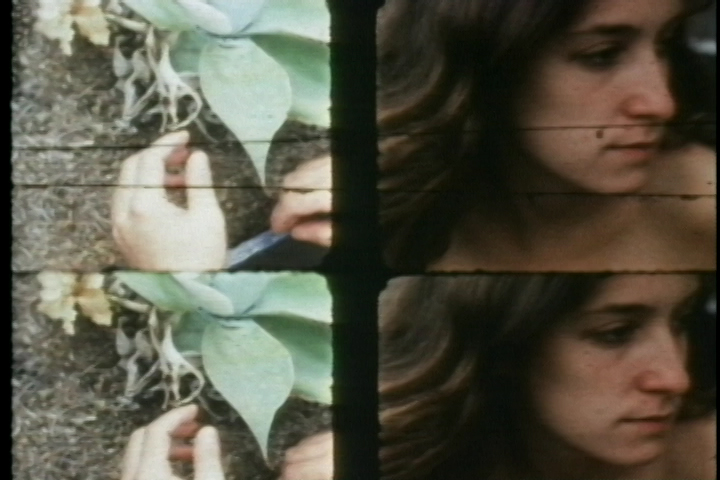
Lynne Sachs films her daughter Maya in 16mm black and white film, at ages 6, 16 and 24. At each iteration, Maya runs around her mother, in a circle – clockwise – as if propelling herself in the same direction as time, forward. Conscious of the strange simultaneous temporal landscape that only film can convey, we watch Maya in motion at each distinct age.

“My daughter’s name is Maya. I’ve been told that the word maya means illusion in Hindu philosophy. In 2001, I photographed her at six years old, spinning like a top around me. Even then, I realized that her childhood was not something I could grasp but rather – like the wind – something I could feel tenderly brushing across my cheek.  Eleven years later, I pulled out my 16mm Bolex camera, as she allowed me to film her – different but somehow the same.  Recently, at age 24, Maya took another spin — we look at one another, moving, filling space, aware.  Completed during the 2020 pandemic, the film includes the intimate yet awkward rhythms of our two voices while living together during quarantine.” – Lynne Sachs


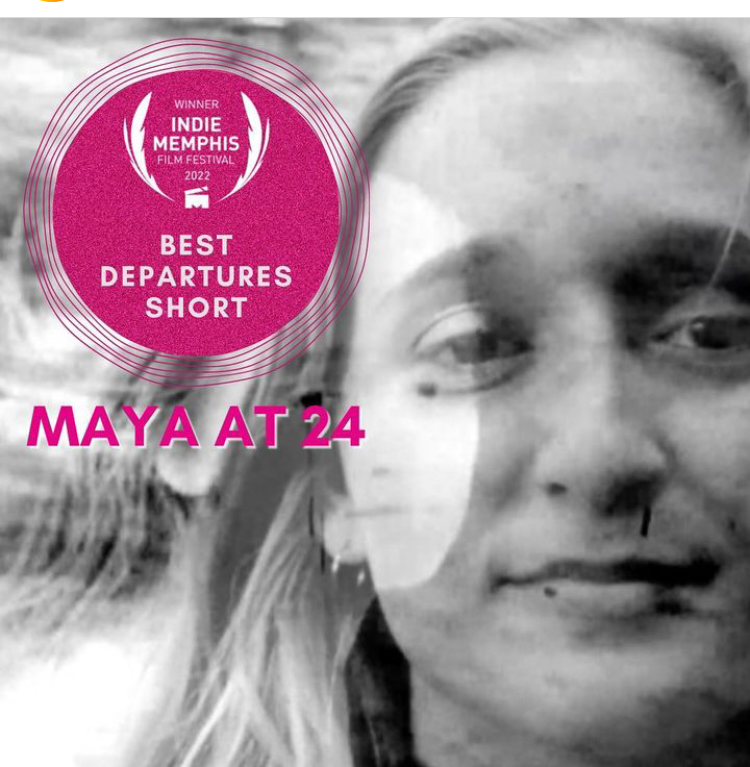
Screenings: Museum of the Moving Image (Queens, NY), Indie Memphis Film Festival (Tennessee), Best Departures Short, 2022; Onion City Experimental Film + Video Festival (Chicago); Black Maria Film Festival (New Jersey), Jury Citation Award, 2021; Northwest Film Forum (Seattle), 2021; Mill Valley Film Festival (California), 2021.


Featured on Beyond Chron’s Best of 2021 List by Peter Wong:
Maya at 24 – Lynne Sachs’ short uses the simple image of her daughter Maya running in front of the camera to offer kinetic snapshots of how our children change physically and emotionally over the years.


Criterion Channel streaming premiere with 7 other films, Oct. 2021.

For inquiries about rentals or purchases please contact Canyon Cinema or the Film-makers’ Cooperative. And for international bookings, please contact Kino Rebelde.


This film is currently only available with a password. Please write to info@lynnesachs.com to request access.

Gay City News on “Film About a Father Who”

“Film About a Father Who” Explores Ira Sachs, Sr.’s Turbulent Life
By Steve Erickson
January 14, 2021
Gay City News
https://www.gaycitynews.com/film-about-a-father-who-explores-ira-sachs-sr-s-turbulent-life/

Lynne Sachs’ documentary “Film About a Father Who” circles around a hole. Her father Ira is now 84, and she’s old enough to be the mother of an adult daughter. But one can tell that she still doesn’t fully understand him. That’s the reason why she made this film, which follows the messiness of a man whose idea of freedom consisted of running from one short-term fling to the next with no regard for the fact that he kept fathering children.

“Film About a Father Who” incorporates footage newly shot by Sachs for the documentary, as well as home movies dating back as early as 1965 and material shot by her father and her brother, the accomplished, out gay director Ira Sachs, Jr. Almost every possible video format is credited, as well as 8mm and 16mm film. The result is a hodgepodge of textures and styles. To add to the mélange, Sachs often plays audio of people whose voices we can’t place on top of unrelated images. While the film begins with promotional video made by Ira Sr. in Park City, Utah in 1992, it spans his entire adult life. Ira, Jr. fictionalized aspects of his father’s life in his 2005 film “Forty Shades of Blue.” Lynne nursed this project for 30 years, then decided to complete it by recording a voice-over in January 2019.

Sachs refuses to pass judgment on a man who was neglectful and selfish. The film’s spectators probably won’t be so reluctant. Ira, Sr. never should’ve had children or agreed to participate in a monogamous relationship, although his lifestyle as “the Hugh Hefner of Park City” probably made the former inevitable. (Without using the word “vasectomy,” his mother tells him he should get one.) But while his appearances on screen don’t lead to any epiphanies about the sources of his behavior, Sachs is equally interested in the experiences of her siblings, who are better equipped to explain their lives.

She brings the whole family together to film a discussion on this subject. The class and racial differences of her siblings are apparent. While she’s white and Jewish, some of her siblings are of different races. In the end, he fathered nine children by six women, but concealed two because his mother threatened to cut him out of her will if he kept having kids. One woman contrasts her life of hunger and poverty with the middle class lives of Lynne and Ira, Jr.

While she doesn’t emphasize this part of her father’s personality or her own work, she’s best known for the anti-war films she made in the 2000s. She may have been influenced by Ira, Sr.’s “life-long interest in doing good in the world,” as she describes it in the press kit. Very early on, “Film About A Father Who” describes him as a “hippie businessman, using other people’s money to develop hotels named after flowers,” and mentions his resistance to defining himself by his job. But Ira, Sr. remains bound to a ‘60s idea of masculinity – he even looks like David Crosby today – that viewed women and children as impediments to his freedom.

Sachs is also receiving a five-program retrospective at the Museum of the Moving Image starting Jan. 13th. It’s not complete, focusing on her family-themed work rather than her more political fare. But obviously that makes a fitting context for “Film About a Father Who.” She films children with a tenderness that seems to have been lacking from her own youth. She’s made three shorts reworking the same images of her daughter, Maya, as well as a depiction of her niece and nephew in the 2015 “Viva and Felix Growing Up.”

In Sachs’ most recent film, the four-minute short “Maya at 24,” she edits together film of her daughter at 6, 16, and 24. “Maya at 24” suggests that change is the only constant in life. It’s based around the image of Maya running in a clockwise circle as Sachs pans the camera to keep up with her. “Maya at 24” also uses superimposition to place earlier versions of the woman inside her head. While not exactly a subtle film, it suggests something real about the way we carry our pasts inside us as we race towards an uncertain future. “Film About a Father Who” expands that notion on a grander scale, with a nagging sense that Sachs is searching for emotions she never received as a child and her entire family wants answers from Ira Sr. while he’s still alive. They don’t seem likely to be forthcoming.

FILM ABOUT A FATHER WHO | Directed by Lynne Sachs | The Cinema Guild | Starts streaming through the Museum of the Moving Image Jan. 15