“Usually when I decide to write a poem, I immediately begin a fight with myself over whether I actually have something to say. This argument can open turn into a capitulation of my creative self to my practical self, resulting in my opening up my checkbook, changing the cat litter, emptying the dishwasher, or simply filling my day with the tasks of a so-called productive life. If I still feel tugged by a desire to write but can only allocate a few minutes, I turn to punctuation. When you don’t know what to write, return full circle to what you’ve already written and begin to experiment and play. Like a musician at the piano or a florist giving shape to an ikebana arrangement, exploring the shifts of intonation and meaning that come with reevaluating your punctuation can result in the sensation of creating something new.”
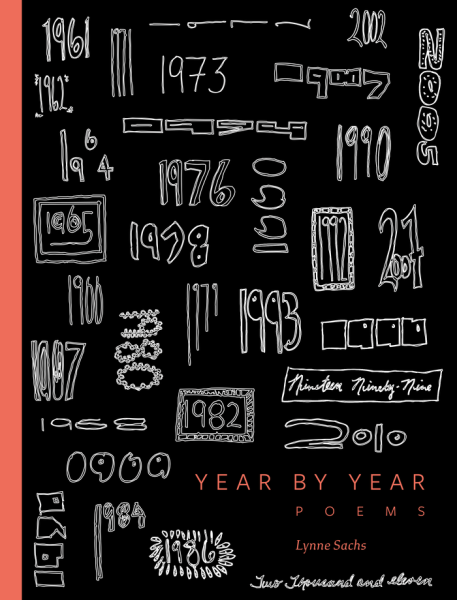
—Lynne Sachs, author of Year by Year Poems (Tender Buttons Press, 2019)
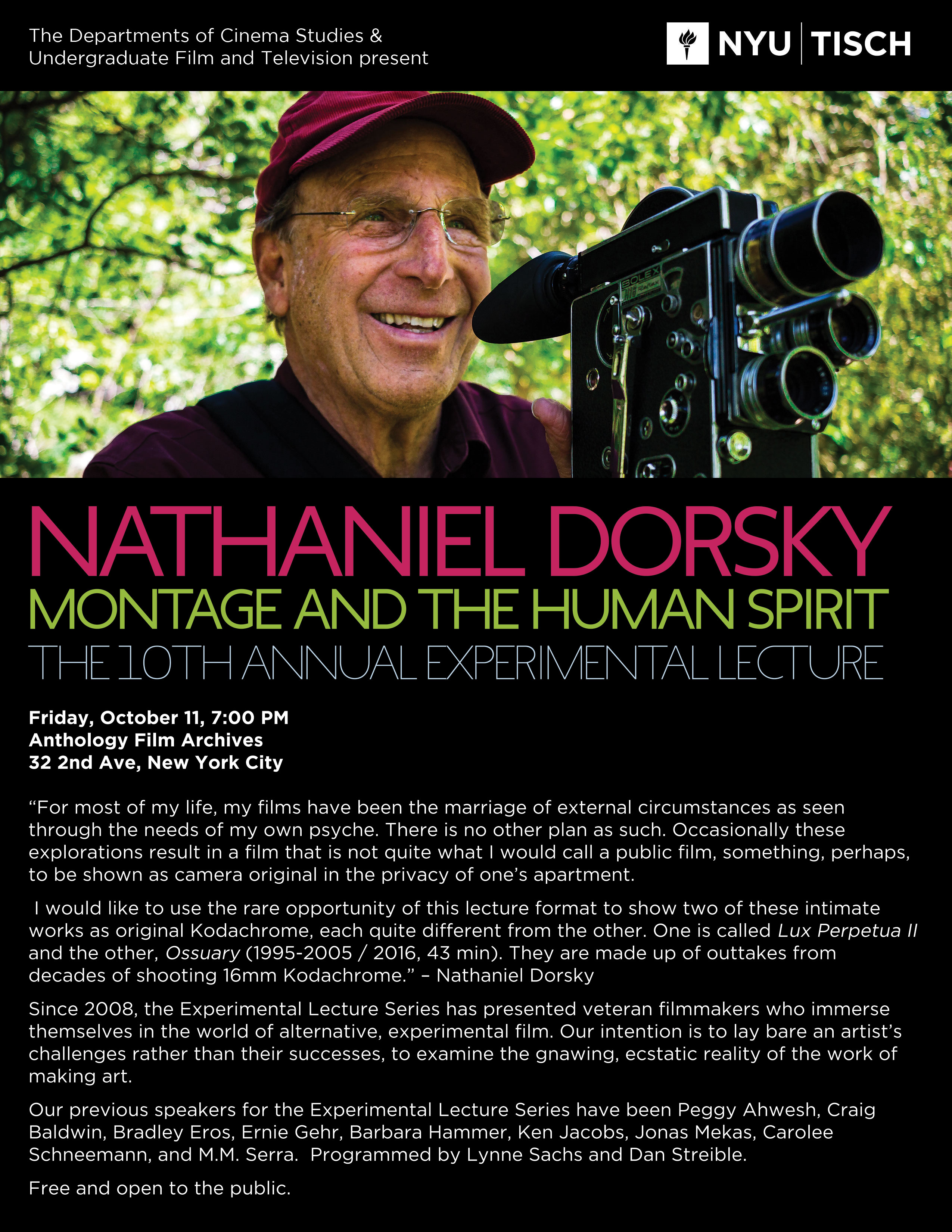
Oct. 11, 2019
Anthology Film Archives, New York City
“For most of my life, my films have been the marriage of external circumstances as seen through the needs of my own psyche. There is no other plan as such. Occasionally these explorations result in a film that is not quite what I would call a public film, something, perhaps, to be shown as camera original in the privacy of one’s apartment. I would like to use the rare opportunity of this lecture format to show two of these intimate works as original Kodachrome, each quite different from the other. One is called Lux Perpetua II and the other, Ossuary. They are made up of outtakes from decades of shooting 16mm Kodachrome.” – Nick Dorsky
Since 2008, the Experimental Lecture Series has presented veteran filmmakers who immerse themselves in the world of alternative, experimental film. Our intention is to lay bare an artist’s challenges rather than their successes, to examine the gnawing, ecstatic reality of the work of making art. Our previous speakers for the Experimental Lecture Series have been Peggy Ahwesh, Craig Baldwin, Bradley Eros, Ernie Gehr, Barbara Hammer, Ken Jacobs, Jonas Mekas, Carolee Schneemann, and M.M. Serra. Programmed by Lynne Sachs and Dan Streible.
Lynne’s Intro:
“I am thrilled to welcome Nathaniel Dorsky today to present our 10th Annual Experimental Lecture. Nick comes to us after a decade of talks and screenings by Peggy Ahwesh, Craig Baldwin, Bradley Eros, Ernie Gehr, Barbara Hammer, Ken Jacobs, Jonas Mekas, Carolee Schneemann, and M.M. Serra. In this series, artists have explored their own process, their own investigation of the shift from discouragement to realization – the why and the how that allows them to continue. My intention has always been to ask each artist to lay bare their challenges rather than their successes, to examine the gnawing, ecstatic reality of the work of making art. I remember Barbara Hammer coming to her lecture ten years ago, “fresh” from a round of chemotherapy, with much hair on her head, of course, she draped the hall with a paper film and then picked up a very heavy Pagent Projector and proceed to create a work of expanded cinema in which all four walls and our skin became screens. I remember Craig Baldwin’s lecture on Cinema Povera and his uncomfortability with actually talking about his own process. Bradley Eros brought in a chorus of poets and performers to accompany him as he stood in the back of the room and spoke in the darkness. Carolee Schneemann gave a lecture that was both introspective and hilarious at time minutes after she had fallen downstairs and broken her hip. MM Serra gave a wonderful lecture that included her own feminist journey exploring her embrace of the erotic image. And Jonas Mekas spoke to us for three hours, without notes or any films whatsoever – about everything from the history of underground cinema in NYC to his own approach to the camera. There were so many people we had to create an overflow hall where the audience watched Jonas on the screen. I would like to dedicate tonight’s program to Barbara, Carolee and Jonas, dear friends, and loving artists.” Lynne Sachs
With additional introductions by poet Lee Ann Brown and UGFTV teacher Darrell Wilson.
When filmmaker Lynne Sachs turned fifty, she dedicated herself to writing a poem for every year of her life, so far. Each of the fifty poems investigates the relationship between a singular event in Sachs’ life and the swirl of events beyond her domestic universe. Published by Tender Buttons Press, Year by Year Poems juxtaposes Sachs’ finished poems, which move from her birth in 1961 to her half-century marker in 2011, with her original handwritten first drafts. In this way, she reveals her process of navigating within and alongside historical events such as the Moon Landing, the assassination of Martin Luther King, Jr., streaking, the Anita Hill hearings, the Columbine shootings, and controversies around universal health care. In Year by Year Poems, Lynne Sachs realizes the long anticipated leap from her extraordinary career in filmmaking to this, her first book of poems.
With an introduction by Paolo Javier,former Queens Poet Laureate and author of Court of the Dragon, and book design by Abby Goldstein.
Lynne Sachs reads from “Year by Year” at Beyond Baroque (LA)
#12 on Small Press Distribution’s October 2019 Best Seller List! Favorite Poetry in 2019 – Dennis Cooper Year End List Praise for Year by Year Poems:
“The whole arc of a life is sketched movingly in this singular collection. These poems have both delicacy and grit. With the sensitive eye for details that she has long brought to her films, Lynne Sachs shares, this time on the page, her uncanny observations of moments on the fly, filled with longings, misses, joys and mysterious glimpses of a pattern of meaning underneath it all.”
–– Phillip Lopate, author of Portrait of My Body and Against Joie de Vivre
“The highly acclaimed filmmaker Lynne Sachs is also a captivating and surprising poet. Year by Year distills five decades into lyric, a lustrous tapestry woven of memory, wisdom, cultural apprehension and the delicate specificities of lived life.”
–– Claire Messud, author of The Woman Upstairs and When the World Was Steady
“In Year by Year, Lynne Sachs selects and distills from larger fields of notation, acute scenes representing her life and the world she was born into. Her measured, spare account brings her to an understanding and acceptance of the terrible and beautiful fact that history both moves us and moves through us, and, more significantly, how by contending with its uncompromising force, we define an ethics that guides our fate.” – Michael Collier author of Dark Wild Realm
“Renowned experimental documentary filmmaker Lynne Sachs wrote one of 2019’s best books of poetry. In 2011, after deciding to write one poem for each of the fifty years of her life, Sachs asked herself, “How have the private, most intimate moments of my life been affected by the public world beyond?” The graceful, diaristic poems that she went on to produce successfully distill events and themes in the poet’s life and simultaneously, magically, reflect larger movements of history and culture. Intimate and imagistic, the poems unfold a series of miniature stories with sensuous rhythms, telling visual detail, and gentle humor. Thus, in “1969” a young Sachs imagines Neil Armstrong calling on the telephone, then turning “to look at all of us (from the moon).” This beautifully designed book includes facsimiles of many of the poetry’s initial drafts, which subtly illumine this artist’s creative process.” – John Smalley, 2019 Staff Pick, San Francisco Public Library, Poetry Librarian
“As an artist, Sachs keeps playing, again and again, with each of the thirty-three films she has made over the decades and now, with her first book of poems, which are just as inventive and fresh, just as delightfully playful with form. These poems are innovative but never intimidating or deliberately opaque. Instead, they invite us in, encouraging us to play along. They give us a structure to enter into our own retrospective lives, our own distillations of time, our own superimpositions of the newsworthy world onto our most intimate moments.” – Sharon Harrigan, Cleaver: Philadelphia’s International Literary Magazine (excerpt)
“Powerful collection! We’re loving Year by Year, a rich poetry collection and visual journey of ideas by filmmaker Lynne Sachs. The book includes original handwritten first drafts with each finished piece. Unique process immersion. Fascinating to view the first drafts with the complete pieces, exploring them together like a map, what is gained (& lost) as we move through time and ideas. Elegant and elegiac.” – Margot Douaihy, Northern New England Review (posted in Twitter)
“The poems of Year by Year led Sachs to create a feature-length hybrid documentary called ‘Tip of My Tongue”, an indication of how richly resonant these poems are, with their skillful intermingling of private and public.” – John Bradley, Rain Taxi (championing aesthetically adventurous literature)
About the Author: Lynne Sachs makes films and writes poems that explore the intricate relationship between personal observations and broader historical experiences. Her work embraces hybrid form and combines memoir with experimental, documentary, and fictional modes. In recent years, she has expanded her practice to include live performance with moving image. Lynne was first exposed to poetry by her great aunt as a child in Memphis, Tennessee. Soon she was frequenting workshops at the local library and getting a chance to learn from poets like Gwendolyn Brooks and Ethridge Knight. As an active member of Brown University’s undergraduate poetry community, she shared her early poems with fellow poet Stacy Doris. Lynne later discovered her love of filmmaking while living in San Francisco where she worked with artists Craig Baldwin, Bruce Conner, Barbara Hammer, Carolee Schneeman, and Trinh T. Minh-ha. Lynne has made thirty-five films which have screened at the New York Film Festival, the Sundance Film Festival, the Museum of Modern Art, the Whitney Museum of American Art, the Walker Art Center, and the Wexner Center for the Arts. Festivals in Buenos Aires, Beijing and Havana have presented retrospectives of her work. Lynne received a 2014 Guggenheim Fellowship. In early 2020, her newest movie, Film About a Father Who, will premiere on opening night at the Slamdance Film Festival and in NYC at the Museum of Modern Art. Lynne lives in Brooklyn. Year by Year Poems is her first book of poetry.
Selected Readings: Maysles Documentary Center – Film Video Poetry Symposium, New York City (6/19); Museo de Arte Moderno, Buenos Aires w/ films (9/19); Penn Book Center, Philadelphia (9/19); Brooklyn Book Festival (9/19) Montez Press Radio with Tender Buttons, 9/19; Unnameable Books, Boog Festival, Brooklyn (9/19); Other Cinema with films, 11/19; Topos Books w/ films, Brooklyn (12/19); Burke’s Books, Memphis (1/20); Volume Writers’ Series, Hudson, NY (1/20); Greenlight Books Celebration of Tender Buttons Press (2/4); Bar Laika w/ films, Brooklyn (TBA); San Francisco Public Library National Poetry Month (2021); Mana Contemporary, Jersey City (4/25/20); McNally Jackson Books, NYC with Valery Oisteanu (TBA); KGB Bar with Paolo Javier, NYC (TBA); Maysles Documentary Center Film & Poetry Conference (5/3/20); Beyond Baroque, Los Angeles.
About the Press: Founded by poet Lee Ann Brown in 1989, Tender Buttons Press publishes experimental women’s and gender-expansive poetry through innovative forms that play with the boundaries between life and art, generations and generativity.
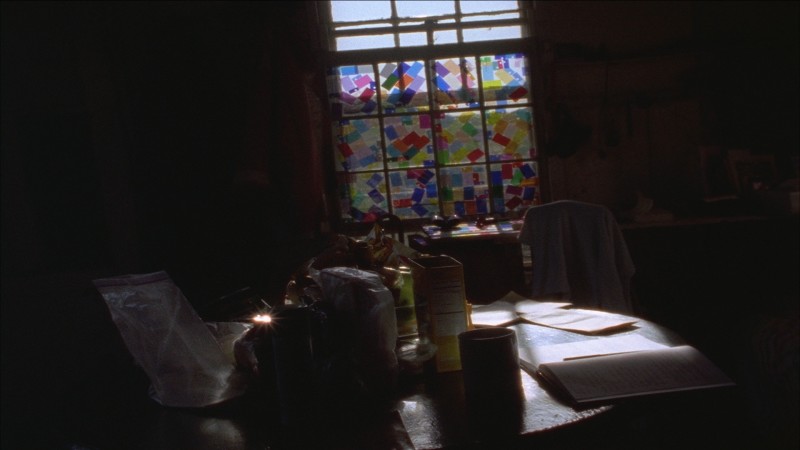
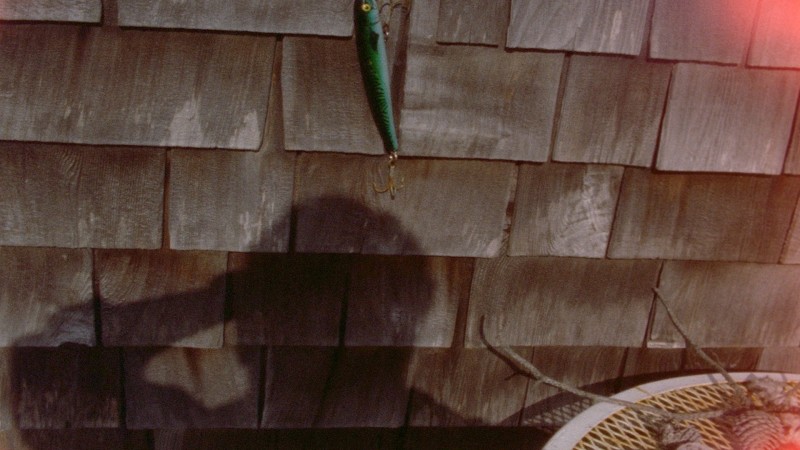
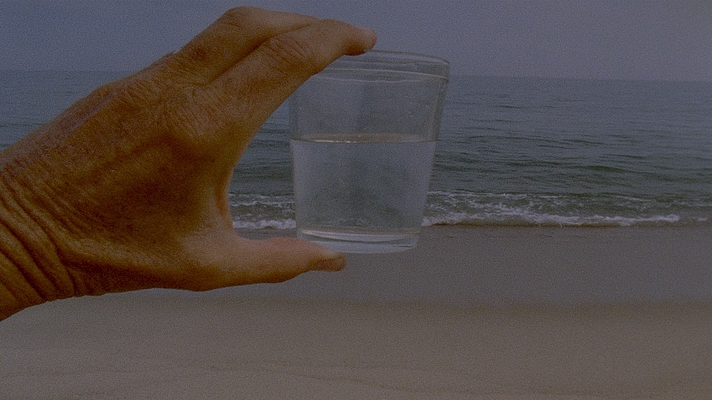
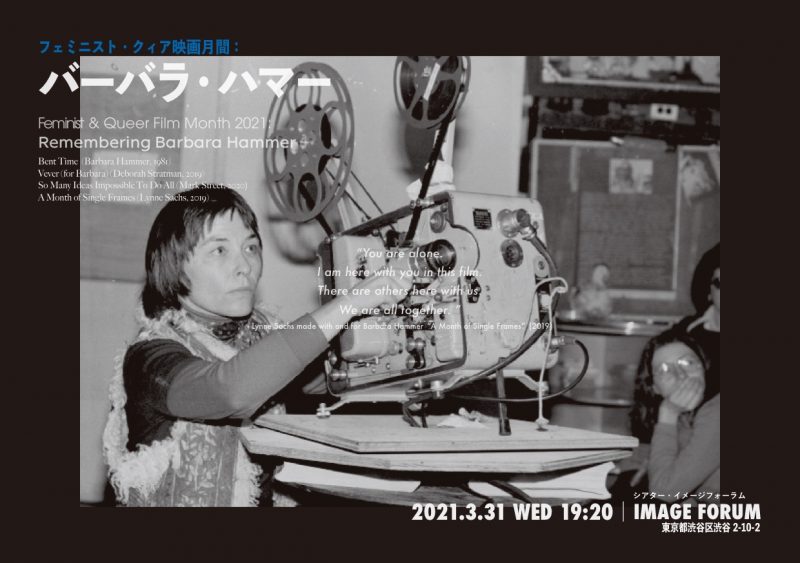
In 1998, filmmaker Barbara Hammer had a one-month artist residency in the C Scape Duneshack which is run by the Provincetown Community Compact in Cape Cod, Massachusetts. The shack had no running water or electricity. While there, she shot 16mm film with her Beaulieu camera, recorded sounds with her cassette recorder and kept a journal.
In 2018, Barbara began her own process of dying by revisiting her personal archive. She gave all of her Duneshack images, sounds and writing to filmmaker Lynne Sachs and invited her to make a film with the material.
“While editing the film, the words on the screen came to me in a dream. I was really trying to figure out a way to talk to the experience of solitude that Barbara had had, how to be there with her somehow through the time that we would all share together watching her and the film. My text is a confrontation with a somatic cinema that brings us all together in multiple spaces at once.” — Lynne Sachs
Support provided by Wexner Center Film/ Video Studio and Artist Residency Award – Jennifer Lange, Curator. Additional Editing by Paul Hill; with gratitude to Florrie Burke.
“The result is an incredibly potent study of life in all its many forms and the difficulty of facing one’s own mortality … Sachs deliberately contrasts Hammer’s shots of the gorgeous sun-dappled ridges with her close-ups of plants and insects, setting the grand majesty of the world against its delicate minutiae to form a rich tapestry of life among the banks. Crucially, the film never feels manufactured or over-structured. Sachs successfully maintains the feeling of an off-the-cuff journal that captures Hammer’s ideas as they come to her… At the beginning of the film, Hammer reads from her diary “I didn’t shoot it, I saw it,” and it is this feeling of spontaneous observation and meditation that Sachs manages to recapture so successfully here.”
–Robert Salsbury, One Room With A View
Winner of the Grand Prize of the City of Oberhausen at the 66th Annual Oberhausen Film Festival
“In the age of necessary social distancing, we would like to highlight a remarkable film which fulfills the noblest vocation of art, fostering an emotional connection between people from different times and geographical locations. For the ability to find poetry and complexity in simple things, for its profound love for life and people, and for attention to detail in working with delicate matters, we decided to award the Grand Prize of the City of Oberhausen to A Month of Single Frames by Lynne Sachs.”
Statement from Oberhausen Jury
This film is currently only available with a password. Please write to info@lynnesachs.com to request access.
Emergency LAUNDRY WORKERS CENTER Picket Saturday, June 22nd, 2019 Sunshine Shirt Laundry Center
Bay Ridge, Brooklyn
Workers Ricarda and Maria of Sunshine Shirt Laundry Center were unjustly fired. Owners Sharon and Huanxin Chen sent letters to the workers stating that their jobs were terminated because the business had closed.
This was a lie. Sunshine Shirt Laundry Center did not close. It has continued to operate business as usual. The center is open and receiving clients.
We brought the power of community to Sunshine Shirt’s door. We raised our voices to demand justice for laundromat workers.
Organized by Rosanna Rodriguez and Mahoma Lopez
Laundry Workers Center addresses the need for community-based leadership development geared toward improving the living and working conditions of workers in the laundry, warehouse, and food service industries, as well as their families. Our work aims to combat abuses such as landlord negligence, wage theft, and hazardous and exploitative working conditions, all of which are endemic in low-income communities in New York City and New Jersey.
Laundry Workers Center’s political philosophy is rooted in organizing workers and building their leadership skills and political power through a variety of worker-led tools and tactics, including taking direct action at the workplace, serving as their own voice to media outlets, speaking out as member of the community, and acting as their own advocates at the negotiation table.
Our members are primarily low-income immigrant workers who believe in social and economic justice. LWC campaigns are all member-led.
Video made by Lynne Sachs and Lizzie Olesker with editing by Amanda Katz.
“A Year in Notes and Numbers” 4 min., digital, silent, 2017 by Lynne Sachs
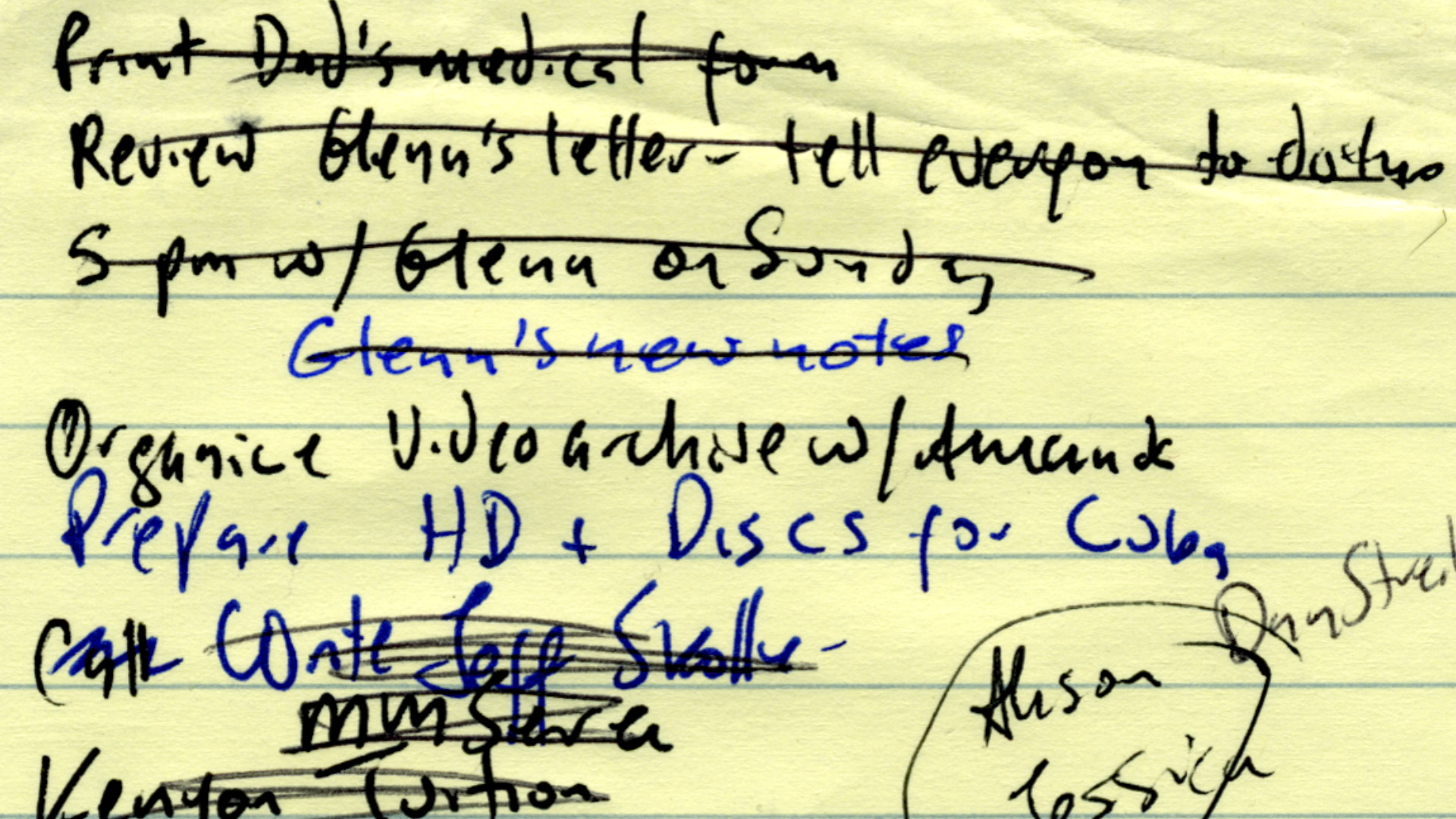
A year’s worth of to-do lists confronts the unavoidable numbers that are part and parcel of an annual visit to the doctor. The quotidian and the corporeal mingle and mix. Family commitments, errands and artistic effusions trade places with the daunting reality of sugar, cholesterol, and bone.
Microscope Gallery presented a shared program with my husband Mark Stree. We called it “A Marriage of Remakes” which was reviewed by Screen Slate writer Chris Shields here:
“Personal and independent, experimental films represent the height of filmic subjectivity, maybe most notably expressed in the work of Stan Brakhage, who sought to recreate the physical act of seeing with his first person films. These works run the gamut from Brakhage’s physiological reconstructions of vision through a range of more poetic and metaphoric approaches, be they perceptual, emotional, historical or material. So the conceit of XY Chromosome Project’s presentation of Lynn Sachs & Mark Street: A Marriage of Remakes at Brooklyn’s Microscope Gallery represents a perspectival place of particular interest in that it itself is an attempt to give material form to intersubjectivity.
Sachs and Street have been a couple for nearly 30 years, and have both made works independently (Street’s 2016 documentary Oiltowns) and together (XY Chromosone Project 2007). The films on view at Microscope Gallery however, which lend the concept and name to A Marriage of Remakes, are somehow neither by one filmmaker or the other: they are remakes, reconstructions, reimaginings, re-realizations of each other’s work. Sachs and Street have each remade films by her or his partner, creating a new dimension in both their work, elucidating through the nature of the project both the translatable and the untranslatable.
In her 2012 16mm work, Same Stream Twice, Sachs films her and Street’s young daughter, Maya, moving in a circle. The camera stands at the center point tracing her circular trajectory. The image is high contrast black and white, grainy and evokes a stoic femininity reminiscent of Gunvor Nelson’s gorgeous and haunting 1969 film My Name is Oona—both are filled with strength and dignity, an almost pagan vision of female power. Street’s video, Boys To Men, is constructed largely around the same axis of movement and the same conceit, with the wheel of time turning as children, in this case boys, become adults. The short video however, is devoid of Sachs’ haunting photography and solemnity, instead taking place in any old park in Brooklyn. It seems more a video document than a poetic vision. From these two works, qualities which distinguish Sachs’ work from Street’s begin to become clear, the revelations moving in both directions—Sachs favors grainy 8 and 16mm film with even, or completely absent, soundtracks, while Street favors more documentary like images and isn’t afraid of jarring sound or colliding frames. What unifies them however is somewhat more nebulous. Is there a shared idea or approach, or is this experiment in “remaking” evidence that a relationship creates it’s own intersubjective perspective, where two independent visions meet? At the very least, Sachs and Street’s project is an intriguing and worthwhile attempt to give this phenomenon a unique expression and form of its own.” (Chris Shields, Screen Slate)
This is a piece I wrote last year and entered into a competition that I didn’t win. (Reading it back today, I’m not very surprised.) It’s just been sitting unread on my hard drive since then, and I have no particular interest in shopping it around for publication, or spending more time editing it in the hope of improving it very much. It’s different to the usual content of the film diary, in that it’s about short experimental films and that thing which is called artist’s moving image. But maybe you, my faithful subscribers, will enjoy reading some thoughts I had on these films; or you might just like to watch some short experimental films by Lynne Sachs, which I think are great. Maybe you will read this and disagree with what I have to say about the films. I’d be interested to hear your thoughts. Thank you for subscribing to the film diary. If you enjoy this little essay, please feel free to share it with anyone who might enjoy it.
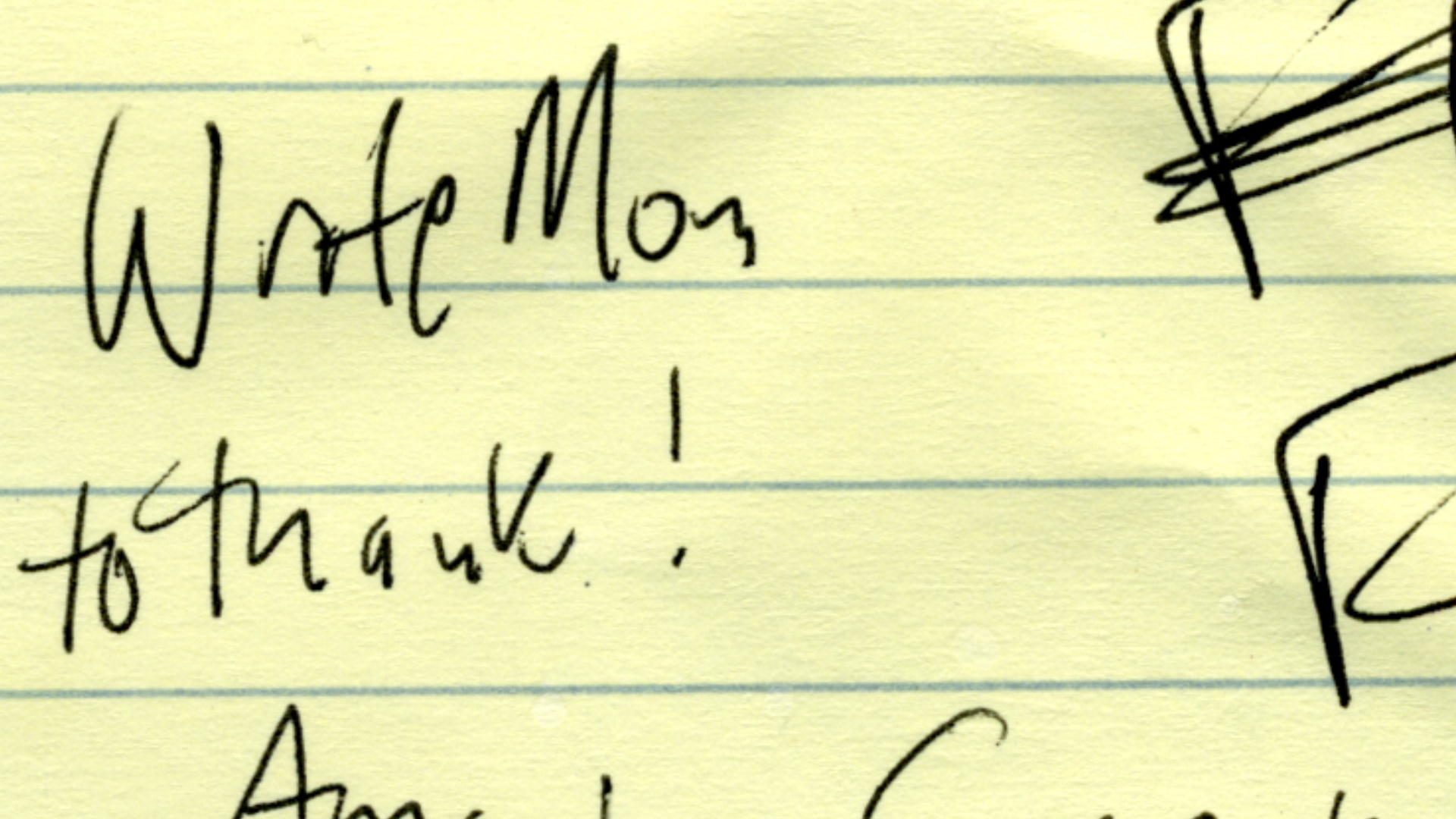
A Year in Notes and Numbers (2017) is a 4 minute silent digital video work by the American experimental filmmaker Lynne Sachs, which consists of close-up shots of a few words from to-do lists and notes to self, mostly written on yellow ruled paper, with names, errands and artistic intentions written in various coloured inks, circled, crossed also see the medical quantification of the body which performs these tasks. There are personal reminders: “Write Barbara H” (Barbara Hammer, presumably); there are political reminders: “Get out the vote”. It ends with the word “Mom”, then the figure “125 LBS”, then a few seconds of swirling reds, yellows and greys.
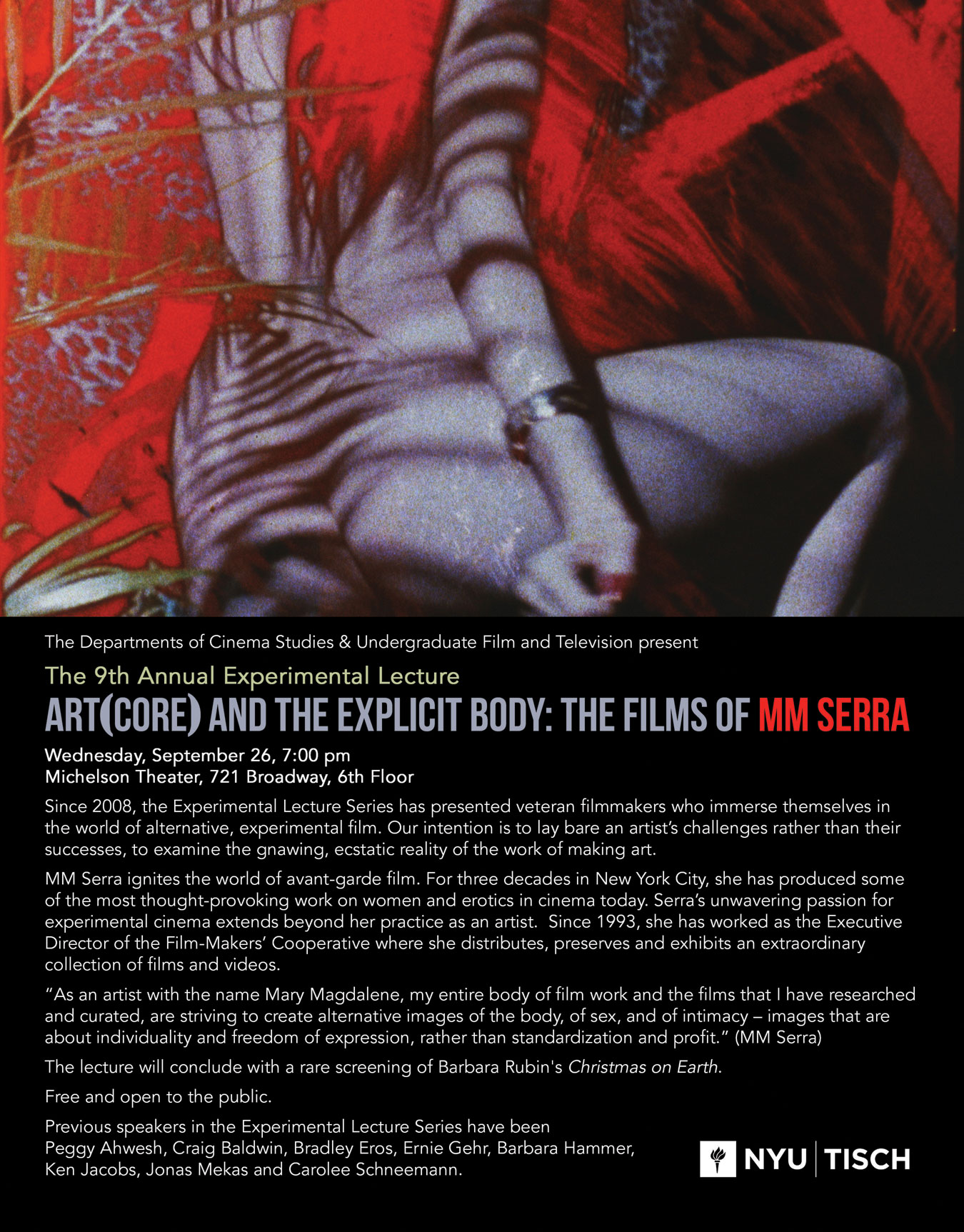
Thrilled to be hosting our 9th Experimental Lecture. This year we are proud to present the brilliant and inimitable filmmaker Mary Magdalene Serra. Join us for MM’s “Art (Core) & The Explicit Body” at NYU Tisch School of the Arts 6th Fl. on Wed. Sept. 26 at 7 pm. Free and open to the public.
In addition to excerpts from MM Serra’s films, we will see a rare screening of Barbara Rubin’s Christmas on Earth.
Since 2008, the Experimental Lecture Series has presented veteran filmmakers who immerse themselves in the world of alternative, experimental film. Our intention is to lay bare an artist’s challenges rather than their successes, to examine the gnawing, ecstatic reality of the work of making art.
MM Serra ignites the world of avant-garde film. For three decades in New York City, she has produced some of the most thought-provoking work on women and erotics in cinema today. Serra’s unwavering passion for experimental cinema extends beyond her practice as an artist. Since 1993, she has worked as the Executive Director of the Filmmakers Coop where she distributes, preserves and exhibits an extraordinary collection of films and videos.
Our previous speakers for the Experimental Lecture Series have been Peggy Ahwesh, Craig Baldwin, Bradley Eros, Ernie Gehr, Barbara Hammer, Ken Jacobs, Jonas Mekas and Carolee Schneemann.
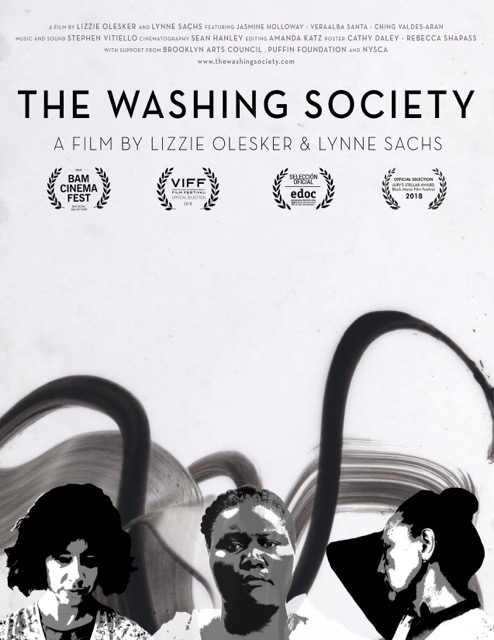
The Washing Society a film by Lizzie Olesker and Lynne Sachs
44 min. 2018
When you drop off a bag of dirty laundry, who’s doing the washing and folding? THE WASHING SOCIETY brings us into New York City laundromats and the experiences of the people who work there. Collaborating together for the first time, filmmaker Lynne Sachs and playwright Lizzie Olesker observe the disappearing public space of the neighborhood laundromat and the continual, intimate labor that happens there. With a title inspired by the 1881 organization of African-American laundresses, THE WASHING SOCIETY investigates the intersection of history, underpaid work, immigration, and the sheer math of doing laundry. Drawing on each other’s artistic practices, Sachs and Olesker present a stark yet poetic vision of those whose working lives often go unrecognized, turning a lens onto their hidden stories, which are often overlooked. Dirt, skin, lint, stains, money, and time are thematically interwoven into the very fabric of THE WASHING SOCIETY through interviews and observational moments. With original music by sound artist Stephen Vitiello, the film explores the slippery relationship between the real and the re-enacted with layers of dramatic dialogue and gestural choreography. The juxtaposition of narrative and documentary elements in THE WASHING SOCIETY creates a dream-like, yet hyper-real portrayal of a day in the life of a laundry worker, both past and present.
Our collaborators include: Laundry workers: Wing Ho, Lula Holloway, Margarita Lopez Actors: Ching Valdes-Aran, Jasmine Holloway, Veraalba Santa Cinematographer: Sean Hanley Editor: Amanda Katz Sound artist: Stephen Vitiello Live Performance Producer: Emily Rubin, Loads of Prose
Criterion Channel streaming premiere with 7 other films, Oct. 2021.
University & College Screenings: Symposium on Black Feminist History, Carter Woodson Institute for African-American Studies, University of Virginia; University of Pennsylvania; Smith College; Mount Holyoke College; University of North Carolina; Dennison College; Amherst College; University of Buffalo; Tisch School of the Arts, New York University; Princeton University, Lewis Center for the Arts; Fashion Institute of Technology; University of California, Berkeley; University of Mississippi Center for the Study of Southern Culture; Yale University, African American Studies Dep’t.
Lynne’s co-director:
Lizzie Olesker is a writer, performer, and director in New York City where she creates theatrical works inspired by social and personal history. Her plays include Dreaming Through History; Verdure; A Kind (of) Mother; and Embroidered Past, seen at the Public Theater, Cherry Lane, Clubbed Thumb, Dixon Place, Here, and New Georges. Her solo performances include housework (St. Mark’s Church) and Infinite Miniature (Invisible Dog and Ohio Theater). Collaborations with other artists include the Talking Band (performing at La Mama and on international tour), Lenora Champagne (Tiny Lights) and upcoming with Louise Smith (Dorothy Lane). She’s received support from the New York Foundation for the Arts, Brooklyn Arts Council and the Dramatists Guild. She teaches playwriting at the New School and New York University where she’s active in the local UAW union for adjunct faculty.
Selected Press:
“Faced with the challenge of making a documentary for which the voices of undocumented immigrants were crucial, filmmakers Lynne Sachs and Lizzie Olesker had to push the boundaries of convention.” —“Bringing the Invisible to Light: Interview with Lynne Sachs and Lizzie Olesker”Cynthia Ramsay,Jewish Independent, Vancouver, BC, Canada, http://www.jewishindependent.ca/bringing-the-invisible-to-light/ )
“This is a slice of life, a celebration of humanity from the historic Atlanta washerwomen to the New York City workers of today in swirling brilliant color — color that comes from the flesh, hair and eyes of the workers, and the mountains of laundry they deal with every day, underwear, socks, sheets, shirts. One has to see it to believe it.” (J.P. Devine, Kennebec Journal, https://www.centralmaine.com/2018/07/16/j-p-devine-miff-movie-review-washing-society-charlie-chaplin-lived-here/ )
“An exercise in high-concept cinema to which Olesker and Sachs devote three quarters of an hour of film stock and many more quarters in tips, revealing the stains (of racism and classicism) on an American Dream that seems to want to scrub away every last trace of its own identity.”(Revolution in the Air & Theories of Weightlessness, Otro Cines Europa by Victor Esquirol, Punto de Vista International Film Festival, Pamplona, Spain, www.otroscineseuropa.com/aires-revolucion-teorias-la-ingravidez )
“Lizzie Olesker and Lynne Sachs’ film is a creative, often lyrical study of laundromat service workers in New York City – women who do a hard job for far too little money. Using a mixture of actors and real industry workers, the directors create a portrait of economic oppression and human resilience that provokes dismay and empathy in equal measure – and yet the hard dose of reality is leavened with poetic visual touches and a warm, humanist tone. What we hear – sometimes without subtitles – rings with authenticity, and it’s the details as much as the general situation of these workers that are alarming. One woman calculates that she washes around 1,000 articles of clothes a day; a “part-time” worker says she’s worked in laundromats for 45 years. How many socks is that? In voiceover, we hear that one of the goals the directors have is “calling attention to something that isn’t paid attention to – hidden labour.” On that score, their film is a success, but there is much else of value here besides journalistic advocacy; with their playful stylistic touches and creative approach to storytelling, Olesker and Sachs have turned politics into art – and vice versa.” Alan Franey, Vancouver International Film Festival, 2018.
THE WASHING SOCIETY has received support from Workers Unite Film Festival, New York State Council on the Arts, Brooklyn Arts Council, Lower Manhattan Cultural Council, Women and Media Coalition, Puffin Foundation and Fandor FIX Filmmakers.
Post-Screening Conversation for WASHING SOCIETY + CLOTHESLINES +A MONTH OF SINGLE Metrograph, NYC December 2021
Co-Directors Lynne Sachs and Lizzie Olesker with special guest feminist scholar Silvia Federici in a post-screening conversation. Hosted by Emily Apter.
On June 28, 2018, laundry workers from El Barrio in New York City marched to the laundromat where they work. Their community and the Laundry Workers Center were there to support them.
This campaign is called “Awaken” and the fight is just beginning.
With the community at their backs, member leaders Juanita and Nicolas delivered their demands to the owner: Respect the minimum wage, respect our right to health and safety, and respect our dignity!
Speakers:
Nicolas Benitez-laundromat leader
Juana F. – laundromat leader
Mahoma López- Laundry Workers Center Co-Executive Director
Heleodora Viva- Street Vendor Project Member Leader
Video:
Camera – Lynne Sachs, co- director “The Washing Society” film
Editing- Rebecca Shappas
Production support: Rosanna Rodriguez, Laundry Workers Center Co-Executive Director; Padre Fabian Arias, Iglesia Sion; Lizzie Olesker, Co-Director “The Washing Society” film
Translation: Maria Scharron
A Morning with Jack Waters (2018) HD Video, 46:34, color, sound
In conversation with filmmaker Lynne Sachs, multi-disciplinary artist Jack Waters discusses his career and experiences as a part of the downtown New York City art scene from the early 80s to the present.
Jack Waters works as a visual artist, filmmaker, writer, media artist, choreographer and performer. As a versatile and multi-faceted artist, his work has been celebrated in all of its forms, showing at the La Mama Galleria (NYC), Fales Library and Special Collections (NYC), Frise (Hamburg, Germany). His films have screened internationally and have been aired on the Sundance Channel and PBS amongst others. Recently, he performed as Jason in Stephen Winter’s highly acclaimed feature film “Jason and Shirley”, a historical re-imagining of the making of Shirley Clarke’s 1967 landmark film “Portrait of Jason”.
With his partner, Peter Cramer, Waters helped to establish and foster various collectives and projects such as POOL, a dance and performance collective which “explored contact and other forms of improvisation… creating performance work, choreography, and ephemeral events in NYC” and beyond.
Additionally, Waters and Cramer are co founders of Le Petit Versailles, a Green Thumb Garden on the Lower East Side of Manhattan that is “committed to providing a space for performers, filmmakers and visual artist to show their work.” In this way Waters continues to engage with and support the downtown community arts scene.