Feminist Queer Movie Month: Barbara Hammer
Curated by Subversive Records
Image Forum
2021 March 31
http://www.imageforum.co.jp/theatre/movies/4259/

Rough English Translation:
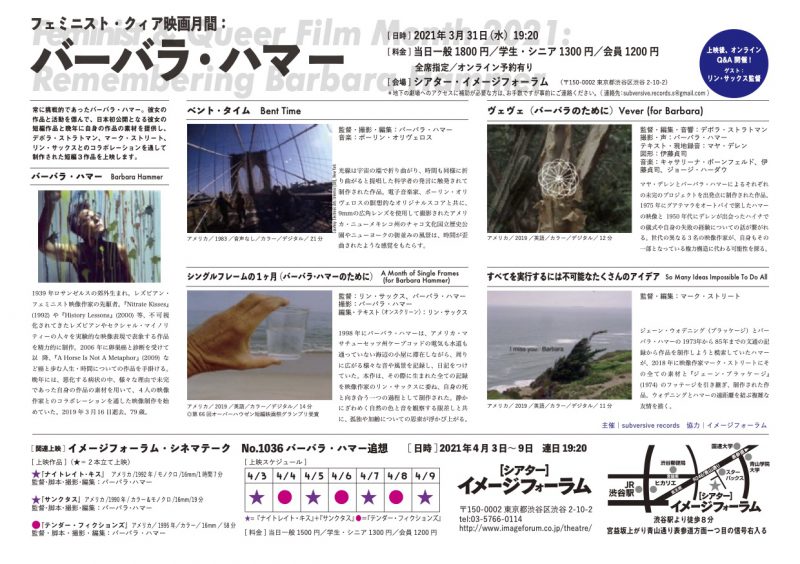
Barbara Hammer has always been challenging. In memory of her work and activities, she provided materials for her short film, which will be released for the first time in Japan, and her own work in her later years, and produced a short film in collaboration with Deborah Stratman, Mark Street, and Lynne Sachs. A special project to screen 3 works.
Feminist Queer movie month: Barbara Hammer
Feminist Ando Queer Film Month 2021: Remembering Barbara Hammer
■ Screening Date: 2021 March 31 (Wednesday) 19:20
★ after the screening, held an online Q & A with phosphorus Sachs Director
■ screenings Works (4 works in total, 58 minutes in total)
“Bent Time” Bent Time
America / 1984 / Digital / 22 minutes
Director / Filming / Editing: Barbara Hammer / Music: Pauline Oliveros
▶ ︎ Rays bend at the edge of the universe, A work inspired by the remarks of scientists who advocated that time also bends. The scenery of Chaco Culture National Historical Park in New Mexico and the cityscape of New Mexico, taken with a 9mm wide-angle lens, along with the meditative original score of electronic musician Pauline Oliveros, feels like time is distorted. Bring.
“Vever (for Barbara)” Vever (for Barbara)
USA / 2019 / English / Color / Digital / 12 minutes
Director / Editing / Sound: Deborah Stratman / Shooting / Voice: Barbara Hammer / Text / Local recording: Maya Deren
Shape: Teiji Ito / Music: Teiji Ito, Teiji Ito, George Hardau / Provided by: Pythagoras Film
▶ ︎ A work created from each unfinished project by Maya Deren and Barbara Hammer. A video of Hammer traveling on a motorcycle in Guatemala in 1975 is linked to a story about the Haiti ritual and his own experience of failure that Deren met in the 1950s. Three filmmakers of different generations explore the possibility of replacing the power structure of which they are part.
“Many Ideas Impossible To Do All
America / 2019 / Color / Digital / 11 Minutes
Director / Edit :: Mark Street
▶ ︎ Jane Wardening (Brackage) and Barbara Hammer Hammer, who was looking to create a work from Hammer’s 1973-85 correspondence record, brought all the materials and footage of “Jane Brakhage” (1974) to filmmaker Mark Street in 2018. The work that was taken over and produced. Draws a complex friendship that connects Wodening and Hummer’s long distance.
“One Month of Single Frames (for Barbara Hammer)” A Month of Single Frames (for Barbara Hammer)
USA / 2019 / English / Color / Digital / 14 minutes
Director: Lynne Sachs, Barbara Hammer / Photo: Barbara Hammer / Editing Text (Onscreen): Lynne Sachs
▶ ︎ In 1998, Barbara Hammer kept a diary by recording various sounds and landscapes around him while staying in a seaside hut in Cape Cod, Massachusetts, USA, where neither electricity nor water was available. This work was produced as a process of confronting her own death by entrusting all the records created at that time to the filmmaker Lynne Sachs. Along with the eyes of observing the quietly buzzing colors and sounds of nature, thoughts about loneliness and aging emerge.
Interview
Remembering Barbara: Conversations with Lynne Sachs, Mark Street and
Deborah Stratman by Subversive Records Collective, Zine Volume 1, Tokyo
2021
Subversive Records is an independent feminist and queer art research collective formed in
2020 by Kanako Nakanishi (lead curator), Emiko Inoue (editor and researcher), and Fumina
Hamasaki (founding member, now departed). The group organized a screening event,
‘Feminism and Queer Film Month: Remembering Barbara Hammer,’ held on March 31, 2021,
at the Theater Image Forum in Tokyo. The Subversive Records Zine Vol. 1 was published on
the occasion of the event. It included an introduction to the screenings, Barbara’s profile, and
Japanese translations of Barbara’s most striking quotes. It also featured the following
interviews with three filmmakers who collaborated with Barbara. All three were prompted by
the same set of questions:
- Could you tell us how this project started and what was your first reaction when you
were asked by Barbara to collaborate with her? - Could you tell us how you processed this film? What was one of the most challenging
things in making this film? (we would be pleased if you could share a memorable
moment in making this film with Barbara? ) - What is your most favorite film by Barbara? Let us know the reasons too.?
- How do you consider (define) Barabara Hammer in the context of feminist and queer
film? - What are the legacies of Barbara for you, and how would you like to put that in
practice?
Lynne Sachs
Barbara and I met in 1987 in San Francisco, California, a mecca for alternative, underground,
experimental filmmaking. She taught me the fine, solitary craft of 16mm film optical printing
during a weekend workshop, thus beginning a friendship that eventually followed us across
the country to New York City. We were able to see each other often during the last few years
of her life. Between 2015 to 2017, Barbara agreed to be part of the making of my short
experimental documentary Carolee, Barbara, and Gunvor (2018) a three-part film that
includes Carolee Schneemann and Gunvor Nelson. During the days that Barbara and I worked
on A Month of Single Frames, she was dealing with the challenges of ovarian cancer and the
chemotherapy that was part of her treatment. For this reason, I would often think about her
films Sanctus (1990) and Vital Signs (1991), which she was making when we first met in San
Francisco. In Barbara’s prescient words, these films ‘make the invisible, visible, revealing the
skeletal structure of the human body as it protects the hidden fragility of interior organ
systems.’ For both of us, these moments of creative intimacy became the gift we somehow
expected from our open, porous artmaking practice.
In 2018, Barbara asked me to come to her home to discuss something she needed to say in
person. I immediately faced a complicated set of emotions. I knew that this tête-à-tête would
involve some kind of good-bye, but I had no idea that she had decided to share a part of her
personal archive, and thus a part of her being on this earth, with me. Filmmaking, in the
tradition that Barbara and I have espoused for most of our lives as experimental makers,
involves a deeply focused solitary period of introspection. By asking me to work with her,
alongside her but not ‘for’ her, Barbara, a feminist filmmaker, was actually creating an
entirely new vision of the artist’s legacy.
As I sat at her side in the apartment she shared with her life partner Florrie Burke, Barbara
vividly described to me her 1998 artist residency in Provincetown, Cape Cod, Massachusetts.
For one month, she lived and made her art in a shack without running water or electricity.
While in her Dune Shack, as it is still called, she shot 16mm film with her Beaulieu camera,
made field recordings, and kept a journal. Barbara’s only instructions to me were very simple:
1 The original version of this text was first published in Subversive Records Zine, Vol. 1, 37-9.
‘Do absolutely whatever you want with this material.’ This was the beginning of A Month of
Single Frames (2019).
*
While writing the text for my own film, the words I placed on the screen came to me in a
dream while I was editing. By this time Barbara had died. I quickly realized that this kind of
oneiric encounter could become a posthumous continuation of the dialogue I had started with
Barbara. Since I would never again be able to speak to her about her life or the ontological
nature of cinema or the textures of a sand dune, I would converse with her through A Month
of Single Frames, the title I chose for my 14-minute film. Through my writing, I tried to
address Barbara’s celebration of solitude and cinematic embodiment. Ultimately, my text on
the screen over Barbara’s images functions as a search for a cinematic experience that brings
us all together in multiple spaces at once. It is also an embrace of an ambiguous second
person you who might be Barbara herself or might be anyone watching the film.
Barbara’s imprint on my own filmmaking practice is profound. I observed in her work a
conscious physical relationship to the camera. For the most part, she shot her own films and in
turn found her own distinct visual language for talking about women’s lives, liberation, love,
struggle, awareness, and consciousness. Discovering Barbara’s films released something in
my own camerawork; my images became more self-aware, and more performative. Thinking
about Barbara’s radical, improvisational and totally physical cinematography continues to
push me to dive deeply and fully into my body as I am shooting.
*
My favorite film by Barbara Hammer is Optic Nerve (1985). I love the intimacy she finds
with her grandmother through the embrace of her camera lens, as well as the playful
detachment she finds in the optical printing process.
*
Barbara Hammer had a profound commitment to cinematic embodiment, an openness and
loving understanding of dying, and a deeply held desire to find common space for women of
all generations.
Mark Street
Barbara was my teacher at the San Francisco Art Institute graduate program in the late 1980s.
I was intimidated by her; she was a heroine of mine, someone to emulate, model myself after.
But she was so warm, direct, friendly, encouraging and gently challenging that she undercut
any fear. When we were all in that room together there was no hierarchy, just a bunch of
artists talking. I’d see her around at screenings over the years; she made the move to NYC and
I did a few years later. Much later I made some food for her and her partner Florrie when she
was battling cancer, and visited a few times. As always she cut through any hero worship and
spoke directly, clearly without any added emotional baggage. Imagine my shock when she
asked me to work on this film (based on her correspondence with Jane Brakhage). Of course I
was terrified at first. How could I possibly make something worthy of her? But in this realm,
as in so many others, she put my mind at ease ‘Mark—this is your film; do with it whatever
you wish to with it.’ So I tried to work as Barbara would; following my own lights, trusting
myself, the artistic impulse, the creative spark.
*
I edited the correspondence down to its bare essence. Then I hired 3 young lesbian
filmmakers in San Francisco. We drove around that city and visited every address that
Barbara had written a note or letter to Jane Brakhage. We just shot whatever we thought
conjured the essence of the presence of Barbara Hammer. I remember us yelling into the
wind, much to the bemusement of passersby ‘Where are you, Barbara? Where are you?’
*
Always loved Sanctus (1990). I saw it at a formative time for me… I was 27, just developing
my own voice as a maker. I thought ‘this is so awesome but…. I could do this, too. Not this
film exactly, but the same sort of unyielding vision could be mine. All I need is my eyes,
some minimal equipment, the kind of confidence that Barbara embodies.
*
Not for me as a cis man to say… but she both spoke to and for a movement AND her own
idiosyncracies in a way I find inspiring. No dogma for Barbara. Barbara was her OWN
dogma.