Category Archives: SECTIONS

The New School / “A Line Break is Like a Cut: The Impulse for Disruption in Poetry and Experimental Film”

“A Line Break is Like a Cut: The Impulse for Disruption in Poetry and Experimental Film”
Lynne Sachs
The New School
Graduate Program in Creative Writing
Oct. 25, 2023


Organized by Margaret Rhee
Assistant Professor of Writing Across Media and Chair of Arts Writing


Working with memoir text as lines of poetry,
Using the 2nd person as the subject
“how do you ….?”
Gives some distance from the subject.

Film About a Father Who
74 min. 2020

a film by Lynne Sachs

Essay on the film by Ela Bittencourt: http://www.lynnesachs.com/2022/08/19/ela-bittencourts-essay-on-film-about-a-father-who/

Over a period of 35 years between 1984 and 2019, filmmaker Lynne Sachs shot 8 and 16mm film, videotape and digital images of her father, Ira Sachs Sr., a bon vivant and pioneering businessman from Park City, Utah. FILM ABOUT A FATHER WHO is her attempt to understand the web that connects a child to her parent and a sister to her siblings. With a nod to the Cubist renderings of a face, Sachs’ cinematic exploration of her father offers simultaneous, sometimes contradictory, views of one seemingly unknowable man who is publicly the uninhibited center of the frame yet privately ensconced in secrets. In the process, Sachs allows herself and her audience inside to see beyond the surface of the skin, the projected reality. As the startling facts mount, Sachs as a daughter discovers more about her father than she had ever hoped to reveal.

Short Poetry Films by Lynne Sachs

Celebration of words and sounds of words in rhythm with images, not working with interpretation in anyway, no precise intersection, instead there is parallel reading.
“Starfish Aorta Colossus” (Lynne Sachs, 4 1/2 min, unsplit 8mm to digital transfer, 2015)
Poetry watches film. Film reads poetry. Paolo Javier’s text is a catalyst for the digital sculpting of an 8mm Kodachrome canvas. Syntactical ruptures and the celebration of nouns illuminate twenty-five years of rediscovered film journeys. NYC poet Paolo Javier invited Lynne to create a film that would speak to one of his poems. In response, she travels through 25 years of her 8 mm films. 
 
Website: http://www.lynnesachs.com/2015/10/01/starfish-aorta-colossus/Links to an external site.
Vimeo: https://vimeo.com/lynnesachs/starfishaortacolossus

Listening to poetry as action, playing with objects in response to words, working with someone else as performer who also interprets.
“Girl is Presence”  by Lynne Sachs and Anne Lesley Selcer (4 min, HD Video, 2020)
During the global pandemic, Sachs and Selcer collaborated remotely to create Girl is Presence, a rhythmic visual poem tinged by gender and violence. Against the uncertain and anxious pandemic atmosphere, inside domestic space, a ‘girl’ arranges and rearranges a collection of small and mysterious things. As the words build in tension, the scene becomes occult, ritualistic, and alchemical. 
Website:http://www.lynnesachs.com/2020/05/28/girl-is-presence-by-lynne-sachs-anne-lesley-selcer/
Vimeo: https://vimeo.com/412447077
 
Homage to Mayer’s home. My shooting and reading is entering Bernadette’s life experience.
“Visit to Bernadette Mayer’s Childhood Home” (Lynne Sachs, 3 min, 16mm, B&W, 2020)
In July 1971, avant-garde writer and language poet Bernadette Mayer produced Memory, a multimedia project in which she shot one roll of 35mm film each day and kept a daily journal. In honor of the project’s compilation and release as a book, Sachs embarks on a study of the memory and language of place. Journeying to Mayer’s childhood home in a Queens neighborhood of New York City, she pays homage to Mayer in a collage of architecture, light, and rhythm. 
Website:http://www.lynnesachs.com/2020/11/02/visit-to-bernadette-mayers-childhood-home-2020/
Vimeo: https://vimeo.com/440075830

Poetry meets painting. I timeless image lands at a moment in history or a current event through the text.
“Orange Glow” by Lynne Sachs and Laura Harrison (1 ½ min, HD Video, 2021)
“Orange Glow” began in September 2020 as an exchange between two friends in two different cities who decided to come together in the making of a film.  From her home in Chicago, Laura Harrison animated each stroke of a painting. She then sent her 90 second video to Lynne Sachs in Brooklyn.  Horrified by the television images of San Francisco enveloped in wildfire smoke at the time, Lynne interpreted Laura’s painting gestures with these thoughts in mind.  She hit the play button of the video and began writing a poem in response to what she saw.
Website: http://www.lynnesachs.com/2020/12/31/orange-glow/
Vimeo: https://vimeo.com/460167751
 
I wanted poetry to become language, like a mode of communication but sometimes also not. Place it in Queens. Place it in the pandemic.
Swerve” (7 min, HD Video, 2022) 
a film by Lynne Sachs with poetry by Paolo Javier
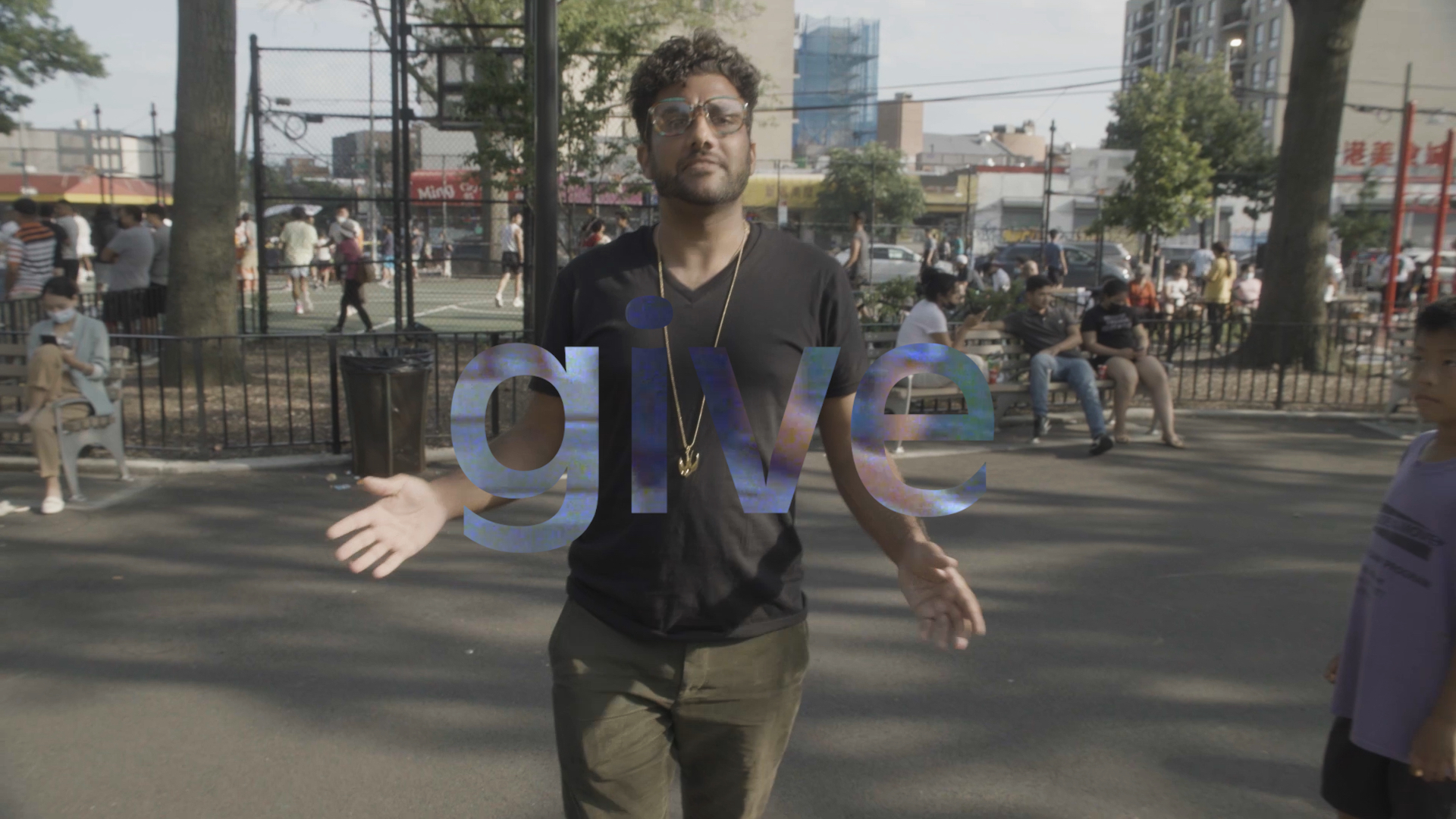
A Queens market and playground become the site for the shooting of a film inspired by Paolo Javier’s Original Brown Boy poems. Wearing the tell-tale masks of our daunting now, five NYC performers search for a meal while speaking in verse. The film itself transforms into an ars poetica/ cinematica, a meditation on writing and making images in the liminal space between a global pandemic and what might come next
Website: http://www.lynnesachs.com/2021/10/12/swerve-with-paolo-javier/ (trailer only)
Vimeo: https://vimeo.com/629421455 (full film)

FILMS TO WATCH IN CLASS that DO NOT explicitly use language

This could be an installation or a performance with language used like the music as punctuation.

“Window Work” (9 min, video, color, 2000)

A woman drinks tea, washes a window, reads the paper– simple tasks that somehow suggest a kind of quiet mystery within and beyond the image. Sometimes one hears the rhythmic, pulsing symphony of crickets on a Baltimore summer night. Other times jangling toys dissolve into the roar of a jet overhead, or children tremble at the sound of thunder. These disparate sounds dislocate the space temporally and physically from the restrictions of reality. The small home-movie boxes within the larger screen are gestural forms of memory, clues to childhood, mnemonic devices that expand on the sense of immediacy in her “drama.” These miniature image-objects represent snippets of an even earlier media technology — film. In contrast to the real time video image, they feel fleeting, ephemeral, imprecise.

Website: http://www.lynnesachs.com/2000/04/11/78/
Vimeo:https://vimeo.com/183875143


Again the quotidian actually becomes pictures and words at the same time. If you look, you find poetry where you don’t expect it.

“A Year in Notes and Numbers” (4 min, HD Video, silent, 2018)
A year’s worth of to-do lists confronts the unavoidable numbers that are part and parcel of an annual visit to the doctor. The quotidian and the corporeal mingle and mix. Family commitments, errands and artistic effusions trade places with the daunting reality of sugar, cholesterol, and bone. Museum of the Moving Image, Museo de Arte Moderno Buenos Aires.

Website: http://www.lynnesachs.com/2019/02/07/a-year-in-notes-and-numbers-2/z
Vimeo: https://vimeo.com/222220963

I used loud whispering and humming as poetry that moves across a generation, btwn a mom and her daughter.
“Maya at 24” (4 min, 16mm to digital transfer, b&w, 2021)
Lynne films her daughter Maya in 16mm black and white film, at ages 6, 16 and 24. At each iteration, Maya runs around her mother, in a circle – clockwise – as if propelling herself in the same direction as time, forward. Conscious of the strange simultaneous temporal landscape that only film can convey, we watch Maya in motion at each distinct age.
 
Website: http://www.lynnesachs.com/2021/01/15/maya-at-24/
Vimeo: https://vimeo.com/432200317

How might we use poetry here?
This is titled from a poem.

“She Carries the Holiday in Her Eyes” 4 min., silent, 2023
A picture of parallels and swirls, two women touch with eyes closed, use cameras in motion, discover a holiday of optics. 
 
“I have seen an individual, whose manners, though wholly within the conventions of elegant society, were never learned there, but were original and commanding, and held out protection and prosperity; one who did not need the aid of a court-suit, but carried the holiday in his (her) eye.”
— From Ralph Waldo Emerson’s “Manners”
 
Website: http://www.lynnesachs.com/2023/06/12/she-carries-the-holiday-in-her-eyes/
Vimeo: https://vimeo.com/829544863 


Plus this film which uses language on screen:

“E•pis•to•lar•y: letter to Jean Vigo” (5 min, HD Video, B&W, 2021)

In a cinema letter to French director Jean Vigo, Lynne Sachs ponders the delicate resonances of his 1933 classic “Zero for Conduct” in which a group of school boys wages an anarchist rebellion against their authoritarian teachers. Thinking about the January 6, 2021 assault on the United States Capitol by thousands of right-wing activists, Sachs wonders how innocent play or calculated protest can turn so quickly into chaos and violence. 

Website:http://www.lynnesachs.com/2021/02/18/e%e2%80%a2pis%e2%80%a2to%e2%80%a2lar%e2%80%a2y-letter-to-jean-vigo-from-lynne-sachs/
Vimeo: https://vimeo.com/513925175

Discuss how this connects to YEAR BY YEAR POEMS.
Poetry on screen and voice.
Who is reading?

“Tip of My Tongue” (80 min, HD Video, 2017)

To mark her 50th birthday, Sachs gathers a group of her contemporaries—all New Yorkers but originally hailing from all corners of the globe—for a weekend of recollection and reflection on the most life-altering personal, local, and international events of the past half-century, creating what Sachs calls ‘a collective distillation of our times.’ Interspersed with poetry and flashes of archival footage, this poignant reverie reveals how far beyond our control life is, and how far we can go despite this. .
 
Website: http://www.lynnesachs.com/2017/04/25/tip-of-my-tongue/
Vimeo: https://vimeo.com/194980606

Poetry reading:

Year by Year Poems

And

“This Is Not How I imagine It But How It Is”
Talk about how this was written in response to one image.

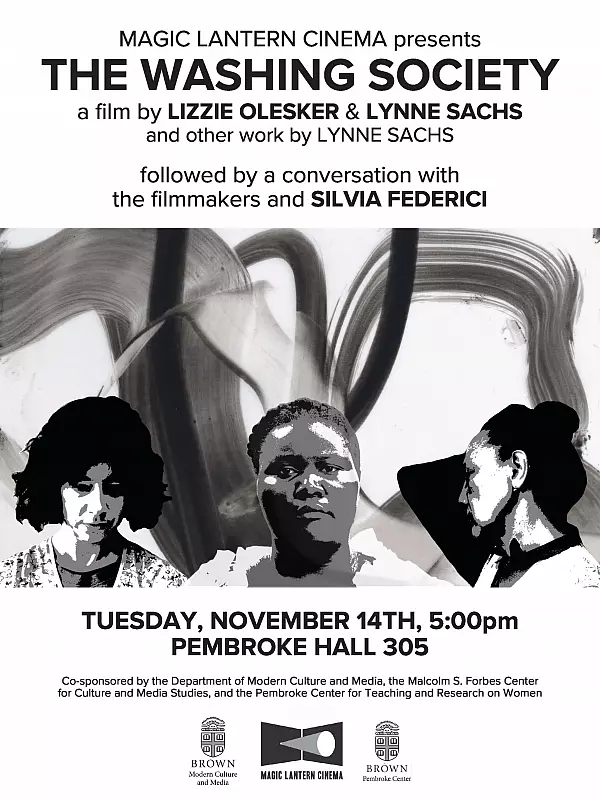
Magic Lantern Cinema at Brown University / THE WASHING SOCIETY

Magic Lantern Cinema presents THE WASHING SOCIETY
Magic Lantern Cinema, Brown University
Nov 14, 2023
https://events.brown.edu/event/267926-magic-lantern-cinema-presents-the-washing-society

Magic Lantern Cinema presents THE WASHING SOCIETY

Time:
5:00pm – 7:30pm EST

Sponsor:
Co-sponsored by the Department of Modern Culture and Media, the Malcolm S. Forbes Center for Culture and Media Studies, and the Pembroke Center for Teaching and Research on Women

Location:
Pembroke Hall

Room:
305

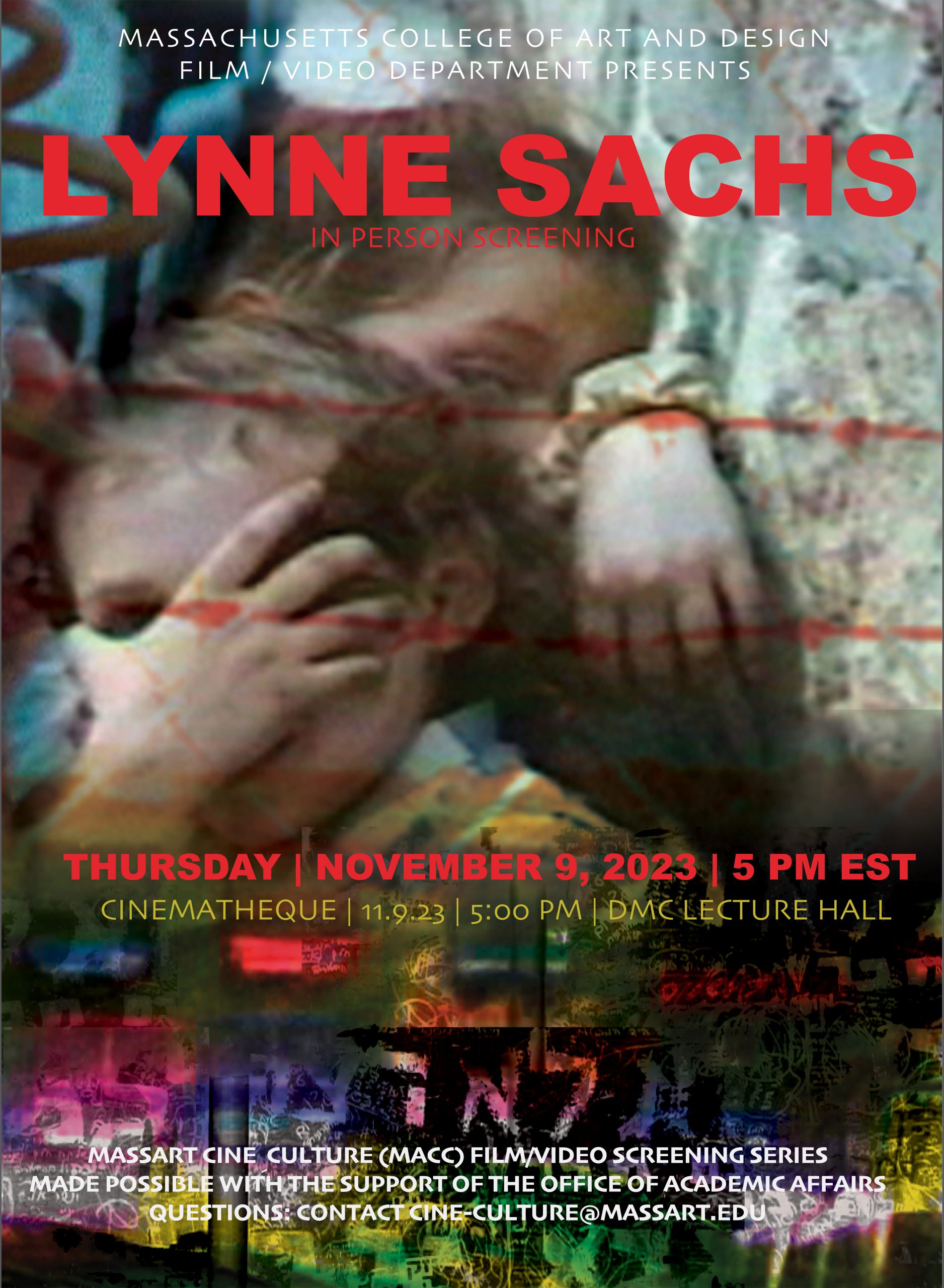
Magic Lantern Cinema presents a screening of THE WASHING SOCIETY, a film by Lizzie Olesker and Lynne Sachs.

When you drop off a bag of dirty laundry, who’s doing the washing and folding? THE WASHING SOCIETY brings us into New York City laundromats and the experiences of the people who work there. Collaborating together for the first time, filmmaker Lynne Sachs and playwright Lizzie Olesker observe the disappearing public space of the neighborhood laundromat and the continual, intimate labor that happens there. With a title inspired by the 1881 organization of African-American laundresses, THE WASHING SOCIETY investigates the intersection of history, underpaid work, immigration, and the sheer math of doing laundry. Drawing on each other’s artistic practices, Sachs and Olesker present a stark yet poetic vision of those whose working lives often go unrecognized, turning a lens onto their hidden stories, which are often overlooked. Dirt, skin, lint, stains, money, and time are thematically interwoven into the very fabric of THE WASHING SOCIETY through interviews and observational moments. With original music by sound artist Stephen Vitiello, the film explores the slippery relationship between the real and the re-enacted with layers of dramatic dialogue and gestural choreography. The juxtaposition of narrative and documentary elements in THE WASHING SOCIETY creates a dream-like, yet hyper-real portrayal of a day in the life of a laundry worker, both past and present.

We will also screen other selected work by Sachs. After the screening, we will hold a panel conversation with the filmmakers and feminist activist Silvia Federici, whose work has inspired the filmmakers.


Lizzie Olesker
 is a playwright, dramaturg, and director. Her original works, exploring the hidden history and poetry of everyday experience, have been developed and seen at the Public Theater, Clubbed Thumb, Dixon Place, Ohio Theater, Invisible Dog, New Georges, and Cherry Lane Theater. Her recent collaborative, hybrid documentary film “The Washing Society” (2018) was shown at international festivals, BAM, the National Gallery, etc. and began as a site-specific performance in NYC neighborhood laundromats. She’s taught playwriting at the New School, Purchase, and NYU where she’s active with her adjunct faculty union, UAW Local 7902.

Lynne Sachs is an American experimental filmmaker and poet based in Brooklyn, New York. Strongly committed to a dialogue between cinematic theory and practice, she searches for a rigorous play between image and sound, pushing the visual and aural textures in each new project. Lynne has produced over 40 films as well as numerous live performances, installations and web projects. Her films have screened at MoMA (Museum of Modern Art), Tate Modern, Image Forum Tokyo, Wexner Center for the Arts, and festivals such as New York Film Festival, Oberhausen Int’l Short FF, Punto de Vista, Sundance, Vancouver IFF, Viennale and Doclisboa. Retrospectives of her work have been presented at MoMI (Museum of the Moving Image), Sheffield Doc/Fest, BAFICI, Cork Film Festival, Havana Film Festival, among others. In 2021, both Edison Film Festival and Prismatic Ground Film Festival at the Maysles Documentary Center gave her awards for her lifetime achievements in the experimental and documentary fields. In 2014, Lynne received a Guggenheim Fellowship in the Creative Arts.

Silvia Federici is a feminist activist, writer, and a teacher. In 1972 she was one of the cofounders of the International Feminist Collective, the organization that launched the Wages For Housework campaign internationally. In the 1990s, after a period of teaching and research in Nigeria, she was active in the anti-globalization movement and the U.S. anti–death penalty movement. She is one of the co-founders of the Committee for Academic Freedom in Africa, an organization dedicated to generating support for the struggles of students and teachers in Africa against the structural adjustment of African economies and educational systems. From 1987 to 2005 she taught international studies, women studies, and political philosophy courses at Hofstra University in Hempstead, NY. All through these years she has written books and essays on philosophy and feminist theory, women’s history, education and culture, and more recently the worldwide struggle against capitalist globalization and for a feminist reconstruction of the commons.


“I was naturally looking for connections across various films, be they thematic or stylistic and formal. The Washing SocietyFossilWindow Work, and Still Life with Woman and Four Objects all clearly reflect upon what in the first film you call “hidden labor.” This labor is of course gendered and raced in different ways. Formally—whether through closeup or still framing upon hands and limbs, through shadow and light, through match cuts—these films also seem to abstract or defamiliarize the bodies who perform such labor, as well as the tools and machines these bodies use or that sometimes replace such bodies. The affiliation between film, repetition, and labor of course has a long history in (experimental) cinema. But I like the way in which you describe in one of your emails what is effectively your contribution to this history: you attempt to capture “quotidian acts of labor as gestures in the devising of movement for the camera.”

Rewatching The Washing Society helped me consider other threads beyond these connections. One of the early shots in that film—one you repeat a few times—is of lint and hair, in soft focus, slowly being pulled apart. I am not sure if this was an intentional metaphor, but this image resonated with the tenuous yet material threads connecting different people that emerge throughout the film as you interview various workers, who are of different races and gender, and as these workers discuss the customers they service. The laundromat in this sense is a place through which disparate people of the city are materially interwoven, even if those connections are “hidden” or obfuscated through classed, gendered, and raced separations of labor. I wonder if these threads might offer a different way in which we might understand “intersectionality,” not only as the way in which (marginalized) identities overlap within a given person, but also as the material connections that weave across people as such in capitalist society. At one point in the film, this comes to the fore in a collage of multilingual voices that sound over shots in different laundromats.

The labor of women in Indonesia is geographically and temporally removed from the labor of laundromat workers in New York or from domestic labor in suburban homes, but how might we think across the material intersections and connections of these various people, or the ways in which we are all materially implicated in both neighborhood and global structures of hidden labor? How does cinema help (formally) represent these structures?”

Stephen Woo, PhD Candidate
Department of Modern Culture and Media
Brown University

YBCA / San Francisco Cinematheque: Contemporary Views from the Bay Area

https://ybca.org/event/san-francisco-cinematheque-contemporary-views-from-the-bay-area/?mibextid=Zxz2cZ

In partnership with San Francisco Cinematheque | October 21, 2023, 3–5 PM

Join us for nine works by ten contemporary Bay Area filmmakers, a cross-section of the Bay Area’s ever-vibrant multi-generational community curated by Steve Polta, artistic director of San Francisco Cinematheque. These works present a compelling mix of contemplative landscape study, critiques of consumerism and media representation, poetic considerations of solitude and connection, and an abiding love for the physical and chemical charms of the filmic medium itself. Full program details, program notes, and artist bios available at sfcinematheque.org →

Curated by BAN9 Curatorial Counsel member Gina Basso, the ongoing BAN9 Film series will span the entirety of the exhibition, featuring acclaimed Bay Area filmmakers, collectives, and new media artists. Offerings will vary monthly, reflecting BAN9’s curatorial themes and diving into the breadth and depth of the Bay Area’s vibrant film scene by highlighting the local organizations and individuals who contribute to the shape and form of the region’s rich cinematic landscape.

Films

(sans)(image) (arc and Sophia Wang, 7 min, 2023, 16mm, black and white, sound)

Light Signal (Emily Chao, 11 min, 2022, 16mm screened as digital video, color, sound)

Caracole (for Mac) (Nathaniel Dorsky, 7 min, 2022, 16mm, color, silent)

The Canyon (Zachary Epcar, 15 min, 2020, 16mm, color, sound)

Locus Suspectus (J.M. Mártinez, 8 min, 2020, digital video, color, silent)

water, clock (Zack Parinella, 9 min, 2021, 16mm, black and white, sound)

The Pendulum (Linda Scobie, 3 min, 2021, 16mm, color, sound)

Girl is Presence (Lynne Sachs and Anne Lesley Selcer, 4 min, 2020, digital video, color, sound)

Tropicollage (Astria Suparak, 1 min, 2021, digital video, silent, color)

The Guardian / Open letter to President Biden: we call for a ceasefire now

The Guardian
Thursday October 19, 2023
https://www.theguardian.com/commentisfree/2023/oct/19/biden-jewish-americans-israel-gaza-call-for-ceasefire

We are a group of Jewish American writers, artists and academics. We oppose what the Israeli government is doing with US assistance

President Joe Biden:

We are a group of Jewish American writers, artists and academics. Being Jewish means different things to all of us, but we all have at least one Jewish parent, which means we could move to Israel and qualify for Israeli citizenship.

We condemn attacks on Israeli and Palestinian civilians. We believe it is possible and in fact necessary to condemn Hamas’ actions and acknowledge the historical and ongoing oppression of the Palestinians. We believe it is possible and necessary to condemn Hamas’ attack and take a stand against the collective punishment of Gazans that is unfolding and accelerating as we write.

Cutting off resources to more than 2 million people, demanding families flee their homes in the north, indiscriminately bombing a trapped population – these are war crimes and indefensible actions. And yet the United States government is offering “moral” and material support for the dehumanization and murder of innocent Gazans. We write to publicly declare our opposition to what the Israeli government is doing with American assistance. We call on the US government to seek an immediate ceasefire and to use our resources towards providing aid ensuring the safe return of hostages and building a diplomatic path towards peace.

As Jews, as Americans, we will be made to feel a sense of safety in our communities, and in the world, not by unequivocal US support for Israel, but by our government’s insistence on the universal human rights that so many of us take for granted.

Timo Andres

Annie Baker

Nico Baumbach

Susan Bernofsky

Judith Butler

Michael Chabon

Deborah Eisenberg

Madeleine George

Masha Gessen

Francisco Goldman

Andre Gregory

Nan Goldin

Alena Graedon

Amy Herzog

Marianne Hirsch

Gabriel Kahane

Cindy Klein

David Klion

Lisa Kron

Rachel Kushner

Tony Kushner

Ben Lerner

Jonathan Lethem

Sam Lipsyte

Zachary Lockman

Kenneth Lonergan

Andrew Marantz

Ben Marcus

David Naimon

Benjamin Nugent

Howard Rodman

Dana Sachs

Ira Sachs

Lynne Sachs

James Schamus

Adam Shatz

Wallace Shawn

Leo Spitzer

V (formerly known as Eve Ensler)

Paula Vogel

Ayelet Waldman

Laura Wexler

Hannah Zeavin

“Oberhausen meets Paderborn” / The 14th Short Film Night

NOA, NOA and A MONTH OF SINGLE FRAMES screen at The 14th Short Film Night, Paderborn University

https://www.uni-paderborn.de/en/event-item/oberhausen-trifft-paderborn-die-14-kurzfilmnacht-praesentiert-internationale-meisterwerke

The city of Paderborn is ready to celebrate the highlights of international short film art when “Oberhausen meets Paderborn” opens its doors for an unforgettable short film night. The event will take place on Wednesday, 18 October at 8pm at Pollux by Cineplex (Westernstraße 34, 33098 Paderborn). Tickets are available online from Cineplex or directly at the box office.

The Short Film Night offers the opportunity to discover emerging talents and renowned filmmakers from all over the world. The programme includes new works by filmmakers such as Lynne Sachs from the USA and artists from Colombia as well as German and Austrian productions. The diverse selection reflects the global range of cinematic art and invites the audience to explore new perspectives and stories.

A special highlight of the event is the presentation of short films carefully selected by students of Paderborn University. Within a seminar, the students were able to experience the “69th International Short Film Festival Oberhausen” and have then put together a programme. These films are the result of passionate work and creative inspiration, covering a wide range of genres and narrative styles.

The 14th “Oberhausen meets Paderborn” Short Film Night is not only an opportunity to enjoy art and culture, but also a platform for filmmakers and the audience to exchange ideas and network. Film enthusiasts in particular will have the opportunity to see short films that are otherwise rarely seen on the internet or even on the big screen.

About “Oberhausen meets Paderborn

“Oberhausen meets Paderborn” is an annual short film night that presents the best short films from around the world. The event provides a platform for emerging filmmakers and established artists to present their work to a wide audience and celebrate the magic of short film.


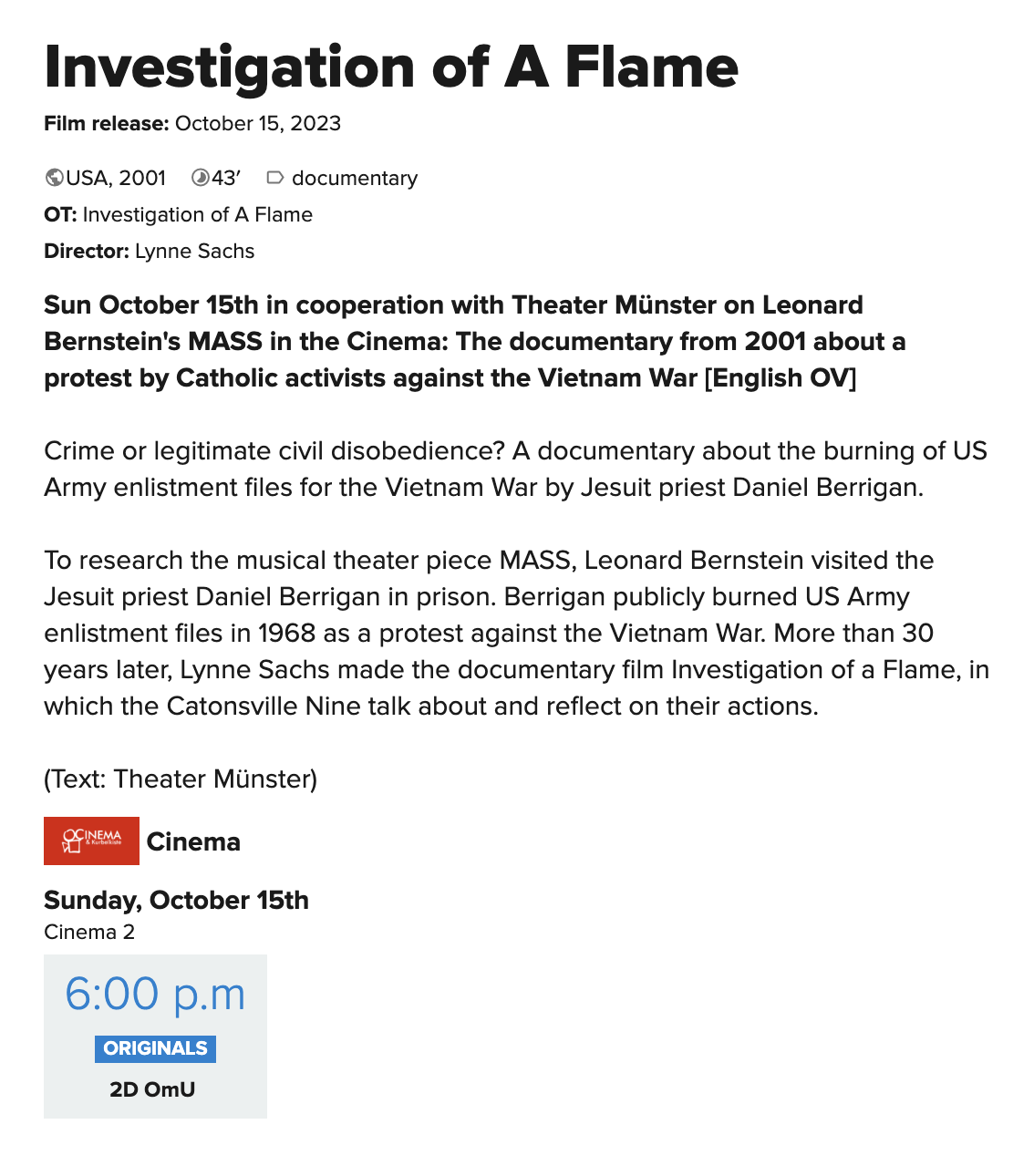
Cinema & Kurbelkiste / Investigation of a Flame

Investigation of A Flame in cooperation with Theater Münster
Film discussion with filmmaker Lynne Sachs
Sun October 15, 2023 • 6:00 p.m.
https://www.cinema-muenster.de/index.php?id=8025

https://www.cineplex.de/film/investigation-of-a-flame/396485/muenster/

Heaven, Hell, Happy Ending #2

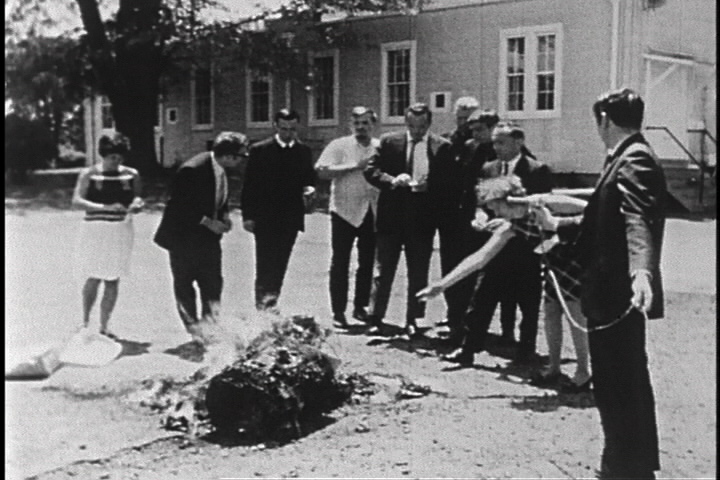
In May 1968, the Catonsville Nine, a group of Catholic priests and laypeople who wanted to stop the Vietnam War, burned draft records. They used homemade napalm. They had previously stolen the files from a district military replacement office in broad daylight. For some it was a crime, for others it was civil disobedience. For the composer Leonard Bernstein, this action, which caused a lot of attention in the public and also in the Catholic Church, was an important impulse for his musical theater piece Mass. He was friends with Father Daniel Berrigan, who was sentenced to prison for this action.

The feminist filmmaker Lynne Sachs made a film about this action in 2001 and allowed the activists, but also employees of the authority, jurors and the public prosecutor to have their say: How do they see the action in retrospect?

She comes to Münster for the premiere of the film (with German subtitles) and speaks to Professor Dr. Oliver Tolmein after the screening about the film and the meaning and consequences of civil disobedience.

This is the second event in “Heaven, Hell, Happy Ending”, the new series that accompanies musical theater productions.


Lynne Sachs If Tomorrow were Peace from Lynne Sachs on Vimeo.


Photos from Münster

PETROPRESENTS / Lynne Sachs: Making Films Personally and Politically

PETROPRESENTS at Petrohradská 13 Screening and Workshop in Prague, Czech Republic
Tuesday October 10 and Thursday October 12

https://petrohradskakolektiv.com/10-12-10-2023-Petropresents-Lynne-Sachs-Making-Films-Personally-and

https://www.facebook.com/events/2283738891833693/2283747248499524/?event_time_id=2283747248499524

For the final PETROPRESENTS at Petrohradská 13, we have invited American poet and filmmaker Lynne Sachs for two evenings of hand-picked short film screenings and one workshop, which are free for the public. Curated by Christopher Small and Daniela Hanusová.

TUESDAY 10
19:30 Program 1: Film is a Collaborative Art (90 mins)

THURSDAY 12
18:00 Lynne Sachs: Making Films Personally and Politically (Workshop, 60 mins)
19:30 Program 2: Feminism as Filmmaking (90 mins)

Lynne Sachs will be present for two nights of screenings, on Tuesday 10th and Thursday 12th October. Before the second program on the 12th, Lynne will give a special workshop to the students of Film Studies at Charles University, which is also open to the public, at Petrohradská kolektiv in Prague, Czech Republic.

Admission to the screenings and the workshop are free of charge, but the capacity of the workshop is limited, so please register if you wish to take part.


Lynne Sachs’s work — both cinematic and poetic — and theoretical thinking teeter on multiple edges; somewhere between the deeply personal and the general, the corporeal and the abstract, the introspective yet always relatable. Kino Petrohradská will screen two blocks of her short documentaries: one exploring feminism as a method of filmmaking, the other Sachs’ frequent tendency to make films collaboratively and communally – whether with her family or with other filmmakers (as in her collaboration with queer cinema pioneer Barbara Hammer on A Month of Single Frames).

In her talk, Sachs will combine film and feminist theory with labour history, focusing on the concepts of reproductive labour, performativity and somatic cinema. The lecture will be based on her forthcoming collaborative publication (with contributions from, for example, the prominent feminist theorist Silvia Federici). The book analyses the process of making her film The Washing Society, exploring the milieu of New York’s laundries and the intersections of immigration, race and capitalism. The talk will be followed by a discussion.

DRAWN & QUARTERED (3 min., 1987)
Recently read Laura Mulvey’s “Visual Pleasure and Narrative Cinema”.
Male gaze challenged.
Talk about French feminist theorists Helene Cixous, Luce Irigeray and Julia Kristeva.

WINDOW WORK (9 min, 2000)
I was performer, cameraperson, and director – one woman band so to speak.
Talk about domestic work, being a mother, Silvia Federici (who came into my life much later), “Wages for House Work” and her theories of Reproductive Labor. Talk about Chantal Ackerman’s “The Bed”.

ATALANTA: 32 YEARS LATER (5 min., 2006)
Revision of mythic story of the princess Atlanta whose father, the King, wanted her to marry a prince. She refused, unless he organized a competition of princes around the kingdom who would race to see who was the fastest. The fastest could marry her. I rewrite this, “queer” it, feminize it as we might say today.
Dedicated to Barbara Hammer.

AND THEN WE MARCHED (3 min. 2017)
How do we as artists participate in the swirl of mainstream politics. Can we change thinking? How does our witness make a difference?

CONTRACTIONS (10 min. 2024)
Working collectively to speak out for reproductive justice. Just the act of coming together can make a difference at least amongst ourselves. Talk about Fred Moten’s concept of “hesitant sociology”. Talk about Meredith Monk’s “Elis Island.”

THE JITTERS (3 min. 2023)
Coming full circle with Drawn and Quarted almost 40 years later. Talk about Carolee Schneeman’s “Fuses”.

Interactive Section – how do we move a concern, concept or conundrum from just being an idea to being a visual or oral experience of very short duration?

Listen to topics from our volunteers and brainstorm on a film they really could make with their cell phone and a computer editing program they probably already have.


Lynne Sachs for Petro presents from Lynne Sachs on Vimeo.

The Jitters

The Jitters
3 min. 16 mm, black and white, silent
by Lynne Sachs

I wanted to create a film with my Bolex 16mm camera that reflects who I am at this moment in my life. I bought my camera in 1987, used. It has lived with me for four decades, and it has witnessed pretty much every aspect of my existence.  I decided to shoot my roll of black and white film one frame at a time. With 24 frames in a second, this gave me the chance to work more expansively with the Bolex, pushing its capabilities as far as they might go. “The Jitters” includes three very specific performative elements.  My partner Mark Street and I wiggle around, watching and celebrating who we are independently and together. I also include my three pet frogs because I like the way that they wiggle in unison and on their own. These small reptiles have been part of our family’s life for 19 years, they needed to be memorialized on film. Lastly, I bring two bonsai trees into the tableaux, because they too should be applauded, for their persistence and longevity. Strangely enough, they wiggle too, that’s part of the magic of film.

“The Jitters” was commissioned for A Century of 16mm at IU Moving Image Archive.

Screenings: Century of 16mm Celebration, Indiana University Film Archive; Petropresents at Petrohradská, Prague (2023); DCTV, New York City (2023); Monira Foundation In Collaboration with Film Diary NYC (2024); Ambulante Festival de Ciné Documental, Mexico (2024)

Distortions: Moscow Conceptualists Working Today / Response to “Execution Love Chair” by Vadim Zakharov

Execution Love Chair – Vadim Zakharov

Assignment: Respond to this photo without any details.

This is Not How I Imagine It But How It Is
Lynne Sachs, July 15, 2023
This is not how I imagine it but how it is. I’m somewhere, probably in a place where I’ve spent all night with my head on a pillow, not mine, with closed eyes in a room where I’m not sure how far the walls are from the soft mattress, and there is a body next to me, but it’s so dark I don’t actually know if the body is on my left and if the wall is on my right. I’m scared, very scared that if I move, I might bang against the wall or the body, and I’ll forget to caress the body or I’ll knock my head thump against the wall, and so I become a hardened plank. My eyes see nothing. I remember the time I learned about the pupils in your eyes. But mine don’t open up in the darkness, or reduce to almost nothing in the sunlight. The little dark holes in my eyeballs don’t ever adapt, the way yours do. They’re set to an open that resembles the way that I drew my first self-portrait, just dark balls in a dirty pool of brown. It’s just a miracle that they see anything at all anymore on a normal day, a normal day. Is it part of growing old? To have this feeling of being in a bed with a wall and forgetting who is there with you. Even when you look, you only see a blue glow casting shadows on darkness from the LED lights of the cable, the clock, the modem, the things that remind you of what you could be, or do when, in reality, you’re happiest, when you are just overwhelmed. Then you scoot down the mattress, worried that you’ll scratch your face on the toenail that belongs to that person who is there with you. The clock reminds you it is 4 AM and you assume you have Covid. What else could it be? A cold, watery chill moves through your limbs and down your belly into your groin. At last you’re on the floor, with no idea how to find the door, your fingers creep along, leading you away from the now red light of the digital clock you found in the closet and thought might be helpful in your life, this time around. There you are on hands on knees, as they say, moving in a direction that might or might not be OUT and your nose tells you to go this way rather than that. Oh my, it’s a piece of furniture. You know it because your forehead smashes against it as soon as you push yourself a little further than you thought you would ever go. UP. It feels like the chair you bought at IKEA, or maybe the one you found in your mother’s attic, the one she didn’t want because it reminds her of your father or maybe it’s the high chair where you first slurped pumpkin through your lips past your gums into your throat, or maybe it’s the chair pulled from a game of musical chairs where you were almost out , but weren’t. You emerged with one chair in your grip. It’s that chair, the one in which you were declared a winner. There in the almost darkness you feel its sturdiness, plus something else you can’t quite detect. Of course, your pupils are still too small but your nose smells a flower. It’s a rose and you know better than to touch it. A rose has thorns. You remember that, at least. Better not touch. Just sit down and maybe you’ll feel different, or maybe better, maybe the same, but at least you’re off the floor now. You pull yourself up higher, feel all your weight, breathe as deeply as you can, like they taught you in that exercise class a few years ago. Then you rest in the chair. Feel the petals coming up through the seat, tickling your anus. Now at long last, you can rest, and then you feel a sensation, electricity, running through your fingers and into your organs and you wonder for just how long you can remain alive.


Distortions: Moscow Conceptualists Working Today
September 9 – October 28, 2023

https://www.205hudsongallery.org/calendar/2023/8/22/distortions-moscow-conceptualists-working-today

Hunter College Art Galleries: 205 Hudson Gallery 
205 Hudson Street
New York, NY 
Hours: Tuesday–Saturday, 12-6pm

Curated by Hunter College Professors Daniel Bozhkov and Joachim Pissarro with Dr. Olga Zaikina and Graduate Curatorial Fellow Victoria Borisova


Exhibition
Moscow Conceptualism began as an alternative underground art world in the late Soviet Union. Its unofficial status shaped its artistic methods and theoretical framework. The exhibition includes original objects, archival materials, and working models of original artworks, alongside new projects created by Moscow Conceptualists in collaboration with art and art history students and faculty at Hunter College. Thus, Distortions is an experiment in intergenerational and cross-cultural collaboration. It aims to transform the gallery into a two-month long forum exploring how existing artworks can be activated to create new living situations, and how documents can be used beyond the preservation of the past. 

Participating artists and art groups:
Yuri Albert (born 1959 in Moscow, lives and works in Cologne)
Collective Actions (active 1976-present)
Gnezdo (active 1974-79)
Sabine Hänsgen (born 1955 in Dusseldorf, lives and works in Bochum, Germany)
Andrei Monastyrski (born 1949 in Pechenga, Russia, lives and works in Moscow),
Victor Skersis (born 1956 in Moscow, lives and works in Bethlehem, PA)
Nadezhda Stolpovskaya (born 1959 in Moscow, lives and works in Cologne, Germany)
SZ Group (active 1980-84, 1989, 1990)
Vadim Zakharov (born 1959 in Dushanbe, Tajikistan, lives and works in Berlin, Germany).

Distortions: Moscow Conceptualists Working Today was developed through a two-semester graduate curatorial seminar at Hunter College led by professors Daniel Bozhkov and Joachim Pissarro with Dr. Olga Zaikina. It included studio art students: Lauren Cline, Tucker Claxton, LeLe Dai, Paula De Martino, Alicia Ehni, Stevie Knauss, Milly Skelington, Johnny Sagan; and art history students: Caitlin Anklam, Victoria Borisova, Jay Bravo, Andrea Dauhajre, Curtis Eckley, Daniel Kuzinez, Jake Robinson. Visiting scholar: Virginia Marano, PhD Candidate, University of Zürich, Switzerland. 

Onward, Patty Zimmerman! / Flaherty Film Seminar

Onward, Patty Zimmerman!
Flaherty
September 7, 2023

Onward, Patty Zimmerman!

1955-2023

After the 1990 Flaherty Seminar in Riga, Patty, her husband Stewart Auyash, Marlon Riggs, and I posed with Matryoshka dolls we had brought back.

As exciting as the rowboat?

I owe my entire career as a film programmer to Patty getting me a job directing Cornell Cinema in 1982. She lobbied the search committee relentlessly, and they had no choice but to hire me. She pulled me into the orbit of the Flaherty Seminar, and we collaborated frequently on the Flaherty Board of Directors and on special events like the 1990 Seminar in Riga, Latvia and the 50th Anniversary program at Vassar College in 2004.

Patty and I met 46 years ago when we were first-year graduate students in Communication Arts at University of Wisconsin-Madison. I had never met anyone like Patty. She was funny, brilliant, radical, and utterly dazzling. As close friends, we were explosive together. We never stopped talking and arguing and debating and laughing our heads off. To make some extra money, both of us were part-time projectionists for film classes at UW. I’d sit in the projection booth with her when she was projecting, and she would sit in with me. David Bordwell, the big shot film professor at UW, would frequently step into the booth and ask us to shut up.

When I think of my relationship with Patty in the early years of our friendship, I always think of the rowboat we took out on a lake in the Adirondacks during the 1983 Flaherty Seminar. Patty and I had gotten worked up by a film, although I can barely remember why. We both tore into the film during the discussion and then immediately got into the rowboat. Patty was still fuming and was paddling furiously, so much so that I thought we might go overboard. For decades after this, we could crack each other up by asking, if one of us mentioned an exciting experience: “As exciting as the rowboat?”

The shock of her sudden, early death has felt like tipping over. But attending her powerful burial service (music and poetry, I was told, programmed by Patty), witnessing the moving testimonials by faculty and administrators during the Ithaca College live-streamed memorial, and reading the cascade of reminiscences by students and colleagues on social media has almost righted me. I’m grateful for having been a part of her well-lived life.

Richard Herskowitz, Past Board president (1993-95), Programmer (1987, 1990 Riga, 1999), Chair of 50th Anniversary Committee (2004)


Patty was a beacon and a shout. 

I don’t often find myself speechless, but I have felt a veil of numbness and disbelief ever since seeing a notice of Patty Zimmermann’s death last week. It feels hard to confront this reality by putting words on paper. Patty touched my life in a number of ways over the years. Patty was a beacon and a shout. Her brilliance and courage showed me a view of the academy that I had not seen before. Her passion for media theory and its concerns was an index of her larger passion for humanity.

I first encountered Patty when we were both on a New York State Council on the Arts (NYSCA), Media panel in the mid 1980’s. I was taken then by her energy and her intelligence. I loved that she was so smart, and willing to defend our teaching of experimental film and cutting edge documentary work that was pushing formal boundaries and exposing issues that came out of the civil rights and women’s movements. She had an intelligence and an edge that reflected a sharp, smart, and critical attitude that I had seen in others from the graduate Communication Arts program at the University of Wisconsin, Madison, during the 70s.  

Patty’s inspirational leadership was instrumental in the founding of the Central New York Programmer’s Group. Patty (from Ithaca College) and Scott MacDonald (from Utica College) came to Colgate where I was teaching for an initial gathering of media programmers from the greater Central, Western, and Southern Tier areas of New York State to discuss ways that we could work together.  The object was to bring filmmakers to our programs that we, as individual institutions, could not afford to do alone. The result was major NYSCA support for additional funding for visiting artists and the salary of a part-time coordinator on the Cornell campus in Ithaca. The CNYPG continued for twenty, years until 2006.

It was Patty’s idea that the Flaherty Film Seminar should move to Colgate. Patty had seen its newly completed Golden Auditorium Cinema and Clifford Art Gallery, and saw the possibilities for the Flaherty. She approached me with the idea. I approached the Flaherty and the rest is history. I tell the story in detail in Patty and Scott’s book Flash Flaherty. This gesture demonstrates, once again, Patty’s devotion to building community.

Finally, I am grateful to Patty for supporting and screening my work around the world, including in Singapore. Many years ago, I sat in on a session about found footage at a media conference at the Northeast Film Archive, in Maine. I walked into a screening room and Patty Zimmerman was on stage talking about one of my early collage videos. I didn’t know that she was going to be there or that she was going to talk about my work.  

Patty Zimmermann was a wonderful colleague, scholar, teacher, and friend. She will be missed and remembered by many who were touched by her.

John Knecht, Russell Colgate Distinguished, University Professor of Art and Art History and Film and Media Studies. Emeritus.
Moscow Road, August 31, 2023


A provocateur, an intellectual, an activist.

Patty was a dear colleague, a mentor, and an ally. I met her at the Opening Night of the 50th Flaherty Seminar in 2004, and a year later I had the opportunity to hang out with her at the Morelia Film Festival in Mexico. Since then, we developed a close relationship, and she played a big role in my programming the Seminar in 2007 along with Mahen Bonetti.

Patty was generous, she offered insightful professional advice, and always had good gossip. In addition to the Flaherty experiences, she was kind enough to invite me to the Finger Lakes Environmental Film Festival family, where I was able to see her most in her element.

A provocateur, a true intellectual, and an activist, she certainly leaves a big academic and professional legacy. I hope we can all honor it by carrying forward her passion.

Carlos Gutiérrez, 2007 Seminar Co-Programmer


ONWARD

I’d like to share this small hand-written note Patty (and Scott) sent me when they were editing the collective Flash Flaherty volume. Probably the last contact I had with her. Onward.

Josetxo Cerdan Los Arcos, 2010 & 2011 Seminar Participant, 2012 Seminar Programmer


Patty and Helen at the Madres de Plaza de Mayo in Buenos Aires during the Visible Evidence Conference, 2018.

A sparkler. A synthesizer. An enactivist.

Since 1987, when we met at a Flaherty Seminar, I’ve been on a collaborative and co-creative adventure with my dear friend and sister in solidarity, Patty Zimmermann. I will always see her, not only as a media historian and theorist, but as a creator playing on a variety of platforms —from social media to her famous hand notes, from lecturing to our global convenings on Zoom, from the FLEFF festival to books, performances, articles, and online journalism. Her desire to expand media as a free-range environment for the imagination and all its possibilities knew few constraints.

There are three images where her energy and spirit live on for me and, I hope, for all of us connected through the Flaherty Seminar:

Patty. The Fourth of July Sparkler—incandescent, burning brightly, sending out sparks and lighting up everyone who comes into contact with you. Your sizzling flares would ignite new ideas, connections, and explorations. Your appetite for new places and people was loads of fun, bringing all kinds of folks together to spark new relationships, and support one another in new and completely surprising ways.

Patty. The Master Synthesizer. With your background in journalism and skill for deep listening, you would hear and combine multiple parts of conversations, thoughts, and feelings that no one else picked up. You could put your own ego aside to open up to the wonders of other people’s ideas, research and art. You would recognize them fully and generously. In our quarterly global Zoom convenings during the COVID years, we would tag team facilitating the conversations, so everyone involved had a chance to be heard.  At the end, you would pull together all the pieces into a  coherent narrative that was exciting, expansive, and important. I would leave the meeting feeling more empowered than I could have imagined during those dark months of pandemic and protest.

Patty. The Enactivist. You would practice what you valued the most — traveling through life reaching out as an engaged participatory sense-maker. We were drawn together to make sense of co-creation, collaboration, and community building, both in our writings together and in our other convening projects together.

As I recall all your contributions to the larger drifts of film history, digital theory, and media democracy, I am still amazed by how fiercely you championed the media making of communities in small spaces, the media of the unresolved, and the local.

I know you understood that media built in small spaces could mean freedom – to imagine, experiment, and enact new connections with confidence and courage. And you wanted the world to know that this art practice had major significance far from the centers of corporate entertainment.

 A sparkler. A synthesizer. An enactivist. Patty Zimmermann lives on in my heart, encouraging me always to reach out, make stuff with others, and always move from “me-to-we.”

Helen De Michiel, Co-authored OPEN SPACE NEW MEDIA DOCUMENTARY: A TOOLKIT FOR THEORY AND PRACTICE (2018) and several other articles and dossiers on documentary and co-creation with Patty Zimmermann.


A tribute to Patty Zimmermann, my beloved friend and mentor.

I can hear Patty’s voice right now and I bet you can too: that warm emphasis and enthusiastic twang, the infectious sound of her smile. We know Patty was brilliant and always one of the first to notice changes in our field; for example, giving close attention to every new iteration of digital media and bringing to it the most politically astute analysis; noticing subtle currents in transnational independent cinema; embracing environmentalism early; famously, taking amateur movies seriously as archival cinema. 

But Patty was at ease in her brilliance. She had not a shred of snobbism or elitism or mean-spiritedness, and that generosity surrounded her with loving, trusting, and grateful friends. When Patty became your friend you had a friend for life. A solid ally, constant in her support; generous, honest, stalwart, trustworthy, and fun. Patty was one of the very first people who took me seriously as an intellectual when I was a green young graduate student. She invited me to give a talk at Ithaca College in 2000, and she and Stewart (as warm and kind as she) put me up in their beautiful home in the woods and fed me a delicious meal. Later, Patty was like a secret fifth member of my doctoral committee, giving me the best advice and consistent feedback.

Patty was a fighter, in a spirit not of judgement but of love: she fought not against what’s judged to be bad but for what is and generative and live-giving. I am so grateful for her life advice and her vigorous sympathy. Like the time I was devastated from a broken heart, Patty and Stewart took me in and fed me and took care of me and she denounced the heartbreaker in no uncertain terms.

Patty taught me how the Flaherty works, taking me under her wing from the first time I attended the seminar in 1991. She explained Frances Flaherty’s principle of non-preconception and was a model of Flaherty’s ideal attentive, open-minded audience member. When I railed against Flaherty attendees’ seeming mania for correct representation, Patty wisely and compassionately diagnosed their response as a symptom of economic precarity. And when I programmed the Flaherty myself, she encouraged me to plan carefully and then (with that gorgeous, infectious big smile), at the Flaherty itself, to let go control, stay in the background, remain as calm as a Buddhist monk, and allow events to unfold. It’s thanks to Patty that I stayed so calm while bewildered, angry audiences regarding my programming choices, let the storm wash over me, and enjoyed the sunny morning at the end of the week when things fell into place in a way I could not have foretold. “Trust the process,” Patty said. 

Patty was no ascetic. She filled her life and ours with beauty and music and delicious food and sensuous pleasures. When times were rough, she embraced deep enjoyment. Patty always advised me to rise above. But to rise above the problems that dog you, you have to be well grounded, know yourself, and be kind to yourself. It takes a big soul. So as I grieve along with so many others, I will gratefully try to become ever more Patty-like, and so to keep her alive in my heart and my life and those of others.

Laura U. Marks, 2015 Seminar Programmer


Dear Patty,

Where are you? How could you have left us? You went away so quickly! You were such an important, vital, energetic, confusing, academic, literate, articulate, scholarly, and forceful voice of film knowledge in our Flaherty discussions. You would stand up and we would say, “Oh boy, here she goes…” but all of us would be riveted by the pace and complexity of the delivery and analysis of the films we had just seen. Or the intractable weaving of themes as we moved through the week—but it was like opening a piñata. It inspired argument and counter-argument, got blood boiling, people thinking, or just sitting in a daze! It was quintessential Flaherty… essential Flaherty! I think we need you now more than ever! And the wonderful contribution of the books, Flash Flaherty and the earlier one with Scott. I even saw them at the book tables in Bologna! Thank you so much for your energy and insights over all these wonderful years of our dear Flaherty Film Seminar. You will be sorely missed!

Love, Linda Lilienfeld


Unbounded energy and piercing insight

Patty Zimmermann worked intensely with Scott MacDonald on Flash Flaherty: Tales from a Film Seminar (2021). Like so many others, I knew Patty in a public context in the different film environments where she found community and meaning. I witnessed her unbounded energy and piercing insight. For this memorial recognition, I write about the time in which she was particularly supportive of me when I was dealing with an issue with my text in the Flaherty book.

As we all know, the Seminar brings out emotions and reflections, but hindsight offers us deep and complex ways to think about the work we’ve made, and its effects on others. I was invited to present my film Sermons and Sacred Pictures: the Life and Work of Rev. L.O. Taylor at the Flaherty in 1989. Thirty years later, Patty asked me to revisit the experience for the book. Another Seminar participant wrote about her own memories of the screening. She shared her perspective in her piercing and candid reflection. When I read it, I felt very sad… breathless. But it also gave me the ability to witness her distinct perspective. Patty assisted both of us in working through our interpretations of our distinct memories. She also encouraged us to connect directly as artists, which we did. Here is what Patty wrote to me:

“Tell me more about why you are breathless? I think [the writer] shifts the issue away from you a bit? Don’t feel constrained about writing a comment. My suggestion would be to do it as a question or an invitation to more dialogue? Let me know. When we read (the other text), Scott and I realized we needed to have you in this book. Let me know your thoughts. So sorry you found it so intense but tell me more. Maybe something to tap into for your piece?”

Patty pushed me to be forthright and vulnerable in my writing. She wanted Flash Flaherty to articulate the ways that we as makers connect to our work and the impact it can have on others.

Her imprint on me will remain, as it will for those who knew her intimately and those who simply benefited from her profound impact in our field, in the US and beyond.

Lynne Sachs


A brilliant scholar, a force for goodness, and an unforgettable person

I am shocked to learn of the death of Patricia R. Zimmermann, and will miss her always. She was a brilliant scholar, a force for goodness, and an unforgettable person. It was awesome to witness her contributions to the Flaherty Film Seminar. Year after year, during post-screening discussions, she spoke about the meaning of films with clarity and passion, helping to make the Seminar a riveting and extraordinary experience. As an innovative member of the Board of Trustees, 2005-2010, she helped the organization overcome major obstacles and thrive. With co-author Scott MacDonald, she wrote two books about the Seminar: The Flaherty: Decades in the Cause of Independent Cinema (2017) and Flash Flaherty: Tales from a Film Seminar (2021). These remarkable books have been acquired by more than 1,300 universities and public libraries in Switzerland, Sweden, Germany, Netherlands, France, Spain, United Kingdom, Australia, Singapore, China, Taiwan, Botswana, United Arab Emirates, Cyprus, Turkey, Greece, New Zealand, Mexico, Brazil, United States, and Canada. As a result, Patty’s creativity and bold intellect will continue to enrich peoples’ lives in every region of the world.

Steven Montgomery, Flaherty Board of Trustees, 2004-2010

On Sunday, September 17 at 8:30 am, there will be a Mass offered for Patty at Holy Cross Church on West 42nd Street in New York. As lector, it will be a privilege to lead the congregation in a prayer for Patty. May she rest in peace. 


Miss New York, and Miss Everywhere Else

Patty was loved by so many people, including me. And aside from being so thoughtful and rigorous as a scholar, writer, programmer and teacher, she was also a lot of fun. One of my favorite times with her was at the Virginia Film Festival in 2007. We were at a party and she noticed that Miss Virginia was there and said we just *had* to get a picture with her. So we did.

As far as I was concerned, Patty was Miss New York, and Miss Everywhere Else that she went in her storied career. What a wonderful woman; what a loss.

Su Friedrich

Link to page: https://theflaherty.org/patty-zimmerman?ss_source=sscampaigns&ss_campaign_id=64fa1176308d46599448ba39&ss_email_id=64fa1439062e0f458e793937&ss_campaign_name=September+2023%3A+OFFERINGS+v2+%5Bwith+updated+links%21%5D&ss_campaign_sent_date=2023-09-07T18%3A19%3A50Z