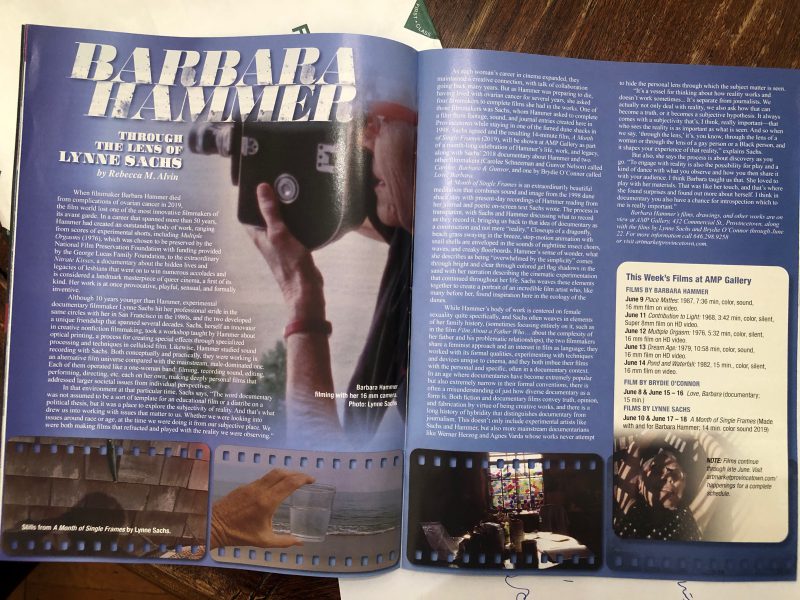
When filmmaker Barbara Hammer died from complications of ovarian cancer in 2019, the film world lost one of the most innovative filmmakers of its avant garde. In a career that spanned more than 50 years, Hammer had created an outstanding body of work, ranging from scores of experimental shorts, including Multiple Orgasms (1976), which was chosen to be preserved by the National Film Preservation Foundation with funding provided by the George Lucas Family Foundation, to the extraordinary Nitrate Kisses, a documentary about the hidden lives and legacies of lesbians that went on to win numerous accolades and is considered a landmark masterpiece of queer cinema, a first of its kind. Her work is at once provocative, playful, sensual, and formally inventive.
Although 10 years younger than Hammer, experimental documentary filmmaker Lynne Sachs hit her professional stride in the same circles with her in San Francisco in the 1980s, and the two developed a unique friendship that spanned several decades. Sachs, herself an innovator in creative nonfiction filmmaking, took a workshop taught by Hammer about optical printing, a process for creating special effects through specialized processing and techniques in celluloid film. Likewise, Hammer studied sound recording with Sachs. Both conceptually and practically, they were working in an alternative film universe compared with the mainstream, male-dominated one. Each of them operated like a one-woman band: filming, recording sound, editing, performing, directing, etc. each on her own, making deeply personal films that addressed larger societal issues from individual perspectives.
In that environment at that particular time, Sachs says, “The word documentary was not assumed to be a sort of template for an educational film or a diatribe on a political thesis, but it was a place to explore the subjectivity of reality. And that’s what drew us into working with issues that matter to us. Whether we were looking into issues around race or age, at the time we were doing it from our subjective place. We were both making films that refracted and played with the reality we were observing.”
As each woman’s career in cinema expanded, they maintained a creative connection, with talk of collaboration going back many years. But as Hammer was preparing to die, having lived with ovarian cancer for several years, she asked four filmmakers to complete films she had in the works. One of those filmmakers was Sachs, whom Hammer asked to complete a film from footage, sound, and journal entries created here in Provincetown while staying in one of the famed dune shacks in 1998. Sachs agreed and the resulting 14-minute film, A Month of Single Frames (2019), will be shown at AMP Gallery as part of a month-long celebration of Hammer’s life, work, and legacy, along with Sachs’ 2018 documentary about Hammer and two other filmmakers (Carolee Schneeman and Gunvor Nelson) called Carolee, Barbara & Gunvor, and one by Brydie O’Connor called Love, Barbara.
A Month of Single Frames is an extraordinarily beautiful meditation that combines sound and image from the 1998 dune shack stay with present-day recordings of Hammer reading from her journal and poetic on-screen text Sachs wrote. The process is transparent, with Sachs and Hammer discussing what to record as they record it, bringing us back to that idea of documentary as a construction and not mere “reality.” Closeups of a dragonfly, beach grass swaying in the breeze, stop-motion animation with snail shells are enveloped in the sounds of nighttime insect choirs, waves, and creaky floorboards. Hammer’s sense of wonder, what she describes as being “overwhelmed by the simplicity” comes through bright and clear through colored gel flag shadows in the sand with her narration describing the cinematic experimentation that continued throughout her life. Sachs weaves these elements together to create a portrait of an incredible film artist who, like many before her, found inspiration here in the ecology of the dunes.
While Hammer’s body of work is centered on female sexuality quite specifically, and Sachs often weaves in elements of her family history, (sometimes focusing entirely on it, such as in the film Film About a Father Who… about the complexity of her father and his problematic relationships), the two filmmakers share a feminist approach and an interest in film as language; they worked with its formal qualities, experimenting with techniques and devices unique to cinema, and they both imbue their films with the personal and specific, often in a documentary context. In an age where documentaries have become extremely popular but also extremely narrow in their formal conventions, there is often a misunderstanding of just how diverse documentary as a form is. Both fiction and documentary films convey truth, opinion, and fabrication by virtue of being creative works, and there is a long history of hybridity that distinguishes documentary from journalism. This doesn’t only include experimental artists like Sachs and Hammer, but also more mainstream documentarians like Werner Herzog and Agnes Varda whose works never attempt to hide the personal lens through which the subject matter is seen.
“It’s a vessel for thinking about how reality works and doesn’t work sometimes… It’s separate from journalists. We actually not only deal with reality, we also ask how that can become a truth, or it becomes a subjective hypothesis. It always comes with a subjectivity that’s, I think, really important—that who sees the reality is as important as what is seen. And so when we say, ‘through the lens,’ it’s, you know, through the lens of a woman or through the lens of a gay person or a Black person, and it shapes your experience of that reality,” explains Sachs.
But also, she says the process is about discovery as you go. “To engage with reality is also the possibility for play and a kind of dance with what you observe and how you then share it with your audience. I think Barbara taught us that. She loved to play with her materials. That was like her touch, and that’s where she found surprises and found out more about herself. I think in documentary you also have a chance for introspection which to me is really important.”
Barbara Hammer’s films, drawings, and other works are on view at AMP Gallery, 432 Commercial St., Provincetown, along with the films by Lynne Sachs and Brydie O’Connor through June 22. For more information call 646.298.9258 or visit artmarketprovincetown.com.
This Week’s Films at AMP Gallery Films by Barbara Hammer
June 9Place Mattes: 1987, 7:36 min, color, sound, 16 mm film on video.
June 11 Contribution to Light: 1968, 3:42 min, color, silent, Super 8mm film on HD video.
June 12Multiple Orgasm: 1976, 5:32 min, color, silent, 16 mm film on HD video.
June 13Dream Age: 1979, 10:58 min, color, sound, 16 mm film on HD video.
June 14Pond and Waterfall: 1982, 15 min., color, silent, 16 mm film on video.
Film by Brydie O’Connor
June 8 & June 15 – 16Love, Barbara (documentary; 15 min.)
Films by Lynne Sachs
June 10 & June 17 – 18A Month of Single Frames (Made with and for Barbara Hammer; 14 min. color sound 2019)
Lynne Sachs
(USA, 1961), is a filmmaker, poet and artist based in New York. She has created
genre-defying cinematic works through the use of hybrid forms and
interdisciplinary collaboration, incorporating elements of essay film, collage,
performance, documentary, and poetry. She taught the workshop “Opening the
family album” and a session was dedicated to her in the contemporary cinema
program.
Project La Casa Encendida Radio is a sound experimentation platform that wants to explore the radio format from an artistic perspective, a space to share interests and concerns with a multitude of voices that resonate in our present and an archive of sounds from our recent history.
Following her feature documentary Film About a Father Who, director Lynne Sachs has set her sights on a market and playground in Elmhurst, Queens with her new short Swerve, inspired by former poet laureate of Queens, Paolo Javier, and his Original Brown Boy poems, and fittingly world-premiering at NYC’s BAMcinemaFest later this month. We’re pleased to exclusively premiere the first trailer.
Wearing the tell-tale masks of our daunting now, five New
York City performers (Emmy Catedral, ray ferriera, Paolo Javier, Jeff
Preiss, Inney Prakash, and Juliana Sass) search for a meal at the Hong Kong
Food Court while speaking in verse. The film itself transforms into an ars
poetica/ cinematica, a meditation on writing and making images in the
liminal space between a global pandemic and what might come next.
The film was inspired by Sachs’ reading of Paolo Javier’s
sonnets in his new 2021 book O.B.B. aka The Original Brown Boy, and
she started to hear them in her head, cinematically. In her imagination,
each of his 14 line poems became the vernacular expressions of people walking
through a food market full of distinct restaurant stalls. She re-watched
Wong Kar-wai’s Happy Together, a favorite of both of theirs, and
immediately thought of the Hong Kong Food Court in Elmhurst, Queens, a
gathering spot for immigrant and working-class people from the
neighborhood. The five performers were then invited to devour Paolo’s
sonnets along with a meal from one of the market vendors.
The American filmmaker and poet Lynne Sachs will be the dedicatee of the tenth edition of the Costa Rica International Film Festival (CRFIC10), which will take place from June 9 to 18.
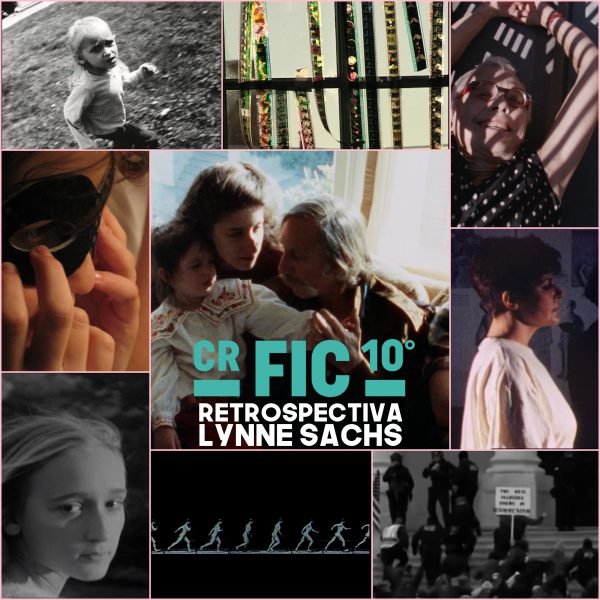
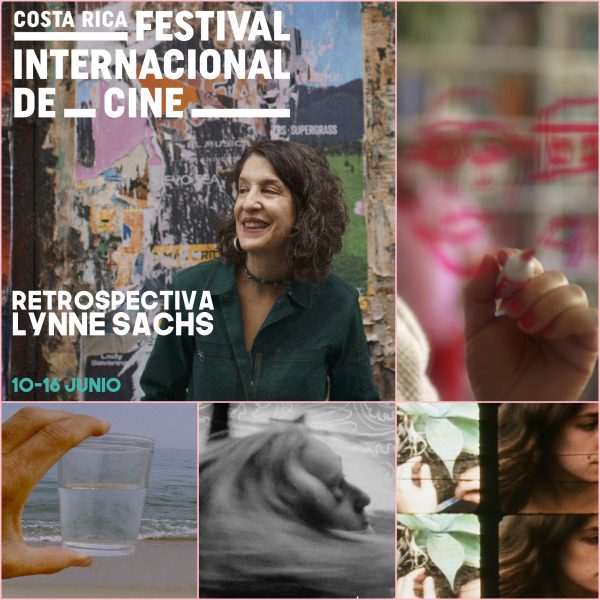
Sachs will visit the country during the festival, as he will be honored in the Retrospective section with a sample of 14 films of his authorship , characterized by a poetic, intimate, experimental and reflective tone with very personal themes.
The Sachs retrospective is made up of the films Epistolary: Letter to Jean Vigo (2021), Maya at 24 (2021); Film About a Father Who (2020) , Carolee, Barbara & Gunvor (2018), Tip of my Tongue (2017), Same Stream Twice (2012), With the Wind in Her Hair (2010), Frame by Frame (2009), Photograph of The Wind (2001), The House of Silence: A Museum of False Facts (1991), Drawn and Quartered (1987), Following the Object to It’s Logical Beginning (1987), and Still Life with Woman and Four Objects (1986).
According to the artistic director of the festival, Fernando Chaves Espinach , “We are interested in Lynne Sachs’s visit because with her films, made with few resources, she tells us about a very particular form of expression that seems relevant to our context. We are proud to present different ways of making cinema and, above all, to share it in a workshop with filmmakers and visual artists who can learn from his methodology and his approaches to cinematographic art”.
In addition to the presentation of his works, the festival has scheduled that Sachs give a face-to-face tutorial to a group of people linked to Costa Rican cinematography.
The main venue for the 10CRFIC will be the Cine Magaly and it will have three more screening rooms in the capital of San José and five outside the Greater Metropolitan Area: San Ramón, San Carlos, Jacó, Grecia, Limón and Paso Canoas.
SPANISH
Costa Rica Festival Internacional de Cine rinde homenaje a la cineasta Lynne Sachs
La cineasta y poeta estadounidense Lynne Sachs será la dedicada de la décima edición del Costa Rica Festival Internacional de Cine (CRFIC10), que se llevará a cabo del 9 al 18 de junio.
Sachs visitará el país durante el festival, pues se le rendirá homenaje en la sección Retrospectiva con una muestra de 14 películas de su autoría, caracterizadas por un tono poético, intimista, experimental y reflexivo con temáticas muy personales.
La retrospectiva a Sachs está constituida por los filmes Epistolary: Letter to Jean Vigo (2021), Maya at 24 (2021); Film About a Father Who (2020), Carolee, Barbara & Gunvor (2018), Tip of my Tongue (2017), Same Stream Twice (2012), Con el viento en el pelo (2010), Cuadro por cuadro (2009), Photograph of The Wind (2001), The House of Silence: A Museum of False Facts (1991), Drawn and Quartered (1987), Following the Object to It’s Logical Beginning (1987) y Still Life with Woman and Four Objects (1986).
De acuerdo con el director artístico del festival, Fernando Chaves Espinach,“Nos interesa la visita de Lynne Sachs porque con su cine, hecho con pocos recursos, nos habla de una forma de expresión muy particular que nos parece relevante para nuestro contexto. Nos enorgullece presentar distintas maneras de hacer cine y, sobre todo, compartirlo en un taller con cineastas y artistas visuales que pueden aprender de su metodología y sus acercamientos al arte cinematográfico”.
Además de la presentación de sus obras, el festival ha programado que Sachs imparta una tutoría presencial a un grupo de personas vinculadas con la cinematografía costarricense.
La sede principal del 10CRFIC será el Cine Magaly y contará con tres salas de proyección más en la capital de San José y cinco fuera de la Gran Área Metropolitana: San Ramón, San Carlos, Jacó, Grecia, Limón y Paso Canoas.
The tenth edition of the CRFIC is celebrated from June 9 to 18, in its first stage, and from June 29 to August 26, in a second itinerant stage, in communities outside the GAM.
The public will be able to enjoy 87 films in competition and screening, from 37 countries and in 15 different languages.
69% of the films in programming are directed or co-directed by women.
With the presence in the country of the American filmmaker Lynne Sachs, the CRFIC10 pays tribute to her career.
RETROSPECTIVE DEDICATED TO LYNNE SACHS
The CRFIC Retrospective section is dedicated to the renowned American filmmaker and poet Lynne Sachs (1961), who has 37 films to her credit, including short films and feature films, some of which have won awards or have been included in retrospectives at major festivals. .
Regarding the Retrospective, the artistic director of CRFIC10, Fernando Chaves, mentioned that last year the Festival showed Film About a Father Who , a poignant and moving film.
“In this tenth edition of the CRFIC we have the honor of having its director, Lynne Sachs, as a guest of our retrospective,” continued Chaves, “whom we are excited to present for her mixture of fiction, documentary, experimental cinema, performance and other media. ”
According to Chaves, with this solid filmography, Sachs demonstrates the energy of contemporary cinema and the multiple forms that this art takes, from an intimate and reflective perspective that dialogues with certain ways of making cinema in our context.
To close with a flourish, Sachs will hold a workshop where he will experiment with national artists.
Program includes: • Film About a Father Who • Con viento en el pelo • Tip of My Tongue • A Month of Single Frames • Carolee, Barbara & Gunvor • Epistolary: Letter to Jean Vigo • Drawn & Quartered • Following the Object to Its Logical Beginning • Maya at 24 • Same Stream Twice • Photograph of Wind • Still Life with Woman and Four Objects • House of Science: a museum of false facts • Cuadro por cuadro
San José, Costa Rica, May 20, 2022- With a program of outstanding independent films from 37 countries and in 15 different languages, the tenth edition of the Costa Rica International Film Festival (CRFIC10) is held from May 9 to June 18, in a first stage, and from June 29 to August 26 in a second itinerant stage.
The CRFIC10 will be held in person in downtown San José, as well as in different communities in the country outside the Greater Metropolitan Area (GAM), with the aim of reaching larger audiences that can enjoy the alternative audiovisual experience proposed by the festival program of the Costa Rican Center for Film Production (Cinema Center).
The artistic director of the 10CRFIC, Fernando Chaves Espinach, stated that “the Festival brings us the opportunity to confront ourselves with the most challenging, innovative and inspiring cinema that is being made today, with different languages and approaches, from very different countries. We have chosen winning films at renowned festivals such as Sundance, San Sebastián and Locarno, films nominated for Oscars and winners at other competitions, but we have also rescued titles that otherwise would not reach our theaters, true discoveries that show us the effervescence of contemporary cinema and its ability to shake us” .
The venues of the Festival will be located in the Magaly Cinema (the Main Hall and La Salita), the Gómez Miralles Hall of the Cinema Center, the French Alliance (in Barrio Amón) and the CCM San Ramón, CCM San Carlos, CCM Jacó rooms. , CitiCinemas Grecia, CitiCinemas Limón, Paso Canoas and Multiplexes Liberia.
In the itinerant stage, it will take place in the communities of Matambuguito, Shiroles, Boruca, Térraba, Sarapiquí and Grano de Oro.
OUTSTANDING CINEMA
The 10CRFIC program is made up of a careful selection of 87 international, regional and national films directed and co-directed, 69% by women, with varied content for audiences of all ages.
“We are proud to present a diverse programming in gender and geographical origin, which shows that cinema has never been monolithic in its language or in its origin; this programming allows us to articulate a defense of cinema as a diverse, complex art whose permanence as a vehicle of artistic expression requires spaces for debate and enjoyment such as festivals” , commented Chaves.
OPENING WITH UTAMA FEATURE FILM For the inauguration of the 10CRFIC, the curatorial team chose the feature film Utama (2022), by Bolivian director Alejandro Loayza Grisi.
The feature film is a co-production between Bolivia, Uruguay and France and is set in the arid Bolivian highlands, where an elderly Quechua couple have lived the same daily life for years.
In the middle of a drought, Virginio (80 years old) gets sick and aware of his imminent death, he lives his last days hiding the illness from Sisa (81 years old).
Loayza Grisi (1985) began her career in still photography and later entered the world of cinema through film photography.
As director of photography, he worked on the documentary series Planeta Bolivia, and on multiple short films such as Aicha, Dochera and Polvo.
Attracted by the stories that can be told through moving images, he ventured into writing and directing his first feature film titled Utama.
The competitive categories of the programming for this tenth edition are the following: Central American and Caribbean Feature Film Competition, with films from Costa Rica, Guatemala, Panama and the Dominican Republic; and the National Short Film Competition, with eleven Costa Rican productions.
The 10CRFIC will award a statuette to three films that stand out for their formal quality and content, as well as 8 million colones (approximately US$11K at the exchange rate) in total in incentives and support to the filmmakers selected as winners of the Competitive categories: a 1 million colones prize for Best National Short Film, a 3 million colones prize for Best Costa Rican Feature Film, and a 3 million colones prize for Best Central American and Caribbean Feature Film, as well as two 500,000 colones prizes for special mention Jury Mention in Feature Films and Jury Mention in Short Films, respectively.
The other sections of the program are: Panorama, Radar, Approach, Last batch, Young people, Memory, Pioneers of cinema and Retrospective.
COMPETITION JURIES The jury for the Central American and Caribbean Feature Film Competition is made up of Peter Taylor (Northern Ireland), programmer and curator, and currently director of the Berwick Film & Media Arts Festival; Christina Newland (United Kingdom), journalist for Vice, Sight & Sound, BBC, Mubi and Empire, on topics such as cinema, pop culture and boxing; and Pablo Hernández Hernández, (Costa Rica), professor at the University of Costa Rica with a doctorate in Philosophy from the Universität Potsdam and specialist in Aesthetics, philosophy of art and culture.
The jury of the National Short Film Competition is Alexandra Latishev (Costa Rica), a filmmaker who graduated from the New Film and Television School of the Véritas University; Juan Soto (Colombia), editor, director and archivist, who currently works at the Filmoteca de Catalunya as Film Preservation Project Manager; and Vanesa Fernández (Basque Country), director of the Zinebi Festival and coordinator of the Degree in Audiovisual Communication at the University of the Basque Country / Euskal Herriko Unibertsitatea (UPV/EHU).
For their part, the CRFIC Industry juries are Gudula Meinzolt (Germany), with training and experience in cultural management and cinema in areas such as research, promotion, organization of festivals, distribution, exhibition and co-production; Karolina Hernández (Costa Rica), founder and general producer of Dos Sentidos SA and coordinator of the Audiovisual Production area of the Office of Communication and Marketing of the Tecnológico de Costa Rica and professor at the University of Costa Rica; and Zsuzsi Bankuti (Hungary), who since 2020 directs the Cutting Edge Talent Camp, since 2022 is the interim director of Open Doors, and also works as an international strategy consultant for the Doha Film Institute, the Torino Film Lab and Cinemart.
Art Market Provincetown AMP: The Happenings | 2022 May 27 through June 22 http://www.artmarketprovincetown.com/happenings/
Films by Barbara Hammer, Brydie O’Connor, and Lynne Sachs
Screenings at AMP
Schedule: Dates are listed below with films. Each film will show individually and looped throughout the day – come anytime.
Films by Barbara Hammer
May 27 & June 11 | Contribution to Light: 1968, 3:42 min, color, silent, Super 8mm film on HD video. “Contribution to Light is all about my excitement and thrill at seeing reflected and refracted light. I shot the edges of pieces of found broken glass that streamed light rays broken into myriad colors. I saw, years later, a shared aesthetic in Stan Brakhage’s study of a crystal ashtray.” — Barbara Hammer
May 28 & June 12 | Multiple Orgasm: 1976, 5:32 min, color, silent, 16 mm film on HD video. This film was preserved by Electronic Arts Intermix and the Academy Film Archive through the National Film Preservation Foundation’s Avant-Garde Masters Grant program and The Film Foundation. Funding provided by the George Lucas Family Foundation.
May 29 & June 13 | Dream Age: 1979, 10:58 min, color, sound, 16 mm film on HD video. A 70-year-old lesbian feminist, seeing little change in the society after years of work, sends out her 40-year-old self on a journey taking her around the perimeters of the San Francisco Bay.
“During her quest she encounters aspects of her personality: the guardian angel who has all that she needs; the seductress who leads her astray; the wise woman of secrets who she meets underground. The film culminates in a visual crescendo ascending a tower as the heroine’s hair is painted white by her counterparts. A dream vision film.” — Barbara Hammer
May 30 & June 14 | Pond and Waterfall: 1982, 15 min., color, silent, 16 mm film on video. An underwater exploration of verdant pond growth pulling the viewer into actually being the creature actively exploring.
“Hiking in Point Reyes National Seashore I came upon a vernal pool with an intriguing and mysterious underwater world. I optically printed swimming underwater to slow the movement to a meditative rhythm. I hoped that the appreciation of the clarity and beauty of water would lead us to better protect it.” — Barbara Hammer
“The camera eye is like an amphibian that sees on two levels in its journey from underwater in a safe pond down to a violent, turbulent ocean. Early in the silent film shot north of San Francisco we see an homage to Monet’s Nymphiades in the faded raspberry color of the step-printed underwater lilies. The painterly effects of the printing make the water seem viscous. Pushing through clouds of fish eggs, fronds and algae, the camera establishes a sense of intimacy and connection in a natural ecosystem. But this amiable underwaterscape acquires ominous overtones as the camera/amphibian surfaces. Splashes strike the lens, and the rock of the ocean surf is destabilizing and disorienting. One of the most provocative foreshadowing ambiguities occurs when the half-submerged camera tracks the tip and slosh of the horizon, echoing the mood change from underwater confidence to vulnerability to natural forces, a passage from balance to defiance.” — Kathleen Hulser, “Frames of Passage: Nine Recent Films of Barbara Hammer,” Centre Georges Pompidou
June 1 & June 9 | Place Mattes: 1987, 7:36 min, color, sound, 16 mm film on video. As the figure and ground are presented as two planar relationships, flattened and made two-dimensional through optical printing, so the artist (figure) is unable to touch the natural environment (ground) in Puget Sound, Yosemite and the Yucatan, yet finally comes to rest in the interior space of a restaurant.
Sound Score: Terry Setter
June 2 | No No Nooky T.V.: 1987, 16mm, color and B&W, sound, 12 min. Using a 16mm Bolex and Amiga computer, Hammer creates a witty and stunning film about how women view their sexuality versus the way male images of women and sex are perceived. The impact of technology on sexuality and emotion and the sensual self is explored through computer language juxtaposed with everyday colloquial language of sex.
No No Nooky T.V. confronts the feminist controversy around sexuality with electronic language, pixels and interface. Even the monitor is eroticized in this film/video hybrid that points fun at romance, sexuality, and love in our post-industrial age.
June 3 | Two Bad Daughters: by Barbara Hammer and Paula Levine. 1988, 12:21 min, B&W and color, sound. “…The ‘Bad Daughters’ reject obedience to the Father in favor of the impish anarchy of self-possession.” — Steve Seid, Berkeley Art Museum and Pacific Film Archive
“Two Bad Daughters, 1988, is a whirlwind tour of paternal institutions: fatherhood, Lacanian psychoanalysis and bondage. The tape turns on the dominators, using a heavy complement of graphics and manipulated images to collapse control. The stratified surface of Two Bad Daughters is playful, an energetic barrage of text, acrimony and artifice. It is play that proves most subversive. The ‘Bad Daughters’ reject obedience to the Father in favor of the impish anarchy of self-possession.” — Steve Seid, Berkeley Art Museum and Pacific Film Archive
June 4 | Still Point: 1989, 9:14 min, color, sound, 16 mm film on HD video. Still Point whirls around a point of centeredness as four screens of home and homelessness, travel and weather, architecture and sports signify the constant movement and haste of late twentieth century life.
“At the still point of the turning world, that’s where the dance is,” wrote T.S. Eliot in “Burnt Norton,” the first poem of Four Quartets. Hammer seeks a point of quiet from which all else transiently moves.
June 5 & June 20 | Our Grief in Not a Cry for War: 2001, 3:36 min, color, sound. Hammer documents a demonstration and, in so doing, makes her own contribution to the national post–September 11 dialogue.
On October 11, 2001, in Times Square, New York City, an ad hoc group of artists named Our Grief Is Not a Cry for War silently demonstrated for peace at a time when the nation was clamoring for war and sacrificing its own civil liberties.
June 6 & June 19 | Lesbian Whale: 2015, 6:35 min, color, sound, HD video. Lesbian Whale is a video animation of Hammer’s early notebook drawings set to a sound track of commentary by the artist’s friends and peers.
“The script is composed of fragments and stray thoughts – ‘as a feminist I’m very skeptical’; ‘not necessarily physical time but emotional time’ – and it’s not quite clear whether it’s spontaneous, planned, composed by the speakers, or read from Hammer’s notebooks. If Hammer’s artistic influence is well documented, this slippage between voices, authors, and images suggests an ethos of collaboration and conviviality that may prove to be her greatest legacy.” — Andrew Kachel, Artforum
Director/Drawer/Sound Designer: Barbara Hammer. After Effects: JiYe Kim. Post Production: Valery Estabrook.
Voice Participants: A.K. Burns, Heather Cassils, Myrel Chernick, Janlori Goldman, Holly Hughes, Daniel Alexander Jones, Reena Katz, Bradford Nordeen, Liz Rosenfeld, Julia Steinmatz.
____
Film by Brydie O’Connor
June 8 & June 15-16 | Love, Barbara (documentary; 15 min.)
Love, Barbara is a short documentary about the iconic legacy of pioneering lesbian experimental filmmaker, Barbara Hammer, through the lens and love of her partner of over 30 years, Florrie Burke.
Directed by Brydie O’Connor; Featuring Florrie Burke and Barbara Hammer; Executive Produced by Anne Alexander, Jessica Chermayeff, Ana Veselic, and Brian Doyle; Produced by Brydie O’Connor and Myriam Schroeter; Cinematography by Maria Rusche; Edited by Matt Hixon; Original Score by Bryn Bliska; Color Grade by Sean Dunckley at Light Iron Post; Sound Mix & Design by Jeremy Siegel at Heard City; Supported by : The Future of Film is Female, Women Make Movies, New York State Council on the Arts, and New York Foundation for the Arts
____
Films by Lynne Sachs
June 10 & June 17-18 | A Month of Single Frames (Made with and for Barbara Hammer; 14 min. color sound 2019)
“In the last few months of filmmaker Barbara Hammer’s life, she asked me to come to her home to discuss something she needed to say in person. I immediately faced a complicated set of emotions. I knew that this tête-à-tête would involve some kind of good-bye, but I had no idea that she had decided to share a part of her personal archive, and thus a part of her being on this earth, with me. As I sat at her side, Barbara vividly described to me her 1998 artist residency in Provincetown, Cape Cod, Massachusetts. For one month, she lived and made her art in a shack without running water or electricity. While there, she shot 16mm film with her Beaulieu camera, made field recordings, and kept a journal. Barbara’s only instructions to me were very simple: “Do absolutely whatever you want with this material.” While writing the text for my own film, the words I placed on the screen came to me in a dream. I quickly realized that this kind of oneiric encounter could become a posthumous continuation of the dialogue I had started with Barbara. Since I would never again be able to speak to her about her life or the ontological nature of cinema or the textures of a sand dune, I would converse with her through A Month of Single Frames. Through my writing, I tried to address Barbara’s celebration of solitude and cinematic embodiment. Ultimately, my text on the screen over Barbara’s images functions as a search for a cinematic experience that brings us all together in multiple spaces at once. It is also an embrace of an ambiguous second person you who might be Barbara herself or might be anyone watching the film.”
June 21 | Carolee, Barbara & Gunvor (Super 8mm and 16mm film transferred to digital, 9 minutes, 2018)
From 2015 to 2017, Lynne Sachs visited with Carolee Schneemann, Barbara Hammer and Gunvor Nelson, three multi-faceted artists who have embraced the moving image throughout their lives. From Carolee’s 18th Century house in the woods of Upstate New York to Barbara’s West Village studio to Gunvor’s childhood village in Sweden, Lynne shoots film with each woman in the place where she finds grounding and spark.
_______________
About the Filmmakers
Barbara Hammer | Selected Films
Barbara Hammer (1939-2019) is a feminist filmmaker and pioneer of queer cinema, who made over 90 moving image works as well as performances, installations, photographs, collages, and drawings.
During her lifetime she created two awards for lesbian and queer filmmakers, and had retrospectives at the Museum of Modern Art, the Tate Modern, the Jeu de Paume in Paris, and the Hammer Museum in Los Angeles. The Leslie-Lohman Museum of Gay and Lesbian Art in New York mounted a retrospective of her film, photography, drawings, and sculpture, which New York Times art critic Holland Cotter named one of the best exhibitions of that year.
Hammer’s work is held in several permanent collections, including the Museum of Modern Art in New York, the Centre Pompidou in Paris, the Whitney Museum of American Art, and the Australian Center for the Moving Image in Melbourne. Her complete catalogue of 16 and 8mm film, as well as Super 8, is in the collection of the Academy of Motion Picture Arts and Sciences Film Archive in Los Angeles, and her papers are available for review at Yale University’s Beinecke Rare Book and Manuscript Library in New Haven.
______
Brydie O’ Connor | Documentary film: Love, Barbara
Brydie O’Conner is a Kansas-bred, New York based filmmaker.
Her award-winning work spans the documentary and narrative fields with a focus on women-driven and queer stories. Brydie has directed short documentaries LOVE, BARBARA (2021) which premiered at Academy Award-qualifying Santa Barbara International Film Festival and FRIENDS OF DOROTHY (2020), which premiered in New York at DOC NYC. In 2021, Brydie was selected for The Future of Film is Female Award, and she received a NYSCA grant sponsored by Women Make Movies in addition to a Brooklyn Arts Council grant. In 2019-2020, she workshopped her forthcoming film in the Female Filmmakers Berlin Directing Lab. Much of her work is inspired by archival histories.
Brydie’s producing credits include THE LESBIAN BAR PROJECT with Executive Producer Lea DeLaria, WOMONTOWN for PBS Kansas City, and she has archival produced Season 7 of THE CIRCUS on Showtime in addition to various projects on Left/Right TV’s roster. She is a graduate of The George Washington University.
______
Lynne Sachs | Films: A Month of Single Frames & Carolee, Barbara & Gunvor
Lynne Sachs is an experimental filmmaker and poet living in Brooklyn. She has produced over 40 films as well as numerous live performances, installations and web projects. In 2019, Tender Buttons Press published Lynne’s first book Year by Year Poems. Working from a feminist perspective, she investigates connections between the body, the camera, and the materiality of film itself. She uses letters, archives, diaries, poetry and music, to take us on a critical journey through reality and memory. Over the years, Lynne has worked closely with fellow filmmakers Craig Baldwin, Bruce Conner, Barbara Hammer, Chris Marker, Carolee Schneemann, and Trinh T. Min-ha. Between 1994 and 2006, she produced five essay films that took her to Vietnam, Bosnia, Israel/ Palestine, Italy and Germany — sites affected by international war — where she looked at the space between a community’s collective memory and her own subjective perceptions. Lynne’s films have screened at MoMA, Tate Modern, Image Forum Tokyo, Wexner Center for the Arts, and festivals such as New York Film Festival, Oberhausen Int’l Short FF, Punto de Vista, Sundance, Vancouver IFF, Viennale and Doclisboa. Retrospectives of her work have been presented at the Museum of Moving Image, Sheffield Doc/Fest, BAFICI, Cork Film Festival, Havana Film Festival.
In a Zoom call, Lynne commented that she liked my wallpaper. Not having paid very close attention to it for some time, I decided to make a video or film based upon it. 3 still photographs (one tilted to the left, one to the right and one straight on) are rapidly alternated to give an impression of the pattern starting to come to life. At the end, the wallpaper, with wet paint, was printed onto a very small amount of 35mm film.
The title may evoke thoughts of the famous short story The Yellow Wallpaper, in which a woman suffering from a nervous disorder begins to claim she is hearing voices from within the wallpaper in her room. Undermining this somewhat, the piece is pointedly silent, though the painted film reveals the pattern of the wallpaper interacting with an optical soundtrack.
Demonstrating 19th century attitudes toward women’s mental and physical health, the original Yellow Wallpaper story is considered an important early work of American feminist literature.
Slamdance: News from Nowhere May 2022 https://preview.mailerlite.com/h8g0m3h0y4
Celebrating Asian American and Pacific Islander Heritage Month on Slamdance Channel
In recognition of Asian American and Pacific Islander Heritage Month, the Slamdance Channel is highlighting Asian voices throughout the entire month of May, including new films premiering on the channel for the first time.
Figuring out the unique grammar of your life can be difficult. People, situations, can give us question marks with no answers and ellipses that lead to nothing. Lynne Sachs, a Memphis-born experimental filmmaker, attempted to answer some of these questions in her own life with the 2020 documentary, Film About a Father Who. She offers an in-depth look at her father and titular character.
Ira Sachs Sr. is an enigmatic hotelier out of Park City, Utah, with an unmissable mustache and a penchant for colorful button-ups. His approach to love parallels in eccentricity. He despises loving like a “swan,” the idea of mating with a single soulmate for life. Sachs Sr. chose instead to surround himself with a steady flow of young women and went on to marry—and divorce—a number of them. Many of Lynne Sachs’ childhood peers were enamored by the bravado and Hefner-esque life her father led. But this way of life caused tension at times with those closest to him, to say the absolute least.
Beginning in 1984, Lynne Sachs chronicled moments in Sachs Sr.’s life for thirty-five years and those in his mother’s, ex-wives’, children’s, and others close to him. Her mission was to elucidate his tucked-away interior life, not just to an audience but to herself. Two years after the release of the film and two years younger than when Sachs began this project, I got to speak with her about it and her greater body of work. Sachs gave a lecture at Sarah Lawrence in the fall of 2021—for those who took Tanya Goldman’s “Experimental Documentary”course. I sat in my apartment in upstate New York and called Sachs, who was in a hotel room in Paris. She’d left her Brooklyn home for a few weeks to attend a screening of her work. In our hours of conversation, what stuck with me the most was what she said about the image above. Sachs stated that it is “the most important in all of Film About a Father Who.” A scene that wasn’t even filmed by Sachs, instead by her father. It’s a tranquil look at three of her siblings as children playing in a creek. For a film that follows a bon vivant and his unorthodox lifestyle, I was taken aback that this scene was the most important.
The scene occurs once in each of the three acts, all different segments of the same shot. Why? Well, it’s part of what makes this film, like each of her films, have a unique “feeling”—or “grammar”—to them. “Grammar,” as a metaphor, is illustrated in another wonderful scene in act one. I told her,
I really loved that scene in Film About A Father Who.
In it, Sachs, her brother, and her sister sit on her childhood bed talking
about how [your father] doesn’t have a grammar and your mother does when you’re living with each of them. Do you feel that your work as a filmmaker has some sort of grammar behind it? Or is it just question marks when you go into each project?
I think that what really, really distinguishes an experimental film from a more conventional film, whether you’re talking about a documentary or a narrative or any other form, is a refusal to embrace a formula around grammar or a template—the grammar of cinema. Because people say things like, “well, a great documentary is character-driven,” or they say “you can’t break the 180-degree rule when you’re shooting,” or you must have the exposition sort of identified and articulated in a narrative film by fifteen minutes in.
There’s all these rules about the shape of things. The way shot-reverse-shot insinuates that two people are in the same room and doing things simultaneously. If you know about making films, you know that they’re probably not, but it relies on an assumption on the part of the audience that the grammar of the film will be accessible and key to that—key is familiar.
So then you jump over to something that is more playful, experimental, distinctive in terms of each work, having its own cosmos. And you think that the audience at first might be a little disoriented because the audience doesn’t understand its distinctive grammar, but through the shaping, evolution of the film, the audience starts to register how meaning is constructed. And I think that’s really exciting. And I think that is an opportunity to constantly reinvent how you work with the medium of film. When I hear about someone who says, “well, I bought this software that helps you to write your screenplays, it comes with a template.”
I think, okay, if it comes with a template, then you are going to construct time in a certain kind of way. You’re going to create your characters in a, probably, formulaic way. So I’m scared of that kind of stuff. I think it’s problematic. So, then you asked that in relationship to Film About a Father Who, and I think that every family has its own grammar as well and that the grammar is significant because it guides you in terms of how you relate to people of different generations or new members of your family. It has to do with how transparent you are. What it means to do something like tell a lie, or what is a white lie? How many different people in your family do you tell white lies to, to protect them?
What does a white lie really mean? People either withhold information or you shift information because you think the truth is going to be complicated or intimidating or painful. So you were asking about the punctuation marks—are my films question marks? I do actually like when people leave my films, asking questions of themselves or questions of society or questions more ontologically about how we construct meaning. I like that. I think that’s an opportunity for being changed by a work of art. Or perhaps being just slightly shifted by it.
There was kind of a shift at the end of the film when you bring in your sister—the one that had been removed from you for so long. A lot of stories about your father- there’s some sort of way you and your other siblings in your minds might have justified them a lot of times, but in that one, there’s no justification for what happened.
Sachs’ half-sister went on a pre-college trip with a best friend from high school, staying in a ski lodge with Sachs Sr. At the end of the vacation, her best friend announced that she had fallen for and would continue to live with her father.
I felt like that really changed the perception of the film.
Sometimes we do that with things that upset us. We create justification in order to move forward, but then it keeps gnawing at us. So if we finally come to terms with our own anguish with the recognition that the reality is not what we want it to be, but it is there and that we can’t make any more excuses for it. Then I think it’s like a cathartic experience, even if it is difficult.
Also what I loved about that film is I felt you’re really comfortable not only behind the camera but also in front. Your [1987] short film, Drawn and Quartered, you talked about how you at first edited out your face because you were so embarrassed [to show yourself nude], but then you ultimately decided to put it back in. And I felt like that was a moment of growth?
In English, we say, “oh, don’t you feel exposed.” We the word exposed on a physical level, and we use it on a psychological level.
So at that point, I was not very secure with showing my body, and I felt vulnerable and I felt too observed. But then later I made a film called the The House of Science: A Museum of False Facts, and I take my clothes off a little, other people do too—it’s a lot about the body.
But what was more of an exposed feeling was the writing. The idea of that you write about things that go on in your body and the grit of it all, the pus, the urine, and all those things. But the thing is, by exposing that, you’re actually saying I’m just like everybody else.I’m a woman. My body’s like all the other women; we’re just shaped a little different. It’s when you open up and expose the narrative of your life and all the compromises that come with that–that’s even more revealing. So there’s all these layers of what it means to be exposed.
As you’ve made films throughout your career, have you felt you’ve been able to be more comfortable [in front of the camera], or was this something from the beginning you felt—
No, no, no, no, no, no, no, definitely not. Sometimes I go back — not that I do this very much — and look at my progress reports from elementary school. And my teachers would say, “Lynne is a good student, but she’s so shy.” I wasn’t a very forthright child. I wasn’t the first person to raise their hand, you know, in those situations. But I think it’s come to me, and I think part of it is, let’s say, making a film like Film About a Father Who. I was so profoundly nervous about making this film.
It’s not just because I was exposing myself to you or to anyone else in the audience, but I was exposing myself, my life to myself. Does that make sense? I’ve never explored this word in this way. You are really making me think! Like I was saying, “Hey, this is really how it is,” because you can get very wrapped up in the day-to-day activities of your life and not really allow yourself to think in an analytical way, an emotional way about how, how you’ve lived your life. And so the film gave me that chance. I realized as I was making Film About a Father Who that two things happen when you’re interviewing and when you’re trying to write.
If I’m talking to one of my siblings and I’m asking them to tell me about how they feel about something, they’re looking to me, and I’m saying, “yes, yes,” and I’m nodding, and I’m affirming as if that’ll fit perfectly into my edit, you know, [like] that’s exactly what I needed. So I found that if we went together into a very dark place, like a closet, there wasn’t that constant affirmation and perhaps, manipulation. So that’s one thing. But then the other thing had to do with the writing and the construction of a voiceover or narration was that I kept censoring myself. So I used a method that has really proven to be super helpful. That was to just record my thoughts in this kind of unfiltered way and then to send it to a transcription service. And then you come back, and you have 20 pages of text. That was how I did it since I kept writing in my moleskin diary and scratching it all out.
I know you got your start with feminist filmmaking.Seeing Film About a Father Who, I wondered was there any sort of [internal] conflict?
I was actually editing Film About a Father Who during the Me Too movement. So I was cognizant of the fact that I was talking about a man who led a life, well, he’s still alive, in which he had a certain kind of power over different women in his life. Maybe not in the workplace, but you know, in his personal life. And I knew that there were contradictions, but I felt that I was not only making it as a feminist but also as a daughter. You look at your parents as role models, but you also look at your parents for ways to be completely different.
They’re your first models of how to exist in the world and for how to define what their sexuality is—how they define the meaning of their gender. And so either you adhere to that, or you move away. And for example, in Film About a Father Who, I think my brothers were all positioning themselves in very different ways in terms of their own identity as men. I think that they were confronting those things in just as complicated ways as we as daughters were. I mean, my brother Ira said he thinks the gist of the whole movie is a kind of search for a new or refined definition for masculinity in the 2020s.
So I was trying to deal with that all the time to move between my rage at my dad, but also my attempt to forgive him or to recognize his flaws.
I also found it interesting that from the beginning of your career, you started filming people in a unique way, compared to traditional documentarians that do shot-reverse-shot and have them look at a certain place. Whereas I feel like a lot of people that you film will look right at the camera or look right at you. How did you even think to do that? Break that rule.
Oh, you really picked up on something. That happened particularly in a film called Investigation of a Flame
(a 2001 documentary by Sachs that illuminates the story of the Catonsville Nine, who were Catholic activists in 1968 who peacefully yet poignantly burned draft files to protest the Vietnam War.)
When I was shooting that film, most of it, not all of it, I shot by myself. I was shooting it, but I was also using it as an opportunity to get to know these incredible anti-war activists, people who had been fighting the fight—the good fight. And even breaking the law in an absolutely nonviolent way as a statement against the Vietnam war. So I was on my way to interviewing someone near Boston. And a friend of mine who worked for National Geographic [said to me], “How are you going to shoot that by yourself? Because where will they look?” But that’s part of a grammar, that conceit, that idea that you have to look like three-quarters off. I think it was Errol Morris, the documentary filmmaker, who came up with a camera which he reconfigured so that people could simultaneously look at him while he was shooting and appear to be looking off at something. He invented some form of refraction to kind of work against that formula for setting up a relationship that isn’t about that the director controlling—[even though] we know the director is controlling. I mean, one of my very favorite places to do interviews is in the car because I think when people look off at a horizon line, even if the car isn’t moving, they become very introspective. Have you ever noticed all the deep conversations you might’ve had in a car?
Yeah. No, I never thought about that. There must be something with like the horizon—
The horizon, the sort of hermetic solitude—removed from the rest of the world but not really. You’re not in a silent chamber. You’re actually watching the world go by. But people become very— what’s the word? Meditative.
I definitely remember you having a couple of interviews where a person is looking out a window, looking outside.
I’ve been criticized for that. Oh my God. I had an interview in Investigation of a Flame where I’m interviewing this man. And then I look out the window— the camera looks out the window. And a lot of people were surprised that I kept that. They said, “why didn’t you just put in ‘B-roll’?” But I actually hate the term B-roll. I can’t stand it. It’s so disrespectful of the image, but also, I wanted the shot to convey that I was listening to him. I mean, I thought it was honest. I was listening to this man so intensely that I needed to not look at him. I needed to take in what he was saying.
I think that’s so interesting that you hate that term “B-roll.” Because I definitely feel like for a lot of your films, what makes them so good is that you have like an eye for beauty in all moments. No moment is B-roll.
I think that I said it was “disrespectful to the image,” but it actually doesn’t allow for the dialogue or the voiceover to have multiple layers of meaning. It just provides a little bit of distraction. I mean, I would say if the idea of B-roll, as in filler, is all you can do, just put in black.
The attention to dialogue is evident in each of Sachs’ films. Her 2013 documentary, Your Day is My Night, documents the lives of Chinese immigrants living in Manhattan’s Chinatown. In a scene where a middle-aged man gives another a back massage, he apologizes for bringing trashed mattresses into their shared living space. He likes to clean them and give them back to people in need. Sachs cut back and forth from a close-up of his hands gingerly rubbing the other’s back to a close-up of his face as he speaks, the window reflecting in his glasses. The audible rhythm of the massage combined with the focus on the scene presented—no, B-roll—makes it feel immersive. It made me linger on every word, every sound.
Sachs cares greatly about the spoken word but also the written. Many of her films intersect both of these mediums. Her 2020 abstract short film, Girl is Presence, silently follows her daughter arranging items from shark teeth to film strips while a poem is recited as a voiceover. For this short, she collaborated with poet Anne Lesley Selcer. I thought it was intriguing that Sachs, being a documentarian who tend to concern themselves with prose-oriented storytelling, has such a strong interest in poetry. Though, it is not surprising because Sachs herself is a poet. In 2019, her first book was published, Year by Year Poems (Tender Buttons Press) which inspired her 2017 documentary Tip of My Tongue.
I know you write poetry as well.
Yeah, I think there’s an interesting intersection between film and poetry that isn’t just about two different disciplines coming together, but it’s a way of listening. So poetry is like a confrontation with or a disruption of more conventional ways of constructing meaning, of organizing sentences. Poetry asks you to think in more associative ways and in speculative ways and redefines words you thought you knew. It asks you to listen in this kind of super-engaged way. And I also like that poetry thinks about the words in collision with each other and overlapping each other like the songs of words and even the fact that we break lines based on sound and based on rhythm, which is not how prose works. And that’s also how I like to edit, for example, dialogue in my films. I like to think about the ways that things are iterated, not just a cause and effect. Like I say this, and then you say that, and then I say this back to you. So I think poetry pushes you to engage with the oral experience in really revealing ways. I have recently, like in the last four or five years, integrated poetry more and more into my own film work, like with “Tip of My Tongue.” Then I made quite a few films in collaboration with other poets, like Bernadette Mayer or Paolo Javier.
Watching your films, I felt like there was a unique flow to the dialogue a lot of times.
One thing that’s been helpful over the years is I often shoot images separate from recording sound. So when you shoot what we call video image or digital, it’s like the sound and the picture usually, as they say, it sounds so terrible, [are] “married.” So you get the image, and you get the sound, and people tend to privilege the hearing of clear, clean sound in order to convey information. But if you let that go, you can allow dialogue to transform into sound effect. Like in conventional filmmaking, you have a track which is dialogue, a track which is effects, and a track which is music. But if you think of it all as an opportunity for dialogue to become music or for a sound effect to register almost like voice, then you start to get surprises that I think are super interesting.
That just reminded me of like- I love that opening of The Washing Society, where it was cutting to different [exteriors of] laundromats [around New York City]. I just remember watching that, and, you know, I had the volume turned up. And I felt like each laundromat, each area, had its unique sounds to it and really flowed into each one quite nicely, but then became distinct.
Thank you for saying that. In that film and about five others, I’ve worked really closely with Stephen Vitiello, who’s a wonderful sound artist and performer. We started working together on Your Day is My Night in 2013. Then he worked with me on Tip of My Tongue , Drift and Bow and Film About a Father Who. I’ll send him sounds from laundromats, then he’ll send me back musical pieces, and they’re usually much longer than the image. So then I have to find more image. And so it’s really like a back and forth the whole time. It’s never simply that he just creates the music track.
That’s the main methodology [for] him making music for your films? You’ll send him soundbites, and he’ll send you music?
Sort of. A lot of times, I’ll send him an image, and then he’ll come up with something, or he’ll say, “listen, [I] sent you all these sounds I made.” He also uses instruments. Sometimes he’ll hire a clarinet player, and then they’ll make these longer pieces, and then I love the piece so much that I think I have to meet him with more image. For me, the places where we have his music are very evocative and also places for thinking so that my films aren’t too much dialogue. I call them a sound vessels so that you can be in this place of resonance without exposition or information or anything like that, listening in a more relational way.
So, sometimes he’ll send you music, and you’ll actually respond by filming more?
Yeah. Yeah, sometimes.
I think that’s awesome.
It’s a lot of pressure, but I try to rise to the occasion.
I think in that way it makes the films breathe a little more, you know, so that you have some kind of scene where you have all this activity and energy and conversation, and then you have, a time that’s more sort of more cerebral. It’s not like a rest time. In fact, I think the audience has to kind of work with what they’ve just experienced in the previous scenes. That’s what I think happens in those sections.
Also, I see that you’re very interested in the ephemeral with a lot of your work. I’m wondering, for something as permanent a medium as film is, what is your interest in that?
Hmm, that’s really a lovely question. So, I guess I explored that most… I’m going to think about a couple of films, but I don’t know if you’ve seen them. Did you see Maya at 24?
Yes-
Maya at 24 is a four-minute short film she released in 2021, which captures her daughter, Maya, at ages 6, 16, and the titular, 24. It’s comprised almost entirely of three paralleled scenes of Maya running in circles around a camera at each of those ages. Sachs shot it in black and white film on her 16mm Bolex.
So I was thinking about this while my daughter was spinning around me and then later as I was watching those moments on film. There on the screen are aspects of her that are no more—like I can’t touch anymore, that I can’t access anymore. But film itself can remind me; it’s almost like saying film is the antidote to the ephemeral? It’s sort of saying, “well, nothing is ephemeral because we can contain it and put it in our computer or put it in a can,” but yet it is also constantly reminding us that it no longer is. Did you see a Month of Single Frames?
No, but that’s the one about Barbara Hammer?
Yeah. You know, Barbara Hammer’s work?
A little bit. I’m not too knowledgeable of her, though.
Well, she was definitely a mentor of mine and a dear friend—she was never a teacher—but I admired her. She was exactly the same age as my mom is, and she was a powerhouse, “lesbian, experimental filmmaker,” that’s what she called herself. And when she was dying, a year before that, she asked me and some other people to make films with materials she had never been able to finish. And so the film that we made, which is a Month of Single Frames, or that I made in homage to her, is also about the ephemeral because it’s a recognition of the mortal coil as well as the changing landscape that you’ll see in the film. The landscape is- has- will always change. So it’s only there to hold onto and to touch in that exact moment. It’s like the Heraclitus, you know, “you can’t step in the same [stream] twice.” And so, it is always passing us by. I’m working on a new film now called Every Contact Leaves a Trace. It’s about people who’ve left imprints on me, but that expression comes from a forensic study. That if you come into my home or space and you take something from me, you leave something of yourself, a residue. So I’m interested in that. What happens when a tangible, touch-based experience is investigated, which is sort of like, how do we confront the ephemeral?
So for that film, Every Contact Leaves a Trace. Are you trying to take like a neutral stance and pull in people that have had any sort of contact with you—negative or positive?
I actually only have a pool of 550 people.
That’s a lot, though.
But I’m not using all of them. No, I’m not. They are people who, at one point, gave me a card. We had a haptic intersection. It could be a doctor. It could be someone from like a hardware store. I have both of those types of people. I met a man on the border between the United States and Mexico, right in Tijuana. We met for about an hour. He gave me his card. So, I’m actually constructing scenarios in my mind about those. Yeah, it’s kind of similar; you said “ephemeral.” It’s like a passing in the night. That man left something with me. Maybe I left something with him. I don’t know. That happened in 2014, but I have these cards going back all the way to the ’90s. I’m interested in not so much the trajectory of their lives but in the detritus of the moment. I might do kind of playful reenactments. I’m not quite sure.
Like Lynne Sachs’ use of business cards to recall moments with strangers, near the end of the interview, I brought out stills from her films to recall scenes. The image I brought for Film About a Father Whowas one of my favorites, but the one I had the most trouble understanding. It’s the image you have seen twice thus far—Sachs’ siblings playing in a creek. I was first drawn to it by the use of color and light. Then, when I noticed she repeated it across the film it made me believe it had to hold more significance than I understood. Though, I was not prepared for how important. I said to her,
I noticed that you repeated this image in Film About a Father Who.
Oh, thank you. Okay. I love that you brought that up. What happens in Film About a Father Who is that I have a seven-minute shot that my dad recorded with his own camera. So it’s the world and his children perceived by him. In many films that one makes, you talk to people, and they tell you exactly how they feel about things. But that was really a challenge for me with my father. So, to see the world through his lens, through his eyes, was such an opportunity for me to think about the positive things that he brought to his children. I had that material, and at first, I absolutely dismissed it because it had been completely degraded by time, by the weather, by the fact that the material had been in a garage for decades. Then I looked at it again, and I realized it was the most important image in all of Film About a Father Who. Because it has this compassion, but also as an image, it’s like the classical golden triangle. It’s constructed graphically like what you’re taught in design school or in drawing class—to create this perpetual motion inward towards the center through a triangle. And so, I was interested in using that as a marker three times in the film, but it’s not exactly the same shot. It’s different parts of the same seven-minute shot. Each time you, as the viewer, have a different level of engagement. The first time the children are sort of archetypal children playing in the water. The second time you know that they’ve grown up and you’ve seen them in other places, and you’re able to have a kind of comprehensive understanding of life live; they have become thinking, engaged adults. The third time that you see it, you bring a kind of gravitas. Like these people have been through some pain. They have wisdom; they have interesting and complex interactions. So I’m interested personally in how you change as viewer because each time you see that frame, you are slightly more knowing. By the end, you’re almost omniscient, but in the beginning, you’re just engaging with it as material image.
That was so profound. I absolutely love that explanation.
It was really a reversal because I was so dismissive of that shot, and then I was so enthralled by it. There’s one other shot in Film About a Father Who that’s kind of like that. At the very end, there’s this static-y black and white shot where you only see the silhouette of my father, and he’s going off towards the horizon line. It probably was at the end of a tape and was damaged in some way. But I liked that it was pared down to these high contrasts blacks and whites, and that was it. It is my father, but it could become your father or anyone in your life you’re trying to hold onto.
You can find many of Lynne Sachs’s films on the Criterion Channel, Fandor, DAFilms and Ovid: