MAY 21: ANIMAL SPIRITS/SPIRIT ANIMALS : JOHNSON’s MANATEES + JOSH HARPER + CHRIS MARKER +
Other Cinema Cur. Craig Baldwin May 21, 2022
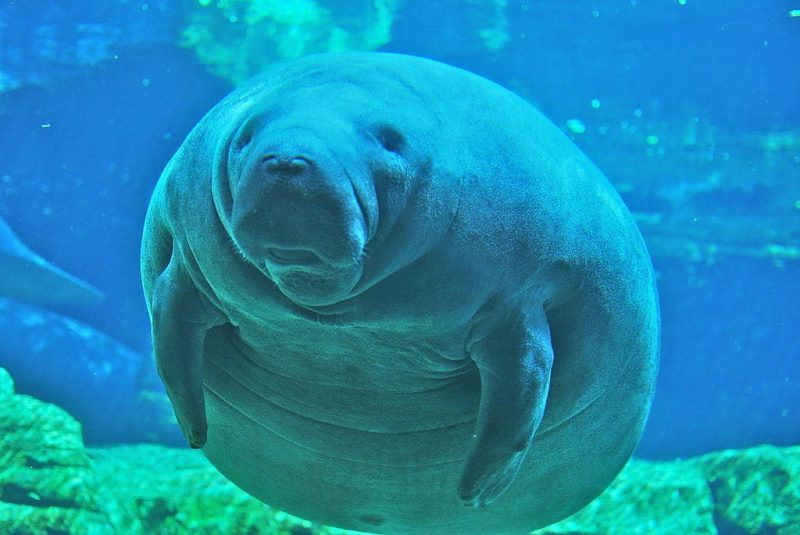
Continuing our wild Animal Spirits/Spirit Animals theme from last season!!..Headlining is the world premiere of local folk-naturalist Daniel Johnson‘s lushly illustrated lecture/video on the crisis facing manatees! He also unspools precious peeks of the UCB Campanile Falcon “soap opera”, as well as his ongoing Cali Condor in-person research. ALSO in the house is the apocalyptic plea of our enlightened East Bay cine-essayist Joshua Harper, with the global debut of and personal intro to his archive-rich WAR ON EARTH…
PLUS: Some time back, OC soul-sister Lynne Sachs teamed up with none Other than Chris Marker to finish their 20-min. Three Cheers for the Whale, and its delightful historical trace tonight rounds out our opening “Animal” hour. But our second half is all about humans, who inhabit animal skins, literally and figuratively, perhaps to better understand our commonalities. Andrew Shirley‘s 30-min. Wasted Land is a revelatory but under-seen work that follows 3 furies as they mark their dystopian territory via graffiti tags! Jim Trainor‘s Moschops is a faux-paleontology animation that endows invented creatures with emotional lives, and in Rainier Gels‘ Brementon Musicians, a 16mm cult clip from a children‘s matinee manages to deliver an uncannier fantasy than any mere cartoon.
AND a quarter-hour excerpt of David Attenborough beautiful Baobob eco-study, Disney‘s now infamous White Wilderness, and of course some Harryhausen beasties! Come in animal costume!!
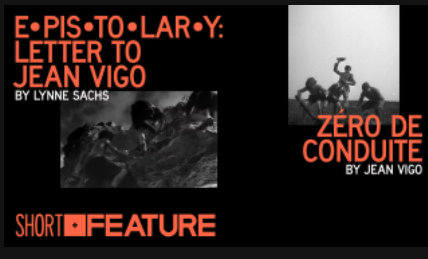
In a cinema letter to Jean Vigo, film essayist Lynne Sachs ponders the delicate resonances of the short-lived but mightily influential French director’s sublime, dynamically inventive 1933 classic ZÉRO DE CONDUITE, in which a group of schoolboys wage an anarchist rebellion against their authoritarian teachers. Thinking about the January 6 assault on the United States Capitol, Sachs contemplates how innocent play or calculated protest can turn so quickly into chaos and violence.
E•pis•to•lar•y: Letter to Jean Vigo Directed by Lynne Sachs • 2021 • United States, Spain In a cinema letter to French director Jean Vigo, filmmaker Lynne Sachs ponders the delicate resonances of his 1933 classic ZÉRO DE CONDUITE, in which a group of schoolboys wage an anarchist rebellion against their authoritarian teachers. Thinking about the assault on the United States Capitol of January 6, 2021, Sachs wonders how innocent play or calculated protest can turn so quickly into chaos and violence.
Zéro de conduite Directed by Jean Vigo • 1933 • France Starring Jean Dasté, Gérard de Bédarieux, Louis Lefebvre So effervescent and charming that one can easily forget its importance in film history, Jean Vigo’s enormously influential portrait of prankish boarding-school students is one of cinema’s great acts of rebellion. Based on the director’s own experiences as a youth, ZÉRO DE CONDUITE presents childhood as a time of unfettered imagination and brazen rule-flouting. It’s a sweet-natured vision of sabotage made vivid by dynamic visual experiments—including the famous, blissful slow-motion pillow fight.
The 2022 BAMcinemaFest has officially unveiled its lineup. IndieWire can exclusively announce that Sundance breakout documentary “Aftershock” will make its New York Premiere on the opening night of the festival, which kicks off June 23 and runs through June 30.
The fully in-person event will begin with Paula Eiselt and Tonya Lewis Lee’s critically acclaimed documentary. The film exposes the failures of the maternal healthcare system that have led to a disproportionate amount of Black women dying in childbirth. “Aftershock” won the U.S. Documentary Special Jury Award: Impact for Change at the 2022 Sundance Film Festival.
Fellow Sundance selection “2nd Chance” is set to make its New York Premiere, as well as breakthrough filmmaker Andrew Infante’s “Ferny and Luca,” a fresh take on the ebbs and flows of a young Brooklyn relationship.
BAMcinemaFest will also mark the world premiere of Amber Bemak’s performative documentary “100 Ways to Touch the Border,” which follows the 40-year career of radical Mexcian-Chicano artist Guillermo Gómez-Peña, who enacts his interventions by “queering the border,” claiming all borders as queer and liminal spaces.
The festival will take place fully in-person at BAM Rose Cinemas in Brooklyn and will feature a blend of premieres, new restorations, along with in-person filmmaker Q&As.
New restorations of Brooklyn filmmaker Ayoka Chenzira’s debut feature “Alma’s Rainbow” (1993) and short “Hair Piece: A Film for Nappyheaded People” (1984) are slated to make their respective premieres. Both films depict multilayered glimpses into the Black woman’s world, with examinations on beauty and the pressure to conform.
Launched in 2009 as a showcase for new independent films, the annual BAMcinemaFest is an extension of BAM’s year-round film program, collecting the most innovative new work from festivals in the U.S. and around the world and bringing them to New York City audiences.
See below for the full lineup. Descriptions courtesy of the festival. Ticketing info is here.
“2nd Chance” (2022) Dir. Ramin Bahrani This critically acclaimed first documentary from Ramin Bahrani follows the life and contradictions of the man that created, and self-tested, the bulletproof vest. 89min. New York Premiere. Documentary.
“100 Ways to Touch the Border” (2022) Dir. Amber Bemak A daring, self-reflexive documentary on the extraordinary Mexican/Chicano performance artist Guillermo Gómez-Peña’s 40-year career of radical artistic practice and work in “queering the border.” 84min. World Premiere. Documentary.
“Actual People” (2021) Dir. Kit Zauhar Desperate to control something, a college grad decides to win the affections of a boy from her hometown in Kit Zauhar’s exciting, honest film by and about a young woman of color. 84min. New York Premiere. Drama.
“Aftershock” (2022) Dirs. Paula Eiselt & Tonya Lewis Lee A powerful NY-filmed documentary that shines a light on the Black women, and bereaved partners, who are failed by the U.S. maternal health system. 86 min. New York Premiere, Opening Night Film. Documentary. From Onyx Collective and ABC News, the film will stream on Hulu domestically later this Summer.
Ayoka Chenzira Retrospective New restorations of African-American filmmaker Ayoka Chenzira’s visionary work center Black womanhood. 95min. New York Premieres.
“Alma’s Rainbow” (1993) Dir. Ayoka Chenzira
Known for her socially conscious films that challenge stereotypes about Black culture, Ayoka Chenzira’s first feature film is a coming-of-age dramedy that highlights a group of middle-class Black women living in Brooklyn. As Rainbow (Platt) enters womanhood and navigates her own experiences around beauty standards, self-image, and the rights of Black women over their own bodies, her pragmatic mother Alma Gold (Weston-Moran) and free-spirited aunt Ruby Gold (Kirby) disagree on the “proper” direction for Rainbow’s life. In this multi-layered Black woman’s world, Rainbow, Alma, and Ruby wrestle with love and what it means to exert and exercise their own agency. New restoration!
“Hair Piece: A Film for Nappyheaded People” (1984) Dir. Ayoka Chenzira In this satirical short, Chenzira utilizes mixed media and animation to unpack the stereotypes associated with Black hair while critiquing the limits of the European beauty standard. She draws attention to the physical pain Black women endure to straighten their hair, and the emotional pain that comes as a result of the pressure to conform. New restoration!
“Chee$e” (2022) Dir. Damian Marcano An award-winning breakout debut by up-and-coming director Damian Marcano about a young father’s eccentric scheme to sell weed. 105 min. New York Premiere. Comedy/Drama.
“Crows Are White” (2022) Dir. Ahsen Nadeem A filmmaker searches for answers in a strict Buddhist monastery and at the bottom of a sundae in this doc-existential comedy. 97min. New York Premiere. Documentary.
“Ferny & Luca” (2021) Dir. Andrew Infante An award-winning lo-fi rom-com, shot in Brooklyn, that follows the hot and cold relationship of a naive pretty boy and a rough and tumble disco queen. 70min. New York Premiere. Comedy/Drama.
“Free Chol Soo Lee” (2022) Dirs. Julie Ha & Eugene Yi This extraordinary portrait of community activism follows the wrongful conviction of Chol Soo Lee and the complex legacy—and human cost—of becoming the symbol of a movement. 83min. New York Premiere. Documentary.
“Happer’s Comet” (2022) Dir. Tyler Taormina Filmed on the weekends across four months during 2020, Tyler Taormina cast his own Long Island family and neighbors in the delicate cinematic meditation on late-night life, which premiered at the Berlin Film Festival. Taormina takes the audience through the nightly routines of suburban residents as they clean their offices, meet their lovers, apply make-up before going out, and rollerblade around town. Dreamlike, gentle, and strangely ominous, this sensory series of vignettes “is a hypnotic ode to the night owl” (The Film Stage). 62min. New York Premiere. Drama.
“The Last Days of August” (2022) Dir. Rodrigo Ojeda-Beck & Robert Machoian From prairie towns in Nebraska to the quiet nightlife of suburban Long Island, these visually stunning films capture the quiet essence of humanity. 13min. Screening with HAPPER’S COMET.
“Nothing Lasts Forever” (2022) Dir. Jason Kohn Jason Kohn pushes the documentary into thriller territory with this riveting investigation of the secretive diamond industry. 87min. New York Premiere. Documentary.
Shorts Program 1 “When There Was Water” (2022) Dir. Nicole Otero A lyrical exploration of family, loss, connection and nature. 15 min.
“The Feeling of Being Close to You” (2022) Dir. Ash Goh Hua This autobiographical film documents an attempt at healing the trauma of touch between mother and child, as the filmmaker and their mother talk openly for the first time about the intergenerational trauma and abuse within their lives. Present-day phone conversations are juxtaposed with archival VHS footage, creating a connection between the past and a re-write for the future. 12min.
“Portal” (2022) Dir. Rodney Evans During the pandemic, two queer BIPOC friends sustain each other through communication and connection in this short non-fiction film about the lack of touch for single people catalyzed by Covid-19. 12min
“When It’s Good, It’s Good” (2022) Dir. Alejandra Vasquez When she returns to rural West Texas to document the effects of the boom-and-bust nature of the oil industry on her hometown, the filmmaker unexpectedly captures the political transformation that takes place in her family over five years and two election cycles. 16 min.
“Winn” (2022) Dir. Joseph East & Erica Tanamachi From activists fighting for the rights of incarcerated pregnant people to singles searching for touch during the pandemic, these shorts focus on family, connection, and trauma. 17min.
Shorts Program 2
“Shut Up and Paint” (2022) Dir. Titus Kaphar & Alex Mallis Winner of the Best Short prize at the 2022 Big Sky Documentary Film Festiva, Shut Up and Paint follows the painter Titus Kaphas as he turns to film when the art world tries to silence his voice. 20min.
“The Body is a House of Familiar Rooms” (2022) Dir. Eloise Sherrid An experimental documentary collaboration between myself, Samuel Geiger, and Lauryn Welch. The film is a window into Sam’s experience living with Ehlers-Danlos Syndrome, a painful connective tissue disorder that limits his mobility and functionality. 10min.
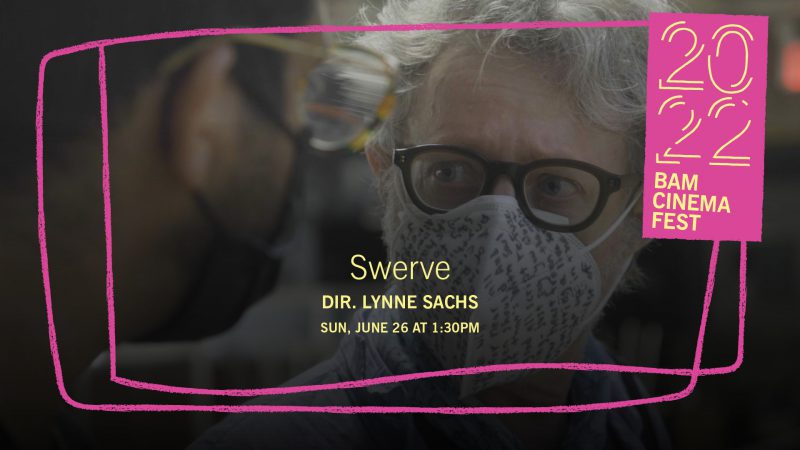
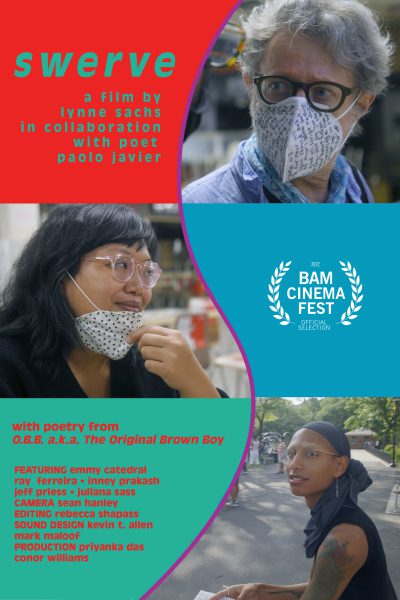
“Swerve” (2022) Dir. Lynne Sachs with Poetry by Paolo Javier A food market and playground in Queens, NY becomes the site for this film inspired by Paolo Javier’s Original Brown Boy poems. The film itself transforms into an ars poetica/cinematica—a meditation on writing and making images in the liminal space between a global pandemic and what might come next—as five New York City performers speak in verse while wandering through food stalls in search of a new sensation. 8min. World Premiere.
“Udeyonv (What They’ve Been Taught)” (2022) Dir. Brit Hensel Filmed on the Qualla Boundary and Cherokee Nation, ᎤᏕᏲᏅ (Udeyonv) (What They’ve Been Taught) explores expressions of reciprocity in the Cherokee world, brought to life by an elder and a first language speaker. Premiering at Sundance, the documentary circles the intersection of tradition, language, land, and a commitment to maintaining balance. 9 min.
“The Fire This Time” (2022) Dir. Mariam Ghani A selection of formally inventive short films ask questions about art and history. 26min.
“Sirens” (2022) Dir. Rita Baghdadi Moroccan-American filmmaker Rita Baghadi captures the unexpected, uplifting behind-the-scenes story of the Middle East’s first all-female thrash metal band. 78 min. New York Premiere. Documentary.
“The Unknown Country” (2022) Dir. Morrisa Maltz| In this narrative/documentary hybrid, Lily Gladstone stars as a grieving woman traveling to the Texas-Mexico border to reunite with her Oglala Lakota family. 85min. New York Premiere. Drama.
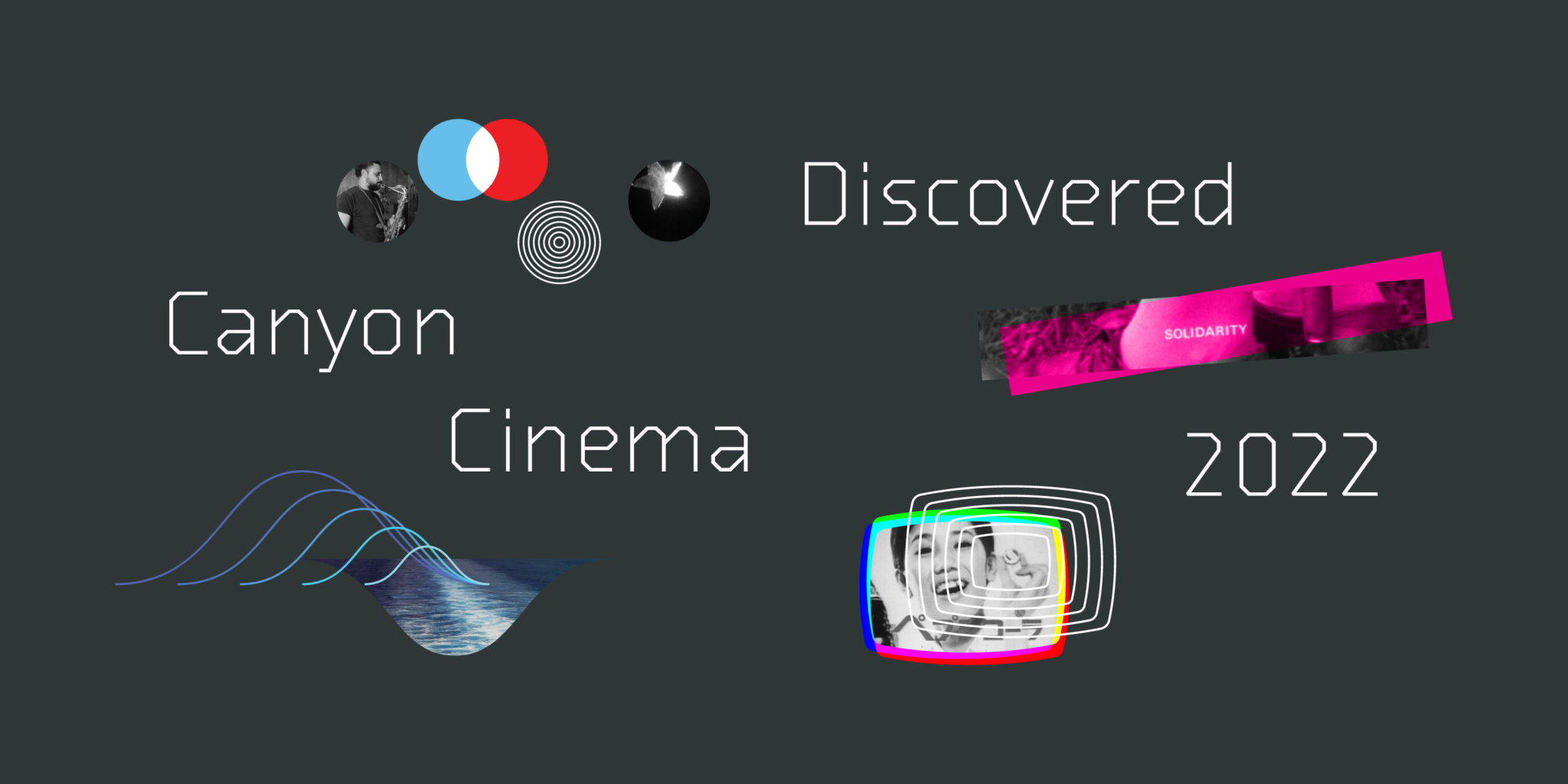
We’re thrilled to finally announce the screening line-ups for our inaugural Canyon Cinema Discovered programs, which will debut this fall in San Francisco and online. Stay tuned for details!
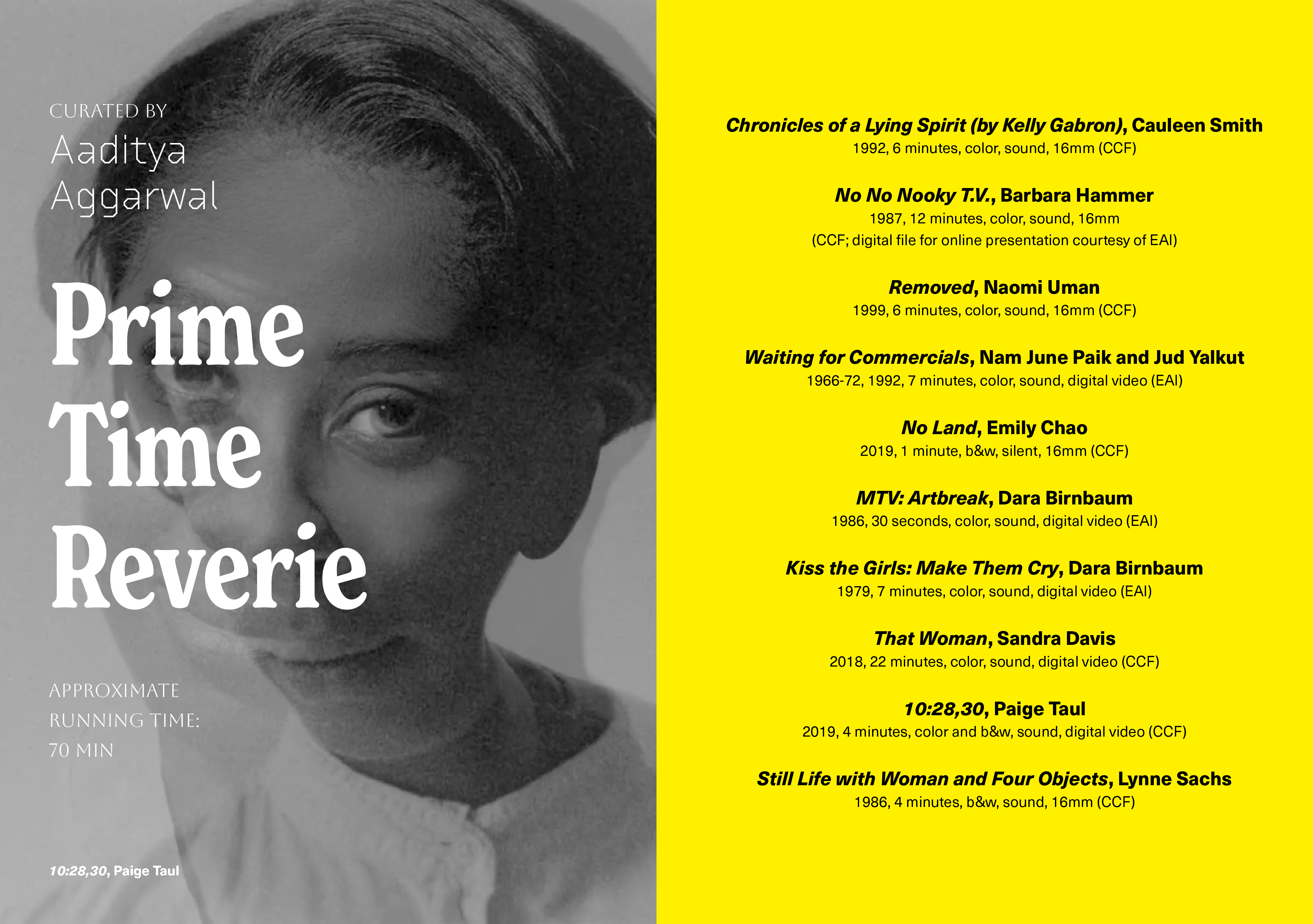
Prime Time Reverie Curated by Aaditya Aggarwal
From cosmetic commercials to women-led talk shows to narrative melodrama, television catered to feminized viewers is a formally diverse genre, nudging, socializing, and mirroring its spectators in intimate and discerning ways. Capturing the urgent, anchoring spirit of prime time telecasts, Prime Time Reverie stages a fragmented history of television as a women’s medium. The works in this program engage multiple tides of broadcasting, from soapy to confessional, from sensationalist to documentarian. Weaving an absent or corporeal presence through each work, televised portrayals of womanhood—hermetic, large, versatile—incite daydreams among a mass populace, flirting with histories of technology, desire, and visuality.
Chronicles of a Lying Spirit (by Kelly Gabron) (Cauleen Smith, 1992)
No No Nooky TV (Barbara Hammer, 1987)
Removed (Naomi Uman, 1999)
Waiting for Commercials (Nam June Paik and Jud Yalkut, 1966-72, 1992)
No Land (Emily Chao, 2019)
MTV Artbreak (Dara Birnbaum, 1986)
Kiss the Girls: Make Them Cry (Dara Birnbaum, 1979)
That Woman (Sandra Davis, 2018)
10:28,30 (Paige Taul, 2019)
Still Life with a Woman and Four Objects (Lynne Sachs, 1986)
Playing in the Dark: Watery Experiments
Curated by Chrystel Oloukoï Playing in the Dark engages the various ways in which blackness haunts the sea and is haunted by the sea. Borrowing from Toni Morrison, “playing in the dark” references the subdued Africanist presence which mediates imaginations of water in the wake of variegated yet entangled transoceanic slave trades but also takes seriously darkness as a subversive ecological milieu, against lures of transparency. In the works gathered here, nothing is left untouched by the confounding qualities of water and its corrosive opacities, from bodies to the environment, to the materiality of film itself. As such, “playing in the dark” also references attempts in Black experimental filmmaking to chart paths in which cameras do not write with light but probe shadows in search of “an aesthetics of turbulence whose corresponding ethics is not provided in advance” (Glissant, Poetics of Relation).
By the Sea (Toney W. Merritt, 1982)
What the Water Said Nos. 1-3 (David Gatten, 1998)
Aqua (Samba Félix N’diaye, 1989)
The Dislocation of Amber (Hussein Shariffe, 1975)
Giverny I (Négresse Impériale) (Ja’Tovia Gary, 2017)
Pattaki (Everlane Moraes, 2019)
What the Water Said Nos. 4-6 (David Gatten, 2006-07)
Towards the Colonies (Miryam Charles, 2016)
Song for the New World (Miryam Charles, 2021)
Trajectories of Self-Determination: Experimental Cinema’s Embrace of Jazz
Curated by Juan Carlos Kase
Experimental cinema has long embraced American vernacular music as a generative model, whether it supplied a formal template, an affective inspiration, or a point of cultural reference. From the collective polyphony of Charles Mingus’ kinetic ensembles to the gale and squall of Joe McPhee’s storming cornet, the improvisational energies of jazz – as well as blues and other popular-modernist musics – have continued to inspire American avant-garde filmmakers. Collectively, the films in this program explore the myriad ways in which experimental cinema has drawn from African-American improvised music and embraced its spontaneous, collaborative, polyrhythmic, and lyrical energies.
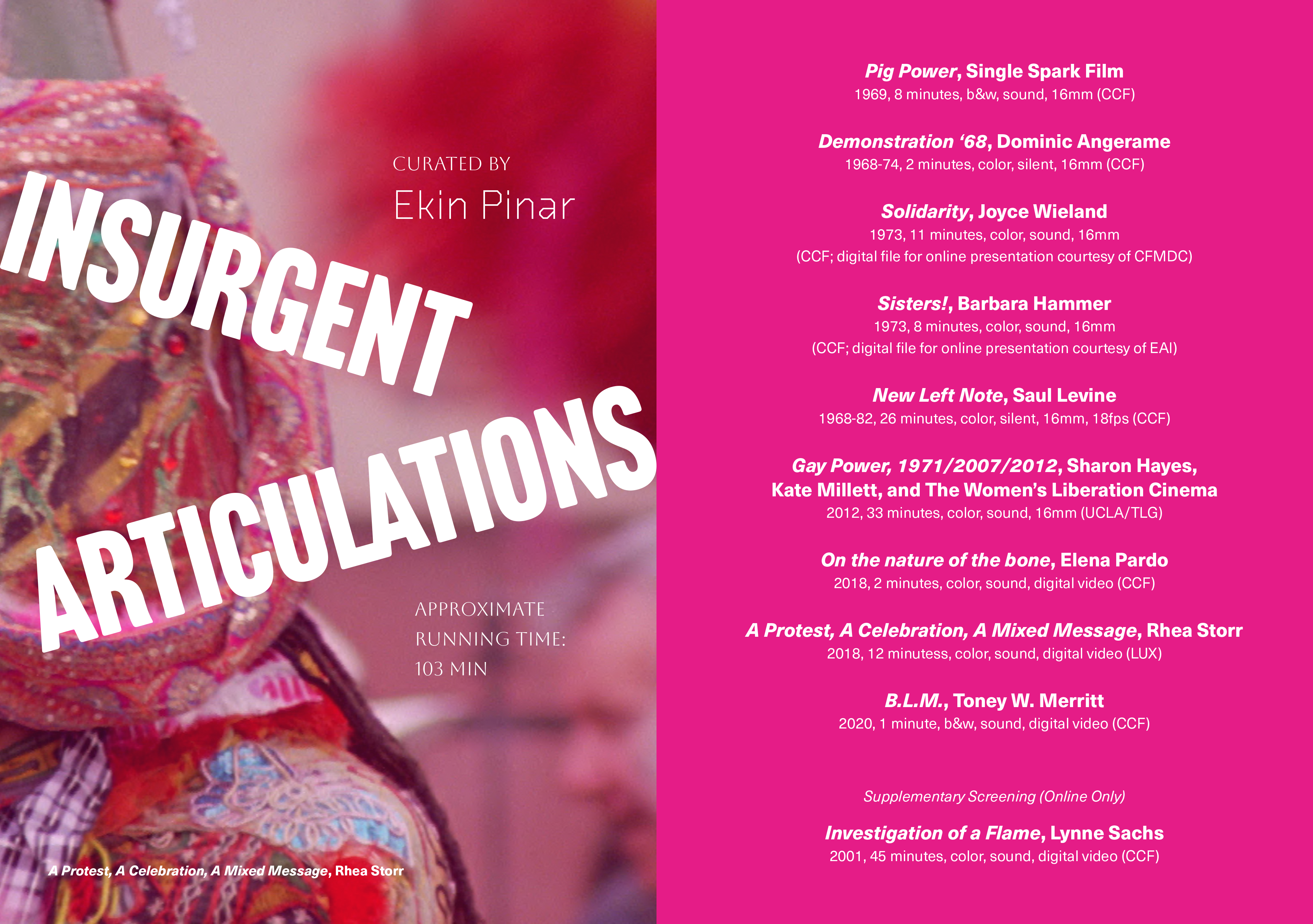
Insurgent Articulations
Curated by Ekin Pinar
A strong interest in the social, political, and cultural contexts has always been part and parcel of a good variety of experimental filmmaking practices, even though canonical works on experimental cinema tend to focus solely on the formal explorations that supposedly reflect the filmmaker’s own (hermetic) subjectivity. Because of this exclusive focus on formal experimentation, the socio-historical, cultural, and representational politics, ethics, and concerns of much experimental work remained unnoticed until recently. Focusing on the theme of the aesthetics of socio-political unrest and protest, this program showcases examples of experimental filmmaking that fictionally constructed or experimentally reconstructed in formally explorative and reflexive ways demonstrations, rallies, marches, and sit-ins.
Pig Power (Single Spark Films, 1969)
Demonstration ’68 (Dominic Angerame, 1968-74)
Solidarity (Joyce Wieland, 1973)
Sisters! (Barbara Hammer, 1973)
New Left Note (Saul Levine, 1968-82)
Gay Power, 1971/2007/2012 (Sharon Hayes, Kate Millett, and The Women’s Liberation Cinema, 2012)
On the nature of the bone (Elena Pardo, 2018)
A Protest, A Celebration, A Mixed Message (Rhea Storr, 2018)
Opening reception: Friday, May 27, 6-9 PM | Barbara Hammer, Brydie O’Connor and Lynne Sach’s film schedule will be posted during the exhibition in “Happenings”. Art Market Provincetown http://www.artmarketprovincetown.com/art/20220527/
Barbara Hammer | Selected Films, Photographs, Drawings & Collages, along with Films by Brydie O’ Connor & Lynne Sachs
Many thanks to Florrie Burke and Louky Keijsers Koning for their support and collaboration on this exhibtion of Barbara Hammer’s works.
All works are Courtesy of the Estate of Barbara Hammer and Company gallery, New York.
Barbara Hammer often said that she had three great loves- art, nature and me. Her time in the dune shack was thrilling for her and she would be gratified that her work has come full circle to land here at AMP in Provincetown. The natural beauty of the Cape has inspired so many-Hammer among them. She loved its’ winds, sand and waves. It is fitting that the waters off Provincetown are her final resting place as she swims with the whales. — Florrie Burke
Barbara Hammer (1939-2019), known for her groundbreaking films that celebrated female sexuality began filming in the 1970s, the decade she called “that glorious time of feminist ideals and lesbian bed-hopping.” It was also the time, after a yearlong trip around the world on a motor scooter, that she decided to be an artist. She enrolled in a painting course taught by abstract expressionist William Morehouse, who saw such movement in Hammer’s paintings that he encouraged her to experiment with film. It was the start of her new life: as filmmaker, single woman, and lesbian—a word she’d never heard until the age of 30.
“When I made love with a woman for the first time my entire worldview shifted,” Hammer said. “In addition to the sensual pleasures, my social network completely changed; I was swept up with the energies and dreams of a feminist revolution.” Hammer made 29 films in the 1970s, many of which reflected her exploration of sex and identity, like Multiple Orgasm, 1976 and Dream Age from 1979.
Hammer’s artistic output wasn’t limited to film only, she took her sketchbooks and photo camera everywhere she went, which resulted in intimate drawing as well as playful and performative photographs, like the BH Gestallt series, which will be on view among a selection of drawings.
Throughout the 1980s and 1990s, the time of Reagan, AIDS, and heightened LGBT activism, Hammer’s films blended feminist politics, lesbian erotica, and social comment. No No Nooky TV (1987), one of the films on display confronts the feminist controversy around sexuality with electronic language, pixels and interface.
In the 2000s Barbara Hammer’s output slowed down, as she focused on feature films. However, in the last 13 years of her life she published an autobiography, Hammer! Making Movies Out of Sex and Life and created 7 new films as well as a digital rendering of a selection of her sketchbook drawings, titled Lesbian Whale (2015).
Hammer’s work is held in several permanent collections, including the Museum of Modern Art in New York, the Centre Pompidou in Paris, the Whitney Museum of American Art, and the Australian Center for the Moving Image in Melbourne. Her complete catalogue of 16 and 8mm film, as well as Super 8, is in the collection of the Academy of Motion Picture Arts and Sciences Film Archive in Los Angeles, and her papers are available for review at Yale University’s Beinecke Rare Book and Manuscript Library in New Haven.
During her lifetime she created two awards for lesbian and queer filmmakers, and had retrospectives at the Museum of Modern Art, the Tate Modern, the Jeu de Paume in Paris, and the Hammer Museum in Los Angeles. The Leslie-Lohman Museum of Gay and Lesbian Art in New York mounted a retrospective of her film, photography, drawings, and sculpture, which New York Times art critic Holland Cotter named one of the best exhibitions of that year.
(The above text is based on a text written by Andrew Durbin and Susan Champlin)
______
Brydie O’ Connor | Documentary film: Love, Barbara
Love, Barbara is short (15 min.) documentary about the iconic legacy of pioneering lesbian experimental filmmaker, Barbara Hammer, through the lens and love of her partner of over 30 years, Florrie Burke.
Brydie O’Conner is a Kansas-bred, New York based filmmaker.
Her award-winning work spans the documentary and narrative fields with a focus on women-driven and queer stories. Brydie has directed short documentaries LOVE, BARBARA (2021) which premiered at Academy Award-qualifying Santa Barbara International Film Festival and FRIENDS OF DOROTHY (2020), which premiered in New York at DOC NYC. In 2021, Brydie was selected for The Future of Film is Female Award, and she received a NYSCA grant sponsored by Women Make Movies in addition to a Brooklyn Arts Council grant. In 2019-2020, she workshopped her forthcoming film in the Female Filmmakers Berlin Directing Lab. Much of her work is inspired by archival histories.
Brydie’s producing credits include THE LESBIAN BAR PROJECT with Executive Producer Lea DeLaria, WOMONTOWN for PBS Kansas City, and she has archival produced Season 7 of THE CIRCUS on Showtime in addition to various projects on Left/Right TV’s roster. She is a graduate of The George Washington University.
______
Lynne Sachs | Films: A Month of Single Frames & Carolee, Barbara & Gunvor
A Month of Single Frames (Made with and for Barbara Hammer; 14 min. color sound 2019): “In the last few months of filmmaker Barbara Hammer’s life, she asked me to come to her home to discuss something she needed to say in person. I immediately faced a complicated set of emotions. I knew that this tête-à-tête would involve some kind of good-bye, but I had no idea that she had decided to share a part of her personal archive, and thus a part of her being on this earth, with me. As I sat at her side, Barbara vividly described to me her 1998 artist residency in Provincetown, Cape Cod, Massachusetts. For one month, she lived and made her art in a shack without running water or electricity. While there, she shot 16mm film with her Beaulieu camera, made field recordings, and kept a journal. Barbara’s only instructions to me were very simple: “Do absolutely whatever you want with this material.” While writing the text for my own film, the words I placed on the screen came to me in a dream. I quickly realized that this kind of oneiric encounter could become a posthumous continuation of the dialogue I had started with Barbara. Since I would never again be able to speak to her about her life or the ontological nature of cinema or the textures of a sand dune, I would converse with her through A Month of Single Frames. Through my writing, I tried to address Barbara’s celebration of solitude and cinematic embodiment. Ultimately, my text on the screen over Barbara’s images functions as a search for a cinematic experience that brings us all together in multiple spaces at once. It is also an embrace of an ambiguous second person you who might be Barbara herself or might be anyone watching the film.”
Carolee, Barbara & Gunvor (Super 8mm and 16mm film transferred to digital, 9 minutes, 2018): From 2015 to 2017, Lynne Sachs visited with Carolee Schneemann, Barbara Hammer and Gunvor Nelson, three multi-faceted artists who have embraced the moving image throughout their lives. From Carolee’s 18th Century house in the woods of Upstate New York to Barbara’s West Village studio to Gunvor’s childhood village in Sweden, Lynne shoots film with each woman in the place where she finds grounding and spark.
Lynne Sachs is an experimental filmmaker and poet living in Brooklyn. She has produced over 40 films as well as numerous live performances, installations and web projects. In 2019, Tender Buttons Press published Lynne’s first book Year by Year Poems. Working from a feminist perspective, she investigates connections between the body, the camera, and the materiality of film itself. She uses letters, archives, diaries, poetry and music, to take us on a critical journey through reality and memory. Over the years, Lynne has worked closely with fellow filmmakers Craig Baldwin, Bruce Conner, Barbara Hammer, Chris Marker, Carolee Schneemann, and Trinh T. Min-ha. Between 1994 and 2006, she produced five essay films that took her to Vietnam, Bosnia, Israel/ Palestine, Italy and Germany — sites affected by international war — where she looked at the space between a community’s collective memory and her own subjective perceptions. Lynne’s films have screened at MoMA, Tate Modern, Image Forum Tokyo, Wexner Center for the Arts, and festivals such as New York Film Festival, Oberhausen Int’l Short FF, Punto de Vista, Sundance, Vancouver IFF, Viennale and Doclisboa. Retrospectives of her work have been presented at the Museum of Moving Image, Sheffield Doc/Fest, BAFICI, Cork Film Festival, Havana Film Festival.
AMP is a live contemporary gallery space dedicated to exhibiting multi-disciplined work by visual, conceptual, performance artists, filmmakers and writers. Exhibitions & Happenings are primarily cutting-edge, and often process-based.
2022 features Martin R. Anderson, Shez Arvedon, Midge Battelle, Susan Bernstein, Mx Justin Vivian Bond, Terry Boutelle, Linda Leslie Brown, Bobby Busnach, Karen Cappotto, Jamie Casertano, Barbara E. Cohen, Liz Collins, Anne Corrsin, Jeanne-Marie Crede, Jay Critchley, Katrina del Mar, Phyllis Ewen, Lola Flash, Kathi Robinson Frank, Barbara Hadden, Barbara Hammer, Michelle Handelman, Heather Kapplow, Jackie Lipton, Shari Kadison, Zehra Khan, David Macke, Jade McGleughlin, Zammy Migdal, Bobby Miller, Pasquale Natale, Alice O’Malley, Pat Place, Mark Rosenthal, Marian Roth, Nancy Rubens, Jicky Schnee, Lori Swartz, Christopher Tanner, Gail Thacker, Judith Trepp, Suara Welitoff, Forrest Williams, Rick Wrigley & others.
JP Art Market, AMP’s independent sister gallery created by artist Patti Hudson has long been an integral contributor to the Boston arts community showing work by emerging and established, local and international artists such as Kristen Dodge, Leslie Hall, Lisa King, Roger Miller, and Patti Smith.
AMP Gallery, 432 Commercial Street, Provincetown MA 02657 | Mail: PO Box 807
This year marks the second installment of Prismatic Ground (May 4 – May 8), a new festival focusing on experimental documentary and avant-garde film and video. Last year’s inaugural edition was a completely virtual affair, but this year the festival returns in a hybrid version with in-person screenings and online viewing available for most of the films in its impressive 14 programs. Co-presented by the Maysles Documentary Center and Screen Slate, Prismatic Ground brings festival-goers a wide range of politically engaged, formally challenging new work by up-and-coming artists alongside established ones like Bill Morrison, Jodie Mack, and this year’s Ground Glass Award recipient, Christopher Harris. In the world of experimental film where visibility and opportunities to premiere new work can be hard to come by, the festival is poised to make a significant splash.
Founded by Inney Prakash in 2021, last year’s edition consisted of four programs of films, as well as a program devoted to its first Ground Glass Award recipient, the avant-garde filmmaker and experimental documentarist Lynne Sachs. The festival honored Sachs, whose career has spanned some three decades, for her sustained contribution to experimental film. In her recent breakthrough film, Film About A Father Who, Sachs collaged decades worth of home movies and new interviews to craft a film about her father, his secret life, and its impact on the people surrounding him (namely Sachs and her siblings). Work like this—intimate, engaged, and formally daring with a documentary slant—similarly characterizes Prismatic Ground’s continued curatorial mission.
“What an honor it was for me to be given the first annual Ground Glass award.” Sachs wrote via email. Sachs was quick to mention the excitement she felt surrounding the new festival’s place in the landscape of experimental film, writing, “Something altogether surprising happened when Prismatic Ground opened its virtual curtains to the world in 2021. People from all over the globe were watching and writing about experimental, underground, international, radical, poetic, and personal cinema in numbers none of us could ever have imagined. Film festivals across the globe have always been nourished by the elite aura of inaccessibility. With Prismatic Ground, those days are over.”
This year’s Ground Glass award recipient is Christopher Harris, graduated from School of the Art Institute of Chicago in 2000, and has spent years as an educator (this writer counts himself as one of his proud former students) and continues to make challenging and meticulous films, like his most well known work, 2004’s haunting and powerful Reckless Eyeballing (its title taken from a Jim Crow-era prohibition on Black men looking at white women), which uses reappropriated footage from D.W. Griffith’s racist epic Birth of a Nation as well as from Foxy Brown to explore the gaze and Black identity in a cinematic context. The filmmaker, who is now the head of film and video production at the University of Iowa, says recognition of his work is welcome. “It’s been a slow build, kind of a slow burn situation,” Harris said. “now it’s even sweeter to have the recognition after just grinding away on my work overtime.” But Harris is quick to add: “I’m more eager and energized to make work now than ever before. So the timing is really great because it just helps to re-energize the passion that’s already there.”
Dreams Under Confinement, Harris’ contribution to this year’s Prismatic Ground, showcases his resolve. The short video, made using Google Earth images, street view, and audio from a police band radio, is the filmmaker’s first all digital work. “This is the first thing I’ve ever made that does not have any analog materials involved,” Harris said. “I’ve never worked this way. But for this work, it was right. For me, whatever materials are used, there has to be an internal logical justification for those materials. I’m not going to use them as if it’s a neutral format and it’s just a content-delivery medium. I don’t treat materials that way.“
The artist’s latest work finds the horror and beauty in the panopticon; surveillance materials create a fugitive, exhilarating race through digital images of Chicago, as the voices of police officers pursuing a suspect frantically blast through static on the soundtrack. Eventually the video’s frenzied journey stops short at the impenetrable walls of Chicago’s Cook County Detention Center. The viewer sees the clouds above as the audio shifts from shrill shouting to peaceful ambience. In a frenetic work about the police, violence, and the racist carceral state, it’s a poignant moment of profound transcendence and tragic wonder. Harris’ approach, with its daring ambition and inherent artistic riskiness, seems to reflect the adventurous spirit found in the best of the festival’s programming.
Referred to as “waves,” Prismatic Ground’s programs are organized on a loose thematic basis rather than by running time or region of origin. Program titles, like “memory of a memory,” “to report an incident,” “touch me don’t touch me,” and “love as cry of anguish,” are often, if not always, taken from one of the program’s films. The monikers are both specific and flexible enough to create a poetically evocative space for a variety of aesthetics, subjects, and approaches.
Wave 1, titled “look at that round ass shit,” takes its name from Sim Hahahah’s Memory Playthrough in which rapid, fragmented narration and early PC game-like graphics work together to create a sarcastic video poem. The video, which clocks in under two minutes, is a splash of brief but biting reflection on personal stories, the reality of the perceived world, and the medium itself. It’s a playful but incisive opening salvo for the program.
In G. Anthony Svatek’s Global Fruit, 16mm photography gives the short a timeless feel. The images of globally sourced fruit covered with the frost of a New York city blizzard create a clear and dynamic visual metaphor. With both Svatek and Hahahah’s films, the image of the globe (both figuratively and literally) emerges, and the program’s thematic concept begins to take shape.
Also in the program, Experimental filmmaker and animator Jodie Mack’s Wasteland No. 3: Moons, Sons is filled with grotesque images of biomatter undergoing a timelapse transformation. The subjects are organic but the rhythm of the piece is smooth and deliberate. There is something funerary about the flowers and plants we see, and their possible thaw or submersion has visceral impact, evoking cellular happenings on a larger scale. The (possible) thawing we witness rhymes nicely with the frosted fruit of Global Fruit and continues wave 1’s theme in an albeit more (welcomely) obtuse way.
Wave 2, titled “wings,” focuses on identity. Paige Taul’s Goat is a sweet ode to a pair of Air Jordan’s and the woman who wears them. Black and white photography shows detailed images of a basketball net, a woman’s hair, and her sunglasses, as a voice unhurriedly narrates a description of her shoes and her feelings about them. Yashaddai Owens’ D’Homme A Homme is a fun 8mm exploration of proud Blackness and masculinity set to hip hop. Filled with exuberant and memorable images, it has a decidedly vintage feel with a modern sonic twist.
Iván Reina Ortiz’s autoethnography, a filmic meditation on sexual orientation, gender, art, and personal history, continues wave 6’s theme in both a reflective and reflexive way. The artist mixes potent poetic imagery with, somewhat less effective, home video footage. Ortiz’s self-interviewing leads to the film’s most powerful moment. We see an image of the filmmaker’s bare chest with the shadow of a hand moving across it, attempting to grasp it in some way, the film’s earlier questioning about the place of the body on screen materializing into visual substance.
While Prismatic Ground does boast a feature length centerpiece, the excellent and unsettling essay film Nuclear Family, the waves seem to uniquely represent the festival’s novel, surprise- filled approach. Wave 4 features Razah AlSalah’s gloriously transcendent Canada Park, a playfully ethereal exploration of both the flatness and three dimensionality of street view imagery from off the beaten path. The narration seems to be from the perspective of the all-seeing digital camera and its (seemingly) unlimited purview. But quickly the cheap, halting imagery of the park becomes pure form and color melting before the viewer’s eyes. The representational digital images reveal themselves for what they really are—the malleable data behind their mundane facades. It’s an elegant variation on glitch set to a swelling synth that lifts the imagery from the practical to the profound as we “see” as the machine “sees.” When representational images of trees and fields return, the viewer seems to soar over them in golden light through space and possibility, seeing beyond mere landscape. But all the while the piece pushes up against the limits of digital imagery, sometimes zooming into its furthest reaches and encountering flatness. The film seems to joyfully revel in its idiosyncratic oscillations and the viewer can’t help but be swept away by it.
Other festival highlights include Gloria Chung’s True Places from wave 5, in which hazy, impressionistic landscapes seen from an airplane window are slowed and abstracted as a calm voice narrates. The words come from a New Yorker article about the changing landscape of Indigenous arctic hunters and the cumulative feeling is mournful but curious. Wave 6 includes cherry brice jr.’s This Is A Pornographic Film–or,goodbyetoArt, a sparse and delicately photographed film in which men masturbate. The images we see are a collection of details: mouths, chests, arms, and close-ups of the surrounding room. There are some candid conversations as well as a more pointed one about high art that serves as, perhaps, a counterpoint to some of the more mundane and graphic images we see. It’s a small, intimate work of the everyday with dual dimensions of irony and candor.
Wave 6, “touch me don’t touch me,” takes its name from Rhea Storr’s Madness Remixed. The film is a well-composed combination of what appears to be single frame abstraction, glitches, and photographs. A few key moments of spoken audio connect what we are seeing, including the film’s images of Josephine Baker, to the issue of cultural appropriation and exploitation of Black bodies in labor and images. The message echoes a slogan seen on signs in various forms during the George Floyd uprising: you love Black culture but not Black people. It’s an impressive mix of formalism and explicit political meaning.
In Edgar Jorge Baralt’s A Thousand Years Ago, from wave 10, images have double lives. We see the world as it is, but the film’s conceit posits what we are seeing as the world that was, the narration reflecting back on what we see from a possible future. Poetic images take on a double meaning as well. An image of the sun reflecting on water evokes the sepia tones of a sonogram. The narration muses on the origins of life long, long ago, as we watch the shape of light on the water resembling the grainy image of a fetus.
Baralt, whose previous film, the gentle Ventana, screened in the Berlin International Film Festival’s Berlinale Shorts in 2021, said in a conversation of his most recent film, “I felt the impulse to make this film after reading Mario Benedetti’s semi-autobiographical novel, Andamios. I didn’t set out to adapt this novel at all, but it helped me arrive at this framework by which to look at the present and all of its spiraling contingencies.” About the film’s use of everyday images for expansive fictive purposes, he explained, “I’ve always admired filmmakers whose raw material is ‘the everyday.’ I think it gets to an essential aspect of my fascination with cinema both as filmmaker and audience: the questioning of what reality is. What we take for granted, what we choose to look at, and what we choose to believe about it all.”
As far as being included in Prismatic Ground’s 2022 edition, Baralt is thrilled, saying, “Aside from the programs being filled with filmmakers whose work I love, I sense an enthusiasm from the programming team for reimagining what a festival is and how it’s experienced.” What Prismatic Ground is adding to the world of experimental cinema is essential and exciting, and in Baralt’s words, “It means everything. Whenever you read about the state of cinema these days, it is all doom and gloom stories of an industry in decay. So it is in these alternative outlets that you see resilience and passion. It’s always inspiring to see work bursting with possibilities, attempting to redefine what cinema can be for the years to come.” To quote the filmmaker’s new work, Prismatic Ground is a spark “illuminating the emptiness.”
Prismatic Ground runs May 4 – 8, 2022 online and in various locations around New York.
We’re thrilled to finally announce the screening line-ups for our inaugural Canyon Cinema Discovered programs, which will debut this fall in San Francisco and online. Stay tuned for details!
Prime Time Reverie Curated by Aaditya Aggarwal From cosmetic commercials to women-led talk shows to narrative melodrama, television catered to feminized viewers is a formally diverse genre, nudging, socializing, and mirroring its spectators in intimate and discerning ways. Capturing the urgent, anchoring spirit of prime time telecasts, Prime Time Reverie stages a fragmented history of television as a women’s medium. The works in this program engage multiple tides of broadcasting, from soapy to confessional, from sensationalist to documentarian. Weaving an absent or corporeal presence through each work, televised portrayals of womanhood—hermetic, large, versatile—incite daydreams among a mass populace, flirting with histories of technology, desire, and visuality.
Chronicles of a Lying Spirit (by Kelly Gabron) (Cauleen Smith, 1992)
No No Nooky TV (Barbara Hammer, 1987)
Removed (Naomi Uman, 1999)
Waiting for Commercials (Nam June Paik and Jud Yalkut, 1966-72, 1992)
No Land (Emily Chao, 2019)
MTV Artbreak (Dara Birnbaum, 1986)
Kiss the Girls: Make Them Cry (Dara Birnbaum, 1979)
That Woman (Sandra Davis, 2018)
10:28,30 (Paige Taul, 2019)
Still Life with a Woman and Four Objects (Lynne Sachs, 1986)
Playing in the Dark: Watery Experiments Curated by Chrystel Oloukoï Playing in the Dark engages the various ways in which blackness haunts the sea and is haunted by the sea. Borrowing from Toni Morrison, “playing in the dark” references the subdued Africanist presence which mediates imaginations of water in the wake of variegated yet entangled transoceanic slave trades but also takes seriously darkness as a subversive ecological milieu, against lures of transparency. In the works gathered here, nothing is left untouched by the confounding qualities of water and its corrosive opacities, from bodies to the environment, to the materiality of film itself. As such, “playing in the dark” also references attempts in Black experimental filmmaking to chart paths in which cameras do not write with light but probe shadows in search of “an aesthetics of turbulence whose corresponding ethics is not provided in advance” (Glissant, Poetics of Relation).
By the Sea (Toney W. Merritt, 1982)
What the Water Said Nos. 1-3 (David Gatten, 1998)
Aqua (Samba Félix N’diaye, 1989)
The Dislocation of Amber (Hussein Shariffe, 1975)
Giverny I (Négresse Impériale) (Ja’Tovia Gary, 2017)
Pattaki (Everlane Moraes, 2019)
What the Water Said Nos. 4-6 (David Gatten, 2006-07)
Towards the Colonies (Miryam Charles, 2016)
Song for the New World (Miryam Charles, 2021)
Trajectories of Self-Determination: Experimental
Cinema’s Embrace of Jazz
Curated by Juan Carlos Kase
Experimental cinema has long embraced American vernacular music as a generative
model, whether it supplied a formal template, an affective inspiration, or a
point of cultural reference. From the collective polyphony of Charles Mingus’
kinetic ensembles to the gale and squall of Joe McPhee’s storming cornet, the
improvisational energies of jazz – as well as blues and other popular-modernist
musics – have continued to inspire American avant-garde filmmakers.
Collectively, the films in this program explore the myriad ways in which
experimental cinema has drawn from African-American improvised music and
embraced its spontaneous, collaborative, polyrhythmic, and lyrical energies.
Insurgent Articulations
Curated by Ekin Pinar
A strong interest in the social, political, and cultural contexts has always
been part and parcel of a good variety of experimental filmmaking practices,
even though canonical works on experimental cinema tend to focus solely on the
formal explorations that supposedly reflect the filmmaker’s own (hermetic)
subjectivity. Because of this exclusive focus on formal experimentation, the
socio-historical, cultural, and representational politics, ethics, and concerns
of much experimental work remained unnoticed until recently. Focusing on the
theme of the aesthetics of socio-political unrest and protest, this program
showcases examples of experimental filmmaking that fictionally constructed or
experimentally reconstructed in formally explorative and reflexive ways demonstrations,
rallies, marches, and sit-ins.
Pig Power (Single Spark Films, 1969)
Demonstration ’68 (Dominic Angerame, 1968-74)
Solidarity (Joyce Wieland, 1973)
Sisters! (Barbara Hammer, 1973)
New Left Note (Saul Levine, 1968-82)
Gay Power, 1971/2007/2012 (Sharon Hayes, Kate Millett, and The Women’s Liberation Cinema, 2012)
On the nature of the bone (Elena Pardo, 2018)
A Protest, A Celebration, A Mixed Message (Rhea Storr, 2018)
San Francisco, CA—Canyon Cinema (est. 1961 in the Bay Area), one of the world’s foremost advocates for and distributors of independent moving-image art, announces the full line-up and screening schedule for its inaugural curatorial fellowship, Canyon Cinema Discovered, taking place throughout the month of October 2022. Four newly-curated programs will premiere at San Francisco’s Roxie Theater across two Sundays: October 2nd and 16th. In addition, each program will be available to view online for a week, free and worldwide, on Canyon’s new online screening and publishing platform, Connects.
Launched in 2021, Canyon Cinema Discovered is a multifaceted fellowship program that aims to engender fresh perspectives on experimental cinema. For its first iteration, four curatorial fellows were invited to assemble programs from Canyon’s unique collection of artist-made films, as well as works from outside the collection, for in-person screening and online streaming; with the goal of instigating critical engagement with experimental cinema’s evolving legacy.
From a pool of nearly 200 international applicants, curatorial fellows Aaditya Aggarwal (Toronto and New Delhi), Juan Carlos Kase (Wilmington, NC), Chrystel Oloukoï (Lagos and Richmond, VA), and Ekin Pinar (Ankara) were selected on the basis of their ability to provide original insights on avant-garde and artists’ cinema and media; to illuminate unheralded or forgotten film and videomakers; to organize programs that speak to contemporary social, political, and artistic concerns; and to forge strong intergenerational connections between legacy films in Canyon’s catalog and contemporary work by today’s moving-image artists.
In continuation with Canyon Cinema’s commitment to providing access to rare artworks in their original medium, fellows had the opportunity to catalyze the creation of new exhibition prints and digitizations of works from the collection. The newly struck 16mm prints made for Discovered will ensure that audiences can continue to experience these works in the best possible light. Meanwhile, the creation of new digital copies of additional films from Canyon’s catalog will help to expand the availability of, and cultivate new audiences for, artist-made cinema. As an outcome of the Discovered project, we are pleased to present new 2K digitizations of political documentation films Demonstration ‘68 (byDominic Angerame), Pig Power (by Single Spark Film, former film unit of the Revolutionary Communist Party), and New Left Note (by Saul Levine); Donna Cameron’s breathtaking handmade film, The Clown, with music by Charles Mingus; and Doug Wendt’s hilarious and charming, Up and Atom, which showed on Saturday Night Live in 1980. Brand new 16mm prints and digitizations of By the Sea and Not A Music Videoby Bay Area filmmaker Toney W. Merritt, and What the Water Said Nos. 1-3 and What the Water Said Nos. 4-6, made by renowned experimentalist David Gatten in collaboration with the ocean, will also premiere as part of Discovered.
Other program highlights include a new English-language translation of the 1975 film The Dislocation of Amber, by celebrated Sudanese artist Hussein Shariffe, which will help make this important work accessible to a wider viewership; a rare presentation of Gay Power, 1971/2007/2012by Sharon Hayes, Kate Millett, and The Women’s Liberation Cinema, featuring a live performance of the film’s script; Duet for Trumpet and Camera, a collaboration between trumpeter Wadada Leo Smith and filmmaker Robert Fenz, long out of distribution (courtesy Harvard Film Archive); groundbreaking work by video legends Dara Birnbaum and Nam June Paik & Jud Yalkut (courtesy EAI); restorations of Harry Smith’s Mirror Animations(courtesy Anthology Film Archives), and Mike Henderson’sDufus (aka Art) (courtesy Academy Film Archive); recent work by acclaimed artists such as Ephraim Asili, Miryam Charles, Sandra Davis, Everlane Moraes, Cauleen Smith, and Rhea Storr; filmmakers new to Canyon’s collection including Emily Chao and Elena Pardo; and much more!
The programs created for Discovered are further enriched and contextualized by new essays written by the curatorial fellows. A full color exhibition catalog, designed by Helen Shewolfe Tseng, accompanies the series, available in both print and digital formats.
Curators: Aaditya Aggarwal • Juan Carlos Kase • Chrystel Oloukoï • Ekin Pinar
Artists: Dominic Angerame • Ephraim Asili • Bruce Baillie • Dara Birnbaum • Donna Cameron • Emily Chao • Miryam Charles • Julie Dash • Sandra Davis • Robert Fenz • Ja’Tovia Gary • David Gatten • Barbara Hammer • Christopher Harris • Sharon Hayes, Kate Millett, and The Women’s Liberation Cinema • Mike Henderson • Saul Levine • Toney W. Merritt • Everlane Moraes • Samba Félix N’diaye • Nam June Paik & Jud Yalkut • Elena Pardo • Lynne Sachs • Hussein Shariffe • Single Spark Film • Cauleen Smith • Harry Smith • Rhea Storr • Paige Taul • Naomi Uman • Doug Wendt • Joyce Wieland
Streaming Schedule (Canyon Cinema Connects website) October 2-8:Insurgent Articulations October 9-15: Prime Time Reverie October 16-22: Trajectories of Self-Determination October 23-29: Playing in the Dark
About Canyon Cinema Canyon Cinema Foundation is dedicated to educating the public about independent, non-commercial, experimental, avant-garde, and artist-made moving images. We manifest this commitment by providing access to our unrivaled collection to universities and cultural organizations worldwide, as well as cultivating scholarship and appreciation of artist-made cinema. We ensure the experience of rare film works in their original medium while also reaching new audiences through our growing digital distribution program.
Canyon Cinema Discovered is made possible with generous support by The Andy Warhol Foundation for the Visual Arts, National Endowment for the Arts, The Academy of Motion Picture Arts and Sciences, Hobson/Lucas Family Foundation, and the Owsley Brown III Philanthropic Foundation.
When Inney Prakash was making a decision on an opening night film for the second edition of Prismatic Ground, the experimental documentary festival making its triumphant return this week in New York and online, he looked for something you couldn’t see anywhere else, quite literally.
“I still really value the in cinema experience, so the opening night film can only be in person because it’s a movie by Charlie Shackleton called ‘The Afterlight,’” said Prakash. “And it exists on a single 35mm print as a conceptual nod to the ephemerality of all film and media.”
In many respects, there couldn’t be a more ideal introduction to what Prakash has in store for the four-day fest than Shackleton’s tapestry of scenes from old films that have been thoughtfully stitched together after the original reels they hailed from were destined for decay, an appreciation of cinema and the role it can play as collective memory, a recontextualization of the past in bold new terms and unique as an experience. However, it might be a surprising choice for an event that was initially founded in response to the cloistered world of film festivals in the midst of the COVID-19 pandemic as Prakash, a programmer at the Maysles Documentary Center in New York, seized the opportunity of stay-at-home orders to remove many of the barriers to entry for both filmmakers and audiences to worthwhile films that may have been seen as too radical or arrived without the attendant connections that usually give a leg up in a submission pile.
Being able to livestream over Twitch, there was a democratization of the festival, which was presented for free and though programming fell on Prakash’s shoulders alone, the lineup that didn’t discriminate between shorts and features, combining a number of both into thematically-driven programs called waves, brought out such well-known innovators and agitators such as Bill Morrison, Anand Patwardhan, Lynne Sachs and the Ross Brothers, whose making-of documentary for Benh Zeitlin’s “Wendy” “Straight On ’Til Morning” may not have fit Fox Searchlight’s plans as a DVD extra, but found a home at Prismatic Ground. But equally crucial was the number of up-and-coming filmmakers that the festival gave a much-needed platform to such directors as Sarah Friedland (“Drills”), Sophy Romvari (“Still Processing”), Emily Packer and Lesley Steele (“By Way of Canarsie”) and Anthony Banua-Simon (“Cane Fire”), and Prakash inspired connections that were bound to make one more curious about voices that you were unfamiliar with based on the savvy selections elsewhere.
That sense of adventure remains even if Prismatic Ground has taken the shape of a more traditional festival as it moves into the physical realm in 2022 with the wind at its back. After daring institutions to look beyond their typical circles, many have become partners — the Criterion Channel is concurrently hosting a selection of last year’s festival titles and “The Afterlight” will make its bow at the Museum of the Moving Image on May 4th while the May 6th centerpiece screening of Erin and Travis Wilkerson’s “Nuclear Family” and the May 8th closing night film Rainer Kohlberger’s “Answering the Sun” will be at Anthology Film Archives. Yet Prakash is continuing down a distinctive as any of the filmmakers he’s featuring when the bulk of the lineup is once again being made available for free online alongside its in-person presentation at the Maysles Documentary Center, enabling audiences to travel anywhere in the world from Thailand to Chile and bereft of geoblocking, allows those audiences to really come from anywhere as well.
While an entire wave “The Blessings of Liberty” is devoted to how America has attempted to shape the rest of the world in its image, often through violent means, a critique of cultural hegemony is complemented by an expansive vision of what riches lie in other perspectives, turning what may seem mundane into the extraordinary. From Isidore Bethel and Francis Leplay’s “Acts of Love,” which finds humor in the painful aftermath of a breakup as Bethel tries to literally reconstruct the relationship dramatically, to Sasha Litvintseva and Beny Wagner’s “Constant,” where a history of the standardization of the meter becomes a recalibration of the senses, the program is filled with immersions into places and situations that might feel out of reach for the casual viewer but extends a notion of inclusivity as much to those seeing the film as those who are behind the camera.
On the eve of an ambitious second season, Prakash spoke about bridging gaps within a program that now transcends the physical/virtual divide, and blurring the lines between other traditional demarcations such as time, country of origin and when a work was created.
From last year’s experience, was there any takeaway to do this all over again?
Yeah, last year, I was responding to a very specific moment in time. That moment has passed, but I’m carrying things over because of lessons I learned. For example, I love the in-cinema experience. I’m a theatrical moviegoer, but I was able to reach so many more people than I had anticipated by making the fest available for free online, not geoblocked worldwide. I realized it would be a shame to alienate all those enthusiasts for experimental documentary by reverting to a purely physical experience, so I’ve decided to make it a hybrid and that’s an experiment really. I’m betting that if I show films in the cinema and have them available for free at the same time, people will still come in person for love of the cinema experience.
And I’ve had to learn how to translate [the festival’s] values into a different realm. It’s a learning experience. For example, something I wanted to do in the first year was try to break down the hierarchy between feature and short films by placing them side by side on the page. A big question I had this year was how do I do that in person? I played with a few different ideas, but what I landed on was having thematic groupings the way you would at many other film festivals, but instead of just including shorts, those programs will include a feature and several shorts or a mid-length and a feature and a couple shorts. If they happen to be too long because of that, I’ve inserted breaks where people can choose to come or go.
The organizing principle of waves is a beautiful way to describe the programs, given the flow of them. How does that idea actually help you curate?
I view curating as an act of creative expression, as a collaboration with the filmmakers and for me, the most exciting way to do that is by creating these instinctual, gestural groupings based on these themes. That’s nothing new. A lot of festivals do it, and [for me] a lot of it is homage to artists and ideas I love and a lot of it is an embodiment of values I hold, including various leftist politics and celebrations of the human spirit. But I think that I have a particular outlook and a particular flavor to the way I group films and I hope it’s one that filmmakers appreciate.
An example [this year] is Joële Walinga’s “Self-portrait,” which is a montage of surveillance footage essentially footage taken from webcams around the world for the purposes of surveilling and protecting property to create an incidental portrait of humanity’s impact on earth. This got me thinking a lot about the way that landscape and technology interact and I saw a lot of other films that with some of the same ideas and questions. That ended up building into a wave called “Industrial Capitalism and the World.”
Last year, there was a great dialogue between the newer films that were selected and the older films you programmed. When you start receiving submissions, do you start thinking of older titles to include?
Unfortunately, I ended up not including as much older work this year because there was so much new work that I wanted to show. I was overwhelmed by the quality of submissions and I wanted to show as many of them as possible. I also wanted to honor the submissions base by primarily programming the festival from submissions, which I didn’t have enough to do last year and which most festivals don’t do. Even if they accept submissions, they tend not to build the bulk of their program from there. I wanted to push back against that and I calculated about 63% of the films in this year’s festival were programmed through blind submissions — people that I didn’t know who haven’t played the festival before who happened to just submit. And I’m happy to say that number is way higher than most festivals. But there will still be older work represented online in the form of the Ground Glass Award, which is being given to Christopher Harris this year in recognition of his outstanding contribution to the field of experimental media and a selection of his filmography will be available online.
There is a real global scope to the selection, which I wondered you actually feel was a benefit from not geoblocking the festival and making it so accessible.
Yeah, a global perspective is something that is entirely exciting to me, but I don’t think that I’m there yet. A lot of submissions that I’m getting are still from the “western world.” There are definitely counter-examples for that, but a big concern for me moving forward is how to create a more globally representative program while still maintaining the community spirit on the ground.
Still, you’ve got to start somewhere in terms of building traditions and community and one way appeared to be the return of Erin and Travis Wilkerson with “Nuclear Family” after they participated in a conversation about the making of the film at last year’s festival and screening Sasha Litvintseva and Beny Wagner’s “Constant” after “A Demostration” played last year. Are those kinds of callbacks exciting?
Absolutely. The waves we mentioned, there were fewer last year because I didn’t have to deal with the practicality of them being in-person programs also, but a lot of the ideas and those themes are carrying over [too] and I think people who responded to those will see similar ideas in this year’s festival. The Wilkersons’ movie is representative of a lot of those themes in terms of its content and I appreciate having them involved again, but it’s [also about] striking a balance between returning filmmakers but also making room for new voices and new ideas.
Prismatic Ground will run through May 4th-May 8th both in person in New York at Maysles, Anthology Film Archives and the Museum of the Moving Image with filmmaker Q & As and available to stream online worldwide here. A full schedule of events is here.
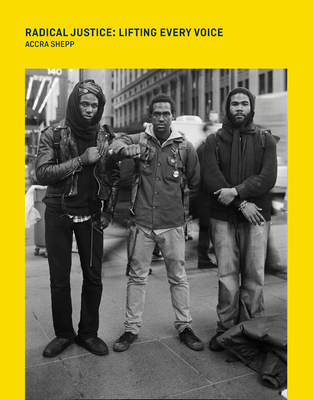
Greenlight is thrilled to invite to our events stage for the first time New York photographer and author Accra Shepp. Radical Justice, Shepp’s first monograph, brings together two bodies of socially engaged photographic portraiture that document New York City’s Occupy Wall Street movement starting in 2011 and its racial justice/Black Lives Matter protests since 2020. Working in the style of August Sander with a large format camera and black and white film, Shepp pictures New Yorkers on their city’s streets in acts of sit-ins and active protest, both unplanned and highly organized, independent and unified, to address notions of the 99% and 1%, which have come to define the American political vernacular. Shepp will present and read from this rich, essential volume and talk with poet, experimental filmmaker, and our Brooklyn neighbor Lynne Sachs; join us for an evening looking out onto the past and future through Shepp’s singular lens.
Radical Justice brings together two bodies of socially-engaged photographic portraiture by Accra Shepp, who has documented New York City’s Occupy Wall Street movement starting in 2011 and its racial justice/BLM protests since 2020.
Working in the style of August Sander with a large format camera and black and white film, Shepp pictures fellow New Yorkers on their city’s streets in acts of sit-ins and active protest, both unplanned and highly organized, both independent and unified, to address notions of the 99% and 1%, which have become part of the American political vernacular. Bearing witness to defining events of the last decade that echo the United States’ longer historical arch, Shepp’s empathetic depictions of fellow citizens standing up for the fair protection of the Constitution provide a prophetic mirror of current events, which reflects back centuries to where the American experiment began, to suggest where we’ll find ourselves in the years to come.
Lynne Sachs will give a workshop on autobiographical family portraits at La Casa Encendida Posted on 04/26/2022 – 12:37:22
The director of “Film About a Father Who” will give this theoretical-practical workshop from May 24 to 26, and will present a monographic session of her work on May 25.
The training program of the cultural center La Casa Encendida (Madrid) will receive the visit of the American filmmaker Lynne Sachs next May, who will give a workshop on the autobiographical family portrait . According to La Casa Encendida, in the workshop “we will explore the ways in which the images of our mother, father, sister, brother, cousin, grandfather, aunt or uncle can become material for the making of a personal film. Each participant will come the first day with a single photograph that she wants to examine. She will then create a cinematic rendering for this image by incorporating narration and acting. In the process, we will discuss and question the notions of expressing the truth and the language necessary for it.”
This workshop is inspired by the work Family Lexicon by the Italian novelist Natalia Ginzburg, whose writing explores family relationships during fascism in Italy, World War II and the postwar period. Ginzburg was a perceptive artist who unified the usual distinctions between fiction and nonfiction: “Whenever I have found myself inventing something according to my old habits as a novelist, I have felt compelled to destroy it immediately. The places, events and people are all real.”
Lynne Sachs is the creator of genre-defying cinematic works through the use of hybrid forms and interdisciplinary collaboration, incorporating elements of essay film, collage, performance, documentary, and poetry. Her highly self-reflective films explore the intricate relationship between personal observations and larger historical experiences. Sachs’s recent work combines fiction, nonfiction, and experimental modes. She has made more than 25 films that have been screened at the New York Film Festival, the Sundance Film Festival, the Toronto Images Festival, among others. They have also been exhibited at the Museum of Modern Art, the Whitney, Walker Art Center, Wexner Center for the Arts, and other national and international institutions. The Buenos Aires International Independent Film Festival (BAFICI), the New Cinema International Festival in Havana, and the China Women’s Film Festival have all presented retrospectives of her films. She currently lives in Brooklyn, New York and is a part-time professor in the Art department at Princeton University.
The workshop will be given in English and Spanish, an adequate level of the language is recommended. Students will have free access to the screening of the Monograph of the filmmaker Lynne Sachs, on Wednesday, May 25 at 7:30 p.m.
SPANISH:
Lynne Sachs impartirá en La Casa Encendida un taller sobre el retrato autobiográfico familiar
Publicado el 26/04/2022 – 12:37:22
La directora de “Film About a Father Who” impartirá este taller teórico-práctico del 24 al 26 de mayo, y presentará una sesión monográfica de sus trabajos el 25 de mayo.
El programa formativo del centro cultural La Casa Encendida (Madrid) recibirá el próximo mes de mayo la visita de la cineasta estadounidense Lynne Sachs, quien impartirá un taller sobre el retrato autobiográfico familiar. Según apuntan desde La Casa Encendida, en el taller “exploraremos las formas en que las imágenes de nuestra madre, padre, hermana, hermano, primo, abuelo, tía o tío pueden convertirse en material para la realización de una película personal. Cada participante acudirá el primer día con una sola fotografía que quiera examinar. A continuación, creará una representación cinematográfica para esta imagen mediante la incorporación de la narración y la interpretación. En el proceso, discutiremos y cuestionaremos las nociones de expresar la verdad y el lenguaje necesario para ello”.
Este taller está inspirado en la obra Léxico familiar de la novelista italiana Natalia Ginzburg, cuya escritura explora las relaciones familiares durante el fascismo en Italia, la Segunda Guerra Mundial y la posguerra. Ginzburg fue un artista perspicaz que unificó las distinciones habituales entre ficción y no ficción: “Cada vez que me he encontrado inventando algo de acuerdo con mis viejos hábitos como novelista, me he sentido obligada a destruirlo de inmediato. Los lugares, eventos y personas son todos reales”.
Lynne Sachs es la creadora de obras cinematográficas que desafían el género mediante el uso de formas híbridas y la colaboración interdisciplinaria, incorporando elementos de la película de ensayo, el collage, la actuación, el documental y la poesía. Sus películas altamente autorreflexivas exploran la intrincada relación entre las observaciones personales y las experiencias históricas más amplias. El trabajo reciente de Sachs combina los modos de ficción, no ficción y experimental. Ha realizado más de 25 películas que se han proyectado en el Festival de Cine de Nueva York, en el Sundance Film Festival, en el Images Festival de Toronto, entre otros. También han sido exhibidas en el Museum of Modern Art, el Whitney, Walker Art Center, Wexner Center for the Arts y en otras instituciones nacionales e internacionales. El Buenos Aires Festival Internacional de Cine Independiente (BAFICI), el Festival Internacional Nuevo Cine en La Habana y el Women’s Film Festival de China han presentado retrospectivas de sus películas. Actualmente vive en Brooklyn, Nueva York y es profesora a tiempo parcial en el departamento de Arte de la Universidad de Princeton.
El taller será impartido en inglés y castellano, se recomienda un nivel adecuado del idioma. Los alumnos tendrán acceso libre y gratuito a la proyección del Monográfico de la cineasta Lynne Sachs, el miércoles 25 de mayo a las 19.30.