Verberenas
Vol.7, November 8, 2021
“For Barbara”
By Natalia Reis
Original article appears in Portuguese here:
https://www.verberenas.com/article/para-barbara/

Please note that this article originally appears in Portuguese. This is a Google Translate version of the article.
In mid-2004, Joan Didion would start one of her most dense and well-known works, The Year of Magic Thought, a recap of the period that followed her husband’s death while her daughter was kept in a serious illness. Didion’s opening sentences in the book speak of the shock of sudden death: “Life changes quickly. / Life changes in an instant./ You sit down to dinner, and the life you used to know ends. / The question of self-pity.”. John Dunne, to whom she had been married for nearly 40 years, had suffered from a heart attack while sitting at the table waiting for dinner, and these lines would be suspended until the writer managed to resume months later the enterprise of plunging into the pain and anguish that permeated her recent widowhood.
“This is my attempt to understand the ensuing period, the weeks and then the months that took with them, any fixed ideas I might have about death, about illness, about probability and luck, about good and bad fortune, about marriage , children and memory, about pain, about the way people deal or not with the fact that life ends, about how their sanity is fragile, about life itself. I’ve been a writer my whole life. So, even as a child, long before the things I wrote began to be published, I developed the perception that the meaning itself resided in the rhythm of words, sentences and paragraphs, a technique to retain what I thought and believed for behind an increasingly impenetrable varnish. The way I write is what I am, or what I have become; however, in this case, I would like to have, instead of words and their rhythms, an editing room equipped with an Avid, a digital editing system in which you could press a button and disassemble the time sequence, showing you, at the same time, all the memory frames that They come to mind now, and let me choose the sequences, the slightly different expressions, the varying readings of the same lines. In this case, words are not enough for me to find meaning. In this case, I need what I think and believe to be penetrable, at least to myself. the slightly different expressions, the varying readings of the same lines. In this case, words are not enough for me to find meaning. In this case, I need what I think and believe to be penetrable, at least to myself. the slightly different expressions, the varying readings of the same lines. In this case, words are not enough for me to find meaning. In this case, I need what I think and believe to be penetrable, at least to myself.”
By mentioning the desire for an editing room in which he could demonstrate and dismantle the memories, as opposed to the apparent aphasia that took him by storm when words were no longer enough to give vent to mourning, Didion leaves behind a kind of precious question: and if, faced with death, we could access through images the legacy of a lifetime? Barbara Hammer, a filmmaker with a 50-year career whose work resonates, among many other things, the vivacity of female bodies and voices in direct contact with the world, will come very close to answering this question.
Hammer died on March 16, 2019, at the age of 79, having lived for the past 13 years with ovarian cancer that has metastasized to the lungs. In an interview conducted with the New Yorker about a month before his death (his “Exit Interview”), he will talk openly about the option for the practice of caring for terminal patients that prioritizes pain relief given the impossibility of recovery — popularly known as palliative care—and about how the experience came to pass through her work and her final moments with her longtime partner, Florie Burke.
In 2018, the director will present on at least four different occasions the reading/performance “The Art of Dying or (Palliative Art Making in the Age of Anxiety)”, created from Letters to a Young Poet, by Rainer Maria Rilke, and its relationship with palliative care. With some of her films shown ( Dyketactics , 1974; Sync Touch , 1981; Sanctus , 1990), Barbara Hammer takes a look back at her artistic trajectory, taking a generous stance as a mentor to new generations of artists, while advocating for more openness to discussions around a subject that he considers so despised in the middle: the inevitability of death.
“There is a general fear of talking about death in the Western world. It is as if, by not mentioning it and discussing it, it disappears. We do ourselves a disservice by not engaging in ruminations about this very powerful life force. Are we not alive to our last breath? And isn’t this a right of way that we want to address in our art? In our seminars? And in our museum exhibits? When we hesitate to face the last phase of life, we give a message to shut up. (…) Instead, I have been discussing terminal illness. We, in the art world, all of us: artists, curators, administrators, art lovers too, are avoiding one of the most potent subjects we can tackle.”
At the end of the reading, the conventional “questions and answers” (Q&A) are converted into what the director will call “answers and questions” (A&Q), at which time she approaches some individuals in the audience and seeks to know about their impressions — a dialogue without hierarchies that will characterize much of his filmography. This farewell, which takes on the contours of sharing and sincere conversation, is an inseparable element of the path he traces so that others can continue to follow in his footsteps, even if he is no longer present. In a similar operation, supported by a Wexner Center grant, Hammer will invite four filmmakers with whom he had creative affinities — Lynne Sachs, Deborah Stratman, Mark Street and Dan Veltri — to make five (1)entirely new films having as a starting point a gesture of appropriation of their archives and their unfinished projects.
So far, only two works have been completed and circulated freely through festivals and streaming channels (including a small show on Mubi called “Ways of seeing with Barbara Hammer”).
Here are some notes on two short films, Lynne Sachs’ A Month of Single Frames (for Barbara Hammer) (2019) and Deborah Stratman’s Vever (for Barbara) (2019):
A Month of Single Frames
(for Barbara Hammer)
Made from footage and notes Barbara Hammer took during an artist residency in Duneshack, Cape Cod, Massachusetts, in 1998, A Month of Single Frames is a re-visit of a lonely creative moment by the director and her relationship with the landscape that unfolds as a possible cinematographic theme. Taking its own archival tone, the short will be guided by a recorded conversation between Lynne Sachs (responsible for its realization) and Hammer, who initially gives the temporal and spatial coordinates of the narration: August 2018, in her studio in Westbeth, housing complex for artists in New York.
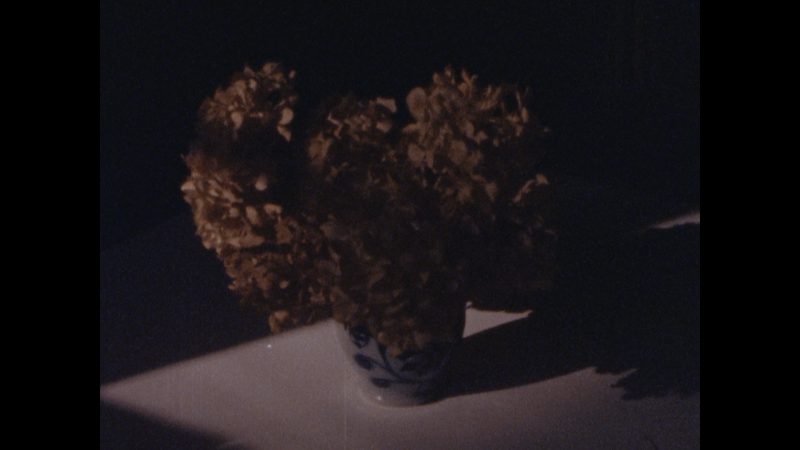
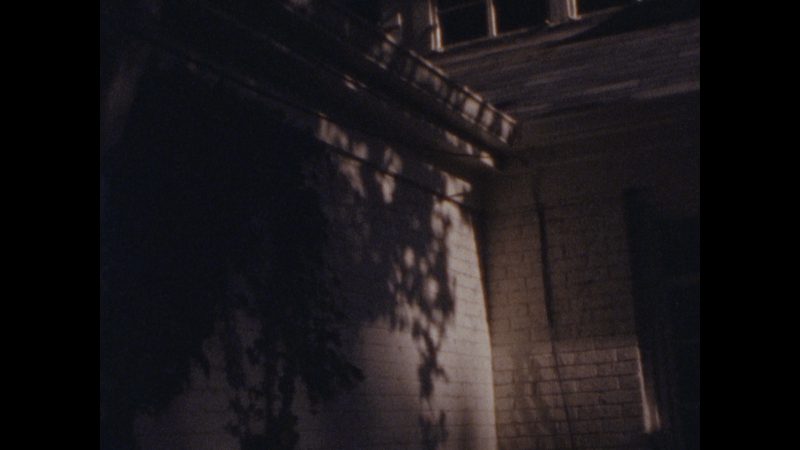
The aging voice reverberates in space, and for a second, in the total darkness of the opening screen, we intuit something of the environment in which the two directors and friends meet, and of the proximity conceived there. This voice of now, while reading passages from the 98 diary, will access a primordial stage of artistic creation (the nothingness, the starting point, the experiment), while it is interspersed with intervals of absolute silence and images of an animistic nature that now stirs and now falls asleep. Giant insects, the director’s nude body bristling with a jet of cold water in the open air, the junction of sky and dunes in unusual tones. We are introduced to a territory of intimacy and constant discovery, guided by the 16mm camera that caresses the elements of this secluded setting, exploring its textures, colors and formats.
The first glimpses of Sachs’ work as a whole reveal the harmony that is preserved between the two directors: multimedia artist, poet, fiction writer, performer and filmmaker, she will also, in her own way, conceive a cinema that often articulates the universe understood as the one of the great causes (activism, pacifist movements, the study of representation and the female condition) and the issues that permeate the family (the portraits of the daughter, the father, collaborations with her brother, Ira Sachs) and the intimate . The compositional method and the reuse of files, the camera that acts as an extension of the arm, fingers, hand, in a cadence of familiarity with the filmed object, all this will come close to Barbara Hammer’s proposal and practices,
“I felt obligated to do absolutely nothing. There is absolutely nothing to be done. Everything is eagerly awaiting discovery. This morning I started the movie. I didn’t film it—I saw it. The dark triangular shadow of the shed through the west window in the upstairs bedroom shrinks and disappears from its formidable presence by the constantly rising sun. As I sat there, sweating, patiently framing second by second.”
In your book Hammer! Making Movies out of Life and Sex, Hammer will list and structure a series of factors that he believes are directly related to his creative process. Between “intuition”, “personal confidence” and “spontaneity and flow”, the topic “remember the loneliness of creativity” stands out as a direct link to what we see in A Month of Single Frames . The “loneliness of creativity” he talks about is materialized in the displaced plane, optically decomposed in his unfilmed but seen film, and in the persistent image of the cabin without electricity or running water that he would inhabit for a month. Viewed from a distance, under the accelerating and decelerating clouds of countless time-lapse attempts, the hut occupies a central and isolated point in the landscape and its experimental procedures.
“what I really want to do here is project colored lights on the dunes, using the sun as a projector” At one point, reading the diary leads to a detailed description of experiments carried out with filters and different propositions to operate the camera’s capture flow, the long, thin grass that grows between the dunes is taken over by small rectangular pieces of colored plastic, and a series of multicolored shadow planes in the sand are displayed with text, which Sachs says would have been revealed to her in a dream during editing: you’re alone / I’m here with you in this movie / there are others here with us / we’re all together. Shortly thereafter, a group of women holding sheets of yellow, green, blue, and pink cellophane are seen moving around in order to follow up with Barbara Hammer’s luminous projections. Lynne Sachs notes the notes that have so far nostalgically guided our impressions.
From the collaborative exercise that shifts time and its initial purposes (Barbara Hammer would say she never used such images because they were “too beautiful”) Hammer’s personal files, Sachs will establish a link that still respects introspection and distancing as essential moments in the development of an artistic practice. The collaboration between two women of different generations is mixed up with the editing exercise itself, of a composition that depends on each single frame, in all its complexity. Finally, between comments about aging and Lynne Sachs’ own realization that she will be 60 soon, the simple message revealed on the screen materializes as a contact from somewhere in the future, and it is clear and calming: there is nothing to fear, you will always be seen and heard.
See (for Barbara)
Barbara Hammer told that she was still living with her husband “in a house in the woods” in California when one day, listening to the radio, she would discover herself as a feminist at the age of 30 (around there, she would “discover” a lesbian too). A year later, she abandoned the marriage, decided to leave in her Volkswagen for Berkeley, was presented with a super-8 camera and since then would not stop making films until her death, adding more than 60 works. He followed demonstrations in which he shamelessly asked intimate details about the participants’ sexual lives, became passionately involved in gender discussions, dealt with female sexuality and desire with the attention they deserve (filming more than once the interconnection of bodies and the frenzy ) and became an invaluable icon of the so-called queer cinema. The kind of extraordinary trajectory whose details accumulate in a symbiotic relationship between art and life.
Adding one more layer to the narrative, in 1975 Hammer would travel alone on a BMW motorcycle to Guatemala, in order to investigate the cultural processes behind indigenous clothing and how the westernized market model affected their mechanisms of exchange and commerce. With the images taken there and later set aside, Deborah Stratman will weave a look that is based not only on the anthropological echoes of Barbara Hammer, but will play a key role in the elaboration of links between the director and Maya Deren, filmmaker associated with the movement Surrealist and independent New Yorker whose notes on myth and history in Haiti in the 50s will serve as a guiding thread to think about the artist’s role as an active observer of dissonant cultures.
Known for her essayistic approach to the re-appropriation of files with sound as a prominent element, Stratman will develop Vever ‘s soundscape based on a phone call as a voice over , and if in A Month of Single Frames Hammer’s voice already carried the hesitation of age advanced, here she is almost unrecognizable, hoarse, sighing. In the call, the director explains the reasons that led her to leave the project: she was never able to find a personal context or a political sense for those images, and the lack of money (at the time she lived in a “basement with no running water or bathroom, with only $100 in the account”) also did not contribute to my expending time and energy trying to find them.
Through the concatenation of Deren’s text — whose highlighted sentences reflect, among other things, on the difficulties encountered when the reality of the material does not correspond to what was initially idealized — and Hammer’s testimony, the film will also deal with a shared feeling for both: the frustration with the unpredictability that runs through certain stages of creation. In this sense, both Deborah Stratman’s and Lynne Sachs’ work offer an internal perspective on Hammer’s creative process, opening up to the universality of themes such as loneliness and dissatisfaction in art.
As for the images, we see Guatemalans looking directly at the camera as if posing for a family portrait, wrapped in warm colored fabrics and prints that simulate creatures and vegetation. Markets full of fruits and vegetables, exchanges and interactions mediated by baskets moving overhead and Pepsi vendors in white uniforms contrasting with the setting. All of this is brought together by the words of Maya Deren racing across the screen, by the sober track that her husband, Teiji Ito, composed for her first film, Meshes of the Afternoon (1943), and by cards with symbols invoking Voodoo entities (so-called “ vever” ), also made by Ito during the couple’s period of immersion in Haitian beliefs.
Although Vever is characterized by a type of cultural curiosity that disperses the camera between unknown faces and the profusion of symbols, references and apparently distant quotations, what stands out from the correlations worked in Deborah Stratman’s montage is a convening and, above all, celebratory movement of complementary female visions, which exemplify collaboration not only as a possibility of completing a work, but also as a possibility of meeting beyond physical existence. And who could say that it would be possible one day to see Maya Deren and Barbara Hammer sharing the same space in the end credits?
( To Barbara and with Barbara)
“Dying is an art like everything else / in that I am exceptional”, would say Sylvia Plath rather bitterly in “Lady Lazarus”. It is known that he probably referenced his numerous suicide attempts, but if the authority of a poetic license does exist, it is evoked here to allow the contemplation of another picture: on more than one occasion Barbara Hammer would say that reading artists’ biographies it would become for her a way of establishing connections and discovering for herself “how to be an artist”. Searching in the lives of those who admire points of intercession to understand their own lives as part of something greater was one of the many pieces of advice left by the director, and now, after her departure, we are left with the same gesture: the admiration and understanding that he lived and died exceptionally, he made the farewell a living work, which opens even today in a continuous movement of creation. At the end of his book, Hammer will state that he would like to have his work remembered even through his writings (“a movie needs to be projected, a book just needs to be opened”), and in a way it’s comforting to think that, contrary to what you imagined, your memory will last in as many ways as possible.